
Big Box Gym vs Local Gym: Which Fits Your Training?
This post contains affiliate links. As an Amazon Associate, we earn from qualifying purchases.
Big box gym vs local gym comes down to duty cycle. A big box club is built for crowds, long hours and amenities. A local gym or rec center is built for a smaller, steadier membership. For most beginners the local option wins, provided the racks are free at the hour you actually train.
Duty cycle is the number of hours a machine runs under load before it rests, and in the big box gym vs local gym question it decides what gets bolted to the floor. A club that opens early and locks up late needs cable systems and welds rated for that grind. A home setup needs a rack that survives a few sessions a week. Same exercises, different steel.
What follows: how to read duty cycle off the equipment itself, why the evening crowd changes the whole calculation, and a trial-visit check you can run in five minutes.
Key Takeaways
- Train at the hour you’ll actually train. A floor that’s empty at 10am can be unusable at 6pm, and no brochure shows you that.
- Ask what the base tier covers. At some chains the weight room is the whole membership and everything else sits behind an upgrade.
- Treat “commercial-grade” as a duty rating, not a quality badge. A heavier rack isn’t automatically the better rack for you.
- Count free racks, not amenities. Three open racks beat a sauna every single time.
What Duty Cycle Actually Means for Your Membership
Chuck Miller, writing for IronCompany’s guide to residential and commercial equipment, draws the line at hours of use: commercial gear is built to take a pounding from many users from opening until close, and residential gear isn’t.
Commercial equipment is rated for continuous use from opening to close, seven days a week. Residential equipment is rated for a handful of sessions per week. Steel gauge, cable rating and weight stack all follow from that duty assumption, which is why a home rack and a club rack can share a footprint and share nothing else.
That’s the useful part. You can walk a gym floor and read the duty assumption off the hardware in about ninety seconds.
Miller’s own comparison makes the gap concrete. Miller notes that a 3″ x 3″ 11-gauge steel power rack is not necessary in a typical residential setting and may even be a detriment in a home gym because it is difficult to move around.
Here’s the part that surprises people.
More steel is more duty, and duty you don’t need is just weight you have to shift when you sweep the floor.
| What to compare | Big box club | Local gym or rec center |
|---|---|---|
| Equipment duty rating | Continuous, open to close | Steady, session-based |
| Peak-hour crowding | High and hard to predict | Lower, easier to read |
| Amenity access | Often tiered behind upgrades | Usually included or absent |
| Hours | Long, sometimes around the clock | Often shorter, sometimes seasonal |
| Staff presence | Front desk first | Often the same faces every visit |
Read that table as a set of questions, not a verdict. Any single row can flip depending on the specific facility.
Why the Equipment in a Big Box Club Feels Different
Walk past the lat pulldown at peak hour and you hear it before you see it: the stack lands with a flat clack, somebody re-racks, and the cable goes slack for half a second before the next pull.
That rhythm is duty cycle in action.
Both work, and the big box gym vs local gym trade-off is clear: the selectorized unit trades your time for the club’s money.
Plate-Loaded vs Selectorized: What a Club Actually Buys
Selectorized machines let a member change resistance with a pin and move on. Plate-loaded machines need someone to load them, which slows the floor down and costs less to buy. That’s a business decision, and it shows up in your experience.
A few things to check when you walk the floor:
- Cable condition. Frayed sheathing near the pulley means the cable is past its inspection window, and that’s a stop-training issue.
- Whether the pin stays put. A stack that jumps between plates mid-set means the selector fork is worn.
- Chalk dust and rubber crumbs. A clean floor with visible chalk usually means the gym expects serious lifters and maintains for them.
- Bar knurling. Polished-smooth knurling on every barbell tells you the bars are old, not that they’re broken in.
Which Gym Wins If You Train at 6pm?
Eight 90-minute slots. That was the sign-up system at one local facility after it cut capacity from 90 people to 40, requiring members to book one of eight 90-minute slots, according to a review of local gyms in the DGN Omega student paper.
That’s a local gym constraint, and it’s the kind of thing no website advertises.
Big box clubs have the mirror-image problem. Capacity is bigger, but so is demand, and the peak window is the same 5pm to 7pm crush everywhere. The question isn’t which gym holds more people. It’s which one holds fewer people at the moment you show up.
So visit twice before you sign. Once at your real training hour, once at an off hour. If you want a structured way to shortlist candidates first, here’s how to find a gym near you without wasting a week of trial passes.
The Amenity Trap: What Your Base Membership Actually Covers
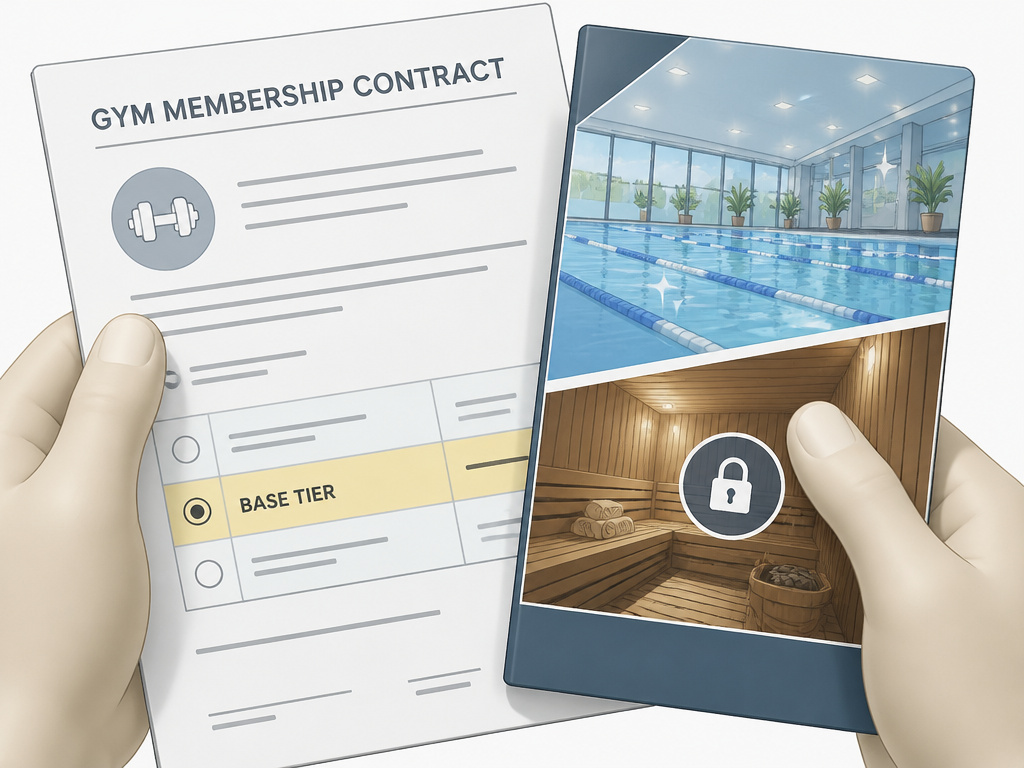
The pool on the tour isn’t always the pool on your contract.
That’s a legitimate business model. It just means the headline number you compared against a local gym wasn’t comparing the same thing.
Where this goes sideways: Signing for the base tier because the tour walked you past the pool. You’ll discover the gap on your first rest day, when the front desk tells you the sauna needs the upgrade, and by then you’re inside the cancellation terms.
Run the comparison properly by pricing the tier that includes what you’ll actually use. Our breakdown of budget vs premium gym memberships covers how the tiers usually stack up.
Local Gym Advantages Nobody Puts on the Website
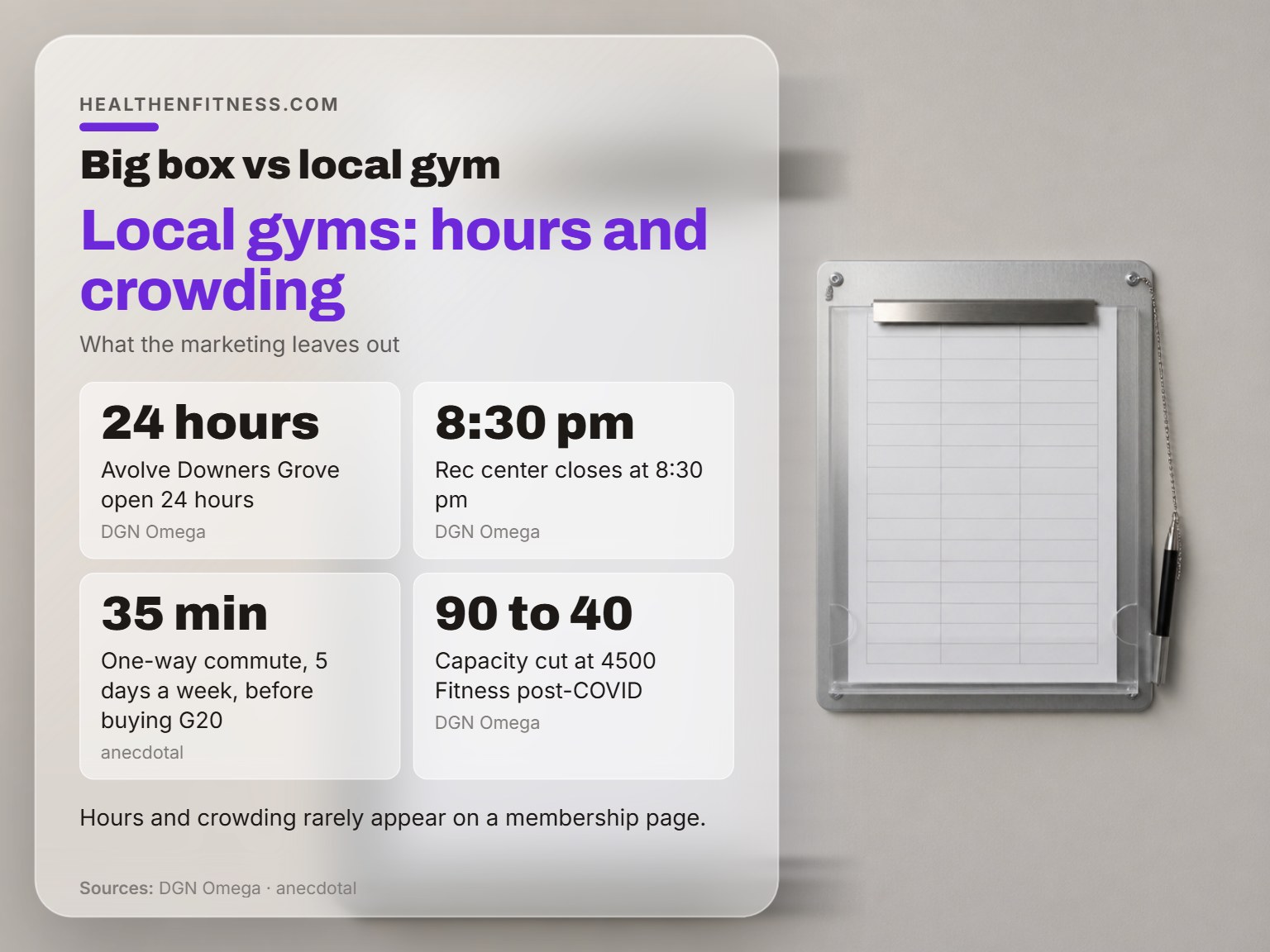
Two things show up in the local-gym reporting and almost never in the marketing: hours and crowding.
Hours are the sharper one. That gap doesn’t matter on paper. It matters on day three, when a late shift pushes your session past the front desk’s closing time and you drive home instead.
There’s a related number worth holding onto. A verified Force USA G20 buyer reported traveling 35 minutes one way, five days a week, to reach a gym before buying the G20. That’s the real cost of a gym that doesn’t fit your schedule, and it never appears on a membership page.
Which is why a home gym vs commercial gym decision often comes down to commute math rather than equipment. If you’re honestly unsure whether any membership pays off for you, work through whether a gym membership is worth it before you tour anything.
Where the Commercial-Grade Label Misleads You
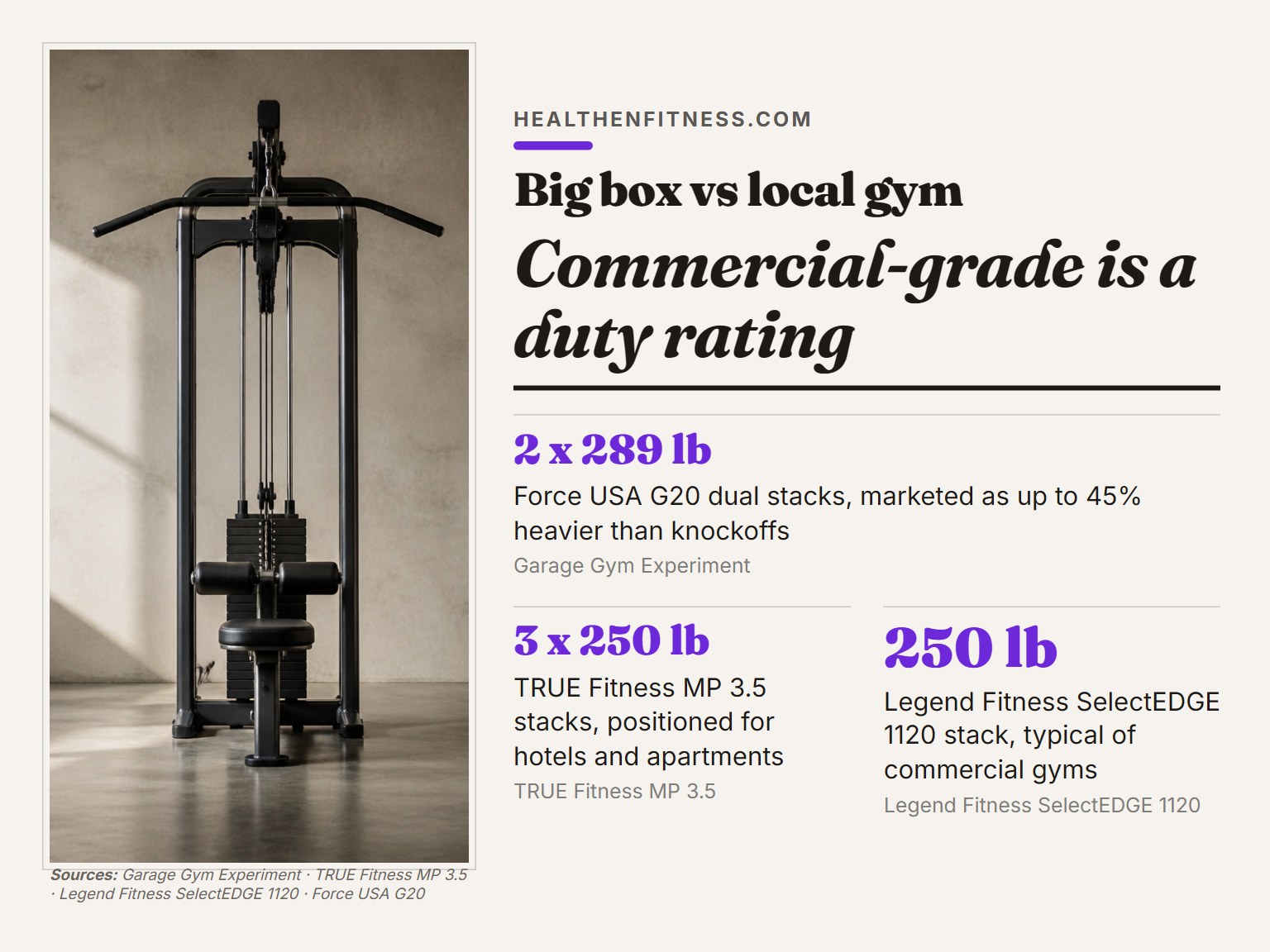
Commercial-grade is a duty rating. It says nothing about whether a machine fits your body.
Both are describing the same distinction from different ends.
BarBend’s review is specific about where the G3 lands. The tester says it isn’t quite commercial-grade, that its shorter height makes lat pulldowns and overhead movements awkward, and that larger athletes may feel cramped.
Garage Gym Experiment reads the bigger Force USA G20 differently, saying much of what can be done in a commercial gym setting can be done on it and calling it commercial quality, while BarBend’s tester says the G3 is not quite commercial-grade and may cramp larger athletes. Garage Gym Experiment notes the G20 Pro can perform hundreds of different workouts within a 35 sq ft footprint and includes 29 attachments, and Force USA lists dual 289 lb stacks.
The Stack Numbers Don’t Share a Benchmark
That claim has no shared reference point, because nobody else measures against Force USA.
| Machine | Stack capacity | Positioning |
|---|---|---|
| Force USA G20 | 2 x 289 lb | Home all-in-one, marketed as 45% heavier than knockoffs |
Three different numbers, three different jobs. It’s answering a different question.
If you’re comparing two gyms and one has heavier stacks, you’ve learned almost nothing. Ask instead how many people can use the rack area at once at 6pm.
That same logic applies if you’re weighing a CrossFit box vs regular gym, where the equipment list matters far less than how the floor is scheduled.
How to Judge a Gym on a Single Trial Visit
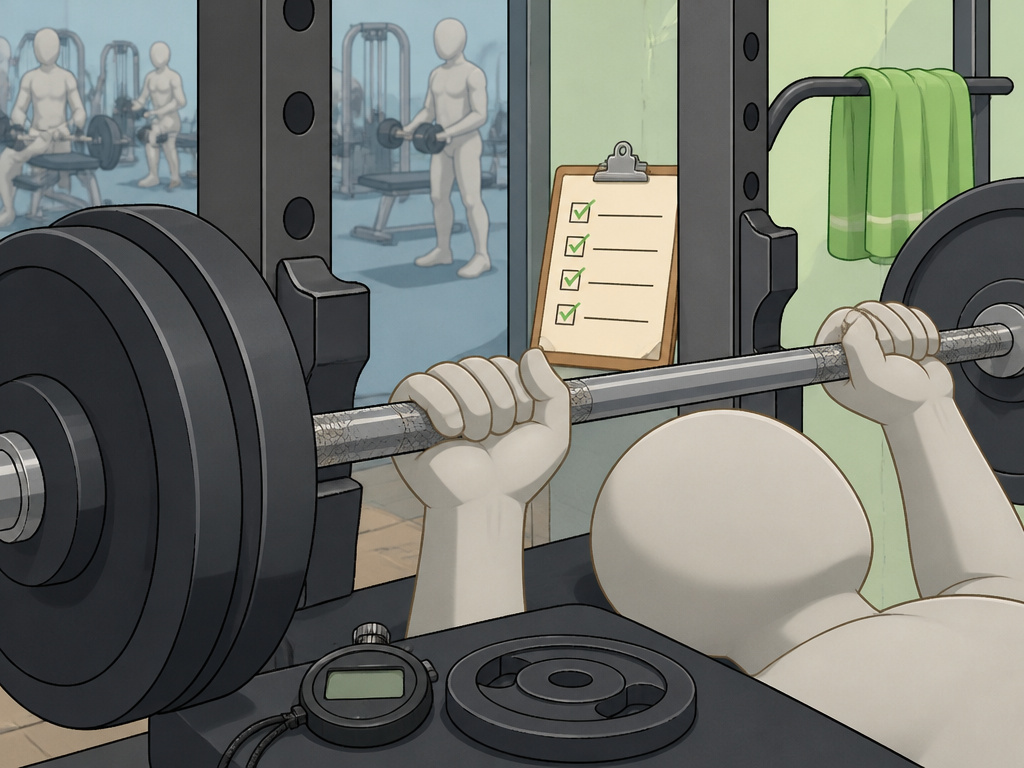
One visit is enough if you spend it on the right five things.
Skip the tour script. Ask for a day pass, walk the floor yourself, and time how long it takes to get under a bar.
Before you start: Check that collars are on the bars before you load anything, because a plate that slides on an unfamiliar sleeve lands on your foot. Confirm there’s a spotter or a safety arm set at the right height before you bench, since a failed rep with nothing to catch it is the most common gym injury setup. And wipe the bench before and after, because the disinfectant smell on a properly maintained floor is the one good sign you can detect from the doorway.
The Five-Minute Walk-Through
- Time your entry to the rack area. If it takes a long time to get a bar at your training hour, the rest of the tour doesn’t matter.
- Count working racks, not total racks. A rack holding someone’s towel is out of service, and that’s how a full rack floor behaves like a smaller one.
- Test the dumbbells in your working range. Gaps in the working range hurt beginners more than gaps at the top end, because that’s where progression actually happens.
- Ask when the equipment was last serviced. A vague answer means never, and cables and pads both fail quietly before they fail visibly.
- Read the cancellation terms before you leave the building. Signing without reading them is how people end up paying for a gym they stopped attending in March.
If a shared floor makes you uncomfortable, a women-only gym or a smaller boutique fitness studio may solve the problem a big box club creates.
Is a Big Box Gym Ever the Right Call?

Yes, in three specific situations: you train outside normal hours, you need a piece of equipment a local gym doesn’t stock, or you’ll use an amenity that’s genuinely included in your tier.
Outside those, the local gym usually wins for a beginner. Not because the equipment is better, but because the floor is quieter, the racks are free, and the same faces show up. That consistency is worth more than a juice bar.
Fair warning: a rec center with three open racks will beat a luxury club with one every time. Judge the gym you’ll actually attend, at the hour you’ll actually attend it.
Frequently Asked Questions
Is a big box gym cheaper than a local gym?
Sometimes, and the gap narrows once you price the tier that includes what you’ll use. One review of local gyms found a chain’s base tier covering the weight room only, with pools and classes behind an upgrade. Compare the tier you need, not the headline rate.
Are local gyms worse equipped than big box clubs?
Not inherently. Equipment is built to a duty rating, and a smaller facility can run the same commercial-grade machines as a large one. What local gyms usually lack is variety and redundancy, so a single broken cable costs you a station instead of a machine type.
How many visits should I make before signing?
Two. One at your real training hour and one at an off hour. The first tells you whether you can get on the equipment. The second tells you whether the gym is maintained when nobody’s watching.
What if I only train at 5am?
Then hours and crowding both stop mattering, and the decision moves to equipment and commute. A 24-hour local facility and a big box club are functionally identical at that hour, so pick the closer one.
Do community rec centers count as local gyms?
They do, and they’re the most underrated option in this whole comparison. They often carry solid equipment at a low monthly cost. Check the hours first, because rec centers frequently close early and run seasonal schedules.
Before You Go
One threshold settles most of these decisions: if you can’t get on a rack at your real training hour, the gym fails, no matter how good the tour was.
Everything else is preference.
One thing to try this week: take a single day pass at the local gym closest to your home and go at the exact time you’d normally train. Don’t tour it, don’t talk to the sales desk, just train. You’ll know by the end of the session whether the floor fits you, and that answer is worth more than any comparison table.
Start smaller than you think. A gym you’ll actually walk into on a Tuesday beats a perfect one you keep deferring.
