
How to Use a Leg Extension Machine: Setup and Form
This post contains affiliate links. As an Amazon Associate, we earn from qualifying purchases.
To use a leg extension machine, set the back pad so your knees line up with the machine’s axis-of-rotation marker, rest the shin pad on your lower shins with light pressure, and push until your legs are straight. Cybex’s VR1, Prestige, and Total Access manuals all specify that same sequence, and the marker is a physical decal on the frame.
The marker fixes the joint angle the machine was engineered around. Slide the back pad forward and the resistance stops running through your quad and starts pulling across the front of the knee. That’s why a badly set leg extension feels like it’s fighting you rather than loading you, and it’s a good reason to set the back pad so your knees align with the machine’s axis of rotation marker.
What follows: the three adjustments in order, the knee-lockout argument the manuals and the consumer press are still having, the weight and rep numbers that actually matter, and the pre-use check that keeps a cable from failing under your shin.
Key Takeaways
- Knees to the axis marker is the setup step that decides whether the machine loads your quad or grinds your knee.
- 300 lbs / 135 kg is the max user weight on the Cybex VR1, Prestige, and Total Access leg extensions. The Stamina 50-3200 home unit caps at 250 lbs.
- 10 to 12 reps at a moderate load is the working range VeryWell Fit recommends, and the leg extension is a poor choice for a one-rep max.
- Cables get replaced annually on both Cybex and TRUE commercial units, whether or not they look fine.
- Full extension is a disagreement: Cybex says straighten the legs, VeryWell Fit says keep a slight bend if your knees complain.
What the Axis-of-Rotation Marker Actually Tells You
The marker is a small decal near the pivot, and it lines up with the side of your knee joint when the back pad is set right. Cybex puts it on the VR1, the Prestige, and the Total Access for one reason: the machine only loads the quad cleanly when the knee turns on the same axis the arm swings on.
The Cybex VR1, Prestige, and Total Access leg extension manuals give the same three-step setup: align the knees with the axis-of-rotation marker using the back pad, position the shin pad comfortably with light pressure, and grasp the handles to stabilize the torso before extending. All adjustment points use yellow handles or knobs.
Every adjustment on those machines wears a yellow handle or knob, so you can find the back pad and shin pad without hunting. The pins seat at fixed intervals, and you can feel when the pad locks rather than slides.
Commercial leg extension machines are built around that marker. The Cybex VR1 Leg Extension owner’s manual prints the sequence in a single line, and the Prestige and Total Access manuals repeat it word for word.
I check the how to use a leg extension machine marker before I check anything else. That’s the whole point of a selectorized machine: it hands you the geometry, and you just have to line up with it.
How Do You Set the Seat and Shin Pad Without Guessing?
Skip the how to use a leg extension machine seat adjustment and the rest of the setup is wasted.
Here’s the fix, in order. It’s the difference between a quad set and a knee complaint. (I skipped it for a year, so no judgment.)
Before you start: Seat the weight pin fully and check it isn’t sitting in an elevated position, which Cybex lists as a reason to skip the machine entirely. Keep loose clothing and dangling jewelry clear of the moving arm. If you feel faint, dizzy, or any pain, stop and get it looked at rather than finishing the set.
- Set the back pad first. Line your knee up with the axis-of-rotation marker. Get this wrong and the resistance pulls across the kneecap instead of through the quad, on every rep, for as long as you keep using the machine.
- Sit with your knees bent to about 90 degrees. VeryWell Fit uses that angle as the check, and you can verify it by eye before you touch the weight.
- Rest the shin pad on your lower shins, just above the ankles, with light pressure. Cybex asks for light pressure specifically. Crank the pad down tight and you push the shin instead of the quad.
- Grip the handles and settle your torso. If your hips lift off the seat mid-rep, the load is too heavy.
- Push forward and up until your legs are straight. That’s the Cybex wording, and the next section covers the one place it’s genuinely contested.
Worth doing.
The same logic carries to the leg press machine, where the seat angle sets the hip position before anything else matters. Get the seat right on one machine and you’ll start noticing it on every other.
The Knee Lockout Question: Two Sources, Two Answers
Two credible sources tell you opposite things about the top of this movement, and neither is being careless.
Cybex, across all three manuals, instructs users to push forward and up against the pad until the legs are straight. Full extension, no caveat, no “unless.” VeryWell Fit’s guide, reviewed by a certified trainer, says the opposite: do not lock your knees at full extension if you’re concerned about knee pain or strain, and keep a slight bend instead.
| Question | Cybex manuals say | VeryWell Fit says |
|---|---|---|
| Top of the rep | Legs straight, full extension | Slight bend, no lockout |
| Who it applies to | All users, no caveat | Anyone worried about knee pain or strain |
| Injury history | Consult a physician before starting | May need to avoid the machine entirely |
| Heavy singles | Not addressed | Not for a 1RM or low-rep heavy work |
How to Reconcile the Two
Follow the manufacturer for setup and follow the clinical caution for symptoms.
If your knees are quiet at full extension, straighten the legs the way Cybex instructs. If you feel a pinch or a grind at the top, stop a couple of degrees short and keep the tension in the quad. The machine doesn’t care where you stop. Your knee does.
I’d take the manufacturer’s instruction as the default and the clinical caution as the override. Quiet knees, straighten them. Cranky knees, stop just short and hold the tension. Nobody’s knee was designed by a manual.
Both positions are defensible. What isn’t defensible is pretending only one exists, which is what most gym-floor advice does.
How Much Weight, and How Many Reps?
10 to 12 reps at a moderate load is the range VeryWell Fit recommends, and it’s a reasonable place to start.
That guidance comes with a hard limit attached. The same source says the leg extension is not the machine for a one-rep max, citing the risk of knee ligament strain, and warns against low-rep, high-load work on it. Save the heavy singles for a leg press or a squat pattern.
The stack ceilings differ by model, and they’re worth knowing before you assume a number transfers.
| Machine | Max user weight | Max training weight |
|---|---|---|
| Cybex VR1 13050 | 300 lbs / 135 kg | 227.5 lbs / 103 kg |
| Cybex Prestige 21050 | 300 lbs / 135 kg | 305 lbs / 138 kg |
| Cybex Total Access 14051 | 300 lbs / 135 kg | 305 lbs / 138 kg |
| TRUE SPL0100 | 300 lbs / 136 kg | Not listed |
| Stamina 50-3200 | 250 lbs | Not listed |
Those training weights are ceilings the frame is rated for. They tell you where the machine stops, not where your working set should live.
Common mistake: Treating the max training weight as a target. On the Cybex VR1 that ceiling is 227.5 lbs / 103 kg, and it exists to describe the frame’s limit, not your program.
At the right load, the pad still travels smoothly through the whole arc. Too heavy, and your hips lift off the seat to help. That is your cue to reduce the weight.
Start lighter.
Balance the quad work with a hamstring curl machine so the back of the thigh gets equal volume. Quads-only leg training is a common habit and an easy one to fix.
What to Check Before You Trust the Machine
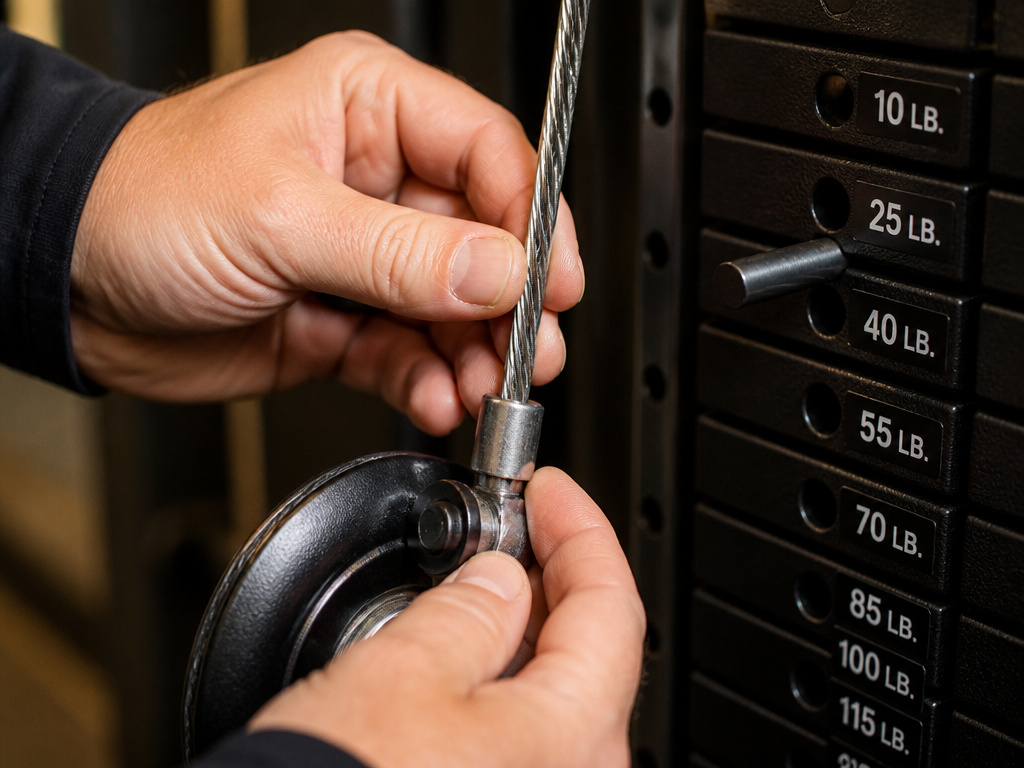
You sit down, push, and the arm comes back with a grainy drag instead of a smooth glide. That drag can mean a dry guide rod or a cable that’s starting to go.
The Daily and Weekly Check
Cybex calls for a daily inspection before use. Here’s what the manuals actually specify:
- Daily: look for loose or worn belts, cables, grips, and pulleys, plus any missing or damaged labels. Cybex says fix the deficiency before the machine goes back into use.
- Weekly: tighten loose nuts and bolts, run your fingers along each cable at the bends and attachment points, and wipe the guide rods clean before applying a light coat of medium-weight automotive engine oil.
- Annually: replace all cables and belts. Both Cybex and TRUE call for this on a fixed schedule rather than waiting for visible failure.
TRUE adds a detail the Cybex manuals don’t spell out. Its SPL0100 manual lists the specific wear patterns that take a machine out of service immediately: a twisted cable with a zig-zag pattern, a break or tear in the cable cover, a stretched covering, or a dislodged crimp connector. It also requires TRUE-supplied cables only, with no fittings attached by hand-crimp tools.
Where this goes sideways: A cable that fails mid-rep drops the weight arm while your shin is under the pad. TRUE recommends annual cable replacement to maintain the safety of all users, even on a cable that looks intact.
The TRUE SPL0100 owner’s manual is worth reading even if you train on a different brand.
I check the cable before I check the weight. Check it anyway.
One more thing nobody reads: the environment specs. Cybex’s manual warns that if you experience static electricity, you should increase humidity to a comfortable level using a humidifier. If you experience static electricity, the manual says to increase humidity to a comfortable level using a humidifier. The same manual forbids installing the unit near a steam room, sauna, indoor pool, or outdoors, because chlorine and bromine exposure damages the parts.
That rules out the poolside corner of a lot of hotel gyms. It also rules out storing the unit outdoors.
Where the Leg Extension Fits in a Week of Training
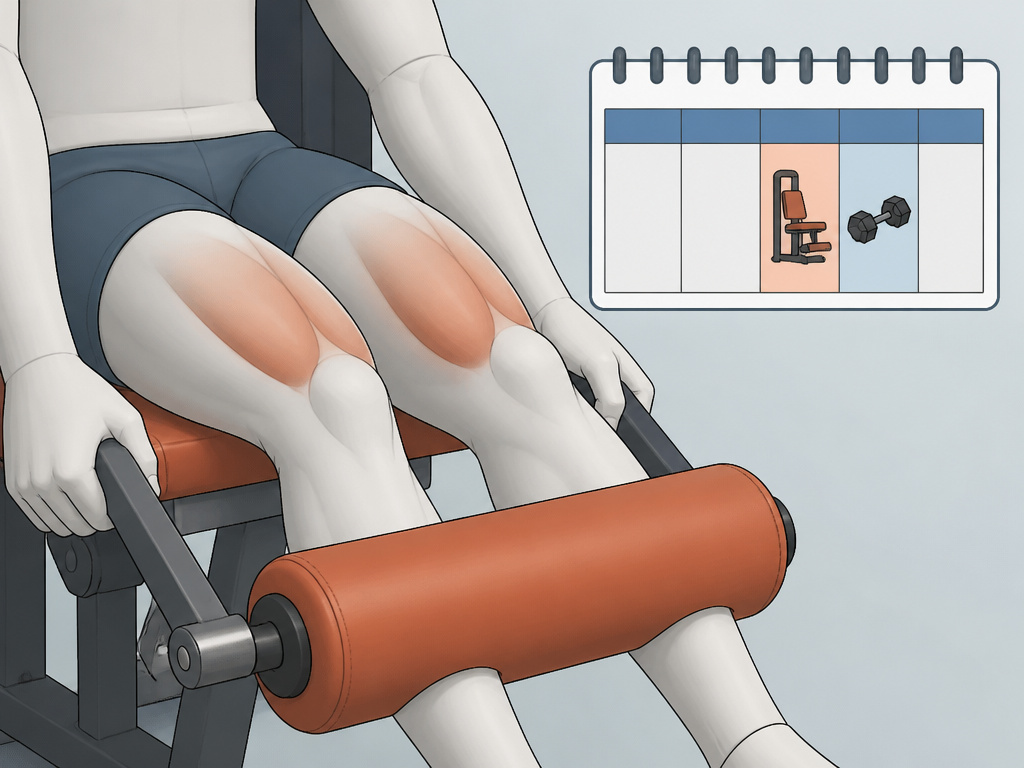
The leg extension has a place in a full-body session or a split.
The machine is an isolation movement for the quadriceps. VeryWell Fit makes the case that it adds volume to quad training. That’s the honest use case: extra quad work that doesn’t wreck you for the rest of the session.
Pairing It With Free Weights
Machines are a smart tool, and treating them as inferior to free weights is an outdated habit. A simple approach is one free-weight movement per session, with machines to fill in the rest.
If you want a compound movement with a fixed path, the hack squat machine is an option. Finish with a calf raise machine if calves are part of the goal. For a wider look at what else belongs in the session, the leg workout machines breakdown covers the rest.
The leg extension isolates the quad, so it can add volume alongside compound work.
If You Train at Home
The Stamina 50-3200 is the honest home option, and its 250 lbs user cap is the first thing to check against your own weight. It also takes standard Olympic plates through an adapter that locks with an M8x1.25x10mm set screw, per the Stamina 50-3200 assembly instructions.
If space is tight, home gym leg machines are worth comparing before you commit to a full commercial frame. The footprint difference is real: the Cybex VR1 runs 70 inches long in use and 54 inches at rest.
That’s fine.
Frequently Asked Questions
Should your knees be straight or slightly bent at the top?
Cybex’s manuals say push until the legs are straight, with no caveat. VeryWell Fit says keep a slight bend if you’re concerned about knee pain or strain. Use the manufacturer’s version if your knees are quiet and the clinical version if they aren’t.
How heavy should you go on a leg extension machine?
VeryWell Fit recommends a moderate load for 10 to 12 repetitions. The same source advises against using the leg extension for a one-rep max or low-rep, high-load conditioning because of knee ligament strain risk.
Can you use a leg extension machine with bad knees?
VeryWell Fit suggests seeking guidance from a doctor, physical therapist, or strength coach first, and notes they may say to avoid the machine entirely. Cybex’s manuals go no further than a general instruction to consult a physician before starting an exercise program.
How often do the cables need replacing?
Annually, on both Cybex and TRUE commercial units. Cybex lists it under yearly procedures and TRUE states that all cables should be replaced on an annual basis to maintain user safety. TRUE also says to pull a machine out of service immediately if the cable sheath is stretched or the crimp connector is dislodged.
What’s the maximum user weight on a leg extension machine?
It varies by model. The Cybex VR1, Prestige, and Total Access leg extensions are all rated at 300 lbs / 135 kg. The TRUE SPL0100 is rated at 300 lbs / 136 kg. The Stamina 50-3200 home unit is rated at 250 lbs.
The Bottom Line
One thing to try this week: sit down on the leg extension and find the axis-of-rotation marker with the side of your knee. Note the pin position. Next session, set it there before you touch the weight and see whether the movement feels different.
If your knee, ankle, or thigh has an injury history, none of this applies until a clinician clears it. VeryWell Fit is direct about that, and it’s the one piece of advice on this page I’d never soften.
Fair warning: I’d rather see you do clean reps at a moderate load than grinding reps at a weight that looks respectable on the pin. What matters is whether the tension stayed on the quad for the whole set.
Keep it simple and keep showing up.
