
How Gym Memberships Work: Terms, Fees and Exit Rules
This post contains affiliate links. As an Amazon Associate, we earn from qualifying purchases.
Gym memberships work as contracts with three moving parts: a fixed term, a billing cycle, and a cancellation clause. State law caps all three. California limits health studio contracts to three years, New Jersey to 36 months, and Washington bans lifetime memberships entirely.
The term is where the money sits. A twelve-month commitment prices every skipped session into the contract itself, so the gym gets paid whether you show up in February or not. That’s why the exit rules matter more than the monthly number on the flyer, and understanding how gym memberships work starts with reading that fine print.
What follows is the machinery: how the term and billing cycle are built, where the cooling-off windows differ by state, what a cancellation actually costs, and the questions that separate a fair contract from a trap.
Key Takeaways
- Term caps are legal limits, not suggestions. California and New Jersey both stop at three years, and Washington bans lifetime memberships outright.
- The cooling-off window scales with the money in California, running from 20 days up to 45.
- Notice periods run from a payment date, so a letter sent today can take a full calendar month to land.
- Verbal promises don’t count. Wisconsin’s consumer office is blunt about getting them written into the contract.
- Month-to-month costs more per month and less per mistake, which is the trade I’d take every time.
What the Contract Actually Commits You To
A gym contract bundles four things: the term, the payment schedule, the cancellation process, and access to one specific facility. Washington’s health club law requires all of it in writing. The document has to name the operator and address, the signing date, the equipment and services covered, the term, the payment amount, the conditions for raising it, and your cancellation rights, which is how gym memberships work.
A health studio contract is a term commitment with a defined payment schedule and a statutory cancellation right. The written document must state the total obligation, the length of the term, and the method for ending the agreement early. State law sets the outer limits, and those limits vary by jurisdiction.
California requires the term length to be stated in the written contract above the signature line. That’s big enough to read without leaning in, which is the entire point of the rule. If the term shows up in small grey text instead, someone made a deliberate choice about that.
Three things are worth doing before you leave the desk:
- Ask for an unsigned copy to take home and read. New Jersey’s consumer brief recommends exactly that.
- Get your own copy of the signed contract, which New Jersey law entitles you to.
- Photograph the cancellation clause with your phone.
The gym membership contract is the only document that matters when a dispute starts six months later.
Wisconsin’s DATCP fitness center guide puts it plainly: if a salesperson says something is part of your membership, they should be willing to write it into the contract. The same guide warns that a big fee doesn’t make a better gym.
Common mistake: Signing on the spot because the terms are described as standard. Verbal promises that never make it into the written contract aren’t worth much, and a commission-driven pitch is built to keep you at that desk.
How Long Can a Gym Contract Legally Run?
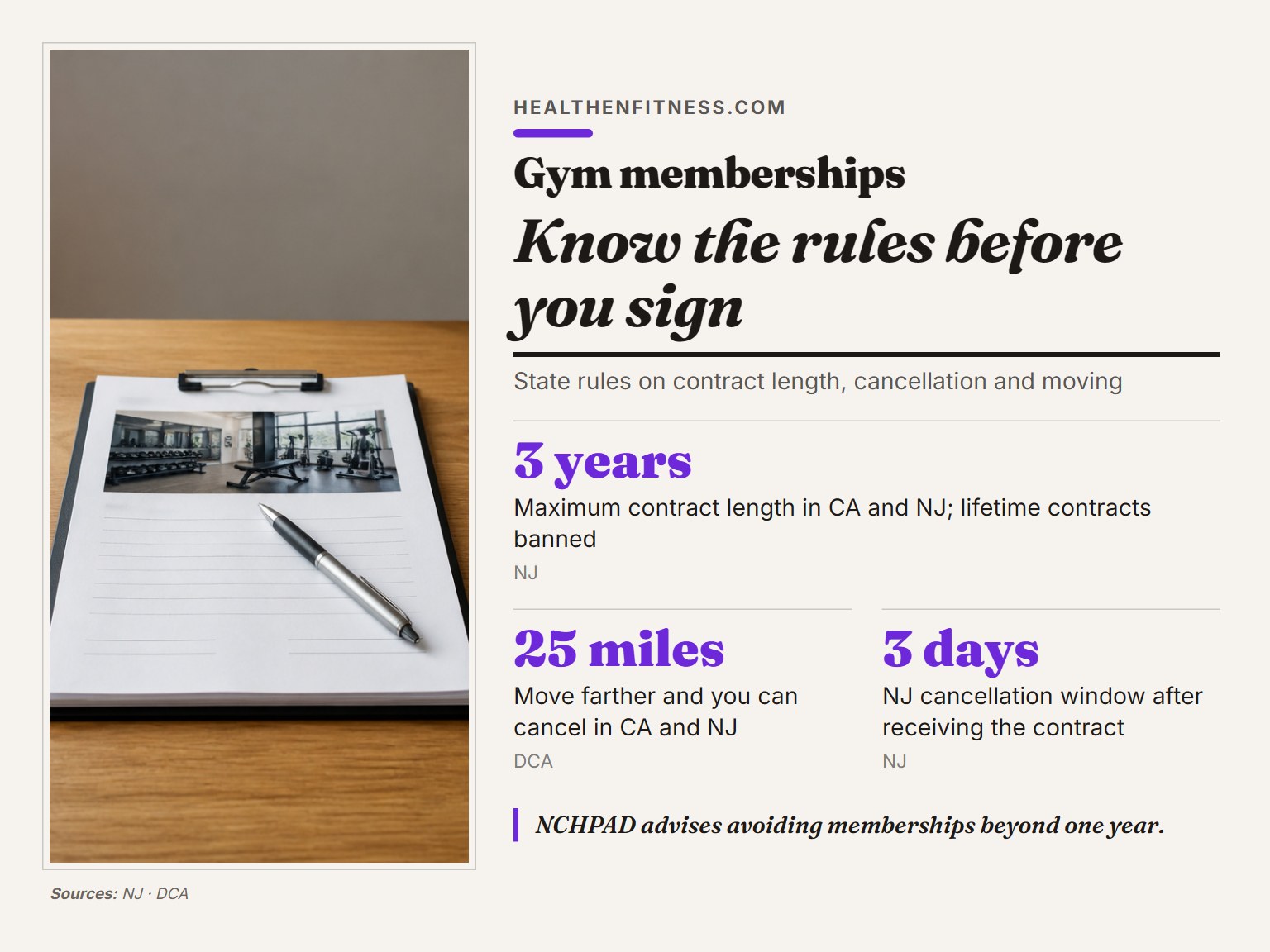
Three years is the ceiling in California and New Jersey, though the National Center on Health, Physical Activity and Disability advises avoiding any membership that runs beyond one year. California’s health studio law prohibits lifetime contracts and caps the term at three years. New Jersey sets the same 36-month limit. Washington bans lifetime memberships without stating a numeric cap at all.
The National Center on Health, Physical Activity and Disability takes a stricter line for consumers on how gym memberships work: avoid any membership that runs beyond one year, because a closure can take your money with it.
| Rule set | Maximum term | Cooling-off window | Distinctive rule |
|---|---|---|---|
| California | Three years | 20 to 45 days, scaled to value | Total contract value is capped |
| New Jersey | 36 months | Three operating days | Security bond above three months’ advance pay |
| Washington | No lifetime memberships | Not set out in the AG summary | Dues rise no more than once a year |
| Anglia Ruskin (UK) | Fixed 9 or 12 month terms | 14 days | One month’s notice before a fee rise |
A three-year contract is lawful in California and New Jersey. It’s still a bad first contract. The statute sets the ceiling, and the ceiling is nowhere near the smart choice.
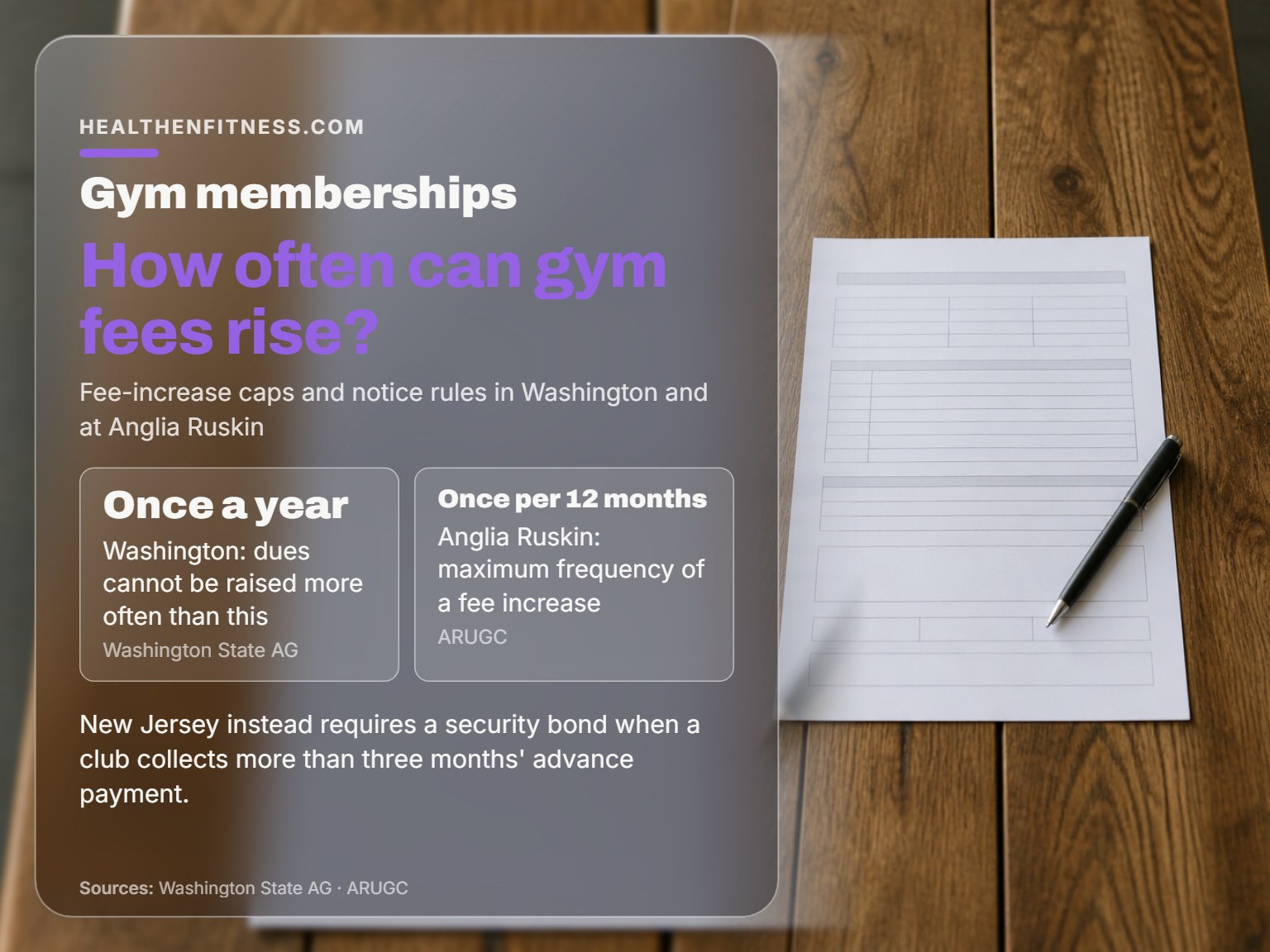
Washington’s Washington state health club rules add a detail the others leave out: dues can’t be raised more than once per year, and the contract has to state how and when a rise can happen.
Whether a long term is worth it at all comes down to cost versus usage. A modest plan used regularly beats a premium one used rarely.
The Cooling-Off Window Is Not the Same Everywhere
Forty-five days. That’s the longest window in this set, and it only opens in California once the total contract value climbs through the top tier.
California scales the window to the size of the commitment, running from 20 days up to 45 as the total value rises. The DCA Legal Guide W-10 sets out the tiers in full.
The California Tier
Smaller commitments get the shortest window. A mid-sized contract buys 20 days, one tier up buys 30, and anything past the top threshold buys 45.
New Jersey’s Three Operating Days
Three days sounds tight, and it is. The count uses operating days rather than calendar days, which matters a lot if you sign on a Friday afternoon.
The Anglia Ruskin gym terms give 14 days under the UK Consumer Contracts Regulations. That right disappears if you asked for immediate access and used the facilities inside the window.
What counts as proper notice varies too:
- A clear written statement by post or email, which is what the Anglia Ruskin terms require.
- An online cancellation link or button, which New Jersey requires if the club let you sign up online.
- A phone call to the location where you signed, which New Jersey accepts.
Where this goes sideways: Using the gym during the cooling-off period after ticking the “immediate access” box. Under the Anglia Ruskin terms that request cancels the 14-day right outright, and the refund you were counting on never arrives.
Once the window closes, the steps to cancel a gym membership change completely.
What Does a Cancellation Actually Cost You?

Cancellation is where the friendly part of the contract ends.
California allows a club to charge or withhold a capped cancellation fee when you move more than 25 miles and cannot transfer to a comparable facility. That cap halves once more than half the contract life has expired. New Jersey allows the same 25-mile cancellation and mentions no fee at all.
Washington handles it differently. After a proper cancellation you owe no further contract payments, but you may still owe the initiation fee if you financed it and signed a non-refundable clause.
Notice periods are where the real money hides. Anglia Ruskin’s recurring card members give at least five working days’ written notice from the date the next payment is due. Monthly and annual direct debit members give one full calendar month. Refunds land within 10 working days of the cancellation being confirmed.
A cancellation letter takes little time to write and up to a month to take effect. That gap is where most disputes live.
I’d pay more per month for a rolling plan than save it on a twelve-month term I might need to escape in April. The exit cost never makes it onto the flyer.
- Put it in writing. The Anglia Ruskin terms want a clear statement by post or email, and a phone call may not count.
- Count from the payment date, not from the day you decide to leave.
- One full calendar month for direct debit members.
- Get a receipt. Washington’s AG suggests asking an employee to initial and date your copy if you hand it in.
If the problem is temporary, a membership freeze usually costs less than quitting and rejoining.
How Do Billing Cycles and Fee Increases Work?
Money leaves your account on a schedule the contract sets, and the schedule is where the small print earns its keep. Anglia Ruskin collects monthly direct debits on the 1st or the 15th depending on your join date. Recurring card members pay one month in advance, then on the same date each month.
Fee rises are capped. Washington allows dues to go up no more than once per year. The Anglia Ruskin terms allow one increase per 12 months, require a month’s notice, and give you the right to terminate with a pro-rata refund.
New Jersey takes a different route to the same worry. Any club selling memberships longer than three months, or collecting more than three months’ advance payment, has to post a security bond to fund refunds if it fails. California caps total contract value instead.
| Structure | What you commit to | Best for |
|---|---|---|
| Month-to-month | A rolling payment and short notice | Testing whether you’ll actually turn up |
| Minimum term, then rolling | One to three months, then flexible | Most beginners |
| Twelve-month term | A full year of payments | Someone already training three times a week |
| Paid in full | The whole term upfront | People who won’t cancel on impulse |
I’d take the short-minimum rolling plan every time. It costs a little more each month and saves you a fight.
Skip this if: The club wants the full year upfront and won’t put a refund schedule in writing. Prepaying is the one structure where a closure costs you everything at once.
Fee rises are easier to head off before you sign, and negotiating tactics land better on the enrollment fee than on the monthly rate.
Where the Contract Breaks: Closure, Moves and Disability

The gym closes on a Tuesday with a note taped to the door. Your direct debit still leaves the account on the first.
New Jersey covers that. If a facility closes for more than 30 days through no fault of yours, you’re entitled to an extension equal to the closure or a prorated refund. The state also allows cancellation on death or permanent disability.
When the Gym Closes Without Warning
Washington’s attorney general lists it among the common complaints: clubs closing without notice, and in some cases selling long-term memberships right up to the day they go under.
Moving, Disability and Death
California allows cancellation if you move more than 25 miles and can’t transfer to a comparable facility. New Jersey also allows cancellation on death or permanent disability. Either way, you may cancel the contract.
If a move is the reason, transfer a gym membership to a comparable facility first. The cancellation right usually depends on that transfer not being available.
What to Ask Before You Sign
Four questions do most of the work.
- What’s the total, including enrollment, annual and cancellation fees? Skip this and the introductory rate that looked affordable climbs after a few months.
- Does it renew automatically, and at what price? A silent renewal at the higher rate is the most common billing surprise.
- How do I cancel, and how much notice do I give? Get the method and the notice period in writing, because a phone call may not count.
- What happens if I move, or the club closes? Ask before you sign, since the answer gets much harder to negotiate later.
- Can I freeze the account, and what does that cost? A freeze beats a cancellation and a rejoin on both money and hassle.
The BBB gym joining tips cover the same ground from a complaints angle, and the pattern in those complaints is a fee nobody mentioned at signing. Several state consumer offices publish their own pre-signing list, including this Massachusetts gym membership consumer guide.
Ask for the free equipment orientation. The National Center on Health, Physical Activity and Disability says you should get one at no charge when you join, and the health questionnaire they hand you before your first session is worth filling in properly.
You’ll smell the rubber floor and the cleaning spray before you reach the front desk. That first walk-through tells you more than the brochure does.
A gym day pass at the hour you’d actually train beats a tour at two in the afternoon. And before any of that, work out how you’d find a gym near you that you can reach easily, because travel time quietly decides attendance.
Frequently Asked Questions
Can I cancel a gym membership at any time?
Not without cost. California and New Jersey both allow cancellation in specific situations: a move over 25 miles, death or permanent disability, or a facility closed longer than 30 days. Outside those, you’re bound by the term and the notice period written into your contract.
How long is the cooling-off period on a gym contract?
It depends where you signed. New Jersey gives three operating days. California scales the window from 20 days up to 45 depending on total contract value. The Anglia Ruskin terms give 14 days under UK consumer rules, and that right disappears if you asked for immediate access and used it.
Do I still owe money if the gym closes?
In New Jersey, a closure longer than 30 days through no fault of yours gets you an extension equal to the closure or a prorated refund. New Jersey also requires a security bond from clubs collecting more than three months’ advance payment. Washington’s attorney general lists sudden closures among the most common health club complaints.
What happens if I move far from my gym?
California and New Jersey both allow cancellation on a move more than 25 miles from the club or an affiliated one. California allows the club to charge a capped cancellation fee in that case, and the cap halves once more than half the contract has expired.
Is a longer contract ever cheaper?
Sometimes, and the discount is real. The trade is that the savings only pay off if you stay. A three-year term is lawful in California and New Jersey, and the National Center on Health, Physical Activity and Disability advises against anything running beyond a year.
Can a gym raise my dues whenever it wants?
No. Washington caps dues increases at once per year. The Anglia Ruskin terms allow one rise per 12 months, with a month’s notice and a right to terminate with a pro-rata refund.
The Bottom Line
One thing to try this week: buy a day pass at the gym you’re considering and use it at the hour you’d really train. If the crowd is deep on the only squat rack, the contract terms stop mattering.
Here’s the honest version. If the term runs past a year and the club won’t put a refund schedule in writing, walk. That single refusal tells you more than the tour did.
None of this covers the training itself. If you’re chasing a competition or working around an injury, those are questions for a coach and a clinician, and no contract clause answers either one.
Start smaller than you think. A month-to-month plan at a nearby gym beats a three-year deal you dread driving to.
