
Women Only Gym Pros and Cons: What the Data Says
This post contains affiliate links. As an Amazon Associate, we earn from qualifying purchases.
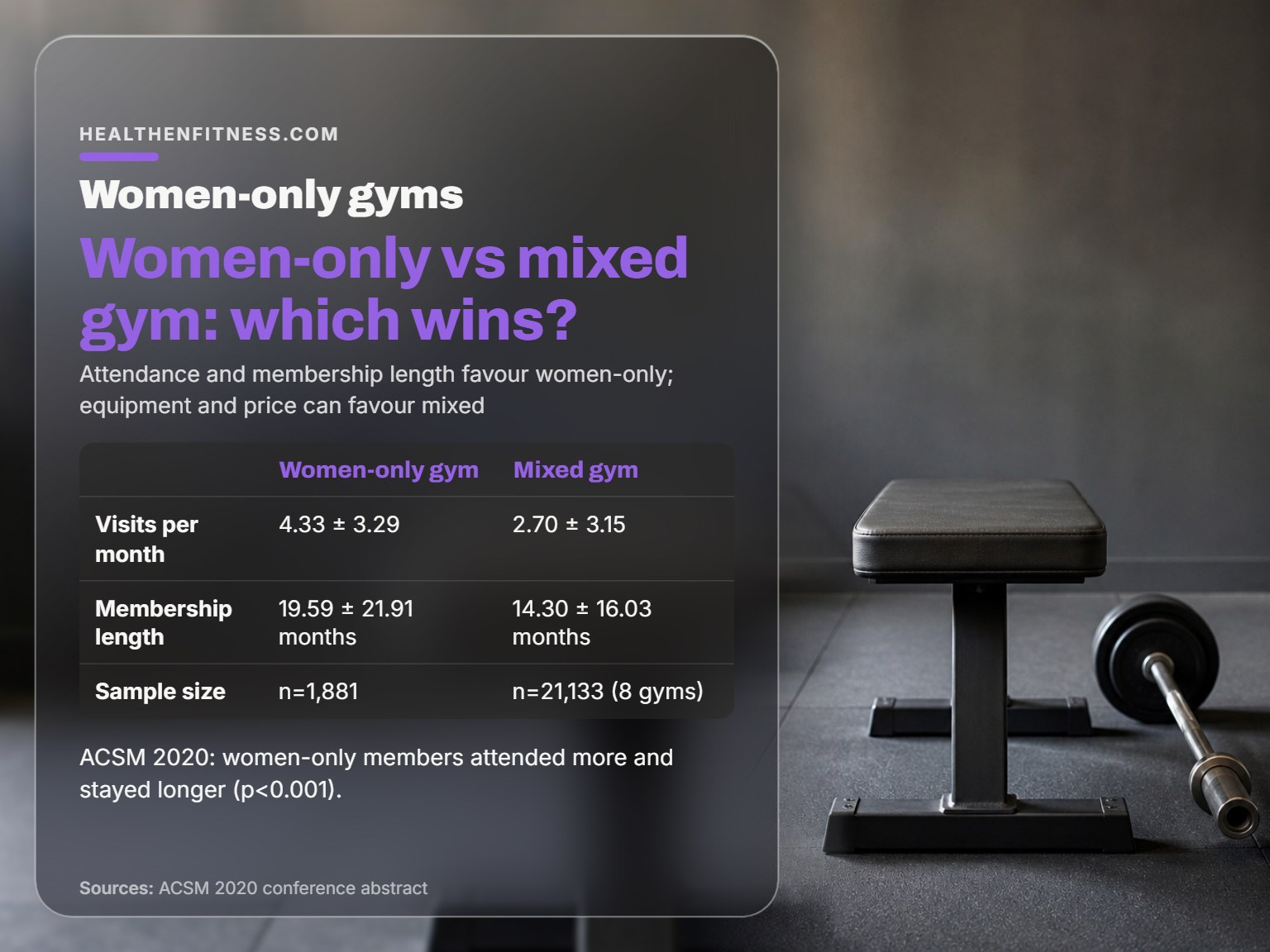
Women only gym pros and cons balance a real attendance gain against a smaller, thinner-equipped room. In an English dataset, female-only gyms drew 4.33 visits a month against 2.70 in mixed gyms, and members stayed 19.59 months against 14.30.
That women only gym pros and cons trade lands differently depending on where you’re starting. In the Total Fitness white paper, 48% of The Women’s Gym members were not active gym members immediately before joining, and 20% had never belonged to a gym at all. For those women, the realistic alternative was staying home.
What follows is the evidence as it actually stands: the attendance and retention numbers, the drawbacks the vendor blogs skate past, the places where the research genuinely disagrees, and a short test for judging a women-only room before you pay for a year.
Key Takeaways
- Comfort drives the decision, not fear. 76% of The Women’s Gym members named comfort as a reason for joining; safety or harassment concerns drew 23%, religious or cultural reasons 22%.
- A capped women-only room filled a waiting list in sixteen months. Total Fitness opened The Women’s Gym to non-members in October 2024 and hit its deliberately capped limit by the sixteenth month.
- Heavy early attendance predicts quitting sooner, not later (r = -0.441 in female-only gyms).
- Freezes are not a churn signal in female-only gyms; more freezes correlated with longer membership (r = 3.660).
- Judge the programming, not the sign on the door. A women-only room running toning circuits is worth less than a mixed gym with a rack and a coach who actually watches.
What the Research Actually Says About Women-Only Gyms
The strongest number in this debate comes from an English dataset. Women in female-only gyms averaged 4.33 visits a month; women across eight mixed-gender gyms averaged 2.70.
The 2020 ACSM abstract compared 1,881 female-only gym members with 21,133 members across eight mixed-gender gyms. Female-only members recorded 4.33 visits per month against 2.70, and 19.59 months of membership against 14.30, both significant at p<0.001. Demographic and membership variables explained less in mixed gyms: R-squared 0.103 against 0.147.
That is the female-only vs mixed-gender gym attendance study most of the vendor blogs never quote, and it cuts both ways. The effect is real and statistically significant. It is also small relative to everything the model couldn’t capture.
Read the R-squared figures carefully. Demographic and membership variables explained 14.7% of attendance behaviour in female-only gyms and 10.3% in mixed ones. My read: roughly 85% of why any given woman shows up in a given month sits outside the gym’s control entirely.
A 2025 systematic review in the Journal of Physical Education, Health and Sport landed somewhere more cautious. It called women-only gyms “a promising environmental strategy” while flagging that effectiveness depends on cultural context and program design, and that longitudinal quantitative evidence is still thin.
Both positions are honest. The English dataset shows a measurable effect; the review says we don’t yet have the long-run data to call the question settled. That gap is worth knowing about before you let anyone sell you a membership on the strength of “the science says.”
Why Do Women Choose a Women-Only Gym?
Walk onto a women-only floor at 6pm and the first thing you notice is the noise. Fewer dropped dumbbells, more conversation between sets, and nobody narrating a rep to the room.
The reasons women give for being there are more ordinary than the marketing suggests. Comfort was cited by 76% of The Women’s Gym members, against 23% for safety or harassment concerns and 22% for religious or cultural reasons. Comfort is the headline, and it’s a much broader category than fear.
The PLOS ONE survey of 279 self-identified women adds texture. Asked how it would feel if a woman stared at them in the gym, most picked “curious” (42.2%, n=89). Asked the same about a man, most picked “intimidated” (27.5%, n=58). More women reported being more intimidated by men than judged by them, 39.2% against 29.2%.
Here’s where the sources part company on emphasis. Vagaro frames the leading driver as avoiding self-consciousness and “gymtimidation.” PerfectGym leads with gymtimidation and unwanted attention, and notes that in many Arab countries women-only facilities are a necessity driven by cultural and religious privacy values. Total Fitness, working from its own member survey, puts comfort first and treats safety as secondary.
The PLOS ONE gym body image research also documents what women actually deal with in mixed rooms: unsolicited advice on technique, negative comments, unwanted advances, and men occupying space and prioritising their own equipment needs. None of that requires a stare to be uncomfortable.
The Case Against: What You Give Up in a Women-Only Room
Some women-only rooms are worse gyms than the mixed gym down the road, and the format does nothing to fix that.
Holly Perkins, a coach who writes about women’s strength training, warns that some women-only facilities run limited equipment, smaller spaces, or programming that leans toward toning rather than genuine strength progression. She argues the test is the quality of programming and the commitment to progressive strength, not whether the place is female-focused.
Vagaro makes a different case: its stated core drawback is that a limited membership inherently narrows the networking circle and the diversity of perspectives on lifting technique and goals, while PLOS ONE and the systematic review instead frame the mixed gym as the constrained environment. That is a real cost if you learn by watching other people train.
Three things you’re trading away:
- Floor space and equipment depth. Circuit-style layouts, which is the Curves model, are efficient for general fitness and poor for anyone chasing a specific strength number.
- A wider coaching pool. A smaller facility hires fewer coaches, so your odds of finding one who can actually fix a squat get thinner.
- Cost certainty. Women-only operators position the format as a premium product; PerfectGym explicitly frames it as a profitability play because many women will pay more for a comfortable, specialised environment.
Common mistake: Joining for the sign on the door and never checking the dumbbell run. A room whose dumbbells stop at a light weight caps your progression, and you’ll feel it when the same weight goes up easy and there’s nothing heavier on the rack.
If the equipment is the weak point, the honest comparison isn’t women-only versus mixed. It’s women-only versus a home gym setup you control, or a smaller boutique fitness studio with a capped class size.
The Attendance Paradox Nobody Mentions

The women who show up most in month one are the most likely to be gone by month twelve. That’s not a motivational slogan; it’s a correlation in the data.
In female-only gyms, monthly visits were inversely related to membership length at r = -0.441. Heavy early attendance predicted shorter tenure. The same dataset found that more membership freezes correlated with longer membership at r = 3.660, which runs against every instinct a gym operator has about freezes as a churn warning.
| Measure | Female-only | Mixed-gender | What it suggests |
|---|---|---|---|
| Visits per month | 4.33 | 2.70 | More frequent attendance |
| Membership length | 19.59 months | 14.30 months | Longer tenure |
| Variance explained | R-squared 0.147 | R-squared 0.103 | Environment beats demographics |
| Visits vs tenure | r = -0.441 | Not reported | Heavy early use predicts earlier exit |
| Freezes vs tenure | r = 3.660 | Not reported | Freezing is not quitting |
I’ve watched people sign a year in January and vanish by March. The ones who lasted were rarely the ones who went hardest in week one, and that r = -0.441 figure is the pattern written down.
This is also where the coaching advice and the data quietly disagree. Holly Perkins builds her case on consistency driving transformation, which assumes more engagement is the goal. The English dataset suggests the relationship between engagement and staying is more tangled than that, at least in the first few months.
A gym acquaintance of mine trained a couple of times a week and got visibly stronger over time. Not because thirty minutes is magic, but because he never had a month where he went five times and then stopped.
Women Only Gym Pros and Cons: Which Setup Wins for You?
Three things decide this: what you’re training for, what hour you actually train, and whether anyone is watching your form.
| Your situation | Better bet | Why |
|---|---|---|
| Back after five or more years out | Women-only | 48% of The Women’s Gym members were previously inactive |
| Already lifting heavy, need racks | Mixed gym or private studio | Women-only rooms often run thin on free weights |
| Need childcare or off-hours access | Women-only | Vagaro lists both as common features of the format |
| Want a coach watching your lifts | Small-group strength, either setting | Coach-to-athlete ratio matters more than the sign on the door |
| Tight budget, basic needs | Mixed gym or rec centre | Women-only operators often price at a premium |
The best value I’ve found anywhere is a small-group strength class with a coach who actually watches your squat and deadlift. I picked up a hip hinge fix in one session that I’d failed to get right alone. Bigger cardio-driven classes are fun, and nobody is correcting your form when you’re tired.
So the head-to-head answer: for a returning beginner who needs a room that feels survivable, a women-only gym wins and it isn’t close. For someone already training hard who needs three racks at 7pm, a well-equipped mixed gym or a big box gym wins on pure utility.
If you’re weighing the whole category against not joining anything, the gym membership question is worth settling first. And if your schedule is the real obstacle, a 24-hour gym solves a different problem than a women-only room does.
Does Women-Only Actually Work? Where the Evidence Splits
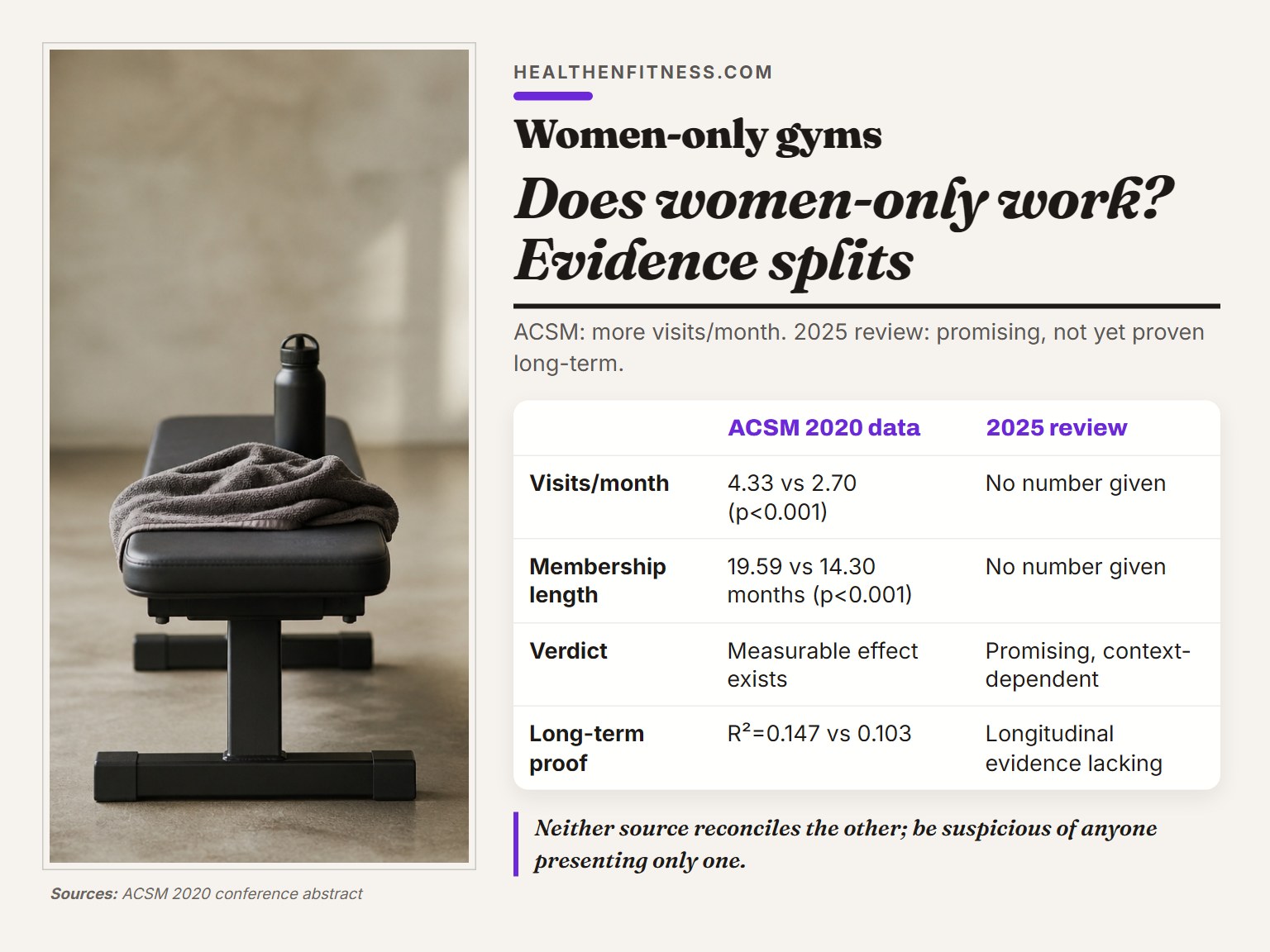
Khairunissya and colleagues reviewed the literature in 2025 and landed on a careful maybe: promising, context-dependent, not yet proven over the long run.
The ACSM dataset complicates that by showing a measurable effect already exists. Neither source reconciles the other, and you should be suspicious of anyone who presents only one of them.
The review also raises a caveat that almost no gym marketing addresses. In some regions, gyms function as status symbols, so membership counts don’t always reflect a meaningful increase in physical activity.
Menstruation concerns appear as a distinct barrier in the review too: leakage, clothing choices, bringing a change of clothes, and awkwardness discussing any of it with male trainers. A women-only room removes the last item on that list and does nothing about the first three.
Judge a women-only gym on what happens in week four, not week one. Any room feels good on a free trial; the programming either progresses you or it doesn’t.
There’s also a facility-type confound worth naming. The PLOS ONE study found women felt safest not only in women-only spaces but also in private and CrossFit-style gyms, where performance is prioritised over appearance. Women-only may be one route to a comfortable room rather than the only one.
Where Women-Only Gyms Stand Legally

Connecticut’s Supreme Court ruled that women-only workout zones inside coed gyms violate state anti-discrimination law. Alaska, Colorado, Hawaii, Illinois, Massachusetts, New Jersey, Tennessee and Wisconsin have exempted gyms from anti-discrimination regulations, much as they exempt restrooms and locker rooms.
PerfectGym’s guidance to operators is blunter: legality varies by country and region, and many women-only gyms operate legally by structuring as private clubs or by offering co-ed hours.
Worth knowing before you start: A women-only format that works in one state can be unlawful three hours down the road. If you’re evaluating a gym as a customer, this rarely matters. If you’re evaluating it as a business, check the jurisdiction before you build a plan around the concept.
The format’s history is genuinely contested, and the sources disagree outright. Vagaro says women-only gyms peaked in the early 2000s and have deflated since, while PerfectGym reports demand is growing. PerfectGym reports online searches up 69% and points to The Girls Spot in London drawing over 7,000 pre-launch sign-ups. Total Fitness, meanwhile, hit a deliberately capped membership limit and opened a waiting list.
Scale isn’t in question, at least historically. Ostgaard’s 2006 ethnography cites Curves International at 9,000 locations and 4 million members, and Contours Express at 327 US locations and over 450 worldwide. That was twenty years ago, and it’s the clearest evidence the format has mass appeal rather than niche appeal.
Mainstream coverage has picked the topic up again as well, including this New York Times women-only gyms article.
How to Judge a Women-Only Gym Before You Pay for a Year
Do you actually know what the free-weights area looks like at your usual training hour? Most people tour at a quiet off-peak time and then train at peak hour.
I have a multi-visit rule now. The first visit I’m learning where to stand and what the moves are called. The second I’m less lost. By the third I can finally tell whether the format suits me.
I wrote off a class after one session because my legs shook and I felt clumsy. A later class was the first one where I actually noticed the coaching. I was wrong about it, and I’d have saved myself a lot of guessing if I’d applied the same rule to every gym I’ve joined.
Here’s the sequence I’d run:
- Tour at your real training hour. If you sign up after a quiet morning walkthrough and train at peak hour, you’ve evaluated a different building than the one you’ll use.
- Count the racks and walk the dumbbell run. A couple of benches and a light dumbbell run is a fine starting room and a dead end before long.
- Ask what a member does in week four. A program that hasn’t changed after a few weeks is a treadmill with extra steps, and you’ll feel it as boredom before long.
- Ask whether membership is capped. A cap protects the thing you’re paying for; an uncapped room fills up and the atmosphere you came for evaporates.
- Give it several visits before you decide. One class tells you nothing except whether you felt clumsy, and everybody feels clumsy the first time.
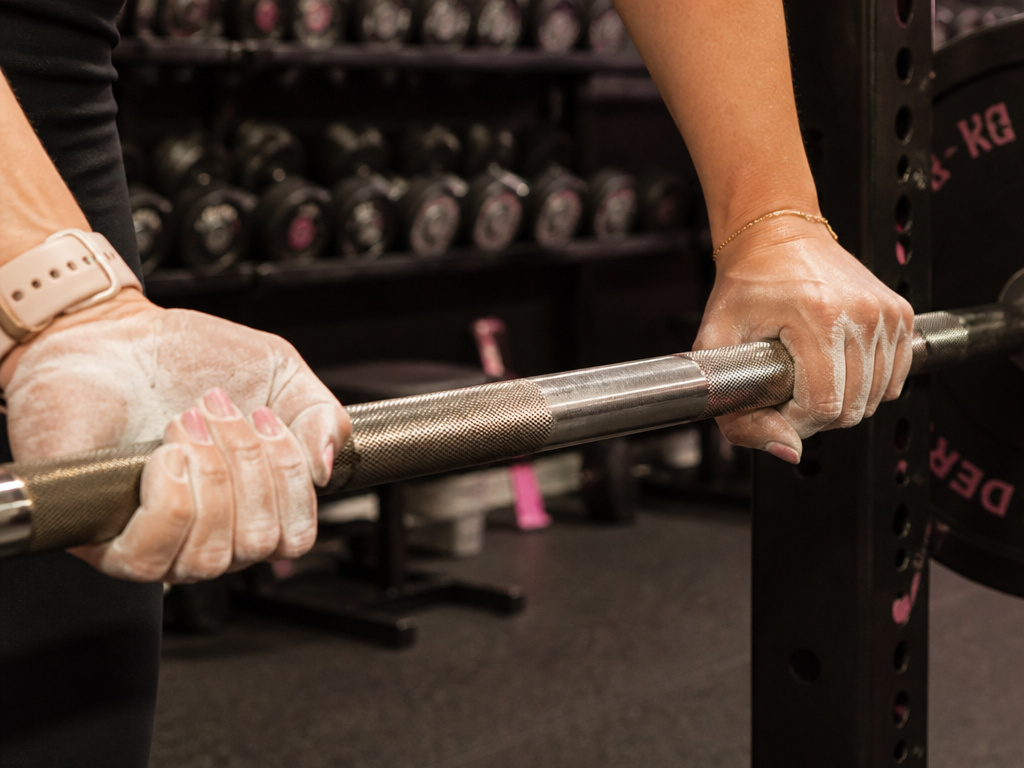
Put your hand on the bar before you sign anything. If the knurling is polished smooth in the middle, that bar gets real use and the room is doing its job. If it’s still sharp, the rack is decoration.
One last thing worth checking: whether the gym publishes gym workout routines that progress week to week, or just hands you a machine circuit and wishes you luck. That single detail separates a facility from a business with treadmills in it.
Frequently Asked Questions
Are women-only gyms actually better for beginners?
The evidence is encouraging rather than conclusive. A 2025 systematic review called them a promising strategy while noting that effectiveness depends on cultural context and program design. The strongest supporting data is behavioural: 48% of The Women’s Gym members weren’t active gym members before joining, and 20% had never belonged to one.
Do women-only gyms cost more than mixed gyms?
Operators often position them as a premium product, and PerfectGym explicitly frames the format as a profitability opportunity because many women will pay more for a comfortable, specialised environment. Cost is also named as a consideration by coach Holly Perkins in her assessment of the format. Compare the actual monthly figure against what you’d spend on a mixed membership plus the classes you’d otherwise buy separately.
Are women-only gyms legal?
It varies by jurisdiction. Connecticut’s Supreme Court ruled that women-only workout zones inside coed gyms violate state anti-discrimination law, while Alaska, Colorado, Hawaii, Illinois, Massachusetts, New Jersey, Tennessee and Wisconsin have exempted gyms from anti-discrimination regulations. Many operators stay compliant by structuring as private clubs or offering co-ed hours.
What if the women-only room has no racks and I want to lift heavy?
Then the format is the wrong tool for your goal. Holly Perkins warns specifically about women-only facilities with limited equipment or programming that leans toward toning rather than progressive strength. A well-equipped mixed gym, a private studio, or a home setup will serve a heavy strength program better.
Why did my attendance drop after the first month?
It’s common enough to show up in the data. In female-only gyms, monthly visits were inversely related to membership length at r = -0.441, meaning heavy early attendance predicted shorter tenure. The practical fix is boring: pick a frequency you can hold in a bad week, not one you can only manage in a good one.
The Bottom Line
One rule before you sign anything: if the gym can’t tell you what a member does in week four, don’t commit to twelve months. That single question filters harder than any tour.
The data supports women-only gyms for a specific job. They get disengaged women back through the door and they hold them longer than mixed gyms do, at least in the one English dataset we have. They’re a poor fit for someone who already trains hard and needs equipment depth.
Here’s the concession. If you’re an experienced lifter chasing a number on a bar, none of the comfort argument applies to you, and a women-only circuit room will frustrate you quickly. Go where the racks are.
One thing to try this week: book a trial at a women-only gym for the hour you’d actually train, and go several times before you decide. Not just once. Several times. The first visit tells you about the room. A later visit tells you about the coaching, and the coaching is what you’re actually buying.
