
When Should You Use a Lifting Belt? A Simple Rule
This post contains affiliate links. As an Amazon Associate, we earn from qualifying purchases.
A lifting belt belongs on heavy work sets, the ones where your trunk quits before your legs do. Leave it off for warm-ups and light sets. Some lifters find the belt gives their abs a wall to brace against, and that bracing is a skill you build first. NIOSH says a back belt isn’t protective equipment.
That bracing skill is the part a belt can’t hand you. A belt works as a hard surface your obliques and deep abdominals push against, so you build pressure in a smaller, stiffer space. Learn that push beltless and the belt amplifies a habit you already own. Learn it with the belt cinched from day one and the belt becomes the habit. This is why when should you use a lifting belt matters: the belt should follow the skill, not replace it.
What follows walks the decision in order: what the federal research actually covers, the four checks that decide whether a belt earns its place, why bracing has to come first, and the belt styles worth knowing before you spend anything.
Key Takeaways
- Warm-ups stay beltless. Your trunk learns to brace by bracing, and a belt on an empty bar teaches it nothing.
- Brace first, belt second. A belt amplifies a brace you already have. It doesn’t create one.
- The federal guidance covers occupational back belts, worn for manual handling at work. It isn’t a study of your squat.
- A belt worn on every set stops teaching you anything, and NIOSH lists a false sense of security as a real risk.
- Style follows the lift. Stiffness, closure, and width matter more than the logo on the front.
What the Federal Back Belt Research Actually Covers
NIOSH published its back belt review, and it’s still the document everyone quotes at each other.
The NIOSH Back Belt Working Group reviewed the available literature and concluded that back belts are not personal protective equipment and should not be recommended for occupational use. The group found no study showing a significant reduction in spinal pressure during a lift, and noted that belts limit mobility and may reduce the suppleness of muscles and tendons.
The stakes behind that review are large. Back injuries account for nearly 20% of all workplace injuries and illnesses, according to the NIOSH back belt injury report. That figure is why the topic drew federal attention in the first place.
OSHA landed in a slightly different spot. In its OSHA back belt interpretation letter, the agency states that back belts are not recognized as effective engineering controls for preventing back injury. It also states that it doesn’t forbid them, and it notes that workers may accept them because they feel as if they provide additional support.
The scope matters more than the headline. Every one of those documents is about occupational back belts worn during manual materials handling, meaning lifting and moving loads at work. None of it examines a stiff leather belt worn for a heavy squat.
So the federal research is worth knowing, and it’s worth knowing its edges. Hold that thought, because it comes back in a minute.
When Does a Lifting Belt Actually Earn Its Place?
When you compare a when should you use a lifting belt, a belt earns its place on the sets where your trunk is the limiting factor, and it stays in the bag everywhere else.
Run these four checks before you buy anything.
- Find out what’s failing first. If your legs give out and your back stays stacked, the belt isn’t your problem yet. Keep it simple and keep showing up.
- Test your brace without it. A belt is feedback. If you can’t hold a hard brace beltless, you’ll just be leaning on a strap.
- Look at the set type. Heavy, low-rep work sets are where a belt pays off. Long sets taken near failure are not, because your brace fades before the set ends.
- Count how often you’d wear it. If the honest answer is every single set, you’ve found a habit rather than a tool.
Before you start: A belt worn too high rides the rib cage, so set it low enough to cover the navel. A lever that snaps shut on a finger will split the skin, so guide it closed with your palm. And a belt that makes you feel bulletproof is how people add load their trunk can’t actually hold.
| Situation | Belt | Why |
|---|---|---|
| Warm-up sets | Off | The trunk learns to brace without a wall |
| Heavy work sets | On | Your trunk is the limiting factor |
| Long sets near failure | Off | The brace fades before the set does |
| Loaded carries and sleds | Off | A belt does nothing for a carry |
| Back still sore from last session | Off | A belt hides the signal, it doesn’t fix it |
The best lifting belts all share one trait: a stiff front panel that doesn’t fold when you push against it. That’s the whole job.
Why Bracing Comes Before Belting
Bracing is the whole skill, and when should you use a lifting belt comes down to the belt being a piece of feedback.
Done right, it feels like a low, hard push outward against the front of the belt, the tension you’d hold if someone were about to poke you in the stomach. Done badly, it feels like sucking your belly in, which moves nothing and steadies nothing.
The full bracing your core while lifting sequence is worth practicing beltless, because a belt hides errors beautifully. You can muscle through a sloppy brace when there’s a stiff panel in front of you.
Here’s the mechanism, since it explains why the research is so tangled. Pushing your abs against a belt raises intra-abdominal pressure, and higher pressure is supposed to stiffen the spine. Whether that actually reduces the force on your discs is genuinely contested, and I’ll show you the argument in the next section.
The most common version of this I see is someone who belts up for their first warm-up set with an empty bar. Fair warning: that’s the set where you’d learn the most.
I’d rather see a lifter spend time learning to brace with nothing around their middle than spend that time shopping for a belt. One of those transfers to every lift you’ll ever do.
What the 2006 Lifting Belt Study Found, and What It Didn’t
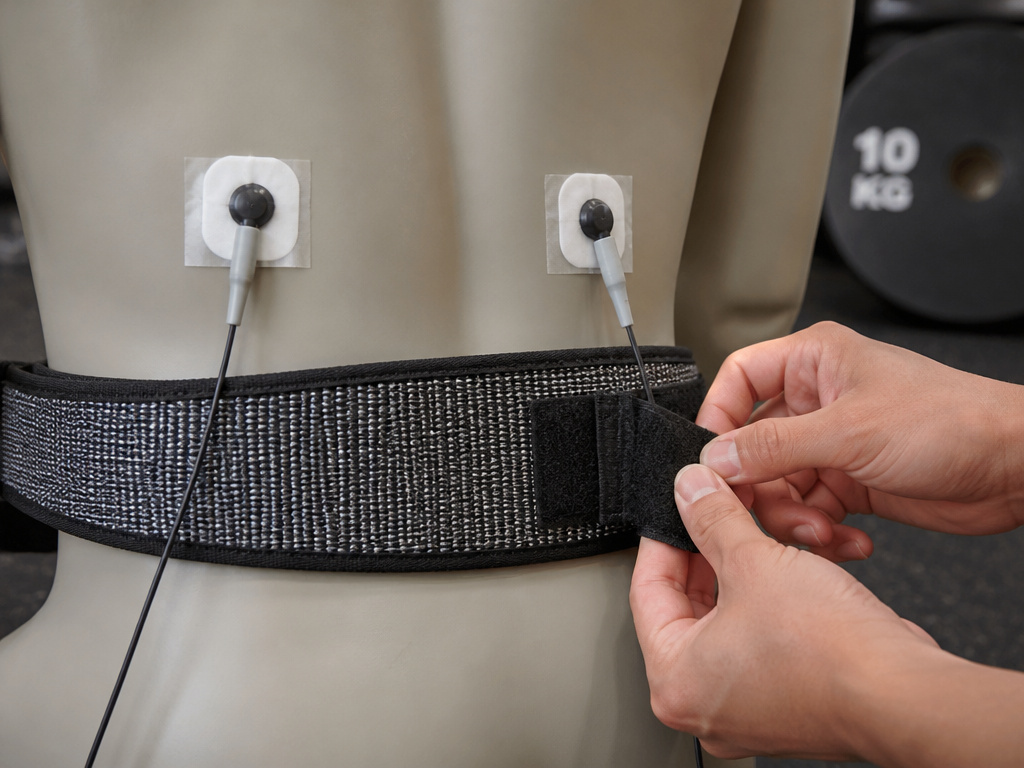
Ten healthy male students, a 5 cm waist belt, and a set of results that get quoted far more confidently than the authors did.
The belt tested in Industrial Health 2006;44:493-502 had three parts: hand-suspenders, a waist belt, and thigh-straps. The waist belt measured about 5 cm wide, slimmer than a conventional industrial belt, and most of the rig was woven mesh with Velcro closures. The design was patent registered in Taiwan, No. 188786.
In the static holding experiment, ten healthy male students took part, with a mean age of 23.5 years, height of 174.5 cm, and weight of 66.5 kg. Electrodes went on the erector spinae at the L1-L2 location. Each subject worked through eighteen tasks: two loads (0 kg and 10 kg), three heights (0 cm, 22 cm, and 75 cm above the floor), and three belt conditions (no belt, hand lifting with belt, hooks lifting with belt).
The static experiment found the belt significantly reduced erector spinae muscle activity under isometric contraction. The dynamic experiment reported reduced erector spinae, triceps and biceps load and postponed force peaks, which the authors described as potentially useful for symmetric industrial lifting tasks.
That sits in real tension with the NIOSH position. CCOHS, summarising the NIOSH working group, states that none of the studies reviewed could show a significant reduction in spinal pressure during a lift. The 2006 authors don’t claim otherwise. They measured muscle activity and force timing, not spinal pressure, and they note that considerable controversy continues over whether belts help in manual materials handling at all.
The intra-abdominal pressure argument is where the two camps really split. Lander reported that wearing a belt raised IAP and lowered back extensor EMG. Krag found IAP rose with dorsal muscle activity. McGill questioned whether the theory that IAP reduces disc loading had received excessive emphasis. NIOSH concluded that even if a belt raised IAP, no evidence existed to support that reducing the forces on the spine.
Different population, different question, and worth reading before you treat any single paper as the final word.
Easy to miss: The 2006 result is limited to symmetric lifts. The authors make no claim about twisting or asymmetric loading, so citing it for a mixed carry-and-turn job stretches the finding past where it was measured.
Which Belt Style Fits Which Job?
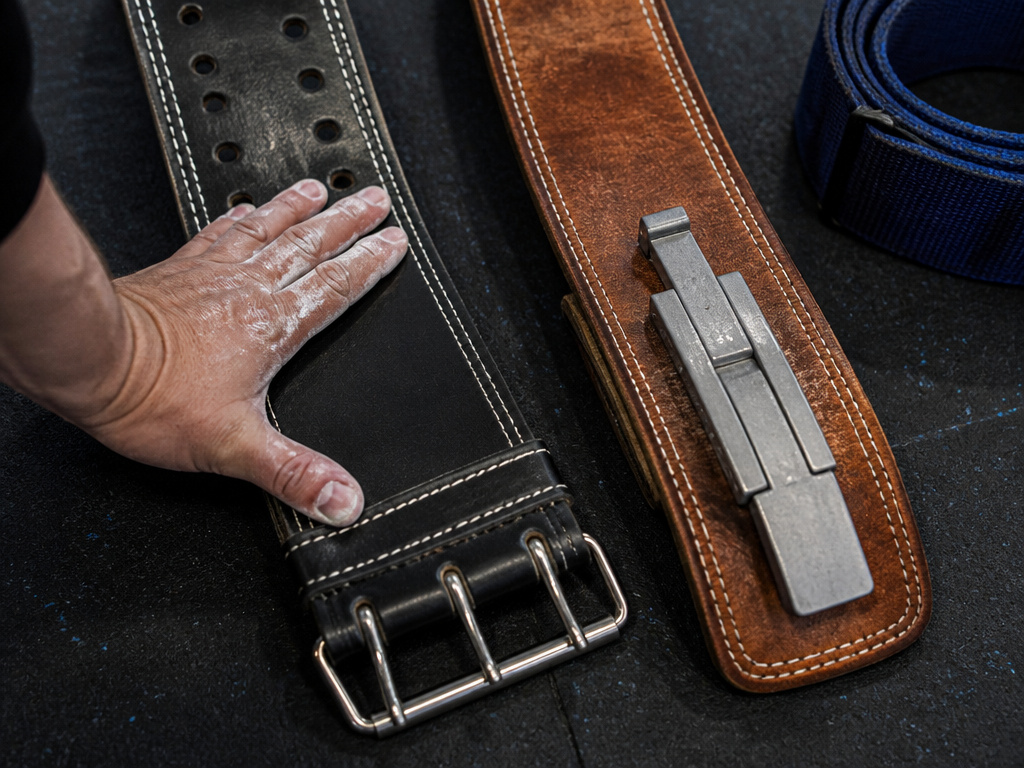
Belt style follows the lift, and the differences that matter are stiffness, closure, and width.
Leather, Nylon, or Nothing
Leather is the default for barbell work because it doesn’t fold under load.
Most leather lifting belts need some use before they stop fighting you, and a stiff new one will stand up on its own out of the box.
Lever or Prong
Prong belts are simpler and cheaper, and threading a strap through a buckle forces you to set the same tightness every time. Lever belts are faster in and out between sets, which matters if you’re supersetting or training in a busy gym. Lever lifting belts are also less forgiving of a bad measurement, so get the sizing right the first time.
Thickness and Width
Thicker and wider means more surface to brace against and less give. It also means a longer break-in and a belt that argues with you on the way down into the bottom of a squat. If you’re chasing a platform total, powerlifting belt thickness matters more than brand name.
The weight lifting belt types question really comes down to those three variables. Everything else is finish and marketing.
What actually matters when you choose:
- Stiffness matches the lift. A deadlift wants a stiff front; a general gym session doesn’t.
- Closure matches your patience. A lever is fast. A prong is simple and hard to get wrong.
- Width matches your torso. A short torso and a very wide belt make for a bad relationship.
Where Belts Backfire
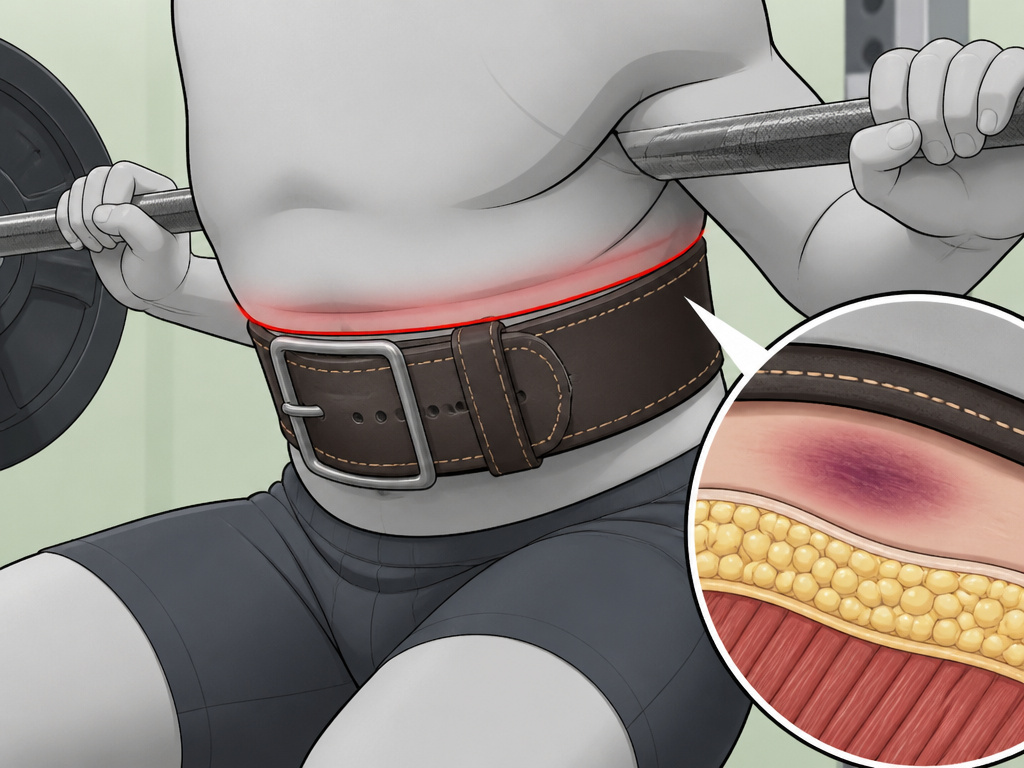
Wearing a belt on every set trains the belt, not your trunk.
NIOSH’s working group listed three specific concerns that led to its conclusions. Belts limit mobility. They may reduce the suppleness and elasticity of muscles and tendons, potentially contributing to back injury. And they may create a false sense of security, which increases the risk of lifting loads that are too heavy.
That third one is the one I’d underline. A belt that makes a heavy set feel manageable is doing its job during the set. It isn’t a licence to add load your trunk can’t hold.
Institutions have taken this seriously for a long time. Duke University’s Duke lumbar support belt policy, Supplement D, revised 3/20/2013, discourages lumbar support belts unless they’re specifically prescribed by Employee Occupational Health and Wellness for an individual employee. A supervisor or employee request triggers an ergonomic consultation of the work area instead, and the corrective measures that come out of it may include training on lifting mechanics or engineering controls such as mechanized equipment and lifting aids.
Notice what that policy does. It replaces the belt with a look at the actual task, which is the same order OSHA recommends: engineering controls first, administrative controls like job redesign when those fall short, and proper lifting technique training either way.
Where this goes sideways: A brand-new stiff leather belt can leave a red line across your ribs after a heavy session, and people read that as “it’s working.” It’s just pressure on soft tissue. If the mark is bruising rather than a temporary line, the belt is sitting too high.
For anyone training around a WOD with a mix of barbell and bodyweight work, CrossFit lifting belts are usually a different animal: thinner and faster to get on and off, because you’re not wearing it for the whole session.
Should You Wear a Belt on Every Set?
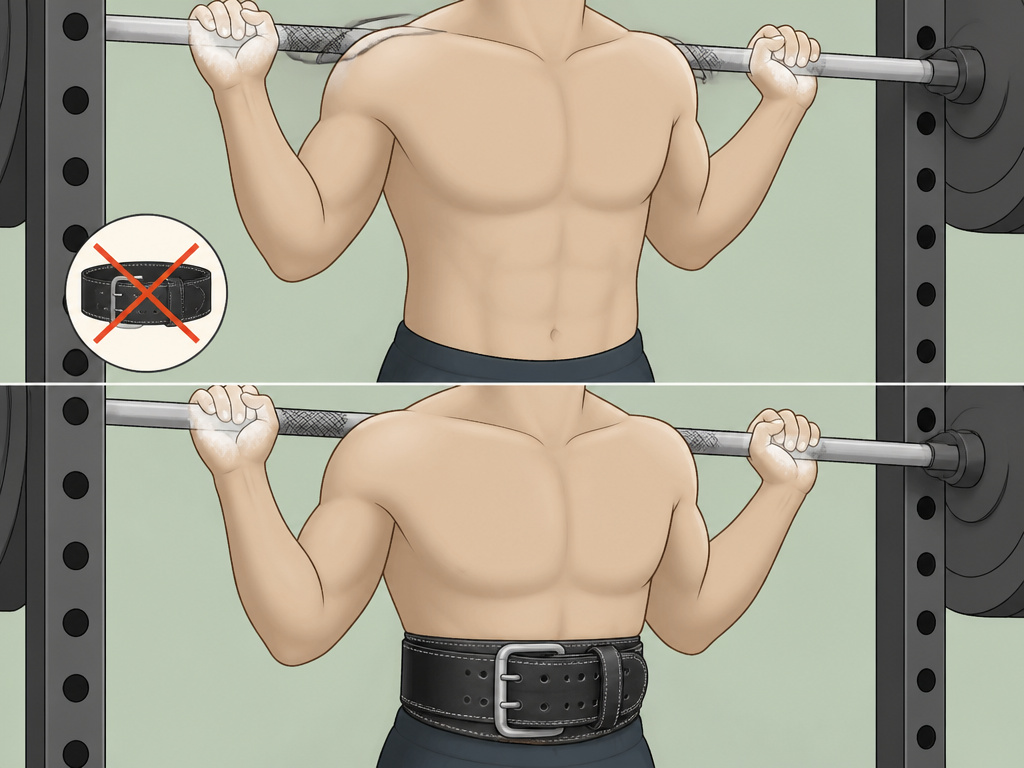
No, and the reason is boring: the belt becomes a substitute for a skill you stop practicing.
Think about what a warm-up set is for. It’s not just blood flow. It’s the rehearsal where you find your brace, set your ribs down, and load the pattern before the weight gets serious. Putting a belt on for that set skips the rehearsal.
The same logic applies to accessory work. A belt on a set of rows or a light squat variation adds nothing except time between sets.
If you’re pulling heavy, deadlift belts are worth having for the top sets, because the front panel gives you something to push against at the start of the pull. That doesn’t mean you wear it for your ramp-up sets.
Common mistake: Treating the belt as a permanent piece of kit rather than a tool for specific sets. The usual result is a lifter whose beltless squat gets shaky over time, and it shows up as a wobbly walkout long before it shows up on the bar.
Frequently Asked Questions
Should beginners use a lifting belt?
Not at first, in my view. The skill you need most is bracing without help, and a belt lets you skip it. Learn the brace beltless, then add a belt when your trunk starts limiting your heavy sets.
Does a lifting belt weaken your core?
The honest answer is that the evidence is thin on this specific claim. NIOSH’s working group noted that belts limit mobility and may reduce the suppleness and elasticity of muscles and tendons, potentially contributing to back injury. That’s a caution, not a proven mechanism. What’s clearer is that relying on a belt stops you practising the brace.
Is a lifting belt the same as a back belt at work?
No, and the distinction matters. The NIOSH and OSHA material is about occupational back belts worn during manual materials handling. NIOSH concluded back belts should not be considered personal protective equipment and should not be recommended for occupational use. A barbell belt in a gym is a different device in a different setting.
How tight should a lifting belt be?
Tight enough that you can push your abs out against it and feel resistance, and loose enough that you can still take a full breath. If you can’t get air in, it’s too tight. If you can’t feel the panel at all, it’s too loose.
Can you use a lifting belt for both squats and deadlifts?
Yes, and most people do. The belt position shifts slightly, lower for a deadlift start and a touch higher for a squat, but it’s the same belt. Some lifters keep a thinner belt for pulls, which is a comfort choice rather than a requirement.
When should you stop using a lifting belt?
When it’s covering for something. If your back gives out before your legs on heavy sets, or if your beltless brace has gotten worse over time, take the belt off for a training block and rebuild the skill.
The Bottom Line
Here’s the trigger I’d give you. If your back gives out before your legs on heavy sets, and you can hold a hard brace beltless for a full work set, go get a belt. If either of those isn’t true yet, you’ve got a cheaper problem to solve first.
One concession worth stating plainly. None of this applies cleanly if you’re coming back from an injury. NIOSH’s non-recommendation is scoped to prevention in workers who were never injured, and CCOHS explicitly notes that the recommendations may not apply to people using back belts as medical treatment during rehabilitation. That’s a conversation with a clinician, and I’m not one.
Progress beats perfection, and the belt is a small piece of progress. Start smaller than you think you need to.
This week, take the belt off for your warm-ups and your first working sets. Pay attention to what your trunk does when there’s nothing to push against. That tells you more about whether you need a belt than any article will.
