
How to Improve Shoulder Mobility for Overhead Press
This post contains affiliate links. As an Amazon Associate, we earn from qualifying purchases.
How to improve shoulder mobility for overhead press: you need 83 degrees of glenohumeral flexion or abduction, external rotation reaching about 53% of your other side, and enough thoracic extension to get the arm overhead without arching your lower back. Range built through a dynamic warm-up and below-90-degree strength work carries over better than long static holds before lifting.
The 83-degree figure comes from a study of post-surgical shoulders, and it describes only the ball-and-socket part of the motion, which is central to how to improve shoulder mobility for overhead press. The rest of the range comes from your shoulder blade rotating upward and your upper back extending. When either of those stalls, the arm stops short and the lower back takes over the slack.
Below is what the research supports: the range cutoffs worth measuring on yourself, the warm-up protocol a 2025 trial rated the broadest of the options tested, the pressing adjustments that let you keep training while you build range, and the places where the evidence genuinely splits.
Key Takeaways
- 83 degrees of glenohumeral flexion or abduction is the cutoff linked to reaching more than 120 degrees of global shoulder flexion.
- External rotation needs to reach about 53% of your other side; degree-based ER targets are unreliable because opposite-side variance is wide.
- Dynamic warm-up beat static stretching on proprioception and strength in a 2025 trial, even though static stretching produced the bigger raw range gains.
- Below-90-degree single-plane work with elastic resistance carries the strongest evidence grade for overhead athletes with shoulder pathology.
- A bench angle of 60-75 degrees allows most people to press without needing as much external rotation.
How Much Shoulder Mobility Does an Overhead Press Actually Need?
Eighty-three degrees of glenohumeral flexion or abduction is the number that matters.
Glenohumeral flexion or abduction of 83 degrees was the cutoff associated with achieving more than 120 degrees of global shoulder flexion in a cohort of 21 post-surgical patients. The cutoff discriminated with an area under the curve of 0.90 to 0.93. External rotation reached significance at 53% of the contralateral side, with an AUC of 0.87.
That cohort shapes how you should read the number. All 21 were post-surgical, split between 71% rotator cuff repair, 19% Latarjet, and 10% biceps tenotomy, with a mean age of 49 and a 76% male sample (glenohumeral range of motion study). Applying 83 degrees to a healthy 25-year-old is an extrapolation.
| Measure | Cutoff | What it predicts |
|---|---|---|
| GH flexion or abduction | 83 degrees | More than 120 degrees of global shoulder flexion |
| GH external rotation | 53% of the other side | Adequate rotation for the overhead position |
| Degree-based ER target | Not reliable | Wide contralateral variance skews the reading |
External rotation is where the sources split. The Dyer study concluded ER matters less than clinical writing usually assumes, provided it clears that 53% mark, and it called degree-based ER cutoffs inaccurate for interpretation because opposite shoulders vary so much. Clinical writing from The Prehab Guys treats soft tissue flexibility and external rotation as a primary limiting factor for overhead mobility.
Both positions can hold at once. ER may need to clear a minimum before anything else matters, and it may stop being the limiter once it does. What you shouldn’t do is chase a specific degree target on your right shoulder because that’s what your left one does.
Why Your Shoulder Blade and Upper Back Decide the Last Part of the Range
The shoulder joint supplies part of the range and the scapula and thoracic spine supply the rest.
Overhead mobility comes from three things working together:
- Shoulder flexion or abduction at the ball-and-socket joint
- Scapular abduction, upward rotation, and elevation, which tilts the socket up as the arm rises
- Thoracic extension, which allows the ribcage and upper back to move back far enough for the arm to pass vertical
Watch someone press who can’t extend the upper back. The ribs flare, the lower back takes the arch, and the bar drifts forward of the ear. The arm never really gets overhead; the spine just leans back to fake it.
I’ve watched people who sit all day do exactly this on every rep. A few weeks of hip and upper-back work cleaned up their posture more than any cue I gave them mid-set.
Reading Your Own Overhead Position
Stand with your back against a wall, heels a few inches out, ribs pulled down. Raise one arm overhead without letting the lower back peel off the wall. If the ribs lift before the arm gets near vertical, thoracic extension is a real part of your limit.
If your ribs flare early, thoracic mobility drills are the place to start. A steady diet of desk sitting tends to leave you with rounded shoulder posture, which shortens the tissues that need to lengthen for overhead reach.
The part nobody mentions: Chasing shoulder range while the upper back stays stiff usually just moves the compensation somewhere else. The arm gains a few degrees and the lower back starts complaining within a couple of weeks.
Should You Static Stretch Before You Press?
I skipped warm-ups for years because they felt like wasted time, until I learned how to improve shoulder mobility for overhead press. Then a cranky shoulder showed up partway through an overhead pressing block and stayed for weeks. I warm up now.
A 2025 randomized crossover trial in young male athletes with shoulder impingement syndrome put numbers on the trade-off. Static stretching produced the biggest range gains: +4.4 degrees of internal rotation and +3.4 degrees of external rotation in the impingement group, and +3.0 and +1.9 degrees in healthy athletes.
It also cost something. The same trial found static stretching increased joint position sense error by 1.2 degrees in the impingement group and 0.9 degrees in healthy athletes, and cut eccentric internal rotation strength at 60 degrees per second by 2.5 newton-metres.
| Protocol | Range result | Proprioception and strength |
|---|---|---|
| Static stretching | IR +4.4°, ER +3.4° (impingement group) | Error up 1.2°; eccentric IR strength down 2.5 Nm |
| Dynamic warm-up | IR and ER range improved | Error down 3.8°; Y-balance reach up 7.4 cm |
| Static plus dynamic | IR and ER range improved | Authors still rated dynamic warm-up the broadest option |
The trial authors concluded that dynamic warm-up was the most broadly useful of the three for overhead athletes with impingement, because it improved proprioception and strength without the performance dip. For range alone, all three protocols worked (static stretching vs dynamic warm-up trial).
Why the Two Studies Don’t Actually Contradict
There’s a second body of work pointing the other way.
Read the timing and the conflict dissolves. One is a single static session performed immediately before activity. The other is a daily programme run across four weeks. Acute pre-session static stretching gets penalised on proprioception and strength; chronic daily stretching gets supported for pain and symmetry. Those are different interventions wearing the same name.
What that means for you: a long static hold right before you press is the version with a measured cost. Shoulder stretches for lifters done after training or on a separate day sit in the other category entirely.
Easy to miss: The range gains from any single session partially fade by follow-up. Whatever you gain on Monday is partly gone by Thursday if you don’t repeat it.
A mobility warm-up routine built around movement rather than holds fits the pre-lift slot better. A warmed shoulder feels different: the arm travels further before it hits that hard stop, and the stop itself feels less like a wall.
The Order That Works: Mobilize, Activate, Stabilize
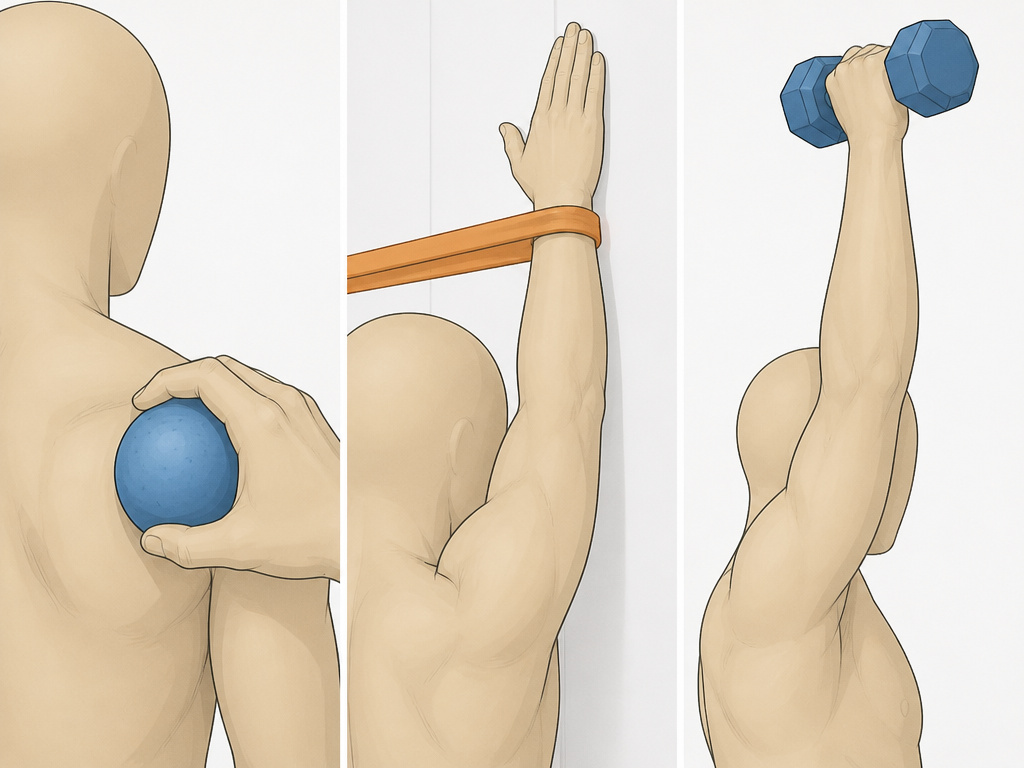
Three steps, in this order: mobilize the tissue that’s limiting you, work the motion you actually want, then load it so the range sticks.
Before you start: Overhead stretching into a stiff glenohumeral joint needs caution, not force, and the Dyer study says so explicitly. Open-chain work above 90 degrees of elevation carries only Level C evidence, weaker than the below-90 work. If a stretch produces a sharp pinch at the front of the shoulder rather than a pull at the back, stop and get it assessed.
- Mobilize first, and only what’s actually tight. Soft tissue work and targeted stretches on the tissue limiting the motion. Skip this and you’re asking a joint to move through a restriction it hasn’t cleared, which is where the pinch at the front of the shoulder comes from.
- Work the motion in the direction you want it. Arm-overhead patterns, wall slides, banded reaches. Skip this and the mobility you just bought has nowhere to be used, and it fades within the session.
- Stabilize last. Load the new range so your body keeps it. Skip this and you get range you can reach passively but can’t control under a bar, which is the version that shows up as a wobbly lockout.
The Prehab Guys lay out this same sequence, and they’re clear that posterior cuff mobility deficits need addressing because they change how the humeral head moves in the socket.
Shoulder stability exercises belong in step three, not step one. So does rotator cuff exercises work. Doing them first, before you’ve cleared the restriction, is a common way to spend a session going nowhere.
How to Press While You’re Still Building Range
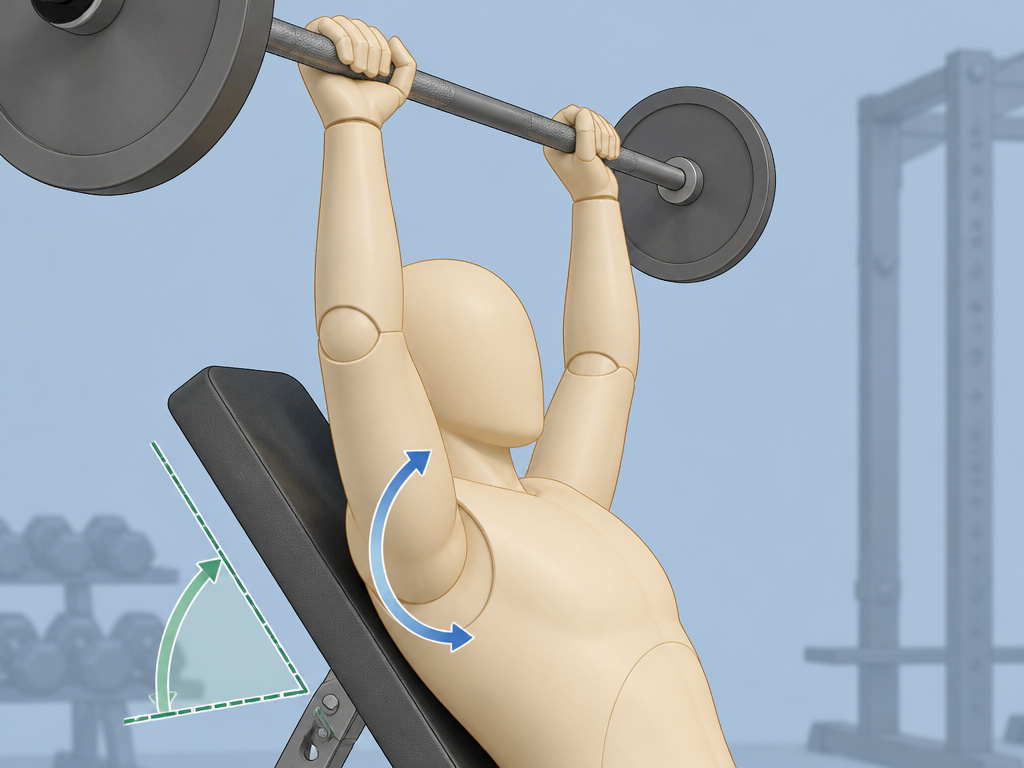
You can train the overhead press with less range than a textbook wants.
Coaching guidance from Physique Development is blunt about this: if external rotation is limited, adjust your arm angle to match what you’ve got and press anyway, while the Dyer study advises caution with overhead stretches in the presence of glenohumeral stiffness and the Wright review grades open-chain work above 90 degrees at only Level C. The trade-off is that the bias shifts from the medial deltoid toward the anterior deltoid, which you can cover by adding dumbbell lateral raises.
The bench angle is the easier fix. Physique Development argues most people would do better with a seated press bench set closer to 60-75 degrees rather than the traditional 90-degree teaching, because a slight recline reduces how much external rotation the shoulder needs. It also tends to give more usable range and less discomfort through the rep.
Where the Coaching Advice and the Evidence Part Ways
This is the clearest split in the whole topic. Coaching content says adjust and press. The Dyer study warns that overhead stretches should be performed with caution in the presence of glenohumeral stiffness, and the Wright review grades open-chain work above 90 degrees at only Level C.
Both are describing real situations. Pressing with a slightly narrower path, a reclined bench, and a neutral grip is a workaround that keeps you training. Forcing a barbell overhead behind your head when the joint won’t rotate is not the same thing, and the caution applies to that version.
Where this goes sideways: Pressing through a front-of-shoulder pinch because you read that you should “press anyway” is how a two-week niggle turns into a two-month layoff. The adjustment advice assumes a range limit. It doesn’t cover pain.
If the pinch is sharp and repeatable, that’s worth reading up on before you load it again. Shoulder impingement from lifting covers what’s actually getting compressed and why the fix isn’t always more stretching.
For the setup itself, overhead press form covers grip width, rib position, and bar path in more detail than fits here.
What the Evidence Grades Say to Actually Do Each Week
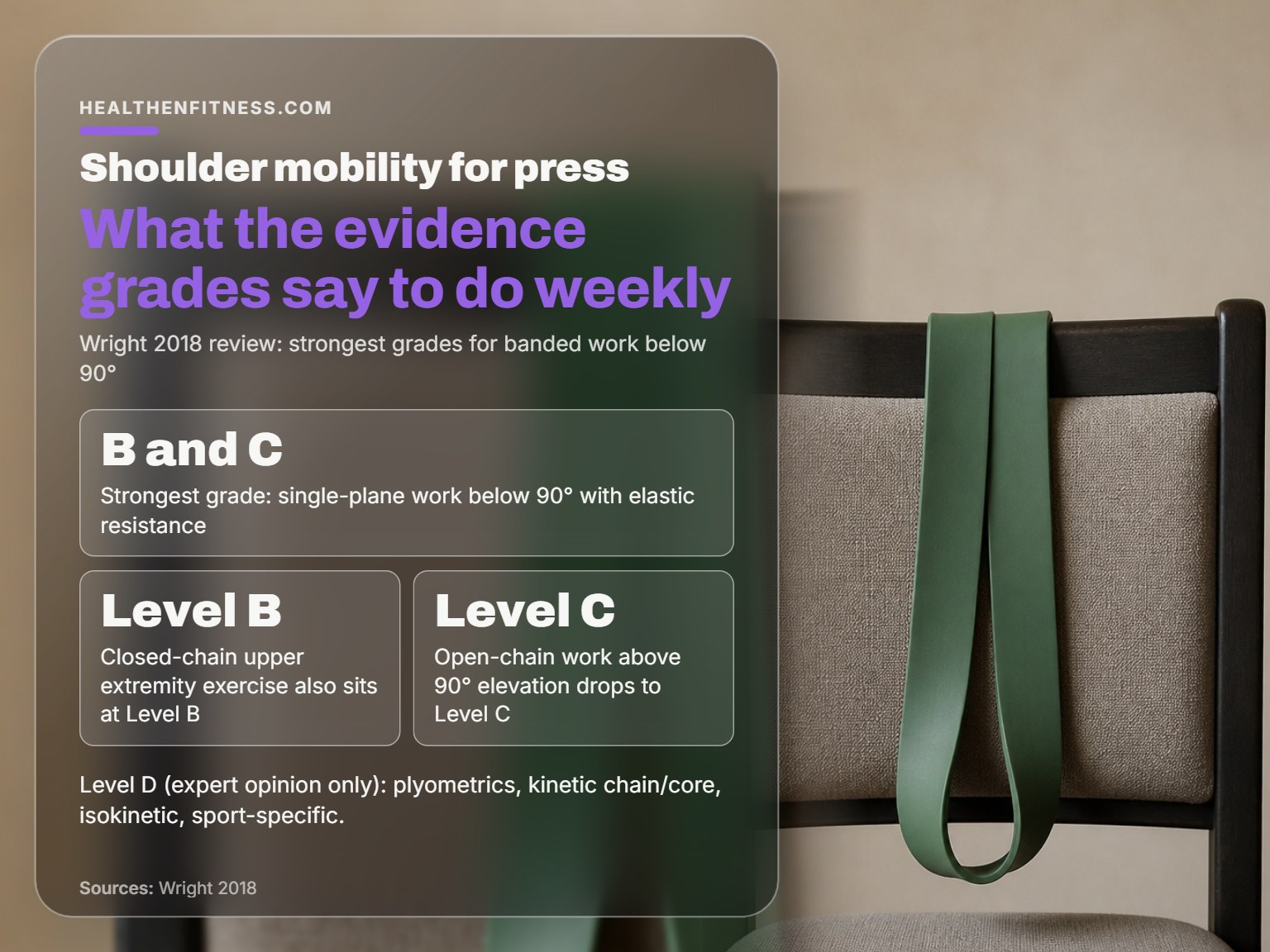
Elastic resistance bands sit at the centre of the work the Wright review graded strongest.
That systematic review sorted exercise selection by evidence grade, and the results are less glamorous than most shoulder content suggests:
- Single-plane upper extremity work below 90 degrees of elevation, with some elastic resistance, holds the strongest grade (B and C). Think external rotation in neutral and prone extension.
- Closed-chain upper extremity exercise also sits at Level B.
- Open-chain work above 90 degrees of elevation drops to Level C.
- Plyometrics, kinetic chain and core work, isokinetic, and sport-specific training sit at Level D, which is expert opinion only.
There’s a wider point buried in the same review. The core and leg muscles produce more than 51-55% of the kinetic energy transferred to the hand. A shoulder-only programme may be part of why reinjury rates stay where they are.
Level V expert opinion in that review did support global work, naming lateral lunges with a resistance band and lateral planks over a Theraball. A foam roller earns its place for the upper back work in step one.
So the weekly shape looks like this: banded external rotation and prone work below shoulder height, some closed-chain loading, thoracic extension work, and one or two global exercises that involve the legs. Keep the volume low enough that you could repeat the session tomorrow.
Frequently Asked Questions
How long does it take to improve shoulder mobility for overhead press?
The only duration the research reports is four weeks of daily self-stretching, which was associated with roughly 40% pain reduction and better internal rotation symmetry in a cohort of overhead athletes. Range gained in a single session partially fades by follow-up, so the honest answer is that consistency matters more than any one session’s length.
Should I stretch before or after overhead pressing?
Before, use movement rather than long holds. A 2025 trial found static stretching improved range most but increased joint position sense error and reduced eccentric internal rotation strength. Dynamic warm-up improved proprioception and Y-balance reach with no measured strength penalty. Save the longer static holds for after training or a separate day.
Is external rotation really the most important thing for overhead mobility?
The sources disagree. The Dyer study found external rotation matters less than usually assumed, as long as it reaches about 53% of the contralateral side, and called degree-based ER targets unreliable. Clinical writing treats ER as a primary limiting factor. A reasonable read is that ER has to clear a minimum before other factors take over.
Can I keep overhead pressing with limited shoulder mobility?
Coaching guidance says yes: adjust your arm angle to match your range and press anyway, then add lateral raises to cover the shift toward the anterior deltoid. The evidence side adds a caveat. Overhead stretching into a stiff glenohumeral joint should be done with caution, and open-chain work above 90 degrees is only Level C. Adjust around a range limit; don’t push through a sharp pinch.
What if one shoulder is much stiffer than the other?
Measure external rotation as a percentage of your other side rather than in degrees. The Dyer study used 53% of the contralateral side as its cutoff precisely because opposite shoulders vary so widely that a fixed degree target misleads. A 20-degree difference means something different on a loose shoulder than on a stiff one.
The Bottom Line
Here’s the threshold worth checking before anything else. Get your arm to roughly vertical with your back against a wall and your ribs down. If the lower back leaves the wall before the arm gets there, spend the next few weeks on thoracic extension and scapular upward rotation before you chase more load.
This week, do one thing: swap your pre-press static stretch for a dynamic warm-up and see how the first working set feels. That’s the whole change. One week, one swap.
Fair warning: the range gains from any single session fade, and the people who end up with real overhead mobility are the ones who keep showing up for it. Start smaller than you think you need to, and keep showing up.
