
How to Use an Assisted Pull up Machine: Step-by-Step
This post contains affiliate links. As an Amazon Associate, we earn from qualifying purchases.
To use an assisted pull up machine, set the pin so more weight means more help, mount the platform as your machine’s instructions specify (Spirit’s manual says one knee at a time; DynPerformance allows knees or feet), grip both handles, and drive your elbows down until your chest reaches the handles. The platform counter-levers your body weight; one outdoor model delivers the equivalent of a 50% pull-up.
That platform is a lever, and the stack is the counterweight on the other end. Pin more plates and, per DynPerformance, the machine carries a bigger share of your body weight, so the same pull costs your arms and lats less; Spirit’s manual never states the direction explicitly. Pin fewer and you carry more of it yourself. Knowing how to use an assisted pull up machine means understanding which way the stack moves the load.
What follows covers the settings that change the movement, the knee-versus-foot split between two manufacturers, the errors that make the platform fight you, and a five-step setup for how to use an assisted pull up machine that you can repeat every session. By the end you’ll have any assisted station dialed in before your first rep.
Key Takeaways
- More pinned weight means more help, not more resistance, according to DynPerformance; Spirit’s manual never states the direction explicitly, leaving users to infer it. The stack carries part of your body weight.
- Mount with one knee at a time off a fixed step, and come down the same way.
- Manufacturers split on knees versus feet. Follow the sticker on your machine.
- Keep knees centered on the pad and stop lifting them once the pull starts.
- Never pin the weights in an elevated position, and use only the manufacturer’s pin.
What the Weight Stack Is Actually Doing
The stack is a counterweight, and the pin decides how much of your body weight it cancels out.
An assisted pull-up machine counter-levers body weight through a platform linked to a weight stack or a fixed lever. Pinning more plates raises the upward force on the platform, reducing the load the arms and lats must move. The latissimus dorsi drives the pull, with the biceps brachii, rhomboids, and middle trapezius assisting.
Pinning more plates raises the upward force on the platform. Your arms and lats then have less mass to move, which is why a heavily assisted rep feels light and a lightly assisted one feels like real work.
Why the Pin Number Isn’t the Weight You’re Lifting
The number on the stack measures the assistance, not the load you are lifting, which is the core of how to use an assisted pull up machine. DynPerformance states it plainly: more assistance makes the exercise easier, and reducing the assistance weight will not make the exercise easier. That second half is listed as a common mistake, which tells you how many people get it backwards.
Spirit’s manual for the CSD-CPSP never states the direction at all. It lists a 17-hole weight selector and a stack of 12 x 20 lb plates plus a separate 5 lb increment weight, then leaves you to work out that more pinned plates mean more help. That silence is the whole reason this confusion survives.
A pin that isn’t fully seated can walk out under load, so the weight pin must be completely inserted.
Which Machine Are You Standing At?
Two machines wear the same name and behave nothing alike.
One is a selectorized stack with a pin. The other is a counter-levered platform with no pin at all. The TGO TGO810 works by counter-levering your body weight on a platform to deliver the equivalent of a 50% pull-up, so there is no dial to turn and no number to read.
Selectorized Stack vs Counter-Levered Platform
| Spec | Spirit Fitness CSD-CPSP | TGO TGO810 |
|---|---|---|
| Assistance type | Selectable weight stack | Counter-levered platform |
| Maximum user weight | 360 lb / 163 kg | Not listed on the datasheet |
| Footprint | 48.7 x 46.7 x 88 in | Not listed on the datasheet |
| Unit weight | 583 lb / 264 kg | Not listed on the datasheet |
| Where it lives | Indoors only | Outdoors |
That last row matters more than it looks. The Spirit manual says plainly: do not use this unit outdoors. The TGO810 is built for outdoor installation. Superficially similar stations, opposite constraints.
Easy to miss: Advice written for a stack machine doesn’t transfer to a counter-lever. “Reduce the pin weight” means nothing on a TGO platform, because there is no pin.
The Five-Step Setup, in Order
Five steps, in order, and the first one happens before your hands touch the handles.
Before you start: Check that the weight pin is fully inserted and that it’s the pin the manufacturer supplied. A partially seated pin can walk out under load. Keep bystanders clear of the platform and the moving arms, and stay off the machine if any guard is missing or damaged.
- Set the assistance with the platform empty. Reaching across a moving platform to move the pin is how people tweak a shoulder. Step off first.
- Set the pad or seat height so your knees land centered. Leaving the last user’s setting in place loads the wrong joint angle, and you’ll feel it in your shoulders before your lats.
- Mount off the fixed step, one knee at a time. Spirit’s manual is specific here: place one knee on the pad, then the second knee. Hopping up puts your full weight on the platform before you’re balanced.
- Grip both handles evenly and center yourself. Knees off-center tilt the platform and pull you to one side for the whole set.
- Dismount onto the fixed step first, keeping the platform under control. Jumping straight to the floor lets the platform snap up behind you.
Knees or Feet: Which Goes on the Platform?
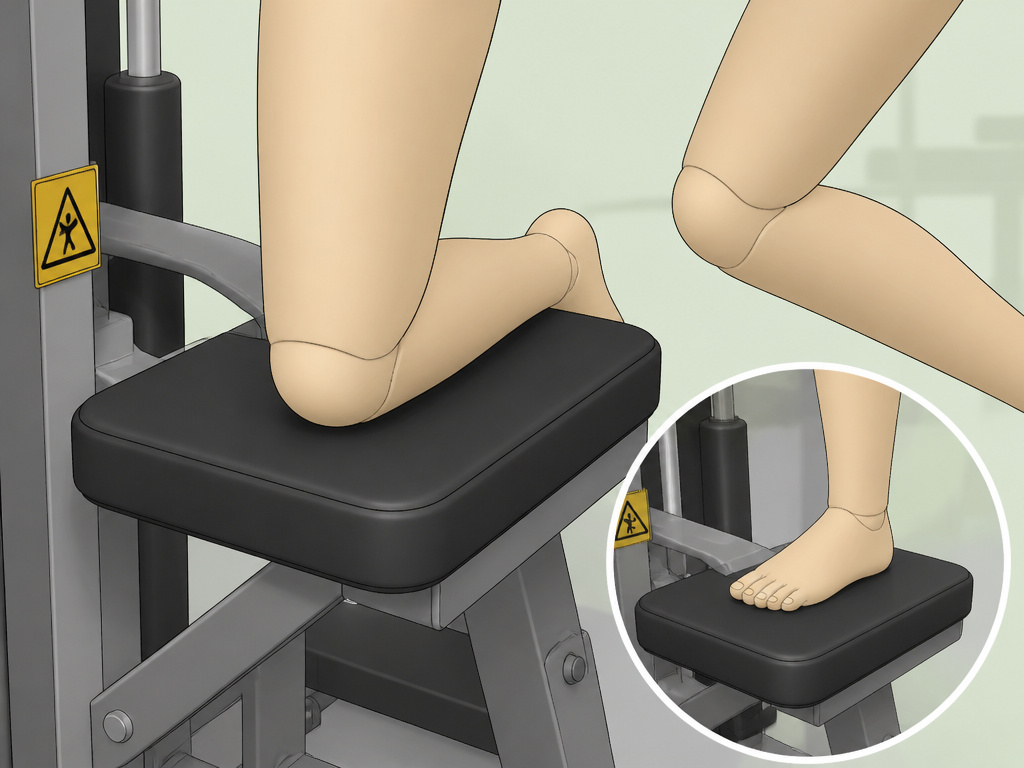
Ever watched someone plant both feet on a platform that everyone else uses with their knees?
The two most-cited documents on this machine give different answers, and neither is wrong for its own equipment. Spirit’s owner’s manual is specific: place one knee on the pad, then the second knee. DynPerformance allows either, instructing users to place knees or feet on the platform as specified by the machine’s instructions.
That’s a real divergence between two documents, and it changes how you mount. Spirit’s wording assumes a padded knee platform on an indoor stack machine. DynPerformance’s wording covers a wider family of assisted stations rather than one model, which is why it defers to the machine in front of you.
Practical rule: read the sticker on the unit. If there’s no sticker and you’re on a home machine, the owner’s manual beats any video you watched last night.
The Four Mistakes That Make It Feel Broken
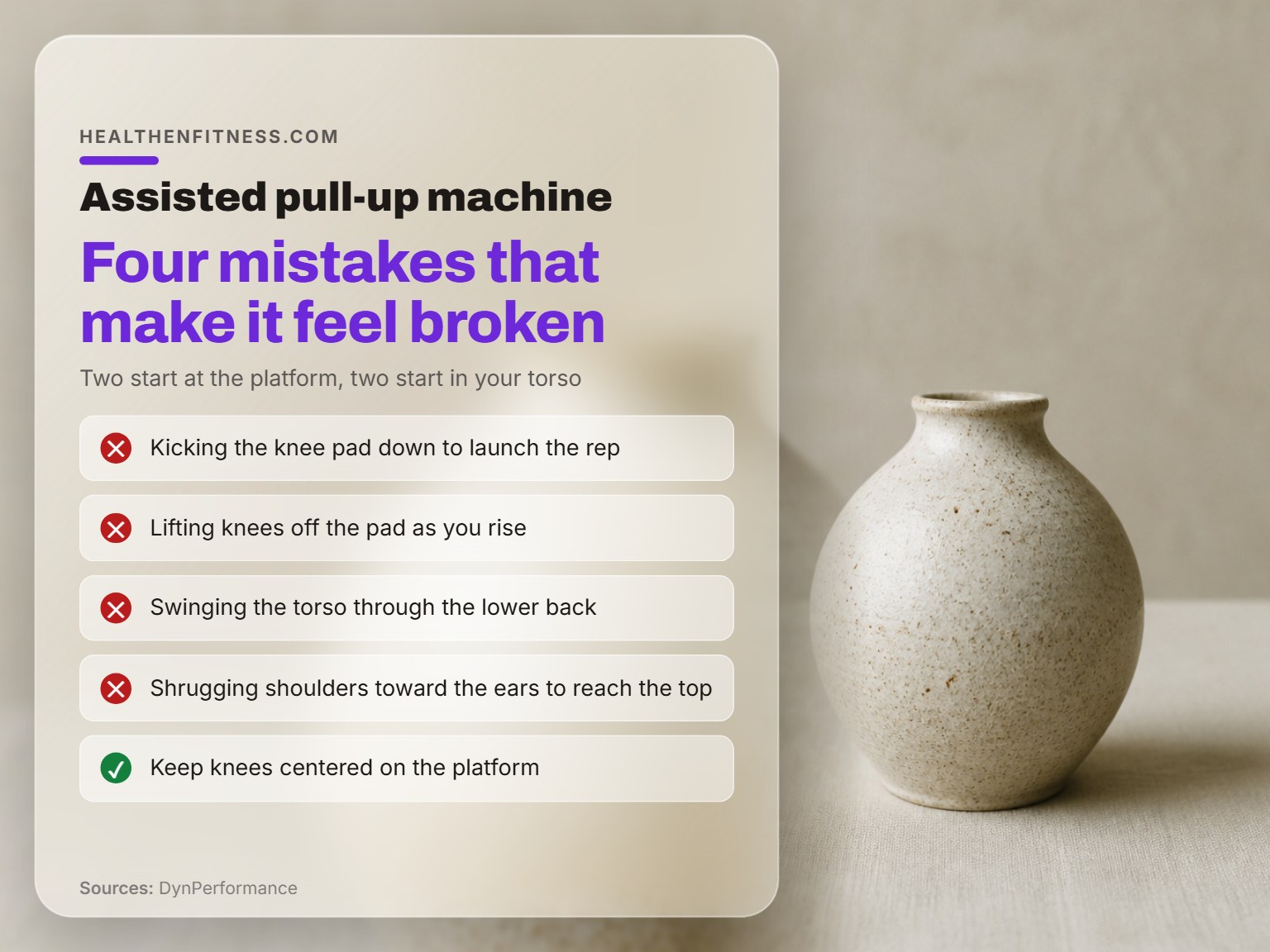
Half the complaints about this machine trace back to the platform.
The Two Errors That Start at the Platform
- Kicking the platform. Pushing the knee pad down to manufacture assistance is listed as a common mistake, and it turns the first inch of the rep into a launch.
- Lifting away from the support. Raising your knees as you rise makes the platform move suddenly under you. Keep them centered and in contact.
The Two Errors That Start in Your Torso
- Swinging the torso. Bouncing through the lower back accelerates the rep and takes the work off your lats. Even with assistance, that’s a cheat.
- Crowding the shoulders. Shrugging toward your ears to reach the top shortens the range you actually trained. Drive the elbows down instead, and pause at the highest point you can hit without craning your neck.
A clean rep is quiet at the bottom. When the platform slams, you hear the stack land before you feel anything in your lats.
The same four errors show up on any vertical pull, and the pull-up vs chin-up comparison explains how much biceps each hand position adds to the mix.
Common mistake: Kicking the knee pad down to start the rep. The platform surges, your shoulders take the load, and the rep ends in a jerk instead of a pull.
| Symptom | Likely cause | Fix |
|---|---|---|
| Platform surges at the start | Knee pad pushed down to launch the rep | Start the pull with your elbows, not your legs |
| Platform drops away mid-rep | Knees lifted off the pad as you rise | Keep knees centered and in contact |
| Lower back aches after sets | Torso bouncing through the bottom | Lower under control, straighten elbows slowly |
| Chin stops short of the handles | Shoulders shrugged toward the ears | Drive elbows down, pause at a reachable height |
| Stack rattles on every rep | Weight pin not fully seated | Push the pin home, use the manufacturer’s pin |
How Do You Know When to Drop the Assistance?
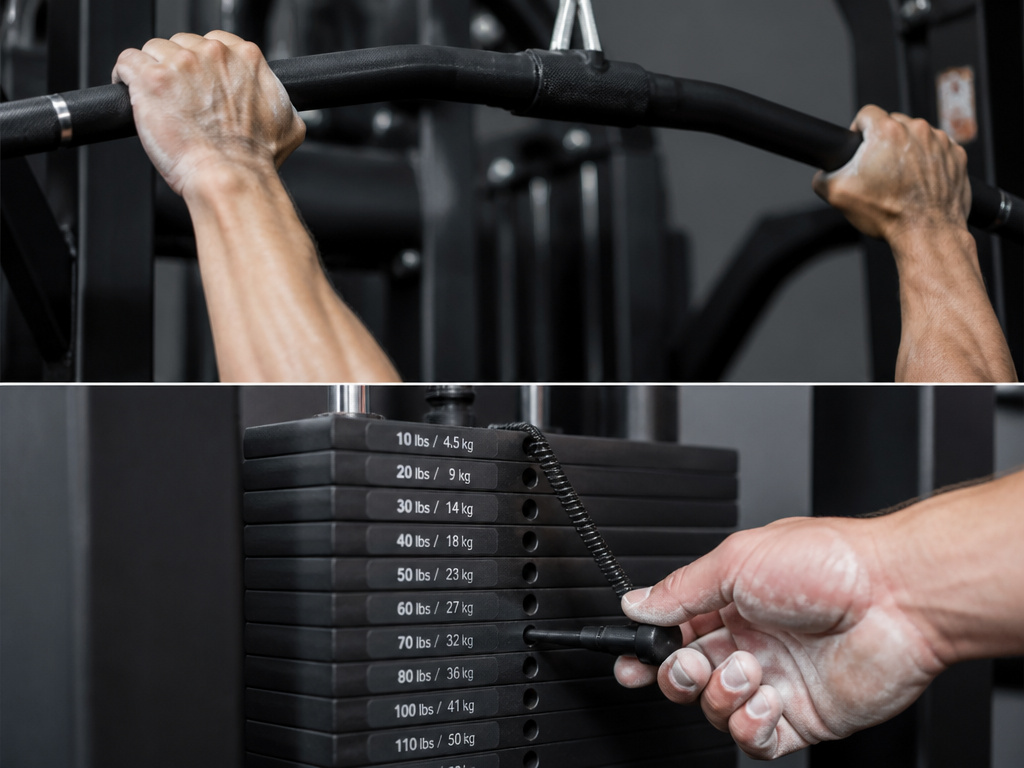
When does the number come down?
I ran a machine-only circuit early on and felt strong right up until I tried a single-leg squat and wobbled like a newborn deer. Nothing on that circuit had asked my balance to do any work. Adding free weights and single-leg work closed the gap faster than another machine would have.
So treat the assisted station as a bridge, not a home. Drop one increment when you can finish your target reps with a brief pause at the top and a controlled lower. Spirit lists a separate 5 lb increment weight as a component of the CSD-CPSP stack, which gives you a smaller step than a full plate.
I’d rather see someone spend time on the assisted machine than failing at a free-hanging bar. You can’t build a pull-up on reps you never complete.
The lower takes longer than the pull, and that’s the half people rush. If you want the full sequence laid out, the pull-up progression for beginners walks from assisted reps to bodyweight. Pair it with clean pull-up form so the machine doesn’t teach you a habit you’ll have to unlearn.
Two other tools fill the gap. A lat pulldown machine lets you load heavier than body weight for the same pattern, and bands for assisted pull-ups travel where the machine can’t. If you’d rather structure the week around pulling, these pull-up workouts slot the assisted station into a full session.
The Safety Rules That Actually Get Skipped
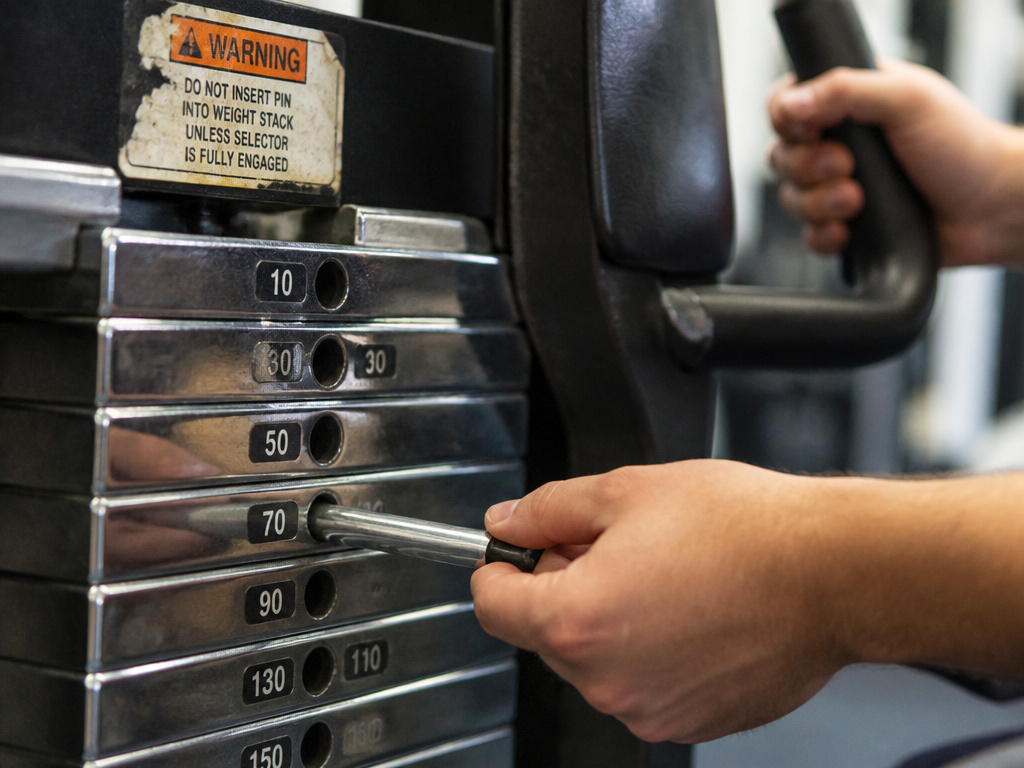
Someone finishes a set, walks away, and the next person grabs the handles without ever looking at the pin.
Spirit’s manual is unusually blunt about this stuff, and most of it applies to any selectorized machine you’ll meet:
- Pin fully inserted, manufacturer’s pin only. The manual says both, in the same line.
- Never pin the weights in an elevated position. If you find the unit in that condition, don’t use it.
- No dumbbells or non-manufacturer incremental weights. That rules out hanging a plate on the stack.
- Check belts, pulleys, and bungee cords regularly and replace anything showing wear.
- Keep the live area clear. It must be not less than 600 mm (23.62 in) greater than the training area on the access sides, including the emergency dismount zone.
- Secure long hair, and keep bystanders clear of users, moving parts, and attached accessories.
- Report malfunctions and damage to the facility, and replace any warning label that’s worn or illegible.
Facility staff are supposed to walk new users through this. If nobody ever did, a university exercise library entry such as the WSU UREC assisted pull-up exercise entry works as a second reference alongside the sticker on the unit.
One more: if you have a health condition, DynPerformance’s guidance is to consult a qualified professional before you start. That’s not boilerplate. A machine that unloads your body weight still loads your shoulders and low back.
Frequently Asked Questions
Does more weight on the stack make an assisted pull-up easier?
DynPerformance says yes: more assistance weight makes the exercise easier, and reducing the assistance weight will not make it easier. Spirit’s manual never states the direction explicitly. The pin number measures help, not load. If a rep suddenly feels harder, check whether the pin moved down a hole.
Should your knees or feet go on the platform?
It depends on the machine. Spirit’s CSD-CPSP manual specifies one knee on the pad, then the second knee. DynPerformance tells users to place knees or feet as the machine’s own instructions dictate. Read the sticker on the unit before you mount.
How much assistance should a beginner start with?
Rather than chase a number, use control as your gauge. If the platform surges, or your shoulders shrug up to reach the top, add assistance. If you finish your reps under control with a slow lower, you’re in the right spot.
Why does the platform kick up during my rep?
Because you pushed the knee pad down to start the pull, or lifted your knees away from the support as you rose. Both are listed as common mistakes. Keep your knees centered and let the platform travel with you.
Can you build real back strength on an assisted machine?
The latissimus dorsi is the primary muscle, with the biceps brachii, rhomboids, and middle trapezius assisting. You’re training the same pulling pattern you’ll use on a free bar, just at a lower share of your body weight. What the machine doesn’t train is balance, which is why single-leg and free-weight work still belongs in your week.
Is it safe to use alone?
For most people, yes, with the machine’s own rules followed: pin fully seated, manufacturer’s pin only, nothing pinned in an elevated position. DynPerformance advises consulting a qualified professional if you have a health condition, and Spirit’s manual tells users to seek floor staff assistance when unsure.
The Bottom Line
Here is the honest version: the setup takes less time than your first set, and almost nobody does it.
Your first step this week is to walk up to the assisted station, set the pin heavier than you think you need, and do controlled reps with a brief pause at the top. If the platform stays quiet and your chest reaches the handles, reduce the assistance next session. If it slams or your shoulders climb toward your ears, put the assistance back.
Everything above assumes a selectorized stack. On a counter-levered unit like the TGO TGO810 there is no pin and no number, just a fixed fraction of your body weight, so your only progression lever is rep quality and range of motion. Same movement, different dial.
I’d rather see a beginner own the assisted machine until the reps get boring than spend that time failing at a free-hanging bar. The machine teaches the pattern under control. The bar will still be there when you’re ready for it.
