
Active Recovery Workout Guide: How Long and How Hard
This post contains affiliate links. As an Amazon Associate, we earn from qualifying purchases.
An active recovery workout guide has to answer three questions: how long, how hard, and whether to move at all. Published recommendations run from 5 to 30 minutes. Intensity stays easy enough to hold a conversation, and if you’re injured, sick, or badly sleep-deprived, skip it.
That spread is the first thing the active recovery workout guide is worth understanding. The five-minute figure comes from cool-down advice. The ten-minute figure comes from performance studies. The thirty-minute figure comes from team-sport protocols that assume very low intensity. Same label, three different jobs.
What follows walks through the duration research, the intensity ceiling, the lactate claim that keeps getting repeated, a ten-minute session you can actually repeat, and the days when moving is the wrong call.
Key Takeaways
- Session length is unsettled, with published recommendations running from 5 to 30 minutes depending on the source and context.
- Keep effort under roughly 50 percent of maximum. NASM puts the ceiling at 30-60 percent of max heart rate and says the talk test is the simplest check.
- Skip it if you’re injured, sick, or badly sleep-deprived. The Cleveland Clinic names sleep, massage, and cryotherapy as the substitutes.
- The lactate-clearance explanation is shaky. Ortiz et al. 2019 called blood lactate clearance unreliable as a recovery marker, and Haller et al. 2022 called its physiological relevance doubtful.
- Haller et al. 2022 rates active recovery as weak evidence and says to apply it individually, even though team-sport athletes rate it as one of the most meaningful post-exercise interventions.
What Counts as an Active Recovery Workout?
The Cleveland Clinic’s Dr. Wichman keeps the definition wide. Any low-impact movement you do between sets, right after a workout, or on a rest day falls under the umbrella.
Active recovery is low-intensity movement performed after training or on non-training days. The category includes walking, cycling, swimming, yoga, Pilates, stretching, and foam rolling. The defining feature is intensity. Heart rate stays low enough that conversation continues without effort, and the session ends with the body feeling better than it started.
That breadth is useful. It means you rarely need special equipment, and it means the cheapest option is usually the right one.
What Counts and What Doesn’t
- Walking at a pace you could chat through. The default, and the easiest to repeat.
- Easy cycling, outdoors or on a stationary bike.
- Swimming, yoga, Pilates, and gentle stretching.
- Foam rolling, which NASM lists as a post-workout technique that can reduce the onset of delayed-onset muscle soreness.
A hard spin class doesn’t count. Neither does a heavy leg session you’d log as training. If you finish wrecked, you trained.
A foam roller and a pair of walking shoes cover almost everything on this page.
How Long Should an Active Recovery Session Last?
Six to ten minutes is the window Ortiz et al. 2019 identified in the performance research, though other sources recommend 5 minutes (Cleveland Clinic), 20 minutes (NASM), or up to 30 minutes at low intensity (Haller et al. 2022).
Ortiz and colleagues conducted a 2019 systematic review of active recovery interventions. Interventions lasting 6 to 10 minutes showed consistently positive performance effects. The same review judged blood lactate clearance rate unreliable as a recovery marker.
Haller and colleagues took a different angle in 2022. Their guidance for team settings: keep it low intensity and don’t exceed 30 minutes, because longer sessions can interfere with glycogen resynthesis and add muscle damage.
| Source | Session length | Context |
|---|---|---|
| Ortiz et al. 2019 review | 6-10 minutes | Best performance results |
| Haller et al. 2022 | Up to 30 minutes | Team setting, low intensity |
| UCSF cardiac rehab | 5-10 minutes | Cool-down, easy pace |
| NASM | 20 minutes | Steady pace, talk test |
| Cleveland Clinic | 5 minutes | Walking cool-down |
The UCSF muscle recovery road map puts the cool-down version at 5 to 10 minutes of walking on a treadmill or pedaling a stationary bike at an easy pace. NASM goes longer, recommending a 20-minute steady pace with ongoing conversation.
So the honest answer in any active recovery workout guide is that nobody has settled this.
Fuel is why longer sessions backfire. Fairchild and colleagues found that long-duration active recovery depletes glycogen in type 1 muscle fibers, the slow-twitch fibers recruited at low intensities. You’re burning the fuel you need for the next session.
Andersson and colleagues found that a full hour of active recovery in female players after a game had no significant effect on performance recovery or biochemical markers. An hour is not a bigger dose of active recovery.
Ten minutes is the safe middle. It sits inside every range above except the five-minute cool-down, and it’s short enough that you’ll actually do it on a Tuesday.
A ten-minute recovery walk feels like it does nothing. The difference shows up the next morning, when the stairs stop being a negotiation.
The Lactate Story Doesn’t Hold Up the Way You’d Expect
Search for active recovery and you’ll hit the same explanation within thirty seconds: it clears lactic acid.
Healthline says active recovery may help clear blood lactate, and that the drop in accumulation helps muscles feel less fatigued. Medical News Today makes a similar case, saying it quickly decreases lactic acid in the muscles and restores pH balance.
That’s the popular version. The peer-reviewed version is less tidy.
Ortiz et al. 2019 judged blood lactate clearance rate unreliable as a recovery marker. Haller et al. 2022 went further, calling the physiological relevance of lactate clearance as a rationale for active recovery doubtful. So the mechanism most people cite is the one the researchers trust least.
That doesn’t mean the walk is pointless.
What the Soreness Data Actually Shows
Dupuy and colleagues pooled the data in a 2018 meta-analysis and found a DOMS effect size of SMD = −0.94. They found no significant effect on perceived fatigue.
Feeling better and performing better are two different measurements.
Haller and colleagues were blunt about the gap in their peer-reviewed active recovery research: team-sport athletes rate active recovery as the most or one of the most meaningful post-exercise interventions, yet neither performance recovery nor injury prevention has been conclusively demonstrated.
For anyone chasing reducing muscle soreness rather than a faster race time, that’s still a reasonable trade. Just know which one you’re buying.
I still do it. Knowing the evidence is weak doesn’t change the fact that a ten-minute walk after a heavy session makes my next morning easier. What changed is that I stopped describing it as a performance tool.
How Hard Should Active Recovery Feel?
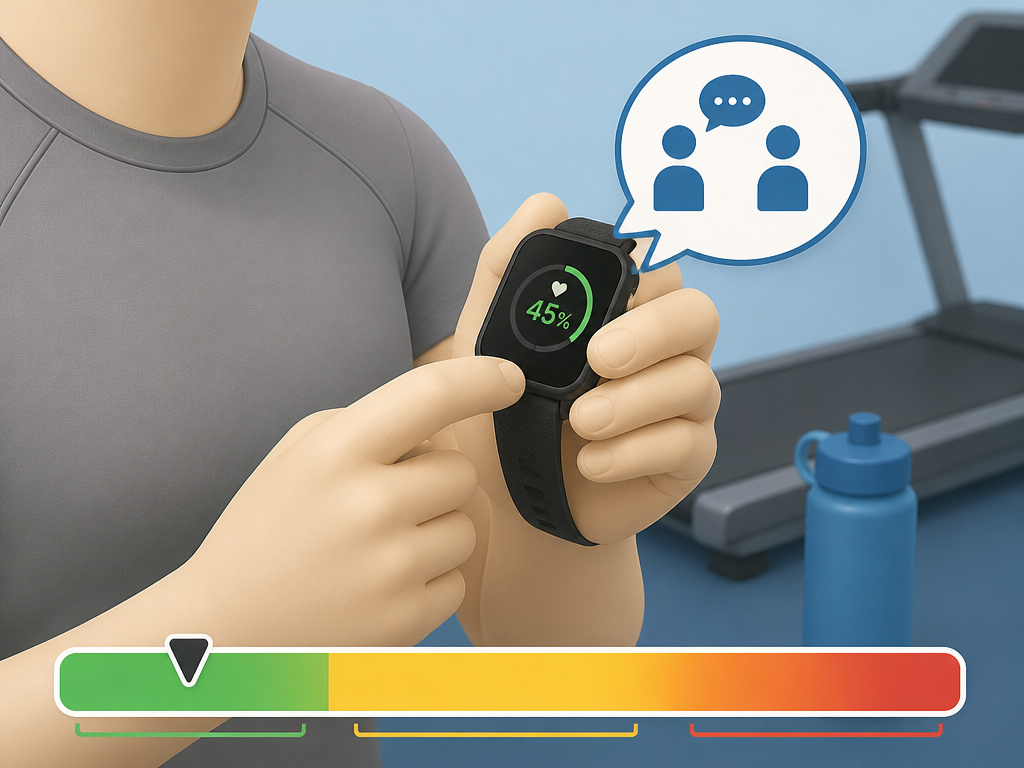
Ever finished a “recovery” session feeling worse than when you started? That’s the intensity ceiling getting crossed.
NASM says keep heart rate at 30 to 60 percent of maximum heart rate. Healthline says no more than about 50 percent of maximum effort. The American Council on Exercise found athletes recovered faster by continuing at 50 percent of maximum effort than by stopping completely, and a separate ACE finding put the figure at less than 50 percent between intervals.
A 2017 study reported benefits from 10 minutes of self-paced work at 50 to 60 percent of maximum effort. Sañudo and colleagues used 40 percent of maximum aerobic velocity in their treadmill protocol.
So the practical band sits between 40 and 60 percent, with most of the weight at or below 50.
| What you can do | Where that lands | Verdict |
|---|---|---|
| Hold a full conversation | 30-60% of max heart rate | Right zone |
| Talk in short sentences | Top of that band | Borderline |
| Sing without effort | Below the band | Fine, just easy |
| Can’t talk at all | Above the band | Training, not recovery |
NASM’s simplest version is the talk test. If you can hold a steady conversation while doing the activity, it’s probably the right intensity.
The NASM active recovery benefits guide also suggests asking one question before you start. After this, will I feel invigorated or exhausted? If the answer leans toward exhausted, it’s too intense for an off day.
Jogging splits the sources. NASM warns that a jog might be too intense to count as active recovery and could over-tax the system over time, while Healthline and the Cleveland Clinic both list jogging as a low-impact option.
If you can hear your own breathing over the treadmill belt, you’ve already left the zone.
Common mistake: Letting the effort creep up. The session starts easy, drifts into a moderate pace, and within two weeks your recovery days are training days with a different name.
The WB-EMS Experiment, Briefly
Sañudo and colleagues tested whether adding whole-body electromyostimulation to active recovery changed anything. Participants walked on a treadmill for 10 minutes at 40 percent of maximum aerobic velocity while wearing a miha bodytec suit.
The suit activates 10 regions at once, including the upper legs, gluteus, lower back, upper back including latissimus dorsi, abdomen, chest, and upper arms. Stimulation ran continuously at 7 Hz with an impulse breadth of 350 microseconds, and intensity was raised to each person’s pain threshold and adjusted every 2 minutes using ratings of perceived exertion (Borg CR10-Scale).
Peak blood velocity was substantially greater with WB-EMS than with active recovery alone, and pain and discomfort were lower. Blood lactate differences were not significant immediately, at 30 minutes, or at 60 minutes.
That’s a maybe, not a protocol.
A 10-Minute Active Recovery Session You Can Repeat
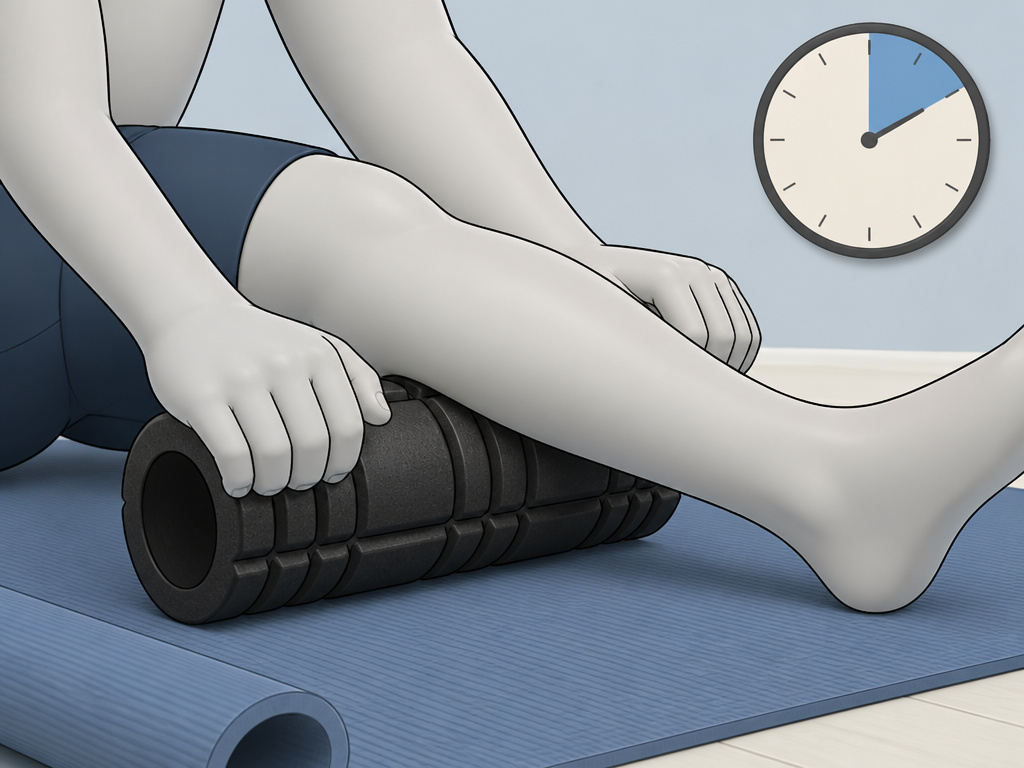
It’s the evening after leg day. Your quads ache, you’re tired, and the last thing you want is a workout.
You don’t need one. Ten minutes of easy movement is enough, and it’s short enough that you’ll actually start.
Before you start: Sharp pain means stop, not push through. Continuing through pain can increase how long recovery takes. If you’re injured, sick, or working on very little sleep, skip this session and take passive recovery instead.
The 10-Minute Session, Step by Step
- Minutes 0 to 2: walk slower than feels useful. Start too fast and the session turns into training by minute four, which defeats the point.
- Minutes 2 to 8: hold a conversational pace. If you can’t finish a sentence without gasping, back off. Ignoring that check is how easy days quietly become hard days.
- Minutes 8 to 10: add one mobility drill for whatever feels stiffest. Skip it and you carry the same restriction into the next session.
- Finish with 60 seconds of foam rolling on the tightest spot. Longer isn’t better here; the first slow pass over a sore area gives you the feedback you need.
That last one is where I notice the most. There’s a spot on my left calf that makes me hold my breath and clench my jaw before it lets go, every single time.
Learn how to stretch after a workout and you can swap the roller for a few static holds on days when rolling hurts too much.
When Active Recovery Is the Wrong Call
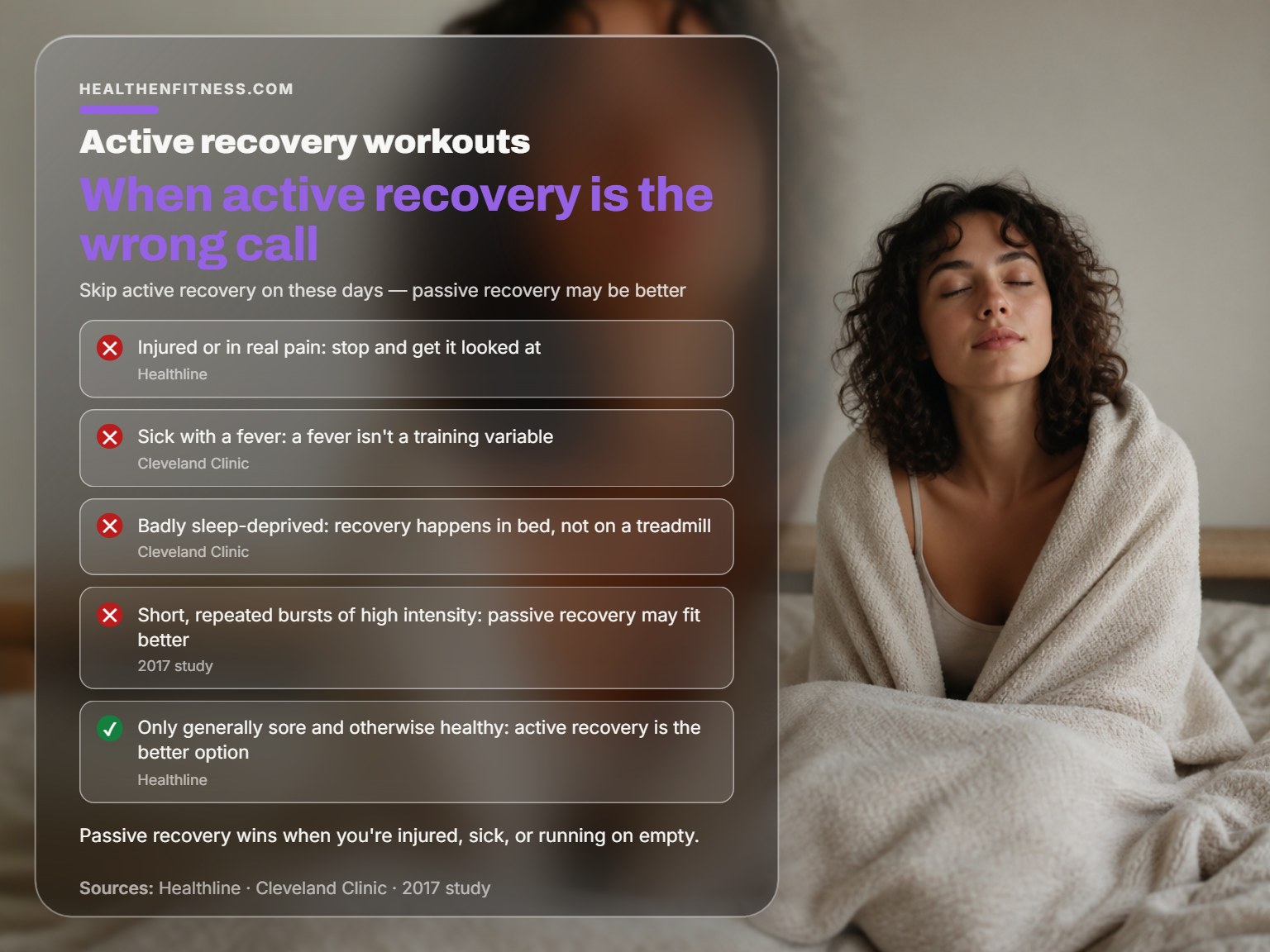
Some days, moving is the wrong answer.
I learned that one the hard way. In my first few months back in the gym, I trained six days a week and tried to add weight every single session. That layoff taught me to program recovery like any other session.
The Cleveland Clinic active recovery guide lists four situations where passive recovery wins: injured, sick, not getting enough sleep, or simply not feeling up to the activity. Sleep, massage, and cryotherapy are the substitutes.
Healthline goes further on pain. If you’re in pain and suspect an injury, avoid active recovery and stop exercising until you see a doctor. Medical News Today says the same about sports injuries, and adds that continuing through pain can lead to further injury and a longer recovery.
Healthline also notes that a doctor or physical therapist may recommend forms of active recovery, including stretches, swimming, or cycling, as you recover from an injury. So the line sits at self-prescription. A clinician can hand you a movement plan; you shouldn’t hand yourself one.
Skip this if: You’re running a fever, you’re limping, or you barely slept. Nothing on this page applies on those days, and a walk won’t fix any of them.
When to Switch to Passive Recovery
- Injured or in real pain. Stop and get it looked at.
- Sick. A fever isn’t a training variable.
- Badly sleep-deprived. Recovery happens in bed, not on a treadmill.
- Short, repeated bursts of high intensity. A 2017 study suggests passive recovery may be the better fit here.
Passive recovery wins when you’re injured, sick, or running on empty. Active recovery wins when the soreness is general and dull and you’re otherwise healthy. Healthline puts it plainly: if none of the passive-recovery conditions apply and you’re only generally sore, active recovery is the better option.
Sleep, Food, and Water Do More Than Any Recovery Walk
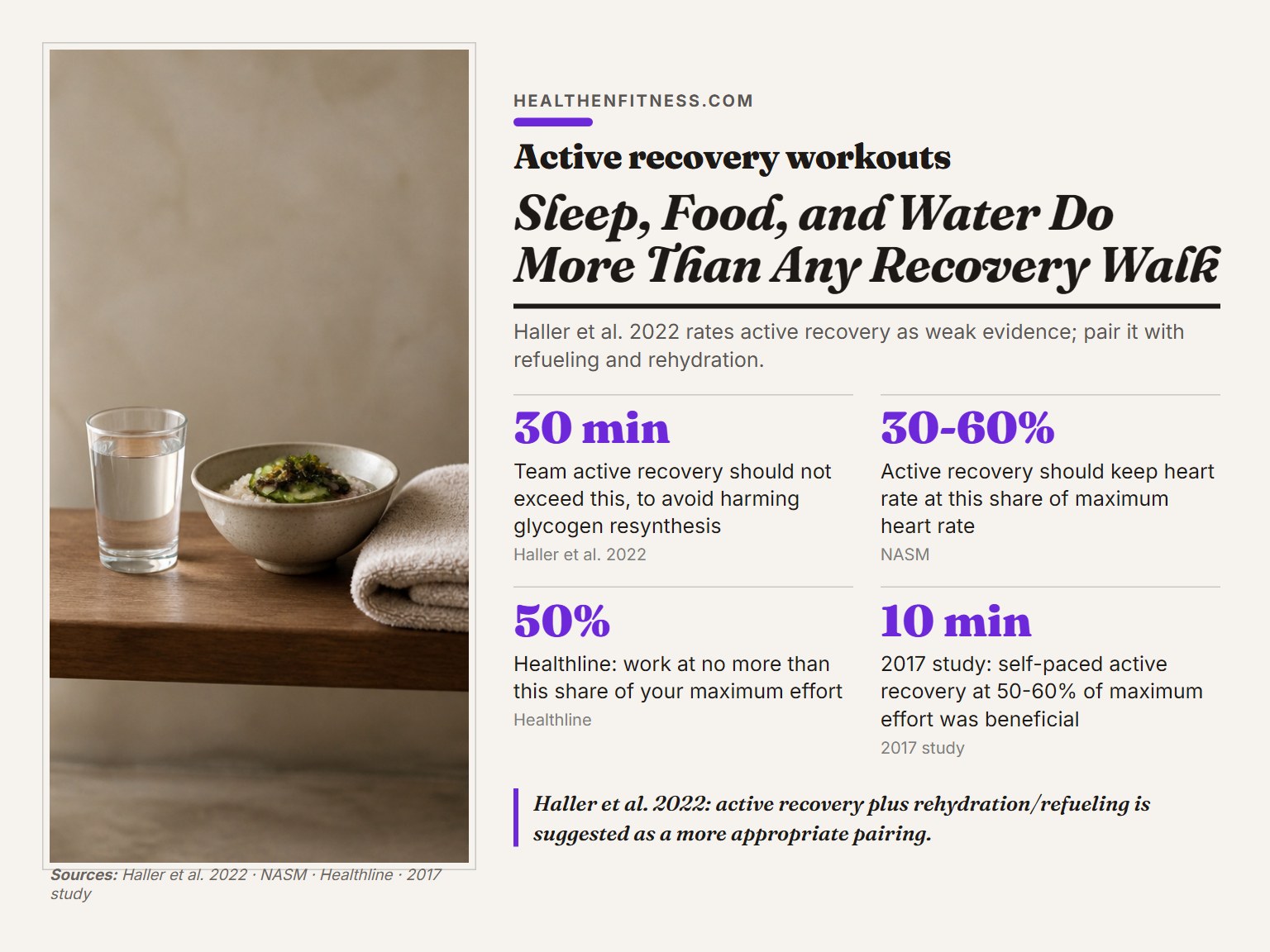
Three things beat any recovery workout: sleep, food, and fluid.
Haller and colleagues classified active recovery as weak evidence and recommended it be applied on an individual basis, and they suggest pairing active recovery with rehydration and refueling.
- Weak evidence: active recovery, psychological recovery, and stretching. Haller and colleagues say these should be applied on an individual basis.
The same paper suggests pairing active recovery with rehydration and refueling rather than running it alone.
Sleep deserves its own line. Haller and colleagues note that sleep is rated as moderate evidence among recovery strategies, with more needed after training or games.
Before you buy anything else, work out how to plan a recovery week so the easy days are actually on the calendar.
Where Active Recovery Fits in Your Week
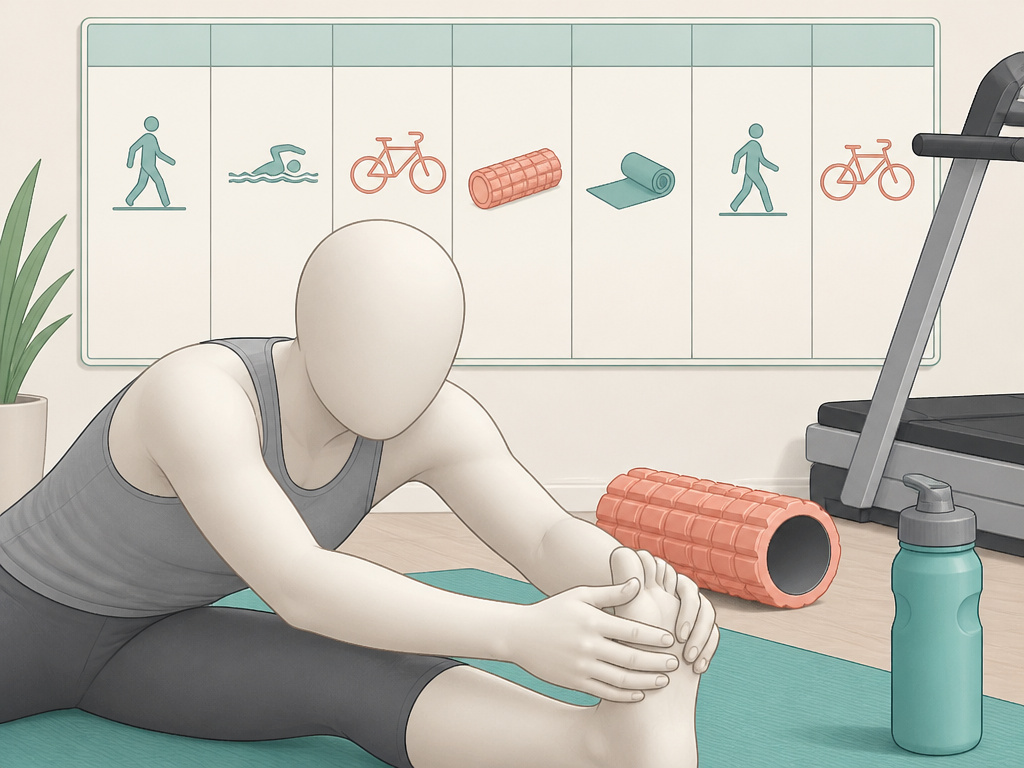
Placement matters more than the protocol.
As a cool-down, the guidance lines up almost everywhere. The Cleveland Clinic’s example is a five-minute walking cool-down on a treadmill. Healthline suggests a short, light jog or walk for 10 minutes after a run or sprint. Medical News Today says active recovery can be more beneficial than passive recovery when cooling down.
Between sets or intervals, the Cleveland Clinic suggests keeping moving in a less intense way, using walking, stretching, yoga, or foam rolling. Healthline and Medical News Today both agree that active recovery between interval sets is beneficial.
On rest days, the Cleveland Clinic recommends different activities that involve different kinds of movement. If you run, cycle or swim on your off day. Healthline says active recovery on rest days helps muscles recover, especially when you’re sore.
A rest day doesn’t have to be a full stop. Active recovery on rest days means swapping the run for a swim or the lift for a walk.
The post-workout recovery strategies that matter most are the boring ones: move a little, eat, drink, sleep. Everything else is a tiebreaker.
In short: cool down after hard sessions, move differently on rest days, and keep both easy enough to talk through.
Frequently Asked Questions
How long should an active recovery session be?
Most published recommendations land between 5 and 10 minutes. Ortiz et al. 2019 found 6 to 10 minutes produced the most consistent performance results, and the UCSF guidance for a cool-down is 5 to 10 minutes. Team protocols allow up to 30 minutes, but only at genuinely low intensity.
Is walking good enough for active recovery?
Yes. Walking is the most common example in the research, and it’s the one that needs nothing you don’t already own. NASM’s test is simple: if you can hold a steady conversation while you walk, the intensity is right.
Should I do active recovery on a rest day?
The Cleveland Clinic recommends different movement on rest days rather than complete inactivity, and Healthline says it helps most when you’re sore. Pick something that uses different muscles than your usual training.
Does active recovery actually work?
The evidence is mixed. Haller et al. 2022 classifies it as weak evidence and says to apply it individually. Ortiz et al. 2019 found weak evidence for performance specifically. A 2018 meta-analysis did find a large effect on delayed-onset muscle soreness, so the soreness benefit has more support than the performance claim.
Can I do active recovery if I’m sore?
If the soreness is general and dull, yes. If it’s sharp, or you suspect an injury, no. Healthline and Medical News Today both say to stop exercising and see a doctor when pain suggests an injury, since continuing can lengthen recovery.
What’s the difference between active and passive recovery?
Active recovery means moving at low intensity. Passive recovery means resting completely, and it includes sleep, massage, and cryotherapy. Passive recovery is the better choice when you’re injured, sick, or badly sleep-deprived. A 2017 study also suggests passive recovery may suit short, repeated bursts of high-intensity work.
The Bottom Line
If the soreness is sharp rather than dull, or it’s still hanging around after a few days, that’s a clinician conversation. A recovery walk won’t touch it, and pushing through can add weeks.
For everyone else, the plan is small. Ten minutes, conversational pace, most days. Haller and colleagues put it plainly: be transparent about what active recovery can do, and leave room for individual response. Some people feel better after it. Some don’t notice anything.
This is general-fitness advice, and I’ll be honest about where it runs thin. If you’re training for a competitive season, your sport coach and a physio own that plan, not a blog post.
Progress you can repeat is progress that lasts. A ten-minute walk you actually do four times a week beats a thirty-minute protocol you abandon by Thursday.
Today, just take a ten-minute walk at a pace where you can talk the whole way.
