
How to Plan a Recovery Week: What to Cut and When
This post contains affiliate links. As an Amazon Associate, we earn from qualifying purchases.
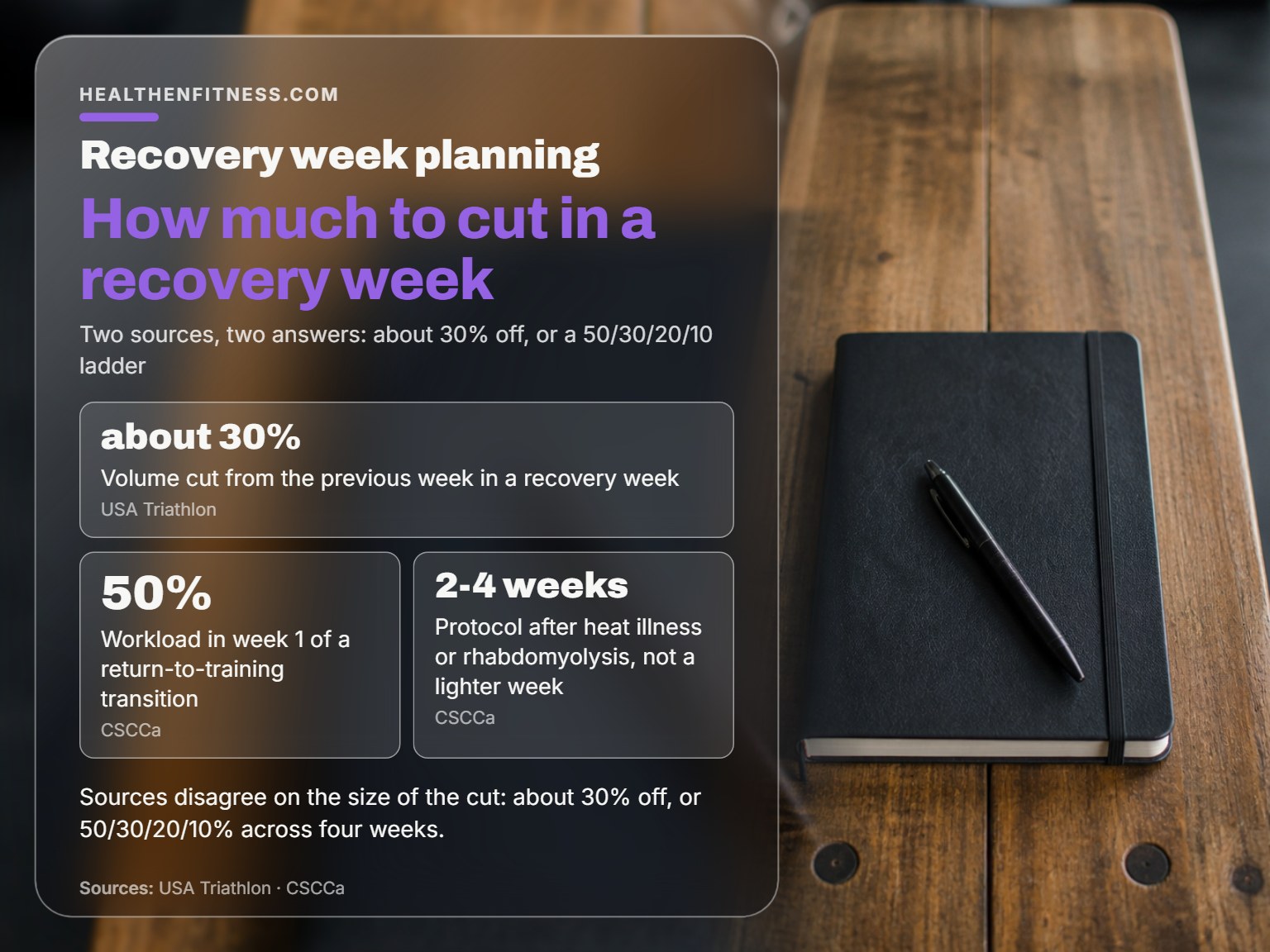
To plan a recovery week, cut training volume and keep at least two full rest days. USA Triathlon coach Dave Burgess puts the cut at roughly 30% from the previous week. The CSCCa/NSCA 2019 consensus guidelines address a different scenario, dropping workload to 50% in the first week of a return-to-training block.
Those two numbers answer different questions. Burgess is describing a planned dip inside a program you’re already running, which is the how to plan a recovery week question. The consensus guidelines are describing someone walking back in after time off, which is why their ladder keeps stepping down across four weeks.
What follows: both volume formulas side by side, the rest-day floor, what active recovery actually buys you, and the cases where a recovery week is the wrong tool entirely.
Key Takeaways
- About a 30% volume cut is the mid-program recovery week number from USA Triathlon, paired with one extra full rest day.
- The 50/30/20/10 ladder belongs to return-to-training, not to a planned easy week inside a program you’re already running.
- Two no-training days minimum. Burgess is explicit about adding a full rest day on top of whatever you normally take.
- Active recovery may help, but the dose is unresolved. The 2024 review of 24 studies says the exact volume, intensity, and timing aren’t established.
- Return from heat illness or rhabdomyolysis runs a separate 2-4 week protocol, not a normal recovery week.
What a Recovery Week Actually Changes
USA Triathlon’s coaching guidance is the cleanest starting point for how to plan a recovery week, because it names both levers at once: training volume and full rest days. Everything else in a recovery week is decoration on top of those two.
Recovery-week programming reduces conditioning volume while preserving movement patterns, with the CSCCa/NSCA 2019 consensus guidelines specifying workload reductions to 50, 30, 20, and 10 percent across four consecutive weeks of a return-to-training transition. Duration depends on the athlete: two weeks for returning athletes, four weeks for new athletes or a new strength coach.
Notice what neither source touches. The movements stay. The patterns stay. What shrinks is the amount of work stacked on top of them.
A workout week structure usually gets built around the hard sessions, with rest bolted on at the end. A recovery week flips that order for seven days.
The first warm-up set feels wrong. The bar comes off the rack lighter than your hands expect, and there’s a half-second where your body braces for a load that isn’t there. That half-second is the whole week in miniature.
I used to treat a recovery week as a week off. I’d come back flat and take longer to feel normal again than if I’d just kept moving. Now I keep the sessions and shrink them.
Volume is the dial both sources turn. Intensity, meaning how heavy or how hard each set is, isn’t part of either published formula.
How Much Should You Cut Back in a Recovery Week?
Two published answers disagree, and each one is correct inside its own scenario. Getting this wrong is the most common way a recovery week becomes either a wasted week or a second overreach.
| Guidance | Volume cut | Built for |
|---|---|---|
| USA Triathlon (Burgess) | About 30% off last week | A planned dip mid-program |
| CSCCa/NSCA 2019, week 1 | 50% of workload | Return after inactivity |
| CSCCa/NSCA 2019, weeks 2-4 | 30%, then 20%, then 10% | Same transition, stepping back up |
| After heat illness or rhabdo | Separate 2-4 week protocol | Not a normal recovery week |
Mid-Program Dip vs Return-to-Training
The USA Triathlon recovery weeks guide puts the cut at roughly 30% of the previous week’s volume, plus one additional full rest day. That’s a dip. You keep training, you keep the movements, and you come out the other side still in the habit.
The CSCCa/NSCA guidelines are managing a different risk. They flag rising incidence of exertional heat illness, exertional rhabdomyolysis, and cardiorespiratory failure in college athletes, concentrated during the shift from inactivity back into training. That’s why week one drops to 50% and the ladder keeps stepping down after it.
If your program already schedules a lighter block, that deload week is doing the same job as the mid-program version here. Same idea, different label.
For a planned dip inside a program you’re already running, USA Triathlon’s Burgess recommends the 30% figure plus the extra full rest day, while the CSCCa/NSCA guidelines prescribe the 50/30/20/10 ladder for return-to-training; borrowing that ladder for a normal training week will leave you undertrained for a month.
Two Full Rest Days, Not One
Two full no-training days is the floor, and it’s the part most plans quietly drop. Burgess is specific about it: one additional full rest day on top of your usual, which lands you at a minimum of two.
What actually counts as one:
- No structured training at all. Not a lighter version of the session you had planned.
- A short, genuinely easy walk sits in the active recovery bucket rather than the rest bucket. Fine to do, just don’t count it twice.
- Sleep and food are part of the day, not separate tasks you get to skip because you’re “resting.”
- Anything that leaves you sore the next morning wasn’t rest. It was training with a friendlier name.
If you’re unsure how many you normally take, work backwards from rest days per week before you plan the lighter week. You can’t add a day to a number you never counted.
I’ve caught myself calling a gentle spin a rest day more than once. It wasn’t. It was a workout I didn’t log.
Common mistake: Filling both rest days with mobility classes, walks, and stretching. Those are rest day activities worth doing, but they’re active recovery. The two full days are the ones where nothing is scheduled.
Does Active Recovery Beat Doing Nothing?
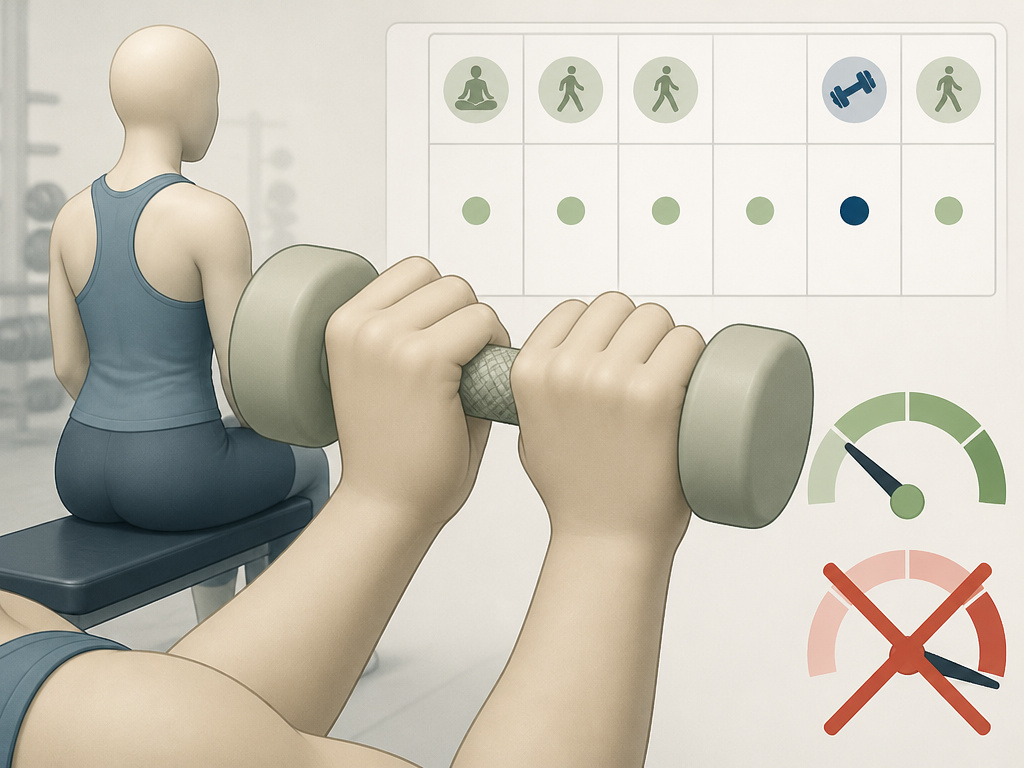
Honestly? The literature won’t give you a clean answer, and anyone who says otherwise is overselling.
A 2024 narrative review of 24 studies in the Journal of Human Kinetics holds two positions at once. It reports that active recovery, meaning opposing muscle groups, light aerobic work, and low-volume power work, may enhance recovery compared with passive recovery, and may prime performance through post-activation potentiation. In the same paper, the authors concede that training cessation may be adequate for allowing sufficient recovery before sessions that matter.
The recovery in resistance training microcycles review is also upfront that the exact volume, intensity, frequency, and time window of active recovery are not well understood.
The Gatorade Sports Science Institute lands in a similar place from the applied side. Its recovery toolkit frames modality selection as athlete-centered and demand-driven within each microcycle, and declines to endorse a single method.
I’d rather see a client take a boring week at 30% and keep showing up than a heroic one that leads to missed sessions. The boring week is the one that survives contact with a real life.
Where Active Recovery Wins and Where It Doesn’t
The same review is specific about which training demands longer recovery: lower-body, multi-joint, high-muscle-recruitment, eccentric, and lengthened-position work. That’s a mechanical list, not a vibe.
A muscle lengthening under load produces the same force with fewer active fibers, so each working fiber carries more tension and takes more damage. That’s why a week of heavy squats and Romanian deadlifts needs more room than a week of curls.
So my rule: after a lower-body eccentric block, lean toward the lighter end of whatever active recovery you’d normally do. After upper-body work, a short easy session is a reasonable use of the day.
How to Plan a Recovery Week: Five Steps, In Order
A client once told me his schedule was tight, and I wrote him a plan anyway. He quit before long. Now I ask how many days someone can actually train before I write anything, and a recovery week is no different.
Before you start: If you’re coming back from heat illness, rhabdomyolysis, or a hospital stay, stop here and get cleared by a clinician first. Those cases run a 2-4 week protocol, not a lighter week. And if a session brings chest pain, dizziness, or confusion, end it and get medical help rather than adjusting the plan.
- Pick the week before you need it. Waiting until you’re wrecked means you’ll cut too deep and lose the habit, which is exactly what happened to my client.
- Set the volume number first. About 30% off for a mid-program dip. The 50/30/20/10 ladder if you’re returning from time off. Skipping this step turns the week into guesswork.
- Block the two full rest days on the calendar. Not “if I feel like it.” Unbooked rest days get eaten by errands.
- Keep the movements, cut the sets. Same lifts, fewer of them. Change the exercise selection and you’ll be sore from novelty instead of rested.
- Write down next week’s volume before the week starts. Without an exit number, a light week quietly becomes three light weeks.
Then check the signals mid-week. Sleep, mood, and motivation tell you more than soreness does, because soreness lags and mood moves first. If your sleep quality for recovery has been poor for a stretch, that’s a bigger lever than anything you do in the gym.
| What you notice | What it usually means | What to change |
|---|---|---|
| Sore long after an easy session | Volume was never the problem | Check food and sleep first |
| Flat mood, no appetite for training | Life stress, not training stress | Cut the week harder, not shorter |
| Legs heavy on stairs, sleep fine | Normal mid-week dip | Nothing. Keep going |
| Sharp joint pain, not muscle ache | Not a recovery issue | Stop and get it looked at |
By the middle of the week your legs should feel dull rather than dead: heavy on the stairs, but not sore to touch.
If you’ve been flat for weeks rather than days, that’s a training slump rather than a recovery week problem, and it needs a different fix.
When a Recovery Week Is the Wrong Tool
Sometimes the honest answer is that a lighter week won’t fix it, and planning one anyway just delays the real conversation.
Return From Heat Illness or Rhabdomyolysis
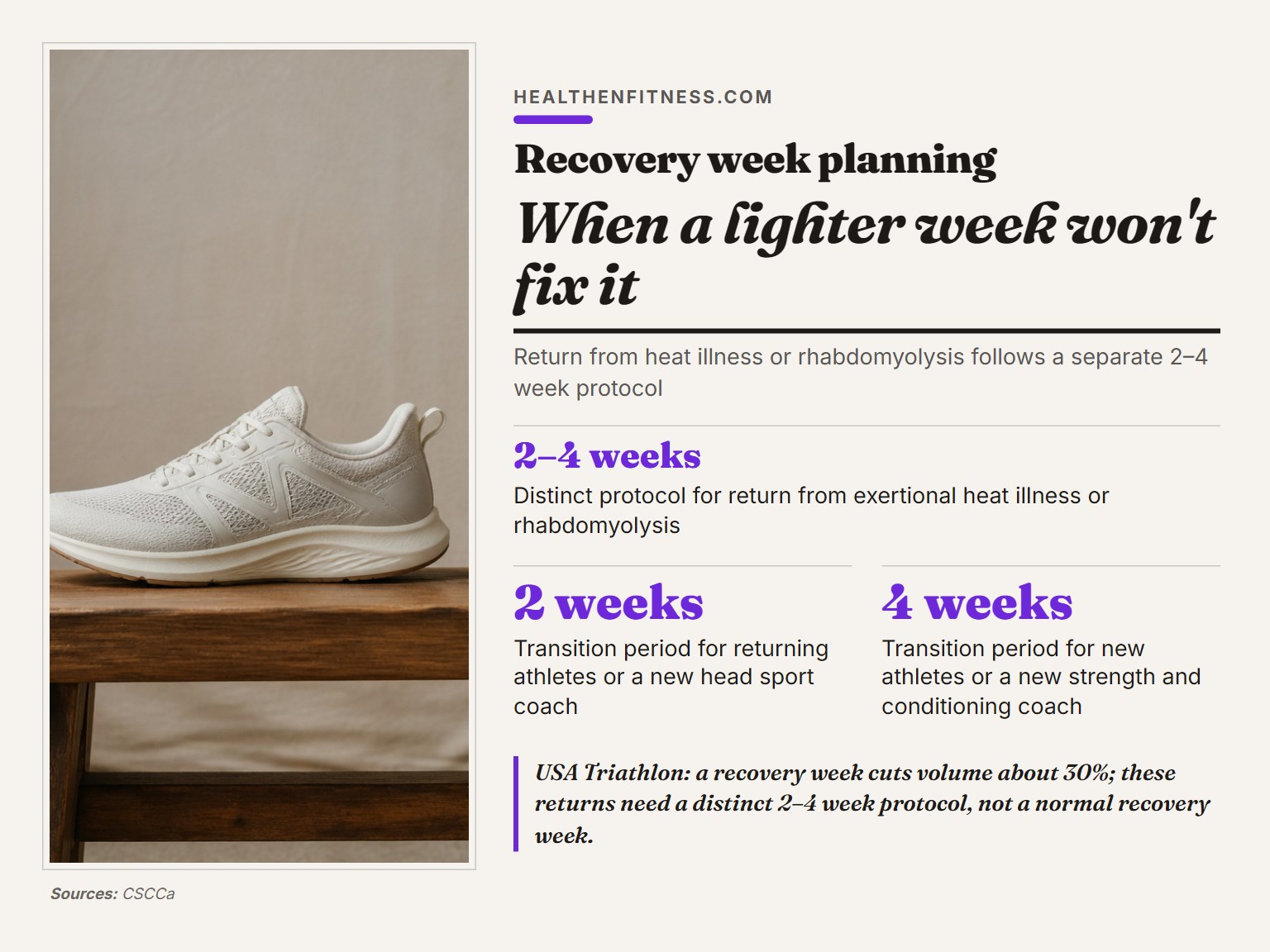
The CSCCa/NSCA guidelines treat return from exertional heat illness or exertional rhabdomyolysis as a distinct 2-4 week protocol rather than a normal recovery week. That’s a medical pathway, not a programming choice.
Where this goes sideways: Applying the 30% recovery-week formula after a heat illness episode. The guidelines put that return on a separate 2-4 week protocol, and treating it as a lighter week skips the part that keeps it from recurring.
New Athletes and New Coaches
The transition period runs two weeks for returning athletes or a new head sport coach, and four weeks for new athletes or a new strength and conditioning coach. That second variable is about personnel, not physiology. A new coach needs longer to learn what an athlete tolerates, so the ramp gets stretched.
Individual response variation is the other reason fixed protocols fail. The 2024 review states plainly that any recovery application has to be individualized and monitored, and it warns that controlled-laboratory findings need careful consideration before you apply them in the real world.
This is where I part company with the gadget-first approach. A wearable sleep tracker is genuinely useful for spotting a sleep trend across a month. Using a single morning readiness number to decide whether to train is where beginners get into trouble, because one bad reading is noise. A wearable logging your resting heart rate over weeks is more honest than any single score.
Life stress counts as training load whether or not it shows up in your log. If work has been brutal, balancing stress and training load matters more than the exact percentage you cut.
Frequently Asked Questions
How long should a recovery week last?
For a planned dip inside a program, one week is the unit Burgess describes. The CSCCa/NSCA guidelines use a longer frame because they’re covering return from inactivity: two weeks for returning athletes, four weeks for new athletes or a new strength coach.
Should I stop lifting entirely during a recovery week?
Not necessarily. The 2024 review notes that training cessation may be adequate before sessions that matter, and also that active recovery may enhance recovery compared with passive rest. The authors are clear that the ideal dose isn’t established, so pick one and watch how you respond.
What counts as active recovery?
The review lists opposing muscle groups, light aerobic cardio, and low-volume power work. Practically, that’s an easy walk, a short spin, or some light work on the muscles you didn’t just hammer.
What if I feel fine and don’t want to cut back?
Feeling fine mid-block is normal, and it’s not a reason to skip the week. Soreness lags behind fatigue, and mood tends to move before either one. Plan the week on the calendar, not on how you feel on the morning you’d rather train.
Is a recovery week the same as a deload?
They overlap. A deload is the term most lifting programs use for a scheduled lighter block. The recovery week numbers above come from two different contexts, so match the number to your situation rather than the label.
The Bottom Line
Here’s the threshold I’d give anyone: if you’ve had a flat, unmotivated stretch and your sleep has slipped alongside it, that’s your recovery week, not a reason to add sessions. Adding work when progress stalls is the mistake I see most, and it usually makes the stall longer.
The exception is the medical one. Return from heat illness or rhabdomyolysis follows a 2-4 week protocol, and no amount of careful percentage math replaces a clinician’s sign-off.
Everything else is simple enough to be boring. Cut volume, keep the movements, book two full rest days, and write down what next week looks like before this one starts.
Today, just open last week’s log and count how many hard sessions you actually did. That’s the number you’re cutting from.
