
Intermittent Fasting for Lifters Pros and Cons: What Works
This post contains affiliate links. As an Amazon Associate, we earn from qualifying purchases.
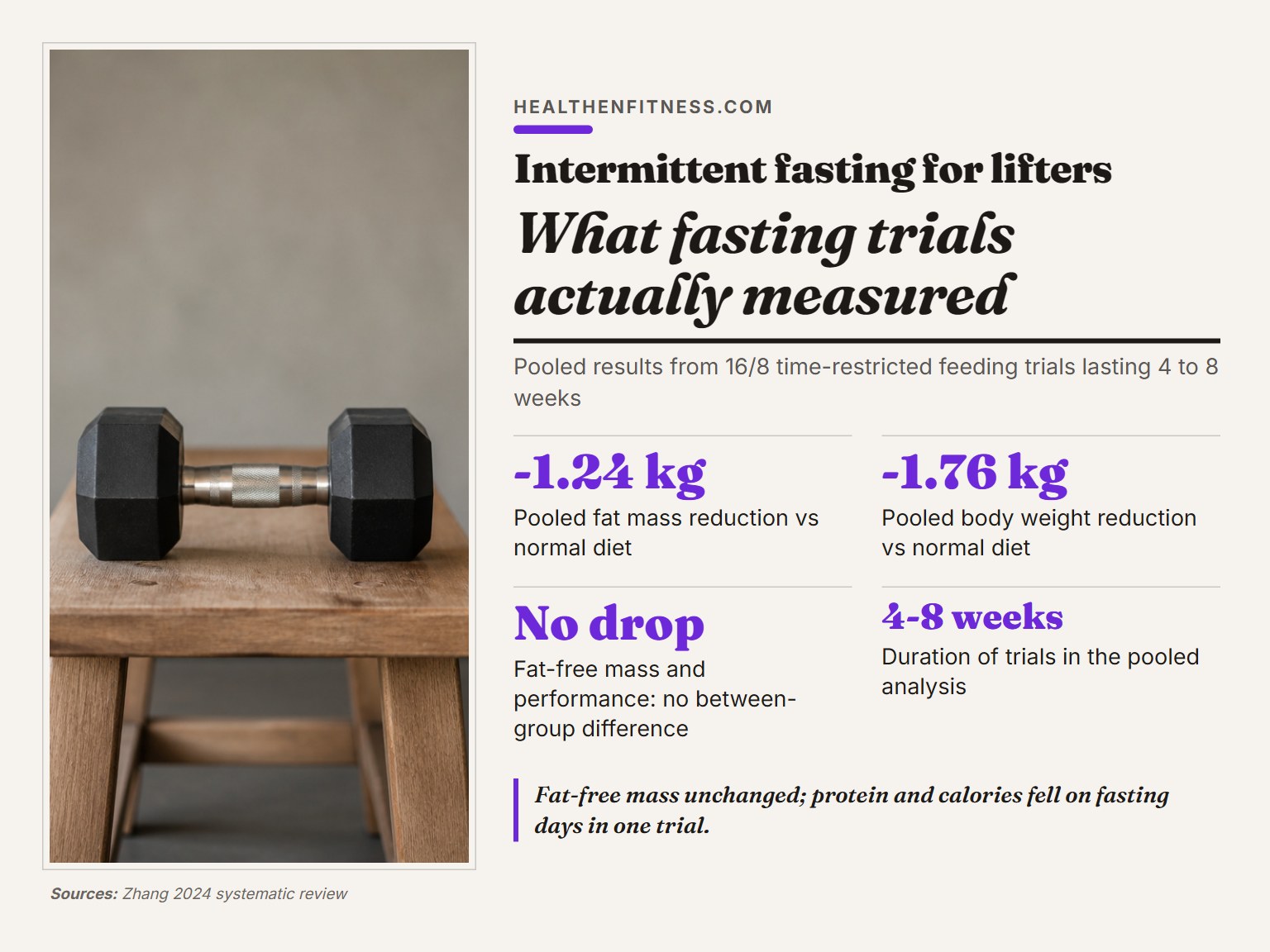
Intermittent fasting for lifters pros and cons are really two questions: does it take fat off, and does it cost you strength? Pooled trial data says about 1.76 kg less body weight and 1.24 kg less fat mass than a normal diet, with strength and lean mass holding steady.
Holding steady is the part worth pausing on. The trials that checked it measured body composition and strength directly rather than relying on bathroom scales, and the intermittent fasting for lifters pros and cons question was tested most often with 8 hours of eating against 16 hours of fasting.
What follows: the pooled numbers, the window lengths that were actually studied, the protein problem on fasting days, and the groups the research barely touches.
Key Takeaways
- Expect about 1.76 kg of weight loss over a normal diet in pooled trial data, which is modest and real.
- Fat mass fell about 1.24 kg in the meta-analysis, though one trial found no fat-loss effect at all.
- Strength held steady in the trials that measured it, with no between-group drop in performance.
- Protein slips on fasting days. Lifters in one trial ate less protein when their window was short.
- Most trials ran 4 to 8 weeks in lean, young men. Year two is untested.
What the Pooled Trials Actually Show About Fat and Strength
The 2024 meta-analysis pooled 15 randomised controlled trials of time-restricted feeding against a normal diet, all in healthy adults who already exercised.
Time-restricted feeding limits all daily calories to a consistent 6- to 12-hour window and fasts the remaining hours, with no calorie counting required inside the eating window. Of the 15 trials pooled, 12 used an 8-hour window with 16 hours of fasting. Seven let participants eat freely within the window; seven matched calories to the control diet.
The headline numbers are small. Body weight fell by a mean difference of 1.76 kg (95% CI -3.40 to -0.13; p=0.03), and fat mass fell by 1.24 kg (95% CI -1.87 to -0.61; p<0.001).
Neither of those is a transformation. Both are the kind of change that shows up across two months and then flattens out.
Fat-free mass showed no between-group difference, and neither did performance. For anyone who cares about keeping muscle, that result carries more weight than the scale number does.
The authors were upfront about study quality. Of the 15 trials, 1 was rated low risk of bias, 13 had some concerns, and 1 was high risk.
A separate systematic review of intermittent fasting and resistance training looked at 8 studies and found lean body mass generally maintained, with one study reporting a significant increase.
One counterpoint belongs here. A trial that restricted eating to a 4-hour window on 4 non-training days per week found no group-by-time interaction for fat mass at all. The pooled 1.24 kg and that null result describe the same intervention from different angles.
Which Fasting Window Did the Studies Actually Test?
The 16/8 protocol dominates the literature: 12 of the 15 pooled trials used an 8-hour eating window against a 16-hour fast.
| Eating window | Fasting hours | Trials |
|---|---|---|
| 8 hours | 16 hours | 12 |
| 10 hours | 14 hours | 1 |
| 4 hours | 20 hours | 1 |
| 2 hours | 22 hours | 1 |
The spread is wider than the headline suggests. One trial pushed participants into a 2-hour window, which sits closer to one meal a day than to anything a lifter would keep up for a month.
Why 16/8 Dominates the Literature
Zhang and colleagues focused their pooled analysis on the 16/8 strategy held for 4 to 8 weeks. So the numbers above describe that protocol, not every version of fasting people actually run.
Hospital guidance lands in a similar place. Mass General Brigham puts time-restricted eating at 8 to 10 hours a day, and calls a 12 to 14 hour fast a pretty safe bet for most people.
Whether you eat at 8am or noon matters less than the total window. That’s why skipping breakfast isn’t automatically a problem, and why a 10-hour window is a sensible first move.
A PubMed systematic review on time-restricted feeding covers anthropometric, metabolic, and fitness outcomes across a broader set of protocols if you want the wider picture.
Does Fasting Cost You Strength?
Strength held. That’s the finding across the trials that tested it, and it’s the one most lifters actually care about.
The 2024 meta-analysis found no between-group difference in performance, and subgroup analysis reached the same conclusion whether the intervention ran under 8 weeks or 8 weeks and longer, with aerobic capacity and power output not reduced; however, one trial found higher leg press 1-RM and bench press endurance in the fasting group.
The eight-week 16/8 time-restricted feeding trial in resistance-trained males found 1-rep-max strength and muscle area maintained while fat mass dropped.
Individual trials get messier, though.
Where the Performance Data Disagrees
In one study of 18 untrained men, there were no group-by-time interactions for strength, yet the fasting group showed a higher leg press 1-RM (p=0.011) and better bench press endurance (p=0.013) than training alone.
So the sources point in different directions. The meta-analysis reports no performance difference; that single trial reports the fasting group slightly ahead on two measures. Neither result is large enough to plan your year around.
Moro’s trial adds another wrinkle. Testosterone and IGF-1 fell significantly, with no corresponding loss of muscle or strength across the 8 weeks. The 2024 narrative review doesn’t treat hormonal suppression as a concern at all, while Moro’s trial found testosterone and IGF-1 fell significantly but with no deleterious body composition or strength changes. Two readings of the same evidence base.
The tell shows up in the last set either way: a bar that moved fast at rep three grinds to a stop at rep seven, and your hands leave chalk prints on the knurling.
I’d rather see a lifter eat three solid meals inside an 8-hour window than white-knuckle a 4-hour one and come up short on protein. The window is the easy part. The food inside it is the work.
None of this settles the carbs for lifting question, which affects session quality more than the length of your window does. And pooled averages hide individual trials, including a Nutrients study on time-restricted eating and resistance training high-speed strength that’s worth reading in full rather than in a summary.
The Protein Problem on Fasting Days
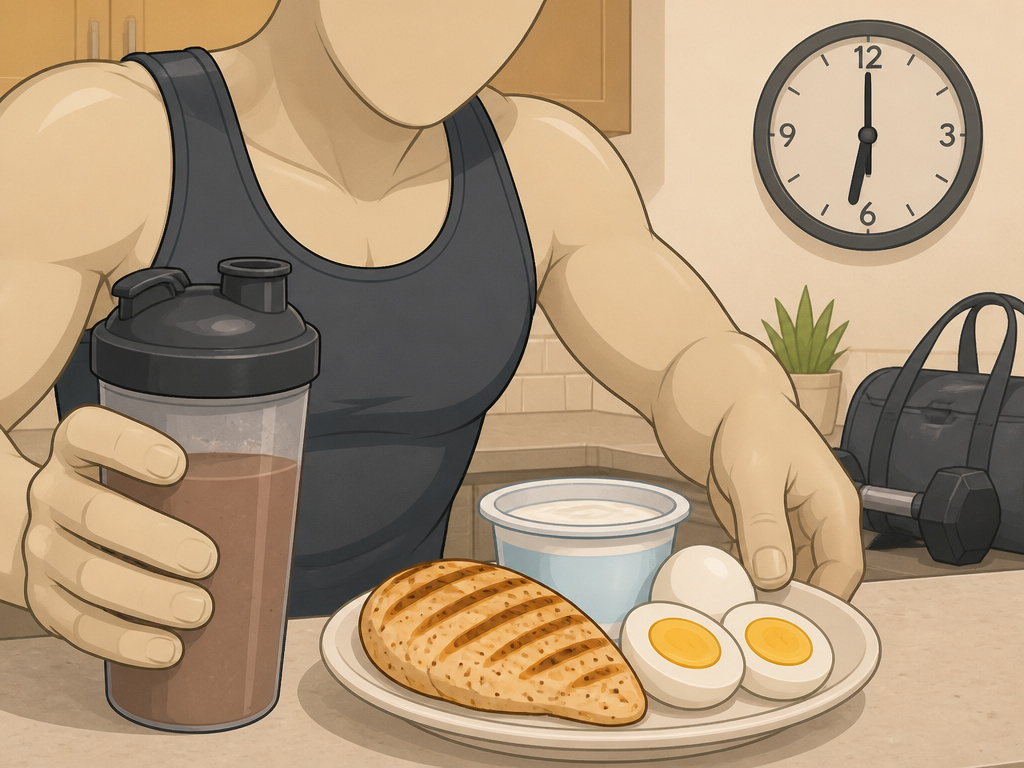
A lifter finishes a session at 6pm, has two hours of eating window left, and needs a serious protein hit before it shuts. That’s the moment most fasting plans fall apart.
In the 18-man trial, the fasting group ate fewer calories (p=0.008), less protein (p=0.017), less carbohydrate (p=0.007), and less fat (p=0.050) on fasting days than on non-fasting days.
The percentage of calories from each macronutrient didn’t change. They simply ate less overall on those days, and the authors flagged protein intake as a particular concern for anyone starting a lifting program.
Moro’s trial found something different. Calories were not restricted in the fasting group, and muscle mass was maintained across 8 weeks.
That’s the disagreement in plain terms. In the 18-man trial, a short window with no planning cut intake and protein; in Moro’s trial, calories were not restricted and muscle mass was maintained.
Where this goes sideways: Cramming a whole day of protein into the last 90 minutes of the window. You end up with one enormous meal you won’t repeat tomorrow, and by day four you’re back to eating whenever.
Protein timing matters here too, because spreading intake across the window beats one lump at the end.
Who the Research Barely Covers
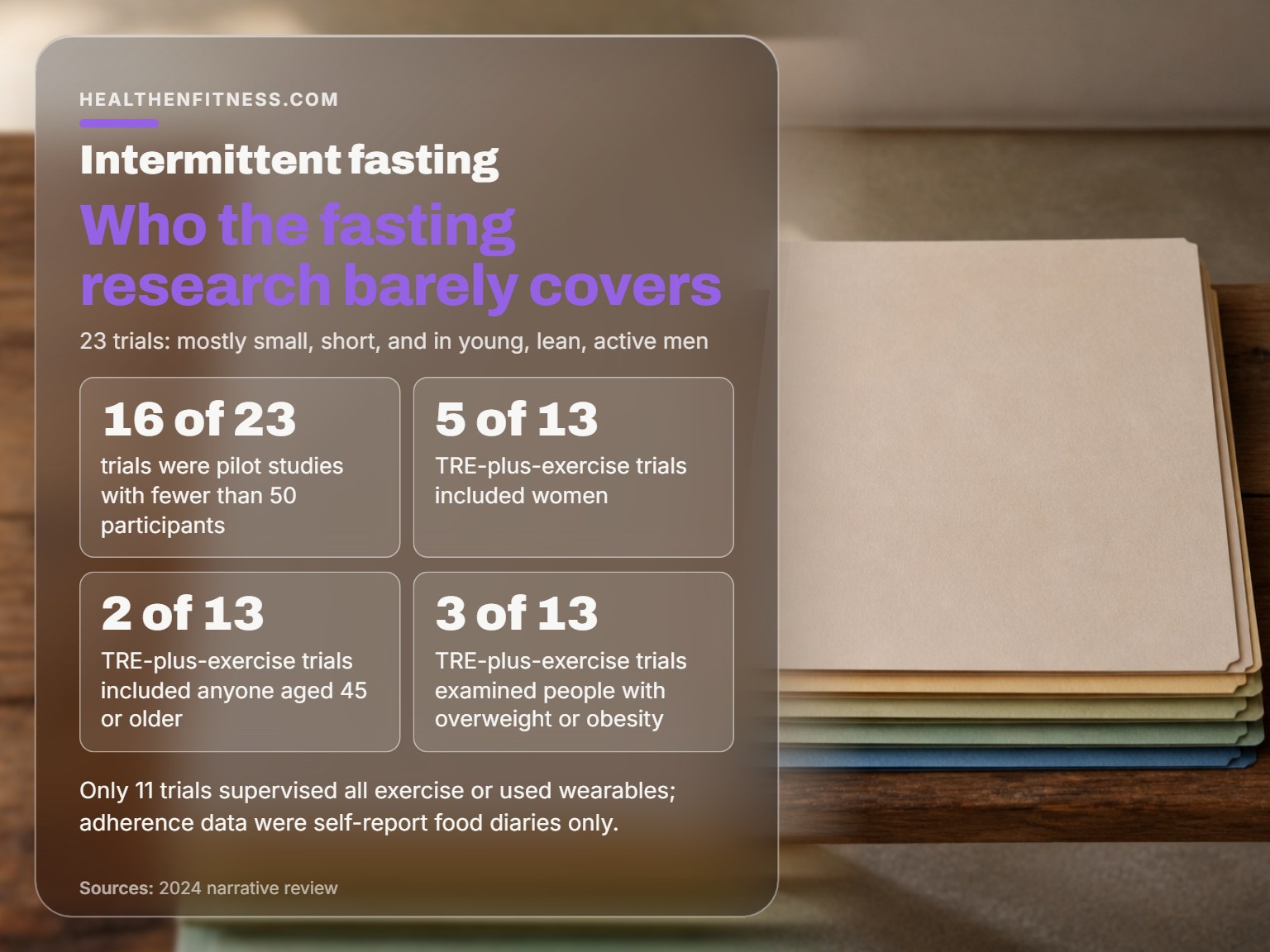
Sixteen of the 23 trials in a 2024 narrative review were pilot studies with fewer than 50 participants randomised into 2 to 4 groups.
That review is the best map of the gaps:
- Duration: 18 trials ran 4 to 12 weeks, 2 ran 16 weeks, and 3 ran 52 weeks.
- Sex: only 5 of 13 time-restricted eating plus exercise trials included women.
- Age: only 2 of 13 included anyone aged 45 or older.
- Baseline health: participants were metabolically healthy at the start, with hypertension, dyslipidemia, and pre-diabetes excluded.
- Adherence data: self-report food diaries only, and just 11 trials supervised all exercise or used wearables.
Many of the time-restricted eating trials were in lean, young, male athletes, though only 5 of 13 included women and only 2 included those aged 45 or older. If you’re 48, carrying extra weight, or coming back after years off, the data is thin on you: only 3 of 13 TRE-plus-exercise trials examined individuals with overweight or obesity and only 2 included people not already physically active.
The long-term question is open too. The pooled trials ran 4 to 8 weeks and none exceeded 8, while the narrative review points to 3 trials at 52 weeks and a one-year follow-up after an 8-week TRE plus resistance training program that showed cardiometabolic improvements. Nobody has tracked lean mass retention past a year.
Mass General Brigham is blunt about who should avoid intermittent fasting: anyone under 18, anyone pregnant or breastfeeding, and anyone with a history of disordered eating.
They also recommend talking to a doctor first if you take medication, have health problems, or are considering more extreme fasting plans. That advice matters most if you’re managing a condition, because a shifted meal schedule can change how a drug lands.
How Do You Set a Fasting Window That Fits Lifting?
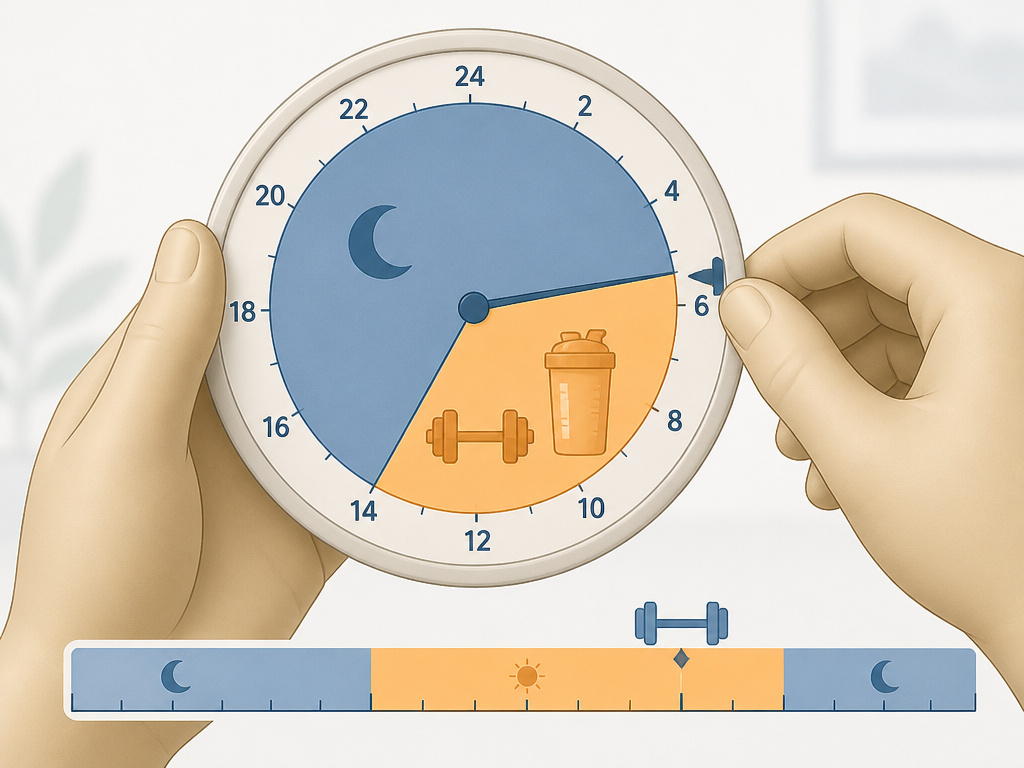
Three things decide whether a window works: where you put it, how much protein you protect, and whether you train inside it.
Before you start: A long fast plus a heavy session can leave you lightheaded mid-set, so keep the first two weeks lighter than your usual effort. If you take medication for blood pressure or blood sugar, get a doctor’s sign-off before you move a meal. Anyone with a history of disordered eating should not run a fasting window at all.
The Five-Step Setup
- Pick the widest window you’ll actually keep. Start at 10 hours of eating, not 8. A window you abandon in week two gives you nothing, and the trials that produced results ran 4 to 8 weeks.
- Anchor protein first, then fill in around it. Skipping this step is how the fasting groups in the research ended up eating less protein than the control groups.
- Train inside the window when you can. If you train before it opens, you’re doing training in a fasted state, which is fine but changes what you need afterwards.
- Hold the window at the same time daily. Consistency is what separates time-restricted eating from random meal skipping, and it’s what the trials actually tested.
- Plan a break before you need one. Diet breaks and refeeds are how you avoid the crash that convinces you the whole thing failed.
Where you put the window is really a meal timing question. A 12pm to 8pm window puts your largest meal after training, which suits most evening lifters.
I now schedule a lighter week before my body forces one on me, and I judge a new eating pattern on that same three-week clock.
If you can’t hit your protein target inside the window three days out of four, the window is too short. Widen it before you buy a supplement.
Common mistake: Starting a strict window and a hard training block in the same week. You’ll blame the fasting when it’s the total load, and you’ll quit both by Friday.
Intermittent Fasting for Lifters Pros and Cons, Side by Side
The pros and cons line up once you separate what was measured from what gets claimed.
| Claim | What the trials show | Who it held for |
|---|---|---|
| It burns fat | Fat mass down 1.24 kg pooled | Lean, trained men mostly |
| It costs strength | No between-group performance drop | Trials lasting 4 to 8 weeks |
| It wastes muscle | Fat-free mass unchanged | Resistance trainers |
| It fixes your diet | Protein and calories fell on fasting days | Untrained men, 4-hour window |
| It works long term | Nothing beyond 8 weeks in pooled data | Untested |
The pattern is clear enough. Time-restricted feeding is a tool for eating less without counting, and it works about as well as any other method that gets you to eat less.
If you’d rather count than clock-watch, flexible dieting gets you the same deficit with more food freedom and the same requirement to hit your protein.
Three things worth skipping:
- Skip the 4-hour window if you lift four days a week. That’s the version that did not elicit body composition improvements in 8 weeks, though lean mass was maintained.
- Skip judging it at week one. Hunger settles, and the trials ran 4 to 8 weeks for a reason.
- Skip fasting entirely if you’re under 18, pregnant, breastfeeding, or have a history of disordered eating.
Frequently Asked Questions
Does intermittent fasting make you lose muscle?
The trials say no, as long as you keep training and keep protein up. Fat-free mass showed no between-group difference in the 2024 meta-analysis, and lean body mass was generally maintained across the 8 studies in the resistance-training review. The risk sits in the protein shortfall in trials where intake dropped, though Moro’s trial found calories were not restricted and muscle mass was maintained.
Is 16:8 the best window for lifters?
It’s the most studied, not necessarily the best. Twelve of the 15 pooled trials used an 8-hour eating window with a 16-hour fast, so that’s where the evidence is thickest. Mass General Brigham puts time-restricted eating at 8 to 10 hours a day, which is a gentler starting point.
Can you build muscle on a fasting schedule?
The evidence points to maintaining muscle rather than adding much. One study in the resistance-training review reported a significant increase in lean body mass, but lean body mass was generally maintained. Building muscle generally requires adequate calories, and a shorter window makes that harder to hit.
What should you break a fast with after training?
Something with protein first, then carbohydrate. The trials that preserved muscle had lifters eating adequate protein overall, and the trial with the 4-hour window had men consuming fewer calories and less protein on fasting days. Plan the first meal rather than improvising it.
Is intermittent fasting safe if you’re new to lifting?
For most people, a 12 to 14 hour fast is considered a pretty safe bet, per Mass General Brigham. Anyone under 18, pregnant or breastfeeding, or with a history of disordered eating should avoid it, and anyone on medication should check with a doctor first.
The Bottom Line
One threshold decides most of this for you. If fitting your usual protein intake into the window takes real effort, the window is too short, and discipline won’t fix a plan that doesn’t fit your food.
The trials are honest about their own limits: 4 to 8 weeks, mostly lean young men, self-reported food intake, and 13 of 15 studies carrying some risk-of-bias concerns (1 low, 13 some concerns, 1 high). Treat that 1.76 kg as a real but small effect, not a promise.
This all changes if you’re prepping for a meet or coming back from surgery. Then the window is the last thing to optimise, and a clinician belongs in the conversation before any of it.
Today, just eat your normal meals inside a 10-hour window for one week and log the protein. That’s the whole experiment, and it tells you more than any of these trials will.
