
How to Start Running as a Beginner: A 9-Week Plan
This post contains affiliate links. As an Amazon Associate, we earn from qualifying purchases.
To start running as a beginner, follow a walk-run plan three times a week for 9 weeks, with a rest day between runs, and finish able to run 30 minutes without stopping. The NHS Couch to 5K schedule is the most-copied version, and every run in it opens with a 5-minute warm-up walk.
The 9-week frame is the easy part to hold onto. What the schedule actually controls is effort, and effort is where beginners come unstuck: they run the easy days at a pace that leaves nothing in the tank for the harder ones. Learning how to start running as a beginner means learning to keep those easy days genuinely easy.
What follows covers the week-by-week timing, the pace test that keeps you honest, and the four places where the major beginner plans genuinely disagree about frequency, stretching, water and doctor screening.
Key Takeaways
- Three runs a week with a rest day between is the NHS structure; Cleveland Clinic allows three to four days, REI works up to three to five walking days, and runDisney asks for two weekdays plus a weekend run, so the exact count is yours to set.
- Week 1’s first session totals 28 minutes 30 seconds, excluding stretches, and it opens with a 5-minute warm-up walk.
- REI’s talk test helps set your pace. If you can’t speak a comfortable sentence while running, slow down.
- Cleveland Clinic caps increases at 10% in minutes or mileage per week, though the NHS uses a fixed 9-week time-block schedule and REI focuses first on increasing time rather than distance.
- Replace running shoes every 4 to 6 months or 300 to 500 miles, whichever comes first.
How Long Does It Take to Run 30 Minutes Without Stopping?
Nine weeks is the NHS answer, and it comes with a fixed structure: three runs a week, a rest day between each one, and 30 minutes of continuous running at the end.
The NHS Couch to 5K plan runs for 9 weeks at 3 sessions a week, alternating walking and running. Each session is bracketed by a 5-minute warm-up walk. Week 1’s first run totals 28 minutes 30 seconds excluding stretches; by the end of week 5, the plan reaches a 20-minute continuous run.
Session totals across the plan range from 25 to 40 minutes, again excluding stretches. The Couch to 5K plan is worth reading in full before week one, because the shape of it is what makes the final three weeks feel survivable.
Two milestones matter more than the rest when you compare a how to start running as a beginner plan. Week 2’s session totals 29 minutes, and by the end of week 5 you’re ready for a 20-minute run with no walking breaks. Everything after that is extending something you already know you can do.
If a week goes badly, repeat it. The NHS plan says outright that repeating runs or weeks is fine, and Dr. Anne Rex at Cleveland Clinic makes the same point from the other direction: there’s no single way to start a running program, and the plan gets adjusted to the person in front of it.
A plan you finish slowly beats one you abandon in week four because the calendar said you were behind.
Your First Run, Step by Step (28 Minutes and 30 Seconds)
Week 1’s opening session is 28 minutes 30 seconds of moving, and most of that time is walking.
Here’s the shape of it:
- Walk gently for 5 minutes first. Every NHS session opens this way, and skipping it means your first running minute lands on cold muscles with your heart rate still sitting at resting.
- Alternate short runs with walks you could hold a conversation through. Cleveland Clinic and REI both land on 1 minute of running to 2 minutes of walking as an entry dose.
- Keep the whole thing near 28 minutes on day one. Blowing past it because you feel good is how week one turns into a fortnight off.
- Take a rest day before session two. The NHS plan builds the rest day in, and it earns its place.
- Walk it out at the end, then stretch. Static holds of 30 to 90 seconds, per Cleveland Clinic, go after the run and not before.
If 1 minute of running feels like too much, drop to Galloway’s entry dose from the runDisney 5K plan, a how to start running as a beginner approach: run for 5 to 10 seconds and walk the rest of the minute. It sounds almost silly. It also gets people moving who would otherwise quit in the first week.
The part nobody mentions: The warm-up walk is doing real work. It raises your heart rate and warms the muscles before the first running interval, which is why the NHS brackets every single session with one. Cut it and the first run of the day feels twice as hard as it should.
A treadmill session for beginners covers the same ground when the weather turns: set the belt to walking pace for the warm-up, then hold the same run-walk ratio you’d use outside.
How Fast Should You Run? The Talk Test Settles It
Slow enough to talk is the whole instruction.
REI’s version is the clearest one going: hold a conversation with a running partner, and if you can’t talk comfortably, slow down. Running alone, say something out loud and listen to how it comes out. Whole sentences mean you’re at the right effort. Chopped two-word bursts between gulps mean you’ve drifted into the grey zone.
I lived in that grey zone for about three months. Every session was the same moderately hard pace, and my 5K time refused to move in either direction. Too tired to push on the days that should have been hard, too comfortable to gain anything on the days that should have been easy. Switching to three runs a week, two of them chat-paced and one short and genuinely hard, dropped my time without leaving me wrecked.
It’s boring advice. It also works.
I’d rather see a beginner run slower than they think looks respectable for the first month. The pace that builds a base is the pace you could narrate your day at. Pride is the expensive part of running, and it costs you the most in week two.
Easy running builds running endurance because it lets you accumulate time on your feet without accumulating fatigue. The talk test works as a governor because it ties pace to breathing rather than to a number on a watch, so it self-corrects on hills, in heat, and on days when you slept badly.
Galloway’s form cue helps here too: short, relaxed stride, feet kept low to the ground. Shorter strides reduce effort and orthopedic stress, which is exactly what you want while the body is adapting.
A fitness tracker is optional at this stage. Pace and heart rate are genuinely useful. The calorie-burn figure is a guess dressed up as data, and it shouldn’t steer what you eat.
Where the Beginner Plans Actually Disagree
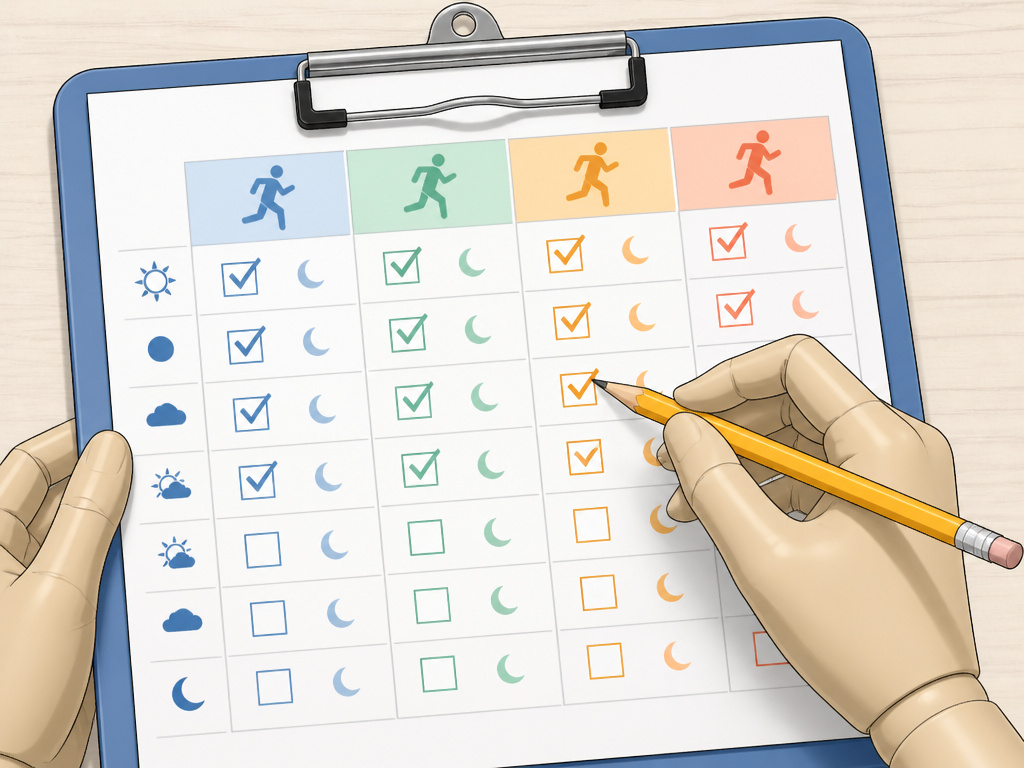
Four sources, four different weekly frequencies, and every one of them is defensible.
| Plan | First session | Sessions per week |
|---|---|---|
| NHS Couch to 5K | 5-minute warm-up walk, then walk-run intervals | 3, rest day between each |
| Cleveland Clinic | 1 minute run, 2 minutes walk, adding 30 seconds weekly | 3 to 4 |
| REI | 5-minute brisk walk, then 1 minute run, 2 minutes walk | 3 to 5 walking days |
| runDisney (Galloway) | 5 to 10 seconds running per minute, walking the rest | 2 weekdays plus a weekend run |
Frequency: Three Days or Four?
The NHS prescribes three runs a week with a rest day between each. Cleveland Clinic says three to four days per week with break days in between. REI suggests working up to brisk walking 30 minutes a day, three to five times a week. The runDisney plan asks for 30 minutes on two weekdays plus one weekend run that builds to 3.5 miles.
Start at three. Add a fourth only once the rest days stop feeling necessary, and drop back the moment they start feeling like a chore.
Stretching: Before, After, or Both?
This is a genuine split. The NHS says to take a few moments to do some stretches before your run, while Cleveland Clinic recommends dynamic stretching before a run and saves static stretching for afterwards. Cleveland Clinic’s Dr. Rex recommends dynamic stretching before a run, naming a leg pendulum and lunges at 10 to 12 repetitions each, and saves static stretching for afterwards, holding each position for 30 to 90 seconds.
Both positions can be read as compatible, since a leg pendulum is a stretch. The practical answer for a beginner: swing and lunge before, hold and breathe after.
If you only remember one rule from this whole article, make it this one: the rest day is part of the training, not a gap in it. Three runs and four rest days beats five runs and two.
Water: Carry It or Leave It?
The NHS suggests taking water with you, especially on warmer days or longer runs, sipping as needed, while REI notes you may be able to forgo drinking on runs of 45 minutes or less. REI notes you may be able to forgo drinking on runs of 45 minutes or less. Cleveland Clinic gives figures instead: 16 to 20 ounces of fluid one to two hours before, 6 to 12 ounces for every 10 to 15 minutes during, and another 16 to 24 ounces afterwards.
For a 28-minute week-one session in cool weather, REI’s position is reasonable. In July, take the bottle.
Do You Need a Doctor First?
The NHS says to speak to a GP first if you’re worried about your health, while Cleveland Clinic advises a physical exam before logging miles if you haven’t been exercising regularly. Cleveland Clinic’s Dr. Rex goes further and says that if you haven’t been exercising regularly, get a physical exam before logging miles, and that it’s always best to speak with your doctor first.
The Cleveland Clinic beginner running guide is where the 10% rule comes from, and it’s the source of most of the specific numbers here. If you want a second government-funded protocol to compare against, the healthdirect beginner running tips page is a reasonable place to look.
My read: if you’ve been sedentary for a long stretch, have a condition you already manage, or you’re pregnant, get the check first. If you already walk regularly and feel fine, the NHS threshold is the sensible one.
Shoes, Clothes and the Kit That Actually Matters
Saturday morning in a shoe shop, two boxes in your hands, and no real idea what separates them.
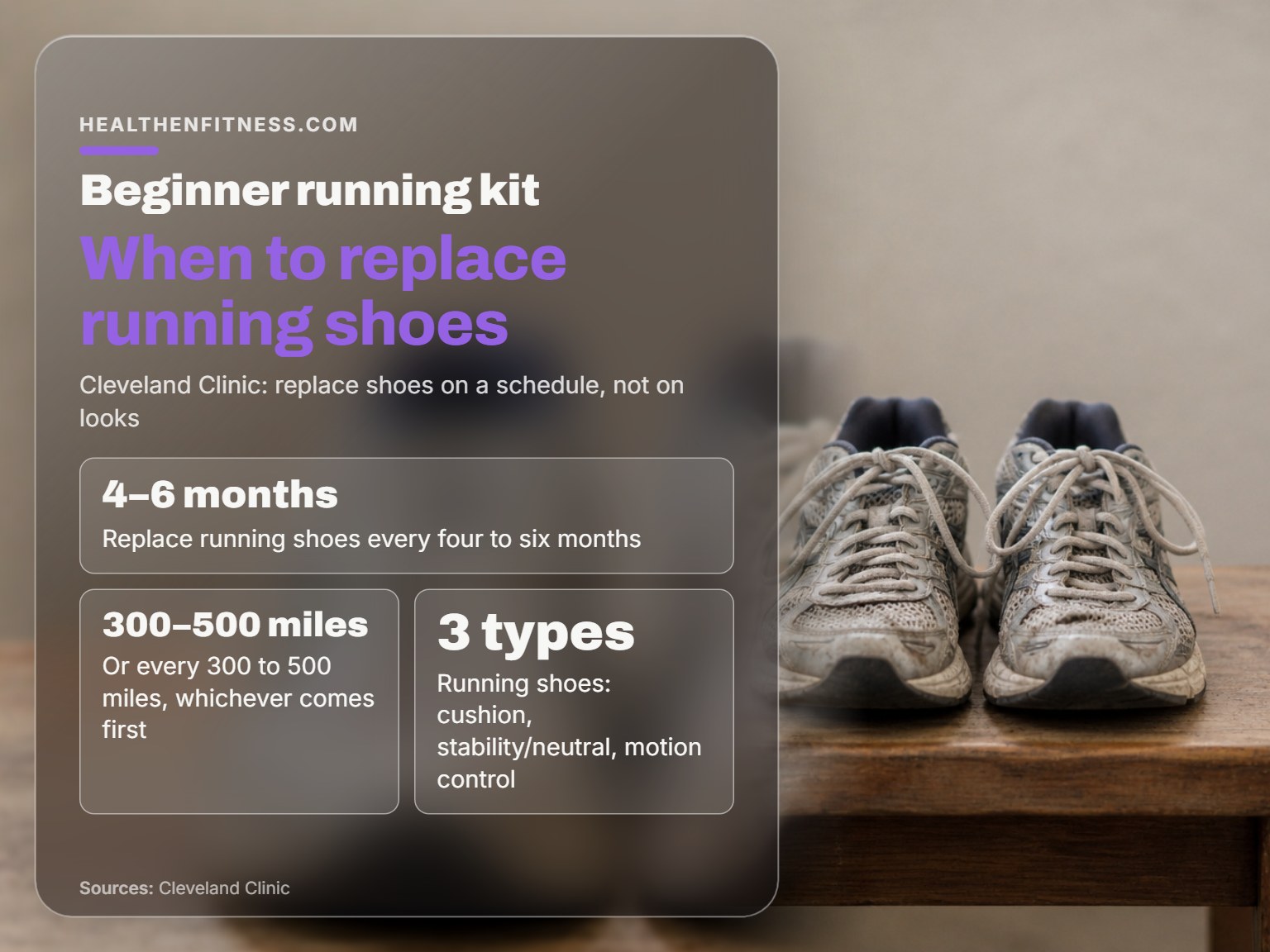
Cleveland Clinic splits running shoes into three categories: cushion, stability or neutral, and motion control. A gait analysis from a physiotherapist or exercise physiologist can tell you which one your stride wants, and many running shops will film you on a treadmill for free. Spend ten minutes choosing running shoes before you spend an afternoon in a shop.
Try a couple of the shoe types back to back on the shop treadmill and you’ll feel which one suits your foot within a few steps.
- Shoes wear out on a schedule, not on looks. Cleveland Clinic puts replacement at every four to six months or every 300 to 500 miles, whichever comes first. A packed-out midsole lands with a flat thud instead of a soft catch, and that’s the tell.
- A supportive sports bra matters as much as the shoes. Dr. Rex is blunt about this one: they’re as important as running shoes when you get started.
- Reflective kit for dark runs, plus well-lit routes. Both the NHS and Cleveland Clinic treat visibility as essential once the light goes.
- Layers in cold weather, light colours in heat, moisture-wicking fabric either way.
If you’d rather have something printable to work from, the Ohio State Start Running guide is a PDF you can print and stick on the fridge.
Why Do So Many Beginner Running Plans Fall Apart?

Ever wondered why week one feels great and week five is where the aches start?
Dr. Rex names the top cause of running injuries plainly: trying to do too much too soon. That’s why Cleveland Clinic’s rule is to add no more than 10% in mileage or minutes week to week. The cardiovascular system adapts faster than tendons and bone, so the lungs will happily let you do something the legs aren’t ready for yet.
| What you notice | Likely cause | What to change |
|---|---|---|
| Shin or heel soreness that eases as you warm up | Load added faster than tissue adapts | Hold weekly minutes to a 10% increase |
| Breathless every session, dreading the next one | Easy days run at a middling hard pace | Slow the easy days until you can talk |
| Sore knees the day after a longer run | Stride too long, feet landing heavy | Shorten the stride, keep feet low |
| Energy crash partway through | Under-fuelled or under-hydrated | 50 to 70% of calories from carbs; fluids before and during |
Three things are worth stopping for outright:
- Pain that changes how you run. REI’s advice is direct: if you feel pain while running, stop and check in with your doctor.
- Heel pain that’s worst on your first steps in the morning. The plantar fasciitis guide covers what to do next.
- A week that leaves you drained rather than tired. Take the extra day. Cleveland Clinic says not to hesitate about it.
Common mistake: Adding a fourth run because week three felt easy. The soreness from that decision shows up days later, in the shins rather than the lungs, and it costs you a fortnight of the plan you were enjoying.
Running alone isn’t a complete program. Cleveland Clinic recommends adding strength training, cycling, swimming or yoga alongside it, and a couple of strength training for runners sessions a week covers the strength side without eating your recovery. Most of the beginner workout mistakes to avoid apply to running too, particularly the urge to add everything at once.
One more thing worth knowing if you like a number to chase: Galloway’s 800-meter test sets your long-run pace. Run two laps slowly, and if you’re not huffing at the end, multiply the time by 2 and add 3 minutes. If you are huffing, add 4. A 6:00 lap without huffing gives a long-run pace no faster than 15 minutes per mile.
Frequently Asked Questions
How many days a week should a total beginner run?
Three is the NHS starting point, with a rest day between each run; Cleveland Clinic allows three to four days per week, REI works up to three to five walking days, and runDisney asks for two weekdays plus a weekend run. Cleveland Clinic allows three to four days per week with break days in between. Add the fourth only when the rest days stop feeling necessary.
Is it OK to repeat a week of Couch to 5K?
Yes. The NHS plan says explicitly that repeating runs or weeks is fine. Dr. Rex makes the same point, noting there’s no single way to start and the plan should be adjusted to your health and fitness level.
Should I stretch before or after a beginner run?
The sources split on this: the NHS suggests a few stretches before you run, while Cleveland Clinic recommends dynamic stretching before and static holds afterwards. The NHS suggests a few stretches before you run. Cleveland Clinic recommends dynamic stretching such as leg pendulums and lunges before, and static holds of 30 to 90 seconds afterwards. Doing both covers the disagreement.
Do I need to drink water on a 30-minute run?
REI says you may be able to forgo drinking on runs of 45 minutes or less, while the NHS suggests taking water anyway and Cleveland Clinic gives specific fluid amounts before, during and after. The NHS suggests taking water anyway, particularly in warm weather. Cleveland Clinic’s guidance is more specific, with fluid before, during and after.
What should I do if running hurts?
REI’s guidance is to stop and get it checked. REI’s guidance is to stop and speak with your doctor if you feel pain while running. Soreness that settles within a day is normal; pain that changes how you move is not.
The Bottom Line
If you take one number out of this, take the 10% cap. Add more than that in minutes week to week and the soreness lands in your shins before it lands in your lungs, days after the run that caused it.
The plans disagree because several routes genuinely work. Three days a week is the NHS structure, while Cleveland Clinic allows three to four days, REI works up to three to five walking days, and runDisney asks for two weekdays plus a weekend run, so a fourth day is a reward for good recovery rather than a target to hit.
Where it all falls apart is the grey-zone pace. I spent three months there and got a 5K time that refused to budge. Two easy runs and one hard one fixed it, and the fix cost me nothing but pride.
Do this today: put three runs in your calendar for next week, decide now that two of them are chat-paced, and do the first one at 28 minutes 30 seconds whether you feel like more or not.
