
10 Best Workout Cables in 2026
This post contains affiliate links. As an Amazon Associate, we earn from qualifying purchases.
For a full-featured home gym, the Body-Solid Powerline PFT100 Cable Crossover is the best overall workout cable, thanks to its dual independent 160 lb weight stacks and rock-solid frame. If floor space is tight, the Goimu WM1 Wall Mount Cable Station offers a smart space-saving design, while the Mikolo Wall Mount Cable Machine delivers excellent value with a built-in weight stack.
A cable machine brings constant tension to every rep, which free weights just can’t match. But finding one that fits your room, your budget, and your strength goals without overwhelming you with specs can be a challenge.
This guide is research-based, pulling from manufacturer specs, expert round-ups, and patterns in owner feedback. We break down what matters most so you can pick the right cable machine for your home gym.
Top 10 Workout Cables in the Market

Certain content that appears on this site comes from Amazon. This content is provided "as is" and is subject to change or removal at any time.
The Best Workout Cables, Reviewed
Body-Solid Powerline PFT100 Cable Crossover

What We Like
- Dual independent 160 lb weight stacks
- Extra-wide mainframe for stability
- 10-year frame warranty
- Versatile for full-body exercises
Trade-offs
- At 476 lbs, moving it is a serious project
- Large footprint (62.6 inches wide) needs ample space
A dual 160 lb weight stack on each side provides dedicated resistance with true isolateral movements, so your left and right sides work independently. The extra-wide mainframe offers a stable platform for a variety of exercises, and the 10-year frame warranty covers the structure. This machine is designed for home or commercial use, giving you a cost-effective way to perform cable crossovers, shoulder presses, pull-ups, and more.
At 476 pounds and with a 62.6-inch-wide footprint, this machine demands a dedicated floor space and at least one helper to move it into place. Once positioned, the extra-wide mainframe stays planted during heavy cable crossovers or lat pulldowns, so you don’t feel wobble mid-rep. The trade-off in portability buys you a stable, permanent station that won’t shift under load, ideal for a home gym where you can leave it set up. Owners note that the weight makes assembly a two-person job, but the payoff is a rock-solid feel that lighter wall-mounted units simply can’t match.
Goimu WM1 Wall Mount Cable Station
What We Like
- Wall-mounted design saves floor space
- 17 adjustable pulley positions for variety
- Dual ratio system for heavy or light lifts
- Includes attachments for 99% of cable exercises
Trade-offs
- Requires concrete or masonry wall for installation
- At 81.3 lb, mounting needs sturdy help
- No weight stack included; plate-loaded only
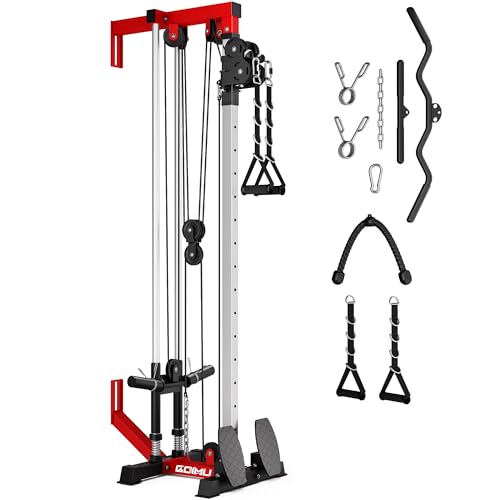
A 3.28-square-foot footprint means this station tucks flat against a wall, leaving the rest of your garage or apartment open for other gear or just moving around. It packs 17 pulley heights, dual independent arms, and a clever cable adaptor that flips between a 1:1 ratio for heavy pulls and a 2:1 ratio for lighter endurance sets. That lets you superset without rethreading. This is the setup for anyone who wants a full cable gym but doesn’t have the floor space for a freestanding tower. The included lat bar, tricep rope, and D-handles cover nearly every upper-body cable move, from face pulls to chest flys, all from a perch that doesn’t wobble thanks to 14-gauge steel and wall anchoring.
You need a concrete or masonry wall to mount it, drywall alone won’t cut it, so renters or folks with plaster walls should check their setup first. Compared to the Body-Solid Powerline PFT100, which has a built-in weight stack but eats over 62.6 inches of floor width, the Goimu WM1 trades that convenience for a much smaller footprint and plate-loading flexibility. It’s a smart pick if you already own plates and want a cable station that disappears when not in use. But if you prefer a stack and don’t mind the space, the Body-Solid might feel more turnkey.
Mikolo Wall Mount Cable Machine

What We Like
- Built-in 118 lb weight stack
- 1:1 pull ratio with included adapter
- 19 adjustable pulley heights
- Compact wall-mount design
Trade-offs
- 118 lb stack limits very heavy lifters
- Wall mount requires sturdy wall installation
A 118 lb selectorized weight stack means you can switch resistance with a pin drop, skipping the hassle of loading plates mid-set. That makes this Mikolo wall mount a clean fit for home gyms where space is tight and you want quick transitions between exercises like lat pulldowns, rows, and cable crossovers. The included 2:1 cable adapter boosts the pull ratio to a true 1:1, so what you set is what you feel, no hidden reduction. With 19 adjustable pulley positions and essential attachments out of the box, it covers nearly every cable move without cluttering your floor.
One limitation is that 118 lbs won’t satisfy advanced lifters chasing heavy progressive overload on pulldowns or rows, especially compared to plate-loaded options like the Titan Fitness Wall Mounted Pulley Tower that can handle 350 lbs with your own plates. But if you’re building a first home gym or upgrading from bands, this machine delivers weight-stack convenience and solid steel stability at a budget-friendly value that’s hard to beat.
Titan Fitness Wall Mounted Pulley Tower
What We Like
- 18 adjustable trolley height positions
- Compatible with standard and Olympic plates
- Dual D-handle straps with four adjustable lengths
Trade-offs
- Requires wall mounting or power rack attachment
- Mounting hardware not included
- 70 lb unit needs secure installation
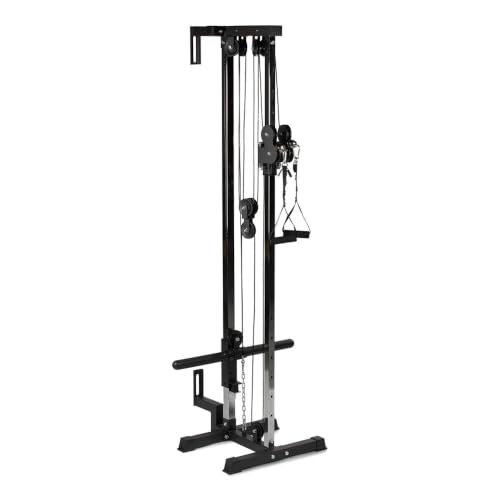
You will need to bolt it to a wall or a compatible power rack, and the mounting hardware is sold separately. That adds a little planning to the setup, but it also keeps the footprint small and the price budget-friendly. For lifters who already have plates and want a cable machine that does not eat up floor space, it is a practical, capable choice.
Product photos
Valor Fitness Cable Crossover Station

What We Like
- 17 adjustable pulley positions for exercise variety
- Includes pull-up bar, lat pulldown, curl/row attachments
- Dual guide bar system for smooth cable movement
- Floor mounting hardware and weight plate storage pegs
Trade-offs
- 174-pound unit requires dedicated floor space and assembly
- Plate loaded, not weight stacks, requires buying plates separately
A 200-pound plate loaded resistance system and 17 adjustable pulley positions give you the versatility to perform everything from cable crossovers to lat pulldowns, seated rows, and bicep curls in one machine. That range of motion means you can target upper body, lower body, and core without needing multiple stations cluttering your garage. It also includes a pull-up bar and several attachments right out of the box, so you can start a full-body strength routine immediately. This setup suits home gym owners who want a single, sturdy station that covers the major cable exercises without jumping between machines.
A 174-pound steel frame takes up a dedicated footprint and requires assembly, plus you will need to buy your own weight plates since it is plate loaded rather than having built-in stacks. If you have the room and prefer a freestanding all-in-one over a wall-mounted option, this machine delivers the exercise variety without needing to bolt it to studs.
JELENS CC01 Cable Crossover Machine

What We Like
- Ultra-smooth pulley system
- 15 height adjustment levels
- Detachable pull-up bar (500 lb capacity)
- Compact footprint (12.1 sq ft)
Trade-offs
- Plate-loaded (no built-in weight stack)
- Assembly requires 2-3 people for 1.5 hours
A 210-pound cable pulley capacity and a 500-pound pull-up bar rating mean this machine can handle serious work without flinching. The upgraded pulleys and PU-coated steel cables deliver a genuinely smooth pull, so you can focus on your form rather than fighting friction. With 15 height settings, you get the range to do everything from seated cable rows to overhead triceps extensions, all while the triangular frame keeps things stable. The footprint is 12.1 square feet, small enough for an apartment corner or a spare room.
This is a plate-loaded machine, so you’ll need to buy your own weight plates. That keeps the upfront cost lower than a stack-based system, but it also means swapping plates between exercises takes a little more time. Compared to something like the Titan Fitness Wall Mounted Pulley Tower, which bolts to a wall and saves even more floor space, the JELENS stands on its own, no stud-finding or drilling required. If you prefer a self-contained unit you can move around or take with you, this flexibility is worth the extra setup time.
Goimu DP01 Power Cage with Cable Crossover
What We Like
- Combines power cage and cable crossover
- 31 cable height adjustments for precision
- Independent dual pulleys for unilateral work
- Compact 17.88 sq ft footprint
Trade-offs
- Plate-loaded cables require separate weight purchase
- 2:1 ratio halves effective weight for cables
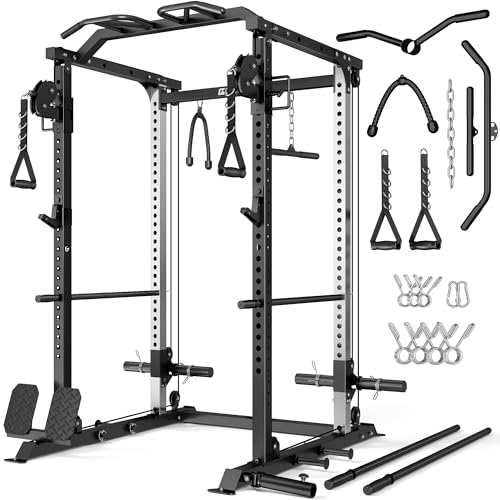
A 2000-pound capacity in a cage that occupies 17.88 square feet means you can squat, bench, and do cable work without needing a separate machine for each. The interior training space is 47.64 inches, and the fully independent dual pulley system offers 31 height settings. That range lets you switch from lat pulldowns to cable crossovers to low rows without stopping to reposition hardware. For anyone building a home gym in a tight space who wants both a power rack and functional trainer in one unit, this combo delivers real versatility without the footprint of two separate machines.
The 2:1 cable ratio means you need double the weight plates to feel the same resistance as a gym stack, so plan your plate budget accordingly. The 2×2-inch steel frame is rated for 2000 lbs, which provides solid stability for most home gym users. Still, for the person who needs a full cage and cable crossover in a compact package, the DP01 offers a smart balance of space and function that standalone cable stations can’t match.
Product photos
GMWD Wall Mounted Cable Machine
What We Like
- Folds flat against wall when not in use
- 26 height holes and 13 arm angles
- Switchable 2:1 or 1:1 cable ratio
- Includes lat bar, cable bar, and leg holder
Trade-offs
- At 165 lb, mounting requires solid wall and help
- Wall-mounted only, needs a dedicated wall space
- No weight stack included; plate-loaded design
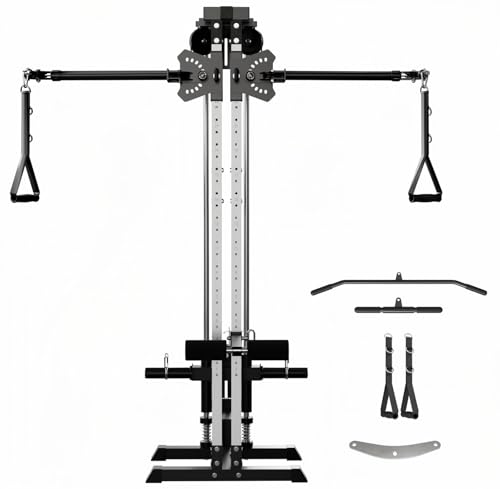
With 26 height adjustment holes and 13 arm angle settings, this station lets you dial in the exact cable path for nearly any exercise, from chest flyes to woodchoppers. That kind of precision is rare in a foldable design, and it makes the GMWD feel like a custom-fit tool rather than a one-size-fits-all compromise. The switchable 2:1 or 1:1 cable ratio adds another layer of control, letting you go from lighter, high-rep work to heavier resistance without swapping machines. For anyone wanting commercial-style range in a home gym that disappears when not in use, this is a smart pick.
Commitment is the key: at 165 pounds and wall-mounted, you are not moving it around the garage on a whim. Installation requires a sturdy wall and a second pair of hands, unlike the Goimu WM1 which is lighter and easier to mount solo. But once it is up, the GMWD’s extra adjustment range and included accessories, lat bar, cable bar, leg holder, mean you can start training right away without buying add-ons. It is a buy-once, install-once, train-for-years kind of machine.
Product photos
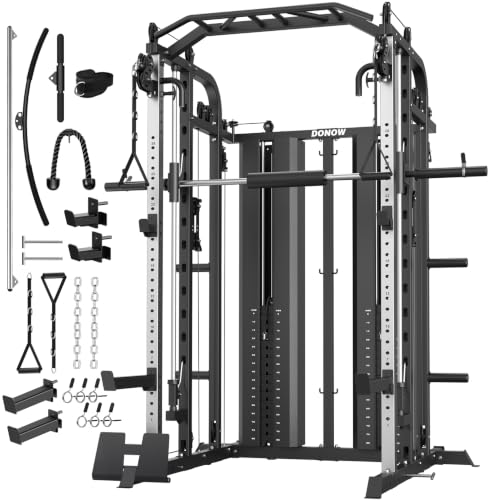
DONOW Smith Machine with Weight Stacks
What We Like
- 352 lb dual weight stacks
- Dual independent cable system
- Linear-bearing Smith bar
- Steel-encased weight stacks
Trade-offs
- Large footprint needs dedicated space
- Heavy frame complicates assembly
A 352-pound total weight stack means you can tackle serious lat pulldowns, rows, and cable crossovers without ever stopping to load plates. The dual independent cable system lets you work each arm separately, mimicking the feel of commercial gym equipment right at home. This machine suits anyone who wants a complete strength setup, combining a Smith machine with a cable crossover in one sturdy 2×2 steel frame. The linear-bearing Smith bar moves smoothly for stable squats and presses, while the enclosed weight stacks keep cables and plates safe from curious pets or kids.
This is a big piece of equipment, measuring nearly 78.6 inches wide and 88 inches tall, so it demands a roomy home gym spot. Assembly is also a project given its weight and complexity, unlike a simpler wall-mounted cable station such as the Goimu WM1. If you have the floor space and want a full dual-stack system that eliminates plate loading, this is a practical all-in-one solution.
Product photos
Powertec Workbench Functional Trainer Deluxe
What We Like
- Expandable to 1,000 lb capacity
- Sturdy steel mainframe for durability
- Functions as chin-up and pull-up station
- Smooth pulley system for fluid motion
Trade-offs
- Base weight stacks not included; add-ons sold separately
- Requires separate purchase of weight stacks to use
A 1,000 lb maximum weight capacity with optional add-on stacks means this machine can grow with you from day one into serious strength territory. The sturdy steel mainframe and smooth pulley system give it a professional feel that suits anyone who wants a functional trainer that won’t wobble during heavy pulls or presses. It also doubles as a chin-up and pull-up station, so you get more than just cable work in one footprint. This is the kind of equipment that rewards patience: start light, add stacks later, and never outgrow it.
The base unit arrives without weight stacks, so your initial investment gets you the frame, cables, and pulleys but not the resistance plates. You will need to budget for the add-on stacks to reach that full capacity. If you want a machine that includes weight stacks from the start, you might consider other options, but the Powertec gives you the flexibility to build up over time.
Product photos
How We Evaluated Workout Cables
We started with the raw specs: weight stack capacity, pulley range, frame dimensions, and footprint. Then we cross-referenced those against expert recommendations and thousands of owner reviews to find common praise and recurring complaints. A machine that looks great on paper but wobbles under load or limits your range of motion didn’t make the cut.
The three factors that mattered most were stability, adjustability, and space efficiency. A wobbly cable machine is unsafe and frustrating, so we prioritized steel frames and wide bases. Adjustable pulley positions are critical for hitting every muscle group, from lat pulldowns to cable crossovers. And since most home gyms fight for square footage, we weighed footprint and storage options heavily.
This is a research-led evaluation, not a hands-on test. We didn’t spend weeks in a lab with each machine. For setup tips and form guidance, our guides on how to use a cable machine and the best cable exercises are great next steps.
What To Look For In Workout Cables
Choosing a cable machine comes down to matching its design to your space, strength, and goals. Here are the key criteria to consider before you buy.
Focus on weight stack vs. Plate-loaded, pulley adjustability, footprint, and frame stability. These four factors determine whether a machine will serve you for years or become a frustrating paperweight.
Weight Stack vs. Plate-Loaded
This is the biggest fork in the road. Weight stack machines like the Body-Solid Powerline PFT100 offer instant resistance changes via a selector pin, just pull and go. They’re convenient but heavier and pricier. Plate-loaded machines like the Titan Fitness Wall Mounted Pulley Tower require you to load plates yourself, which is cheaper upfront but slower between sets. If you lift heavy and want to add weight in small increments, plate-loaded gives you more control. If speed matters more, go with a weight stack.
Pulley Adjustability and Range of Motion
The number of pulley positions directly affects exercise variety. More adjustment points mean you can hit every angle, from overhead presses to low rows. Look for at least 15 height positions. Some machines, like the Goimu WM1, offer 17 adjustable pulley positions, while the Goimu DP01 Power Cage Combo offers 31. More positions also make it easier to perform specific cable exercises for abs, like woodchoppers and cable crunches.
Footprint and Installation
Measure your space before you buy anything. A freestanding crossover like the Valor Fitness Cable Crossover Station needs a permanent floor footprint. Wall-mounted units like the GMWD Wall Mounted Cable Machine save floor space but require a concrete or masonry wall for safe installation. If you rent or move often, a wall-mounted machine may not be practical. If you have a dedicated gym room, a larger unit with dual weight stacks is worth the space.
- Measure your ceiling height to ensure enough room for overhead pulldowns.
- Check your wall type, drywall alone cannot support a heavy wall-mounted unit.
- Consider assembly time; some machines take two people and several hours to set up.
- Look at the machine’s total weight; moving a 476 lb unit is a serious project.
A good rule of thumb: buy for the space you have, not the space you wish you had.
Workout Cables Compared
The table below compares the key specs and trade-offs of our top picks to help you narrow down your choice.
| Product | Weight / Capacity | Dimensions | Pulley Positions / Height Settings |
|---|---|---|---|
| Body-Solid Powerline PFT100 Cable Crossover | Dual 160 lbs each | 42.3 x 62.6 x 83 in | N/A |
| Goimu WM1 Wall Mount Cable Station | N/A | 28.1 x 24.8 x 78.7 in | 17 |
| Mikolo Wall Mount Cable Machine | 118 lbs | N/A | 19 vertical settings |
| Titan Fitness Wall Mounted Pulley Tower | 350 LB capacity | 82.0 x 14.0 x 7.0 in | 18 |
| Valor Fitness Cable Crossover Station | 200 lbs plate loaded | 50.0 x 56.0 x 81.0 in | 17 adjustable |
| JELENS CC01 Cable Crossover Machine | 210 lbs cable pulley | 64.2 x 53.9 x 81.9 in | 15 |
| Goimu DP01 Power Cage with Cable Crossover | 2000 lbs weight capacity | 57.9 x 46.5 x 84.2 in | 31 |
| GMWD Wall Mounted Cable Machine | 165 lb weight | 39.0 x 28.6 x 77.0 in | 26 adjustment holes |
| DONOW Smith Machine with Weight Stacks | 352LB weight stacks | 54.7 x 78.6 x 88.0 in | N/A |
| Powertec Workbench Functional Trainer Deluxe | Up to 1,000 lb | N/A | N/A |
Frequently Asked Questions
What is the difference between a weight stack and a plate-loaded cable machine?
A weight stack machine uses a stack of metal plates and a selector pin to change resistance instantly. A plate-loaded machine requires you to manually load weight plates onto a post. Weight stacks are faster and more convenient; plate-loaded machines are often cheaper and allow finer weight increments.
How much floor space do I need for a cable machine?
It depends on the type. A freestanding dual-crossover machine typically needs a footprint of several feet wide and several feet deep, plus room to move around. Wall-mounted units can save significant floor space but require a clear wall area. Always measure your room and the machine’s dimensions before purchasing.
Can I use a cable machine for full-body workouts?
Yes. A good cable machine with adjustable pulleys can target every major muscle group. You can do chest presses, lat pulldowns, rows, shoulder raises, tricep extensions, bicep curls, leg kicks, and core exercises all on one machine. Adding the right cable attachments like a tricep rope or lat bar expands your options even further.
Do I need to bolt a cable machine to the floor?
Many freestanding cable machines include floor-mounting hardware for added stability, especially during heavy pulls. Wall-mounted units must be bolted to a concrete or masonry wall for safety. Always follow the manufacturer’s installation instructions. A machine that isn’t secured can tip over under load.
What attachments should I get for my cable machine?
Start with a lat pulldown bar, a tricep rope, a straight bar, and a pair of D-handles. These four attachments cover most exercises. As you progress, you can add ankle straps for leg work and wrist cuffs for isolation movements. Many machines come with a basic set included.
The Bottom Line
If you have the dedicated floor space and want the gold standard of cable training, the Body-Solid Powerline PFT100 Cable Crossover is the best overall pick. Its dual weight stacks, wide frame, and 10-year warranty make it a long-term investment for serious home gym owners. It’s not small or light, but it delivers the smoothest, most versatile cable experience in this lineup.
For those with limited floor space, the Goimu WM1 Wall Mount Cable Station is a brilliant alternative. It saves floor space while offering 17 pulley positions and a dual ratio system. If you prefer a built-in weight stack in a compact package, the Mikolo Wall Mount Cable Machine gives you 118 lb of resistance without taking up much room.
Ultimately, the single most important buying factor is honesty about your space and your commitment. A cable machine that fits your room and your routine will get used. One that doesn’t will collect dust. Measure twice, choose wisely, and enjoy the constant tension.
