
10 Best Cable Machines in 2026
This post contains affiliate links. As an Amazon Associate, we earn from qualifying purchases.
For a full-body workout station that combines strength training with versatility, the MAJOR FITNESS F22 Power Rack with Cable Crossover is the best overall cable machine. It offers a massive 1600 lb static capacity for heavy lifts while doubling as a squat rack and cable crossover. For those short on floor space, the GOIMU WM2-V4 Wall Mount Cable Station delivers smooth selectorized resistance, and the XMark Functional Trainer provides independent dual weight stacks for serious home gyms.
The challenge with buying a cable machine is balancing resistance, footprint, and features against your available space and training goals. A machine that fits a garage gym may overwhelm a spare bedroom, and a wall-mounted unit that saves space might not offer enough weight for progressive strength work.
This guide is research-based, drawing on manufacturer specifications, expert round-ups, and patterns in owner feedback to help you choose confidently. We break down the ten best cable machines by their strengths, trade-offs, and ideal use cases so you can match the right machine to your home gym.
Top 10 Cable Machines in the Market
Certain content that appears on this site comes from Amazon. This content is provided "as is" and is subject to change or removal at any time.
The Best Cable Machines, Reviewed
MAJOR FITNESS F22 Power Rack with Cable Crossover

What We Like
- 1600 lb static capacity for heavy lifts
- All-in-one rack, squat stand, and cable crossover
- Dual-triangle base reduces wobble without bolting
- Two people can train simultaneously on cables
Trade-offs
- At 243 lb, moving it around is a real chore
- Large footprint needs a dedicated home gym space
- No weight stack included, you supply plates
A 1600-pound static weight capacity means this rack handles serious squats, deadlifts, and rack pulls without flex or wobble. That kind of stability, paired with a dual-triangle base that keeps things planted without bolting to the floor, makes it a rare find for home gyms where concrete drilling isn’t an option. It replaces three separate machines, power rack, squat stand, and cable crossover, in one compact footprint, which is exactly the kind of space-saving trick I wish I’d known about when I was cramming gear into my garage. If you want to do heavy compound lifts and cable work without buying three different stations, this is the setup that makes that possible.
At 243 pounds and 68.9 inches long, this rack demands a permanent spot on your floor. Moving it around for storage isn’t realistic like with a wall-mounted cable station. You’ll also need to supply your own weight plates for the cable system, since there’s no built-in stack, something to budget for if you’re starting from scratch. But for anyone who wants a single sturdy machine that covers full-body strength training and lets a partner jump in for cable work at the same time, this rack delivers on that promise without the shaky feeling cheaper all-in-ones often have.
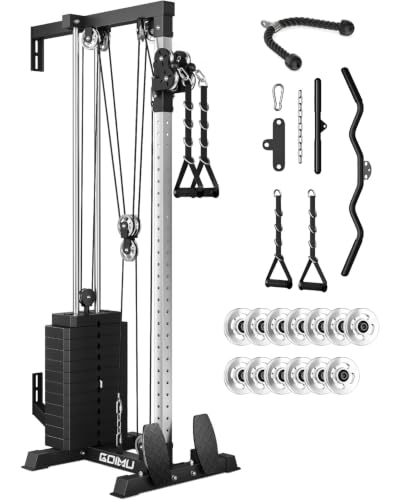
GOIMU WM2-V4 Wall Mount Cable Station
What We Like
- Selectorized weight stack for quick weight changes
- 33 adjustable positions for varied angles
- Ultra-smooth aluminum pulleys
- Wall-mounted design saves floor space
Trade-offs
- Wall mounting requires sturdy wall and installation
- 155 lb weight stack limits heavy lifters.
A 155 lb selectorized weight stack means you can switch resistance between sets without fumbling with plates, just slide the pin and go. This wall-mounted station needs only a 24×33 inch footprint, making it a smart fit for apartments or cramped home gyms where every square foot counts. The 33 adjustable positions let you dial in angles for everything from chest flyes to tricep pushdowns, and the aluminum pulleys glide smoothly, giving you that commercial gym feel without the commercial gym floor space.
The 155 lb selectorized weight stack is well suited for isolation exercises and lighter compound movements. If your training demands heavier loads for rows or pulldowns, you may want to consider a machine with a larger weight stack, such as the Titan Fitness Selectorized Cable Machine with its 320 lb stack. This Goimu model is designed for a compact footprint, not for maximum resistance.
XMark Functional Trainer Cable Machine

What We Like
- Dual 200 lb independent weight stacks
- 19 adjustable pulley heights
- Full attachment kit included
- Built-in pull-up bar with angled grips
Trade-offs
- 800 lb weight needs a reinforced floor
- Requires freight delivery appointment scheduling
The dual 200 lb weight stacks let you work each arm or leg independently, so you can focus on a weak side or do staggered stance presses without swapping cables. With 19 pulley heights from 12 to 75 inches, you get presses, rows, flys, curls, and leg movements covered. The included attachment kit, triceps rope, long bar, short bar, hand straps, ankle straps, leg strap, means you can start training the day assembly finishes.
The trade-off is size and weight. It also ships via freight carrier, so you’ll need to schedule a delivery appointment and have help moving the crated unit into place. Compare that to the Titan Fitness Selectorized Cable Machine, which uses a single 320 lb stack and is longer but lighter, or the Inspire Fitness FTX at 544 lb with twin 165 lb stacks.
Body-Solid Powerline PFT100 Cable Crossover

What We Like
- Dual 160 lb weight stacks for isolateral moves
- Extra-wide mainframe for stability
- 10-year frame warranty from established brand
- Near-unlimited high and low pulley exercises
Trade-offs
- At 476 lbs, moving it is a two-person job
- Weight ratio 1/2:1 means actual resistance is half
Two 160-pound weight stacks with a 1/2:1 resistance ratio give you isolateral cable work, each arm moves independently, which helps fix strength imbalances and keeps your core engaged throughout the motion. The extra-wide mainframe makes the whole setup feel planted even when you’re pulling hard from a low pulley, and Body-Solid backs it with a 10-year frame warranty. For someone who wants a dedicated cable crossover from a name that’s been around for decades, this is the budget-friendly way to get dual stacks without cutting corners on build quality.
Inspire Fitness FTX Functional Trainer

What We Like
- Smallest footprint in a full functional trainer
- Two 165 lb weight stacks for independent arms
- Smooth friction-free pulley system
- Included pull-up bar and 4 accessories
Trade-offs
- At 544 lb, moving it is a two-person job
- Only 165 lb per side limits heavy lifters
A 40 by 54 inch footprint puts this among the most compact full functional trainers available, fitting into a bedroom corner or garage nook where larger machines won’t go. The two independent 165 lb weight stacks let you work each arm separately, which is great for unilateral moves like single-arm rows or twisting cable chops that build balanced strength. A pull-up bar and four included accessories mean you can start training right out of the box without buying extra gear.
The trade-off for that compact size is weight capacity: 165 lb per side is plenty for most intermediate lifters doing cable flyes, tricep pushdowns, or face pulls. But if you need more resistance, the XMark Functional Trainer with its dual 200 lb stacks offers higher capacity. And at 544 pounds, this machine stays planted during heavy work but you will want a friend’s help to move it into place. For anyone who wants real cable versatility without dedicating half a garage to it, this is a practical answer.
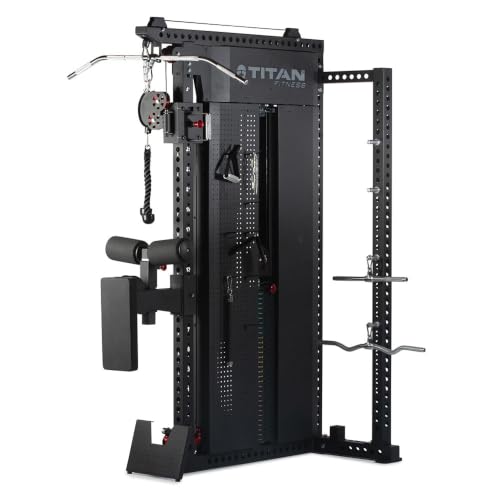
Titan Fitness Selectorized Cable Machine
What We Like
- 320 lb weight stack for heavy loading
- 31 adjustable pulley positions
- 1:1 ratio for lat pulldown and row
Trade-offs
- At 748 lb, needs dedicated floor space
- 92 inches long requires a large room
- 2:1 tower limits max resistance for some moves
A 320 lb weight stack and a 1:1 cable ratio mean you can load up heavy on lat pulldowns and rows without halving the resistance. That makes this machine a natural fit for intermediate and advanced lifters who want to progressively overload without outgrowing the stack quickly. The 31 pulley positions let you hit everything from overhead tricep extensions to low cable curls, and the seat adjusts through seven angles so you can dial in a comfortable rowing or pulldown position. For someone who already knows their way around a gym and wants a dedicated cable station that won’t limit their strength work, this delivers the capacity and adjustability to keep you challenged.
At 92 inches long and 748 pounds, this is a permanent resident of your training space, not something you tuck into a corner or move around. Compared to the MAJOR FITNESS F22, which combines a power rack with a cable system at 243 pounds, the Titan is a dedicated machine that demands real estate. If you have the room and want a pure cable setup with serious stack weight, the Titan is a straightforward choice. If floor space is tight or you need a multi-function station, the F22’s all-in-one design might suit you better.
Product photos
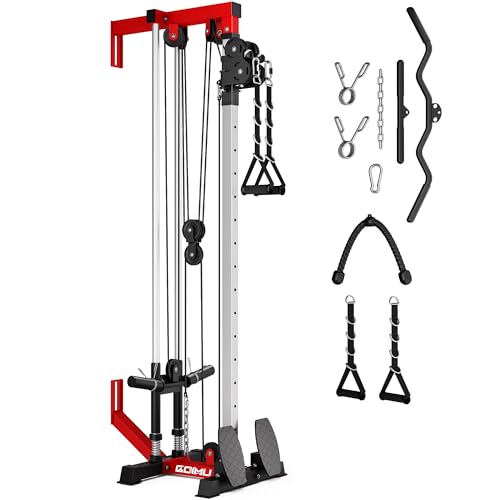
Goimu WM1 Wall Mount Cable Station
What We Like
- 17 adjustable pulley heights
- Switchable 1:1 and 2:1 ratio
- Wall-mounted, zero wobble design
- Compact 3.28 sq ft footprint
Trade-offs
- Requires concrete or masonry wall for installation
- No weight stack included (plate-loaded)
With a footprint of 3.28 square feet, this wall-mounted station turns a tight corner of your garage into a surprisingly capable cable gym. The 17 pulley heights let you hit everything from overhead presses to low rows. The clever adapter lets you switch between a 1:1 ratio for heavy pulls and a 2:1 ratio for lighter endurance work mid-set. It’s a smart solution if you’re short on square footage but don’t want to sacrifice exercise variety. The industrial 14-gauge steel frame keeps things steady even when you’re loading up the plates, and the smooth pulley system won’t rattle your concentration.
You’ll need a concrete or masonry wall to mount it, no drywall shortcuts here, and there’s no built-in weight stack, so you’ll supply your own plates. Compared to the MAJOR FITNESS F22 Power Rack, which takes up 68.9 inches of length and weighs 243 pounds, the Goimu WM1 is far more space-friendly and wallet-friendly, but it doesn’t double as a squat rack. If your priority is a compact, budget-conscious cable setup and you’re comfortable with a permanent wall mount, this is a clever way to get full-body cable work without the footprint of a full functional trainer.
Product photos
Mikolo Wall Mount Cable Machine

What We Like
- Selectorized weight stack for quick adjustments
- 1:1 pull ratio adapter included
- 19 adjustable pulley positions
- Compact wall-mounted design
Trade-offs
- 118 lb weight stack limits heavy lifters
- Wall mount requires sturdy wall and installation
The 118 lb selectorized weight stack means you can change resistance with a simple pin drop, no fumbling with plates mid-set. That makes it ideal for drop sets, supersets, or anyone who values workout flow over setup time. The included 2:1 to 1:1 adapter lets you switch the pull ratio so your 118 lbs selection feels like 118 pounds of resistance, which helps on heavy pulldowns and rows. If you’re outfitting a garage or spare room and want a functional trainer that doesn’t swallow the floor, this wall-mounted unit delivers full-body versatility in a tight footprint.
At 118 lbs, this is on the lighter side for serious strength work. If you’re chasing heavy lat pulldowns or rows beyond that range, you’ll max out faster than you’d like. Compare that to the GOIMU WM2-V4, which offers 155 lbs and 33 positions, but it also takes up more wall space and comes with a higher price tag. For the home gym beginner or intermediate lifter who wants smooth cable work without the bulk or cost of a bigger station, the Mikolo hits a sweet spot between capability and compactness.
Product photos
JELENS CC01 Cable Crossover Machine

What We Like
- Triangular structure saves floor space
- 15 pulley height levels for varied moves
- Detachable pull-up bar holds 500 lbs
- Smooth PU-coated steel cables
Trade-offs
- At 146 lbs, not easily moved alone
- Max cable load 210 lbs limits heavy rows
- Requires 2-3 people for 1.5-hour assembly
The 12.1-square-foot footprint means this cable machine fits where most crossovers simply won’t, apartment corners, spare bedrooms, or tight garage nooks. The triangular structure creates an expansive 64-inch training space at the front, so you can perform cable flyes, lat pulldowns, and seated rows without feeling cramped. With 15 height adjustment levels and a smooth PU-coated pulley system, you get the versatility of a commercial functional trainer in a package that respects your square footage.
The trade-off for that compact size is a 210-pound max cable load, which is plenty for chest flyes, triceps pushdowns, and most isolation work, but it won’t satisfy someone chasing heavy lat pulldowns or rows. The MAJOR FITNESS F22 integrates a power rack and supports heavier pulling, but its footprint is larger. The JELENS CC01 prioritizes space efficiency for cable training.
Product photos
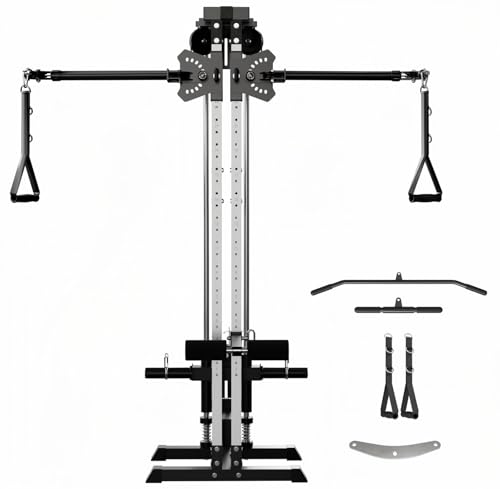
GMWD Wall Mounted Cable Machine
What We Like
- Folds flat against wall when not in use
- 26 height adjustments for personalized fit
- Dual cable ratios (2:1 and 1:1)
- Includes lat bar, cable bar, and leg holder
Trade-offs
- Requires wall mounting, not freestanding
- No built-in weight stack (plate-loaded)
This wall-mounted cable machine weighs 165 pounds and folds flat against the wall when not in use, so it reclaims floor space after your workout. With 26 height adjustment holes and 13 arm angle settings, you can set up exercises like chest flyes or woodchoppers to fit your body. It works well for anyone who wants a versatile cable station without a permanent floor footprint, provided you have a wall to mount it on.
Wall mounting requires a solid wall and some installation effort. Compared to the MAJOR FITNESS F22 Power Rack, which is a larger freestanding unit, the GMWD takes up less floor space but needs to be attached to a wall. If you have the wall space and are comfortable with mounting, this foldable design offers a wide range of exercises in a compact package.
Product photos
How We Evaluated Cable Machines
We analyzed each cable machine based on its published specifications, manufacturer documentation, and patterns we found in owner feedback across multiple expert round-ups. Our goal was to identify what real buyers value most and where each machine falls short.
The four criteria that mattered most were resistance type and range, footprint and mounting requirements, build quality and stability, and exercise versatility. A selectorized weight stack offers convenience, but plate-loaded machines save money. A wall-mounted unit frees floor space but requires a sturdy wall. Stability without bolting to the floor is a real advantage for renters, while dual pulley heights determine how many exercises you can actually perform.
A research-led evaluation has honest limits. If you want to compare more options side by side, our guide to using a cable machine covers setup and safety basics that apply to any model.
What To Look For In Cable Machines
Choosing a cable machine starts with knowing your training goals and your available space. The right machine for a powerlifter with a dedicated garage gym is different from the right machine for an apartment-dweller who needs to store equipment against a wall.
Focus on weight stack capacity, footprint, pulley adjustment range, and whether the machine includes attachments you will actually use. A 1:1 resistance ratio gives you full stack weight, while a 2:1 ratio halves it.
Resistance Type and Capacity
The two main resistance types are selectorized weight stacks and plate-loaded systems. Selectorized stacks let you change weight by moving a pin, which is faster and more convenient for circuit training. Plate-loaded machines require you to handle weight plates manually, but they are typically more affordable and allow you to use plates you already own.
Weight stack capacity matters for progressive overload. A 200 lb stack with a 1:1 ratio gives you full resistance for lat pulldowns and rows. A 2:1 ratio halves that, so a 200 lb stack effectively provides 100 lb of resistance. Heavy lifters should look for stacks of 200 lb or more per side.
Footprint and Mounting
Cable machines range from massive dual-station crossovers that need a lot of width to compact wall-mounted units that fold flat. Measure your space and account for the machine’s depth plus room for movement during exercises like cable flyes and triceps pushdowns.
Wall-mounted machines require installation into studs or concrete. Freestanding units with wide bases or dual-triangle designs can be stable without bolting, but heavier machines often need a dedicated spot.
Pulley Adjustment and Exercise Versatility
The number of adjustable pulley heights determines how many exercises you can perform. Machines with 15 to 33 positions let you target muscles from every angle. Look for smooth aluminum or nylon pulleys and steel cables that reduce friction and wear.
A good cable machine should support best cable exercises like lat pulldowns, seated rows, chest flyes, face pulls, and triceps pushdowns. Check that the included attachments cover your priority moves before buying additional cable attachments.
- Measure your ceiling height: some machines require enough height for full range of motion
- Check the floor type: heavy machines may dent soft flooring or need a platform
- Confirm assembly requirements: some machines need two or three people and several hours
- Verify warranty length: frame warranties from established brands often run several years
A machine that fits your space today will serve you better than a machine that promises more weight than you can lift tomorrow.
Cable Machines Compared
The table below compares the ten cable machines side by side, including resistance type, weight capacity, footprint, and key features to help you narrow your options.
| Product | Cable Ratio | Dimensions | Weight |
|---|---|---|---|
| MAJOR FITNESS F22 Power Rack with Cable Crossover | 2:1 | 68.9 x 55.5 x 82.5 in | 243 lb |
| GOIMU WM2-V4 Wall Mount Cable Station | 2:1 | 33.1 x 23.8 x 79.1 in | N/A |
| XMark Functional Trainer Cable Machine | 2:1 | 65.5 x 43.5 x 83.5 in | 800 lb |
| Body-Solid Powerline PFT100 Cable Crossover | 1/2:1 | 42.3 x 62.6 x 83 in | 476 lbs |
| Inspire Fitness FTX Functional Trainer | N/A | 40 x 54 x 85 in | 544 lb |
| Titan Fitness Selectorized Cable Machine | 1:1 and 2:1 | 92 x 55 x 20 in | 748 lb |
| Goimu WM1 Wall Mount Cable Station | 1:1 and 2:1 | 28.1 x 24.8 x 78.7 in | 81.3 lb |
| Mikolo Wall Mount Cable Machine | 2:1 | N/A | N/A |
| JELENS CC01 Cable Crossover Machine | N/A | 64.2 x 53.9 x 81.9 in | 146 lbs |
| GMWD Wall Mounted Cable Machine | 2:1 and 1:1 | 39 x 28.6 x 77 in | 165.0 pounds |
Frequently Asked Questions
What is the difference between a 1:1 and a 2:1 cable ratio?
A 1:1 ratio means the weight you select on the stack is the exact resistance you feel. A 2:1 ratio halves the resistance through a pulley system, so a 200 lb stack delivers 100 lb of actual resistance. 1:1 ratios are better for heavy compound moves like lat pulldowns, while 2:1 ratios allow smoother lighter movements for isolation exercises.
Can I use a cable machine without bolting it to the floor?
Some freestanding cable machines are designed with wide bases or dual-triangle frames that provide stability without bolting. The MAJOR FITNESS F22 is one example that reduces wobble through its base design. Heavier machines with tall towers, especially those over 500 lb, typically require bolting or a reinforced floor for safe operation.
How much space do I need for a cable machine?
Space requirements vary widely. Compact wall-mounted units like the Goimu WM1 need just over 3 square feet. Full functional trainers require about 4 by 6 feet. Large dual-station crossovers can need a lot of width and depth. Always add a few feet of clearance around the machine for movement during exercises.
What is the best cable machine for a small home gym?
For small spaces, wall-mounted cable machines are the best choice. The GOIMU WM2-V4 offers a selectorized weight stack and 33 adjustable positions in a wall-mounted design. The GMWD Wall Mounted Cable Machine folds flat against the wall when not in use. Both options preserve floor space while still providing a full range of cable exercises.
Do I need to buy extra attachments for my cable machine?
Most cable machines include basic attachments like a lat bar, cable bar, and ankle strap. Higher-end models like the XMark Functional Trainer include a full attachment kit. If your machine comes with limited accessories, you may want to add a triceps rope, single handle, or v-bar for more exercise variety. Check which attachments your machine accepts before purchasing extras.
The Bottom Line
The MAJOR FITNESS F22 Power Rack with Cable Crossover is the best overall choice for home gym owners who want a single station that handles heavy barbell lifts and cable exercises. Its 1600 lb static capacity and dual-triangle base make it a stable, long-term investment for anyone with dedicated floor space.
If floor space is tight, the GOIMU WM2-V4 Wall Mount Cable Station or the Inspire Fitness FTX Functional Trainer offer excellent versatility in compact packages. Budget-conscious buyers should consider the Body-Solid Powerline PFT100 for its dual weight stacks and strong warranty from an established brand, or the Goimu WM1 if they already own weight plates.
The single most important factor in choosing a cable machine is matching its footprint and resistance to your available space and training goals. A machine that fits your room and challenges your muscles will keep you coming back.
