
How to Bench Press With Proper Form: Step-by-Step
This post contains affiliate links. As an Amazon Associate, we earn from qualifying purchases.
To bench press with proper form, set the shoulder blades back and down, keep both feet flat on the floor, grip the bar with the thumbs wrapped around it, and lower it to the chest under control before pressing it back to straight arms. Head, shoulders, and buttocks stay on the bench the whole time.
Those four contact points and the pinched shoulder blades are what let the chest drive the bar instead of the shoulder joint absorbing it. Learning how to bench press with proper form starts with this setup. Lose the shoulder set and the bar drifts toward your face, the elbows flare wide, and the front of the shoulder takes a load it wasn’t built for.
What follows is the setup in order, the grip and elbow arguments that actually change how the lift feels, the frequency question where credible sources split, and the mistakes that get a lift red-lighted.
Key Takeaways
- Set the shoulder blades back and down before you touch the bar. That one move keeps the shoulder joint out of the line of fire.
- Lower under control over three to five seconds and keep the bar clear of your belt.
- Wrap your thumbs around the bar. The IPF rulebook requires it for the entire lift, and a thumbless grip lets the bar roll out of your hands.
- Bench two to three times a week if you recover well; ATHLEAN-X caps most lifters at one or two sessions.
- Stop two to three reps short of failure on ordinary sets, and save the grinders for days you have a spotter.
What Does Proper Bench Press Form Actually Require?
Four contact points hold the whole lift together: head, shoulders, and buttocks on the bench, plus both feet flat on the floor.
Competition bench press requires the head, shoulders, and buttocks in contact with the bench, feet flat on the floor, and a thumbs-around grip maintained throughout the lift. The bar descends until the underside of both elbows reaches level with or below the top of each shoulder joint, then presses to straight arms with elbows locked.
That’s the standard written into the IPF Technical Rules for 2023. It’s worth reading twice, because two clauses in there surprise people who’ve only watched gym-floor benching.
The first is the five-second rule. After you take the bar out of the racks, you wait with straight arms and locked elbows for the Chief Referee’s signal. If you aren’t motionless and correctly positioned after five seconds, you get the command to “Replace” the bar. Setup speed counts as part of the lift.
The second is smaller and stranger: your hair can’t hide the back of your head while you’re lying on the bench. The referee has to see head contact to judge it. If you have long hair, that’s a hair tie issue, not a form issue.
The Setup, Step by Step
You slide under the bar, the pad is cold through your shirt, and the first thing that happens is your shoulders creep up toward your ears.
Fix that before anything else.
Before you start: A failed rep on a bench has nowhere to go but your chest or your throat. Set the safety bars so the bar stops just below your chest, keep the collars on the bar, and don’t chase a personal best on a day when nobody else is in the building.
- Lie back and set the contact points. Head, shoulders, and buttocks on the bench. Skip this and you’ll press from a base that shifts, and the bar path wanders forward within a rep or two.
- Plant the feet flat, about shoulder-width apart. You can pull them in slightly as long as they stay flat. Lifting a foot is a red light in competition and a stability leak in the gym.
- Retract the shoulder blades. Pull them back and down, then press them into the pad. Without that set, the shoulder joint takes the load the chest was supposed to take.
- Grip with the thumbs around the bar, weight sitting in the palm. A thumbless grip lets the bar roll toward your fingers mid-press.
- Unrack and lock the elbows. Aim for the bar to clear the rack hooks by about one to two inches without reaching for it.
- Breathe in and brace before the first rep comes down.
Bracing is the other half of the setup. The breathing technique that keeps your trunk stiff under a squat works the same way when you learn how to bench press with proper form.
If you train at home, setting safety pins at the right height takes two minutes and removes the worst-case scenario. A spotter who knows the handoff is worth more than another pair of plates. Solo lifters who learn how to bench press without a spotter early never face the choice between dumping the bar and waiting for help.
A bench that sits too tall forces you onto your toes, so choose one low enough that most people can plant both feet flat, which is the entire point of the rule.
Where Should the Bar Touch Your Chest?
The IPF rulebook defines the bottom position by joint angle, not by a spot on your T-shirt. The underside of both elbows has to reach level with or below the top of each shoulder joint, and the bar has to touch the chest or abdominal area.
There’s a clause attached to that. If the bar comes down onto your belt, the Chief Referee calls “Rack.” Wearing a belt changes where your legal bottom position sits, and plenty of lifters find that out the hard way at a meet.
The Cleveland Clinic’s Cleveland Clinic bench press guide takes a looser line for general training. Bring the weight as far down as you can while keeping control of the bar and staying out of joint pain. Some people are most comfortable right above the nipple line; others need it a bit lower depending on anatomy and grip.
You’ll know a controlled touch when you feel it. The bar settles into the chest. A bounce sounds different, a hollow slap off the sternum that you hear before you register it, and it’s the opposite of how to bench press with proper form.
Bar path is where the two main camps split outright. The Cleveland Clinic says push the weight straight up. Stronger by Science says drive the bar up and back off the chest while flaring the elbows and internally rotating the shoulders. Straight line versus arc. Both are describing a lift that works, and the difference is mostly about how much you’re willing to trade shoulder comfort for a shorter bar path.
Grip, Thumbs, and the Elbow Argument
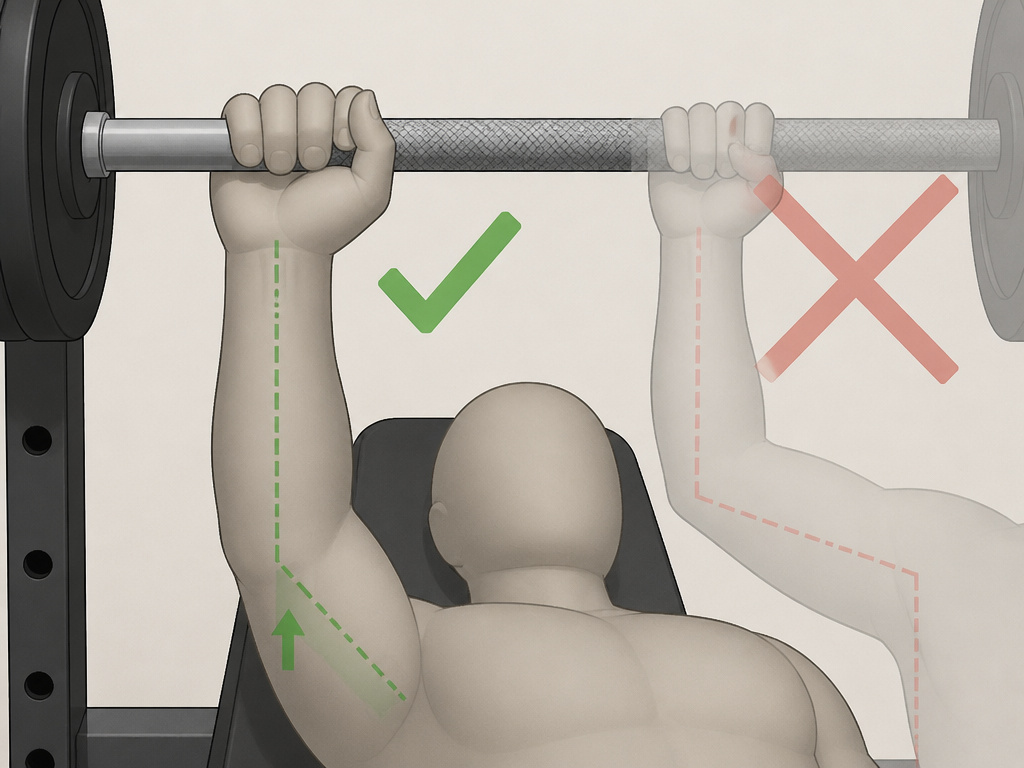
Everyone agrees your elbows shouldn’t be pointing at the ceiling in a guillotine position. What happens after that is where the advice splits.
Thumbs Around, or Thumbs Over the Bar?
The IPF rulebook is blunt: hands and fingers grip the bar with a thumbs-around grip, and that position is maintained throughout the lift.
The Cleveland Clinic lands in the same place from a different direction. Hold the weight in the palm and wrap the thumb over the fingers so you can brace the wrist. The rulebook makes it a requirement; the clinic frames it as wrist stability. Either way, the thumbless grip is the one to drop.
How Wide Should Your Grip Be?
Beginners should start at shoulder width. That grip works the chest, shoulders, and triceps together, while a wide grip shifts the emphasis to the pecs and a close grip loads the triceps.
For a close grip bench press, place your hands slightly closer than shoulder-width apart. Going narrower than that mostly shortens your range of motion and annoys your wrists.
The elbow question during the press is the messy one. Stronger by Science wants the elbows to flare and the shoulders to internally rotate as you drive up and back. ATHLEAN-X warns against high, guillotine-style elbows because they leave no room for the rotator cuff to work. The Cleveland Clinic says elbow position varies by individual and most people find their spot after a few reps.
My read: the bottom position is where the disagreement matters, and the fix is usually the same. If you’re fixing elbow flare on bench, you’re really fixing the shoulder blades.
Common mistake: Letting the elbows flare to ninety degrees at the bottom. The shoulder joint ends up carrying the bar in its least stable position, and the ache shows up the next morning, not during the set.
Where the Rulebook and the Gym Actually Disagree
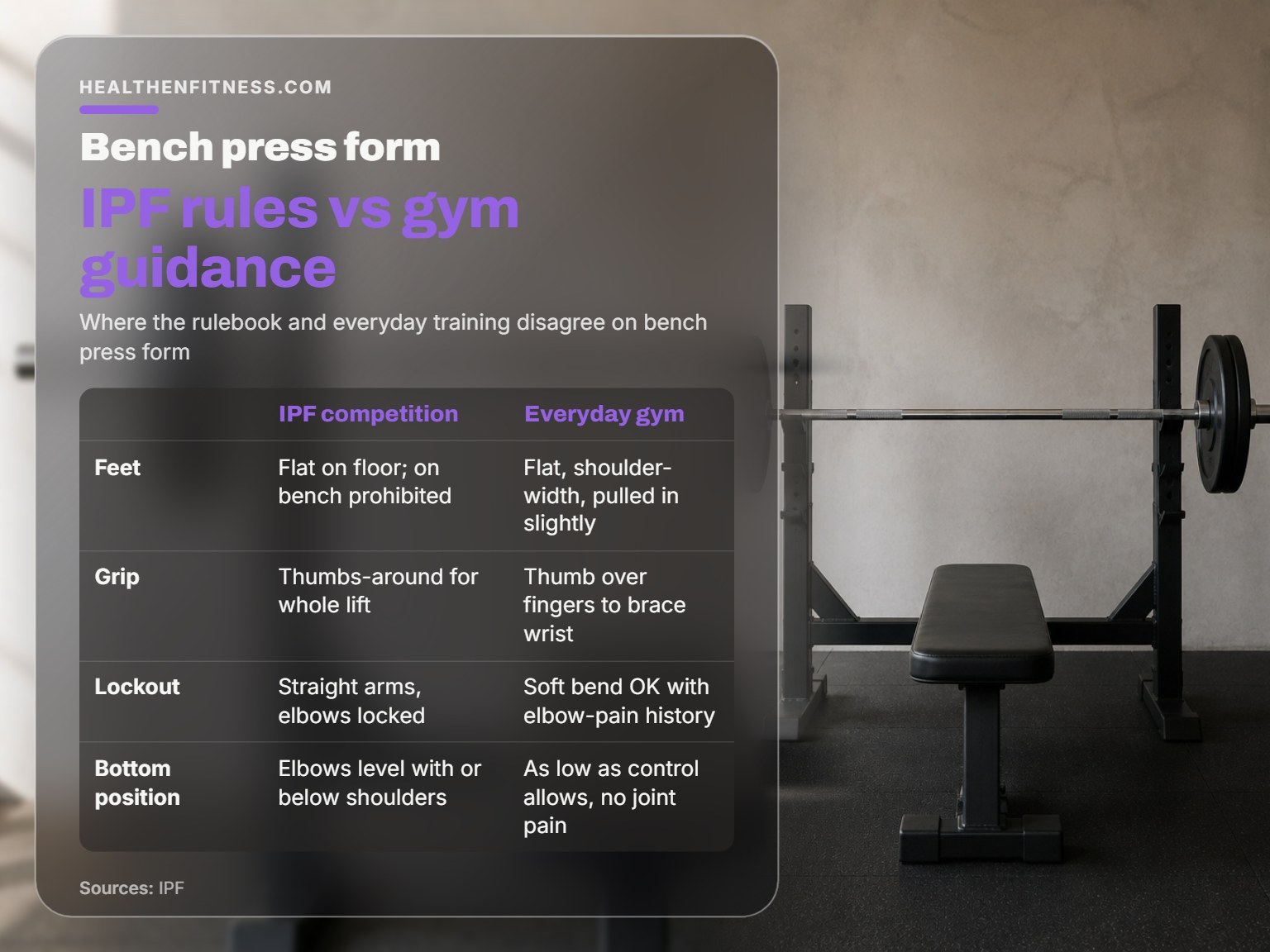
Two of the five rows below will change how you set up tomorrow, and neither one is about how strong you are.
| Point of form | IPF competition rule | Everyday gym guidance |
|---|---|---|
| Feet | Flat on the floor, never on the bench during setup | Flat, about shoulder-width, pulled in slightly if comfortable |
| Grip | Thumbs-around, held for the whole lift | Thumb over the fingers to brace the wrist |
| Lockout | Straight arms, elbows locked at completion | Soft bend acceptable with a history of elbow pain |
| Bottom position | Elbows level with or below the shoulder tops | As low as control allows without joint pain |
| Bar path | Not specified in the rulebook | Straight up, or up and back off the chest |
Lockout: Locked Elbows or a Soft Bend?
This is the cleanest disagreement in the whole lift. Competition rules require the bar pressed to straight arms’ length with elbows locked. Fail to lock out and the lift doesn’t count.
The Cleveland Clinic takes a different view for training. Locking out at the top isn’t inherently bad, but slamming into lockout can irritate the joint, and a soft bend at the top works fine for anyone with a history of elbow pain.
So the answer depends on what you’re doing. If you compete, lock it. If you’re training for general strength and your elbows complain, a soft bend costs you nothing.
How Often Should You Bench Press?
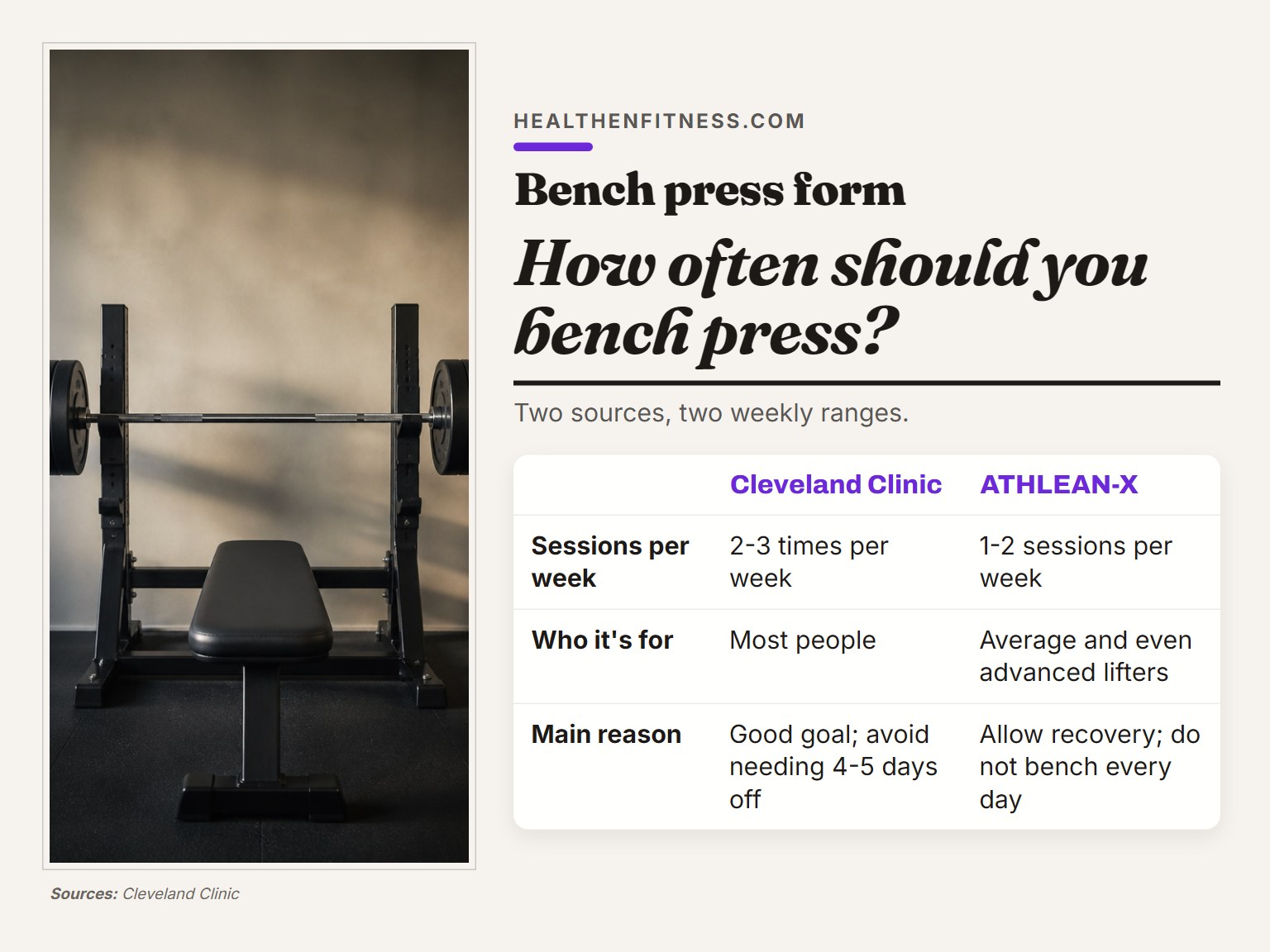
The Cleveland Clinic suggests two to three sessions a week for most people, while ATHLEAN-X caps average and even advanced lifters at one or two sessions a week to allow recovery.
But the sources don’t agree on the exact number, and it’s worth seeing both before you pick one.
The Cleveland Clinic says bench pressing two to three times each week is a good goal for most people, with a warning attached: don’t get so sore that you need four or five days off between sessions. ATHLEAN-X puts the ceiling lower, arguing that average and even advanced lifters should stick to one or two sessions per week to allow recovery, and that daily benching doesn’t leave enough time to rebuild.
Both are talking about hard sets. The two-to-three range assumes you’re not grinding every session into the dirt. The one-to-two range assumes heavier work with more recovery cost per set.
Start at two sessions. Add a third when soreness clears before the next one is due. If you’re still wrecked on day three, the extra session is costing you more than it’s building.
Where this goes sideways: Adding a third bench day because the program says so, while your last set of the week is already grinding. Two weeks in, the bar speed drops on every rep and you blame the program instead of the recovery.
How Many Reps, How Heavy, and When to Stop
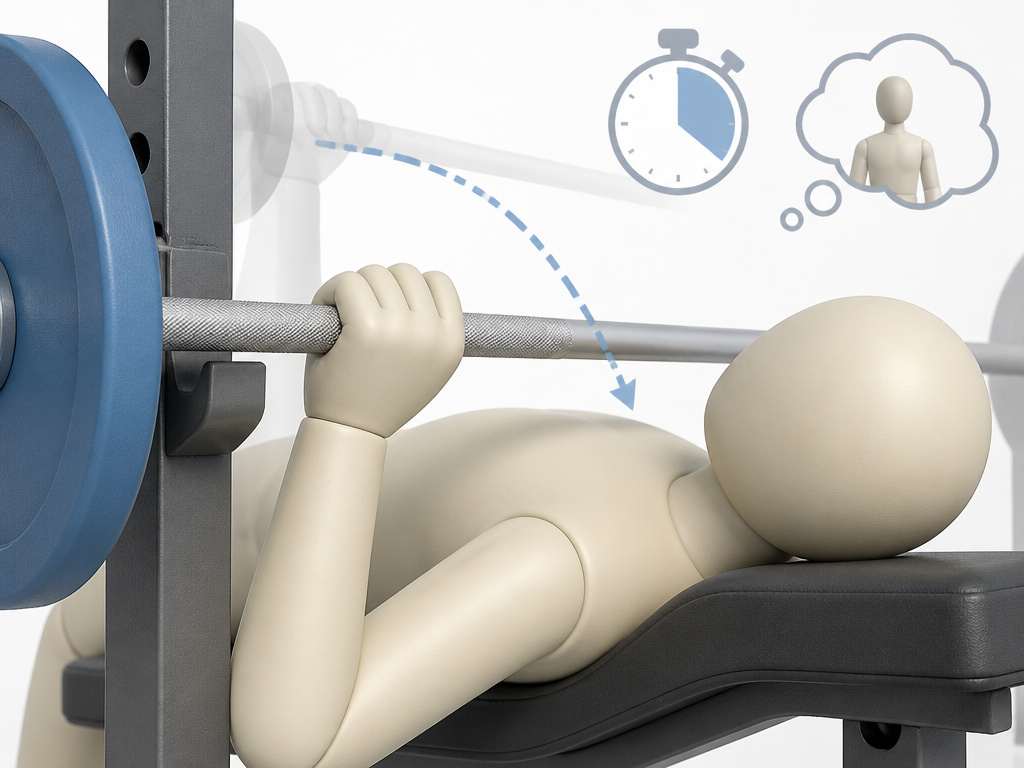
I used to finish every chest session with a high-rep burnout set. The last five reps were always ugly: elbows flaring, bar drifting toward my chin, lower back peeling off the bench. I dropped the finisher entirely. Controlled sets at a weight I could actually own left me fresher for the next session, and my pressing went up anyway.
The rep range depends on the goal. For muscle size, the Cleveland Clinic puts it at eight to 30 reps per set across two to three sets, with a simple starting point of three sets of 10 for beginners. Lower the weight with control over about three to five seconds.
The stop signal matters more than the number. You should feel like you could do two to three more reps when you rack it, and no more than that.
Here’s a why-layer most rep charts skip. Stronger by Science notes that research shows external cues, the “throw the bar through the ceiling” kind, produce faster bar speed and greater force. Internal cues, the “squeeze your pecs” kind, produce higher pec activation with weights below 80% of your max. Same lift, two different instructions, two different outcomes. If you want to move more weight, think about the bar. If you want to feel the chest working, think about the chest.
The part nobody mentions: A three-to-five-second lowering phase feels glacial at first. Count it out loud once. Most lifters who swear they’re lowering slowly are done in under two.
What Gets a Lift Red-Lighted
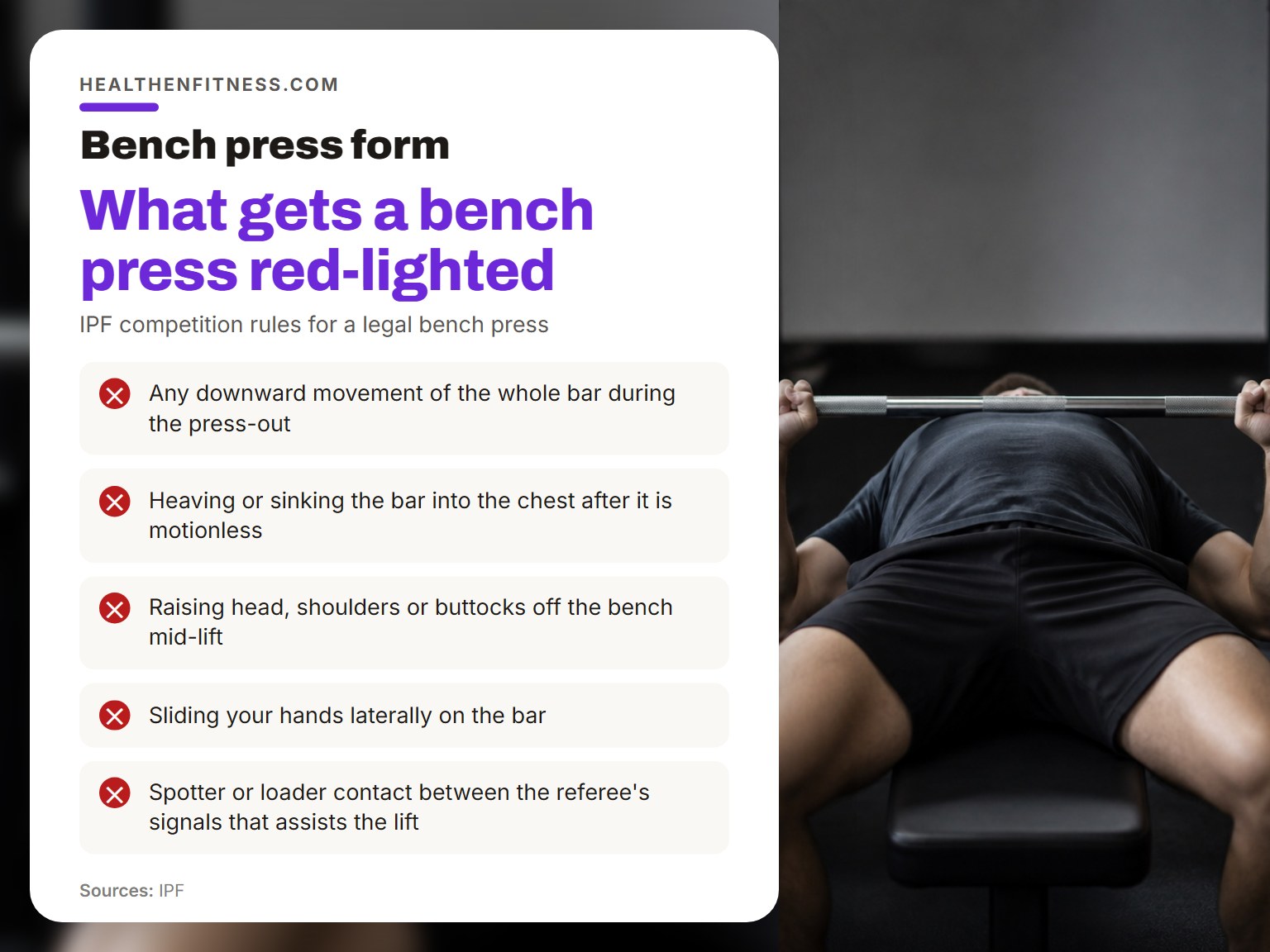
Several things end a bench attempt early, including a bar that stops moving down, a heel that comes off the floor, and a hand that slides on the bar.
Under IPF rules, any of these is a violation:
- Any downward movement of the whole bar during the press-out. The bar has to travel one direction once it starts up.
- Heaving or sinking the bar into the chest after it’s motionless, in a way that makes the lift easier.
- Raising your head, shoulders, or buttocks off the bench mid-lift, or sliding your hands laterally on the bar.
- Contact from a spotter or loader between the referee’s signals in a way that assists the lift.
- Lowering the bar short of the chest, or letting it touch your belt.
Some of these are competition-only. The bar-sinking one isn’t. Bouncing the bar off your chest is the same energy whether a referee is watching or not, and it’s the mistake I see most often in a commercial gym.
| What you notice | Likely cause | Fix |
|---|---|---|
| Bar drifts toward your face | Shoulder blades came unlocked | Reset the blades back and down before the rep |
| Miss at lockout | Elbows facing forward instead of away | Screw the elbows outward as you press |
| Buttocks lift off the bench | Feet too far forward, no leg drive | Pull the feet back and drive through the floor |
| Wrist aches after the set | Bar sitting high in the fingers | Set the bar in the palm, thumb around |
Bench Press Variations Worth Knowing
Ever watched someone press with a grip so narrow their elbows brush their ribs and wondered what that’s for?
Triceps, mostly. A close grip forces a longer range of motion through the triceps, which makes it a useful change of pace rather than a replacement.
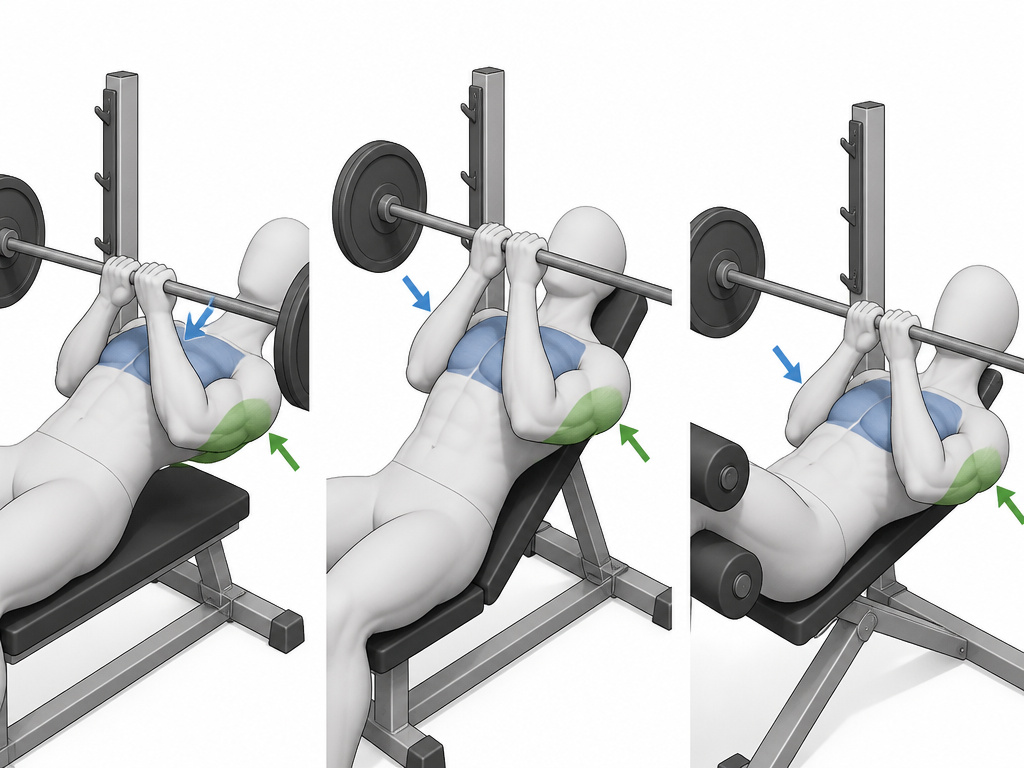
The incline bench raises the head of the bench toward upright and shifts work to the upper part of the pectorals. The decline bench press lowers the head of the bench up to 30 degrees and targets the lower fibers of the pecs. Neither is mandatory. Both are ways to keep the same lift interesting for another few months.
Close Grip and Decline: When They Beat the Flat Bench
Close grip wins when your triceps are the thing failing at lockout. Decline wins when you want the lower chest without the shoulder position of a flat press.
The overhead press covers the vertical push the bench can’t, and skipping it is why so many lifters have a strong chest and nothing above it.
I’d start a beginner on dumbbell presses and push-ups before the barbell. You get the same chest work from a shoulder position you can bail out of, and a dumbbell that stalls just stops moving instead of pinning you. A pair of adjustable dumbbells covers a lot of ground without a rack of dumbbells, and a barbell with a flat bench is the setup I’d point most home lifters toward once the dumbbells stop being enough.
Frequently Asked Questions
How wide should my grip be on a bench press?
Start at shoulder width. That grip trains chest, shoulders, and triceps together. A wider grip shifts emphasis toward the pecs and a narrower one loads the triceps, but neither is a better starting point for someone learning the movement.
Should my feet be flat on the floor when I bench press?
Yes, and it’s a rule in competition, not just a suggestion. Feet stay flat, about shoulder-width apart, and you can pull them in slightly as long as they stay flat. Placing your feet on the bench during setup is prohibited.
How long should I lower the bar on a bench press?
Around three to five seconds per rep if you’re training for muscle size. The eccentric phase is where a lot of the growth stimulus lives, so rushing it gives away free work. If you can’t control the descent, the weight is too heavy.
Can I bench press every day?
No. ATHLEAN-X is explicit that daily benching doesn’t leave enough recovery time for the muscles to rebuild. The Cleveland Clinic’s guidance of two to three sessions a week comes with a soreness check: if you need four or five days off between sessions, you’re doing too much.
Is it bad to lock out my elbows at the top?
Locking out isn’t inherently harmful. Slamming into lockout can irritate the joint, though, and a soft bend at the top is a reasonable choice if you have a history of elbow pain. In competition, straight arms with locked elbows are required for the lift to count.
Do I need a spotter to bench press?
It’s safer with one, and the Cleveland Clinic notes that a spotter also gives you confidence to push harder. If you train alone, set the safety bars at a height that catches the bar just below your chest before you load anything heavy.
The Bottom Line
Here’s the trigger I’d give anyone: if you can’t finish a rep without the bar drifting toward your face, the weight comes off. That drift means your shoulder blades are coming loose, and it happens before the rep fails, not after.
One concession worth stating plainly. If you compete, the rulebook wins over comfort every time. Locked elbows, thumbs around the bar, feet flat, no belt contact. The softer guidance here is for training, not for a platform.
And if you’re brand new, the flat barbell bench isn’t the only door in. Dumbbell presses and push-ups train the same chest with a shoulder position you can escape from, and nobody hands out medals for starting with the hardest version.
Keep it simple and keep showing up.
Do this today: before your next set, lie back, pull your shoulder blades down and together, and hold that position for a full breath before you touch the bar.
