
Are Naps Good for Muscle Recovery? What the Data Says
This post contains affiliate links. As an Amazon Associate, we earn from qualifying purchases.
Naps are good for muscle recovery, but the benefit lands on how you feel rather than on tissue repair. A 2025 meta-analysis of 35 studies found napping lowered perceived exertion during exercise (SMD 1.62) and improved perceived recovery (SMD 1.66), while showing no significant effect on muscle soreness.
Perceived exertion and perceived recovery are self-reported scales, which is exactly why the are naps good for muscle recovery question moves so easily. A nap changes the brain’s read on the effort you just made, and that read is what gets you back under the bar. The tissue side is a slower, murkier story.
What follows separates the outcomes with real support from the ones the reviews keep failing to confirm. It covers the 20-versus-90-minute argument, the timing detail most nap advice skips, and the one number in this literature nobody should trust yet.
Key Takeaways
- Perceived effort is the strongest result. Napping cut RPE during exercise at SMD 1.62, the only outcome the 2025 review rated moderate certainty.
- Soreness stays unproven. That same review found no significant effect on muscle soreness despite a large SMD of 1.57.
- Aim for 25 to 90 minutes; the 2025 review recommends taking naps between 13:00 and 16:00, though a 2025 timing trial found 13:00 beat 15:00.
- Longer naps may favor power output, though the 2023 review found no significant effect on muscle force (ES 0.175, p=0.267) while the judoka trial found power gains after ~90 min, and that trial ran athletes through partial sleep deprivation first.
- Give yourself more than 30 minutes between waking and training. Thirty minutes may not be enough to clear sleep inertia.
What Does “Recovery” Mean in a Nap Study?
Four different things get called recovery in this literature, and they don’t move together.
Daytime napping is assessed against four separate outcome families: rating of perceived exertion during and after exercise, perceived recovery status, self-reported fatigue, and delayed-onset muscle soreness. Pooled effect sizes differ sharply across those families, and the certainty of the underlying evidence differs with them. Only the perceived-exertion result reaches moderate certainty.
Here’s what each one actually measures:
- Rating of perceived exertion (RPE): how hard the work feels, scored during or right after the set.
- Perceived recovery status: a self-rating of how restored you feel, often taken five minutes after waking.
- Fatigue: general tiredness, not tied to any specific muscle group.
- Muscle soreness (DOMS): the stiff, tender feeling that arrives 24 to 72 hours after hard work.
Only the first has moderate certainty behind it. The other three sit at low to very low on the GRADE scale, which is the standard system for rating how much confidence a body of evidence deserves.
That gap matters more than any single effect size. A nap leaves you feeling looser and less beaten up while your soreness scores sit exactly where they were. Both things are true at once.
Night sleep does the structural work. If you want the bigger lever, sleep and muscle growth covers what happens across a full night.
The Numbers That Hold Up and the Ones That Don’t
Training hard with a little more weight every session, my elbows eventually ached badly enough that I took time off. That was the first time recovery stopped being an abstract idea for me.
So when a pooled analysis reports that naps improve perceived recovery at SMD 1.66, I want to know what the are naps good for muscle recovery number is measuring.
Napping lowered RPE during exercise at SMD 1.62 and after exercise at SMD 1.11. It improved perceived recovery at SMD 1.66 and reduced fatigue at SMD 0.91. Those are large numbers by the usual standards.
Then there’s muscle force. A daytime napping after normal sleep review covering 18 studies and 269 participants found no significant effect on muscle force (ES 0.175, p=0.267).
That’s the awkward one. Napping didn’t move force production in the pooled data, even though it moved how hard the same work felt.
Read the two together and the shape gets clearer. Naps change perception reliably and contractile output inconsistently. If your goal is to feel less wrecked walking into the gym, the evidence is on your side. If your goal is a bigger squat single today, don’t count on it.
One more limit: only one of those 18 studies included female athletes. The rest were male-only, which caps how far the pooled numbers travel.
The baseline still comes first. How much sleep athletes need is 7 to 9 hours a night, and a nap doesn’t replace any of it.
How Long Should You Nap: 20 Minutes or 90?
Ever set a 20-minute alarm, spent 15 of those minutes staring at the ceiling, and woken up feeling worse than before?
Duration is where the research splits hardest, and the split isn’t a rounding error.
What a 20-Minute Nap Gives You
A roughly 20-minute nap reduced multiple-choice reaction time with an effect size of 0.61 in nine male judokas who had been partially sleep deprived. That result is about decision speed. It says nothing about strength.
The same trial concluded that a short nap suits effort that’s brief and demands frequent decisions. Think a conditioning circuit with a lot of reacting, or a skill session.
What a 90-Minute Nap Gives You
Minimum power and mean power rose only after the roughly 90-minute nap, at d=1.63 and d=1.16. Neither moved after 20 minutes.
The mechanism is slow-wave sleep. A 30-minute nap contains about 1.4 minutes of it. A 60-minute nap gets 13.7 minutes. A 90-minute nap reaches 16.0 minutes. More slow-wave sleep means more of the restorative work.
A 20-minute nap ends before your body gets heavy. A 90-minute nap ends with you surfacing from something, and the first moments back are thick.
The 2025 review recommends 25 to 90 minutes as the practical window for sport settings, while the 2023 review favors longer naps and the judoka trial splits it by task. That range is wide on purpose.
| What you need | 20-25 minute nap | 90 minute nap |
|---|---|---|
| Brief effort, fast decisions | Better fit | Less suited |
| Minimum and mean power | No measured gain | Gains after 90 min |
| Slow-wave sleep available | About 1.4 min | About 16 min |
| Sleep inertia on waking | Lower risk | Higher risk |
| Fitting it into a workday | Easy | Hard |
I’d start at 25 minutes and only go longer when the session after it is genuinely hard. A 90-minute nap eats a big chunk of a workday, and the payoff shows up mostly in power output and damage markers, not in how your knees feel on the stairs.
Common mistake: Setting a 90-minute alarm when you have 75 minutes before you need to leave. You wake into sleep inertia with no buffer, and 30 minutes after waking may not be enough to clear it.
(I’ve done this. Twice. The second time I set a longer alarm and somehow made it worse.)
Why 13:00 Beats 15:00 for a Post-Lunch Nap
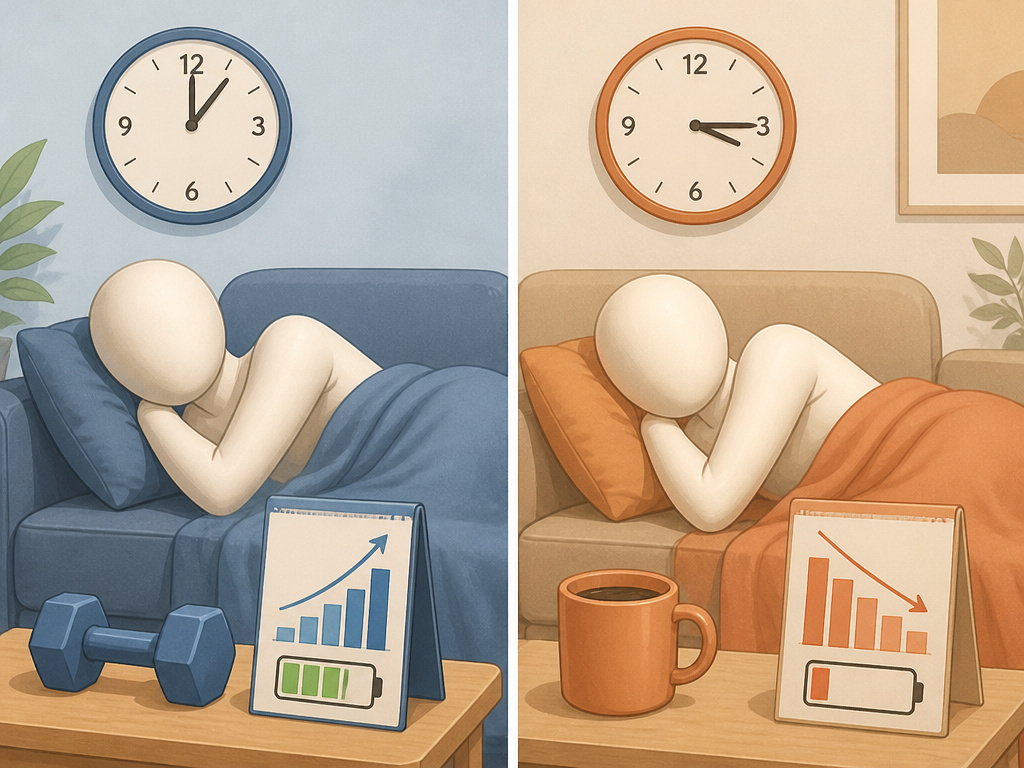
The post-lunch dip runs roughly 13:00 to 16:00, and performance sags through it. Sleepiness climbs, vigilance drops, and the 14:00 meeting gets harder than the 9:00 one.
If you’ve sat through that meeting with your eyelids at half mast, you know the dip before you know the term for it.
The 13:00 nap beat both on total distance in the 5-meter shuttle run test (p=0.001 against the 15:00 nap, p=0.0009 against the 15:00 no-nap control).
The same trial found no significant effects on fatigue index, feeling scale, or the Hooper index. So the win was narrow and specific.
There’s a cost too. Perceived recovery status at five minutes after waking was lower under both nap conditions than under no nap. That’s sleep inertia showing up on the score sheet.
The lesson is that a nap isn’t free. You pay for it in the first minutes after the alarm.
If you’re chasing the same dip with a second coffee, caffeine and sleep explains why that trade usually costs you at night.
The Soreness Question Nobody Has Settled
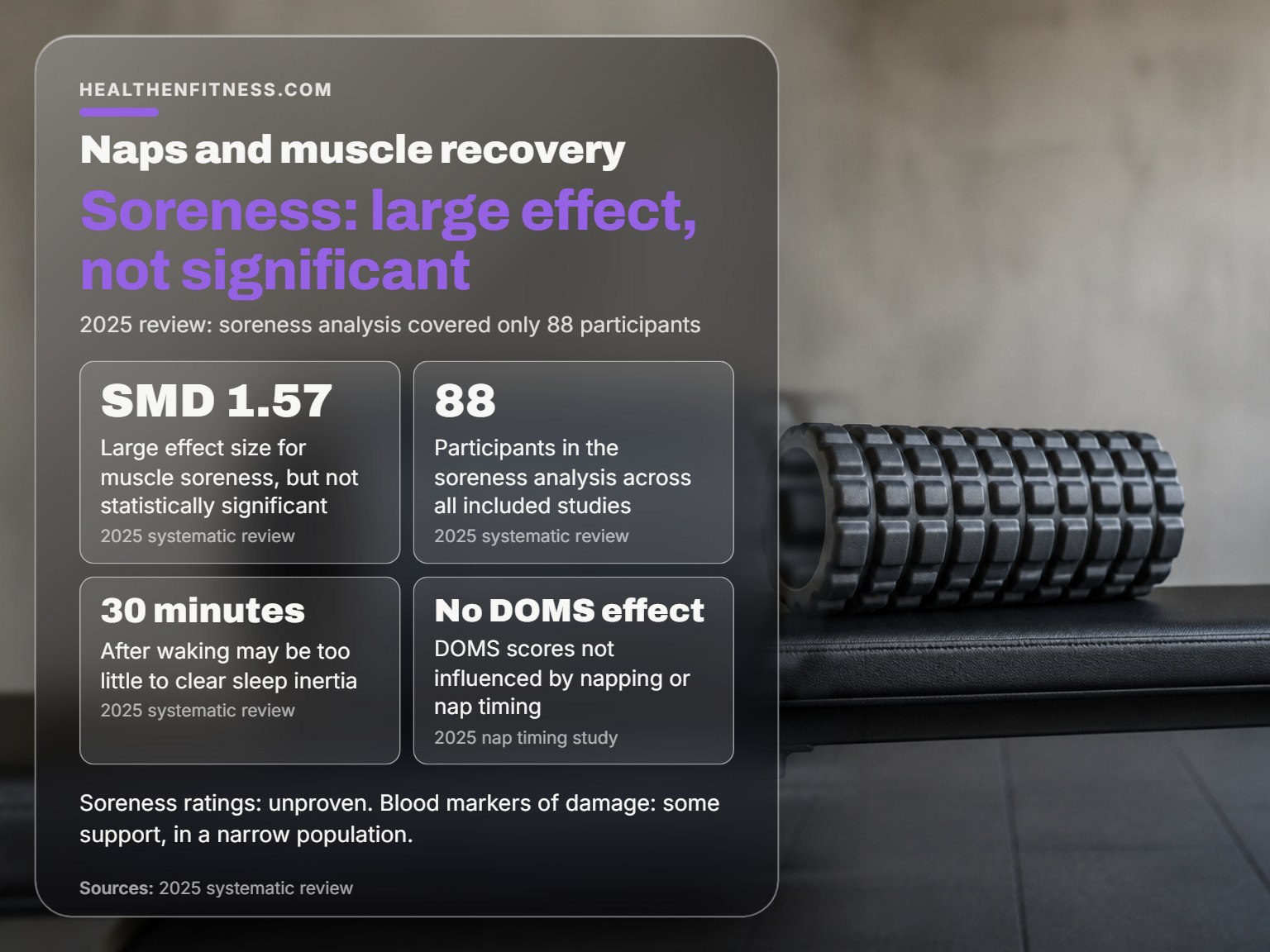
Soreness is the outcome most lifters care about, and it’s the one the evidence handles worst.
I ran a massage gun over sore quads after heavy leg days. A few minutes in, everything felt great. My soreness the next morning was identical to the weeks I skipped it entirely. I still use it, but I’ve stopped pretending it changes the recovery curve.
Napping has the same problem in the data. The 2025 review found a large effect size for muscle soreness (SMD 1.57) that was not statistically significant. The soreness analysis covered only 88 participants across all included studies.
The review’s own read is that the sample was too small and underpowered to detect the effect. It also flags one included study that allowed only 30 minutes between waking and testing, which recent meta-analyses suggest is insufficient to clear sleep inertia.
A separate 2025 timing trial found DOMS scores weren’t influenced by napping or by nap timing at all. Its authors suggest there may simply have been too little soreness to begin with for a benefit to show.
Then there’s the biomarker side, which tells a different story. A longer nap opportunity may be preventive against muscle and oxidative damage, even at higher performance outputs, according to work in partially sleep-deprived judokas.
So the honest answer splits by what you measure. Soreness ratings: unproven. Blood markers of damage: some support, in a narrow population.
The broader question of sleep and exercise-induced muscle injury is better established than the nap-specific version of it.
Where the Research Disagrees
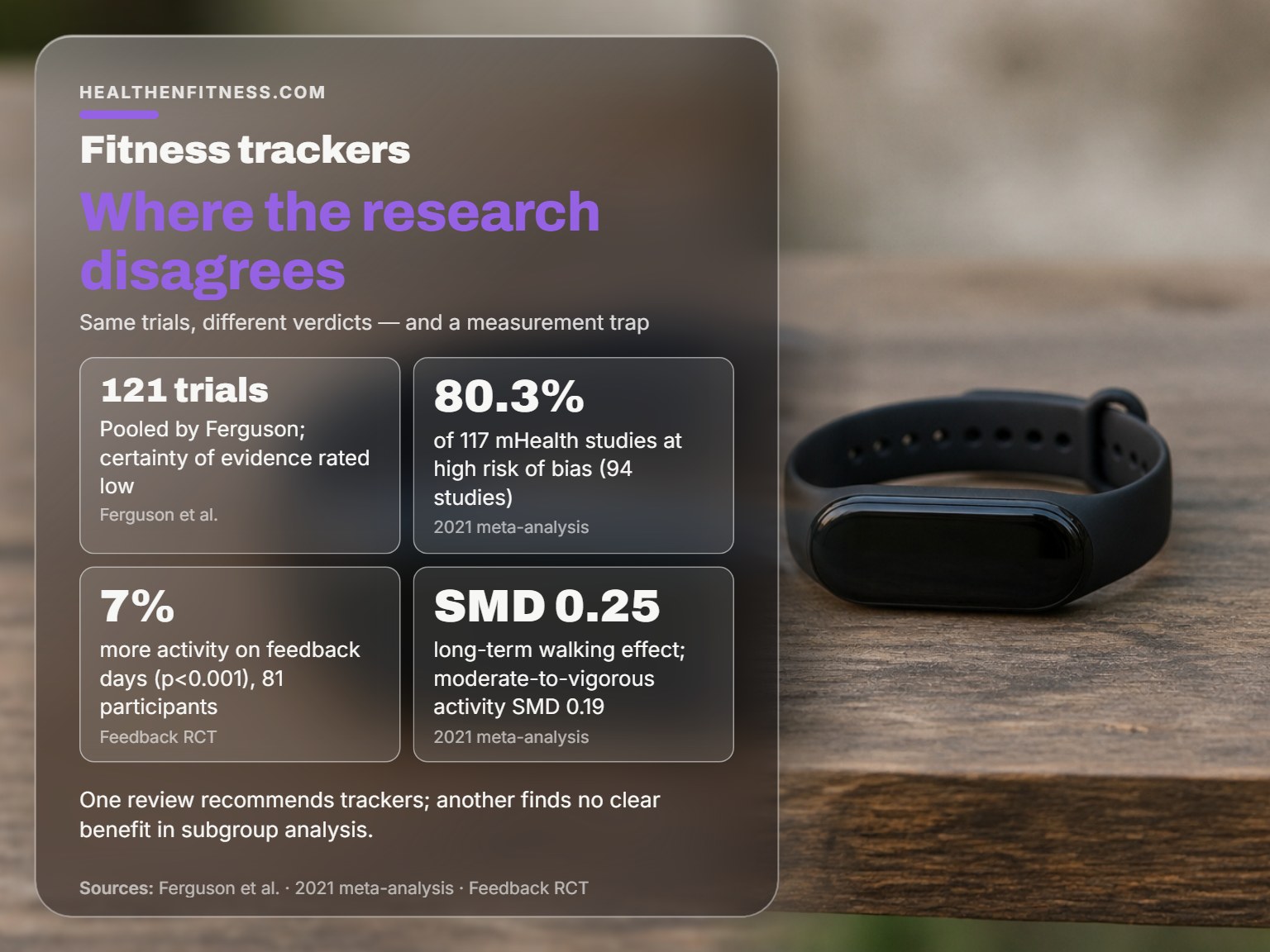
Four of the biggest questions here have two defensible answers each, and any article that hands you one clean rule is skipping the argument.
| Question | One position | The other position |
|---|---|---|
| Muscle soreness | 2025 review: no significant effect (SMD 1.57) | 2020 judoka trial: longer naps may limit damage |
| Muscle force | 2023 review: no effect (ES 0.175, p=0.267) | 2020 judoka trial: power up after 90 min |
| Best duration | 2023 review: longer naps favored | 2020 judoka trial: short for brief efforts |
| Evidence quality | 2025 review: low to very low except RPE | 2023 review: 15 of 18 rated strong |
| Nap timing | 2025 review: 13:00 to 16:00 window | 2025 timing trial: 13:00 clearly beats 15:00 |
On duration, the 2023 review concluded longer naps might be more beneficial for physical performance. The 2020 judoka trial split it by task, favoring short for brief and decision-heavy work and long for damage and oxidative stress. The 2025 review splits the difference at 25 to 90 minutes.
On muscle force, the pooled 2023 data found nothing. The judoka trial found minimum and mean power gains after 90 minutes. Those two measure different things. Force is a single maximal contraction. Power is force times velocity across a whole effort.
On evidence quality, the 2025 review rates certainty low to very low except for RPE. The 2023 review rated 15 of its 18 studies as strong. Same literature, different verdicts.
On timing, the 2025 review recommends the 13:00 to 16:00 window, while the 2025 timing trial found a 13:00 nap beat a 15:00 nap, suggesting later naps can backfire.
What to do with all that:
- Trust the RPE result more than anything else in this literature.
- Treat soreness claims as unproven in both directions.
- Pick duration by task, not by a universal rule.
- Nap early if you nap at all, though the 2025 review recommends the broader 13:00 to 16:00 window while the timing trial found 13:00 beat 15:00.
The bigger variable is still the night before. Improve sleep quality for recovery before you start optimizing a 25-minute window.
How to Nap Without Losing the Afternoon
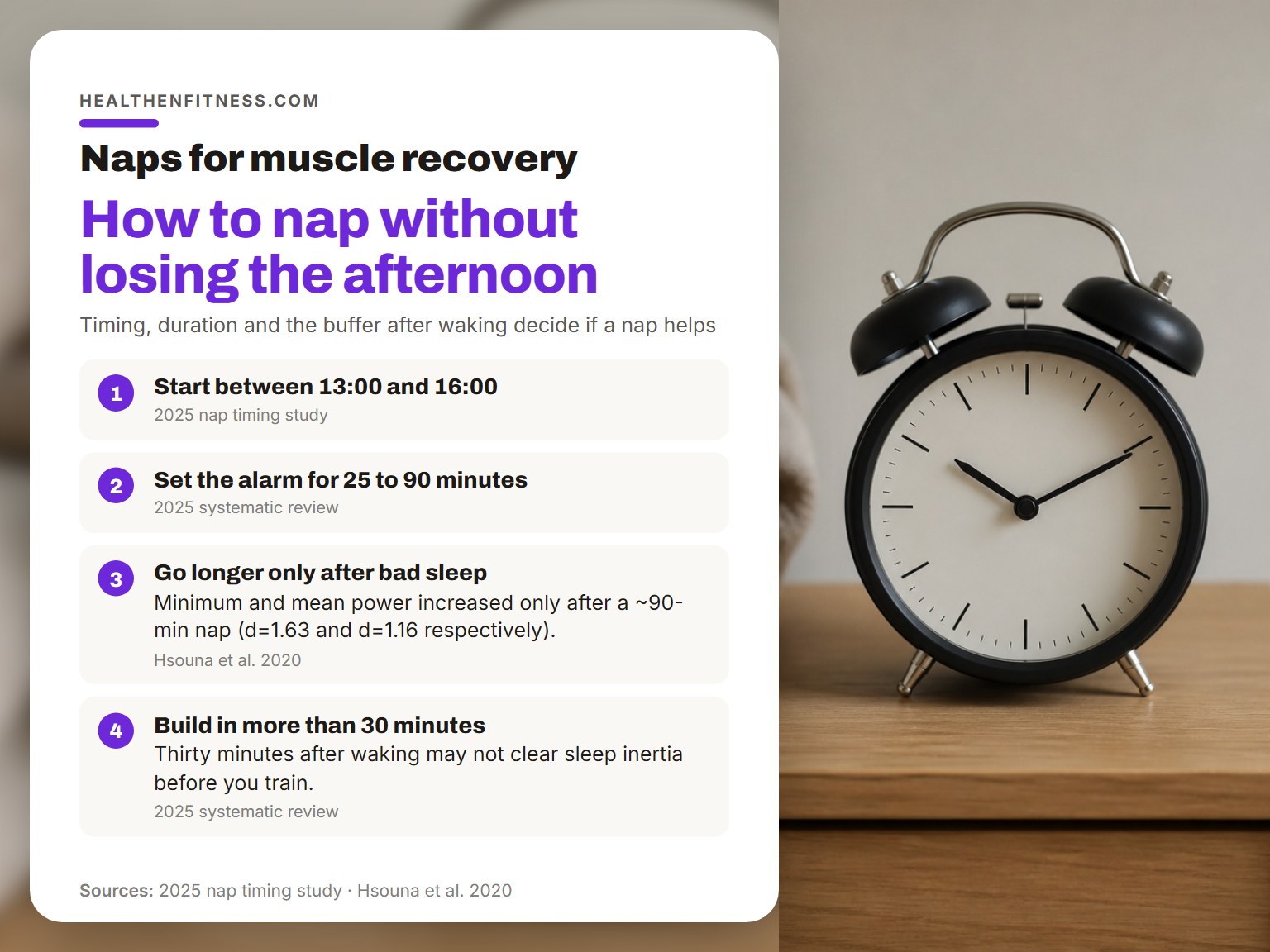
Three things decide whether a nap helps or wrecks the next four hours: when you start, how long you set the alarm for, and what you do in the ten minutes after you get up.
- Start between 13:00 and 16:00. The dip is already working for you, and the 13:00 slot beat 15:00 on total distance in the timing trial. Nap at 15:00 and you risk pushing your night sleep later.
- Set the alarm within the 25 to 90 minute range if the next session is skill or conditioning work. Go longer and you’ll wake out of slow-wave sleep, which is where that thick-headed first minute comes from.
- Set it for a longer nap only if the next session is heavy and you slept badly. The power gains in the judoka trial showed up after partial sleep deprivation, not after a normal night.
- Build in a buffer before you train. Thirty minutes after waking may not be enough to clear sleep inertia. Give yourself more than 30 minutes if your schedule allows.
- Skip the nap if it sits late enough to push your bedtime back. You’ll trade a small afternoon gain for a worse night, and the night is worth more.
The Two-Alarm Trick
Set one alarm for 25 minutes and a second a few minutes later as a hard stop. The first gets you out of sleep. The second is a hard stop for the lying-there-blaming-yourself phase.
When to Skip the Nap Entirely
Two situations where the nap costs more than it returns. If you slept a full 7 to 9 hours and your next session is light, you’re spending time on a nap for a benefit you probably won’t notice. And if the nap lands late enough to eat into your night, the trade is bad.
A nap is a patch. The night before is the repair. One changes how the next session feels, and the other changes what the next session can actually do.
Skip this if: You slept 7 to 9 hours and your next session is a light one. You’ll spend the time to feel roughly the same.
Fix the bedtime routine for recovery first, then add a nap if you still need one. Other muscle recovery methods are worth more of your attention than a 25-minute window.
Frequently Asked Questions
Are naps good for muscle recovery?
They’re good for how recovery feels. Napping lowered perceived exertion during exercise at SMD 1.62 and improved perceived recovery at SMD 1.66 in a 2025 meta-analysis of 35 studies. The evidence for actual tissue repair is much weaker, and the pooled data showed no significant effect on muscle soreness.
How long should a nap be for recovery?
The 2025 review puts the practical range at 25 to 90 minutes. Short naps suit brief efforts that demand fast decisions, while longer naps carry more slow-wave sleep and show up better on power output and damage markers.
Do naps help with sore muscles?
The data is split and you should know it. The 2025 review found a large effect size for soreness (SMD 1.57) that wasn’t statistically significant across only 88 participants. A separate 2025 timing trial found no DOMS effect at all. Biomarker studies in sleep-deprived athletes suggest longer naps may limit muscle damage, which is a different measure than how sore you feel.
Is a 90-minute nap better than a 20-minute nap?
It depends on what comes next. A 90-minute nap produced gains in minimum and mean power (d=1.63 and d=1.16) that a 20-minute nap didn’t, but that trial ran on partially sleep-deprived athletes. For brief, decision-heavy work, the 20-minute nap reduced reaction time (d=0.61) and carries less sleep inertia.
What time should I nap?
The 2025 review recommends napping between 13:00 and 16:00, while a 2025 timing trial found a 90-minute nap at 13:00 beat the same nap at 15:00 on shuttle run total distance, suggesting earlier is better within that window.
Can napping replace sleep at night?
No. Normal sleep is defined as 7 to 9 hours a night, and napping is studied as a supplement to that, not a substitute. Naps do appear preventive against performance decline caused by sleep loss, but that’s damage control, not a replacement.
The Bottom Line
Here’s the threshold I’d use. If you slept under 7 hours and you have a heavy session in the afternoon, a longer nap starting around 13:00 is worth rearranging your day for. If you slept a full night and the session is light, skip it. The evidence for that second case is thin and the time cost is real.
One concession: this whole picture comes from small trials, mostly male athletes, with inconsistent nap protocols. A short nap in one lab isn’t the same as a short nap in another. Treat the effect sizes as direction, not dosage.
And keep the soreness question open. Feeling less beaten up after a nap is a genuine result. It just isn’t the same claim as your muscles repairing faster, and the reviews haven’t closed that gap yet.
Today, just set an alarm within the 25 to 90 minute range tomorrow after lunch, lie down, and see whether the afternoon session feels different. That’s the whole experiment.
