
How to Build a Bedtime Routine for Recovery: 3 Steps
This post contains affiliate links. As an Amazon Associate, we earn from qualifying purchases.
To build a bedtime routine for recovery, anchor three things: a fixed wake time, a wind-down hour without screens, and a bed you only enter when drowsy. The Sleep Foundation suggests starting with three steps and adding more later. Kaiser Permanente allows plus or minus 20 minutes of drift, seven days a week.
That 20-minute window is the part that falls apart on a Friday. Kaiser sets it as the outer edge of a regular schedule; the NHLBI guidance says same time every day and leaves the tolerance unstated. Hold the tighter number and your body clock gets one clear signal all week.
What follows is the order that matters: the three steps to open with, the clock math that sets your bedtime, and the places where the major sleep sources contradict each other.
Key Takeaways
- Start with three steps, not a full routine. The Sleep Foundation’s advice is to add pieces over time, and repetition is what makes the sequence automatic.
- Keep sleep times regular. Kaiser Permanente allows plus or minus 20 minutes, seven days a week; the NHLBI says go to bed and wake up at the same time every day and sets no number.
- Naps split the experts. The NHLBI says adults should nap no more than 20 minutes and limit naps if they have trouble falling asleep at night; Kaiser Permanente says avoid naps.
- Get out of bed after 15 minutes of wakefulness. Kaiser Permanente’s instruction: read a book, with no Internet or TV; the Sleep Foundation does not specify a time limit.
- Keep hard exercise out of the last hour before bed. The Sleep Foundation found vigorously exercising in the hour before sleep can impair sleep; exercise later in the day but not in that hour did not seem to negatively impact sleep.
Does a Bedtime Routine Actually Improve Sleep?
The Sleep Foundation says the quiet part out loud: bedtime routines have not been widely studied. Its guidebook calls the supporting research initial and suggestive, then recommends building one anyway.
Bedtime routines have not been widely studied. The Sleep Foundation calls the supporting research initial and suggestive rather than settled. Kaiser Permanente lists a bedtime ritual as a core behavior method in its insomnia program. Both organizations still recommend building one, and neither treats thin evidence as a reason to skip it.
That gap between evidence and advice tells you how to build a bedtime routine for recovery and how to hold the recommendation. A routine is a cheap bet. A few wasted evenings on one side, a bedtime cue your body answers on its own on the other.
What the sources do agree on is narrower and more useful. Going to sleep at a consistent time makes it easier to fall asleep, according to the Sleep Foundation. Repetition does the rest: the more you stick to a routine, the easier the routine gets.
Kaiser Permanente treats it as more than a nice habit. Its insomnia program lists a bedtime ritual, such as a warm bath or shower plus quiet time, as a core behavior method. The payoff for training is real too, since sleep and muscle growth are tied together more tightly than most lifters assume.
I’ve built and abandoned this routine more times than I want to count, and the versions that survived were always the dull ones. Two or three actions, same order, no app.
Dull wins.
How to Build a Bedtime Routine for Recovery in Three Steps
Night one goes fine. Night four is where routines die, because the first version was too big to repeat on a tired Tuesday.
The Sleep Foundation’s advice is to start small with three steps and add more over time. That’s the whole plan. Three, then more.
Before you start: Cutting time in bed is a clinical technique from a structured insomnia program, not a general wellness tip. If you take sleep medication, manage a medical condition, or work rotating shifts, run the plan past a clinician first. And expect the first two weeks to feel worse, because that’s how long Kaiser says the adjustment takes.
- Set the wake time first, and keep it inside 20 minutes. Kaiser’s tolerance is plus or minus 20 minutes, seven days a week. Skip this and the rest of the routine has nothing to hang on.
- Build a wind-down hour. Kaiser asks for an hour or so of relaxing before bed; the Sleep Foundation wants devices out of the room before that hour starts. Cut the hour and you’re asking your brain to downshift from a screen to sleep in one move.
- Make the bed a sleep-only zone. Go to bed only when drowsy, and if you’re awake past 15 minutes, get up. Stay and fight it, and the bed slowly becomes the place where you lie awake.
Those three cover the mechanics. Two additions come later, once they feel automatic.
The first is a one-week sleep log, which is the same trick as writing your reps in a notebook. The second is a daytime relaxation practice, done in the afternoon rather than in bed. Kaiser places both in its program, and neither works as a rescue move at 11pm.
I’ve tried the ten-step version of this. It lasted nine days.
What Time Should You Get Into Bed?
Five and a half hours is the number Kaiser Permanente uses when your current sleep is very short. It’s also the number almost nobody quotes, because it sounds backwards.
Here’s the math. Log your sleep for a week, add the hours, divide by seven. If that average is under 5.5 hours, you start your new schedule with 5.5 hours in bed. If it’s over, you start with your average. Then subtract those hours from your chosen wake time to get your earliest allowable bedtime.
The reasoning behind it is blunt. Too much time in bed is the most common cause of insomnia, per Kaiser, including lying there before you’re drowsy and after you wake up. Your nervous system runs on regular sleep-wake cycles, and a long bed window blunts the signal.
| What you notice | What’s usually driving it | What to change |
|---|---|---|
| Lying awake before you feel drowsy | More time in bed than sleep | Go to bed later, at the calculated time |
| Waking at 3am and checking the clock | Clock-watching feeds the worry | Turn the clock to face the wall |
| Falling asleep fast, waking too early | Schedule longer than your sleep need | Match hours in bed to your average |
| Routine collapses every weekend | Drift past the tolerance | Hold within 20 minutes, all seven days |
Track sleep efficiency while you’re at it. Hours slept divided by hours in bed, times 100. Six hours slept in a seven-hour window is 86%. Kaiser uses that figure to decide when to add time back.
Give the whole thing two weeks before you judge it. The first stretch feels worse, and that’s expected rather than a sign it failed. Total sleep needs are a separate question from the size of your bed window, so don’t confuse the two.
Where the Sleep Authorities Disagree
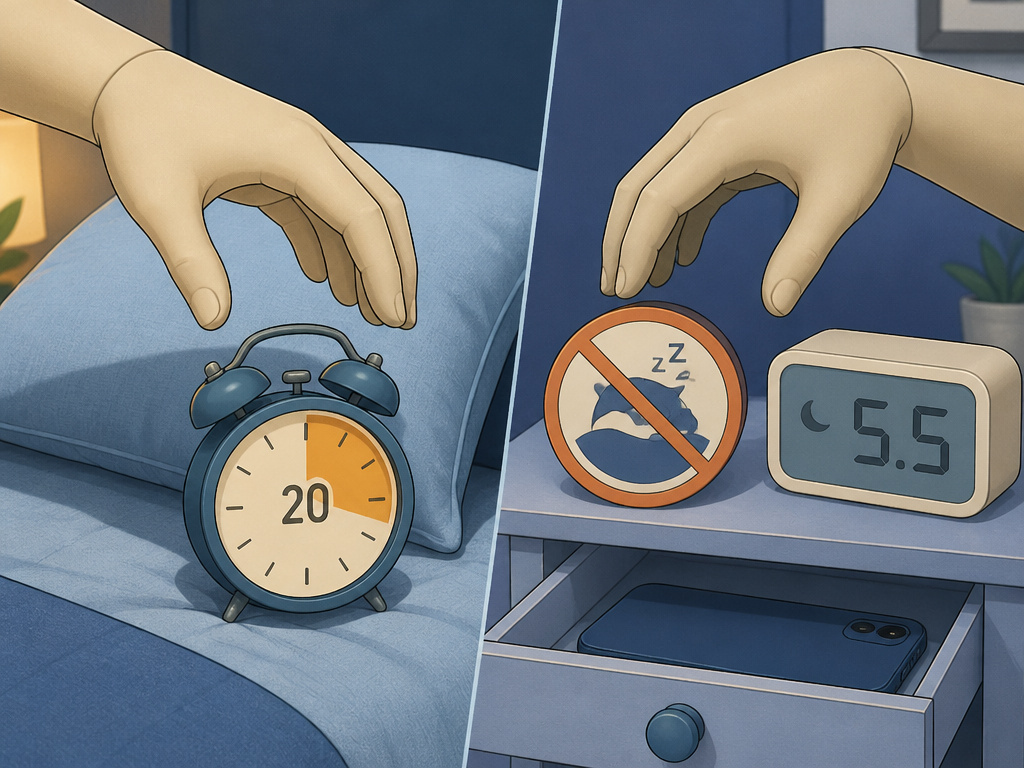
You can follow every major sleep source at once and still get contradictory instructions. The nap question is the clearest example.
Where this goes sideways: Following the NHLBI nap cap and Kaiser’s no-nap rule simultaneously. Pick one and stay with it for a month, because switching weekly means you never learn how naps affect your own night.
| Question | NHLBI / Sleep Foundation | Kaiser Permanente |
|---|---|---|
| Should adults nap? | Yes, 20 minutes maximum | Avoid naps |
| How much schedule drift? | Same time daily, no figure given | Plus or minus 20 minutes, 7 days a week |
| Screens before bed? | Devices out of the room | No Internet or TV if you get up |
| Time in bed? | Build a routine, no restriction given | Cut it to 5.5 hours or your average |
The nap split has a real logic to it. The NHLBI position is that napping may boost alertness and performance, with a 20-minute cap and a note to limit naps or take them earlier in the afternoon if you struggle to fall asleep at night. Kaiser’s position comes from insomnia treatment, where any daytime sleep chips away at the pressure that gets you to sleep at night.
Both are describing different people. That’s the part worth holding onto.
- Follow Kaiser if you’re fighting insomnia. Its protocol is the more aggressive one, and cutting time in bed is the lever with the strongest reasoning behind it; the Sleep Foundation does not specify restriction of time in bed.
- Follow the NHLBI if you sleep fine and just want a sharper afternoon. The NHLBI caps naps at 20 minutes; Kaiser Permanente says avoid naps entirely.
- Follow the Sleep Foundation on devices. It says avoid digital devices as much as you can when winding down and put them in another room; Kaiser Permanente says no Internet or TV if you get up at night.
If you want the longer version of the nap argument, naps get a full breakdown of when they help recovery and when they backfire.
The Wind-Down Hour: Screens, Light, and the Room
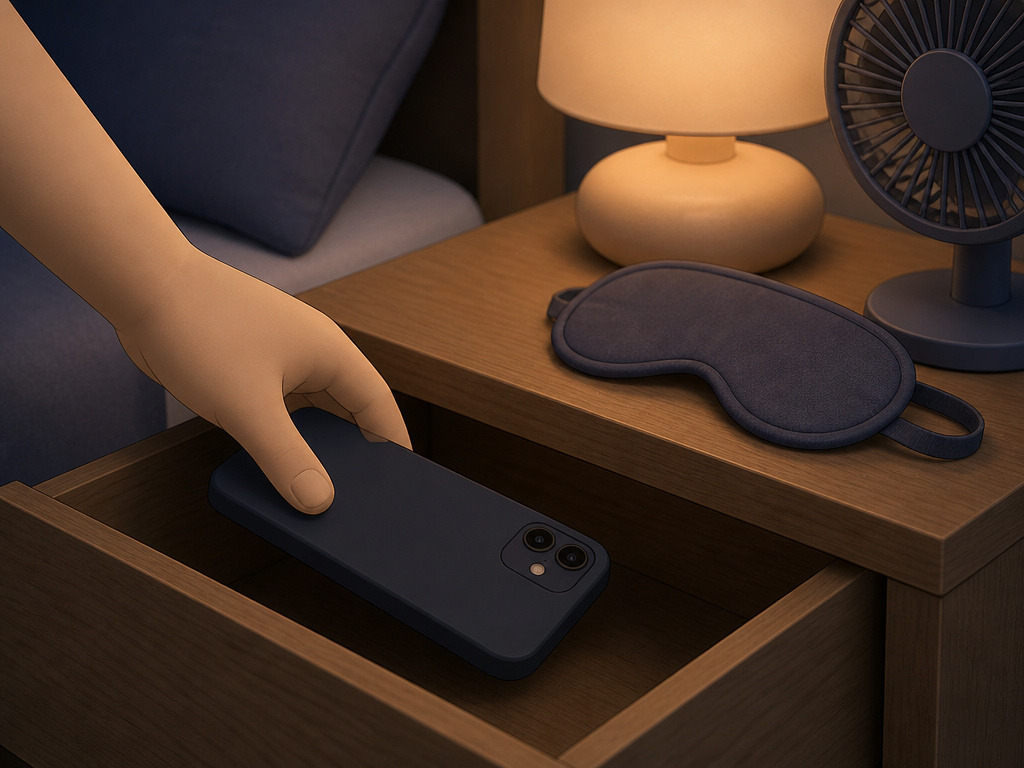
It’s 10:40 at night, the phone is face-up on the nightstand, and the last thing you read was an email from work. That’s the hour this section is about.
Screens: What Blue Light Actually Does
Phones, computers, and tablets emit blue light, and blue light exposure suppresses melatonin production in the brain. That’s the mechanism, stated plainly by the Sleep Foundation. Melatonin is the hormone that makes you sleepy, so suppressing it at 11pm is a poor start.
The practical instruction is to avoid digital devices as much as you can while winding down, and to put them in another room or a less visible space before the routine starts. Out of sight matters more than willpower. A phone in the drawer doesn’t buzz at you.
Kaiser’s version is narrower and easier to keep: if you get up in the middle of the night, do something calming like reading a book, but no Internet or TV.
Morning Light Sets the Night
Bright light in the morning helps you fall asleep earlier at night and wake earlier in the morning, per the Sleep Foundation. Bright light in the two hours before sleep does the opposite, pushing you to stay up later and wake later.
So the routine has two ends. A morning walk gets the front half. Dimming the room after dinner gets the back half. Bright light in the morning helps you fall asleep earlier at night and wake earlier, so get morning light if your bedroom gets no sun.
The Room, the Clock, and the Noise
Kaiser’s clock rule is the one people skip: if you worry and watch the clock overnight, turn it to face the wall. You can hear the alarm. You just can’t do the arithmetic at 3am.
The rest is physical. A sleep mask blocks the light your eyelids don’t, and steady noise can cover a house that creaks. Both are cheap fixes for problems that have nothing to do with discipline.
I’d spend money on the room before I’d spend it on a sleep app. A mask and a fan fix light and sound permanently; an app gives you a score and one more thing to check at midnight.
Two more things belong in this hour. The Sleep Foundation points to gentle yoga or a few slow stretches rather than an hour-long video, and one study found nearly 60% of people who practice yoga say it improves their sleep. Deep breathing or guided meditation can happen after you’re already in bed.
Caffeine deserves its own line here, because a late afternoon coffee sits in the system for hours. The full picture is in caffeine and sleep, and if you’re considering a supplement, magnesium timing matters as much as the dose.
Exercise Timing: The One Rule That Actually Holds
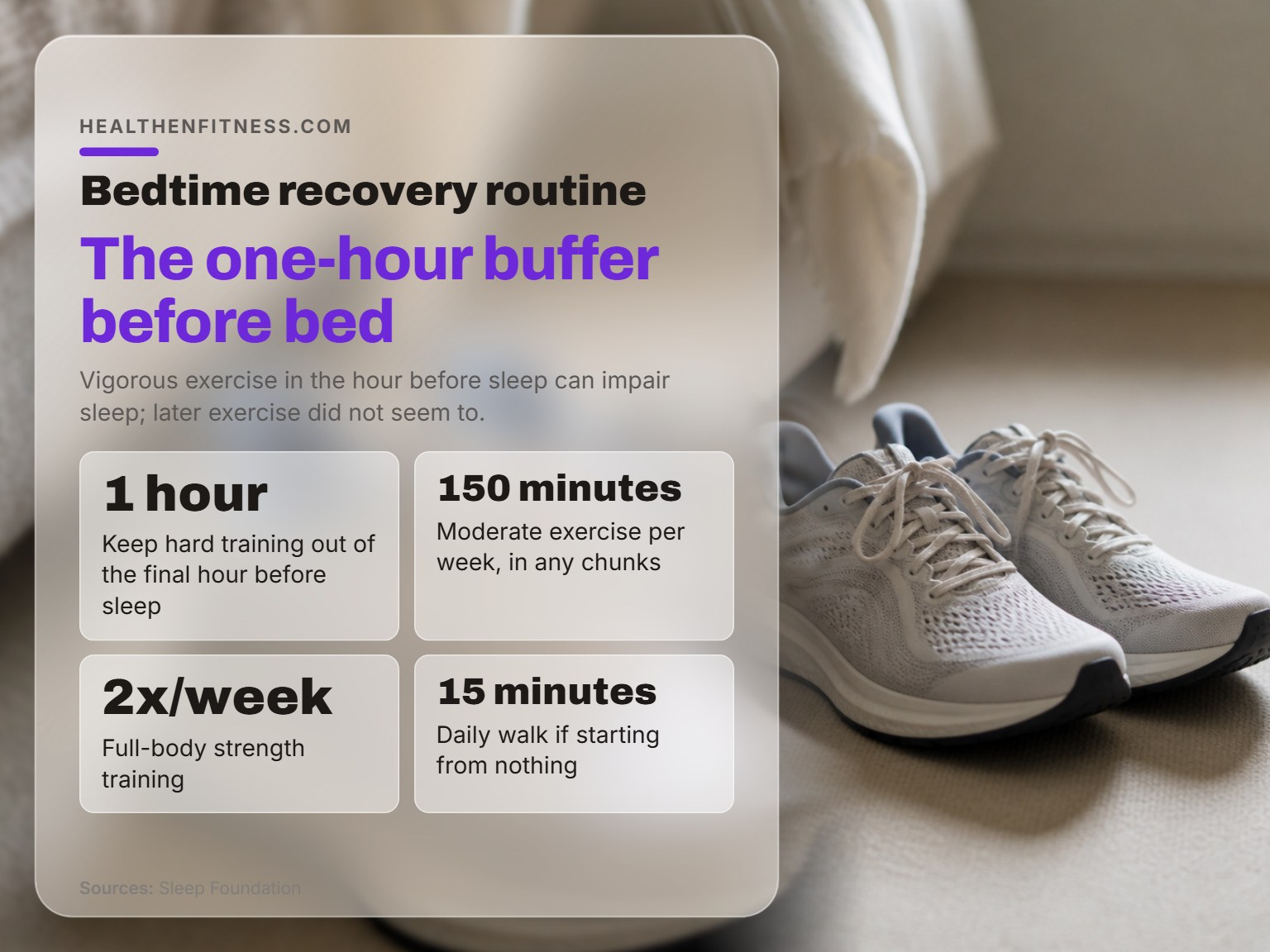
Hard training inside the last hour before bed wrecks sleep. The rest of the day is fine.
The Sleep Foundation’s review found that vigorously exercising in the hour before sleep can impair sleep, likely by interfering with melatonin production. Exercise done later in the day, but not inside that final hour, did not seem to negatively affect sleep.
So the rule is a one-hour buffer, not a morning-only mandate. If the only slot you have is 8pm, train at 8pm and finish by 9.
- 150 minutes of moderate exercise a week, broken into whatever chunks you’ll actually do.
- Strength training twice a week, full body, per the CDC guidance the Sleep Foundation cites.
- Walk 15 minutes a day if you’re starting from nothing.
- Keep the hard session out of the final hour. The Sleep Foundation found vigorous exercise in the hour before sleep can impair sleep; later exercise outside that hour did not seem to negatively impact sleep.
Easy to miss: Finishing a hard session at 9:45 and getting into bed at 10. The buffer is the rule, not the workout.
I add a rep before I add weight, and the same logic applies here. One new routine step at a time beats a total overhaul you abandon by Thursday. If you’re regularly training late, how to sleep after a late workout covers the wind-down that actually works at that hour.
When the Routine Breaks: Shift Work, Late Workouts, and Bad Nights
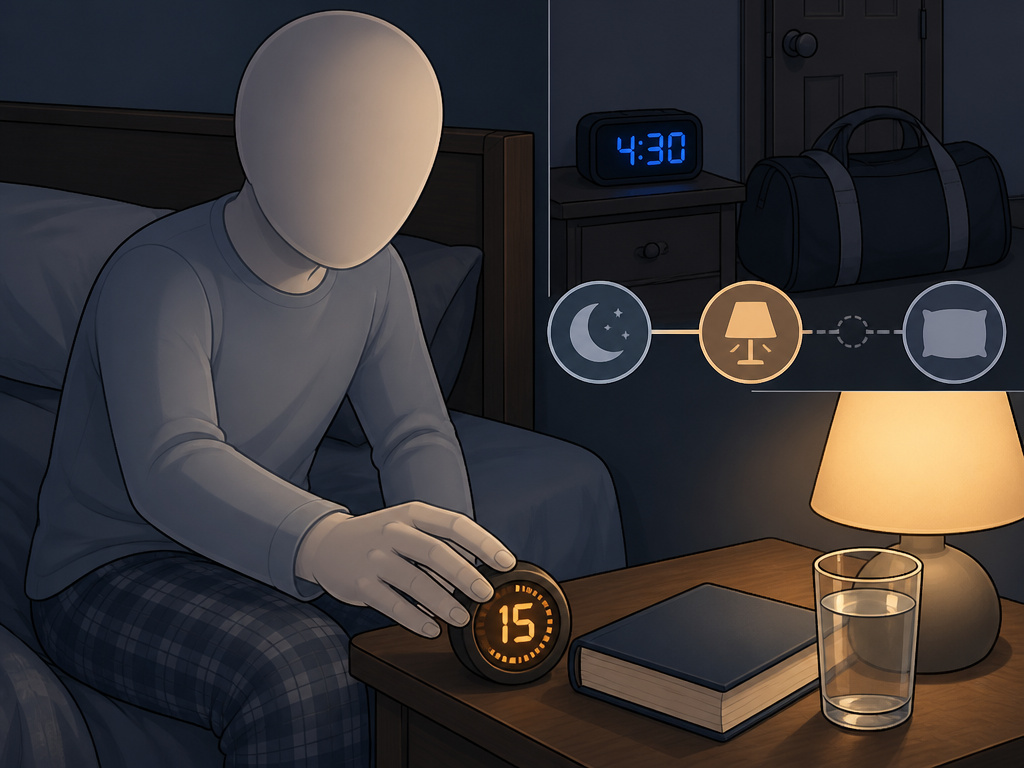
Shift work is the case the standard routine was never designed for. The NHLBI notes that people whose schedules conflict with their internal body clocks, shift workers especially, may have trouble getting enough sleep, and that this affects how they feel mentally and physically.
The fix isn’t a stricter routine. It’s a smaller one. Anchor the sleep block you can protect, keep the wind-down short, and accept that the 20-minute drift window is a target rather than a law on rotation weeks. There’s more on that in shift work recovery.
For the rest of us, the failure mode is a bad night that turns into a bad week. Kaiser’s protocol handles it: don’t lie awake in bed for more than 15 minutes, get up, do something calming, and go back when you’re drowsy.
A routine you keep 80% of the time beats a perfect one you quit in March. The point is the cue chain, and a chain with a few missing links still pulls.
If you’re stringing together several short nights, the compounding effect is worth understanding before you add more training on top of it. Sleep debt and training performance covers what happens next.
The professional societies publish their own patient-facing versions of all this, including the AASM how to sleep better guide and a military sleep under stress guide built for people whose schedules aren’t theirs to choose.
Frequently Asked Questions
How long should a bedtime routine be?
About an hour of winding down, based on Kaiser Permanente’s guidance to allow yourself an hour or so to relax before bedtime. The Sleep Foundation’s counterweight is to start with only three steps inside that hour. A short routine you repeat beats a long one you skip.
Is it bad to read on a phone in bed?
The Sleep Foundation advises avoiding digital devices as much as you can while winding down and putting them in another room before the routine starts, because blue light suppresses melatonin. A paper book avoids the problem entirely.
What if I can’t fall asleep within 15 minutes?
Get up. Kaiser’s rule is not to lie awake in bed for more than 15 minutes: leave the bed, do something calming like reading, and skip the Internet and TV. Return when you feel drowsy. Staying put teaches your body that bed is where you struggle.
Do naps ruin a bedtime routine?
It depends which guidance you follow. The NHLBI caps adult naps at 20 minutes and suggests limiting them or taking them earlier in the afternoon if you have trouble falling asleep at night. Kaiser Permanente says avoid naps altogether. If your nights are solid, the 20-minute version is unlikely to hurt.
Should I go to bed earlier to get more recovery?
Usually the opposite. Kaiser identifies too much time in bed as the most common cause of insomnia, and starts people at 5.5 hours in bed or their current average sleep time, whichever applies. Add time back slowly once sleep improves.
How long before a new routine starts working?
Give it two weeks or longer, which is the adjustment window Kaiser Permanente specifies. The first stretch often feels worse than no routine at all. That’s the schedule tightening, not the plan failing.
The Bottom Line
If two weeks pass and you’re still lying awake, the fix is time in bed, not more routine steps. Cut the window before you add another ritual. That single move sits behind most of the advice above.
One concession worth stating plainly: none of this assumes you control your schedule. If you work rotating shifts or have a newborn, the fixed wake time is the first thing to bend and the last thing to abandon. Protect the wind-down instead.
And keep the whole thing small enough to be boring. Three steps, same order, most nights. The Sleep Foundation’s point about repetition is the real engine here, and repetition needs something you can actually repeat.
That’s how to build a bedtime routine for recovery without turning it into another project to manage.
Today, just pick your wake time and set it for tomorrow.
