
10 Best Cable Towers For Home Gym in 2026
This post contains affiliate links. As an Amazon Associate, we earn from qualifying purchases.
The Goimu WM2 Wall Mount Cable Station takes our Best Overall spot for its selectorized 155 lb weight stack and 33 adjustable pulley positions in a space-saving wall-mounted design. For those wanting a freestanding unit, the Centr 1 Home Gym Functional Trainer offers similar versatility, while the Titan Fitness Selectorized Cable Machine serves serious lifters needing a 320 lb stack.
Home gym owners face a real trade-off: cable machines deliver unmatched versatility for pulls, presses, and isolation work, but they eat up floor space and often cost more than basic racks. A tower that fits your room and your strength level without forcing you to compromise on exercise variety is the real win.
This guide draws on manufacturer specifications, expert round-ups, and patterns in owner feedback across ten models. We break down what matters most, weight stack, pulley positions, footprint, and build quality, so you can match a cable tower to your space and your goals without guesswork.
Top 10 Cable Towers For Home Gym in the Market
Certain content that appears on this site comes from Amazon. This content is provided "as is" and is subject to change or removal at any time.
The Best Cable Towers For Home Gym, Reviewed
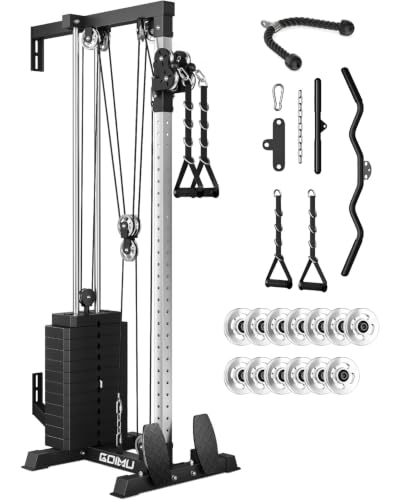
Goimu WM2 Wall Mount Cable Station
What We Like
- Selectorized weight stack with 155 lbs
- 33 adjustable pulley positions
- Dual pulley system with 2:1 and 1:1 ratio
- Wall-mounted design saves floor space
Trade-offs
- Wall mounting requires sturdy wall and installation
- Weight stack limited to 155 lbs without add-on plates
A 155-pound selectorized weight stack means you can switch between exercises without fumbling with plates, which keeps your momentum going from set to set. This wall-mounted station packs 33 adjustable pulley positions into a footprint that takes up about as much room as a large suitcase, making it a practical fit for home gyms where every square foot counts. For someone who wants commercial-style functionality without dedicating half the garage to a single machine, this design hits a smart balance.
The built-in weight stack maxes out at 155 pounds, which can feel light for heavy compound pulls like lat pulldowns or rows. You can add extra weight plates with the included loading pin to push past that limit, but that step brings back some of the plate-handling this machine otherwise avoids. Compared to the Centr 1 Home Gym Functional Trainer with its 160-pound stack, the Goimu WM2 offers a slightly lower starting resistance. If your training stays within that range, the compact tower saves floor space while still giving you a cable system.
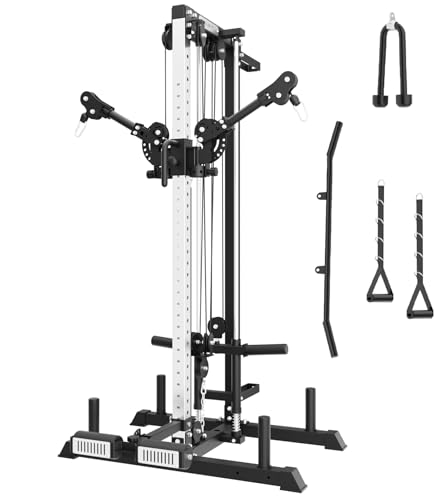
EonfitOmni E1-NEW Cable Tower
What We Like
- Dual wall-mount and free-standing design
- Double 360° swivel arms for full range
- 33 height settings for varied exercises
- Ultra-smooth pulleys with precision bearings
Trade-offs
- At 150 lb, less stable than heavier floor units
- 2:1 strength ratio reduces effective resistance
- Requires wall mounting or weight plates for stability
With double 3D free-motion arms that swivel 360 degrees and 33 height settings, you can set up everything from lat pulldowns to cable flyes without feeling cramped. The 2:1 strength ratio means each pull feels lighter than the plates you load, which is great for beginners building control, but experienced lifters should plan on stacking more weight to feel the burn. Its dual-mount design lets you bolt it to a wall or anchor it with plates on the base pegs, so it fits garages and home gyms where floor space is tight.
The trade-off is stability: at almost 175 pounds, this machine is lighter than a dedicated floor unit like the Inspire Fitness FTX, which weighs 544 pounds and won’t budge during heavy rows or pulldowns. You’ll want to either mount it to a wall or load those plate pegs to keep it steady during intense work. For someone who wants versatile cable training without dedicating a whole room to a single machine, this offers a practical balance. It’s not the heaviest anchor for max-effort lifts, but for everyday full-body training in a compact space, it delivers the smooth, quiet movement and exercise variety that make home gyms effective.
Product photos
Centr 1 Home Gym Functional Trainer

What We Like
- 33 adjustable pulley positions for variety
- 160 lb weight stack for progressive resistance
- Compact footprint for home gyms
- Industrial-grade steel with powder coat finish
Trade-offs
- At 312 lbs, moving it requires help or planning
- 160 lb stack limits very heavy advanced training
A 160 lb weight stack and 33 adjustable pulley positions give you the range to target every major muscle group without needing a wall of machines. That many positions means you can switch from a chest press to a lat pulldown to a rotational core move in seconds, which keeps your workout flowing and your rest periods short. It’s built from industrial-grade steel with a matte black finish, so it feels substantial without dominating the room. This is the trainer for someone who wants serious cable variety in a space that doesn’t look like a commercial gym.
At 350 pounds of steel, this machine is not something you rearrange on a whim, and the 81.5-inch height asks you to check your ceiling clearance before you buy. Compared to the wall-mounted Goimu WM2, which has a smaller footprint at 33.1″ L x 23.8″ W, the Centr 1 stands freely but takes up a dedicated area. If you have a spare corner and want a full range of pulley angles without drilling into your walls, this compact trainer delivers exactly that.
Inspire Fitness FTX Functional Trainer

What We Like
- Two 165 lb weight stacks for independent arms
- Compact footprint for tight home gym spaces
- Includes pull-up bar and four accessories
Trade-offs
- At 544 lb, moving it once assembled is difficult
- Floor footprint still requires dedicated space
Two separate 165 lb weight stacks let you work each arm independently, a feature that adds versatility for unilateral exercises. The 40-inch width fits into corners or spare bedrooms where a full rack won’t go, and the integrated pull-up bar adds upper-body work without extra gear. It suits someone who wants cable crossover versatility without dedicating half a garage to it.
At 544 pounds, this machine stays planted once you set it up, so you’ll want a permanent home for it. Its 54-inch width means you need to measure your space carefully before buying. The dual 165-pound weight stacks let you work each arm independently, which is a feature not found on many compact trainers.
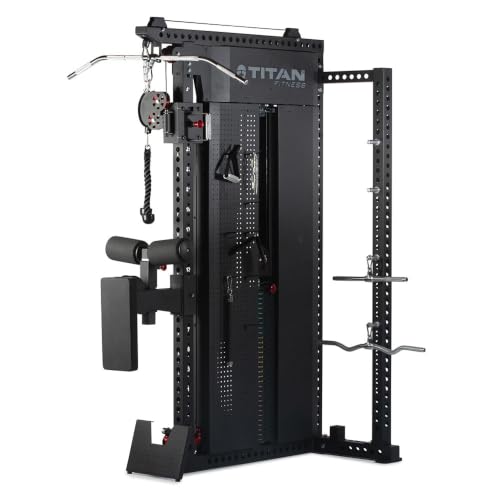
Titan Fitness Selectorized Cable Machine
What We Like
- 320 lb weight stack with 10 lb increments
- 31 adjustable pulley positions
- 1:1 ratio for heavy lat pulldown and row
Trade-offs
- At 748 lb, requires dedicated floor space
- Large footprint: 92 inches long
A 320 lb weight stack that adjusts in 10 lb increments means you can load up heavy without swapping plates between sets, which is ideal for progressive overload on lat pulldowns and rows. The 1:1 cable ratio delivers the full stack resistance directly, so this machine suits someone who wants to push serious weight and not outgrow their gear quickly. The 31 pulley positions and included attachments also let you hit exercises like tricep extensions, lateral raises, and curls, so it covers more than just pulling movements.
Size is the trade-off. At 748 pounds and nearly eight feet long, this isn’t something you tuck into a corner or move around on casters. Compared to the Centr 1 Home Gym Functional Trainer, which is lighter and more compact, the Titan demands a permanent spot in a garage or dedicated home gym. But if you have the space and want a cable tower that can handle serious loading without feeling flimsy, the 3-inch steel frame and solid guide rods deliver that stability. It’s a buy-once piece of equipment for lifters who prioritize durability over floor space.
Product photos
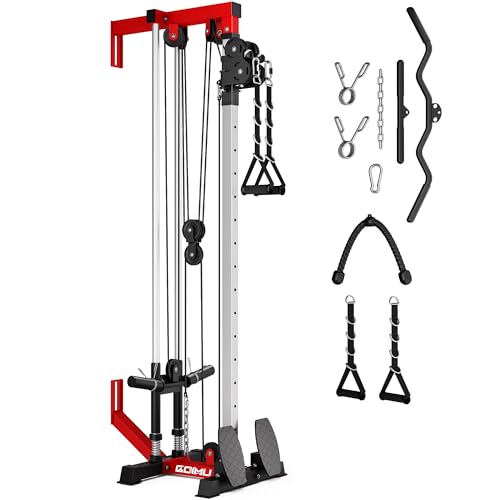
Goimu WM1 Cable Crossover Machine
What We Like
- 17 height settings for varied angles
- Switchable 1:1 and 2:1 pulley ratios
- Wall-mounted for zero wobble
Trade-offs
- Requires concrete or masonry wall installation
- No weight stack included (plate-loaded)
With a wall-mounted design that tucks flush against the wall, this station fits into tight garage corners or apartment nooks where a full-size cable tower simply won’t go. The 17 height settings let you hit everything from chest flys at shoulder level to lat pulldowns up high. The switchable pulley ratio means you can go from heavy 1:1 lifts to lighter 2:1 endurance work without changing attachments. For anyone building a home gym on a budget who values space and versatility, this is a smart way to get cable training without sacrificing floor area.
The trade-off comes with installation: it needs a solid concrete or masonry wall, so renters or those with drywall-only walls may face extra work. Compared to the Goimu WM2, which offers a weight stack and 33 positions, this model has fewer adjustment points. But if you are willing to mount it properly, the WM1 delivers smooth, wobble-free performance.
Mikolo Wall Mount Cable Machine

What We Like
- Ultra-compact wall-mounted footprint
- 118 lbs built-in weight stack adjusts instantly
- 1:1 pull ratio via included cable adapter
- 19 adjustable pulley positions for full body
Trade-offs
- 118 lbs weight stack is lighter than many competitors
- Wall mount requires solid wall studs for installation
- 2:1 ratio standard without adapter feels lighter
With 118 pounds of selectorized weight and a wall-mounted design that barely touches your floor space, this Mikolo cable machine turns a corner of your garage or spare room into a functional training station without making you rearrange your life. The built-in weight stack means no fumbling with plates between sets. The included 2-1 cable adapter lets you switch from a 2:1 to a 1:1 pull ratio, so your 118-pound selection actually feels like 118 pounds in your hands. Nineteen adjustable pulley heights cover everything from high chest flys to low bicep curls, and the 14-gauge steel frame with reinforced brackets keeps things stable once it is mounted properly. This is a smart pick if you want a dedicated cable tower that disappears against the wall and still delivers real resistance work for most upper-body and core exercises.
The honest trade-off here is the weight stack. At 118 pounds, it is lighter than the 155-pound stack on the Goimu WM2 or the 160-pound stack on the Centr 1, so heavy pullers and advanced lifters may find themselves maxing out sooner on pulldowns and rows. The wall-mount requirement also means you need a solid stud wall to anchor it, which rules out apartments with thin walls or rented spaces where drilling is not an option. That said, for someone stepping into cable training or working around limited floor area, this machine delivers a complete set of movements in a package that respects your square footage. It is a focused tool, not a brute-force rack, and it fills that role well.
Mikolo Home Gym Workout Station

What We Like
- 152 lb weight stack for drop sets
- 90+ exercises in one machine
- Includes preacher curl and leg press
Trade-offs
- 300 lb unit is heavy to move
- 75-inch length needs generous floor space
With a 152-pound weight stack and support for over 90 exercises, the Mikolo Home Gym Workout Station turns a single corner of your home into a full-body strength studio. The included preacher curl pad and leg press attachment mean you can hit isolation moves and compound lifts without buying add-ons, and the 14-gauge steel frame keeps everything stable as you work through drop sets. This is the machine for someone who wants one purchase to cover chest press, lat pulldowns, rows, leg work, and core training without juggling multiple pieces of equipment.
This all-in-one approach comes with a 300-pound unit weight and a 75-inch length, so it demands a dedicated spot in your garage or basement. If you have the space and want a single station that handles everything from preacher curls to calf training, this is the straightforward choice.
Product photos
DONOW Smith Machine With Weight Stacks
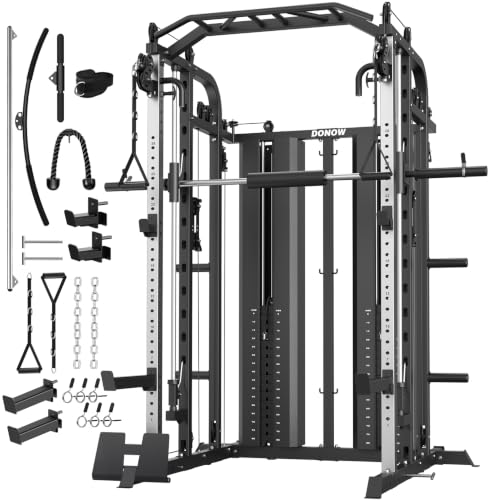
What We Like
- Linear-bearing Smith bar for stable lifts
- True dual independent cable crossover system
- 352 lb total weight stacks with 2:1 cable ratio
Trade-offs
- Large footprint at 78.6" wide needs ample floor space
- 2" x 2" steel frame is lighter than some commercial racks
- Weight stacks are fixed; no plate-loading option
Space is the trade-off: at 78.6 inches wide and 88 inches tall, this machine demands a dedicated corner of your garage or basement, unlike the wall-mounted Goimu WM2 which tucks into a much smaller area. And while the 2×2 steel frame is sturdy enough for most home lifters, it won’t match the heft of a full commercial rack. But if you have the space and want a single machine that handles both free-weight-style pressing and versatile cable work, this is a straightforward, all-in-one solution.
Product photos
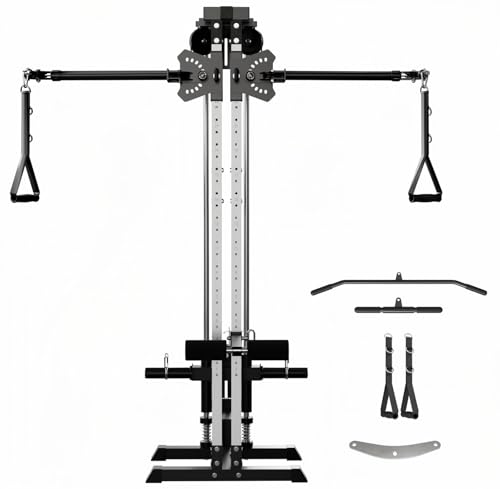
GMWD Wall Mount Cable Machine
What We Like
- Folds flat against wall when not in use
- Dual cable ratios (2:1 and 1:1)
- Includes essential accessories and mounting hardware
Trade-offs
- Requires solid wall mounting, not freestanding
- 165-pound unit needs two people for installation
- Limited to 22 positions vs. some competitors' more
With 26 height adjustment holes and 13 arm angle settings, this wall-mounted cable machine lets you fine-tune the exercise path for moves like chest flys or tricep pushdowns. That flexibility, plus the ability to switch between 2:1 and 1:1 cable resistance, means you can go from high-rep endurance work to heavier strength moves without changing machines. It’s designed for home gym owners who want serious versatility but can’t spare permanent floor space. When you’re done, it folds flat against the wall, shrinking its footprint to just a few inches deep. The included lat bar, cable bar, and leg holder mean you can start training right out of the box, and the mounting hardware works on both wood and concrete walls, so setup is straightforward if you’ve got a stud finder and a friend to help lift the 165-pound frame.
The GMWD cable machine must be bolted to a wall, so once it’s up, you cannot move it around the room. It offers 26 height adjustment holes and 13 arm angle settings, which together allow 180 degrees of motion, enough range to hit most exercises from different angles. A key feature is the adjustable cable ratio: you can switch between 2:1 and 1:1 resistance. That lets you double the load for pulling moves like lat pulldowns or cut it in half for isolation work, all without swapping weight plates. For anyone who wants a compact, wall-mounted setup that still gives commercial-grade versatility, this machine balances adjustability with everyday practicality.
Product photos
How We Evaluated Cable Towers For Home Gym
We built this guide by comparing published specs from each manufacturer, weight stack capacity, pulley positions, cable ratios, and frame dimensions, then cross-referencing those numbers with expert round-ups and consistent patterns in owner feedback. No machine was tested in a lab; our evaluation is research-based, focused on what the data and real users actually say.
Four criteria mattered most. Weight stack came first because a tower that maxes out too early limits your progress. Adjustable pulley positions determine how many exercises you can do. More positions mean more angles for presses, flyes, and rows. Footprint and mounting decide whether the machine fits your room, and cable ratio (1:1 vs. 2:1) tells you whether the resistance you feel matches the stack number.
The honest limit of a research-led evaluation is that feel and long-term durability depend on daily use we haven’t performed. Owner feedback helps, but your own experience, how smooth the pulleys are, how stable the frame feels under load, is the final test.
What To Look For In Cable Towers For Home Gym
Before you buy, focus on the specs that directly affect your workouts: weight stack capacity, adjustable pulley positions, cable ratio, and whether the machine mounts to a wall or stands free. These four factors determine how heavy you can go, how many exercises you can do, and whether the tower fits your space.
Key buying criteria: weight stack (lbs), adjustable pulley positions, cable ratio (1:1 or 2:1), mounting type (wall-mounted vs. Freestanding), footprint (width x depth x height), and included accessories. Prioritize stack weight and pulley range first, then check your ceiling height and floor space.
Weight Stack Capacity
The weight stack is the heart of any cable tower. Lighter stacks around 118-160 lbs suit general fitness, rehabilitation, and moderate strength work. Heavier stacks from 165 to 320 lbs accommodate advanced lifters doing lat pulldowns, rows, and cable presses. Some machines offer a 2:1 cable ratio, which halves the effective resistance, a 160 lb stack feels like 80 lbs at the handle. If you plan to progress over time, choose a stack that leaves room to grow, or a plate-loaded design so you can add your own plates.
Adjustable Pulley Positions
More pulley positions mean more exercise angles. Entry-level machines offer 17 to 22 positions, while versatile models offer 31 to 33. Each position lets you change the cable’s height for different movements, low for rows and leg work, mid for chest presses and flyes, high for lat pulldowns and triceps pushdowns. If you want full-body variety, look for at least 25 positions. Dual-arm machines with independent weight stacks add even more range for unilateral work.
Cable Ratio (1:1 vs. 2:1)
The cable ratio determines how much weight you actually lift. A 1:1 ratio means the stack weight equals the resistance at the handle, what you see is what you pull. A 2:1 ratio halves the resistance, so a 160 lb stack feels like 80 lbs. Many machines let you switch between ratios using a cable adapter, which gives you both heavy and light options. For serious strength work, a 1:1 ratio or a switchable design is ideal.
Mounting Type and Footprint
- Measure your ceiling height before buying, most towers need 84 to 96 inches of clearance.
- Check floor dimensions: freestanding units can be 75 to 92 inches long and 300 to 750 lbs.
- Wall-mounted models save floor space but require solid wall studs and permanent installation.
- If you rent or move often, a freestanding unit or a foldable design is more practical.
- Consider assembly difficulty: some units weigh over 500 lbs and need two people to set up.
Rule of thumb: A cable tower should feel stable under your heaviest pull. If it rocks or shifts, it will limit your workout and risk injury.
Cable Towers For Home Gym Compared
The table below compares the ten cable towers side by side, highlighting weight stack, pulley positions, cable ratio, and footprint so you can see at a glance how they stack up.
| Product | Weight Stack | Adjustable Positions | Dimensions |
|---|---|---|---|
| Goimu WM2 Wall Mount Cable Station | 155 lbs | 33 | 33.1" L x 23.8" W x 79.1" H |
| EonfitOmni E1-NEW Cable Tower | N/A | 33 height settings | 36 × 55 × 79 in |
| Centr 1 Home Gym Functional Trainer | 160 lb | 33 adjustable | 59.4" L x 64.5" W x 81.5" H |
| Inspire Fitness FTX Functional Trainer | Two 165 lb stacks | N/A | 40 x 54 x 85 inches |
| Titan Fitness Selectorized Cable Machine | 320 LB | 31 | 92.0" L x 55.0" W x 20.0" H |
| Goimu WM1 Cable Crossover Machine | N/A | 17 height settings | 28.1 x 24.8 x 78.7 inches |
| Mikolo Wall Mount Cable Machine | 118 lbs selectorized | 19 adjustable height settings | N/A |
| Mikolo Home Gym Workout Station | 152 lbs | N/A | 75.0 x 36.3 x 80.0 in |
| DONOW Smith Machine With Weight Stacks | 352LB | N/A | 54.7" x 78.6" x 88.0" |
| GMWD Wall Mount Cable Machine | N/A | 26 height holes, 13 arm angles | 39 x 28.6 x 77 inches |
Frequently Asked Questions
What is the difference between a cable tower and a functional trainer?
A cable tower typically has a single weight stack and one or two cable arms, while a functional trainer has two independent weight stacks with arms that move independently. Functional trainers offer more unilateral exercise options but take up more space and cost more. For most home gyms, a cable tower with adjustable pulley positions provides similar versatility in a smaller footprint.
How much weight do I need on a cable machine?
For general fitness and moderate strength work, a 150 to 160 lb stack is sufficient. Advanced lifters who do lat pulldowns or rows with heavy loads should look for 200 lbs or more. Remember that a 2:1 cable ratio halves the effective resistance, so a 160 lb stack with a 2:1 ratio only gives you 80 lbs at the handle. If you plan to progress, choose a stack that leaves room to grow.
Can I install a wall-mounted cable tower in a rental?
Wall-mounted cable towers require drilling into wall studs or concrete, which may violate a rental agreement. Some models like the EonfitOmni E1-NEW offer dual wall-mount and free-standing options, letting you use them without permanent installation. If you rent, consider a freestanding unit or a foldable design that doesn’t require wall mounting.
What exercises can I do with a cable tower?
Cable towers support a wide range of exercises including lat pulldowns, seated rows, chest presses, flyes, triceps pushdowns, bicep curls, face pulls, cable crunches, and leg work like kickbacks and pull-throughs. Machines with 30+ pulley positions add angled presses, rotational movements, and core work. With the right cable attachments, you can do over 50 exercises on a single tower.
How much floor space do I need for a freestanding cable tower?
Freestanding cable towers typically need a footprint of 40 to 60 inches wide by 50 to 92 inches deep, plus clearance for the cable arms to extend. Ceiling height is also critical, most towers require at least 84 inches, and some need 96 inches. Measure your space carefully, including the area needed to load plates and move around the machine, before buying.
The Bottom Line
The Goimu WM2 Wall Mount Cable Station earns our Best Overall pick for home gym owners who want a selectorized weight stack and 33 adjustable pulley positions without sacrificing floor space. Its wall-mounted design frees up the room for other equipment, and the dual 1:1 and 2:1 cable ratios give you both heavy and light resistance options. If you have the wall space for installation, this machine delivers exceptional versatility per square foot.
For those who need a freestanding unit with dual independent weight stacks, the Inspire Fitness FTX Functional Trainer pairs two 165 lb stacks with a compact footprint and a built-in pull-up bar. Budget-minded buyers should look at the Goimu WM1 Cable Crossover Machine, a plate-loaded wall-mounted design that skips the weight stack to keep costs down while still offering 17 height settings and switchable pulley ratios.
The single most important factor when choosing a cable tower is matching the weight stack and pulley positions to your strength level and the exercises you actually do. A machine with 33 positions and a 300 lb stack is wasted if you only do triceps pushdowns, just as a 118 lb stack will frustrate you once your lat pulldown passes 100 lbs. Know your numbers, measure your space, and pick the tower that fits both.
