
10 Best Power Racks With Cable System in 2026
This post contains affiliate links. As an Amazon Associate, we earn from qualifying purchases.
The GOIMU DP01 Power Cage wins as the best overall power rack with cable system because it packs a 2000-lb capacity, 31 cable height options, and independent dual pulleys into a compact home gym footprint. The MAJOR FITNESS F22 Power Rack is the best for multi-user training, while the JELENS C21 Power Cage delivers a true 1:1 pulley ratio for exact resistance.
Adding cables to a power rack solves the classic home gym dilemma: you want barbell strength work and cable versatility without buying two separate machines. But pulley ratios, frame capacity, and independent vs. Single-pulley designs can make the choice confusing.
This guide is research-based, drawing on manufacturer specifications, expert round-ups, and patterns in owner feedback across ten leading models. We break down the key differences so you can match a rack to your training style, space, and budget.
Top 10 Power Racks With Cable System in the Market
Certain content that appears on this site comes from Amazon. This content is provided "as is" and is subject to change or removal at any time.
The Best Power Racks With Cable System, Reviewed
GOIMU DP01 Power Cage
What We Like
- 2000-lb capacity for heavy lifting
- 47.64-inch interior for full bench press
- 31 cable height options for precise training
- Dual independent pulleys for unilateral work
Trade-offs
- Cable pulley ratio is 2:1, not 1:1 for some exercises
- 2000 lb capacity requires heavy weight plates for stability.
A 2000-pound weight capacity means this cage can handle serious loading without wobbling, while the 47.64 inches of interior space lets you bench press with full range of motion inside the safety bars. That combination of heavy-duty stability and room to move is what makes it such a smart pick for someone building a home gym from scratch. The dual independent pulley system adds real versatility, you can work one arm at a time for rehab or balanced training, or have a partner use the other side without getting in each other’s way. With 31 cable height settings and 29 adjustment points on the J-hooks and safeties, you can dial in everything from lat pulldowns to squats without fighting a clunky setup.
For most home lifters, that’s plenty of strength without the extra weight and cost of thicker steel. The real win here is the compact 17.88-square-foot footprint, it packs a full cage, cable crossover, lat pulldown, and landmine into a space that fits neatly in a garage corner or spare bedroom.
MAJOR FITNESS F22 Power Rack

What We Like
- Independent dual-pulley system for two users
- 1600 lb static capacity for heavy lifts
- Dual-triangle base reduces sway without bolting
- Includes dip bars, landmine, and T-bar
Trade-offs
- At 243 lb, moving it is a two-person job
- 68.9-inch width needs generous floor space
- 2:1 pulley ratio feels lighter than 1:1
A 1600-pound static capacity and a dual-triangle base that stays planted without bolting to the floor mean this rack handles heavy squats and aggressive pull-ups without that wobble that makes you second-guess your setup. Where the F22 really shines is the independent dual-pulley system with a 2:1 ratio, which lets two people train at the same time without cables tangling or fighting for space. That makes it a natural fit for couples, training partners, or anyone who wants to superset quickly without resetting the pulleys between sets. The included dip bars, landmine, and T-bar round out a package that covers a wide range of exercises in one footprint.
The trade-off for that multi-user capability is the rack’s footprint: at 68.9 inches wide, it demands more floor space than the JEEKEE Power Cage (46.9 inches wide), so it won’t slip into a tight garage corner as easily. At 243 pounds, it is also a heavy piece of gear, so plan on assembling it where it will stay rather than shuffling it around. The 2:1 pulley ratio gives smoother cable travel, which some users may need to adjust to if they are used to a different ratio. For a home gym that needs to serve two people at once without compromise, that extra width and weight are worth the trade.
JELENS C21 Power Cage

What We Like
- True 1:1 pulley ratio for exact resistance
- Two independent weight stacks allow co-training
- 2,000-lb frame handles heavy loads safely
- UHMW-coated safety bars catch failed reps
Trade-offs
- Half-rack design offers less front-to-back depth
- Requires assembly with multiple heavy parts
A true 1:1 pulley ratio means the weight you load is exactly the weight you train, so tracking progress is straightforward. Two independent weight stacks let two people train at once with zero waiting, a practical perk for shared home gyms. The 2,000-lb frame and UHMW-coated safety bars catch failed reps, giving you confidence to train heavy alone. The half-rack footprint occupies 17.27 sq. ft., saving space and simplifying installation.
The trade-off for that space-saving design is less front-to-back depth than a full cage, so you’ll want to be mindful of bar path on squats inside the rack. Compared to the GOIMU DP01, which has a length of 57.9 inches versus the C21’s 53.5 inches, the C21 offers a shorter overall length. If you have the ceiling height, 84.7 inches is the height of this unit, and value the ability to train with a partner, this is a practical choice for steady, safe progress.
Mikolo Power Cage HR05
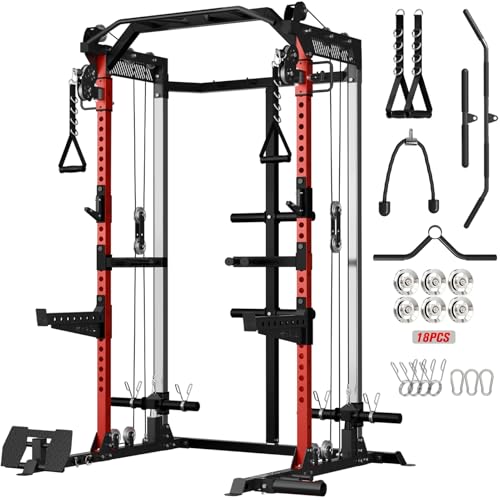
What We Like
- Independent dual pulleys for supersets
- 30 height options with location markers
Trade-offs
- At 205 lb, lighter than some full cages for stability
- Half-rack frame offers less side protection than full cage
The two-sided pulley system operates at a 1:1 ratio, meaning the weight loaded onto the pegs is exactly what you lift, no friction or mechanical advantage to fudge the numbers. This setup pairs a power rack, a multi-grip pull-up bar, a cable crossover machine, and a 360° landmine into a single unit that occupies nearly two-thirds less floor space than a conventional full cage. Reviewers note that the half-rack style frame and the extra weight storage built into the middle of the unit help keep the rack stable during heavy pulls while also organizing the home gym area.
The trade-off is that the half-rack frame saves floor space but gives up some of the wraparound protection a full cage offers. At 205 pounds, it’s lighter than the MAJOR FITNESS F22 (243 pounds), so some users may find it less stable under heavy loads. Still, for someone who values cable independence and a compact footprint over brute mass, the HR05 delivers a lot of function per square foot.
MAJOR FITNESS Drone1 Premium

What We Like
- Aircraft-grade aluminum pulleys with sealed bearings
- 100 lb weight stack for cable exercises
- Lifetime support from Major Fitness
Trade-offs
- 100 lb stack limits heavier cable work
- Requires 85-inch ceiling clearance for full use
That 100 lb stack will feel light for advanced lifters on exercises like pulldowns or rows, so you may outgrow it sooner than a plate-loaded system. Compared to the MAJOR FITNESS F22, which uses a dual pulley system, the Drone1 Premium gives you a dedicated weight stack instead of loading plates onto cables.
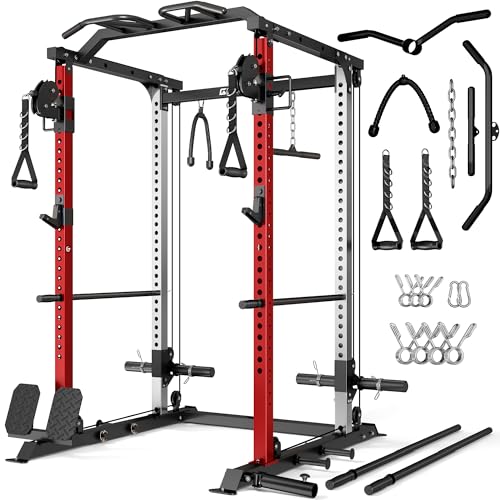
Mikolo K6 Power Cage

What We Like
- 8-in-1 design for full-body training
- In-cage workouts improve safety for beginners
- Upgraded pulley system with four white rollers
Trade-offs
- At 220 lbs, moving it requires two people
- Internal cage width 41 inches limits very wide benches
- Single pulley ratio (2:1) less versatile for cable exercises
The K6 power cage weighs 230 pounds and uses eight reinforcing tabs to increase stability during training, which helps keep the frame steady during heavy lifts. Its 8-in-1 design combines a power rack, cable crossover, lat pulldown, low row, chin-up, dip station, core trainer, and resistance station into one unit. That means you can do a wide range of exercises without needing separate machines. That makes it a practical choice for anyone setting up a home gym who wants both safety and versatility in a single footprint.
The cable system uses a 2:1 ratio for the low row station, which means the cable moves twice as far as the weight stack. This differs from the independent dual pulley systems found on some other power cages, such as the JELENS C21 and GOIMU DP01, which allow each side to move separately. If you need independent cable movement for exercises like unilateral flys, those models offer that capability. For the included accessories. T-bar, lat pulldown bar, tricep rope, cable bar, cable handles, dip bars, landmine, footboard, J-hooks, spring clamps, and storage pins, the K6 comes ready to use out of the box.
Product photos
OPPSDECOR 2.0 PRO Power Cage
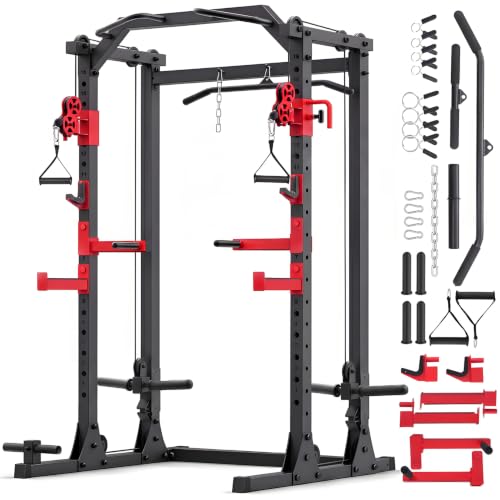
What We Like
- 2000 lb capacity with reinforced steel frame
- Independent dual pulleys with 19 height settings
- 16 adjustable J-hook and safety bar positions
- Includes weight pegs and storage hooks
Trade-offs
- 2:1 pulley ratio reduces cable weight feel
- 4-inch spacing on J-hooks limits fine adjustments
A 2000-pound capacity means this rack can handle heavy squats and presses without flexing, yet it weighs only 158 pounds, so you can move it into place without a crew. The steel frame uses triangular reinforcement plates to reduce sway during intense lifts. The two-sided pulley setup with 19 height settings lets you do single-arm cable work or lat pulldowns without both sides tied together. For someone building a first home gym or upgrading from a basic squat stand, this cage combines barbell, bodyweight, and cable training in a footprint that fits a standard garage or basement corner.
The 2:1 pulley ratio means the cable resistance feels lighter than the weight you load, so you will need to stack on more plates to get the same tension, something to factor in if you are used to a 1:1 system. The 4-inch spacing on the J-hooks and safety bars is standard at this price point, but it can leave you wishing for a half-inch adjustment when setting up for bench press or squat depth. For someone who wants a versatile all-in-one setup that does not require a forklift to assemble, this is a smart place to start.
Product photos
Mdeam Folding Squat Rack
What We Like
- Folds flat to save space
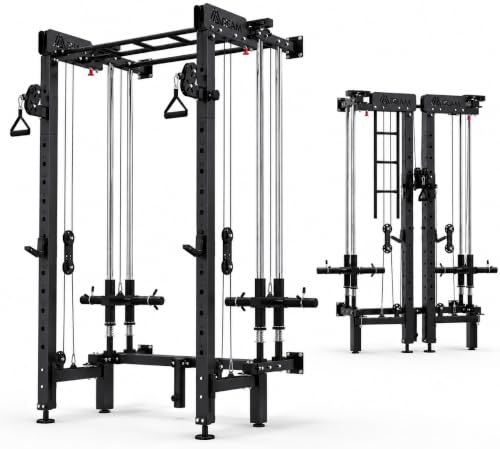
- Dual cable pulley for three users
- Seven adjustable cable angles
- 1000 lb capacity with wall mounts
Trade-offs
- Wall mounting requires permanent installation
- No full cage enclosure for heavy squats
- Folding design limits upright storage stability
A 1000 lb capacity from 14-gauge steel lets this rack handle serious weight without wobbling, but the real trick is how it disappears when you’re done. The folding design lets you press it flat against the wall, freeing up floor space for yoga, storage, or just not tripping over a cage. With seven adjustable cable angles and a dual pulley system that three people can use at once, it’s built for a household that shares gym time without sharing a cage footprint. If your garage doubles as a living area or your basement has to multitask, this is the rack that gets out of your way.
Because it’s a wall-mounted unit, not a free-standing cage, you lose the wraparound protection of a full enclosure. That means you’ll want to be careful with heavy squats or failing a rep. For anyone who prioritizes space over competition-level safety, though, the folding design is a fair swap. You gain a room that doesn’t scream ‘gym’ when the rack’s tucked away, and the included landmine and multi-grip pull-up bar keep your routine varied without needing extra gear.
Product photos
YOLEO 9-in-1 Power Cage
What We Like
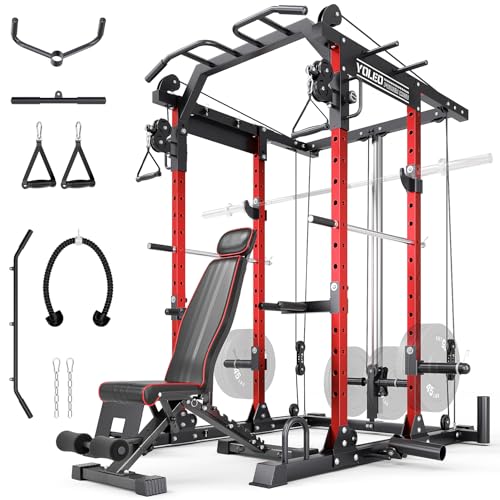
- 9-in-1 design for full-body workouts
- 1600LB capacity with reinforced steel frame
- Smooth dual-pulley cable system with 2:1 ratio
Trade-offs
- No independent pulley system for unilateral cable work
- Cable system uses 2:1 ratio, not 1:1 for direct resistance
A 1600-pound weight capacity from 1.8mm-thick steel uprights lets this rack handle serious squats, bench presses, and deadlifts without wobbling. The 9-in-1 design packs a lat pulldown, low row station, dip bars, and a landmine into a single footprint, so it’s a smart fit for anyone building a home gym from scratch who wants one machine that covers pressing, pulling, and cable work without buying separate attachments later. The dual-pulley system with a 2:1 ratio gives smooth resistance for flys and tricep work, and the internal cage depth leaves room for most benches to slide inside safely.
At 88.2 pounds, the frame is lighter than some competitors listed in the guide, so it may not feel as planted during heavy band work or explosive movements, though the reinforced stress points help. If you want a complete kit out of the box, this setup saves you time and money on add-ons. But if a heavier frame is a priority, some competitors offer that.
Product photos
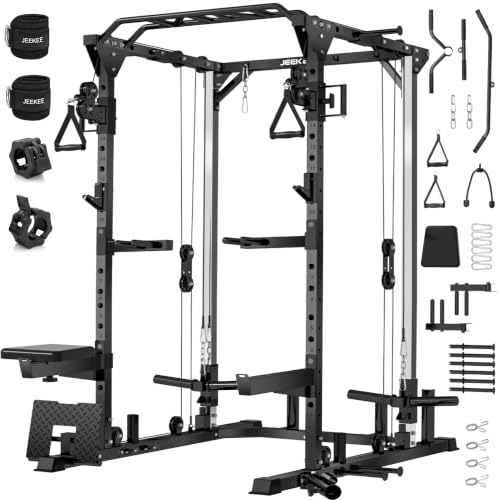
JEEKEE Power Cage with Independent Dual Pulleys
What We Like
- Independent dual pulleys for supersets and crossovers
- Adjustable lat pulldown seat cushion included
- 2000 lb frame capacity for heavy lifting
- 20+ attachments for full-body training
Trade-offs
- Weighs 240 lbs, making relocation difficult
- Requires 86-inch ceiling clearance for assembly
The two-sided pulley setup on this JEEKEE cage means you can run supersets, drop sets, and cable crossovers without one side locking up or fighting the other. That freedom is rare at this price tier, and it turns a standard squat rack into something closer to what you’d find in a commercial gym. The adjustable lat pulldown seat cushion mounts right onto the safety arms, so you’re not sliding around during pulldowns, it keeps your hips planted and your back engaged. With a 2000 lb frame rating and 500 lb pulley capacity, it’s built for steady progress without worrying about the structure giving out.
The trade-off is footprint and portability. At 240 pounds and 46.9 inches wide, this cage takes up real floor space and isn’t something you’ll want to reposition often. If your home gym is tight, the MAJOR FITNESS F22 offers a shorter length at 55.5 inches, though it gives up some pulley independence. For lifters who value cable variety and don’t mind dedicating a corner of the room, the JEEKEE delivers a versatile setup that lets you rotate through exercises without constant reconfiguration.
Product photos
How We Evaluated Power Racks With Cable System
We started by analyzing the technical specs of each rack: frame capacity, pulley ratio, cable height options, and interior space for bench press and squat work. Manufacturer data on steel gauge, weight, and dimensions formed the baseline for comparing structural integrity and footprint.
Three criteria mattered most. First, the pulley system type — independent dual pulleys allow unilateral work and supersets, while single-pulley designs are simpler but less versatile. Second, the pulley ratio: a 2:1 ratio halves the felt resistance, while a true 1:1 ratio gives direct weight feel. Third, the overall capacity and stability, since a rack that wobbles under heavy loads is unsafe and frustrating.
A research-led evaluation has limits. We haven’t assembled or trained on these racks ourselves, so we rely on what owners consistently report about assembly difficulty, pulley smoothness, and long-term durability. For detailed comparisons across categories, our comprehensive guide to power racks with cables covers even more options.
What To Look For In Power Racks With Cable System
Choosing a power rack with cables comes down to understanding how the pulley system works and whether it fits your training goals. Here are the three factors that matter most.
Focus on pulley ratio, independent vs. Single pulley design, and frame capacity. These three specs determine whether the rack feels right for cable crossovers, heavy squats, or partner training.
Pulley Ratio: 2:1 vs. 1:1
The pulley ratio changes how the cable resistance feels. A 2:1 ratio means the weight stack moves half the distance of the handle, so a 50 lb plate feels like 25 lb of resistance. This is fine for high-rep cable work, isolation exercises, and beginners, but it can feel too light for advanced lat pulldowns or rows.
A true 1:1 ratio, like the JELENS C21 offers, gives you exact resistance. Pull 50 lb and you feel 50 lb. This matters most for lifters who want to track progressive overload precisely on cable exercises. If you are unsure which ratio suits you, our guide to pulley system racks explains the trade-offs in more depth.
Independent vs. Single Pulley Design
Independent dual pulleys let you perform cable crossovers, unilateral rows, and supersets where two users train simultaneously. This is the feature that transforms a power rack into a true dual-cable station. The GOIMU DP01 and MAJOR FITNESS F22 both offer independent pulleys, while the YOLEO 9-in-1 uses a single pulley system.
Single-pulley designs are simpler, cheaper, and take up less cable path space, but they lock you into one movement at a time. If you train alone and don’t need crossover work, a single pulley may be all you need. For a broader look at options, check our roundup of home gym power racks.
Frame Capacity and Stability
Frame capacity tells you the maximum load the rack can hold, including barbell weight and the user’s body weight. A 2000 lb capacity, like the GOIMU DP01 and OPPSDECOR 2.0 PRO offer, gives plenty of headroom for heavy squats and deadlifts. Lower capacities like 1000 lb suit moderate training.
Stability depends on the base design and weight of the rack itself. Heavier racks (240 lb and up) stay planted without bolting, while lighter racks may need floor mounting or weight pegs loaded with plates. The MAJOR FITNESS Drone1‘s dual-triangle base is a good example of a design that reduces sway without permanent installation.
- Check the pulley ratio matches your training style (2:1 for versatility, 1:1 for direct resistance)
- Confirm the interior width fits your bench and allows full range of motion on bench press
- Measure ceiling height before buying — some racks need 84-86 inches of clearance
- Look at the number of cable height settings for lat pulldown, row, and crossover positions
A rack’s listed capacity includes the user’s body weight, so subtract your weight from the max to see how much barbell load it can handle.
Power Racks With Cable System Compared
The table below compares the ten power racks across pulley type, ratio, capacity, and best-use scenario so you can see the differences at a glance.
| Product | Weight Capacity | Pulley Ratio | Footprint |
|---|---|---|---|
| GOIMU DP01 Power Cage | 2000 lbs | 2:1 | 17.88 sq ft |
| MAJOR FITNESS F22 Power Rack | 1600 lbs | 2:1 | N/A |
| JELENS C21 Power Cage | 2000 lbs | 1:1 | 17.27 sq ft |
| Mikolo Power Cage HR05 | 2000 lb | 1:1 | N/A |
| MAJOR FITNESS Drone1 Premium | 1500 lbs | N/A | 63" × 66" |
| Mikolo K6 Power Cage | 1500LBS | 2:1 | N/A |
| OPPSDECOR 2.0 PRO Power Cage | 2000 lbs | 2:1 | 13.26 sq ft |
| Mdeam Folding Squat Rack | 1000 lbs | 1:1 | N/A |
| YOLEO 9-in-1 Power Cage | 1600LB | 2:1 | N/A |
| JEEKEE Power Cage with Independent Dual Pulleys | 2000 lbs | N/A | N/A |
Frequently Asked Questions
What is the difference between a 2:1 and a 1:1 pulley ratio?
A 2:1 ratio means the handle moves twice as far as the weight stack, so the felt resistance is half the loaded weight. A 1:1 ratio gives direct resistance — pull 50 lb and you feel 50 lb. The 2:1 is smoother for high-rep work and isolation, while the 1:1 is better for tracking progressive overload on compound cable exercises.
Can two people use a power rack with cable system at the same time?
Yes, if the rack has independent dual pulleys. Models like the MAJOR FITNESS F22 and GOIMU DP01 let two users perform cable exercises simultaneously without the cables interfering. Single-pulley designs only support one user at a time on cable work.
Do I need to bolt a power rack with cables to the floor?
It depends on the rack’s weight and base design. Heavier racks over 200 lb with wide bases, like the MAJOR FITNESS F22‘s dual-triangle base, stay stable without bolting. Lighter racks or folding models like the Mdeam Folding Squat Rack require wall mounting or floor bolting for safety.
What ceiling height do I need for a power rack with cable system?
Most full-size racks need at least 84 inches of ceiling clearance for lat pulldowns and overhead presses. The GOIMU DP01 requires 84 inches minimum, while the JEEKEE Power Cage needs 86 inches. Always measure your ceiling height before purchasing.
Can I add cable attachments to a standard power rack?
Some standard power racks accept bolt-on cable pulley systems, but integrated cable racks offer smoother operation and more height settings. For dedicated cable work, a cable machine for home gym might be a better fit than retrofitting a basic rack.
The Bottom Line
The GOIMU DP01 Power Cage is the best overall pick for home gym owners who want a heavy-duty power rack and cable trainer in one package. Its 2000-lb capacity, 31 cable height options, and independent dual pulleys cover everything from heavy squats to cable crossovers. It works best for lifters with at least 84 inches of ceiling height who train alone or with a partner.
If you train with a partner regularly, the MAJOR FITNESS F22 Power Rack is the better choice with its independent dual-pulley system designed for two simultaneous users. For those who want exact resistance on cable exercises, the JELENS C21‘s true 1:1 pulley ratio makes it the standout pick. Budget-conscious buyers should look at the Mikolo K6 Power Cage for its 8-in-1 value or the OPPSDECOR 2.0 PRO for a lightweight 2000-lb option.
The single most important factor is the pulley ratio and design. Match it to how you train — 2:1 for versatile cable work and supersets, 1:1 for precise progressive overload. Everything else, from capacity to attachments, is secondary once you get that right.
