
10 Best Recumbent Cross Trainers in 2026
This post contains affiliate links. As an Amazon Associate, we earn from qualifying purchases.
The Teeter FreeStep Recumbent Cross Trainer Stepper earns our Best Overall spot for its zero-impact stride, whisper-quiet magnetic resistance, and free companion app. The NuStep T4r offers the easiest entry for mobility-limited users, while the HCI Fitness CardioStep CS-600 leads for heart-rate-controlled training.
A recumbent cross trainer solves a specific problem: how to get a challenging, full-body cardio workout while keeping your spine, hips, and knees fully supported in a seated position. The right machine delivers that without feeling cramped, wobbly, or frustratingly limited in resistance.
This guide is based on manufacturer specifications, expert round-ups, and patterns in owner feedback across ten models. We focused on stride smoothness, ease of access, build stability, and resistance range to help you match a machine to your space and goals.
Top 10 Recumbent Cross Trainers in the Market
Certain content that appears on this site comes from Amazon. This content is provided "as is" and is subject to change or removal at any time.
The Best Recumbent Cross Trainers, Reviewed
Teeter FreeStep Recumbent Cross Trainer Stepper

What We Like
- Zero-impact on joints and back
- Whisper-quiet magnetic resistance
- Free trainer app included
Trade-offs
- At 150 lbs, not easy to move alone
- No included heart rate monitor strap
For anyone dealing with arthritis, joint sensitivity, or just wanting a low-stress way to build cardio and strength, this design makes every session feel gentler than a typical recumbent bike or elliptical. The 20 levels of magnetic resistance give you room to progress from light movement to a real challenge, and the free Teeter Move app adds structured workouts without a subscription fee.
The trade-off is size and weight. At 150 pounds and nearly five feet long, this machine takes up dedicated floor space and isn’t something you’ll casually slide under a bed. The NuStep T4r is heavier at 210 pounds but shorter, and its swivel seat may help with entry and exit for some users. The FreeStep does include an electronic step lock and transport wheels to assist with getting on and off, but if you need to move it between rooms regularly, the heft is worth considering. For most home gyms where the machine will stay put, the combination of physical therapy-inspired motion, quiet operation, and app-based coaching makes this a strong pick for sustainable, joint-friendly workouts.
Product photos
NuStep T4r Recumbent Cross Trainer

What We Like
- 360° swivel seat locks every 45°
- Quick Start button for one-click workouts
- StrideLock stabilizes handles and pedals
- Fully assembled with room placement
Trade-offs
- At 210 lb, moving it is a two-person job
- Delivery crew won't show you how to use it
A 360-degree swivel seat that locks every 45 degrees means you can approach this machine from any side and slide right on, no awkward straddling or twisting. That wheelchair-height seat also slides forward and backward to match different leg lengths, so getting comfortable takes seconds. The Quick Start button gets your workout going with one click, and StrideLock keeps the handles and pedals locked in place for stability. For anyone who values easy access over flashy features, this design puts safety and convenience first.
At 210 pounds, this machine stays put once you set it up, so you won’t be moving it around for storage or cleaning. The Teeter FreeStep is 150 pounds and easier to shift, but the extra heft here means a more stable platform during use. You get ten resistance levels and app compatibility, so you can dial in the intensity yourself. For someone who wants a steady, low-hassle entry and exit, and has the floor space, this model delivers a solid experience.
NuStep T5 Recumbent Cross Trainer

What We Like
- Locking handles and pedals for secure movement
- Larger swivel seat for easy entry and exit
- Supportive foot pedals for stable workouts
- LCD color display for clear feedback
Trade-offs
- At 285 lb, it is very heavy to move
- Takes up more floor space than lighter models
At 285 pounds, the NuStep T5 is the heaviest model listed among the other products, and that weight keeps the machine planted during use. The locking handles and pedals stay secure while you push, and the larger swivel seat makes it easier to get on and off. Owners report it feels steady even during intense sessions, so it works well for a home gym where you don’t plan to move the equipment often.
The 285-pound weight and 73-inch length mean you need a dedicated spot for this machine. Compared to the Teeter FreeStep at 150 pounds and 59 inches, the T5 is much heavier and longer, so it won’t fit in a closet or under a bed. If you have a permanent workout area and want a stable machine that stays put, this fits; if you need to store gear after each use, a lighter model would be easier to handle.
Sunny Health & Fitness SF-RBE4886SMART Recumbent Cross Trainer
What We Like
- 16 levels of electromagnetic resistance
- 12 pre-programmed workouts plus 4 custom user programs
- Bluetooth connectivity to free SunnyFit app
- Low-impact design protects joints
Trade-offs
- No published weight capacity or dimensions for space planning
- No published weight capacity for heavier users
Sixteen levels of electromagnetic resistance give you fine-grained control over intensity, from a gentle recovery session to a challenging full-body workout. That range, paired with 12 built-in programs and the ability to create four of your own, makes this machine feel like it adapts to you rather than the other way around. The Bluetooth connection to the SunnyFit app adds leaderboards, goal tracking, and a library of free workouts, so you never run out of structure or motivation. If you want a recumbent cross trainer that keeps your joints happy while still letting you push yourself, this one delivers that balance clearly.
The 16 electromagnetic resistance levels let you dial in everything from a gentle recovery session to a challenging full-body workout, so you can match intensity to your goals without guessing. Bluetooth connectivity links to the SunnyFit app for free workouts, progress tracking, and leaderboard competition, which makes it easy to stay motivated. With 12 pre-programmed routines and room to create up to 4 custom user programs, you get plenty of variety without needing to plan every session yourself.
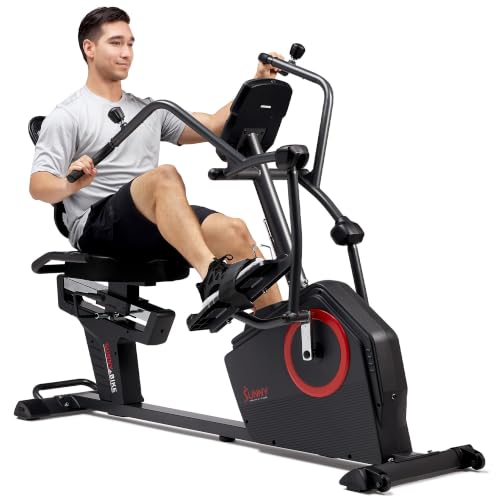
Sunny Health & Fitness 2-in-1 Recumbent Elliptical
What We Like
- 2-in-1 elliptical plus bike training
- 16 electromagnetic resistance levels
- 24 workout programs with heart rate control
- Free SunnyFit app with 2,000+ workouts
Trade-offs
- 113.1 lb machine is heavy to move
- 300 lb capacity lower than some competitors
- Pulse sensors only on built-in grips
A 16-level electromagnetic resistance system and 24 workout programs give you room to grow from gentle movement to a real sweat session without ever touching a manual dial. The 2-in-1 design lets you use the moving handles and pedals together for full-body cardio or isolate just your arms or legs, which offers variety without swapping machines. The open step-through frame and adjustable seat (fits inseams from about 30 to 40 inches) mean getting on and off is genuinely easy, and the free SunnyFit app adds thousands of trainer-led rides and scenic routes with no subscription required.
At 113.1 pounds this isn’t a machine you casually slide across the room, and the 300-pound weight limit is lower than the Teeter FreeStep’s 350-pound capacity. If you need a higher user weight ceiling or a lighter footprint, the Teeter might be a better fit. But for someone who wants the flexibility of two movement styles in one comfortable, app-connected package, and doesn’t mind a heavier frame that stays put, this Sunny Health & Fitness model delivers a lot of value for the space it takes up.
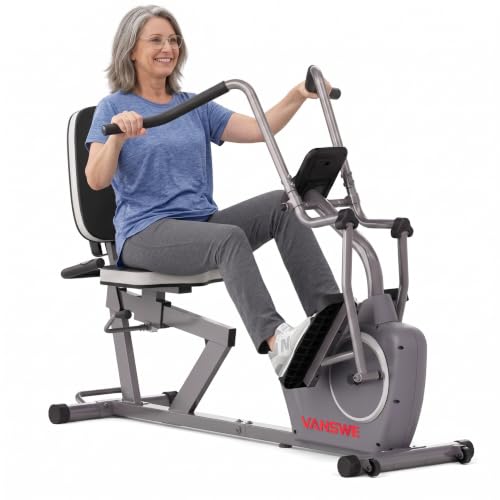
VANSWE Recumbent Elliptical Exercise Bike
What We Like
- 400 lb weight capacity
- Under-10dB quiet operation
- Full-body arm and leg workout
- Infinite seat slider fits 5'2" to 6'5"
Trade-offs
- At 75 lbs, still heavy to move
- 8 resistance levels limit challenge for advanced riders
The eight resistance levels provide a reasonable range for steady cardio and recovery, but riders accustomed to more intense workouts may find the top end limited. At 75 pounds, this machine is lighter than many competitors like the Teeter FreeStep (150 pounds) or NuStep T4r (210 pounds), but it still needs two hands and the front transport wheels to move. For someone who needs a high weight capacity, quiet operation, and the ability to switch between cycling and striding mid-workout, this model covers those priorities.
Product photos
JLL Fitness RB100 Recumbent Cross Trainer

What We Like
- Bluetooth pairs with free SunnyFit app
- 8-level magnetic resistance for quiet workouts
- Weighs 68.8 lb with front transport wheels
Trade-offs
- No swivel seat for easier entry/exit
- Seat slides on rail, no swivel for easier entry
At 68.8 pounds, this recumbent cross trainer is lighter than many full-body machines, and the front transport wheels make it easier to reposition. The 59.8-inch length and 26.7-inch width let it fit into tighter spots in a home or apartment, and the dual-action arm exercisers still provide upper-body work while you pedal. The 8-level magnetic resistance is near-silent, so it won’t disturb others in the same room, and Bluetooth pairs with the free SunnyFit app for guided workouts and scenic routes.
At 68.8 pounds, this machine is light enough to move around the house using its built-in transport wheels. Reviewers note it may feel less planted during vigorous efforts compared to heavier models like the 150-pound Teeter FreeStep. The seat slides on a reinforced rail instead of swiveling, so getting on and off requires a bit more mobility than a swivel-seat design. If your priority is steady-state cardio and gentle intervals that don’t dominate the room, this JLL model delivers full-body engagement without the bulk.
Product photos
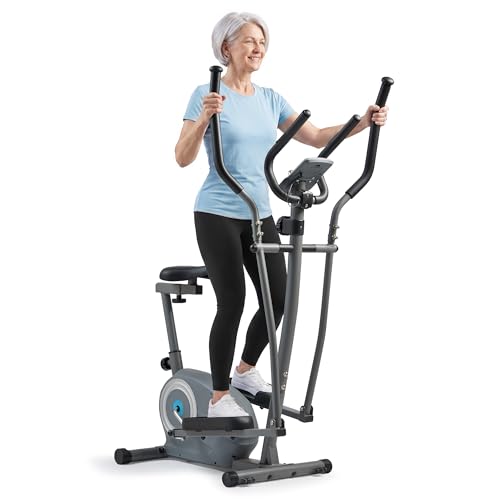
JLL Fitness Recumbent Cross Trainer
What We Like
- Compact 45.3-inch length saves floor space
- Adjustable padded seat fits different heights
- Quiet belt-driven operation for home use
- Forward and reverse pedaling targets varied muscles
Trade-offs
- 8 resistance levels limit progressive overload for advanced users
- No arm exercisers for full upper-body engagement
At just 45.3 inches long and 69 pounds, this is the machine you slide into a corner of the living room or tuck under a loft bed without a second thought. The adjustable padded seat means you can share it with a taller or shorter partner, and the quiet belt-driven system lets you pedal through a podcast without waking anyone up. If your biggest hurdle is finding room for a cross trainer, this one solves that problem neatly.
The compact footprint comes with a lighter frame that might feel less planted during aggressive strides, and the eight magnetic resistance levels won’t challenge someone who has built serious leg strength. The Teeter FreeStep, which weighs 150 pounds and offers a wider stride, feels more like a heavy-duty machine than this JLL, which is more of a friendly entry point. It is a smart pick for apartment dwellers or anyone who values space over raw stability.
HCI Fitness CardioStep CS-600 Recumbent Cross Trainer

What We Like
- Heart rate control programs included
- 360° swivel seat for easy access
- Fits users 4'9" to 6'2"
- 450 lb max user weight capacity
Trade-offs
- At 230 lb, it is heavy to move
- 66-inch length needs decent floor space
- No app connectivity for guided workouts
A built-in heart rate control program and contact sensors in the handles let you set a target pulse and the machine automatically adjusts resistance to keep you there. That makes the CardioStep useful if you want to train in a specific heart rate zone without fiddling with buttons every minute. With a 450-pound weight capacity and a 360-degree swivel seat that lets you step on from either side, it is built for accessibility and long-term use.
At 230 pounds, this machine is heavy enough that you will want a permanent spot for it rather than planning to move it around. It stretches 66 inches long, so it needs a dedicated floor space. The Teeter FreeStep, which weighs 150 pounds and is 59 inches long, is more portable, but the CardioStep offers heart rate control programs that the Teeter FreeStep does not list.
HCI Fitness PhysioStep LXT Recumbent Stepper

What We Like
- Patented linear stepping motion
- Oversized 20" orthopedic foam seat
- Swivel handle for easy transfers
- 18 workout programs
Trade-offs
- At 210 lbs, moving it requires effort
- No built-in app connectivity mentioned
A 400-pound weight capacity and a seat that adjusts for users from 4’6″ to 6’4″ mean this machine welcomes nearly any body type without compromise. The oversized 20-inch orthopedic foam seat with lumbar support and a swivel handle makes getting on and off genuinely easier, especially if mobility is a concern. For someone who wants a low-impact total-body workout that prioritizes joint-friendly movement and stable comfort, this design delivers exactly that.
Heft is the main consideration: at 210 pounds, the PhysioStep LXT is not something you’ll casually roll across the house, though rear roller wheels do help with doorway navigation. Its 30-inch width is slightly less than the Teeter FreeStep’s 32.7 inches, but the Teeter is 60 pounds lighter. If you need a machine that moves between rooms frequently, the Teeter may be more practical. But if your priority is a sturdy, high-capacity recumbent stepper with a natural linear stride and a seat that accommodates tall and heavier users, this HCI Fitness model earns its keep.
Product photos
How We Evaluated Recumbent Cross Trainers
We started by combing through manufacturer specs for every model, dimensions, weight capacity, resistance type, and included features. Then we cross-referenced those numbers against patterns in long-term owner feedback to see which machines actually hold up and which trade-offs matter most in daily use.
Our evaluation centered on four criteria: stride quality (smooth, natural motion without jerky transitions), ease of entry and exit (swivel seats and low step-over height), resistance range (magnetic vs. Friction, number of levels), and build stability (unit weight and frame construction). A machine that wobbles at high resistance or requires a contortionist act to mount won’t get used.
The honest limit of a research-led evaluation is that we can’t tell you exactly how a machine feels under your own stride. What we can tell you is which models consistently satisfy owners with similar needs, whether that’s a 400 lb capacity for heavier riders or a compact footprint for apartment living.
What To Look For In Recumbent Cross Trainers
Start by matching the machine’s dimensions and weight capacity to your body and your floor space. A cross trainer that doesn’t fit your height or your room is a non-starter.
Look for a swivel seat if you have limited mobility, magnetic resistance for quiet operation, and a weight capacity at least 50 lb above your body weight for a comfortable safety margin.
Stride Quality and Resistance Type
The stride should feel natural and gliding, not choppy. Magnetic resistance is quieter and smoother than felt or friction-based systems, and it requires virtually no maintenance. Look for machines with at least eight resistance levels, more is better for progressive overload as you get fitter. Some models offer electromagnetic resistance with dozens of levels and programmable workouts, while simpler magnetic systems use a manual tension knob.
Seat Design and Accessibility
A 360-degree swivel seat makes entry and exit dramatically easier, especially for anyone with hip or knee stiffness. Check the seat width and padding depth: orthopedic foam seats (like the 20-inch model on the HCI PhysioStep LXT) offer far more comfort for longer sessions than thin vinyl pads. Also verify the seat slider range, infinite adjustment is ideal for households where multiple users of different heights share the machine.
Build Quality and Footprint
Heavier machines are more stable at high resistance and less likely to shift during a vigorous workout, but they’re difficult to move. Lighter models with front transport wheels are better for apartment dwellers who store the machine between uses. Measure your space carefully: the shortest machines run about forty-five inches long, while full-size models can exceed sixty-six inches. Always add a few feet of clearance behind and to the sides for safe entry and exit.
- Check the published weight capacity against your body weight plus a safety buffer
- Measure your doorway width and floor space before ordering
- Look for locking handles and pedals if you need to stabilize the machine during mounting
- Confirm the power source, some machines require a wall outlet, others run on batteries
- Read the delivery details: some models arrive fully assembled, others require significant setup
A machine that’s too heavy to move will stay in one spot forever, so choose your trade-off between stability and portability.
Recumbent Cross Trainers Compared
The table below compares all ten recumbent cross trainers across key specs, weight capacity, unit weight, resistance type, and standout features, so you can see the differences at a glance.
| Product | Dimensions | Weight | Resistance Levels |
|---|---|---|---|
| Teeter FreeStep Recumbent Cross Trainer Stepper | 59.0 x 32.7 x 54.8 in | 150.0 lbs | 20 magnetic |
| NuStep T4r Recumbent Cross Trainer | 60 x 27 x 45 in | 210 lb | 10 |
| NuStep T5 Recumbent Cross Trainer | 73.0 x 30.0 x 46.0 in | 285.0 lb | N/A |
| Sunny Health & Fitness SF-RBE4886SMART Recumbent Cross Trainer | N/A | N/A | 16 |
| Sunny Health & Fitness 2-in-1 Recumbent Elliptical | 71.7 x 33.3 x 50.8 in | 113.1 lb | 16 |
| VANSWE Recumbent Elliptical Exercise Bike | 57.0 x 19.8 x 47.0 in | 75 lbs | N/A |
| JLL Fitness RB100 Recumbent Cross Trainer | 59.8 x 26.7 x 47.0 in | 68.8 lb | 8 magnetic |
| JLL Fitness Recumbent Cross Trainer | 45.3 x 26.0 x 60.2 in | 69.0 lb | 8 magnetic |
| HCI Fitness CardioStep CS-600 Recumbent Cross Trainer | 66 x 25 x 56 inches | 230 pounds | 32 electronic levels |
| HCI Fitness PhysioStep LXT Recumbent Stepper | 60.0 x 30.0 x 40.0 in | 210.0 lbs | N/A |
Frequently Asked Questions
What is the difference between a recumbent cross trainer and a recumbent bike?
A recumbent cross trainer combines upper-body arm handles with a leg stride motion similar to an elliptical, engaging both arms and legs simultaneously. A recumbent bike works only the legs through a circular pedal motion. Cross trainers provide a more complete full-body workout.
How much floor space do I need for a recumbent cross trainer?
Most machines require between 45 and 66 inches in length and about 25 to 30 inches in width. Always add at least two feet of clearance behind the machine for safe entry and exit. Measure your room carefully before ordering.
Can a recumbent cross trainer help with knee pain?
Many users choose recumbent cross trainers specifically to reduce stress on the knees. The seated, low-impact motion keeps the knees in a supported position without the jarring impact of walking or running. For specific medical concerns, consult a physical therapist or doctor.
What weight capacity should I look for in a recumbent cross trainer?
Look for a weight capacity at least 50 pounds above your body weight for a comfortable safety margin. Models range from 300 lb to 450 lb. Heavier machines with higher capacities tend to be more stable during use.
Do I need a machine with app connectivity?
App connectivity adds workout variety, progress tracking, and guided training programs. It’s a nice bonus if you enjoy structured workouts, but it’s not essential for effective cardio. Machines without apps still deliver excellent workouts through manual resistance adjustment and built-in programs.
The Bottom Line
The Teeter FreeStep Recumbent Cross Trainer Stepper is our Best Overall pick for most home users. Its zero-impact stride, whisper-quiet magnetic resistance, and free training app make it the most well-rounded machine here, especially if you need joint-friendly cardio that doesn’t feel like a compromise.
If your priority is easy access, the NuStep T4r’s 360-degree swivel seat and quick-start button make it the most user-friendly option for anyone with mobility concerns. For heavier riders, the VANSWE Recumbent Elliptical Exercise Bike supports up to 400 lb with a quiet, full-body workout.
The single most important factor is fit: measure your space, check the weight capacity, and choose a machine with a stride that feels natural to you. A cross trainer you can comfortably mount and use consistently will always outperform a fancier one that sits in the corner. For more options, explore our guides on recumbent cross trainers, best recumbent ellipticals, and recumbent elliptical machines.
