
Carb Timing Around Workouts: What Actually Matters
This post contains affiliate links. As an Amazon Associate, we earn from qualifying purchases.
Carb timing around workouts matters most when sessions are long, stacked close together, or done fasted. Aim for 1-4 g of carbs per kg of body weight before training, 30-60 g per hour during sessions that run past an hour, and 1-1.2 g per kg per hour in the first 2-4 hours afterward.
The back-to-back part is where the standard advice starts to fray. If your next session is more than 8-10 hours away, the German Nutrition Society’s 2019 position is blunt: timing stops affecting 24-hour glycogen resynthesis as long as total intake is adequate. What’s left is a much smaller set of decisions than the supplement aisle suggests.
What follows walks the three windows in order, shows where the major position stands disagree with each other, and ends with a plate you can build tonight without weighing anything.
Key Takeaways
- Total intake beats clock-watching when your sessions sit more than 8-10 hours apart.
- 30-60 g per hour is the ISSN band for carbs during exercise; a Journal of Nutrition review puts it at 30-80 g per hour for sessions over an hour.
- 1-1.2 g per kg per hour is the post-exercise glycogen target, and the DGE states that more than that adds nothing.
- Short, fed sessions need nothing special. The resistance-training benefit shows up mainly past 45 minutes and after an 8-hour fast.
- A carb snack before an early session is the cheapest fix for feeling flat and weak at 7 a.m.
So What Does Carb Timing Around Workouts Actually Change?
Three windows, and usually only one of them is worth rearranging your day for.
Carbohydrate ingested before exercise tops up liver glycogen and steadies blood glucose. Carbohydrate taken during exercise maintains plasma glucose and delays fatigue once sessions run past roughly one hour. Carbohydrate after exercise restores muscle glycogen fastest in the first two to four hours, provided total daily intake is adequate.
The pre-session window does the most work for beginners. It’s the easiest one to skip, and it’s the one you feel fastest.
Zoom out and the bigger lever is meal timing for workouts across the whole day, which decides more than any single snack does.
| What you notice | Likely cause | What to change |
|---|---|---|
| Flat and shaky by 7 a.m. | Overnight fast, no pre-session carbs | 30-60 g of easy carbs before training |
| Bonking around 70-80 minutes | No carbs during a session over an hour | 30-60 g per hour during |
| Bloated and sloshy mid-run | Solution mixed too concentrated | Dilute toward 6-8% |
| Weak again the next day | Total daily carbs too low | Raise overall intake, not just timing |
Read that as a triage list. Fix the top row first, because a flat 7 a.m. Session is usually a breakfast problem rather than a mid-workout problem.
None of it holds if your daily carbs for training are too low to begin with. Timing distributes fuel. It doesn’t create it.
The Pre-Workout Window: 1-4 g of Carbs per Kilo, Scaled to Duration
1-4 g of carbohydrate per kilogram of body weight is the pre-exercise range the German Nutrition Society sets in its 2019 position, and the width of that band is deliberate.
The low end suits a short session. The top end suits a long one. For a 75 kg lifter that’s roughly 75 g at the bottom and 300 g at the top, which is the difference between a banana and a full rice-based meal.
What 1-4 g per Kilo Looks Like on a Plate
- Low end, short session: a banana and a slice of toast, 60-90 minutes out.
- Middle of the range: a bowl of oats with fruit, or a small bowl of rice with eggs.
- Top end, long session or a race: a full rice or pasta meal 3-4 hours before, then a small carb snack in the final hour.
- Nothing at all, if you ate properly two hours ago and you’re training for 40 minutes.
If you’re deliberately loading for a long event, carb loading is a separate protocol with its own math, and it isn’t something to improvise the night before.
Most people don’t need to weigh anything. They need to notice that the pre-workout carbs they pick change how the first 20 minutes feel.
Eat at the top of that range an hour before a hard session and you’ll know it: a full, heavy stomach and a burp that tastes of oats on the first set of squats.
I’d rather see someone eat a plain bowl of oats two hours out than a “perfect” pre-workout shake ten minutes out. The gut needs time more than it needs precision.
That’s why timing matters as much as amount here. A big meal wants 3-4 hours. A small snack wants 60-90 minutes. If you train within an hour of waking, simple carbs are the practical pick, because there’s no time to digest anything bulky.
During Exercise: 30-60 g per Hour, or 30-80?
Two major position stands disagree about how much carbohydrate belongs in the bottle, and neither one is wrong.
| Source | Carbs per hour | Solution strength |
|---|---|---|
| ISSN position stand | 30-60 g | 6-8% carb-electrolyte |
| Journal of Nutrition review | 30-80 g (sessions 1 h+) | 8% or less |
| Jeukendrup review | ~60 g single source, higher if mixed | Not specified |
The ISSN nutrient timing position stand sets 30-60 g per hour in a 6-8% carbohydrate-electrolyte solution, taken as 6-12 fl oz every 10-15 minutes. A Journal of Nutrition carb ingestion study covering exercise of at least an hour puts the range at 30-80 g per hour in a solution of 8% or less.
Why the Single-Source Ceiling Sits Near 60 g per Hour
This is the part that gets flattened into one number. A carbohydrate intake during exercise review notes that a single carbohydrate source is oxidized at up to about 60 g per hour. Multiple transportable carbohydrates raise that ceiling, because different sugars use different intestinal transport routes and don’t queue behind each other.
So 60 g per hour is a single-source limit, not a universal cap, though the ISSN still recommends a 30-60 g/h band. Drink a single-sugar sports drink and 60 is your practical ceiling. Use a mix and the ceiling moves.
There’s a second disagreement worth naming. Gatorade’s 2024 guide frames during-exercise carbohydrate as body-weight-independent, while the DGE expresses its targets per kilogram of body weight. Same physiology, two reference frames.
Mix the bottle too strong and you’ll feel it: a coating on the mouth, a heavy weight in the stomach, and a slosh on the first set of walking lunges.
Where this goes sideways: Doubling the concentration to “get ahead” on carbs. Fluid leaves the stomach more slowly as concentration climbs, so the carbs sit there, and by the 40-minute mark you’re nauseated instead of fueled.
Source choice matters more than the total here, and intra-workout carbs is where that decision actually gets made.
Do You Need Carbs During a 45-Minute Lift?
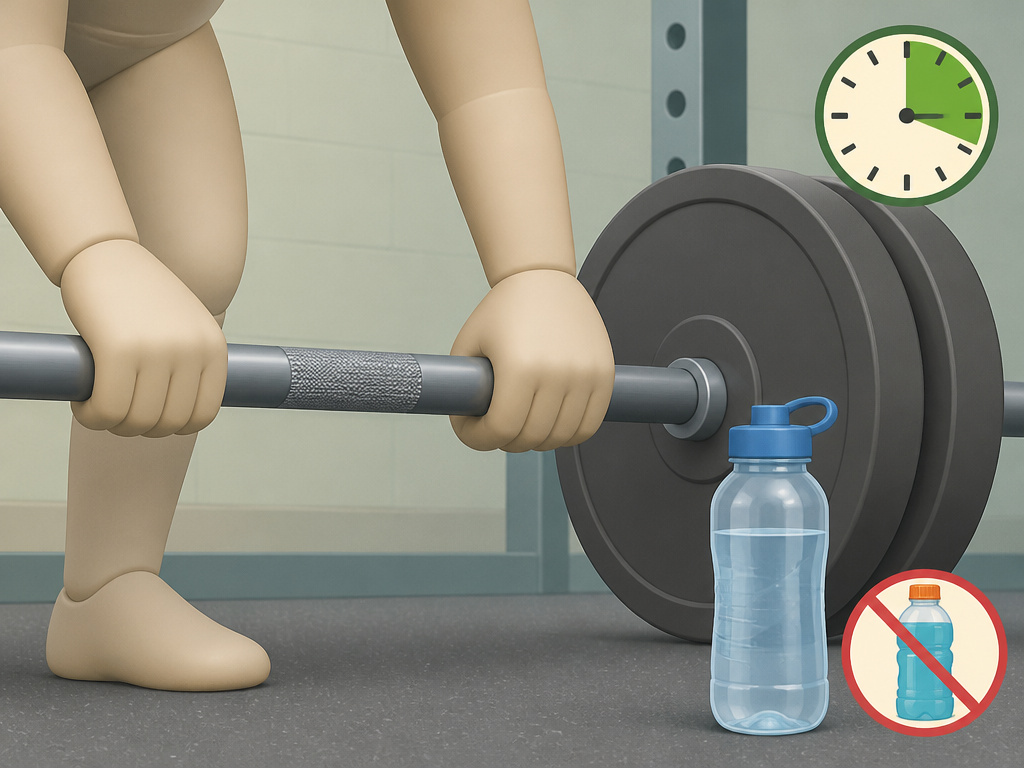
A lift under 45 minutes in a fed state doesn’t need a sports drink.
A meta-analysis of carbohydrate and resistance training puts the overall benefit at a standardized mean difference of 0.61. That figure is an effect size, meaning it describes how far apart the carb and no-carb groups landed, not a percentage improvement.
Break it down and the pattern sharpens. Sessions longer than 45 minutes: SMD 1.02. Sessions started after an 8-hour fast or longer: SMD 0.39.
Short and fed is the case with no support. That’s most lunchtime lifters.
For carb timing around workouts, the resistance-training data is the most specific evidence available, and it points at duration and fasting state rather than at the clock.
When to skip the intra-workout carbs:
- Under 45 minutes, eaten within the last few hours. Water is fine.
- Any session where you’d rather not think about your stomach at all. Some people tolerate nothing mid-lift, and that’s a real constraint, not a weakness.
- Sessions where the “carbs” would come from a bottle you mixed too strong. Fix the mix first.
- Easy technique days. Low effort, low cost.
I’ve never taken a gel into a 45-minute lifting session, and I’ve stopped treating that as a gap in my preparation.
The Post-Workout Window Is Narrower Than the Internet Says
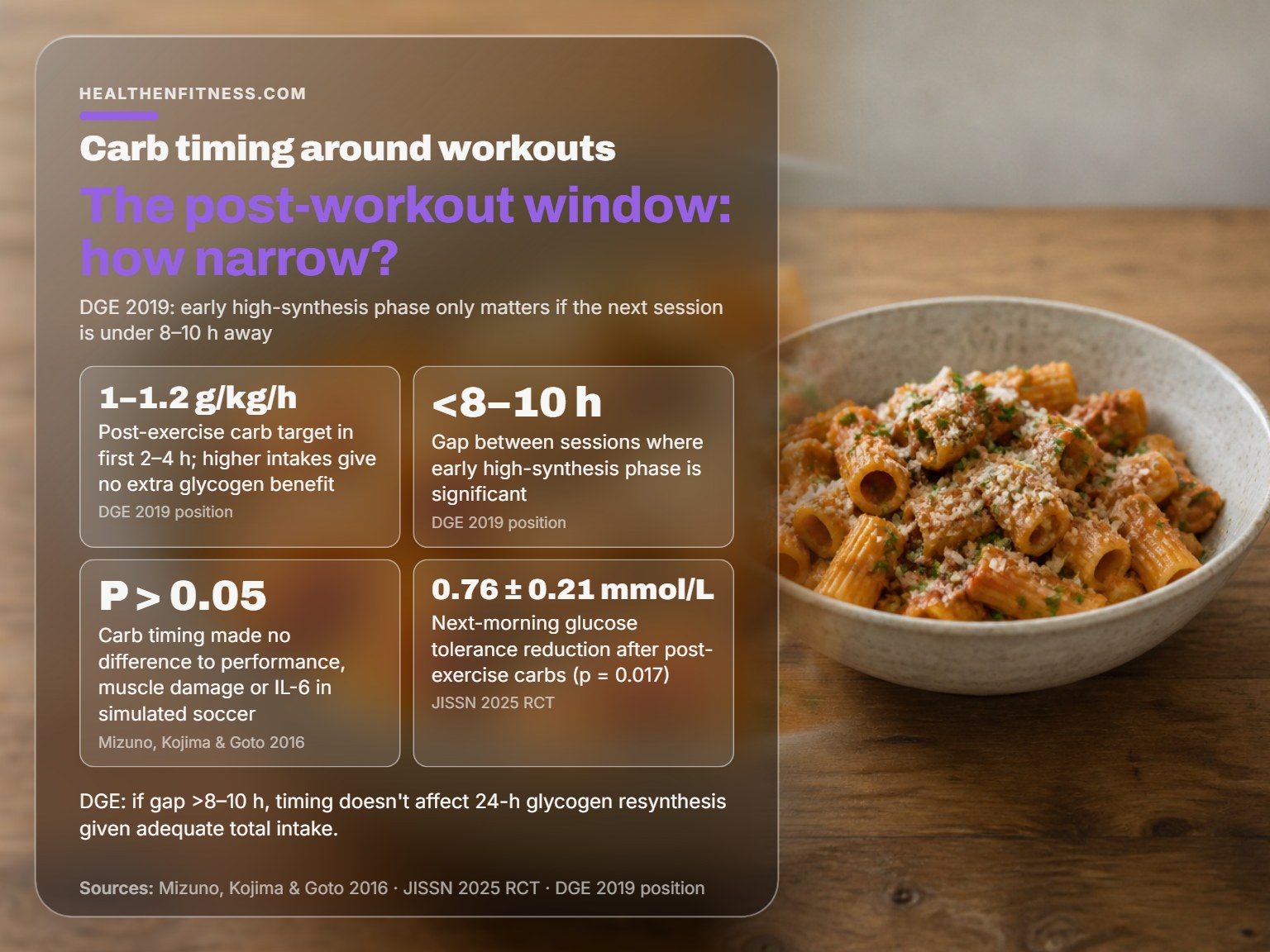
It’s 9 p.m., the evening session is done, and every article you open says you have 30 minutes to eat.
The DGE’s 2019 position gives a post-exercise target of 1-1.2 g of carbohydrate per kg of body weight per hour in the first 2-4 hours, and states plainly that higher intakes give no significant additional glycogen resynthesis.
It also adds the caveat that most of the urgency disappears. The early high-synthesis phase is only significant when the gap between sessions is under 8-10 hours. Past that, timing doesn’t affect 24-hour glycogen resynthesis as long as total intake is adequate.
That puts a public health body directly at odds with the industry framing. Gatorade’s Sports Science Institute material treats post-exercise carbohydrate as a time-critical window. The DGE treats it as a scheduling question that only bites on double-session days.
A timing of carb ingestion performance study in simulated soccer found no difference in performance, muscle damage markers (myoglobin, creatine kinase) or IL-6 across the timing conditions. The reported P values sat above 0.05, which means the gaps were within what chance alone would produce.
The 2025 Trial Everyone Quotes Half Of
An evening-exercise trial gave cyclists 253 ± 52 g of carbohydrate, matched to what they oxidized during 50 minutes at 70% of maximal work rate plus a roughly 24-minute time trial.
Post-exercise carbohydrate reduced next-morning glucose tolerance, with a mean difference of 0.76 ± 0.21 mmol/L (p = 0.017). The same intervention improved metabolic flexibility, with 70% and 91% higher carbohydrate oxidation compared with the pre-carbohydrate and control conditions (p ≤ 0.029).
Both halves belong together. Quote only the glucose result and you’ve described a problem. Quote only the oxidation result and you’ve described a benefit. It’s one finding with two faces, and it’s the only source here that tested evening exercise at all.
The long-term picture on nocturnal glucose is genuinely thin. One trial is one trial, and anyone who tells you otherwise is overselling it.
If your next session is more than 8-10 hours away, stop scheduling your day around a 30-minute window. Eat a normal meal and get on with it.
The following day matters as much as the following hour, and glycogen replenishment is where that gets decided.
How to Build the Plate Without Weighing Anything
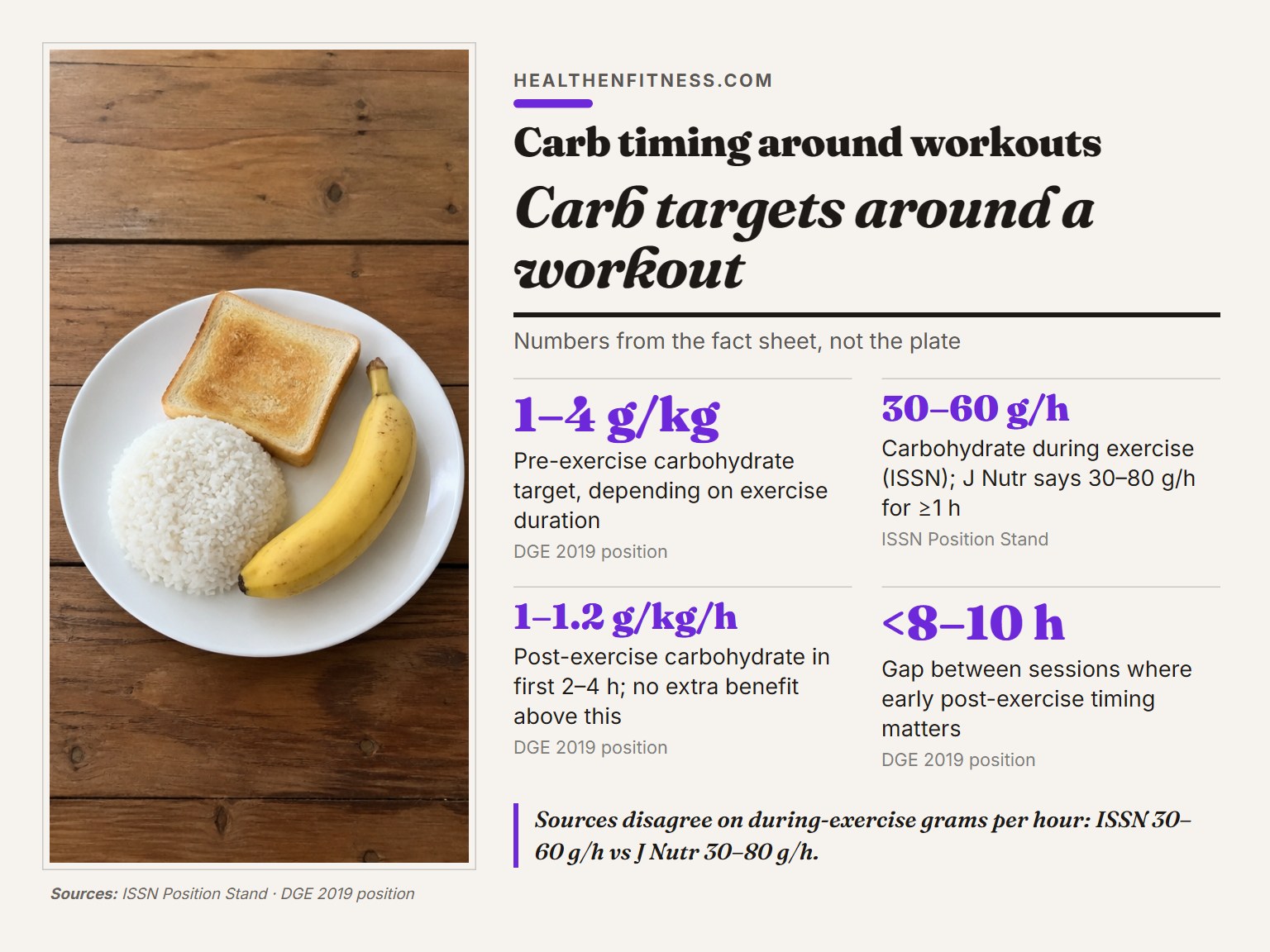
The plate is where all of this actually happens.
Before you start: If you take insulin or any glucose-lowering medication, the numbers above don’t apply to you without medical input, because carb timing changes your glucose curve directly. If you have a history of disordered eating, structured carb rules can do more harm than good, so get a clinician involved before you start counting anything.
- Anchor breakfast around a carb you already like. Oats, toast, fruit. Skipping this is the most common reason a morning session feels heavy and flat.
- Scale the pre-session meal to the gap. Three to four hours out, eat a full meal. Sixty to ninety minutes out, keep it small and low in fiber, or you’ll feel it on the first hard set.
- Add carbs during anything past an hour. 30-60 g per hour from a 6-8% solution. Skip it on a two-hour session and the last 30 minutes will be noticeably worse.
- Eat a normal meal within a couple of hours after training. You don’t need a shaker in the parking lot. You need total carbs landing near 1-1.2 g per kg per hour over the first few hours if you’re training again soon.
- Check the total for the day. Flat for three sessions in a row? The answer is almost always more total carbohydrate, not cleverer timing.
I use a plain kitchen timer for rest periods, usually 90 seconds on the big lifts. Not because 90 is magic. It’s because it stops me rushing one set and scrolling through the next, and my sessions got shorter and more consistent once I quit guessing. Carb timing works the same way. Progress you can repeat is progress that lasts.
For most people the default is boring, and that’s fine: oats before a morning session, rice with dinner on training days, and a carbohydrate-electrolyte drink if the session runs past an hour. If you’d rather see the numbers than guess, a food-logging app can track carbohydrate without much fuss.
Skip carb cycling. It adds a layer of daily math that rarely changes anything for someone still building the habit.
The other half of the plate is protein timing, and it’s a simpler question than this one.
Frequently Asked Questions
Does carb timing matter if I only train once a day?
Less than total intake does. The DGE position states that when the gap between sessions is longer than 8-10 hours, timing doesn’t affect 24-hour glycogen resynthesis provided total carbohydrate is adequate. Once-a-day trainees are almost always in that group.
How many carbs should I eat before an early morning workout?
The DGE pre-exercise range is 1-4 g per kg of body weight, scaled to how long you’re training. For a 75 kg person that’s roughly 75-300 g. Training within an hour of waking, keep it small and quick to digest.
Do I need carbs during a workout under an hour?
Usually not, especially if you ate in the previous few hours. The resistance-training meta-analysis found benefit concentrated in sessions over 45 minutes and after an 8-hour fast. A fed lift under 45 minutes sits outside both conditions.
Is the 30-minute post-workout window real?
It’s real in a narrow case: the DGE ties the early high-synthesis phase to gaps under 8-10 hours between sessions, while Gatorade’s Sports Science Institute material treats post-exercise carbohydrate as a time-critical window. Past that, timing stops affecting 24-hour glycogen resynthesis. A 2016 intermittent running trial found no performance or inflammation difference by timing, while the DGE holds that timing matters when the gap between sessions is under 8-10 h.
Should I use a sports drink or real food during training?
Either works if the carbohydrate concentration stays in range. The ISSN specifies a 6-8% carbohydrate-electrolyte solution, and the Journal of Nutrition review caps it at 8% or less. Above that, the drink sits heavier and empties more slowly.
The Bottom Line
One trigger decides most of this: the gap between sessions. Under 8-10 hours and the post-exercise window is real, so eat carbs soon and don’t overthink the rest. Over 8-10 hours and the window mostly stops mattering, so total daily intake takes over.
None of it applies cleanly if you take insulin or a glucose-lowering medication, or if you have a history of disordered eating. Those are conversations for a clinician, not a training article.
And the thing I’d defend hardest: a beginner who eats a normal breakfast and trains will outperform a beginner who fasts and chases a perfect intra-workout ratio. Every time.
Today, just eat one proper carb serving before your next session and see whether the first 20 minutes feel different.
