
How to Carb Load Before a Workout: The 90-Minute Rule
This post contains affiliate links. As an Amazon Associate, we earn from qualifying purchases.
To carb load before a workout, you need more than 6.5 g of carbohydrate per kilogram of body weight per day to raise muscle glycogen, and a real loading dose sits above 8 g/kg/day for 36 to 48 hours before a long event. Under 90 minutes, loading buys you nothing.
That 90-minute line is where most of the confusion lives. A pasta dinner before a 45-minute lifting session gets called carb loading all the time, but the research on how to carb load before a workout is about topping off glycogen for endurance work that runs long. The dose and the timing only start to matter once you clear that threshold.
What follows is the dose, the timing, and the honest answer about whether any of this matters for your workout. It also covers where the major sources disagree with each other, because they do, and pretending otherwise would be dishonest.
Key Takeaways
- More than 6.5 g/kg/day is the threshold where glycogen actually rises, per a 2026 meta-analysis.
- A real loading dose is above 8 g/kg/day for 36 to 48 hours before a long event, or 24 to 36 hours if you deplete first with high-GI carbs.
- Under 90 minutes of activity, loading does nothing for performance, according to the US Army HPRC.
- The pre-workout meal needs at least 1 g/kg of carbs, taken 1 to 4 hours before training.
- The “avoid carbs in the hour before exercise” rule is an unfounded myth, per Mata 2019.
What Carb Loading Before a Workout Actually Does
Carb loading tops off the glycogen stored in your muscles, and glycogen is the fuel your body leans on hardest once exercise gets long and hard.
Muscle glycogen is the storage form of glucose held inside skeletal muscle. High carbohydrate intake raises it by roughly 191.9 mmol/kg dry mass compared with low intake, according to a 2026 meta-analysis of 63 trials. The effect is real, measurable, and strongly influenced by how much carbohydrate is eaten and for how long.
That meta-analysis is the most current systematic review of carbohydrate loading, and it found the threshold for “high” intake sits at 6.5 g/kg/day.
Below that line, glycogen barely moves. Above it, the how to carb load before a workout effect shows up clearly.
The same paper also found that carbohydrate intake explains glycogen better in endurance-trained athletes than in recreationally active people. The r-squared was 0.332 for the recreational group and 0.490 for the trained group. In plain terms, the more trained you are, the more your diet predicts your glycogen. Beginners get less out of loading, not more.
Here’s the part that gets skipped. The HPRC carb loading guide states flatly that carb loading confers no benefit for activity lasting under 90 minutes. A 45-minute lifting session, a 5K, a pickup basketball game: none of these are loading targets. I’d skip loading for anything under 90 minutes.
For more on how glycogen gets rebuilt after training, glycogen and recovery covers the refill side.
How Many Grams of Carbs Per Kilo Do You Actually Need?
Eight grams per kilogram is the number most sources converge on. The sources do not agree on much beyond that.
| Source | Recommended dose | Context |
|---|---|---|
| Jones 2026 meta-analysis | >8 g/kg/day | 36-48 h before competition |
| US Army HPRC | 10-12 g/kg/day | Days 1-2, taper/rest |
| ISSN Position Stand | 600-1000 g or 8-10 g/kg | General loading |
| Mata 2019 | 10 g/kg | 24-36 h before competition |
Read that table twice. Four credible sources, four different numbers, all within shouting distance of each other but not identical. The Jones paper sets the effective floor. The HPRC prescribes the highest dose. The ISSN gives a range. Mata lands in the middle.
If you want one number to work from, use 8 to 10 g/kg/day. That range covers the floor and the middle of the pack without going to the HPRC extreme.
The ISSN nutrient timing position stand frames the same idea differently, in absolute grams rather than per-kilo math. It recommends 600 to 1,000 g of carbohydrate total, or roughly 8 to 10 g/kg. That’s 600 to 1,000 g of carbohydrate per day, which is a lot of rice.
That is also why loading is uncomfortable. Eating 600+ g of carbs in a day means eating constantly, and most people who try it for the first time underestimate the volume.
How Long Before Your Event Should You Start Loading?
Sources disagree: Jones 2026 and the US Army HPRC describe a 36-to-48-hour window, while Mata 2019 puts it at 24 to 36 hours.
The Jones 2026 meta-analysis recommends more than 8 g/kg/day for 36 to 48 hours before competition. The US Army HPRC lays out a three-day structure: Day 1 and Day 2 are taper/rest days at 10-12 g/kg/day, and Day 3 is the event. That’s effectively a 48-hour window.
Mata 2019 puts the loading window at 24 to 36 hours before competition, at 10 g/kg. That’s shorter than Jones and shorter than HPRC.
The compressed protocol in the Jones paper is the interesting one. If you do a glycogen-depleting exercise session first and then eat high-GI carbs, 24 to 36 hours is enough. The catch is that both conditions have to be met. Deplete without the high-GI carbs, or eat high-GI carbs without depleting first, and the compressed window breaks.
If you’re going to try the 24-to-36-hour version, do the depletion workout. Skipping it and just eating a lot of rice for a day and a half doesn’t produce the same result, and you’ll feel heavy without the payoff.
For most people, a practical answer is 36 to 48 hours, the window Jones 2026 supports; Mata 2019 instead puts the window at 24 to 36 hours.
The Pre-Workout Meal: Timing and Dose That Actually Works
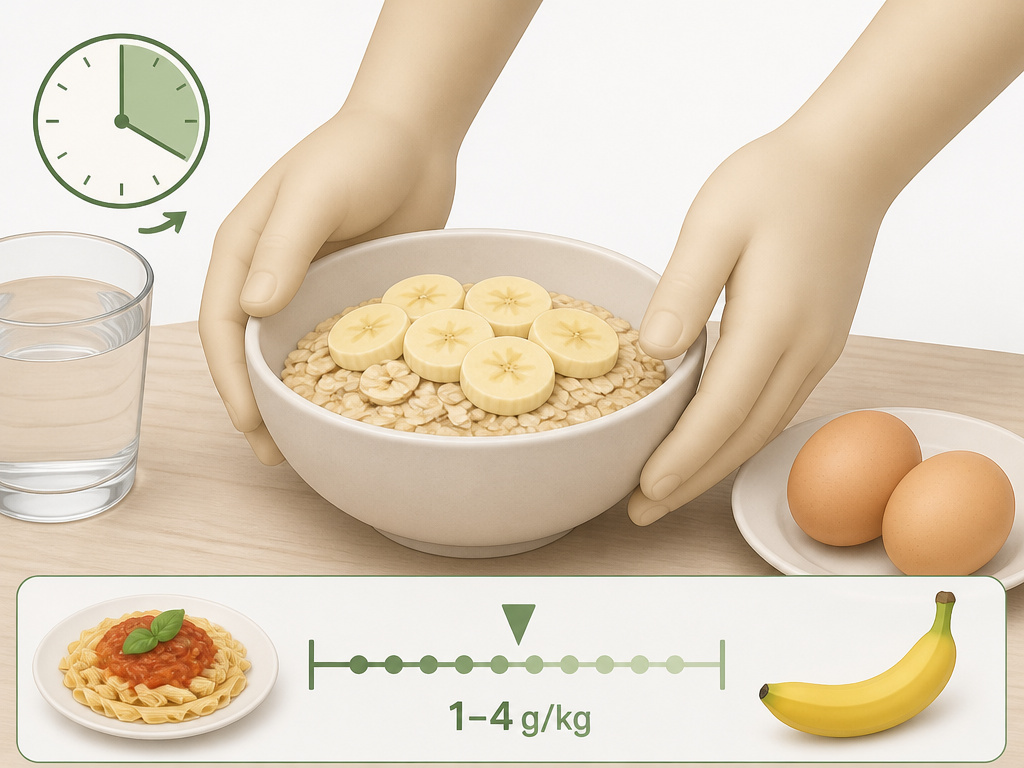
Mata and colleagues put the pre-exercise carb dose at 1 to 4 g/kg, taken 1 to 4 hours before training. That’s a separate recommendation from the multi-day loading protocol, and it applies even when you’re not loading.
At 1 to 4 g/kg, that’s a wide range of carbs in the pre-workout meal. The low end is a banana and some oats. The high end is a full pasta dinner.
The 1-to-4 g/kg Rule in Practice
The pre-event meal should supply at least 1 g/kg of carbohydrate, per the same paper. That’s the floor. The ceiling is higher.
Before you start: If you have diabetes, insulin resistance, or any condition that affects blood sugar regulation, talk to your doctor before running a high-carb loading protocol. The doses here are for healthy athletes, and 8 to 12 g/kg/day is a large metabolic load. If you’re not used to eating this volume, build up over a week rather than jumping straight to a loading day.
- Pick your carb source first. Oats, rice, potatoes, or fruit. Rolled oats with a banana is a reliable option for a morning session.
- Add a protein. Eggs, Greek yogurt, or a scoop of whey. Protein doesn’t fuel the workout directly, but it blunts the hunger crash two hours in.
- Keep fat and fiber low if you’re eating within 90 minutes. High-fat and high-fiber meals slow gastric emptying, and that’s the last thing you want at the start of a hard session.
- Drink water with it. A dry carb meal sits heavy, so have water with the meal.
Skipping step 3 is the most common mistake. A bowl of oatmeal with a big scoop of peanut butter an hour before a long run is a recipe for cramps, and the fat is the reason.
How This Fits With Carb Timing
If you want the full picture on carb timing around workouts, the pre-workout meal is one piece of it. The other pieces are what you eat the night before and what you eat during the session itself.
For specific pre-workout meals, the same 1 g/kg floor applies. And meal timing for workouts matters as much as the dose.
The “Don’t Eat Carbs Before Exercise” Rule Is Wrong
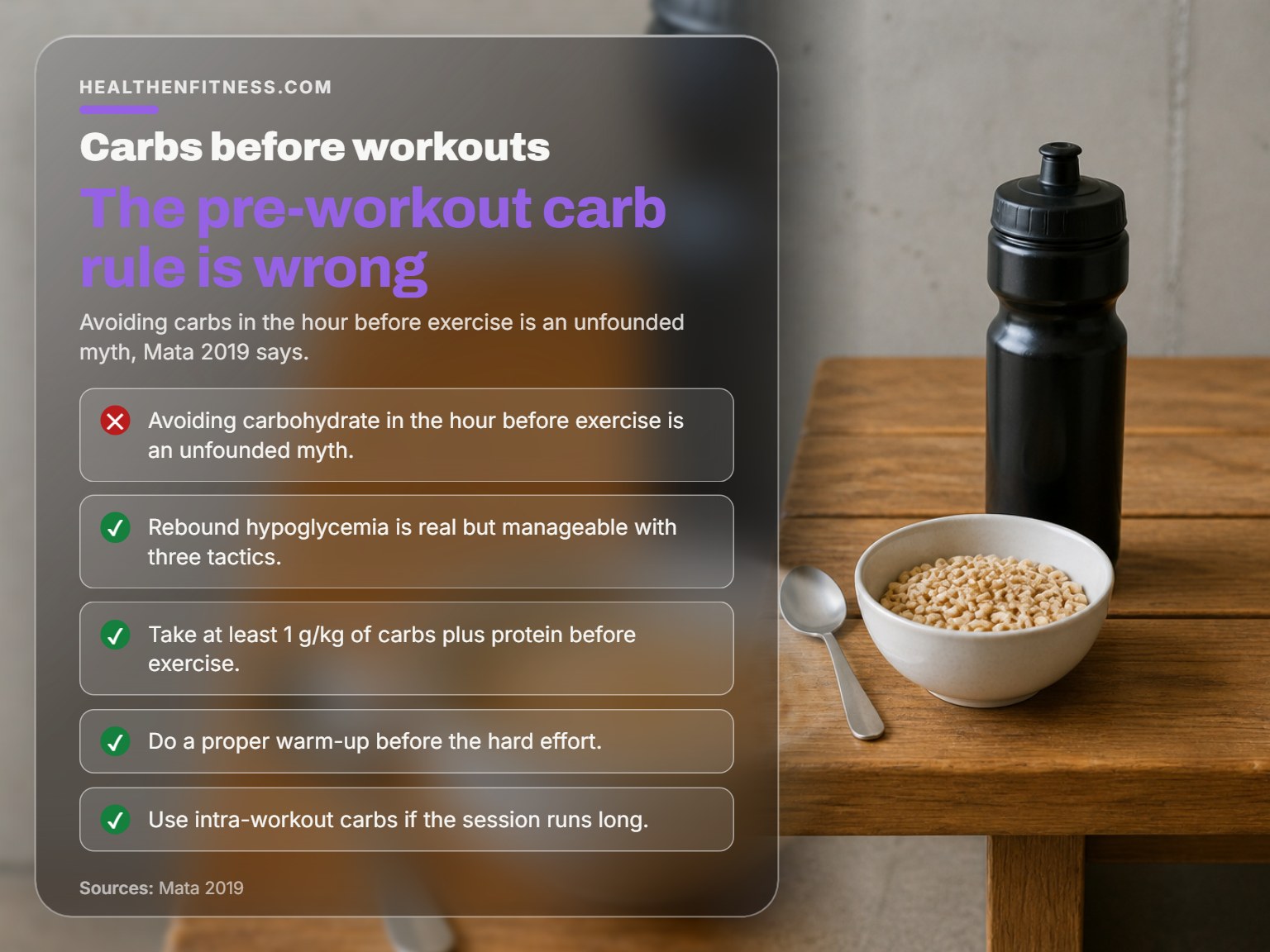
That rule is an unfounded myth, and the paper that calls it that isn’t subtle about it.
Mata 2019 explicitly labels the “avoid carbohydrate in the hour before exercise” advice an unfounded myth. The concern behind the rule is rebound hypoglycemia, a real phenomenon where a carb dose spikes insulin and blood sugar drops below baseline during exercise.
The drop is real, and the rule that follows from it doesn’t hold up.
Rebound hypoglycemia can be managed. The carbohydrate availability and performance overview lists three tactics:
- At least 1 g/kg of carbs plus protein
- A warm-up before the hard effort
- Intra-workout carbs if the session runs long
All three together make the effect small enough to ignore.
I’ve had clients swear they can’t eat before morning training. Nine times out of ten, what they actually can’t do is eat a huge bowl of high-fiber cereal 15 minutes before sprinting. A smaller, lower-fiber dose an hour out solves it.
For more on simple carbs before a workout, the practical takeaway is that the hour before exercise is a usable window. If your session runs past 90 minutes, intra-workout carbs are worth planning.
Does Carb Loading Help Lifting? Mostly No
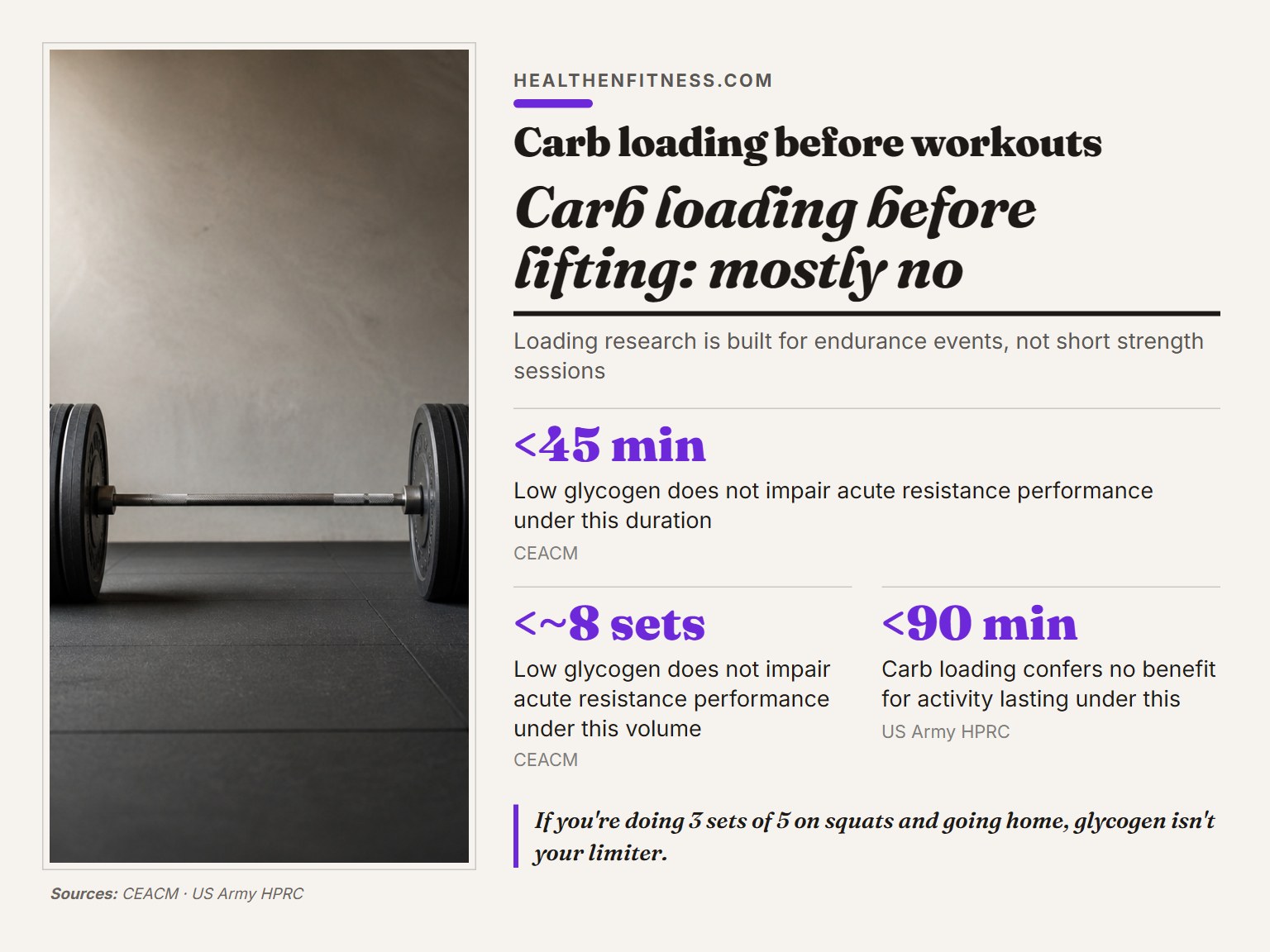
Lifting isn’t endurance work, and the loading research doesn’t transfer cleanly.
Cholewa and colleagues, cited in the Mata 2019 review, found that low glycogen does not impair acute resistance performance when volume is under about 8 sets and duration is under 45 minutes. That covers most of what a recreational lifter does in a session.
So if you’re doing 3 sets of 5 on squats and then going home, glycogen isn’t your limiter. Sleep, warm-up, and technique are.
When Loading Is a Waste of Time
- Sessions under 45 minutes. The HPRC 90-minute threshold and the Cholewa 45-minute threshold both point the same way.
- Low-volume strength work. Under 8 working sets, glycogen status doesn’t change the outcome.
- Recreational lifters. The Jones 2026 meta-analysis found the diet-glycogen relationship is weaker in untrained people, not stronger.
- Anyone loading for a 5K. The research on loading is about events long enough to deplete glycogen meaningfully. A 5K isn’t that event.
That list isn’t a knock on lifting. It’s a knock on importing endurance-nutrition advice into a strength session and expecting it to do something. I wouldn’t load for a lifting session, and I lift four days a week.
If you want the deeper physiology, carbs and workout performance covers why glycogen matters more for sustained work than for short sets.
Women and Carb Loading: The Numbers Shift
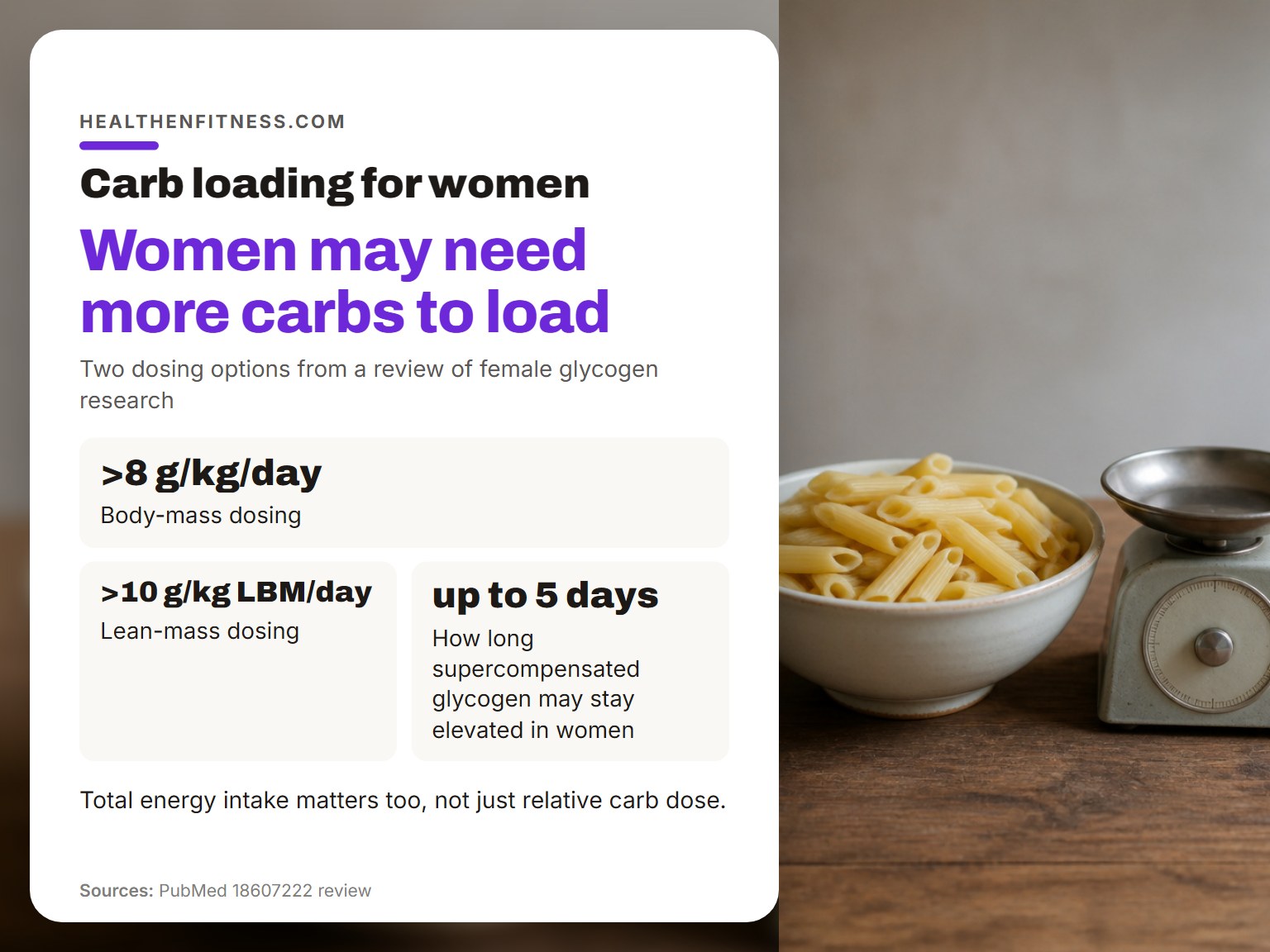
Two numbers show up in the practical guidance for women: above 8 g/kg/day, or above 10 g/kg of lean body mass per day.
A practical carbohydrate loading approach suggests women may need above 8 g/kg/day, or alternatively above 10 g/kg of lean body mass per day, to load effectively. The same review notes that supercompensated glycogen may stay elevated for up to 5 days in women, which is longer than the male-derived windows.
Lean Mass Dosing for Women
Lean-body-mass dosing is the more useful of the two options for anyone carrying more body fat. Body-mass dosing inflates the carb target with tissue that isn’t storing much glycogen. Lean-mass dosing scales the target to the muscle that actually uses it.
The two options look like this:
- Body-mass dosing: above 8 g/kg/day, simple but inflated for higher body fat.
- Lean-mass dosing: above 10 g/kg of lean body mass per day, more precise but requires a lean-mass estimate.
The review also flags total energy intake as a variable that matters alongside relative carb dose. Eating 10 g/kg of carbs while running a large calorie deficit isn’t the same experiment as eating 10 g/kg at maintenance. For women especially, the total calories matter.
The 5-day elevation window is worth knowing if you’re loading for a weekend event. You may not need to start as late as the standard 36-to-48-hour protocol suggests.
The glycogen research on women is thinner than it should be. I’d want to see more research before applying the male-derived numbers to every woman.
What to Actually Eat (and What to Skip)
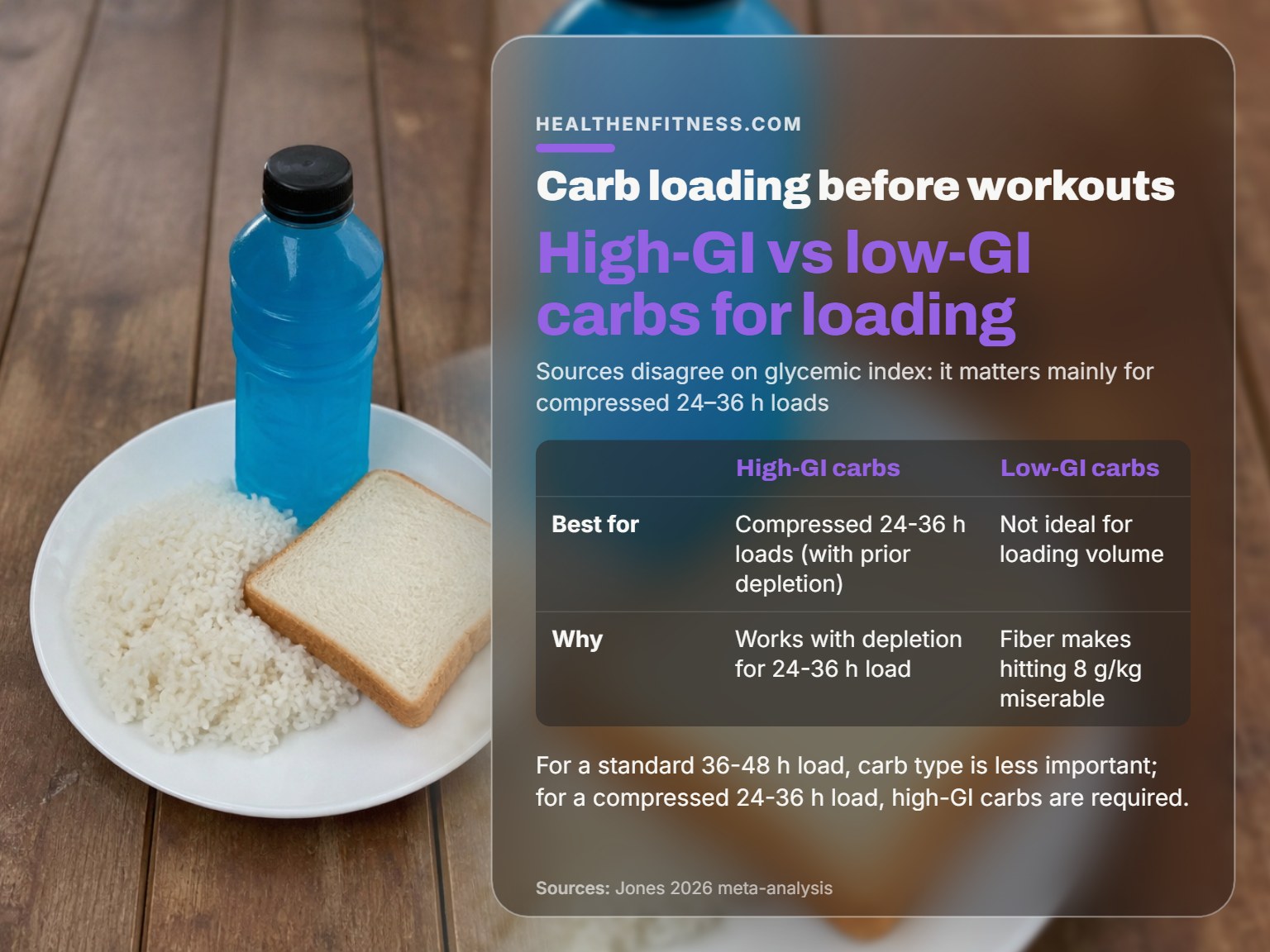
Picture a plate the night before a long ride: rice, potatoes, a little chicken, fruit. That is what a loading day looks like. A protein bar and a black coffee is a snack.
The carb sources that work for loading are the boring ones. Rice, pasta, bread, potatoes, oats, fruit, and sports drinks. Converted rice and rolled oats are both easy to portion and easy to digest, which is why they show up in a lot of loading plans. Sports drinks do the same job in liquid form when you can’t face another bowl of rice.
High-GI vs Low-GI: What the Sources Actually Say
This is another place where the sources disagree. The PubMed review on practical carb loading says carbohydrate type is “less important” for loading, except in 1-day protocols where glycemic index matters. The Jones 2026 meta-analysis says the compressed 24-to-36-hour protocol only works if you use high-GI carbs alongside the depletion workout.
The practical read: for a standard 36-to-48-hour load, mix your carbs and don’t overthink the GI. For a compressed 24-to-36-hour load, lean high-GI.
| Carb type | Examples | Best for |
|---|---|---|
| High-GI | White rice, white bread, sports drinks, ripe bananas | Compressed 24-36 h loads |
| Moderate-GI | Oats, whole wheat bread, sweet potato | Standard 36-48 h loads |
| Low-GI | Lentils, beans, most vegetables | Not ideal for loading volume |
The reason low-GI carbs don’t work well for loading is volume. You’d have to eat an enormous amount of lentils to hit 8 g/kg, and the fiber would make you miserable before you got there.
For more on pre-workout carb foods, the short version is that white rice and sports drinks aren’t cheating. And best carbs to eat pre-workout is a useful shortlist if you want specific options.
Rule of thumb: If you’re hitting the carb number but feeling bloated and slow, cut the fiber before you cut the carbs. High-fiber loading days are a common way to under-fuel while feeling full.
Frequently Asked Questions
How many carbs should I eat before a workout?
Aim for at least 1 g/kg of carbs in the 1 to 4 hours before training, per Mata 2019. For a 70 kg person, that’s 70 g minimum. If you’re loading for a long event, the multi-day target is much higher: above 8 g/kg/day for 36 to 48 hours.
Do I need to carb load for a 45-minute lifting session?
No. The US Army HPRC states carb loading confers no benefit for activity under 90 minutes, and Cholewa’s work shows low glycogen doesn’t impair resistance performance under about 8 sets and 45 minutes. Eat a normal meal with some carbs and move on.
Can I carb load in one day?
Only under specific conditions. The Jones 2026 meta-analysis says a compressed 24-to-36-hour load works if you do a glycogen-depleting workout first and eat high-GI carbs. Skipping either condition breaks the protocol. A single day of high-carb eating without the depletion workout doesn’t produce the same result.
What should I eat the morning of a long event?
At least 1 g/kg of carbs, 1 to 4 hours before the start. Oats with a banana, white rice with eggs, or a sports drink plus a bagel are options. Keep fat and fiber low if you’re eating within 90 minutes of the start.
Does carb loading work differently for women?
The practical guidance suggests it might. A review of the literature recommends women may need above 8 g/kg/day, or above 10 g/kg of lean body mass per day, and notes that elevated glycogen may persist for up to 5 days. Total energy intake matters alongside the relative carb dose.
Is it bad to eat carbs right before exercise?
No. Mata 2019 calls the “avoid carbs in the hour before exercise” rule an unfounded myth. Rebound hypoglycemia is real but manageable with at least 1 g/kg of carbs plus protein, a warm-up, and intra-workout carbs if the session runs long.
The Bottom Line
If your session is under 90 minutes, skip the loading protocol entirely. Eat a normal meal with at least 1 g/kg of carbs an hour or two out, drink water, and train.
If you’re prepping for a long event, Jones 2026 puts the floor at above 8 g/kg/day for 36 to 48 hours, while the US Army HPRC uses 10–12 g/kg/day on Days 1–2 and Mata 2019 uses 10 g/kg in the 24–36 hours before competition.
Here’s the concession. If you’re a woman, or if you’re loading for a compressed timeline, the standard numbers may not fit. Lean-mass dosing and a 24-to-36-hour window with high-GI carbs are both legitimate alternatives, and the research on women is thinner than the male-derived protocols suggest.
The honest answer to how to carb load before a workout is that most people don’t need to. The people who do are the ones running long, riding long, or racing long, and they already know who they are.
Today, just check one meal. Look at what you ate before your last workout and count the rough carb grams. If it was under 1 g/kg, add a banana and a slice of toast next time. That’s the whole starting point.
