Foam Rolling Before or After Workout: Which Is Better?
This post contains affiliate links. As an Amazon Associate, we earn from qualifying purchases.
Foam rolling before or after workout serves two different purposes. Roll before training and flexibility improves by 4.0% while sprint speed gains 0.7%. Roll after and sprint speed improves by 3.1% while muscle pain drops by 6.0%. Pre-rolling is a warm-up tool; post-rolling is a comfort tool.
Those percentages are small, and the effect sizes behind them are smaller still: g=0.28 for the pre-rolling sprint gain, g=0.47 for the post-rolling pain drop. Small effects still count when the alternative is doing nothing. They just don’t justify a long ritual before every session.
The rest of this walks through what each timing actually does, where the studies contradict each other, how long to roll, and the situations where you should leave the roller on the floor.
Key Takeaways
- Pre-rolling buys range, not power. Flexibility improves by 4.0%, while jump performance drops 1.9%.
- Post-rolling buys comfort. Muscle pain falls by 6.0%, and sprint speed gains 3.1%.
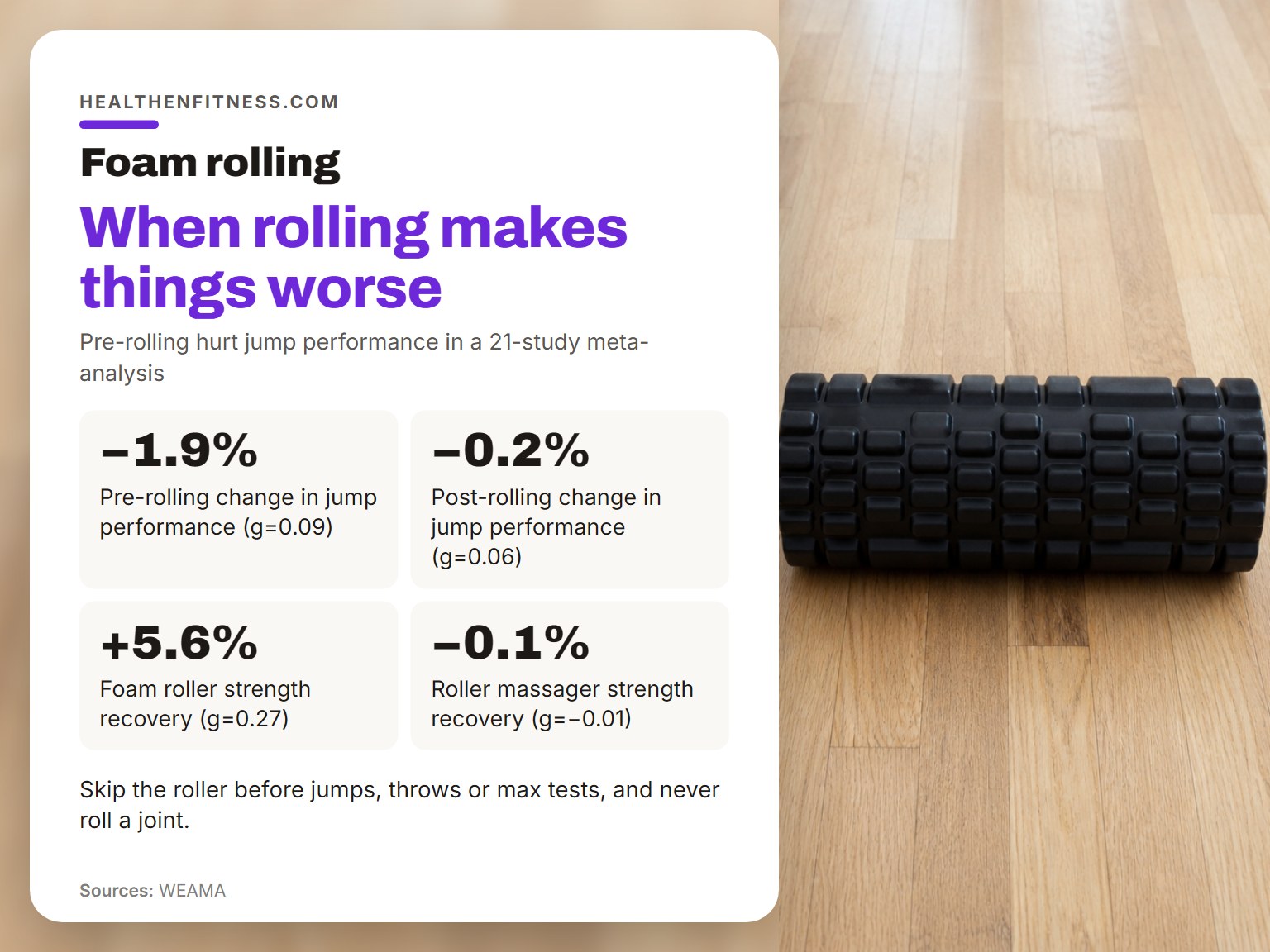
- The device matters as much as the timing. Foam rollers improved strength recovery by 5.6%; roller massagers changed it by -0.1%.
- Rolling ties stretching for range of motion. A 2019 review found no superiority (SMD -0.02), so pick whichever one you’ll actually do.
- Skip the joints and the lower back. Roll the muscle around a sore spot, not the sore spot itself.
Does Foam Rolling Before or After Workout Matter More?
Timing changes what a roller gives you. Rolling before training nudges flexibility and sprint speed. Rolling after training nudges sprint speed and how sore you feel the next day.
A 2019 meta-analysis of 21 foam rolling studies, 14 of them pre-rolling and 7 post-rolling, measured small performance effects in both directions. Pre-rolling raised flexibility by 4.0% and sprint speed by 0.7%, while post-rolling raised sprint speed by 3.1% and reduced muscle pain by 6.0%. Both sets of numbers come from the same pooled dataset.
Notice how tightly those numbers cluster. A 4.0% flexibility gain is the biggest effect either timing produces, and most of the others land between 0.7% and 6.0%. One goes the wrong direction entirely.
That spread is what you’d expect from a tool that mostly feels good. It’s also why the two camps arguing about timing are both half right. Here’s the pooled comparison side by side.
| Outcome | Rolling Before | Rolling After |
|---|---|---|
| Sprint speed | +0.7% | +3.1% |
| Jump performance | -1.9% | -0.2% |
| Strength | +1.8% | +3.9% |
| Flexibility | +4.0% | not reported |
| Muscle pain | not reported | +6.0% |
The jump row is the one worth staring at. Pre-rolling cost 1.9% on jump performance in the pooled data, which is small but pointed in the wrong direction for anyone about to sprint or jump.
Small, but pointed.
That’s the whole argument for keeping a pre-workout roll brief. Roll longer than you need to and you’ve spent real energy on a 4.0% range gain and a 1.9% power loss. Roll briefly and you may keep the range without paying for it. The foam rolling performance and recovery meta-analysis is the source for every figure in that table.
What Rolling Before a Workout Actually Does
Ten minutes on the roller before squats, and I still felt flat. The only thing it reliably produced was a looser-feeling quadriceps and less energy for the actual work.
Now it’s 30-60 seconds per stiff area, then straight into bodyweight squats or hip airplanes while the range is still fresh. Same roller, a fraction of the time, and the session doesn’t suffer.
The research lines up with that experience, mostly. Pre-rolling produces a 4.0% flexibility gain and a 0.7% sprint gain. It also produces a 1.9% drop in jump performance, which is the number that argues for keeping the roller brief. What pre-rolling buys, and what it doesn’t:
- More range, right now. The 4.0% flexibility gain shows up immediately after a short bout.
- A slightly faster sprint. 0.7% is real in the data and invisible on the clock.
- Nothing for jumping. Jump performance dropped 1.9%, the only negative in the pre-rolling set.
- No lasting change. Hip extension range returned to baseline after one week in one controlled trial.
Which is fine, if you use it the way the evidence supports.
A tight quad under a roller feels gritty and catching, like dragging a knuckle across a taut cord. After four or five slow passes the surface smooths out and the roller glides. That smoothing is what you’re chasing, not the grimacing.
Rolling yourself is a form of self-myofascial release, which is just the formal name for working your own muscles with a tool. The basics of foam roller technique are simple: slow passes, steady breathing, and staying off the joints.
Then it stops being a roller session and becomes a dynamic warm-up with a roller stuck on the front end. That’s the version worth keeping.
What Rolling After a Workout Actually Does
The 6.0% pain reduction has an effect size of g=0.47, and it’s the one most people actually notice.
Rolling after training is where the numbers get more interesting. Muscle pain drops 6.0%, sprint speed gains 3.1%, and strength recovery improves 3.9%. Those are three of the positive results in the analysis.
That pain reduction and the performance gains don’t always travel together. In a 2021 study of loaded military tasks, foam rolling improved stair-climb and ammo-can-carry performance without reducing how sore the participants felt. Performance and perception are separate outcomes, and a roller can move one while leaving the other alone.
Which matches what I’ve seen on myself. Rolling after a workout feels nice, and I’ve never once seen it change how I felt the next morning.
Sleep did more for my recovery than any roller I’ve owned. That’s not a knock on the roller. It’s just the honest ranking.
Think of it like seasoning at the end of cooking. A pinch of salt on the plate changes how tonight’s dinner tastes. It doesn’t change how the leftovers hold up tomorrow, and nobody expects it to.
I keep a lacrosse ball in my gym bag and a foam roller at home, and the ball gets used ten times more often. It fits in a side pocket, it works a calf or a glute against a wall, and it never gets left behind.
If you’re building a post-workout recovery routine, put sleep and food at the top and the roller somewhere below them. For the soreness itself, there are better remedies for sore muscles after exercise than a long roll, starting with actually eating and actually sleeping.
Why the Studies Keep Contradicting Each Other
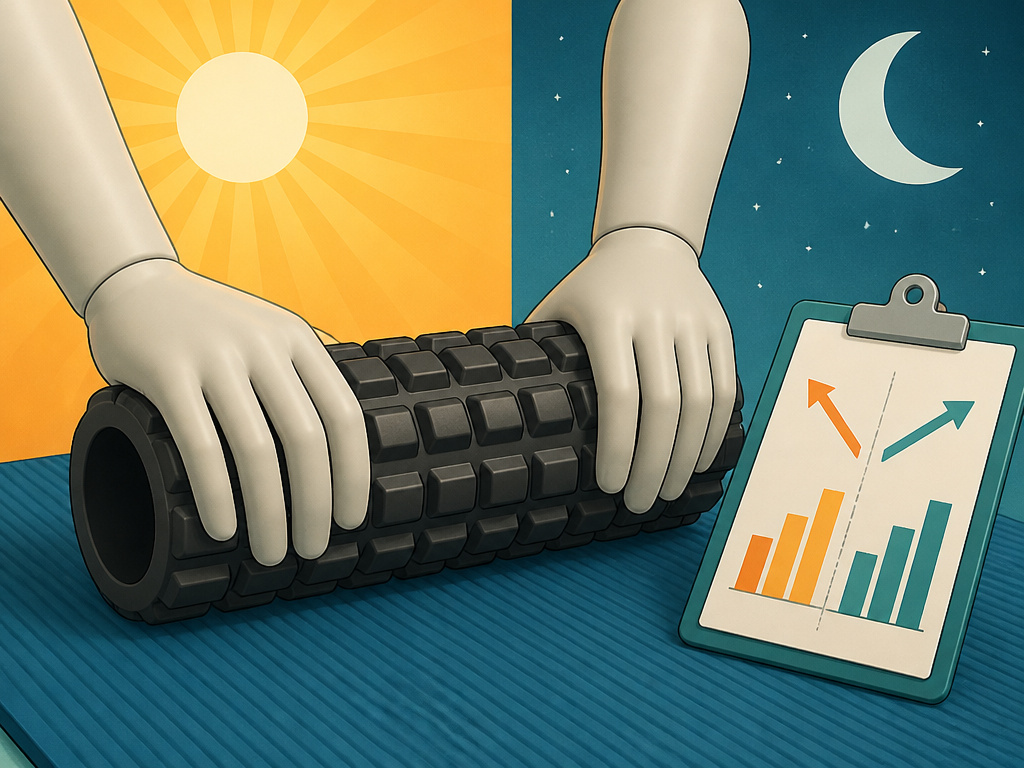
Two of the better studies on this topic point in opposite directions, and neither one is wrong.
The preventive versus regenerative foam rolling study measured maximal isometric voluntary force loss five minutes after exhaustion. Preventive rolling lost 16%, regenerative rolling lost 12%, and the control group lost 21% (p<0.001). The authors concluded that regenerative rather than preventive rolling seems sufficient to prevent further fatigue, while Wiewelhove 2019 concluded the evidence seems to justify foam rolling as a warm-up activity rather than a recovery tool.
Wiewelhove 2019, working from the pooled data, concluded the opposite: the evidence seems to justify foam rolling as a warm-up activity rather than a recovery tool.
Why the Populations Matter
Both can be right because they measured different things. Wiewelhove looked at performance markers across a mixed pool of 21 studies. Schroeder ran a controlled trial on force loss at a single time point. A lab study that measures soreness and sprint times is asking a different question from a CrossFit study that measures lactate, heart rate, and perceived exertion.
And that CrossFit study found nothing. Fourteen participants, foam rolling versus passive rest, no significant difference on blood lactate, heart rate, or perceived exertion. A separate systematic review of foam rolling effects looked at range of motion, recovery, and performance markers together.
| Question | One Position | The Other |
|---|---|---|
| Best timing | Wiewelhove 2019: warm-up tool | Schroeder 2017: recovery tool |
| Versus passive rest | Pearcey 2015: clear benefit | MDPI 2025: no benefit |
| Versus stretching | Common framing: substitute | Behm & Wilke 2019: not superior |
| Roller vs stick | Standard protocol: interchangeable | Wiewelhove 2019: +5.6% vs -0.1% |
When two good studies disagree, match the study to your situation instead of picking a winner. Chasing performance tomorrow? Copy the recovery study. Want to feel loose in ten minutes? Copy the warm-up study.
Foam Roller, Roller Massager, or Massage Gun?
Foam rollers and massage guns do different jobs, and the research treats them as different devices.
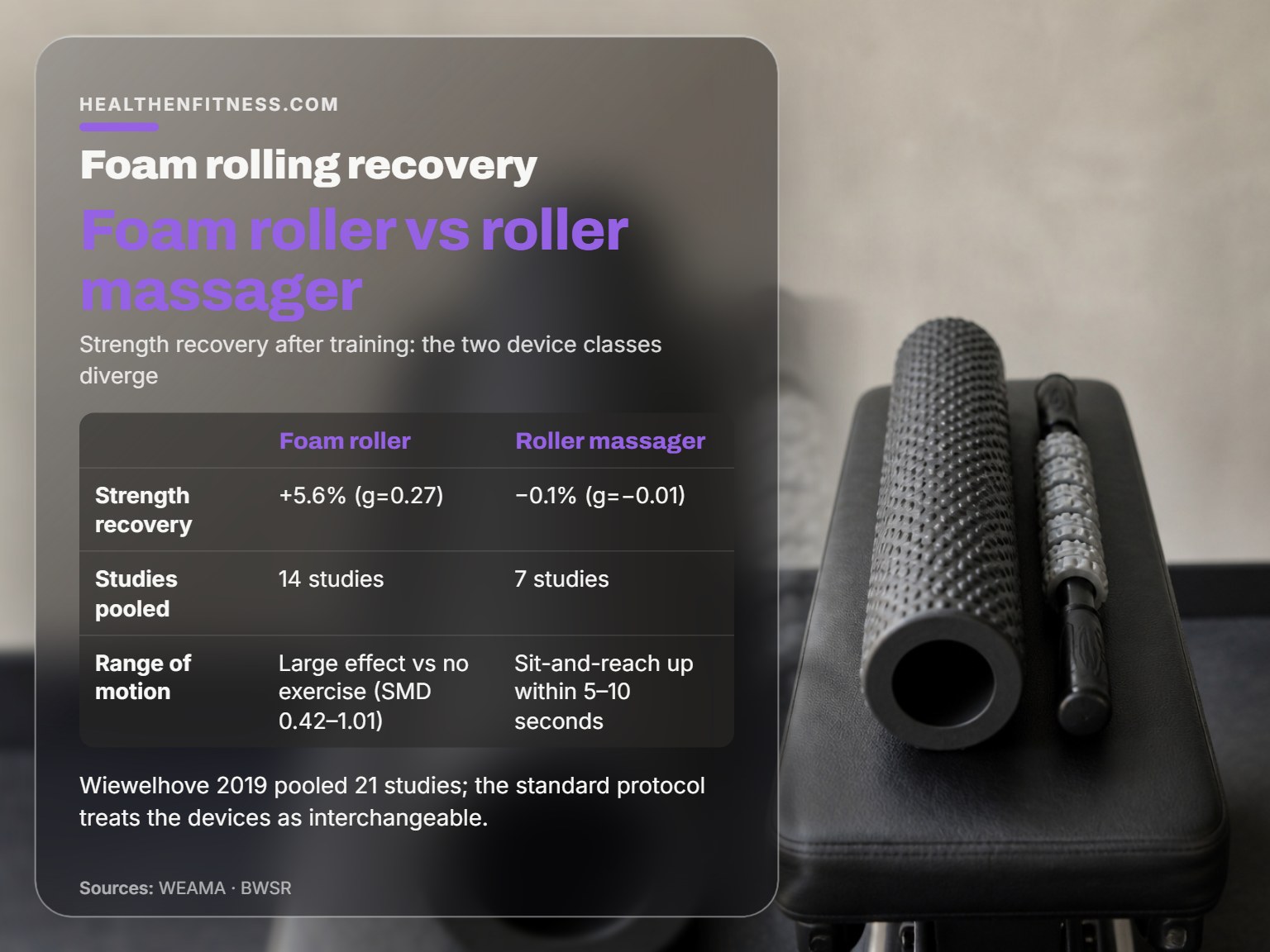
Wiewelhove’s pooled data split 14 foam roller studies against 7 roller massager studies, and the two device classes diverged where it counts. Foam rollers improved strength recovery by 5.6% (g=0.27). Roller massagers changed it by -0.1% (g=-0.01).
That’s a gap wide enough to change what you buy.
Foam Roller vs Roller Massager
For strength recovery, Wiewelhove 2019 found foam rollers improved recovery by 5.6% while roller massagers changed it by -0.1%, though the standard protocol treats the devices as interchangeable. For range of motion in a hurry, the stick is faster. A roller-massager application to the hamstrings increased sit-and-reach range within five to ten seconds, with no performance drop.
So if you’ve got a few seconds before a set, a roller massager does the job. If you’re working a whole quadriceps after leg day, the roller does.
My read on why they separate: a stick concentrates force on a narrow band of muscle, while a roller spreads the load across the whole quadriceps. The data only tells you the two classes diverge. The reason is my guess.
The best foam rollers for exercise aren’t the hardest ones. Most people buy a rock, wince through two sessions, and never touch it again. A medium-density roller you’ll actually use beats a firm one you won’t.
Where Massage Guns Fit
A percussion gun at full speed is a buzzing rattle you can hear through your headphones. It’s also the only tool in this group that does the work for you.
Massage guns get marketed as recovery miracles, and the pooled evidence doesn’t reach that far. The meta-analysis covered foam rollers and roller massagers. Percussion guns weren’t part of it.
So the honest position is that a massage gun is a convenience tool with a serious marketing budget behind it, and the roller-versus-gun question is still open.
If you’re weighing them, the foam roller or massage gun decision usually lands on which one you’ll actually pick up. Either way, the principles of self-myofascial release don’t change: slow passes, breathe, stay off the joints.
The part nobody mentions: Vibration rollers don’t follow the same dose rules. Behm and Wilke found rolling with vibration may be more effective than a non-vibrating roller or no exercise.
How Long Should You Foam Roll?
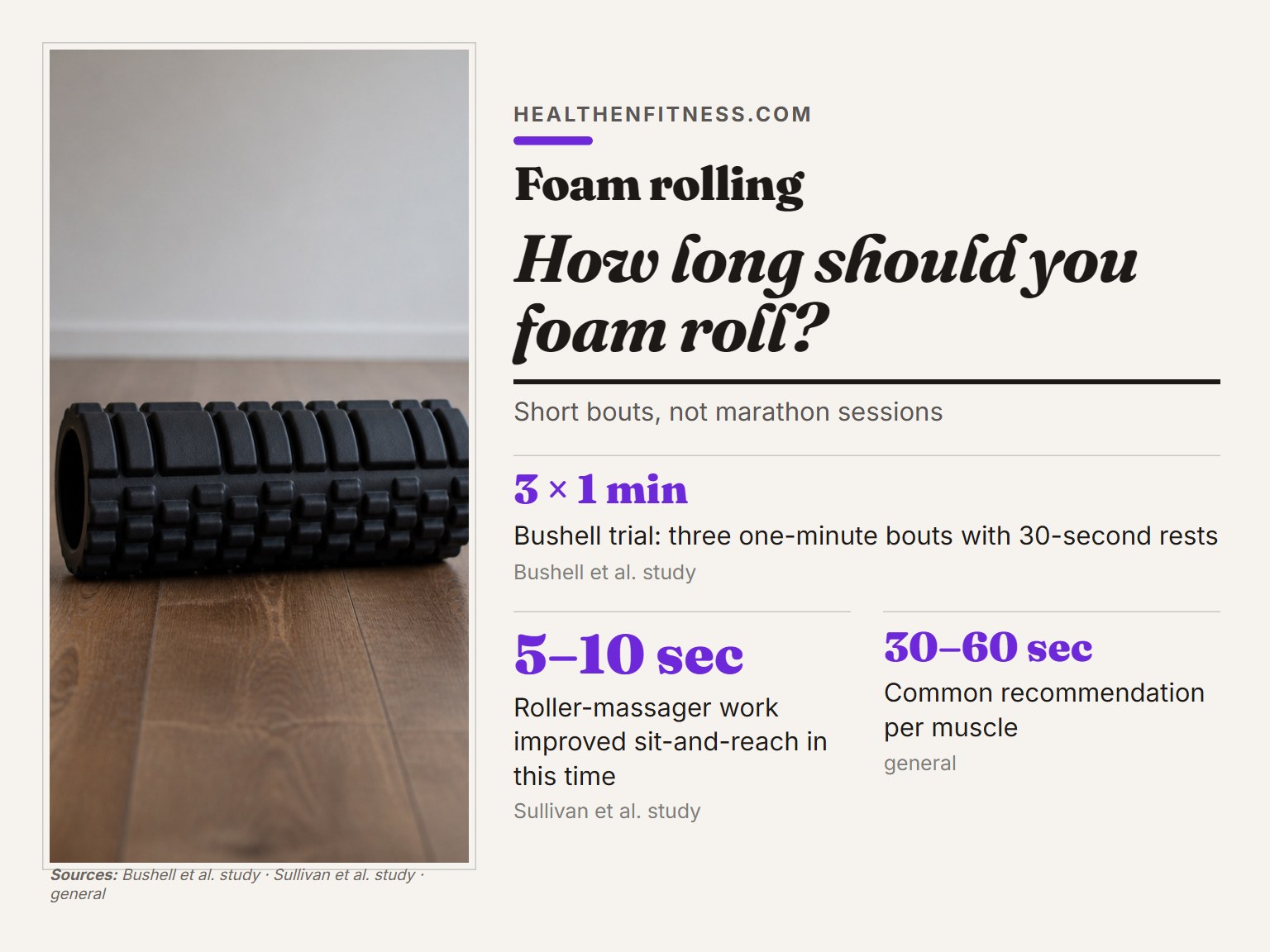
Shorter than you think. One controlled trial used three one-minute bouts with 30-second rests between them. Another got a sit-and-reach improvement from five to ten seconds of roller-massager work.
Before you start: Three things go wrong most often. Rolling directly over a joint or the lower back puts pressure where there’s no muscle to absorb it. Rolling a fresh bruise or a swollen area can extend the damage by a day or two. And rolling hard enough to leave marks turns a comfort habit into a minor injury.
The 5-Step Roll (and the Step Everyone Skips)
- Pick one or two tight spots. Not the whole body. A quad, a calf, a glute. Roll everything and you’ll spend ten minutes and feel nothing.
- Roll slowly for 30-60 seconds. Long passes, breathing the whole time. Fast scrubbing just irritates the surface.
- Pause on the tender spot. Steady pressure beats speed. Skip this and you’re warming skin, not muscle.
- Move through the range right after. Bodyweight squats, hip airplanes, ankle rocks. Skip it and the range fades within the week.
- Keep the roller off the joints. Kneecap, IT band, spine: move along. Roll one of those and you’ll know about it tomorrow.
Step four is the one people skip. Bushell’s group had measurably more hip extension, and those measures were back to baseline a week later.
Cheatham’s foam roll joint range of motion review gathered 14 articles on the topic. The Bushell trial inside it used three one-minute bouts with 30-second rests and never reported a rolling cadence at all.
So the honest answer to “how long” is: long enough to feel the tissue change, short enough that you still do it tomorrow.
When Rolling Makes Things Worse
Two situations turn a foam roller into a bad idea.
The first is right before a jump or a max-effort power test. Pre-rolling cost 1.9% on jump performance in the pooled data, and if you’re chasing a personal best, that’s the wrong 1.9% to hand over.
The second is rolling hard over something that’s already damaged. The IT band is the classic mistake. It’s a thick band of connective tissue, and grinding a roller into it leaves a bruise the width of the roller by the next morning.
Common mistake: Rolling hard directly over a sore joint or the IT band. Pressure on tissue with no muscle belly to absorb it produces bruising instead of relief, and the bruise shows up the next morning.
Skip the roller when:
- You’re about to jump, throw, or test a max. The pre-rolling penalty lands hardest on power.
- The tissue is bruised or swollen. Wait until the swelling is gone.
- You’re rolling a joint. Kneecap, elbow, ankle: the roller goes around them.
- It’s replacing sleep. A roller can’t do what a full night can.
None of that makes the roller useless. It makes the roller a small tool with a small effect, and small tools work best when you point them at the right spot.
Frequently Asked Questions
Is it better to foam roll before or after a workout?
For range of motion, before. Pre-rolling improved flexibility by 4.0% in pooled data. For comfort, after. Post-rolling cut muscle pain by 6.0% and added 3.1% to sprint speed. Pick the timing that matches what you want out of the session.
How long should you foam roll?
Shorter than the internet suggests. One controlled trial used three one-minute bouts with 30-second rests. A roller-massager study got a range improvement from five to ten seconds of work. Sixty to ninety seconds on one or two tight spots covers most people.
Does foam rolling actually help recovery?
It depends on what you mean by recovery. Post-rolling improved sprint speed by 3.1% and strength recovery by 3.9% in pooled data. A 2025 CrossFit study found no benefit over passive rest for lactate, heart rate, or perceived exertion. The effect shows up in some measures and not others.
Can you foam roll every day?
Nothing in the research suggests a daily limit, and the effects are short-lived anyway. The bigger risk is boredom. If daily rolling turns into a ritual you dread, cut it to one tight spot and keep going.
Is a massage gun better than a foam roller?
There’s no head-to-head evidence in the pooled data, which covered 14 foam roller studies and 7 roller massager studies. Percussion guns weren’t in it. Foam rollers improved strength recovery by 5.6%; roller massagers changed it by -0.1%. Wiewelhove 2019 found foam rollers improved strength recovery by 5.6% while roller massagers changed it by -0.1%, though the standard protocol treats the devices as interchangeable.
The Bottom Line
Short version: foam rolling before or after workout matters less than most articles claim. Roll 30-60 seconds on the one or two spots that feel tight, then move through that range while it’s fresh.
One threshold worth remembering. If you’re about to jump, throw, or test a max, skip the pre-roll. The pooled data puts jump performance 1.9% lower after pre-rolling, and that’s the wrong direction on the one day it counts.
Everything above assumes you’re healthy and training normally. If you’re coming back from an injury or surgery, a foam roller isn’t the tool and I’m not the person to program around it. See a physio.
Start smaller than you think you need to.
Today, just roll one tight spot for 30-60 seconds and then do ten bodyweight squats. That’s the whole habit.
