
High Volume vs Low Volume Training for Muscle: What Wins?
This post contains affiliate links. As an Amazon Associate, we earn from qualifying purchases.
High volume vs low volume training for muscle splits the evidence: higher weekly set counts produced more hypertrophy in some trials, while a 12-20 set range per muscle group per week matches the strongest review. Strength gains stayed volume-neutral across 1, 3, and 5 sets in trained men.
Volume-neutral means the 1-set group and the 5-set group in that eight-week trial walked away with similar squat and bench numbers. What separated them was muscle size at the elbow flexors, mid-thigh, and lateral thigh, measured by ultrasound. That split is why the answer changes depending on whether you want to lift more or look bigger.
What follows: the two camps in the research, the set-count numbers behind each, the muscle-specific exceptions, and a practical way to set your week. No magic number, just what the trials actually measured.
Key Takeaways
- Hypertrophy trends up with volume in some trials, not all. Schoenfeld’s eight-week RCT found greater growth at 5 sets per exercise than 1, but a 2022 review found no moderate-vs-high difference for quads or biceps, so the sources disagree.
- A 12-20 weekly set range per muscle group may be an optimum standard recommendation for trained men, per Baz-Valle’s systematic review, though Schoenfeld’s trial found a dose-response favoring higher volume.
- Strength gains were volume-neutral across 1, 3, and 5 sets in Schoenfeld’s trial, while a separate meta-analysis found high weekly set volume superior to low weekly set volume for combined exercises (ES 0.18).
- Triceps respond to high volume; quads and biceps don’t show the same pattern in the same review.
- Three 13-minute sessions per week built real strength and endurance in trained men, so time is not the excuse.
What the Two Camps Actually Disagree About
The high volume vs low volume training for muscle debate is really two claims wearing the same label.
One claim says hypertrophy follows a dose-response curve, so more weekly sets produce more growth. The other says the curve flattens somewhere around 12-20 sets per muscle group, and past that point the extra work stops paying.
Resistance training volume is measured in weekly sets per muscle group. In a 2019 randomized trial, trained men performing 1, 3, or 5 sets per exercise for eight weeks showed no significant between-group strength differences, while muscle thickness at the elbow flexors, mid-thigh, and lateral thigh increased more at the higher set counts.
Here is the split in table form.
| Question | Dose-response camp | Moderate-volume camp |
|---|---|---|
| Does more volume build more muscle? | Yes, across 1, 3, and 5 sets (Schoenfeld 2019) | Only up to about 20 sets; 12-20 is the sweet spot (Baz-Valle 2022) |
| Strength response | Volume-neutral | Load matters more than set count |
| Best-supported range | Higher is better, no stated ceiling | 12-20 weekly sets per muscle |
The dose-response camp leans on a single randomized trial with 34 trained men. The moderate-volume camp leans on a training volume and hypertrophy systematic review that pooled seven studies. The sources disagree: Schoenfeld et al. Found a dose-response favoring higher volume, while Baz-Valle et al. Found no moderate-vs-high difference for quadriceps and biceps.
Most lifters tracking weekly sets land somewhere between 10 and 20 per muscle group without trying, which is why the 12-20 range feels familiar.
Does Higher Volume Really Build More Muscle?
What happens when you hold reps at 8-12 and only change the set count?
Schoenfeld and colleagues ran that exact experiment. Thirty-four resistance-trained men trained three days a week for eight weeks, with one group doing 1 set per exercise, one doing 3, and one doing 5. The 1-set group performed one set per exercise per training session.
Three outcomes came out of it:
- Strength: no significant between-group difference on the squat or bench press.
- Hypertrophy: greater at higher volumes, measured at the elbow flexors, mid-thigh, and lateral thigh.
- Upper-body endurance: no differential effect from volume.
The weekly set totals were 6 and 9 sets for the 1-set group, 18 and 27 for the 3-set group, and 30 and 45 for the 5-set group, counting upper and lower body separately. That is a wide spread. The 5-set group did roughly five times the work and got more growth for it in Schoenfeld’s trial.
By set four of squats at the same weight, the bar speed drops and the last rep grinds to a near-stop. That slowdown is the fatigue the extra sets are buying.
What the 2022 Review Found
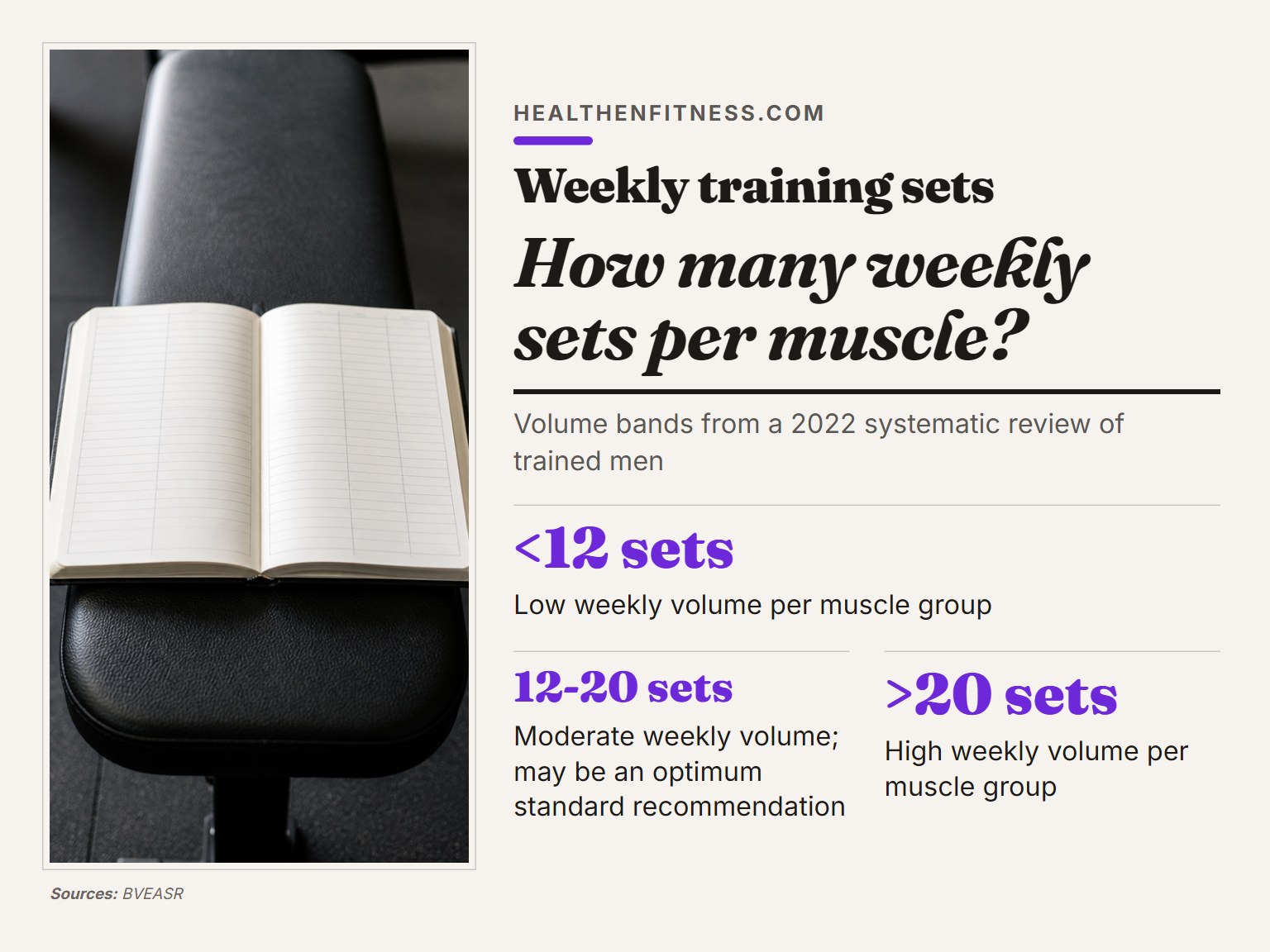
Baz-Valle and colleagues pooled seven randomized trials and split volume into three bands: low under 12 weekly sets, moderate 12-20, and high above 20. Six studies went into the meta-analysis.
The moderate-versus-high comparison came back flat for quadriceps (p = 0.19) and biceps (p = 0.59). Triceps was the exception, where high volume won (p = 0.01). The review suggested 12-20 weekly sets per muscle group may be an optimum standard recommendation for young, trained men.
The Resistance Training Volume Enhances Muscle Hypertrophy paper is explicit about its own finding: volume enhanced size, not strength. The sets and reps stayed fixed at 8-12 across all three groups, which is what makes the comparison clean.
So the two camps are both describing real results. One found a dose-response across a wide range. The other found the curve flattening inside a narrower band.
The Set-Count Numbers Behind the 12-20 Range
Twelve to twenty weekly sets per muscle group is the range the 2022 review suggested may be an optimum standard recommendation, and the bands behind it are worth memorizing.
| Volume band | Weekly sets per muscle | Defined by |
|---|---|---|
| Low | Under 12 | Baz-Valle 2022 |
| Moderate | 12-20 | Baz-Valle 2022 |
| High | Above 20 | Baz-Valle 2022 |
| Schoenfeld 1-set | 6 upper / 9 lower | Schoenfeld 2019 |
| Schoenfeld 3-set | 18 upper / 27 lower | Schoenfeld 2019 |
| Schoenfeld 5-set | 30 upper / 45 lower | Schoenfeld 2019 |
The Schoenfeld rows show why the bands matter. The 1-set group sat below the low threshold. The 3-set group landed in the moderate band for upper body but above the high threshold on lower body. The 5-set group blew past the high threshold on both.
Counting sets gets messy when you factor in multi-joint work. A set of rows counts toward your biceps, and a set of close-grip bench counts toward your triceps. The Baz-Valle review counted all of it.
Weekly set count and training frequency interact. Twenty sets split across two sessions is a different stimulus than twenty sets across four.
Set count is only half the equation. A load effects on hypertrophy and strength network meta-analysis of 28 studies and 747 adults found hypertrophy similar across low, moderate, and high loads when sets went to failure.
Common mistake: Adding sets to fix a stalled lift. If the weight hasn’t moved in three weeks, the problem is usually recovery or progression, not volume.
Why Strength Gains Don’t Follow the Same Curve
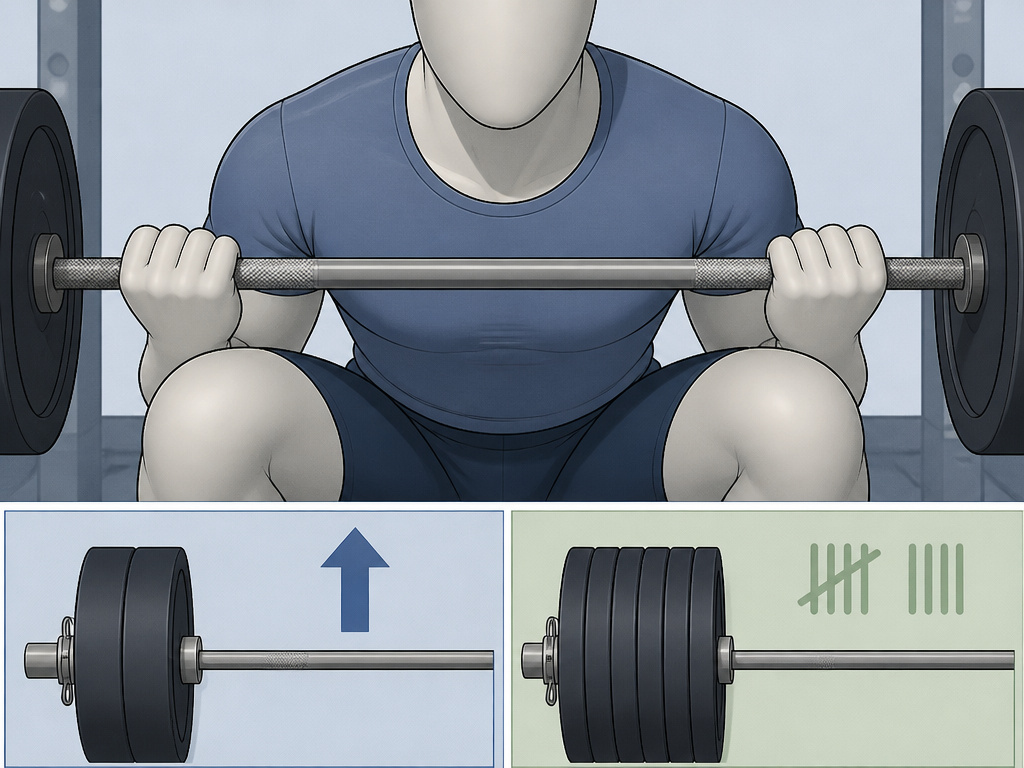
Strength is a different animal.
Hypertrophy responds to set count in some trials. For strength, some sources find load matters more than set count, while others find volume had no differential effect on strength.
Schoenfeld’s trial found no between-group strength difference across 1, 3, and 5 sets. A separate meta-analysis found the opposite: high weekly set volume beat low weekly set volume for combined exercises, with an effect size of 0.18 (95% CI 0.06-0.30, p = 0.003).
Both can be true. The Ralston analysis pooled data from multiple studies, which is a broader net than one eight-week trial.
Pick a set count you can recover from and repeat for eight weeks. A program you finish at 12 sets beats a program you abandon at 25.
Load matters more than set count for strength in some analyses. The Lopez network meta-analysis found high-load and moderate-load training both beat low-load training for strength (SMD 0.60-0.63 and 0.34-0.35, P < 0.001-0.003), while Schoenfeld’s trial found volume had no differential effect on strength. High load edged moderate load, though not significantly (SMD 0.26-0.28, P = 0.068).
The Effect of Weekly Set Volume on Strength meta-analysis is the strongest counterweight to the volume-neutral finding. If your goal is a bigger squat, the hypertrophy vs strength split matters more than the set count.
I have cranky shoulders, so the classic three sets of ten never fit me. Lighter loads in the 12-15 rep range let me keep training without flaring them up. Standard rep schemes are starting points, not rules.
The Frontiers 2022 trial adds another wrinkle. High-volume training did not improve leg extensor strength, while high load was superior at POST and POSTPR (p<0.025).
Where Volume Actually Matters: The Triceps Exception
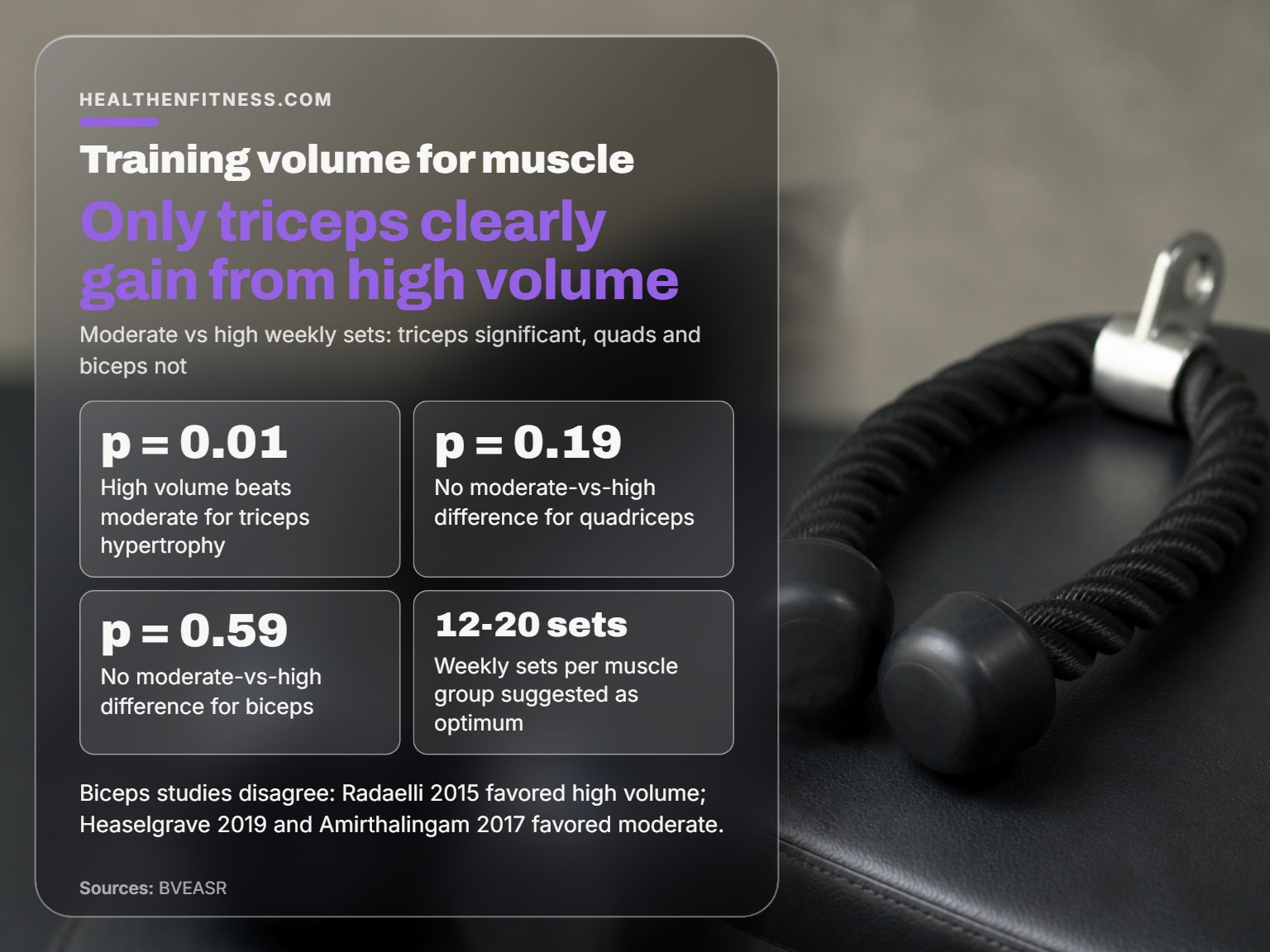
The triceps brachii is the one muscle where high volume clearly won in the 2022 review.
Baz-Valle found a significant advantage for high volume on triceps (p = 0.01). Quadriceps (p = 0.19) and biceps (p = 0.59) showed no moderate-versus-high difference.
By the fourth set of triceps pushdowns, the elbow starts to ache before the muscle does. That ache is the signal to stop adding sets, not push through.
The Biceps Data Conflicts
This is where the review gets interesting. The pooled result says no difference, but the individual studies it cites disagree with each other.
- Radaelli 2015 found biceps thickness gains of 1.9%, 7.6%, and 17.5% for low, moderate, and high volume, favoring high volume.
- Heaselgrave 2019 found moderate volume beat both low (8.5% vs 3.8%) and high (8.5% vs 4.6%).
- Amirthalingam 2017 found moderate volume beat high volume (7.2% vs 0.8%).
Three studies, three different answers. The pooled analysis landed on no difference, which is what happens when individual results cancel out.
A separate low volume high-intensity training comparison trial found low-volume HIT produced greater strength gains on 3 of 9 exercises (p < 0.05) and larger effect sizes on 8 of 9, conflicting with the volume-neutral finding.
The rep ranges for muscle growth question is separate from set count, but the two interact when you push a muscle past 20 weekly sets.
How Do You Set Your Weekly Sets Without Guessing?
What number do you write in the notebook on Monday?
- Count what you already do. Add up sets per muscle group for one normal week. Most lifters land between 10 and 20 without trying.
- Pick a band. If you’re under 10, add 2-3 sets per muscle. If you’re over 20, hold steady and check recovery before adding more.
- Hold the count for eight weeks. Change one variable at a time. Adding sets and changing exercises in the same week tells you nothing.
- Track the lift, not the soreness. Write down weight and reps. If the number moves up over four weeks, the set count is working.
- Stop a rep or two short of failure on most sets. The training to failure question matters here, and the research on failure is mixed.
The tool matters less than the habit. A paper notebook works, and any notebook with columns for weight and reps does the job.
Skip it if you have joint pain that shows up the day after a session and lingers. That’s a recovery signal. Treat it like one.
The number on the bar matters more than the set count. Progressive overload is what turns sets into growth.
When Low Volume Wins
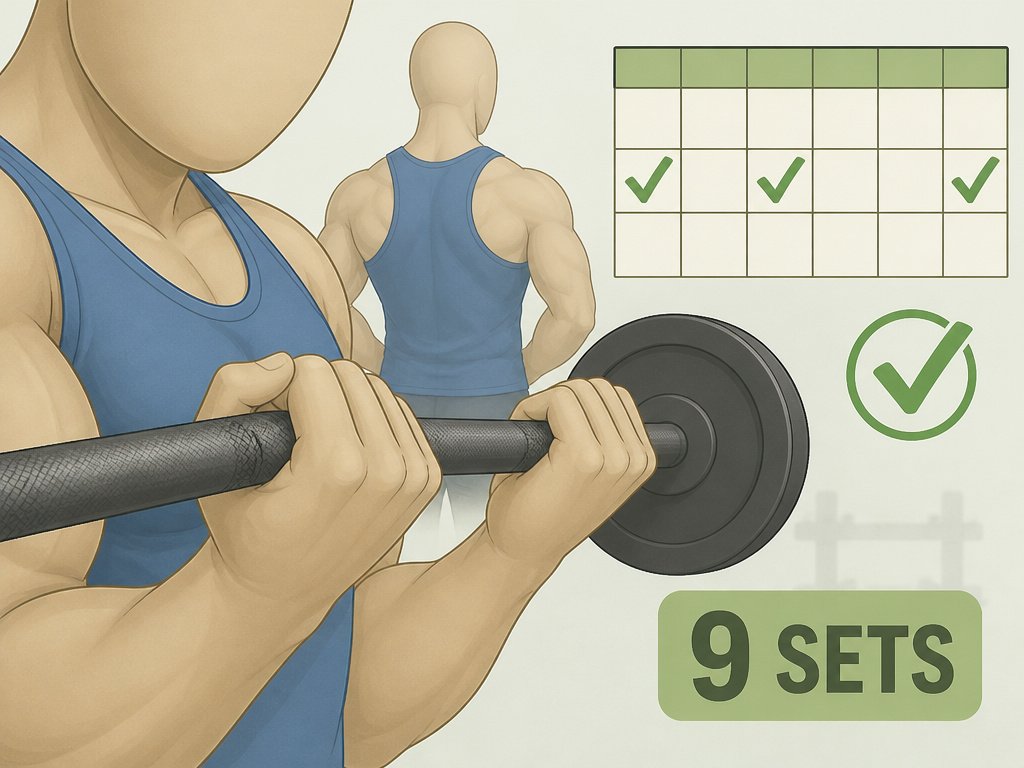
Some lifters grow on nine sets a week, and the research backs them up.
A multi-site randomized trial by Steele and colleagues compared 9 versus 36 fractional sets per week over 12 weeks. The equivalence test came back at p = 0.032, meaning the two groups were statistically equivalent for hypertrophy.
That trial is a preprint, so treat it as a strong signal rather than settled fact. It does line up with the Schoenfeld finding that the 1-set group matched the 5-set group on strength.
Low volume wins when time, recovery, or joint health is the limiting factor. Three 13-minute sessions per week built real strength and endurance in Schoenfeld’s trial. That’s the minimum effective dose for a lot of people.
Never jump from 10 weekly sets to 30 in a single week. Tendon and joint tissue adapts slower than muscle, and the elbow or knee pain that shows up around week three is the signal you skipped a step.
The soreness from a genuinely hard low-volume session can show up later, not necessarily the next morning. If it’s still there on day four, the session was too much.
Low volume only works if the sets you do are hard. Rest periods of two to three minutes let you put real effort into each set instead of turning them into cardio.
Where this goes sideways: Copying a pro bodybuilder’s 30-set week without their recovery, sleep, or training age. The extra sets become junk volume and the joints pay first.
The Mistake That Makes Both Approaches Fail
You finish a session, feel wrecked, and decide the program is working. Three weeks later the weights haven’t moved.
I used to chase soreness as proof of a good workout. I dropped that habit after being too sore to train properly for several days in a row. Now I judge a session by rep quality and how ready I feel the next day.
Soreness tells you the workout was unfamiliar. Productivity is a separate question. A high-volume week and a low-volume week can both leave you sore, and neither one guarantees the bar moves next month.
The real failure mode is training the same weight and reps for months. That’s true whether you run 10 sets or 30. The body adapts to what you repeat, and then it stops.
Adding sets to fix a stalled lift is like adding more paprika to a soup that needs salt. You’re fixing the wrong thing.
Boring works. Add a rep or a small amount of weight each week, keep the lowering phase controlled, and let the set count serve the progression instead of replacing it.
Volume boosters like drop sets and supersets can add sets without adding gym time, but they don’t fix a program that never progresses.
Start lighter than your ego wants. A weight you can control for 8-12 clean reps beats a weight you survive for 5 ugly ones, and it lets you add reps next week.
Frequently Asked Questions
Is high volume or low volume better for building muscle?
It depends on the muscle and the lifter. A 2022 systematic review found 12-20 weekly sets per muscle group may be an optimum standard recommendation for trained men, with high volume winning only for triceps, while a 2019 trial found a dose-response favoring higher volume. A 2019 trial found a dose-response favoring higher volume for size but not strength.
How many sets per week should a beginner do?
Start at the low end. Ten to twelve weekly sets per muscle group gives you room to add volume later. Schoenfeld’s 1-set group built real strength and endurance on three 13-minute sessions per week, so beginners don’t need high volume to see progress.
Does low volume training build muscle?
Yes, especially for time-constrained lifters. A multi-site trial found 9 and 36 weekly sets produced statistically equivalent hypertrophy (p = 0.032), though that result is from a preprint. Low volume works when the sets you do are hard and you progress the load.
Why did my strength stall on high volume?
High volume can outrun your recovery. If sleep, food, or stress is already maxed out, extra sets become junk volume. Cut back to 12-15 sets per muscle, keep the load, and check whether the bar moves again in two weeks.
Is it better to add sets or add weight?
Add weight first, then sets. Progressive overload drives long-term progress, and set count is a tool for managing it. If you can add a rep or a small amount of weight each week, you don’t need more sets yet.
The Bottom Line
One rule most set-count guides skip: if your weekly sets have climbed past 20 per muscle and the bar hasn’t moved in three weeks, cut back to 12 and add weight instead. More sets won’t fix a recovery problem, and the joint pain that shows up around week three is the bill coming due.
The 12-20 range is a starting point. Treat it like one. The triceps exception is real, the biceps data conflicts, and the Steele equivalence trial suggests some lifters grow on nine sets a week. Track your lifts, hold the set count steady for eight weeks, and let the notebook tell you which camp you’re in.
This all changes if you’re a competitive powerlifter or a bodybuilder in a peak week. The volume math shifts when the goal is a single lift on a platform date, and the conservative advice here is aimed at recreational lifters who want to keep training for years.
If you take one thing from this: pick a set count you can recover from, add a rep or a small amount of weight each week, and stop a rep or two short of failure. That’s the version of high volume vs low volume training for muscle that survives contact with a real schedule.
