
How Many Sets Per Muscle Group Per Week? Three Bands
This post contains affiliate links. As an Amazon Associate, we earn from qualifying purchases.
How many sets per muscle group per week you need depends on your training age: about 10 sets is the general minimum, 12 to 20 sets is the range most trained lifters should aim for, and above 20 sets the results are mixed, with clear gains for triceps but no added benefit for quads or biceps.
The triceps result is the one that breaks the tidy answer. High volume beat moderate volume for the triceps brachii in that same review (p = 0.01), while the quadriceps and biceps showed no difference at all. Pressing already loads the triceps indirectly before a single direct set gets counted, and that hidden work makes the triceps numbers the messiest in the whole dataset.
What follows covers the three volume bands, what each major review actually recommends, how to count a set when one bench press works four muscles at once, and the progression rule that keeps a volume jump from turning into a week of soreness.
Key Takeaways
- About 10 sets per muscle per week is the general minimum in the IUSCA position stand, and it comes with a progression rule attached.
- 12 to 20 sets is the range the Baz-Valle meta-analysis calls optimal for young, trained men.
- Above 20 sets helped triceps (p = 0.01) but showed no extra benefit for quadriceps (p = 0.19) or biceps (p = 0.59).
- Cap increases at roughly 20% of your previous volume per four-week cycle.
- Count indirect sets from pressing and pulling, or your triceps and biceps totals will look far smaller than the work you actually did.
How Many Sets Per Muscle Group Per Week? The Three Volume Bands
Researchers sort weekly volume into three bands: low is under 12 sets per muscle group, moderate is 12 to 20, and high is anything above 20.
Weekly set volume counts every working set that directly loads a target muscle. Multi-joint pressing and pulling also contribute indirect sets to the triceps and biceps, so direct-set counts for those muscles run lower than the raw total suggests. Volume bands are defined as low (under 12 sets), moderate (12 to 20), and high (over 20).
A set counts if it’s a working set taken anywhere near failure on the target muscle. Warm-up ramps don’t count, and neither does the half-set you abandoned because your phone rang.
Here is where most lifters go wrong with the counting:
- Direct sets are the obvious ones. Curls for biceps, extensions for triceps, leg extensions for quads.
- Indirect sets come from multi-joint work, and they add up faster than people expect: the triceps during a bench press, the biceps during a row, the quads during a lunge.
- Warm-up sets stay out of the total.
Common mistake: Counting only the sets on a muscle’s dedicated day. A lifter doing 16 chest sets and 4 triceps sets is already well past 20 triceps sets once the pressing is added in, and then wonders why the elbows ache.
What Each Major Review Actually Recommends
Ten sets per muscle group per week is the figure the IUSCA position stand lands on as a general minimum, and it’s the only number here with a built-in rule for how fast to go up from there.
| Source | Weekly sets per muscle | Population |
|---|---|---|
| IUSCA position stand (Schoenfeld et al., 2021) | About 10 as a minimum; no upper limit established | General trainees |
| Baz-Valle et al. Meta-analysis (2022) | 12 to 20 | Young, trained men |
| Frontiers in Physiology (de Santana et al., 2021) | At least 10 | Older adults |
| Schoenfeld et al. (2017), cited in Frontiers | 10 or more may be needed to maximize growth | Mixed |
Three reviews, three different floors: 10, 12, and 10-plus. That gap deserves naming rather than smoothing over. The IUSCA stand sets a floor most healthy trainees should clear. The systematic review of training volumes worked only with men aged 18 to 35 who had at least a year of training behind them, and it puts the sweet spot higher, at 12 to 20. The older-adult paper lands back at 10, but for a different reason: the concern there is avoiding excess muscle damage, not chasing the biggest possible stimulus.
Where the Reviews Disagree
Above 20 sets is where the sources stop agreeing outright.
The IUSCA stand reports that more than 20 weekly sets may produce a greater response, then adds that this is not universal and that no upper threshold has been determined. The Baz-Valle meta-analysis found no difference between moderate and high volume for the quadriceps (p = 0.19) or the biceps (p = 0.59), and high volume came out ahead only for the triceps brachii (p = 0.01).
The individual trials inside that review point both ways. Radaelli et al. (2015) reported biceps thickness gains of 1.9%, 7.6%, and 17.5% across low, moderate, and high volume groups over 24 weeks. Heaselgrave et al. (2019) found moderate volume beating high volume, 8.5% against 4.6%. Same broad question, opposite answers, which is why the high-volume vs low-volume training for muscle question keeps coming back around.
Why 12 to 20 Sets Became the Default (and Where It Breaks)
Sixteen sets a week is a sensible target for a pair of quads and a heavy number for a pair of triceps, and the difference has nothing to do with effort.
That 12 to 20 range came out of a narrow sample: men aged 18 to 35 with at least a year of resistance training. It’s a solid starting estimate for that exact person. It’s a rougher guess for a 52-year-old returning after a decade off, and it’s close to useless for a beginner in week three.
Twelve to twenty sets is a starting estimate for a healthy young lifter, not a law of nature. The number that matters is the one you can recover from and beat next week.
Adding a fourth chest exercise to fix a stalled bench is like adding more paprika to a soup that needs salt. The problem is progression, not exercise count. If you want the fuller picture on pairing sets and reps for muscle growth, the volume number only works once the reps and the load are moving.
Does Training Frequency Change How Many Sets You Need?
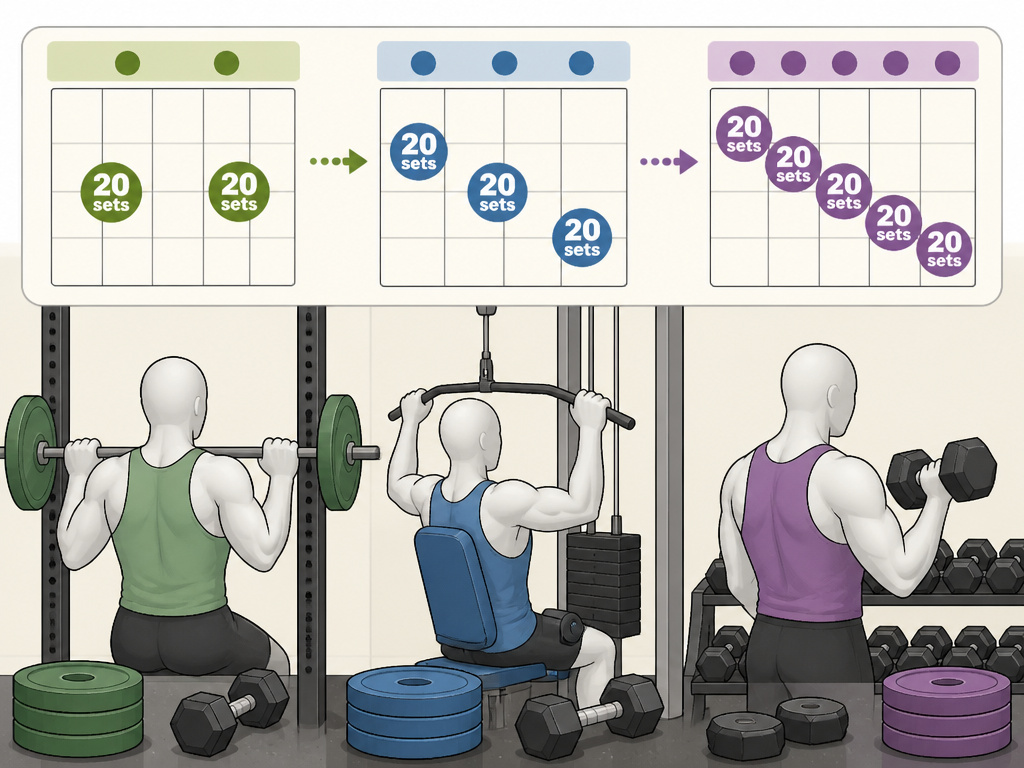
Splitting the same weekly sets across more days changes how a session feels, not the weekly total.
Zaroni et al. (2019) found high-frequency training (five versus one session per week) may confer a superior hypertrophic response in young individuals, while Pina et al. (2019) found no lean mass difference between older adults training two or three times a week over 12 weeks.
The practical read: frequency is a delivery mechanism for volume. If 20 sets in one session leaves you wrecked by set 14, splitting them across two days gets the work done at a volume you can actually recover from.
Three common ways to spread it:
- Two full-body days, which cram the same weekly sets into fewer, longer sessions.
- Three upper/lower days, which thins each session out and keeps the last set of the day from turning into a formality.
- A body-part split, where each muscle gets one big day and then a full week off. The bro split pros and cons are worth reading before you commit a whole year to that structure.
The Bayesian network meta-analysis training prescription that pooled 119 studies and 3,364 participants found the largest relative effect on hypertrophy came from higher-load, multiset training done twice a week (SMD 0.66). Twice a week is a reasonable default, and it’s also the easiest structure to actually keep. If you want the deeper breakdown on training frequency per muscle group, that’s where the scheduling detail lives.
How to Add Sets Without Wrecking Recovery
A friend I trained with could not do one full push-up when she started. Nothing about that progression was dramatic. It was small enough to repeat, which is the whole trick.
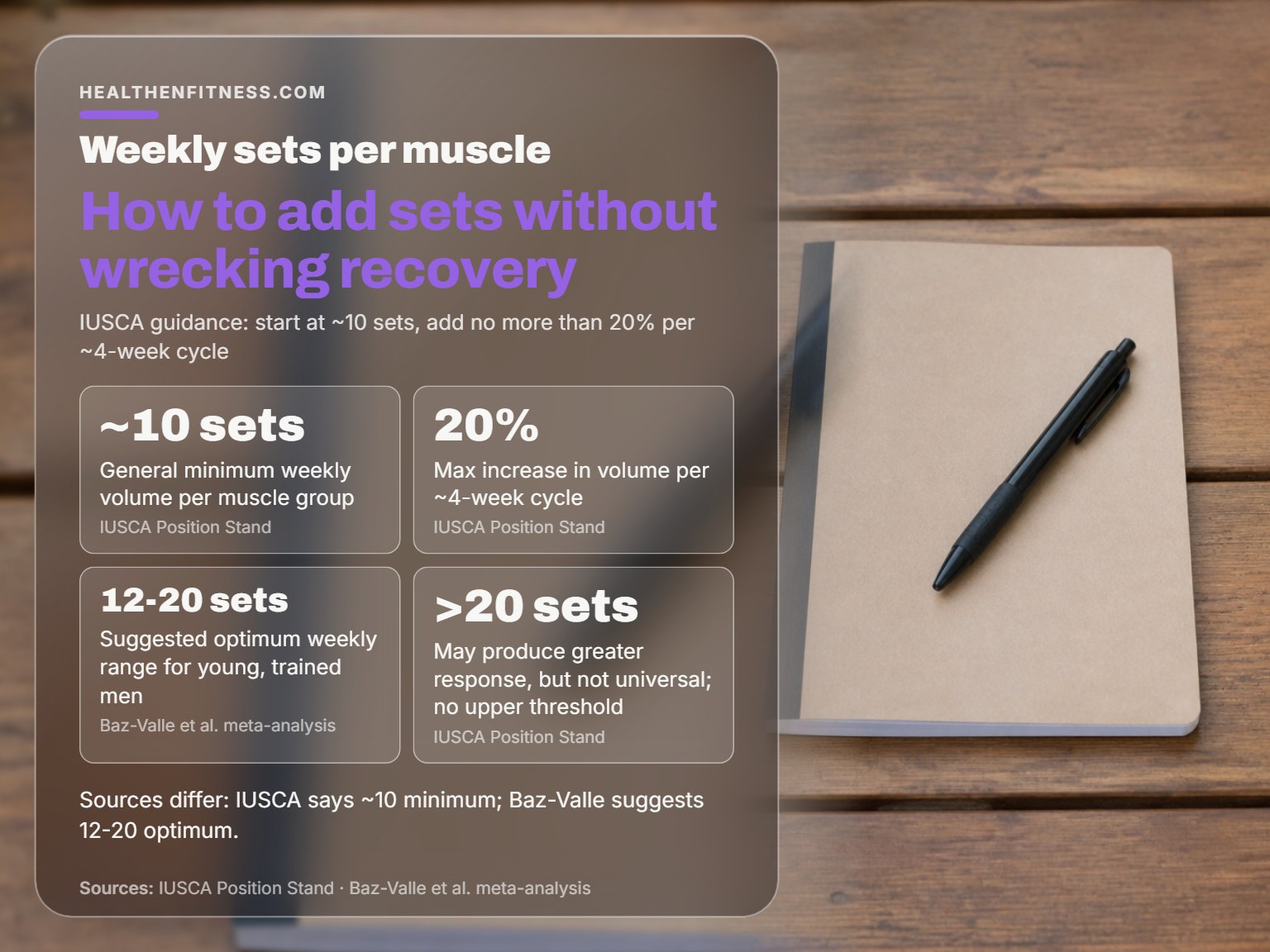
The IUSCA stand applies the same logic to volume: incremental increases capped at about 20% of previous volume per four-week cycle. That’s the number most volume articles leave out.
- Start at 10 sets per muscle per week. Skipping this and opening at 20 leaves you sore for days and guessing at which variable broke you.
- Hold that number for four weeks. Bailing after ten days tells you nothing, because the adaptation you’re measuring takes longer than that to show up.
- Add no more than 20%. Going from 12 sets to 14 is fine. Going from 12 to 20 in one jump is how elbows start filing complaints around week three.
- Keep the total flat when you specialize. The IUSCA stand recommends holding total weekly sets constant and shifting volume toward underdeveloped muscles instead.
- Log every set. A paper notebook or a tracking app does more for your progress than any supplement, because it’s the only thing that tells you whether last month beat the month before.
I would rather see a lifter add two sets a week for a month than double their volume in one enthusiastic Sunday. The first version you can measure. The second one you just survive.
The 20% Rule in Practice
That’s the whole progression, and it feels almost too slow to work.
The last two reps of a genuinely hard set feel different from the first eight. The bar slows, your grip shifts a millimetre, and the rep that moved fast at six becomes a small negotiation at ten. That slowdown is the signal you’re in the right volume range, not the number in your notebook.
Pair the volume with sane rest periods for muscle growth and a rep range you can actually progress, and the weekly set count stops being the only lever you’re pulling.
If you’re brand new, the honest starting point is lower than 12. The how many sets and reps should a beginner do breakdown handles that case directly, and it’s worth reading before you copy an intermediate program off the internet.
When More Sets Stop Working
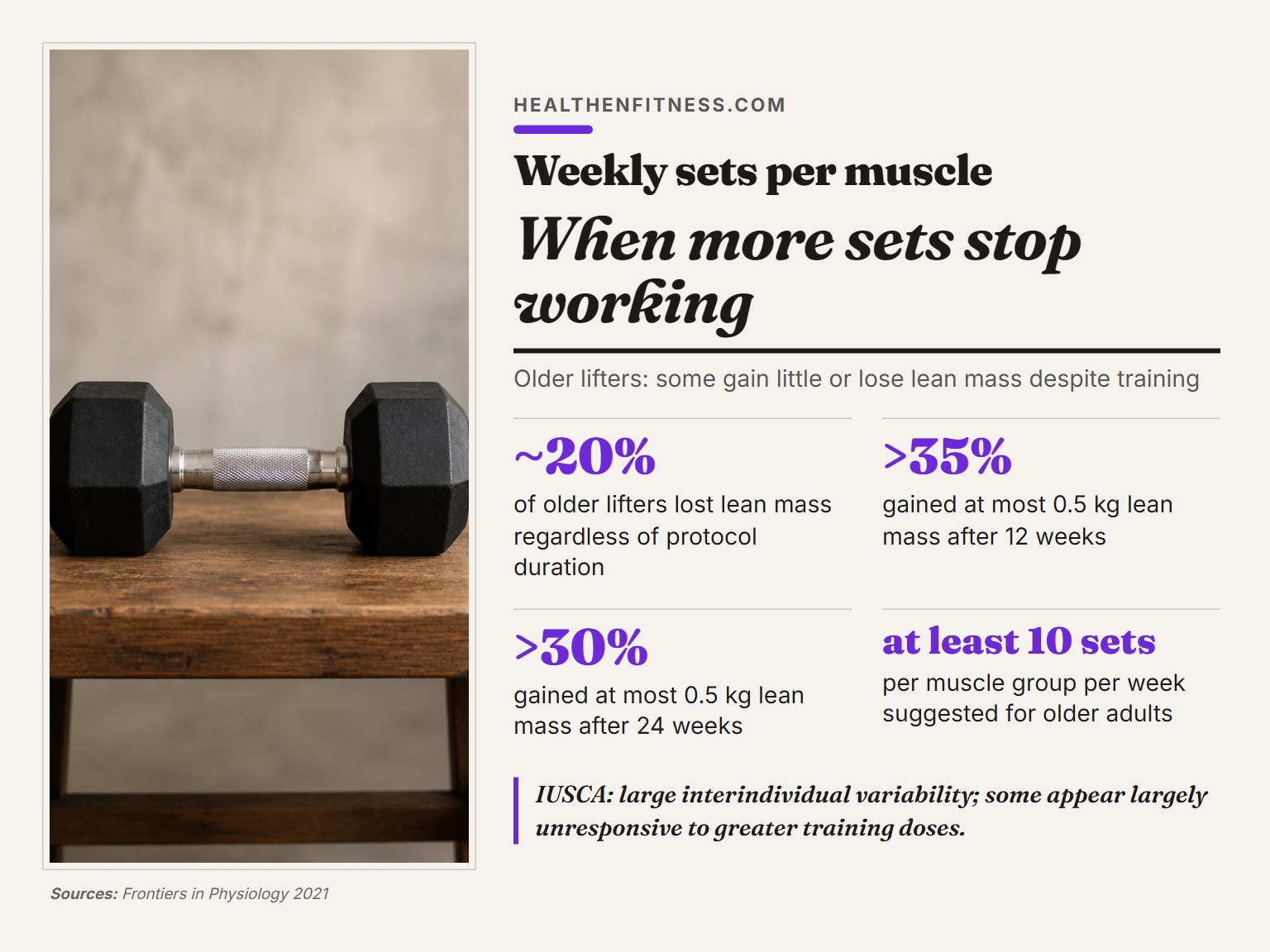
Some lifters add sets and grow. Others add sets and get sore, sleep badly, and press the same weight for two months.
The IUSCA stand is blunt about this: large interindividual variability exists, and some individuals appear largely unresponsive to greater training doses. The Frontiers paper on older lifters found that about 20% had a decrease in lean mass regardless of protocol duration, while more than 35% and 30% had a maximum lean mass increase of 0.5 kg after 12 and 24 weeks respectively.
| What you notice | Likely cause | What to change |
|---|---|---|
| Same weights for eight weeks | Volume is fine, progression is missing | Add reps or load, not sets |
| Sore for four or more days after every session | Volume jumped faster than recovery | Return to last month’s total |
| Elbows or shoulders ache before set one | Too many pressing sets, too little rest | Trim indirect volume, add a rest day |
| Sleeping worse, feeling flat all week | Total weekly sets above what you recover from | Hold volume flat for two weeks |
The morning after a big volume jump, your quads introduce themselves on the first stair descent of the day, a deep ache that arrives before you’re properly awake. That ache on day two is normal. The same ache on day five is a bill you didn’t budget for.
Older Lifters and the Damage Question
The damage data is genuinely split, and it’s worth saying so. Roth et al. (2000) found 15 weekly sets per muscle group caused more ultrastructure muscle damage in older women than young women after a 9-week intervention. Roth et al. (1999) found no such difference in older men compared to young men.
The Frontiers authors suggest at least 10 sets per week for older adults, and Fragala et al. (2019) recommends training each muscle two to three times a week with one or two exercises per muscle group per session. That’s a different structure from a young lifter chasing 20 sets, and it’s built around recovery rather than maximum stimulus.
Signs to back off rather than add:
- Soreness that outlasts the week. A muscle that’s still complaining on day five got more than it could absorb.
- Joints speaking before muscles do. Tendons adapt slower than muscle, and they don’t send polite reminders.
- Numbers going sideways for three weeks. Flat strength while volume climbs is a warning, not a plateau to push through.
Skip this if: you’re over 60, returning from a long layoff, or managing a joint that has already complained. Start at 10 sets, run it for a full month, and add nothing until the numbers move.
Frequently Asked Questions
Is 10 sets per muscle group per week enough?
For most healthy trainees, yes, as a starting point. The IUSCA position stand treats roughly 10 sets per muscle group per week as a general minimum, and the older-adult literature suggests the same floor. It’s enough to grow on if you’re progressing the load or the reps. It’s not a ceiling.
Should I count indirect sets from compound lifts?
Yes, and most people undercount them. The Baz-Valle meta-analysis counted both single-joint and multi-joint sets following Schoenfeld et al. (2019b), precisely because pressing and pulling add real work to the triceps and biceps. If you do 16 chest sets, your triceps are already well fed before you touch a pushdown.
Do I need more than 20 sets per week to grow?
The evidence is mixed: the Baz-Valle review found no difference between moderate and high volume for most muscles, while the IUSCA stand notes that more than 20 sets may produce a greater response in some people. The Baz-Valle review found no difference between moderate and high volume for the quadriceps (p = 0.19) or biceps (p = 0.59). High volume did come out ahead for the triceps brachii (p = 0.01), and the IUSCA stand notes that more than 20 sets may help some people without establishing an upper limit.
Does it matter how I split the sets across the week?
The evidence is mixed. Schoenfeld et al. (2019) found frequency does not meaningfully affect hypertrophy when volume is equated, while the Baz-Valle group suggests higher frequency may distribute high volume more effectively. Splitting the work across two or three sessions is the practical compromise most lifters land on.
How long before I should add more sets?
Give a volume block about four weeks before you change it. The IUSCA stand caps increases at roughly 20% of previous volume per four-week cycle, which is slow enough to tell you whether the last increase actually worked.
The Bottom Line
Here is the honest version: if you’ve been running the same 8 sets per muscle for six months and nothing has changed, more sets probably aren’t your missing piece. A logged progression on the sets you already do is.
The trigger for adding volume is simple. Once you’re clearing 10 sets per muscle per week, adding reps or weight most weeks, and still recovering well, you’re inside the range the research supports. Push toward 20 only while sleep, joints, and your logbook all keep agreeing with you. The moment two of those three stop cooperating, hold the number flat for a month.
One concession worth stating plainly: the network meta-analysis behind a lot of this excluded well-trained elite athletes, military personnel, and people with chronic disease. If you fall into any of those groups, treat these numbers as a starting reference and get individual guidance.
So the answer to how many sets per muscle group per week is a range, not a number, and the range moves with you. This week, write down your current weekly sets for each muscle, find the lowest one, and add two sets to it. Start smaller than you think. Then keep showing up long enough for it to matter.
