How Deep Should You Squat? 3 Depth Bands Explained
This post contains affiliate links. As an Amazon Associate, we earn from qualifying purchases.
Squat depth for most people is the medium band: hip crease just below the knee, roughly 90 to 110 degrees of knee flexion. That range loads the quads and glutes hard, though the biomechanical review advises avoiding deep squats because tibiofemoral compressive forces and contact stresses increase with knee flexion, while the scoping review concludes deep squats are safe with proper technique. Go deeper only when your hips and ankles let you without your heels lifting.
The heels lifting is the tell. When your ankle can’t dorsiflex far enough, your weight rolls onto the balls of your feet and your knees travel forward to compensate, which changes which tissue takes the load. Depth advice that ignores ankle range hands you a number you can’t hit, which is why how deep should you squat depends on your ankles.
What follows: the three depth bands the research actually uses, what the knee-load numbers show at each one, and how to pick a depth you can repeat next week.
Key Takeaways
- Medium depth is one common default for many lifters: hip crease below the knee, heels flat, roughly 90 to 110 degrees of knee flexion, though the CJTER 2025 study recommends the 50%-loaded parallel squat for strength, the biomechanical review advises avoiding deep squats, and Klein recommended capping squats at half depth.
- Deep squats have a worse reputation than the evidence supports. A scoping review of 15 studies found 14 showed no negative effect on knee joint health.
- Load reduction doesn’t cancel the knee moment. Taking weight off as you go deeper still leaves peak external knee flexion moment higher than at parallel.
- Glute work climbs early, then flattens. Gluteus maximus activity rises 65% from shallow to medium depth, and the deep-versus-medium picture is genuinely contested.
- Fix the pattern before you chase depth. Heels up means ankle range, not weak quads.
What Counts as Shallow, Parallel, and Deep?
Researchers don’t argue about depth by feel. They measure knee flexion angle and pick a landmark, which is why the literature and gym talk rarely line up.
Squat depth is defined by knee flexion angle: partial or shallow runs from 0 to 90 degrees, medium runs from 90 to 110 degrees with the thigh parallel to the floor, and full or deep runs from 110 to 135 degrees. A separate kinetic study used the inguinal crease dropping just below the proximal patella as its parallel landmark.
| Depth band | Knee flexion | Landmark | Best fit |
|---|---|---|---|
| Shallow / partial | 0-90 degrees | Above parallel | Early rehab, knee-sensitive lifters |
| Medium / parallel | 90-110 degrees | Hip crease below kneecap | Default strength work |
| Full / deep | 110-135 degrees | Hamstrings touch calves | Mobility work, weightlifting |
Two studies can both say “parallel” and mean different things. One defines it by the inguinal crease sitting just below the kneecap. Another defines it by thigh angle relative to the floor. Check which landmark a paper used before you decide your own squat is shallow.
The practical version: film a set from the side with the camera at hip height. If the crease of your hip sits level with or below the top of your kneecap, you’re at parallel by the most common standard. That’s also the checkpoint most proper squat form breakdowns use, and it beats guessing from feel.
One more thing. When your heels come up a few millimeters, the sole of your shoe squeaks against the platform. That sound is your ankle running out of range, not your quads failing.
How Deep Should You Squat? Start With the Knee Load Numbers
One rep max falls 13.6% from above-parallel to parallel, then another 3.6% from parallel to below-parallel. That’s the raw cost of depth, measured in 16 recreationally trained men.
The more useful finding sits in the joint moment, not the load on the bar. One knee kinetics study found net peak external knee flexion moment rises with both depth and load, though the biomechanical review notes the increase with depth is not consistent across studies. The slope is steepest at the light end, climbing faster from unloaded to 50% of 1RM than from 50% to 85%.
So the instinct to strip weight off as you sink deeper doesn’t rescue the knee according to the knee kinetics study, though the biomechanical review notes the moment increase with depth is not consistent across studies. The authors of that knee kinetics in squatting research put it plainly: typical decreases in squat loads used with increasing depths are not enough to offset increases in peak external knee flexion moment.
That single line undercuts the most common gym workaround according to the knee kinetics study, though the biomechanical review notes the moment increase with depth is not consistent across studies.
Where this goes sideways: Stripping weight off the bar and dropping into the hole to play it safe. The load comes off, the knee moment still climbs, and you’ve done a lighter set at the depth that loads you most.
A 2025 biomechanics study adds a wrinkle that no single depth rule survives. Peak patellofemoral joint force and quadriceps force landed at 50% load across all three depths. PCL force, hamstring force, and gastrocnemius force peaked at 85% load instead. Depth had no significant effect on PCL force at all.
One load number cannot satisfy both tissues. That study recommends the 50%-loaded parallel squat for strength work, which is a narrower prescription than most coaching advice.
A systematic review of knee and vertebral column squat load took the same question to the spine as well as the knee, which matters if you’ve ever felt a deep squat in your lower back before your legs.
I’ve watched lifters chase depth for months while their actual limiter was a stiff ankle. The knee numbers above only become useful once you know which variable you’re actually changing.
Deep Squats and Knee Health: Where the Experts Genuinely Disagree
Two credible reviews reach opposite conclusions about the same movement. One says deep squats should be avoided because tibiofemoral compressive forces and contact stresses climb as knee flexion increases, while the scoping review concludes deep squats are safe provided proper technique is maintained. The other kept 15 studies and concluded the deep squat is safe provided technique holds.
| Position | Held by | Basis |
|---|---|---|
| Avoid deep squats | Biomechanical review (PMC10987311) | Tibiofemoral compression and contact stress rise with flexion |
| Deep squats are safe | Scoping review (PMC11618833) | 14 of 15 studies found no negative knee joint impact |
| Cap at half depth | Dr. Karl Klein, cited in that review | Ligament elongation concerns from 1960s cadaver work |
Only one of those 15 studies, a single case study, linked deep squats to higher injury risk. The other 14 found nothing negative. The review authors still flag their own limits, and the included studies varied widely in quality.
Klein’s half-depth recommendation was made to prevent ligamentous weakening. The deep squat knee joint structures evidence notes that the case for it is limited and that no cause-and-effect link between deep squats and injury has been established.
So the honest position is this: the “deep squats wreck your knees” claim is older than the data behind it, and the “deep squats are fine for everyone” claim rests on short studies of trained lifters. Neither side gets to be the universal rule.
I’ve stopped treating “deep squat” as one exercise. A high-bar squat with an upright torso and a low-bar squat that folds you forward are not the same movement at the same depth, because the trunk and tibia angles change the knee moment. When someone tells me deep squats hurt their knees, my first question is which deep squat.
The biomechanical review of the squat exercise makes that point directly: the rise in knee flexion moment with depth isn’t consistent across studies, and trunk versus tibia orientation shifts load between the knee and the hip. If you already have knee pain from squats, that distinction is where I’d start.
Which Muscles Actually Change With Depth?
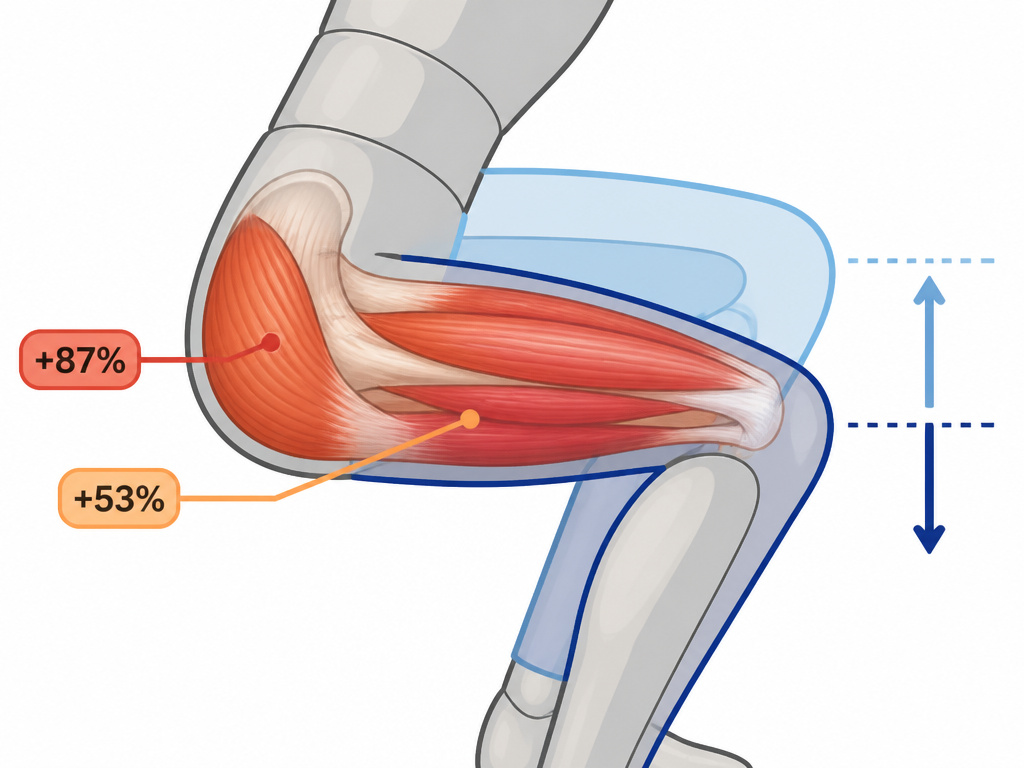
Gluteus maximus activity climbs 65% from shallow to medium depth. Past that point, the studies start arguing with each other.
- Quadriceps: one study found a 29% increase in EMG activity with depth; others found no change at all.
- Glutes, deep versus medium: reported as 25% greater in one study (28% versus 35% MVIC) and roughly equal in another.
- Glutes, partial versus deep: activity was actually higher in the partial by 29% MVIC in a third study. Same muscle, opposite direction.
- Hamstrings: one study reported a 12% MVIC decrease as depth increased.
Read those together and depth has no single muscle signature. Trunk and tibia position probably explain most of the noise, which is the same variable that muddies the knee-load picture.
You’ll feel the shift before any study explains it. Take a few inches off your depth and the burn moves up the front of your thigh while your glutes go quiet. That matches the shallow-to-medium jump in the data, even if the deeper comparisons stay unresolved.
Which is fine. You don’t need a definitive EMG answer to train. You need a depth you can control and a reason to pick it.
The Variables That Change the Load at the Same Depth
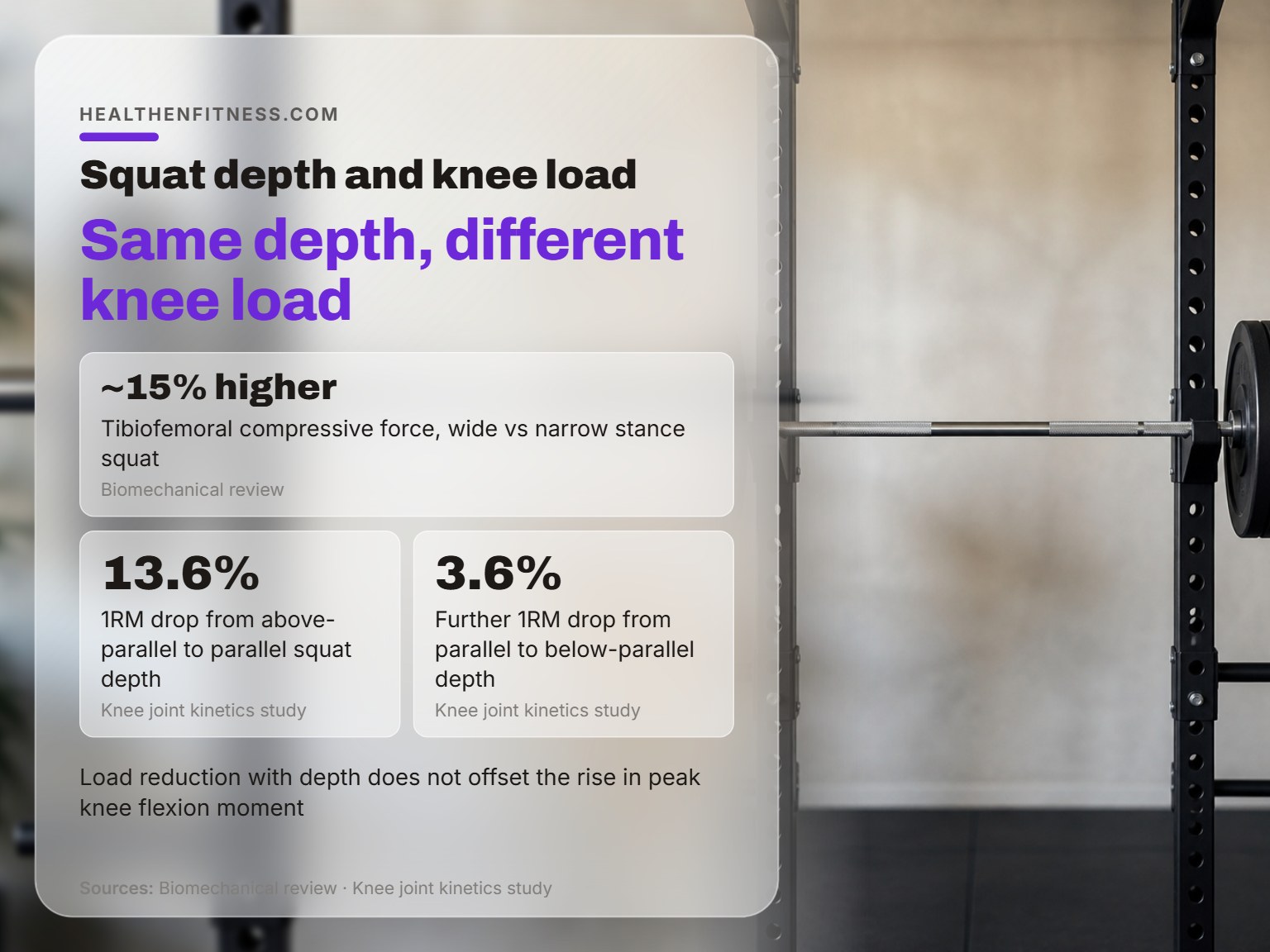
Depth gets all the attention. Stance width, bar position, and ankle range change the knee load at the exact same depth.
Wide-stance squats produce roughly 15% higher tibiofemoral compressive forces than narrow-stance squats. A wide box squat to parallel and a narrow one aren’t interchangeable just because both hit the same knee angle.
Bar Position Changes the Angle, Not Just the Feel
Where the bar sits changes how upright you can stay, and that changes the moment arm at the knee and hip. The high bar vs low bar distinction is really a torso-angle decision dressed up as a bar placement one. Most lifters who “can’t squat deep” are trying to squat deep with a bar position that forces them forward.
Ankle Range Decides Whether You Can Get There
I’ve seen the same edge case more times than I can count: desk workers with stiff hips and stiffer ankles who can’t reach depth without their heels coming up. Putting a couple of small plates under the heels for a few weeks usually helps them find a stable bottom, and then the range comes along on its own.
That’s a workaround, not a fix. Real ankle mobility for squats work is slower and more boring, and it’s the thing that helps you ditch the plates.
Front Squat Depth Runs Into a Different Ceiling
The front squat vs back squat comparison trips people up because the front rack demands more ankle range and a more upright torso. You’ll often hit a depth ceiling on front squats that you cleared easily on back squats. That’s a mobility limit, not a strength one.
How to Pick Your Depth This Week
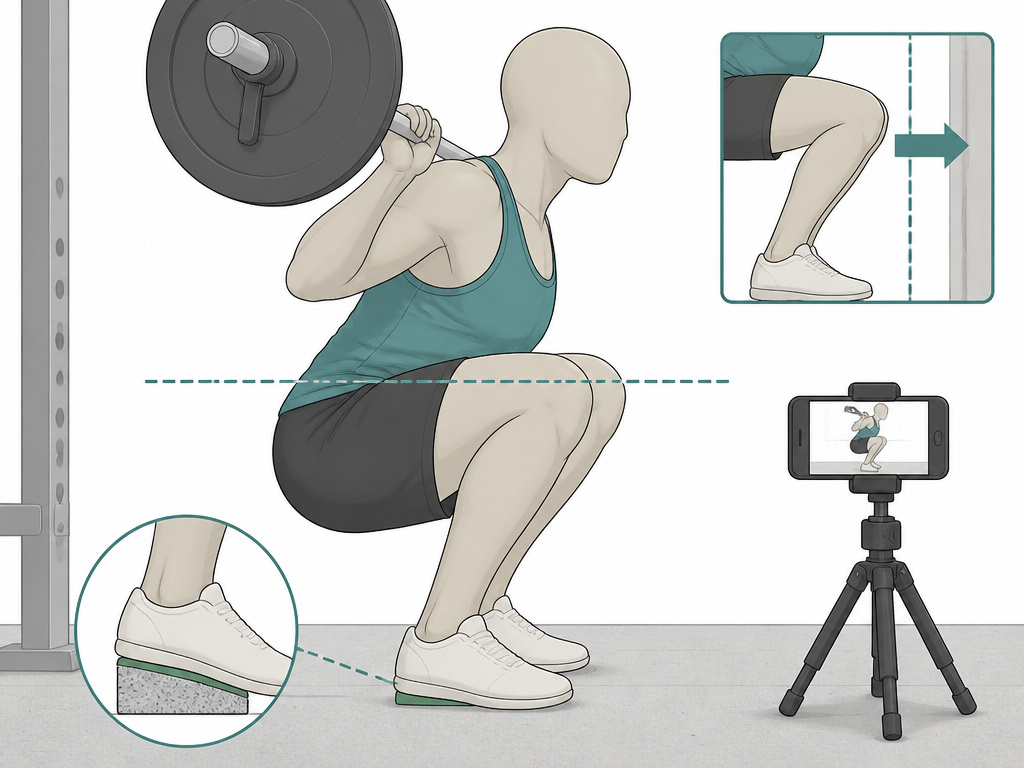
Three things decide your depth: ankle range, hip anatomy, and how much load you’ll own at the bottom. Work them in that order.
- Film one set from the side, camera at hip height. Skip this and you’re guessing at a depth you can’t see, which is how people spend a year “just above parallel” and never fix it.
- Test ankle range against a wall before you load anything. Toes a few inches from the wall, drive the knee forward over the middle toes. If the knee stops well short of the wall, depth is an ankle problem first.
- Pick a target depth you can hit with both heels down. If your heels lift, drop the target, not the standard. A depth you can’t reach with a flat foot is a depth you don’t own.
- Load it at a weight you can control for every rep, not just the first. The set that feels easy at rep three is the one that folds you at rep eight.
- Change depth or load, never both in the same week. That’s progressive overload the way you’d season a pot of soup: a pinch at a time, because you can’t take the salt back out.
A few pieces of gear make this easier without changing the physics. If your heels still lift after a few weeks of ankle work, a raised heel buys range by letting the knee travel forward without the ankle giving way. Set your rack safeties at the bottom of your squat so they can catch a missed rep just below your lowest point.
Bar choice matters more than people expect. A Rogue Ohio Bar sits differently across the upper back than a thicker power bar, and that changes how upright you can stay at the bottom. Between the Rogue and the Eleiko Sport Training Bar, the Rogue is the more forgiving everyday pick for a home setup. Whatever you use, know how to bail out of a failed squat before you test a new depth under load.
The part nobody mentions: Depth you gain by bouncing out of the bottom isn’t depth you control. If the last few inches only happen because of momentum, you’ve added range to the rep and taken it off the muscle.
Frequently Asked Questions
Is it bad to squat below parallel?
The evidence doesn’t support a blanket yes. A scoping review of 15 studies found 14 showed no negative impact on knee joint health, and one case study linked deep squats to higher injury risk. A biomechanical review still recommends avoiding deep squats because compressive forces climb with knee flexion, while the scoping review concludes deep squats are safe with proper technique. Both positions are defensible, and the disagreement is unresolved.
How deep should a beginner squat?
To a depth you can reach with both heels flat and your spine neutral. For most beginners that lands somewhere between a quarter squat and parallel, and it improves as ankle range improves. Adding depth slowly beats forcing a number you can’t hold.
Does squatting deeper build more muscle?
Not in a straight line. Glute activity jumps 65% from shallow to medium depth, then the deep-versus-medium comparisons conflict. Quadriceps EMG rose 29% with depth in some studies and showed no change in others. Depth is one variable among several, and load and consistency still do most of the work.
Why do my heels lift when I squat deep?
Ankle range, almost always. If the ankle can’t dorsiflex far enough, your weight shifts to the balls of your feet and your knees travel forward to compensate. Small plates under the heels can bridge the gap for a few weeks while you work on the underlying range.
Should I go deeper or add weight first?
Deeper first, then heavier. Depth you can’t control at a light load won’t improve when you add weight, and one knee kinetics study found the knee moment climbs with both variables, though the biomechanical review notes the increase with depth is not consistent across studies. Earn the range, then load it.
The Bottom Line
Here’s the trigger to watch for: if your heels come off the floor at the depth you want, stop chasing that depth for three weeks and work ankle range instead. Depth you can’t reach with a flat foot isn’t depth, it’s a leak.
Everything above assumes healthy knees and a program you can recover from. If you’ve had ligament surgery or a repair, how deep should you squat is a question for your clinician, not a website. Generic depth advice can mislead someone with a complicated history.
I’d rather see a lifter hit parallel with a load they own than grind out a shaky below-parallel single. The second one photographs better. The first one still works in five years.
Today: film one set from the side, watch your heels, and write down the depth where they first lift. That number is your real starting point.
