
How Long Does It Take to Build Muscle? 4 to 12 Weeks
This post contains affiliate links. As an Amazon Associate, we earn from qualifying purchases.
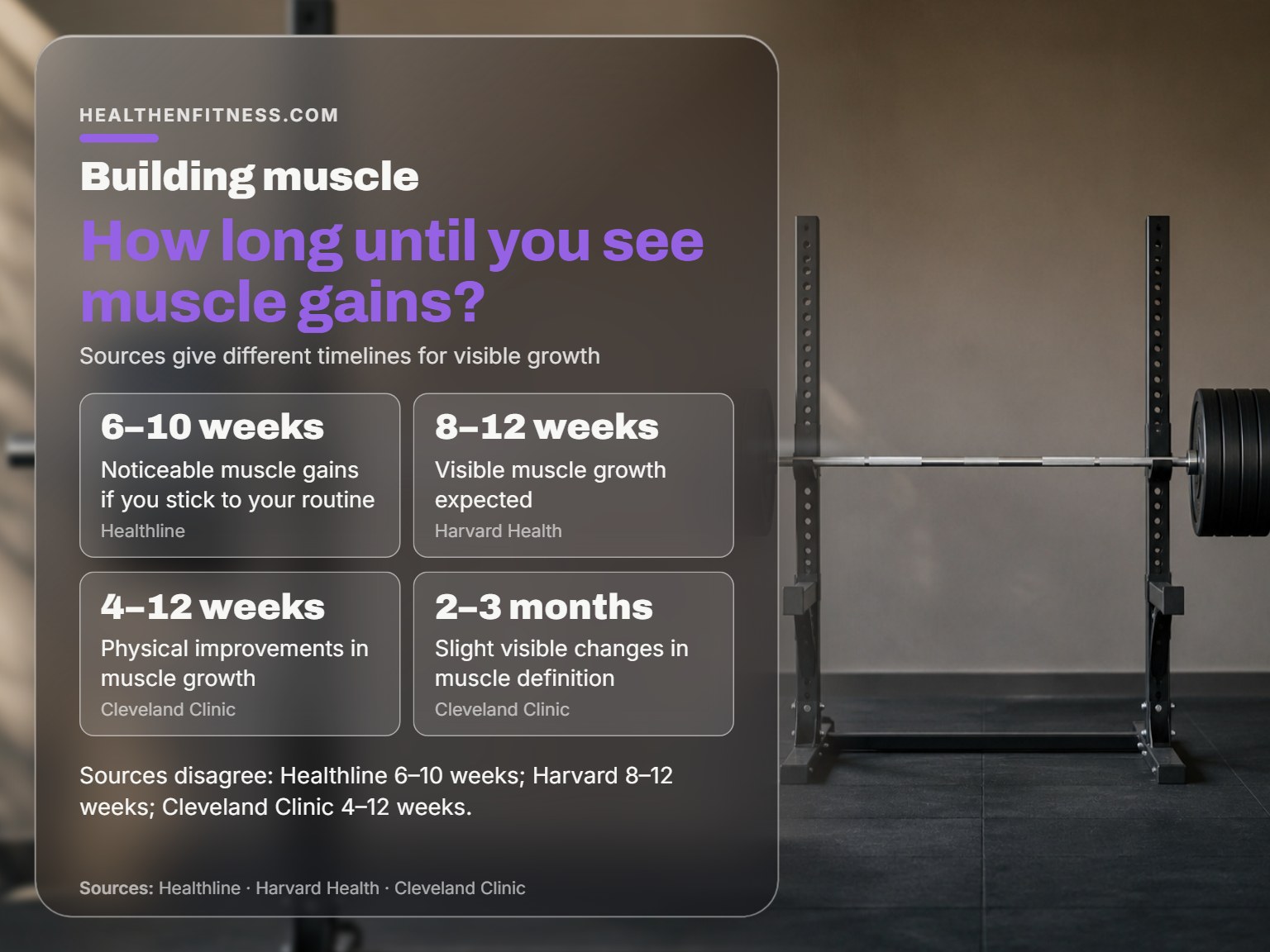
Building muscle takes about four to 12 weeks before you see physical improvements, and visible growth tends to land between six and 12 weeks depending on which source you read. The first three weeks are mostly your nervous system learning the movement, not new tissue. Obvious changes to your frame take four to six months.
That early stretch is your nervous system learning to fire the fibers you already have, which is part of how long does it take to build muscle. Motor units start switching on in a smoother order, more of them come online at once, and the same muscle produces more force without a gram of new tissue. Which is why a beginner can add weight to the bar in week three and still look identical in the mirror.
What follows is the timeline the major sources roughly agree on, the places where they flatly disagree, and the handful of variables that actually move your date. Training setup, protein, rest, age, and the one habit that stalls beginners for months.
Key Takeaways
- Strength gains can show in about two weeks from better nerve recruitment, according to Harvard Health, though Cleveland Clinic points to performance improvements at three to four weeks and Damas et al. Found the first significant strength increase at week four.
- Visible growth estimates range from 4 to 12 weeks, depending on which source you read and what they measured: Cleveland Clinic says 4 to 12 weeks for physical improvements, Healthline says 6 to 10 weeks, and Harvard Health says 8 to 12 weeks.
- Realistic gain is 1 to 2 kg of fat-free mass per 8 to 12 weeks, and it slows as training age climbs.
- ACSM’s 2026 position stand says hypertrophy is enhanced by at least 10 sets per week, though the 2020 meta-analysis found excessive sets per workout negatively moderated mass gains, and Healthline notes even a single heavy set of 12 reps can help.
- Protein matters at up to 1.6 g/kg per day, where Healthline says growth data sits, well above the 0.8 g/kg RDA for basic health, though Healthline also frames intake as 10 to 35 percent of daily calories.
What the First 12 Weeks Actually Look Like
The first twelve weeks split into three phases, and only the last one shows up in a mirror. I’ve watched people quit at week three because the reflection was quiet and the bar felt heavy.
Hypertrophy is measured as a change in muscle cross-sectional area. In one eight-week protocol using weekly imaging, cross-sectional area rose 3.46 percent by week one, but the authors attributed part of that early signal to edema. The adjusted first true hypertrophy signal appeared at week three, and total cross-sectional area rose 9.60 percent by week eight.
The practical version of how long does it take to build muscle is simpler. Performance moves first, appearance moves last, and the gap between them is where most people give up.
Here’s how the phases stack up across the sources.
| Timeframe | What changes | Source |
|---|---|---|
| Weeks 1 to 3 | Nervous system learns the lift; little visible change | Cleveland Clinic |
| Weeks 3 to 4 | Endurance climbs, heavier weights feel manageable | Cleveland Clinic |
| Weeks 6 to 10 | Noticeable muscle gains if you stay consistent | Healthline |
| Weeks 8 to 12 | Visible muscle growth | Harvard Health |
| Months 2 to 3 | Slight visible changes in definition | Cleveland Clinic |
| Months 4 to 6 | Obvious changes to your frame and composition | Cleveland Clinic |
What Changes Before You Can See It
Your first four weeks of progress are logged in reps, not in photographs. You’ll do more reps at the same weight, or the same reps with less grinding. That’s the signal to watch, because the mirror lags it by a month or more.
Why the First Three Weeks Feel Like Nothing
Tom Iannetta, an athletic trainer at Cleveland Clinic, calls the first three weeks “neuromuscular reeducation.” His point is that your muscles are learning the pattern of a specific lift, so the early gains are coordination, not size.
The imaging data backs the shape of that, with one wrinkle worth knowing. A 2011 study tracked 25 sedentary men over eight weeks with weekly scans. Cross-sectional area jumped 5.0 square centimeters by week one, a 3.46 percent rise, but the authors flagged that early number as partly edema, meaning swelling rather than new tissue. The first honest hypertrophy signal landed at week three.
The same study found that maximal voluntary contraction, a direct strength measure, didn’t rise significantly until week four.
Iannetta’s timeline matches. Performance improves at three to four weeks, which is exactly when the coordination phase ends and you can finally express the strength you’ve built. The Cleveland Clinic muscle-building timeline puts visible definition at two to three months.
How Long Until You Notice a Difference in the Mirror?
Mirror change is the slowest of the three signals, and it’s the one beginners fixate on. That’s a shame, because it’s also the noisiest measure you could pick.
The sources don’t agree on a single number here, and they’re not really trying to. They’re measuring different things.
| Source | What it says | What it’s measuring |
|---|---|---|
| Cleveland Clinic | 4 to 12 weeks for physical improvements | Clinician timeline |
| Harvard Health | Visible growth at 8 to 12 weeks | Visible growth |
| Healthline | Noticeable gains at 6 to 10 weeks | Noticeable gains |
| Van Every et al. 2025 | 1 to 2 kg fat-free mass per 8 to 12 weeks | Measured tissue |
Read that table as four honest answers to four slightly different questions.
What you’ll actually see first is usually a line, not a shape. A bit of separation where there wasn’t one. The overall silhouette takes months.
Sore again? That’s normal early on and it fades as you adapt.
How Much Muscle Can You Realistically Gain in 8 to 12 Weeks?
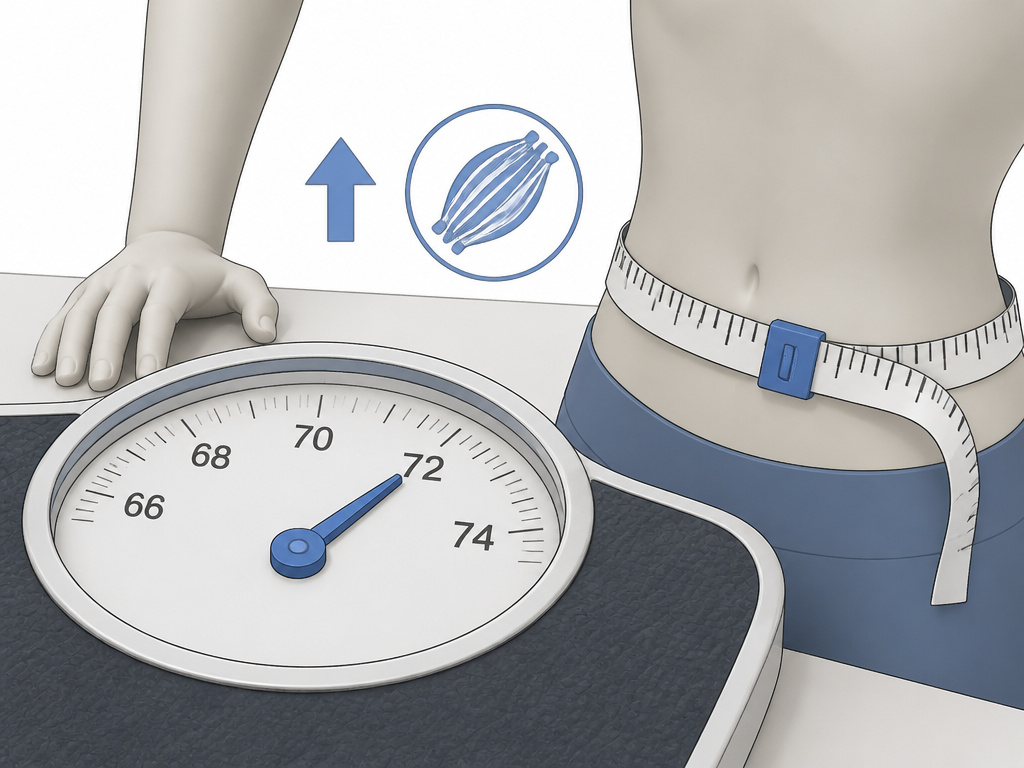
One to two kilograms of fat-free mass per 8 to 12 weeks is the honest estimate for a novice to intermediate lifter, according to Van Every and colleagues in a 2025 review. That’s actual tissue, not scale weight.
A large resistance training meta-analysis whole-body growth found a mean whole-body hypertrophy of 1.53 kg, with a 95 percent confidence interval of 1.30 to 1.76. Useful number. Also a narrow one, because that analysis was restricted to healthy adult males, so it doesn’t transfer cleanly to women.
If your scale is up a couple of kilos over a few weeks and your waist hasn’t moved, that’s a good outcome. If it’s up much more, most of the extra isn’t muscle.
Beginners get the fastest run at this.
The Weekly Setup That Moves Your Timeline
Four things decide your weekly setup: how often you train, how many sets you do, how heavy the load is, and how long you rest.
Before you start: A bar loaded past what your form can hold folds you forward on the last rep, and that’s how lower backs go. Set rack safeties at chest height or get a spotter. Warm up for 5 to 10 minutes first, because cold muscle tears more easily than warm muscle.
They left me too wrecked to train properly the next day, so I’d miss sessions and call it “overtraining.” I dropped them for fewer, better sets I could actually recover from, and the bar started moving again.
- Pick a schedule you’ll repeat. Two or three full-body sessions a week hits every major muscle group at least twice, which is what Healthline recommends. Skip the body-part split for now; missing leg day once a week is how a year passes with no leg growth.
- Warm up for 5 to 10 minutes. Brisk walking or a light set of your first lift. A pulled hamstring costs you training time, and that’s a bigger setback than any program tweak.
- Do 2 to 3 sets of 8 to 15 reps. Rest about a minute between sets. Cut that rest too short and your next set loses reps, which turns training into cardio.
- Load it heavy enough to be tired at 12 to 15 reps. If rep 15 feels like rep 3, the weight is too light and you’re practicing, not building.
- Take 3 seconds up, hold 1 second, 3 seconds down. Rushing the lowering half skips the eccentric work that the ACSM resistance training position stand flags as a hypertrophy driver.
The Minimum Effective Week
Healthline puts the floor at 20 to 30 minutes of weight training, two to three times a week. The ACSM position stand sets strength work at two or more sessions per week and notes that hypertrophy is enhanced by at least 10 sets per week.
Those two numbers aren’t in conflict. One is per session, one is per week. If you’re building muscle at the gym three times a week, four sets per muscle group per session gets you there.
Sets, Reps, and Load
For strength specifically, ACSM calls for loads at 80 percent of your one-rep max or above, full range of motion, and 2 to 3 sets placed early in the session while you’re fresh. For size, the same stand points to eccentric overload and weekly volume.
Rest is the variable people cut first.
Protein and Calories Decide How Fast This Goes
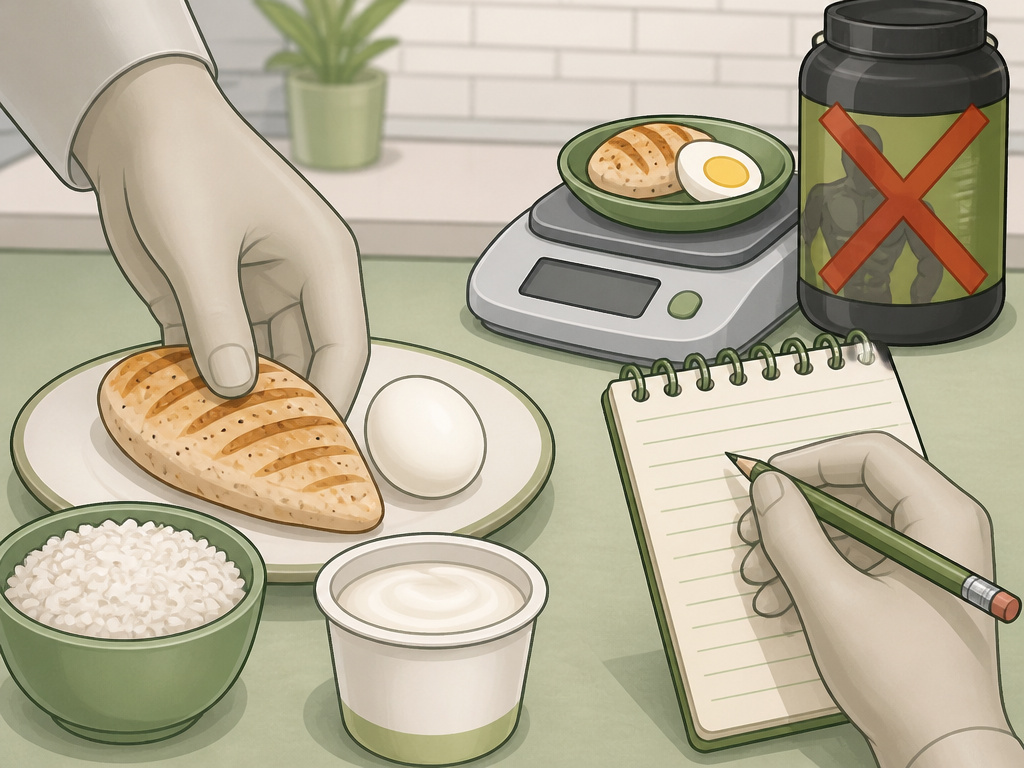
Protein is the raw material, and calories are the permission slip. Neither one is optional, and neither one is complicated.
The RDA sits at 0.8 g/kg per day for adults 18 and over, per the American Heart Association figure Healthline cites. Significant muscle increases have been found at intakes up to 1.6 g/kg per day.
How Much Protein, in Plain Numbers
- 0.8 g/kg per day is the floor for basic health, not a muscle-building target.
- Up to 1.6 g/kg per day is where the growth data sits, and that’s the number worth aiming at.
- 10 to 35 percent of daily calories from protein is the range Healthline gives for a normal diet.
Timing is looser than the old advice suggested. Eating quality protein within 4 to 6 hours before and after a session covers it comfortably.
Common mistake: Eating far more than you need while lifting the same weights every week. That’s how a beginner gains mostly fat and blames their metabolism. A slow surplus is plenty, and a lean bulk keeps the waist measurement honest.
Mass-gainer shakes are the wrong tool here. They’re mostly sugar and they train you to drink calories instead of eating them. Add a second simple meal of rice, eggs, or yogurt when appetite is low, and skip the powder.
What Slows the Timeline Down
You take eight weeks off, come back, and load the bar exactly where you left it. Two days later your legs won’t let you sit down without a countdown.
I’ve watched that happen to several people. Now I tell them to start lighter than their old weights for the first week back. It feels insulting and it saves a week of walking sideways.
The bigger slowdowns are structural, and they’re worth knowing up front.
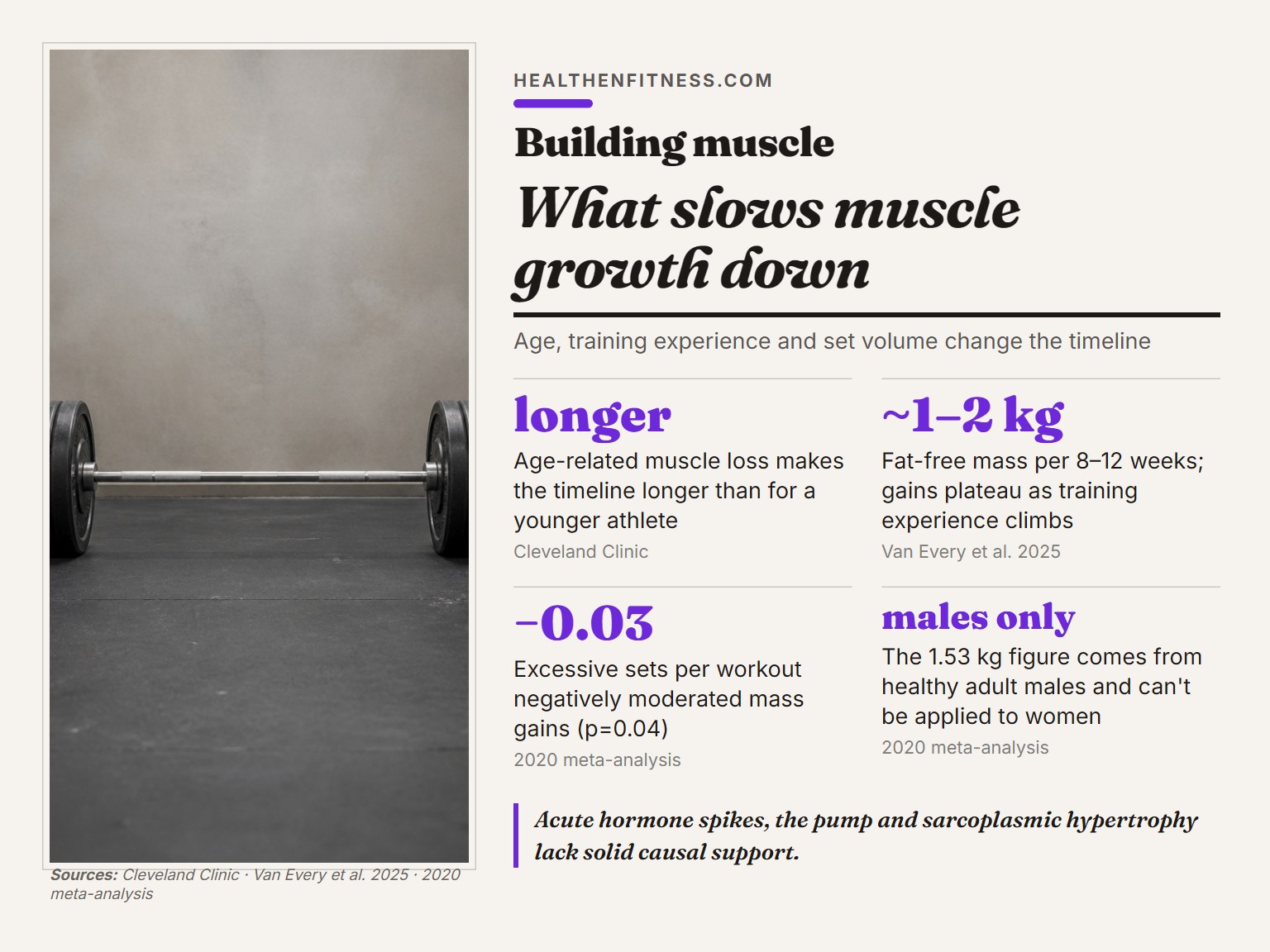
- Age. Cleveland Clinic notes that age-related muscle loss makes the timeline longer than it is for a younger athlete. The 8 to 12 week figures come largely from younger cohorts.
- Training status. Van Every’s review is explicit that gains plateau as experience climbs. The 1 to 2 kg figure is a novice-to-intermediate estimate, not a lifetime rate.
- Too many sets in one session. The 2020 meta-analysis found that excessive sets per workout negatively moderated mass gains, with a moderator of minus 0.03 and a p-value of 0.04.
- Sex-specific extrapolation. That same meta-analysis covered healthy adult males only, so applying 1.53 kg to women isn’t supported by it.
The part nobody mentions: A 2025 review found that acute post-workout hormone spikes, the pump, and sarcoplasmic hypertrophy as a separate growth mode all lack solid causal support. The hypertrophy myths and misconceptions paper is blunt about it. Chase load and reps instead.
Frequently Asked Questions
Does muscle growth really start in week one?
Measurable cross-sectional area can rise in week one, but the 2011 study that reported it flagged the change as partly edema. The authors re-anchored the first true hypertrophy signal at week three. Treat week one as a nervous system event, not a tissue event.
Is six weeks enough to see results?
Healthline puts noticeable gains at 6 to 10 weeks, which is the shortest estimate among the major sources. Harvard Health says 8 to 12 weeks and Cleveland Clinic says two to three months for slight visible definition. Six weeks is enough to feel stronger and see a difference in reps, not always enough to see it in a mirror.
How long does it take to build muscle after 40?
Longer than the standard figures suggest. Cleveland Clinic notes that age-related muscle loss makes building muscle take longer than it does for a younger athlete, though it’s still possible with consistent training and adequate protein. The 8 to 12 week numbers come mostly from younger cohorts.
Do men and women build muscle at the same rate?
2016 study Healthline cites found untrained college-aged men and women achieved similar elbow flexor strength gains over 10 weeks, with no need for separate programs. The 2020 meta-analysis figure of 1.53 kg, though, comes from healthy adult males only and shouldn’t be applied to women.
Can you build muscle in 20 minutes a day?
Healthline puts the effective dose at 20 to 30 minutes of weight training, two to three times a week. That’s enough to see results. What it doesn’t allow is long rest periods, so keep sets tight and skip the phone.
The Bottom Line
If you’re several weeks in with no change in the weights you’re handling, the problem is almost always the plan, not your genetics. Check three things in order: are you adding weight or reps most weeks, are you eating enough protein, and are you sleeping.
Everything above assumes a healthy adult with no injury history. If you’re coming back from surgery or managing a condition, the timeline stretches and the first stop is a clinician, not a program.
I’d rather see a beginner add weight to their squat over a few months and keep it than chase a transformation photo in six weeks. Steady beats flashy.
Today, just write down the weight and reps from your last session, and add one rep next time.
