
How to Build a Balanced Meal for Training Days
This post contains affiliate links. As an Amazon Associate, we earn from qualifying purchases.
To build a balanced meal for training days, set protein first (about 0.4 g/kg or 20-40 g), then size carbohydrate to the session (USADA’s ladder runs 3-4 g/kg at 3-4 hours out), and keep fiber away from the pre-activity window. The plate shifts with the session.
That fiber clause carries more weight than it looks. USADA sets the daily target at 25-30 g, then tells you to place it away from pre-activity meals, because a fiber-heavy lunch sitting in the gut at 2 p.m. Turns into a GI problem at 4 p.m. Knowing how to build a balanced meal for training days means timing that fiber around your sessions.
What follows: the protein ranges four separate bodies publish, the pre-event carb ladder by hours out, and the edge cases that break the template.
Key Takeaways
- Set protein before anything else. USADA puts muscle-building intake at 1.6-2 g/kg/day, spread as 0.4 g/kg or 20-40 g every 3-4 hours.
- Carbohydrate is the lever that moves with the session. 3-4 g/kg at 3-4 hours out, 2-3 g/kg at 2-3 hours, 30-60 g at 30-60 minutes.
- The 50/25/25 plate is a floor, not a finish line. Heidl et al. Found it met 52.6% of energy needs for a 71 kg, 15-year-old male athlete.
- Keep fiber at 25-30 g/day, but move it away from training. Pre-event fiber is a documented GI risk.
- Treat supplements with suspicion. USADA flags contamination risk from limited regulation, not from bad intentions.
What a Training-Day Plate Actually Has to Do
A training-day plate has three jobs: fuel the session, deliver enough protein to build and repair, and sit light enough in the gut that you can train, which is the how to build a balanced meal for training days question. Most plates handle the first two and fumble the third.
Pre-event carbohydrate intake follows a graded ladder rather than a single figure. Three to four hours before activity, the target sits at 3-4 g/kg body weight; two to three hours out, 2-3 g/kg; and 30-60 minutes out, 30-60 g. Protein, fat, and fiber taper as the session approaches, and sodium rises in heat.
That ladder is the part generic meal advice skips. It treats carbohydrate as a time-dependent dose rather than a plate division.
Here’s what the plate has to deliver, in order:
- Protein at a real dose. Around 20-40 g, or 0.4 g/kg, per feeding.
- Carbohydrate sized to the clock, not to a fist estimate.
- Fiber held back from the two or three hours before you train, even though the daily target is 25-30 g.
- Fat. A thumb of it, not a fist.
Get those four in the right order and the meal works whether you lift at 6 a.m. Or 6 p.m.
How Much Protein Do You Actually Need on a Training Day?
Four credible bodies publish four different ranges, and the spread is wide enough to matter when you compare a how to build a balanced meal for training days. Here they are side by side.
The lower bound is the interesting number. The sedentary dietary reference intake sits at 0.8 g/kg/day, roughly 56 g/day for an average man, and every athlete-facing body puts its floor well above that.
| Source | Daily protein target | How it’s split |
|---|---|---|
| USADA | 1.6-2 g/kg | 0.4 g/kg or 20-40 g every 3-4 hours |
| NASM | 1.6-2.2 g/kg | 3-5 feedings of 25-40 g |
| ACSM, ISSN and IOC | 1.2-2.0 g/kg | Daily total only, no split given |
| IOC (fat loss plus lean mass) | 1.8-2.7 g/kg | Daily total only, no split given |
Those two split framings describe the same day with different arithmetic. USADA’s 0.4 g/kg works out near the low end of NASM’s 25-40 g window for a lighter lifter and above it for a heavier one. Neither is wrong. Pick the one you can count.
The IOC’s 1.8-2.7 g/kg figure is the outlier, and it’s narrow in scope: it applies when someone is losing fat while gaining lean mass in a slight caloric deficit with proper training. If you’re eating at maintenance, that range overshoots.
If you want to see how these numbers land against fat and carbohydrate, the macro splits breakdown does the arithmetic. The peer-reviewed training-day fueling research is where the ACSM, ISSN and IOC consensus numbers come from.
Common mistake: Chasing the daily protein total in one big dinner. NASM’s guidance is to split protein across three to five feedings of 25-40 g per day rather than concentrating it in one meal.
The Pre-Event Carb Ladder, by Hours Out
Three to four grams of carbohydrate per kilogram of body weight, three to four hours out. That’s the top rung of USADA’s pre-event ladder, and it’s the number most people never see because most meal advice stops at “eat carbs.”
| Time before session | Carb target | Fiber and fat |
|---|---|---|
| 3-4 hours out | 3-4 g/kg body weight | Moderate; a full mixed meal fits |
| 2-3 hours out | 2-3 g/kg body weight | Taper both |
| 30-60 minutes out | 30-60 g carbohydrate | Keep minimal |
Two things about that table. First, the top rung is a large amount of carbohydrate, and it’s meant to be a meal, not a snack.
Second, the ladder is USADA’s, and it answers a different question than most recovery guidance does. The ISSN nutrient-timing position stand focuses on in-event and post-event fueling rather than a pre-event ladder, so the two don’t contradict each other. They just cover different hours of the day.
Carb loading is a separate protocol with its own disagreement. The Fueling for Performance review puts it at 8-10 g/kg/day for 1-3 days before competition. Heidl et al.’s estimated requirements table for a 15-year-old male athlete uses 6-10 g/kg/day. The ISSN position stand goes higher at 8-12 g/kg/day to maximize glycogen. Same variable, three different ceilings.
If you’re actually planning a load, carb loading before a workout walks the timeline. For the everyday version, carbs for training covers why the dose scales with session length.
Why the Standard Balanced Plate Under-Delivers
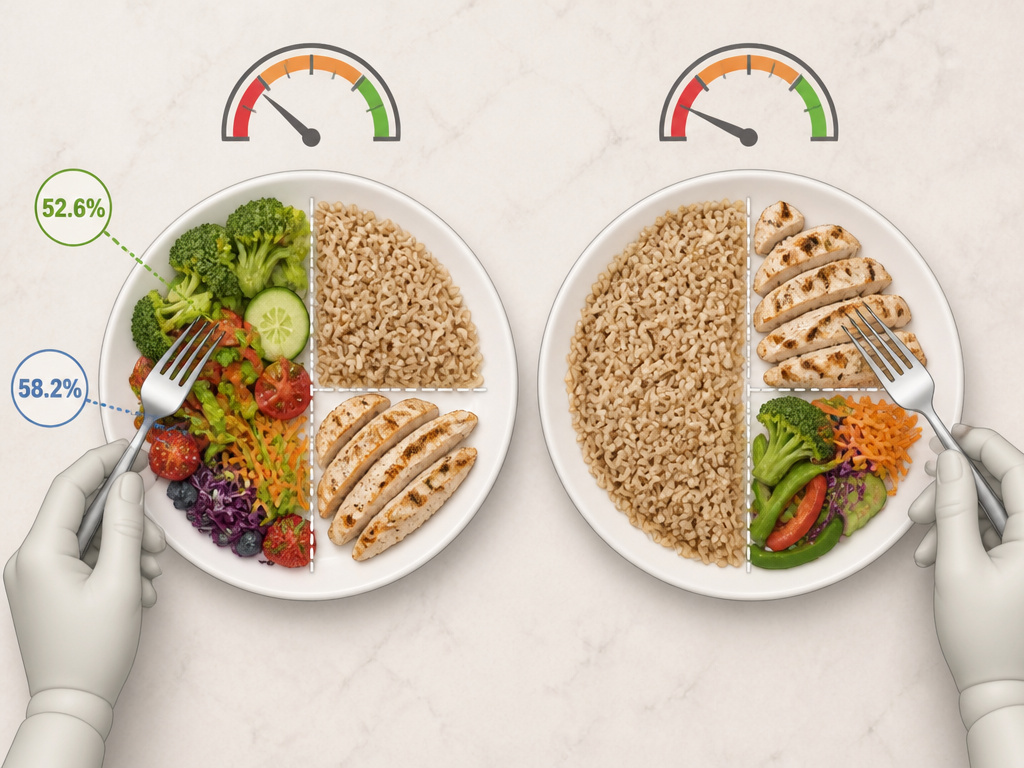
Health Canada’s 2019 balanced plate is good public health advice and a poor fit for a training day. That’s not an opinion. Somebody measured it.
The plate is 50% fruits and vegetables, 25% whole grain foods, and 25% protein foods. Heidl et al. Built five menu scenarios from it and tested them against a 15-year-old male athlete weighing 71 kg, whose lowest estimated energy requirement was 2,840-3,190 kcal/day, or 40-45 kcal/kg/day.
The balanced plate met 52.6% of that requirement. Adding an energy-dense beverage at every meal lifted it to 86.7% in one scenario and 85.0% in another. Still short.
Carbohydrate was worse. The plate met 58.2% of minimum carbohydrate needs. A “flipped” plate with half the volume as whole grains reached 72.8%. And the snacks built from the guide failed to hit either 20 g of protein or 50 g of carbohydrate.
The authors’ conclusion is blunt: the 2019 plate needs adjustment to meet the needs of people with active lifestyles. The Canada’s Food Guide athlete study is worth reading in full if you want the menu scenarios.
The plate division is the least useful number in sports nutrition. It tells you proportions and says nothing about total, and total is where hard-training people actually fall short.
So use the plate for the shape of a meal and ignore it for the size of one.
Hand Portions or Grams: Which Should You Use?
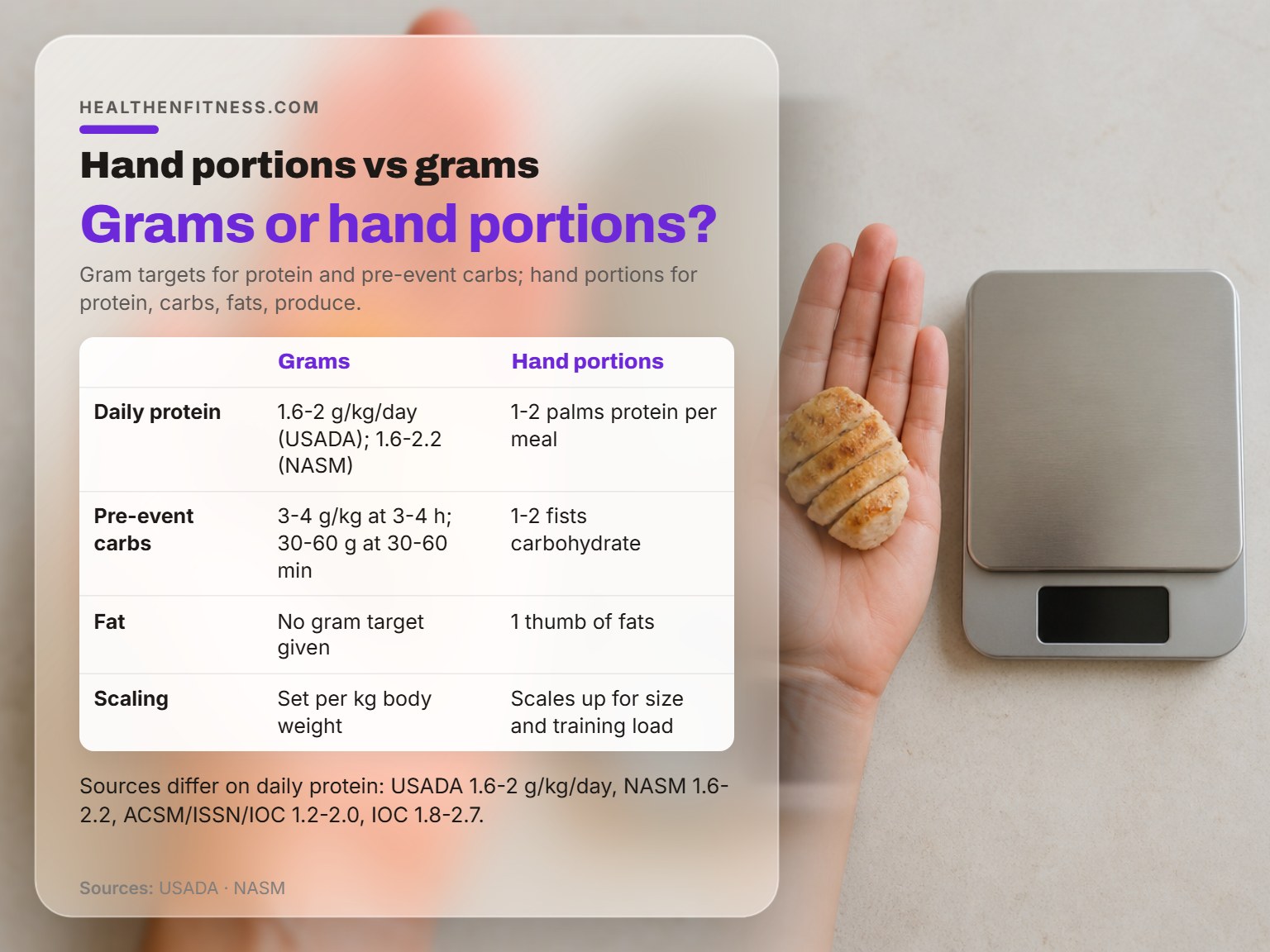
Grams win for the two numbers that matter most, and palms win for everything else. That’s the whole answer, but the reasoning is worth a minute.
NASM coaches a hand-portion template: one to two palms of protein, one or two fists of carbohydrate, a thumb of fats, and produce for volume. Portions scale up for bigger clients and harder training phases. It’s fast, it needs no scale, and it survives a restaurant.
USADA and the position statements work in grams per kilogram. USADA and the position statements work in grams per kilogram, while NASM’s hand-portion template scales up for bigger clients and harder training phases.
When grams win
Use grams for your daily protein total and for anything on the pre-event ladder. Those are the two places where precision matters most.
When palms win
Use palms for fat, for vegetables, and for the second and third meals of the day once the protein number is already banked. Precision there buys you nothing you can measure.
If you want the food side handled, the muscle-building foods list maps protein and carb sources onto these portions. The NASM meals for muscle guide is the source for the hand template, and it’s explicit that individualized plans belong with a registered dietitian.
Fiber, Sodium, and the Edge Cases That Break the Template
It’s hot, you sweat through your shirt on the warm-up, and the template says nothing about salt. That’s the first place a clean plan falls apart.
Hot days and salty sweaters
Recovery windows under four hours
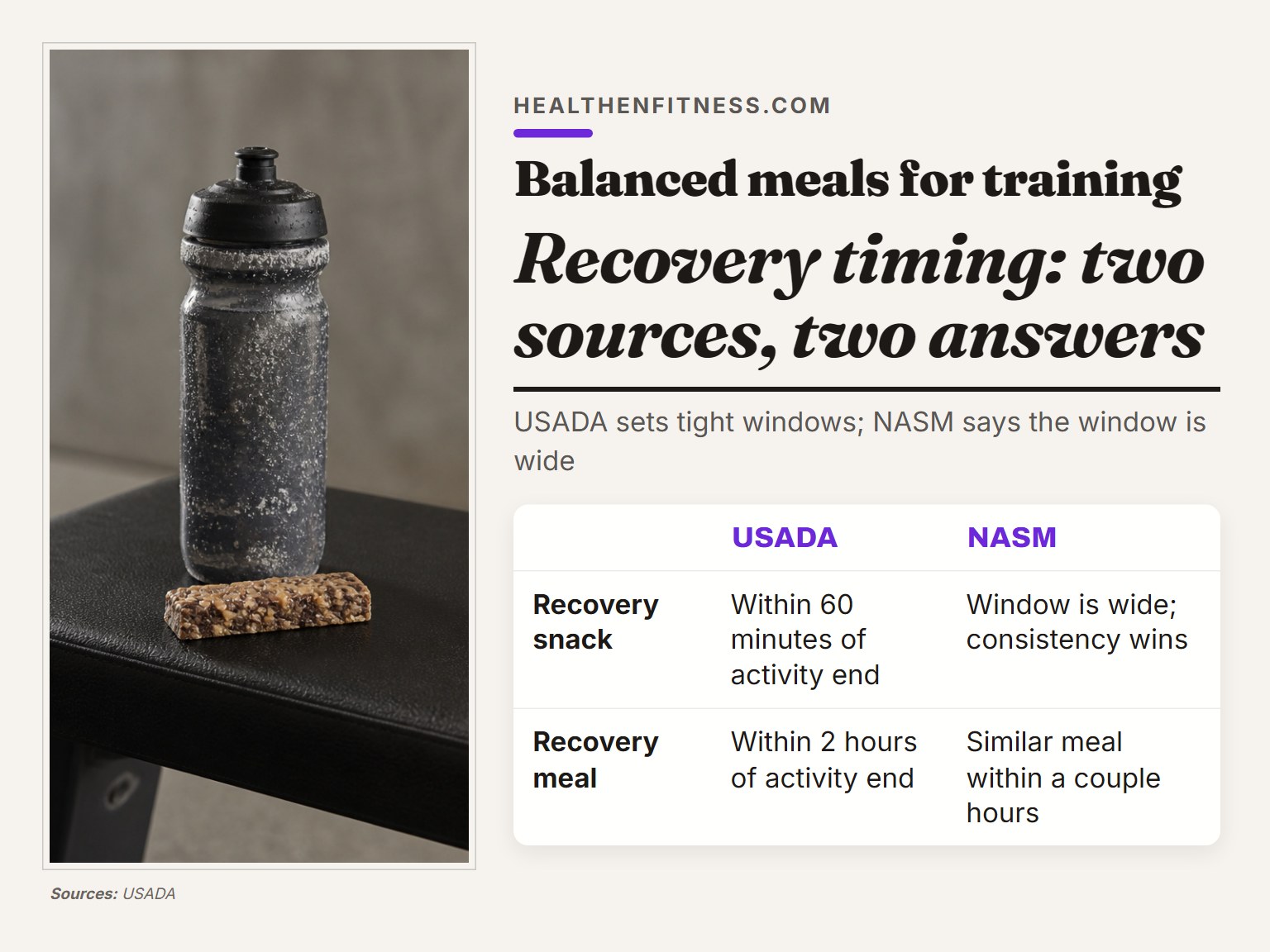
Two sources handle post-session timing differently, and both are right within their scope. USADA puts a recovery snack within 60 minutes of the end of activity and a recovery meal within 2 hours. NASM says the post-workout window is wide and consistency beats perfect timing.
If you train again in under four hours, USADA’s recovery guidance still applies: a recovery snack within 60 minutes and a recovery meal within 2 hours of the end of activity.
Other cases where the template needs adjusting:
- Young and developing athletes. The 71 kg, 15-year-old index case in Heidl et al. Is exactly the model where the standard plate fails outright.
- Vegetarian and vegan lifters. PMC5753973 flags possible needs for vitamin B12, iron, calcium, vitamin D, riboflavin and zinc depending on food choices. The vegan meal planning approach covers the gaps in practice.
- Anyone with a medical condition. NASM draws the line clearly: that’s registered dietitian territory.
Where this goes sideways: Stacking a high-fiber lunch two hours before a hard session. USADA’s 25-30 g daily fiber target is deliberately placed away from pre-activity meals, and moving it costs you a session you’ll spend watching the clock instead of the set.
Institutional manuals like the NSU student athlete nutrition manual exist because general guidance leaves exactly this gap for people training at volume.
Building the Actual Day: A 5-Step Template
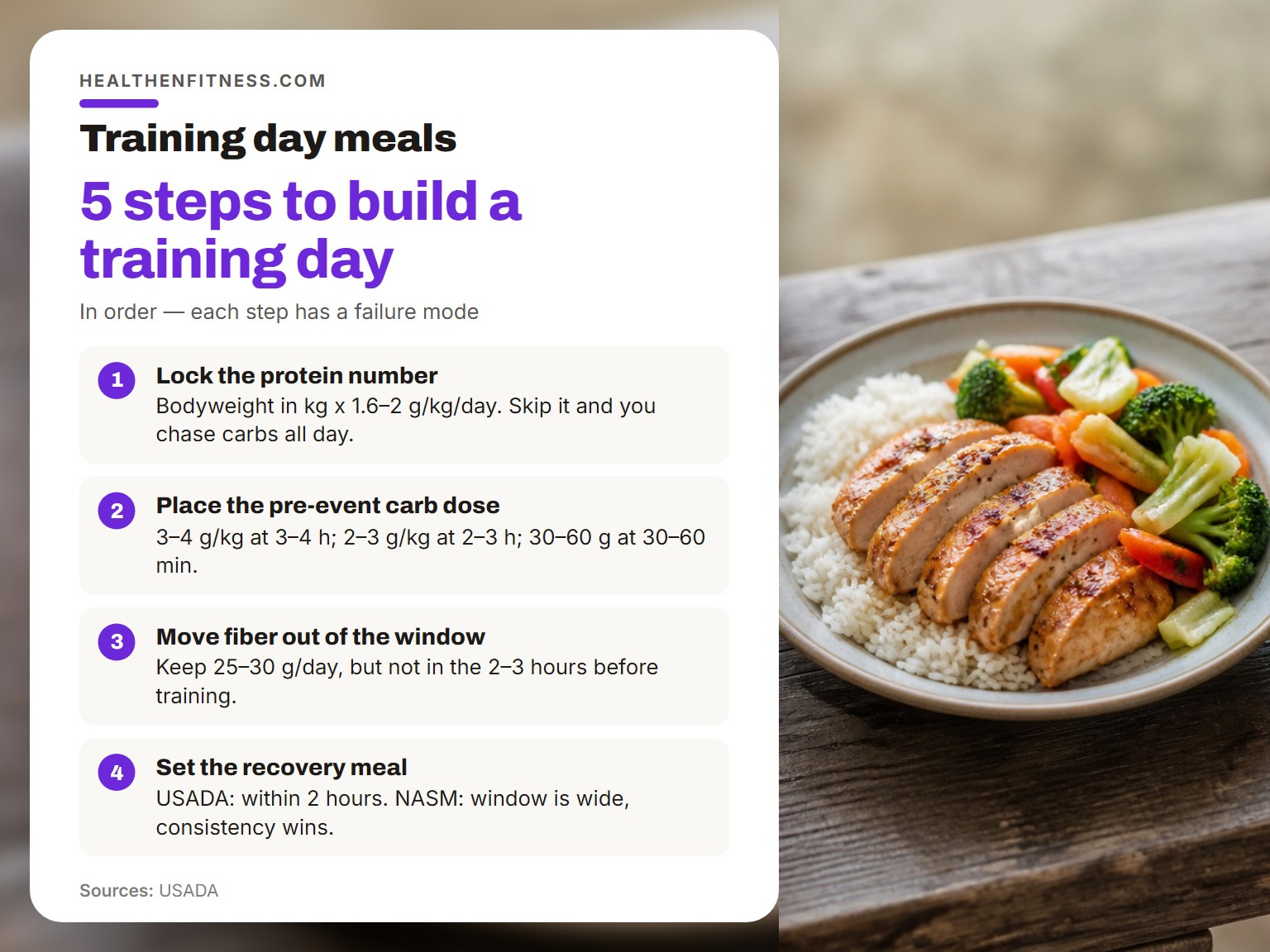
Five steps, in order. Each one has a failure mode attached, because the order is what makes the day work.
Before you start: The dietary supplement industry is lightly regulated, and USADA warns that products can carry prohibited or unknown substances with or without the manufacturer’s knowledge. Check anything you take against a third-party testing program first. If you have a medical condition, hand the plan to a registered dietitian rather than a coach.
- Lock the protein number. Multiply your bodyweight in kilograms by 1.6 to 2 and write the total down. Skip this and you’ll spend the day optimizing carbs while missing your protein target.
- Place the pre-event carb dose on the clock. Pick your rung from the ladder and work backward from the session.
- Move fiber out of the pre-activity window. Keep the 25-30 g daily target, just not in the two or three hours before training. Get this wrong and the session gets uncomfortable fast.
- Set the recovery meal inside two hours. USADA’s window, and NASM’s wider one, both land here.
- Repeat it for a week before you change anything.
For the timing side in more detail, meal timing for workouts and the post-workout meals list handle the hours around the session.
So: protein number, carb ladder, fiber timing, recovery meal, repeat. That’s the whole system.
Frequently Asked Questions
How many grams of protein should a training-day meal have?
USADA’s working figure is about 0.4 g/kg of body weight, or roughly 20-40 g, every 3-4 hours. NASM frames the same day as three to five feedings of 25-40 g. Both land in the same place for most lifters.
Do I need to eat within 30 minutes of finishing a workout?
USADA puts a recovery snack within 60 minutes of the end of activity and a recovery meal within 2 hours. NASM describes the post-workout window as wide, with consistency mattering more than perfect timing. The 30-minute rule is tighter than either source states.
Is the 50/25/25 balanced plate enough on a training day?
For a 71 kg, 15-year-old male athlete, Heidl et al. Found the 2019 Canada’s Food Guide plate met 52.6% of the lowest estimated energy requirement and 58.2% of minimum carbohydrate needs. It’s a reasonable meal shape and an insufficient meal size for hard training.
Should I count macros in grams or use hand portions?
Use grams for your daily protein total and for pre-event carbohydrate, since those are the targets with published g/kg figures behind them. Use hand portions for fats, vegetables and later meals, where NASM’s palm, fist and thumb template is fast and accurate enough.
When should I keep fiber away from a workout?
USADA sets a 25-30 g/day fiber target and places it away from pre-activity meals. Practically, that means keeping the fiber-heavy foods out of the two or three hours before training and loading them into later meals instead.
The Bottom Line
Here’s the threshold that decides most of this. If your session is under an hour and you’re training at an easy pace, the full pre-event ladder may be more carbohydrate than you need. Drop to the 30-60 minute rung and stop worrying about the rest.
Today, just write your bodyweight in kilograms at the top of a page, multiply it by 1.6 to 2, and put that number on the fridge.
