
How to Do Zone 2 Cardio: Step-by-Step
This post contains affiliate links. As an Amazon Associate, we earn from qualifying purchases.
How to do Zone 2 cardio: hold a pace where your heart rate sits at 60% to 70% of your maximum and you can speak 3 to 5 words before needing a breath. Brisk walking, easy cycling, and slow laps all work. You should not be able to sing.
That talk-test number is the part most people skip past. It sounds simple, and it is, but the whole method falls apart when your easy session drifts into a medium-hard grind. Two major clinic guides and a panel of 14 sport scientists disagree on how to find Zone 2. They agree on what it should feel like.
What follows covers the two definitions, the practical ways to set your range, which activities work, how long to go, and the honest limits of the method.
Key Takeaways
- Hold 60% to 70% of max heart rate if you use the clinic formula, or aim just below your first lactate threshold if you have lab access.
- The talk test is your best cheap check: 3 to 5 words per breath, no singing.
- A brisk walk at 1 mile per 15 to 20 minutes counts as Zone 2 for most people.
- Aim for at least 150 minutes a week of moderate cardio per the American Heart Association.
- Zone 2 is not proven to be the optimal intensity for mitochondria or fat oxidation, per a 2025 narrative review.
How to Do Zone 2 Cardio: The Basics
Zone 2 cardio is the second step on a five-zone heart rate scale, and it sits in the moderate range where you’re working but not grinding. The Mayo Clinic Press Zone 2 cardio explainer and the Cleveland Clinic Zone 2 cardio guide both define it as 60% to 70% of your maximum heart rate. That’s a useful sanity check if the percentages start to blur.
Zone 2 cardio is moderate-intensity aerobic exercise performed at roughly 60 to 70 percent of maximum heart rate, or just below the first lactate threshold. The intensity is high enough to raise breathing and heart rate but low enough to sustain for 30 minutes or more.
At the top of the scale, Zone 5 is a full sprint. At the bottom, Zone 1 is easy enough to sing through. Zone 2 is the band in between, where you can talk but not belt out a chorus. The Mayo Clinic Press puts the talk-test marker at 3 to 5 words per breath. If you can say “shake it off,” you’re in range. If you can sing it, you’ve dropped to Zone 1.
Here’s where the definitions start to pull apart. A panel of 14 sport scientists and coaches, published through the University of Zaragoza, argues that Zone 2 should be set just below your first lactate threshold or first ventilatory threshold, not at a fixed percentage of max heart rate. That’s a lab-tested number, not a calculator output. The gap is real.
Why Experts Disagree on the Numbers
The clinic guides and the research panel are describing the same effort from different angles, and the gap between them matters more than it sounds. Mayo Clinic Press and the Cleveland Clinic both anchor Zone 2 at 60% to 70% of max heart rate. The Zaragoza panel says that range is a population average that misses the individual. A 2025 study of 50 cyclists, published in Translational Sports Medicine, found coefficients of variation between 6% and 29% across Zone 2 markers. The individual variability in Zone 2 thresholds is the key finding: two people with the same calculated zone can be at very different metabolic points.
| Source | Zone 2 Definition | How to Find It |
|---|---|---|
| Mayo Clinic Press | 60% to 70% of max HR | Calculator app |
| Cleveland Clinic | 60% to 70% of max HR | 220 minus age |
| Zaragoza expert panel | Just below LT1 or VT1 | Lab test or field test |
| Seiler zone table (via panel) | ~67% to 82% of max HR | Lactate or breathing rate |
The Meixner study goes further. Its authors write that the variability “leads us to discourage from their general application in place of physiologically based diagnostic procedures.” That’s a polite way of saying the calculator gets you close, not exact. The Zaragoza panel reaches the same conclusion from a coaching angle: anchor Zone 2 to the threshold, then use heart rate and perceived effort to hold that internal load.
None of this means the 60% to 70% range is wrong. It means the range is a starting point. If you have a chest strap and a bit of patience, you can refine it. If you don’t, the talk test will get you most of the way there. The Cleveland Clinic puts it plainly: if heart rate calculations feel like a stumbling block, focus on how your body feels.
How to Find Your Zone 2 Without a Lab
I thought I was building a base. I was building a rut.
The fix was less dramatic than I expected. That’s the adaptation the panel describes: capillarization and mitochondrial enzymes building quietly while you feel like you’re barely working.
Start smaller than you think you need to. A shorter walk at the right pace beats a longer run at the wrong one.
The 220-Minus-Age Method
The Cleveland Clinic’s method is the simplest: subtract your age from 220 to estimate max heart rate, then take 60% and 70% of that number. For a 40-year-old, that’s 180 bpm max and a Zone 2 range of 108 to 126 bpm. The formula is a population average, so it fails at the extremes. Someone who has trained for decades may have a higher true max than the formula predicts. Someone who has never trained may have a lower one. Use it as a starting number, not a diagnosis.
The Talk Test
The talk test is the fallback when you don’t have a monitor, and it’s surprisingly good. Mayo Clinic Press sets the marker at 3 to 5 words per breath. If you can say 3 to 5 words before needing a breath, you’re in range. The test works because your breathing rate tracks your ventilatory threshold. When you cross VT1, your breathing rate rises and your speech gets choppy. That’s why the word count is a useful proxy even without a lab.
It is a proxy, though. Nobody in these sources has validated it directly against LT1, so treat it as a guess rather than a measurement.
Before you start: If you have a heart condition, high blood pressure, or haven’t exercised in years, get a doctor’s clearance before starting Zone 2 work. Stop immediately if you feel chest pain, dizziness, or unusual shortness of breath. Pushing through those symptoms is how people end up in an ER instead of a gym.
- Estimate your max heart rate with 220 minus your age, or use a lab test if you have access.
- Multiply by 0.6 and 0.7 to get your starting Zone 2 range.
- Test the range with the talk test on your first session. You want 3 to 5 words per breath.
- Adjust down if you can’t hold that word count. Most people start too high.
- Adjust up if you can sing through the whole session. That means you’re in Zone 1.
A heart rate monitor or chest strap will show you the number in real time. The chest strap is more accurate during intervals and rowing, where wrist-based optical sensors tend to lag.
Which Cardio Counts as Zone 2?
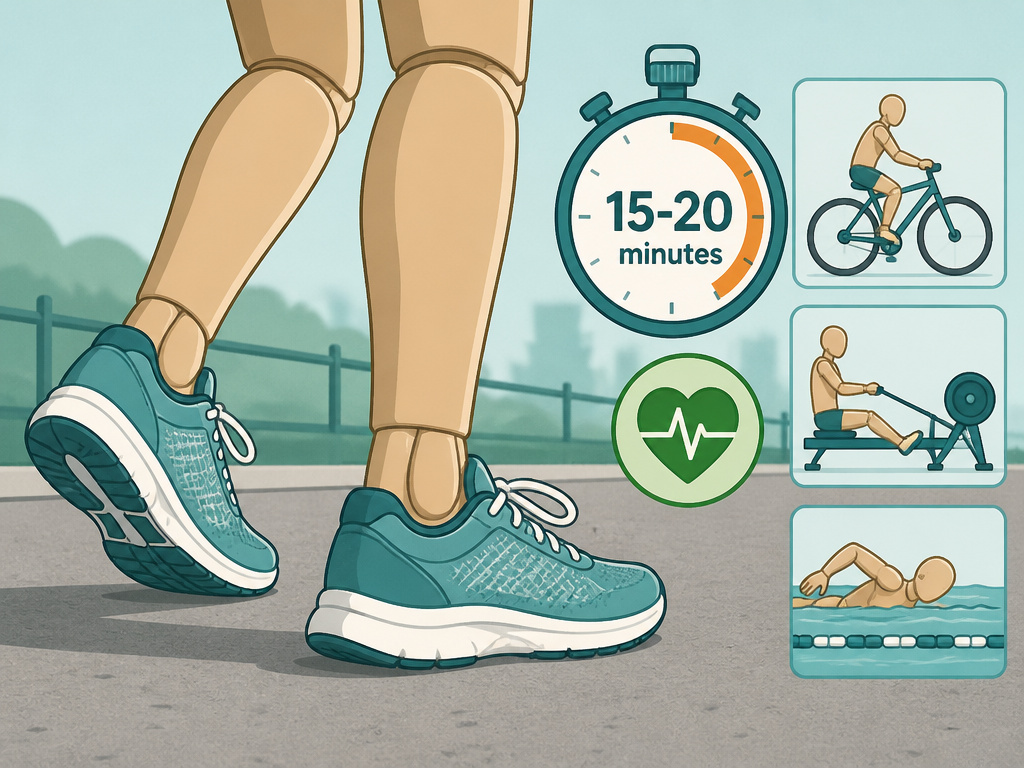
Any cardio activity can land in Zone 2 if you adjust the intensity, according to the Cleveland Clinic. The modality matters less than the effort. That said, some activities make it easier to hold the range without drifting.
Brisk Walking
Brisk walking is the most underrated Zone 2 tool, and I’ll defend that position. The Cleveland Clinic’s benchmark is 1 mile in 15 to 20 minutes on flat terrain. That’s a purposeful walk, not a stroll. It fits into a lunch break, it doesn’t require a gym, and it’s easy to repeat. If you want a single default pick for most people, this is it.
Cycling and Rowing
Relaxed cycling and slow laps in the pool are the other two easy entries. The Cleveland Clinic lists both, along with the elliptical and rowing machine. For rowing, a rowing machine works; the pace you want is conversational, not a 2K test. The pace you want is conversational, not a 2K test. If you’re gasping between strokes, you’ve left Zone 2.
- Brisk walking at 1 mile per 15 to 20 minutes on flat ground
- Slow running at 2 to 3 minutes per mile slower than race pace
- Relaxed cycling at a conversational pace
- Slow swimming laps
- Elliptical or rowing machine at low resistance
If you’re weighing this against harder interval work, the steady-state cardio comparison is worth reading before you commit. Zone 2 sits at the easy end of that spectrum.
Common mistake: Picking a cardio machine and holding the same medium-hard pace for 30 minutes. That’s Zone 3, not Zone 2, and it leaves you too tired to recover and too easy to build a real base.
The Duration Question: 30 Minutes or 2 Hours?
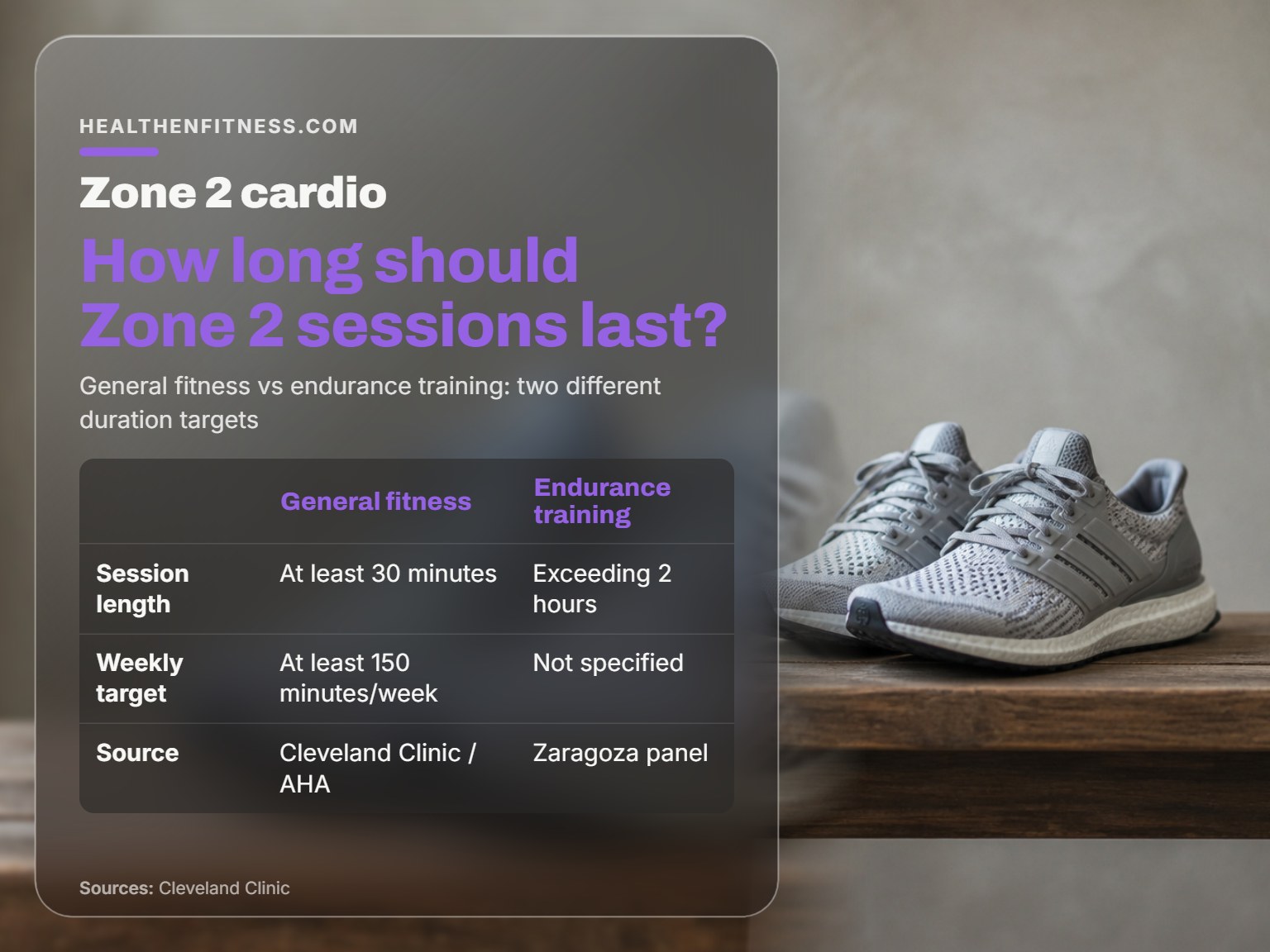
The Cleveland Clinic says most Zone 2 activities last at least 30 minutes, while the Zaragoza panel suggests continuous sessions exceeding 2 hours may be preferred for inducing adaptations. The Zaragoza panel goes further: continuous sessions performed just below LT1 or VT1 for durations exceeding 2 hours may be the preferred method for inducing a wide range of adaptations. Those two claims aren’t contradictory, but they’re aimed at different people.
For general fitness, 30 to 60 minutes is plenty. The American Heart Association recommends at least 150 minutes per week of moderate-intensity aerobic activity, which Zone 2 falls under. Thirty minutes works.
If you’re training for an endurance event, the panel’s longer prescription starts to make sense. If you’re training for life, the shorter one does.
Building Zone 2 volume works like seasoning a soup. A pinch at a time, taste, adjust. Dumping in the whole shaker on day one ruins the pot, and you can’t take it back out.
The panel also recommends a 5-to-1 ratio when you’re accumulating higher Zone 2 volume: long Zone 2 workouts interspersed with short periods in Zone 1. For interval sessions, the panel prefers a 1-to-1 work-to-rest ratio, with Zone 2 as active recovery between harder efforts. If you want a deeper look at cardio session length across different goals, that’s covered separately.
What Zone 2 Does for Your Body (and What It Doesn’t)
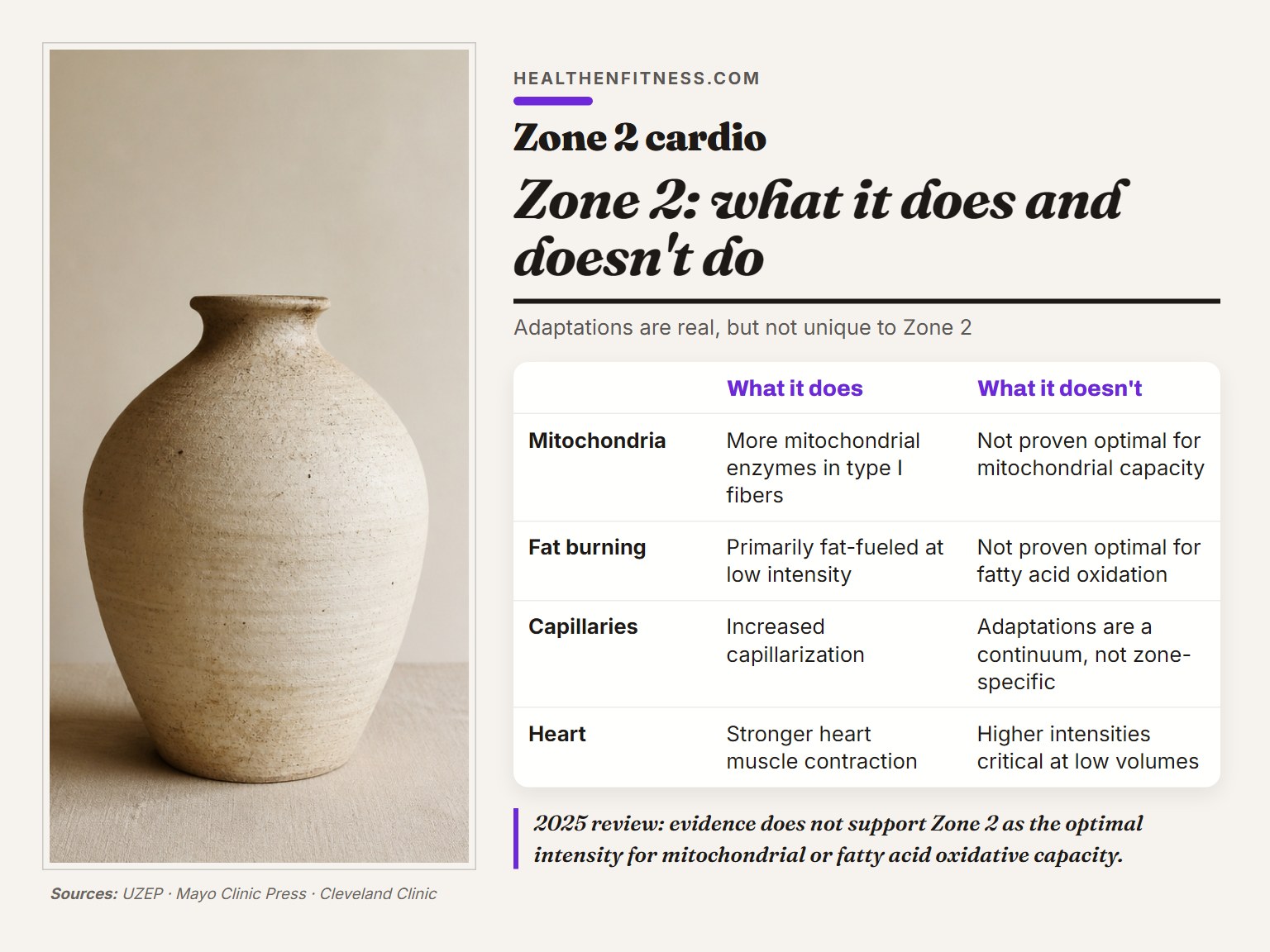
The case for Zone 2 rests on a set of adaptations that happen at low intensity: increased capillarization, more mitochondrial enzymes in type I muscle fibers, improved metabolic efficiency, and modest gains in critical power and VO2max. The Cleveland Clinic adds stronger heart muscle contraction, more capillaries, and increased red blood cell production. Those are real, and they’re the reason elite endurance athletes spend so much time at this intensity.
The case against Zone 2 being uniquely optimal is newer and less comfortable. A 2025 narrative review of Zone 2 efficacy by Storoschuk and colleagues concluded that current evidence does not support Zone 2 as the optimal intensity for improving mitochondrial or fatty acid oxidative capacity. The authors argue that higher intensities are critical, particularly at lower training volumes. The Zaragoza panel reaches a related point from a different angle: adaptations are better explained as a continuum, and they don’t expect large differences between the upper end of Zone 1 and the lower end of Zone 3 compared with Zone 2.
That doesn’t mean Zone 2 is useless. It means the marketing around it has outrun the evidence. Zone 2 is a useful, sustainable intensity that most people can recover from and repeat. It is not a magic switch that flips on fat burning and mitochondrial growth while everything else stays off. If you enjoy it and you can do it consistently, you’ll get most of the benefits. If you hate it and you skip it, you’ll get none of them.
If you want to build endurance workouts alongside Zone 2, the aerobic base work overlaps significantly. The NASM heart rate training zones guide covers the five-zone model from a coaching perspective, and it’s a useful cross-check on the clinic numbers.
If you’re training for an endurance event, get a coach who can individualize the plan. The advice in this piece is aimed at people who want to feel better, move more, and stay consistent.
Where Zone 2 Goes Wrong
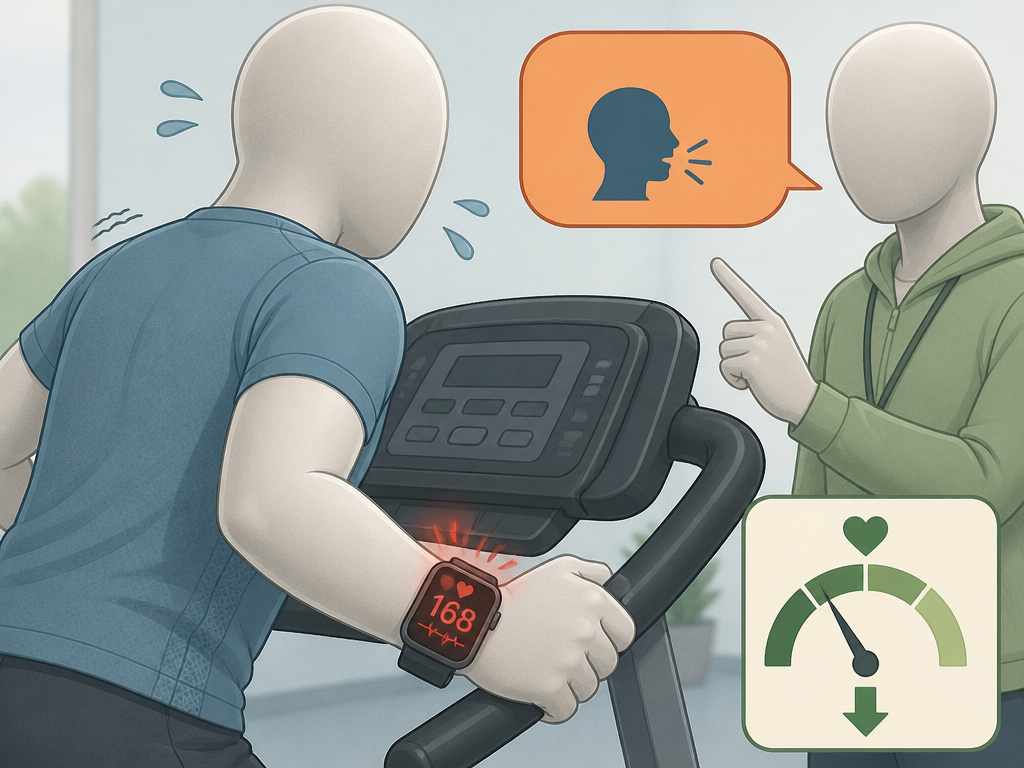
The most common mistake is going too hard. I see it in the gym: someone reads about Zone 2, hops on the treadmill, and runs at a pace that feels “easy” but is actually a solid Zone 3. They do this repeatedly, they get tired, and they quit. The fix is to slow down until the talk test passes, even if it feels embarrassingly slow.
The “fat-burning zone” label on cardio machines is not wrong, but it is not the whole story. Zone 2 does burn a higher percentage of fat than higher intensities, per Mayo Clinic Press. But total calorie burn and overall fitness gains depend on volume and consistency, not on the label. Chasing the label while ignoring the effort is how people end up doing medium-hard work that’s too tiring to be easy and too easy to be effective.
You’ll know you’ve drifted out of Zone 2 when your breath gets shallow and you start counting down the minutes instead of losing track of them. That’s the tell. Slow down, reset, and finish the session at the right effort.
- Going too hard and calling it easy
- Chasing the watch number instead of the feel
- Skipping the warm-up
- Doing every session at the same medium-hard pace
- Ignoring the talk test when the watch says you’re in range
I’ve watched more people quit Zone 2 from going too hard than from going too easy. The sessions that feel almost embarrassingly slow are the ones that stick.
If you want to track this properly, a heart rate monitor is worth the investment. The heart rate zones breakdown covers the five-zone model in more detail, and the workouts by heart rate zone guide has session templates. For the recovery side, heart rate variability is a useful signal that you’re adapting rather than accumulating fatigue.
Frequently Asked Questions
How do I know if I’m in Zone 2 without a heart rate monitor?
Use the talk test. You should be able to speak 3 to 5 words before needing a breath. If you can sing, you’re in Zone 1. If you can only get out one word, you’re working harder than Zone 2. The test is a proxy, not a measurement, but it’s a useful one.
Is Zone 2 better than HIIT for fat loss?
Not necessarily. Zone 2 burns a higher percentage of fat per minute, but HIIT burns more total calories in less time. The better question is which one you’ll actually do consistently. For most people, a mix of both works better than either alone.
How many days a week should I do Zone 2?
Reasonable starting point is to build up gradually toward at least 150 minutes per week of moderate-intensity aerobic activity. The American Heart Association recommends at least 150 minutes per week of moderate-intensity aerobic activity. Build up gradually if you’re new to cardio.
Can I do Zone 2 on a treadmill or do I need to be outside?
Either works. The modality doesn’t matter as much as the effort. A treadmill, bike, rower, or pool all count. The advantage of outdoor walking or cycling is that it’s easier to hold a conversational pace without watching a screen.
What if my heart rate drifts above Zone 2 during a session?
Slow down. The Zaragoza panel recommends prioritizing heart rate and perceived effort within Zone 2 ranges, even if that means reducing your pace or power output. Cardiac drift is normal, especially in heat. Adjust the effort, not the target.
The Bottom Line
How to do Zone 2 cardio comes down to a few things you can check without a lab: a pace where you can speak 3 to 5 words per breath, a heart rate that sits near 60% to 70% of your max, and a session long enough to matter but short enough to repeat. The clinic guides give you a workable starting range. The research panel gives you a more precise target just below your first lactate threshold. The talk test gives you a cheap way to check both.
The honest limit is this: Zone 2 is not proven to be the optimal intensity for mitochondria or fat oxidation. A 2025 review argues that higher intensities matter too, especially at low training volumes. If you enjoy Zone 2 and you can do it consistently, you’ll get most of the benefits. If you’re using it as an excuse to avoid harder work, you’re leaving gains on the table.
If you want one number to remember, make it this: 3 to 5 words per breath. It’s not perfect, but it’s free, it’s portable, and it works.
Do this today: pick one walk this week. Keep it at a pace where you can talk but not sing. That’s your first Zone 2 session.
