
How to Structure a Workout Week: Days, Sets, Splits
This post contains affiliate links. As an Amazon Associate, we earn from qualifying purchases.
To structure a workout week, train your whole body two to three times on non-consecutive days, cover every major muscle group, and pick a weight that lets you finish 8 to 12 reps before true fatigue. Those three numbers come straight from the AUSactive resistance guidelines for healthy adults.
The non-consecutive part is doing more work than it looks. Spacing sessions out gives each muscle group a recovery window before the next load lands on it. Stack three whole-body days back to back and the third one becomes a workout you survive rather than train. Knowing how to structure a workout week keeps that spacing deliberate.
What follows is the version I’d hand a beginner: how many days, which exercises, how many sets, and the places where the published guidelines openly contradict each other.
Key Takeaways
- Two to three full-body days is the recommended range for general health, spaced so no muscle group gets hit on back-to-back days.
- 8 to 12 reps to near-fatigue is the AUSactive anchor; Iversen et al. Widen the band to 6-15 reps, and up to 15-40 if you take sets to failure.
- The sources disagree on volume. AUSactive treats one set per muscle group as adequate for health; Iversen et al. Set the floor at four weekly sets.
- Splits are for specific goals, not for year one. AUSactive recommends body-part splits only for advanced trainees or people chasing maximum muscle mass.
- Failure is not the target. The final rep should land at 15-18 on the RPE scale, where 20 means failure.
Why the Split You Copied Is Probably the Wrong Starting Point
I used to ego-lift on Mondays and wonder why my chest day never produced a chest. The program wasn’t the problem. The structure was.
AUSactive’s resistance guidelines recommend training the entire body two to three times per week on non-consecutive days for general health. Training splits, which divide muscle groups across separate sessions, are reserved for more specific goals such as maximising muscle mass or for more advanced trainees. AUSactive frames frequency as the primary weekly lever, while Iversen et al. Argue weekly training volume matters more than frequency.
Read that again and notice what it does to the standard gym advice. A body-part split gives each muscle one hard session a week and six days of nothing. A full-body rotation gives the same muscle three smaller doses, and each dose lands on tissue that has recovered from the last one.
The AUSactive resistance exercise guidelines put the whole recommendation on a single page, which is refreshing after a decade of twelve-week transformation content.
Your training frequency per muscle group is the number that actually changes when you add a day. That’s the trade you’re making.
How Many Days a Week Should You Actually Train?
Two to three days a week is the recommended range, and three is the sensible default for most people starting out. AUSactive recommends the whole body be trained two to three times weekly on non-consecutive days.
The reason for non-consecutive days is straightforward. Muscle repair and adaptation take time, and a full-body session loads everything at once, so how to structure a workout week matters. Put two of those back to back and the second session is training tissue that hasn’t finished responding to the first.
The rest days between sessions are doing real work, not padding.
| Days Per Week | Who It Suits | What It Asks Of You |
|---|---|---|
| 2 | First month back, or a genuinely packed schedule | Nothing beyond showing up twice |
| 3 | Most beginners and general health goals | One recovery day between each session |
| 4 | Second year onward, or a specific strength goal | An upper/lower or push-pull structure |
| 6 | Advanced trainees chasing muscle mass | Short sessions and disciplined recovery |
Here’s where the first real disagreement shows up. Iversen and colleagues argue the opposite emphasis in their review on designing time-efficient lifting programs: weekly training volume matters more than how many days you spread it across. Same question, opposite lever.
My read is that both are describing the same thing from different ends. Frequency is how you distribute volume, and volume is what you’re distributing. If you can only train twice, you need each session to carry more sets.
One Set or Four Sets Per Muscle? The Sources Don’t Agree
This is where the guidelines stop agreeing with each other, and it’s worth seeing the numbers side by side rather than picking whichever one sounds better.
| Source | Weekly Sets Per Muscle Group | Who It Applies To |
|---|---|---|
| AUSactive guidelines | 1 set minimum; 2-3 sets of 8-12 for greater benefit | General health |
| Iversen et al. 2021 | 4 sets minimum | Time-efficient programming |
| Schoenfeld et al. 2016 | Higher weekly sets beat lower (ES 1.01 vs 0.82) | Novice and intermediate men |
The gap between one set and four sets is not a rounding error when you compare a how to structure a workout week. A reader following AUSactive’s floor would land well under Iversen’s threshold, and both documents are describing healthy adults.
The weekly set volume meta-analysis by Schoenfeld and colleagues gives the clearest picture. Low weekly sets produced a mean effect size of 0.82 (95% CI 0.47-1.17). High weekly sets produced 1.01 (95% CI 0.70-1.32). The difference between them was 0.18, with a confidence interval of 0.06 to 0.30 and a p value of 0.003.
So more sets won, but the margin was modest, and the same analysis found low weekly sets did not produce strength gains compared with moderate or high weekly sets in novice and intermediate men.
Common mistake: Chasing a split before you’ve earned the volume. Adding a fourth and fifth training day while each muscle still gets three sets a week doesn’t add stimulus, it adds travel time. Get to four or more sets per muscle group per week across two or three sessions first.
What I’d actually do: treat AUSactive’s one set as the health floor and Iversen et al.’s four weekly sets as the working target. If you’re training for change rather than maintenance, the extra sets are cheap.
Full-Body, Upper/Lower, or Body-Part Split?

Three arrangements cover almost everything, and the right one depends on how long you’ve been training rather than which one looks better on paper.
Full-Body Training
Every session hits legs, hips, back, chest, abdomen, shoulders, and arms. AUSactive lists exactly those groups as the ones a program should involve. It’s the default for general health and the easiest structure to repeat when life interferes.
The Upper/Lower Split
An upper lower split is the natural next step once three full-body days stop being enough. You train upper body twice and lower body twice across four sessions, which keeps frequency high while shortening each session.
Body-Part Splits
One day for chest, one for back, one for legs. AUSactive permits this for advanced trainees or people specifically maximising muscle mass.
The workout splits that get passed around gyms are usually built for someone training six days a week with a recovery routine to match. Copy the structure without the recovery and it underperforms a three-day plan.
Signs a split is worth considering:
- You’ve trained consistently for over a year and stalled on full-body.
- You can commit to four or more days without missing.
- Sessions are running long because you’re fitting everything into three.
- Your goal is specifically muscle mass, not general health.
Machines and free weights also change the feel of a week. Machines fix the path, so your stabilisers go quiet and the target muscle does all the talking. AUSactive notes machines need less skill and suit beginners or people with coordination problems, while free weights better replicate sporting situations and suit athletes.
What a Repeatable Three-Day Week Actually Looks Like
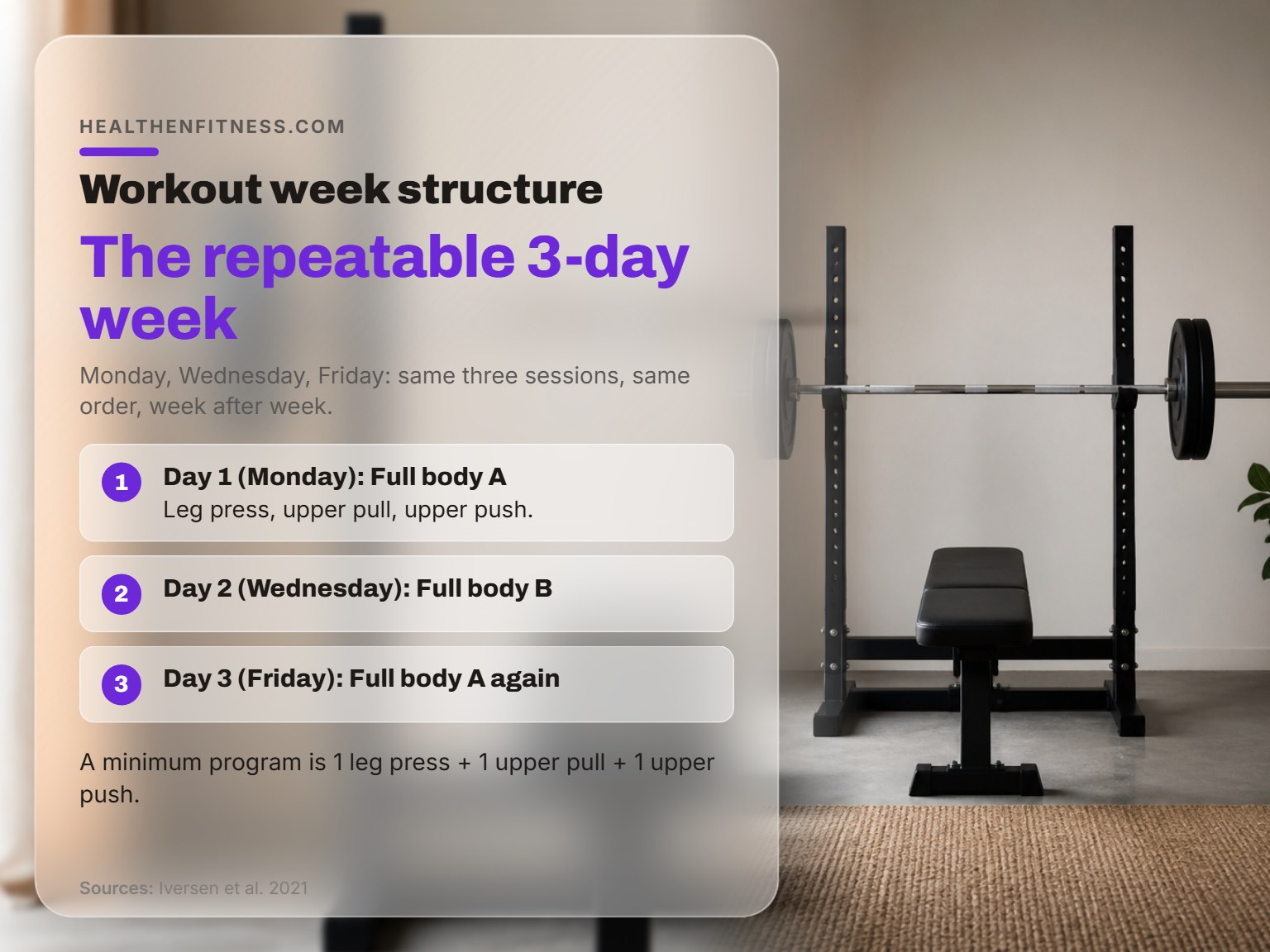
Monday, Wednesday, Friday. Same three sessions, same order, week after week. That’s the whole structure, and it’s boring on purpose.
I once worked with a student who told me flat out that they hated exercise. We agreed on 20-minute sessions, three days a week, nothing more. They kept it up for about six months. What I took from that is simple: a workout that feels doable beats an ambitious one that gets skipped.
Before you start: Load the first set lighter than your ego wants, because a bar you can’t control on rep three is how most home-gym injuries start. Breathe out through the hard part of the rep rather than holding your breath, since breath-holding spikes blood pressure fast. And if a joint gives you a sharp, localised pain rather than a muscle burn, stop the set and get it looked at.
Here’s the rotation I’d hand someone in month one:
- Day 1 (Monday): Full body A. One leg press or squat pattern, one upper pull such as a row, one upper push such as a press, then a hinge and a core movement. Iversen et al. Describe a minimum program as one leg press plus one upper pull plus one upper push, so this is already above the floor.
- Day 2 (Wednesday): Full body B. Same pattern, different exercises. Swap the row for a pulldown, the press for a floor press, the leg press for a split squat. Same muscles, new angle.
- Day 3 (Friday): Full body A again. Repeat Monday. Repeating a session is how you actually measure progress, because the exercise is identical to last week.
The 3-day vs 4-day split question comes up as soon as someone wants to add a day, and the honest answer is that three days done for a year beats four days done for six weeks.
There are weekly workout schedules built around two, three, four, and six days. The differences are mostly about how much time you have, not which one is superior.
A 20-minute session has its own rhythm. You’re not resting between sets so much as catching your breath while you set up the next one.
Reps, Sets, and Rest: The Numbers That Actually Matter
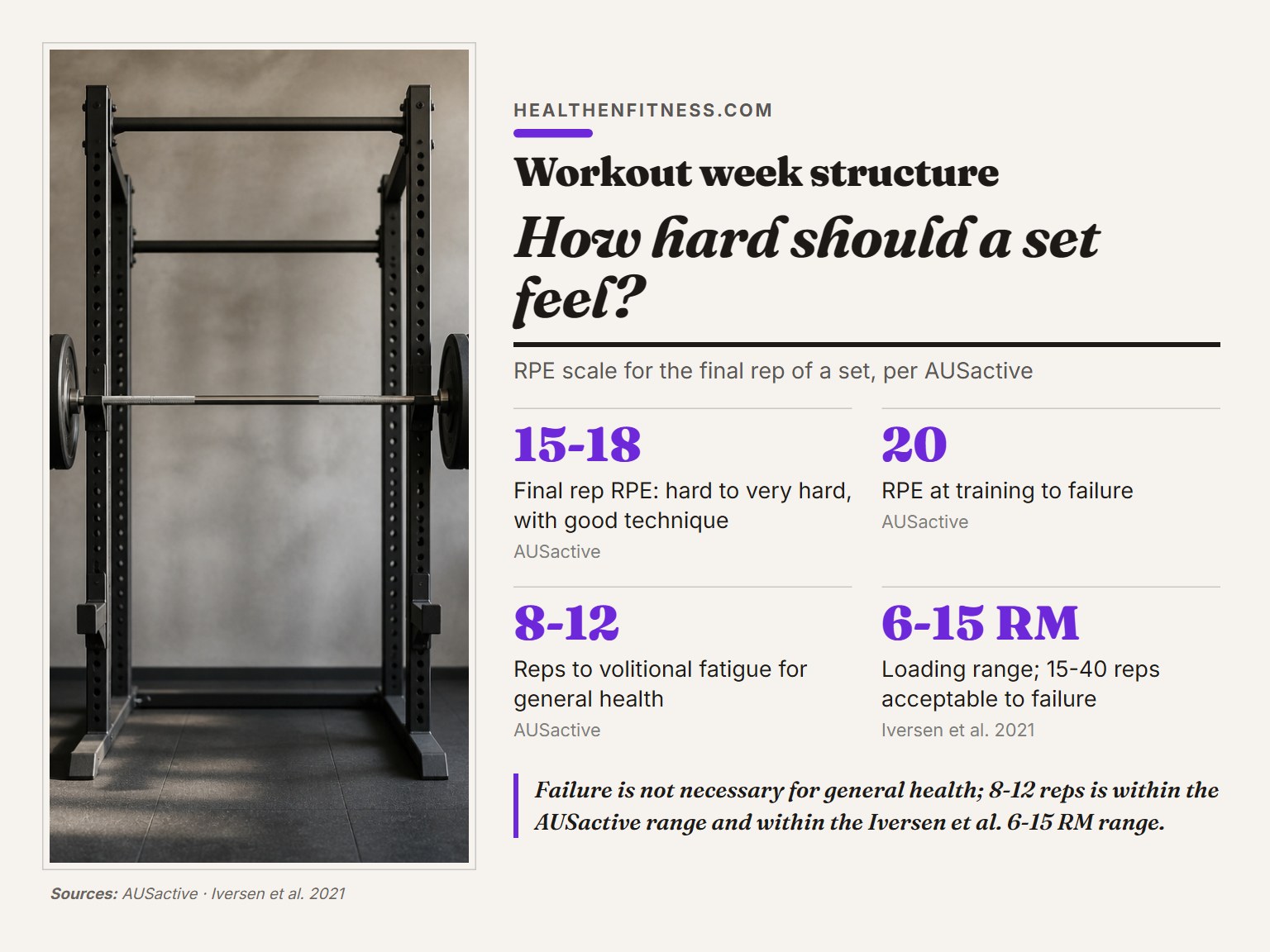
The RPE scale is the tool AUSactive uses to pin down intensity, and it’s more useful than a percentage of a one-rep max you’ve never tested. For general health, the final rep of a set should land between 15 and 18, described as hard to very hard, completed with good technique. Training to failure represents a 20.
That single sentence replaces most of the confusion around “how hard should this feel”. You’re looking for a rep that slows down and makes you work, not one you fail.
Where this goes sideways: Taking every set to failure. AUSactive states plainly that training to failure isn’t necessary for general health, and it may apply for specific goals like maximising muscle mass. Do it on every set and your recovery debt climbs while your results don’t.
The rep range is the second disagreement: AUSactive anchors general health at 8 to 12 reps to volitional fatigue, while Iversen et al. Iversen et al. Recommend a 6-15 RM loading range, with 15-40 reps acceptable if the set is taken to volitional failure. The bands overlap heavily, so 8-12 sits comfortably inside both.
Progression is the part people skip. When you can complete more than 12 reps with good form, AUSactive advises increasing the load. That’s the whole progressive overload story, and it’s the same logic as seasoning a soup a pinch at a time. Dump the whole shaker in and you can’t take it back out.
The last rep at RPE 17 has a sound to it. The plates stop clinking, because the bar has slowed to a crawl and nothing is rattling anymore.
When a Split Actually Makes Sense
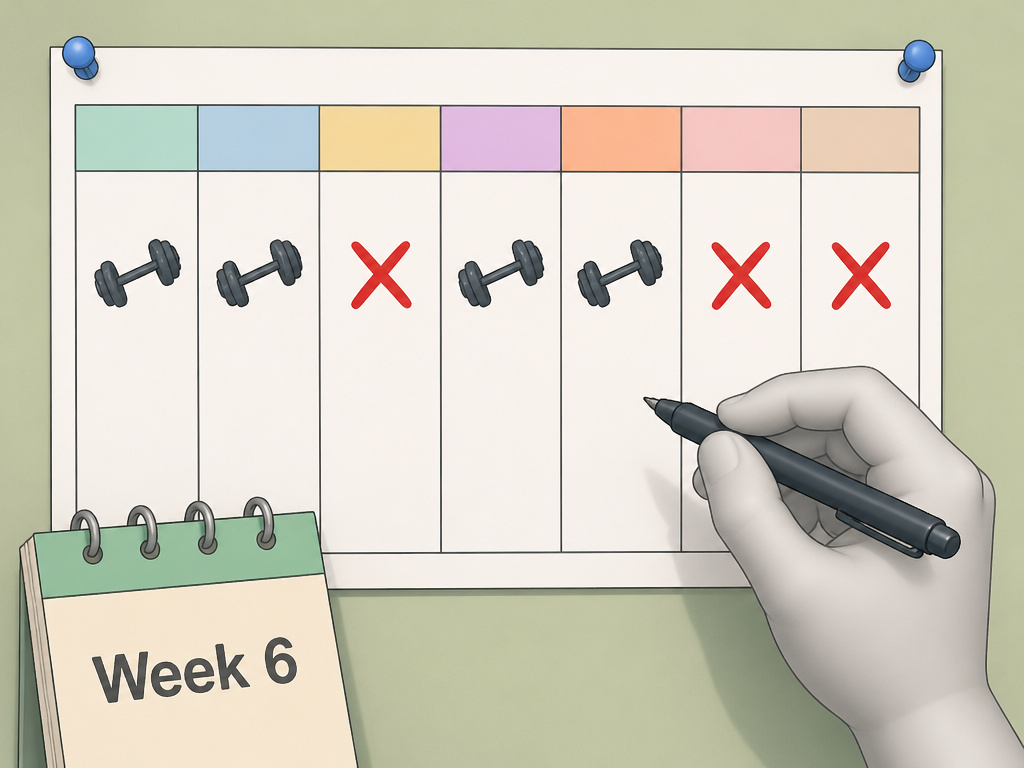
A split is the right answer for a narrow group of people, and the guidelines are specific about who. AUSactive recommends training splits only for more specific goals such as maximising muscle mass, or for more advanced trainees.
That’s a narrower door than the internet suggests. A 6-day workout split only works when the volume per session is small enough to recover from, which is why advanced lifters run short sessions rather than long ones.
I’ve had more than one person ask me to write them a six-day split in their second month of training. The answer is usually no, and the reason isn’t gatekeeping. It’s that a six-day structure assumes you can already generate enough intensity per session to make a small dose count.
The honest way to choose a workout split is to ask what you’ll still attend in week six, not what looks best in week one.
The Parts of the Week Most People Skip
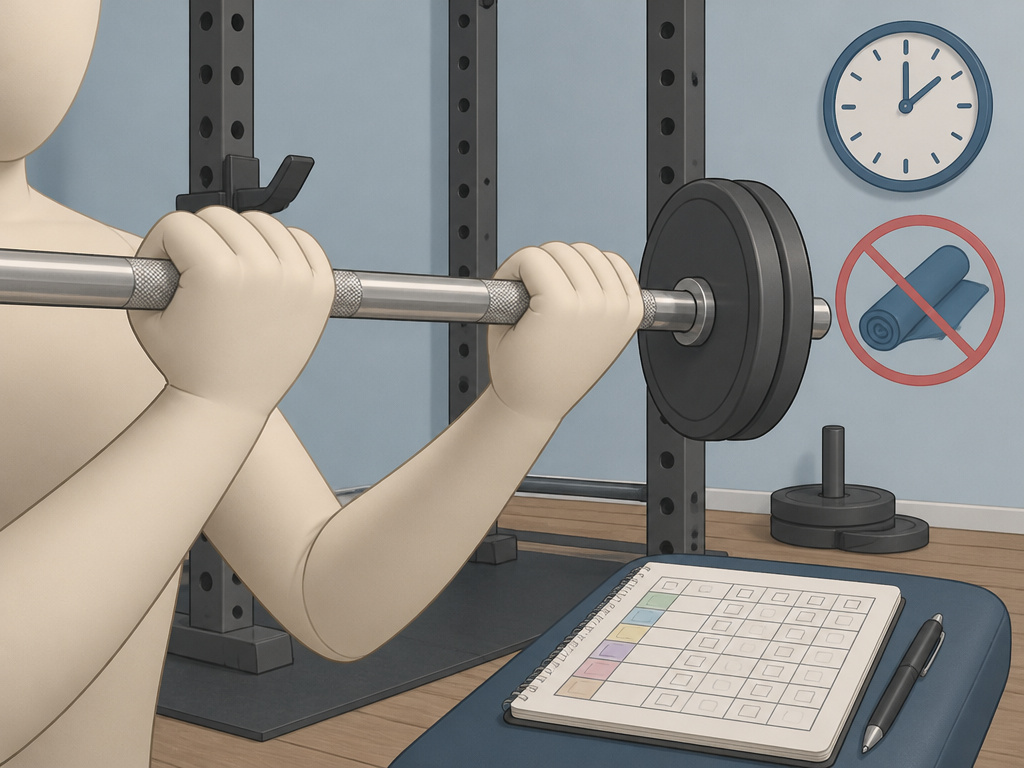
When did your warm-up become a workout of its own? Twenty minutes of cardio and a round of static stretching before you touch a weight is a common ritual, and the research doesn’t back it.
Iversen et al. Recommend restricting the warm-up to exercise-specific warm-ups and deprioritising stretching unless flexibility is the goal. AUSactive’s guidelines are silent on warm-up entirely, which is worth knowing before you treat either position as settled.
If your warm-up takes longer than your first working set, it has stopped being a warm-up. Two or three light sets of the exercise you’re about to do covers the same ground in a fraction of the time.
Periodisation is the other gap. AUSactive recommends systematic variation or periodisation of volume and intensity for trained individuals maximising strength or hypertrophy, and treats it as optional for general health. Turner’s non-linear periodization fitness review presents non-linear (daily undulating) periodization as a valid alternative to linear periodization.
For a beginner running three full-body days, none of this changes anything yet. Add load when you hit the top of the rep range and keep the exercises stable enough to measure.
Frequently Asked Questions
Is a three-day full-body split better than a five-day body-part split?
For general health and anyone in their first year, yes. AUSactive recommends whole-body training two to three times weekly and recommends splits only for advanced trainees or people maximising muscle mass. A five-day split works for that narrower group because they can generate enough per-session volume to justify a week between sessions.
How many sets per muscle group should a beginner do each week?
AUSactive treats one set per muscle group as adequate for general health, with 2-3 sets of 8-12 reps possibly associated with greater benefit as fitness improves. Iversen et al. Set a higher floor of four weekly sets per muscle group. Starting at four weekly sets per muscle group satisfies Iversen et al. And exceeds AUSactive’s floor.
Do I need to train to failure?
No, not for general health. AUSactive states that training to failure isn’t necessary for general health and may apply for specific goals such as maximising muscle mass. The recommended target is a final rep at 15-18 on the RPE scale, where 20 represents failure.
Can I do full-body training four days a week?
You can, but the guidelines don’t call for it. AUSactive’s recommendation is two to three non-consecutive whole-body days per week. Once you’re past that, an upper/lower structure spreads the same volume across four shorter sessions and keeps frequency per muscle group high.
What should I do if I only have two days a week?
Train the whole body both days and accept that each session carries more sets. AUSactive lists two days as a valid starting frequency, and Iversen et al. Note that weekly volume matters more than how many sessions it’s split across.
The Bottom Line
Everything above assumes you’re healthy enough to train and that nothing hurts in a way that isn’t muscle. If you’re coming back from surgery or managing a joint issue, this structure is a starting point for a conversation with a clinician, not a prescription. I’m not the person to program around a complicated medical history.
The one thing I’d change about how most people approach this: stop shopping for the perfect split and start counting weekly sets per muscle group. Two numbers decide almost everything. Days per week, and sets per muscle per week. Get those to three and four respectively and the exercise selection barely matters for the first year.
If you take one thing from this, take the boring version. Three full-body days, non-consecutive, 8 to 12 reps, last rep hard but not failed.
Do this today: open a notes app and write down your last seven days of training, one line per session, with the sets you actually completed for legs, back, chest, shoulders, and arms. Whatever number you land on, that’s your real starting point.
