
How to Choose a Workout Split: Frequency First
This post contains affiliate links. As an Amazon Associate, we earn from qualifying purchases.
To choose a workout split, start with how many days you can actually train. For general health, AUSactive recommends training the whole body two to three times a week on non-consecutive days, using 8 to 12 reps per set. Splits suit specific goals and more advanced trainees.
That two-to-three-times-a-week line is where plans quietly fall apart. A five-day split looks tidy on paper, then day four arrives and your hamstrings are still complaining about day two. Frequency is the load-bearing decision, and everything else hangs off it, which is why how to choose a workout split matters so much.
What follows is the order I’d actually decide things in: how often you train, what a set should feel like, which exercises earn their place, and only then what to call the thing. By the end you’ll be able to look at any split on the internet and know within a minute whether it fits your week.
Key Takeaways
- Two to three full-body days cover general health, and AUSactive specifies non-consecutive days for exactly that reason.
- 8 to 12 reps is the range AUSactive ties to general health and lean mass, with the final rep landing at RPE 15 to 18 on a 20-point scale.
- Splits are a scheduling tool for specific goals or advanced trainees, not a rite of passage you graduate into.
- Equal weekly volume erased the gap in an eight-week trial: training muscles four times a week beat twice a week by nothing measurable.
- 48 hours between sessions for the same muscle is the recovery floor Healthline’s medical reviewers cite.
How Often Should You Train Each Muscle Group?
Twice a week per muscle group covers general health, and AUSactive sets the whole-body version at two to three sessions a week on non-consecutive days.
AUSactive recommends training the entire body two to three times per week on non-consecutive days for general health. Splits are reserved for specific goals such as maximizing muscle mass, or for more advanced trainees. Intensity is set so that no more than 8 to 12 repetitions are completed before volitional fatigue.
The training frequency per muscle group numbers are where the major sources start to pull apart, and the split is worth seeing rather than smoothing over.
| Source | Frequency position | Who it fits |
|---|---|---|
| AUSactive | Whole body 2-3x/week, non-consecutive days | General health, beginners |
| ACE | At least 2 days/week for basic benefits | Most clients |
| NASM | 4-day upper/lower, each muscle ~2x/week | Clients with 4+ days |
| Evangelista 2021 | 4x/week gave no extra strength over 2x/week | Untrained men, 8 weeks |
ACE’s position is the most conservative on paper: muscle-strengthening activity on at least two days per week realizes the basic benefits, and split routines are framed for a client who is already training full-body multiple days a week and is ready to devote more time.
NASM sits at the other end and still concedes the obvious. Its four-day upper/lower template trains each muscle group about twice weekly with three recovery days spread across the week, but NASM also states plainly that if a client can only train about three days a week, a four-day split doesn’t fit cleanly and full-body often delivers more effective stimulus at that frequency.
Then there’s the trial everyone cites. In the split vs full-body strength research from Evangelista and colleagues, 67 untrained men trained for eight weeks. The split group hit each muscle twice a week with 8 sets per session. The full-body group hit each muscle four times a week with 4 and 8 sets per session. Both used 8-12 RM and 60 seconds of rest.
Bench press 1RM went up 18.1% in the split group and 17.5% in the full-body group. Squat went up 28.2% and 28.6%. There was no significant difference between them.
Read that again, because it kills a lot of arguments. Four days a week per muscle produced no additional strength gain over two, once weekly volume was matched.
Why the Pro’s Six-Day Split Won’t Survive Your Calendar
The six-day split you screenshotted from someone with a supplement sponsor will not survive a normal Tuesday.
A guy I worked with told me flatly that he hated exercise. We didn’t argue about it. We set up three full-body sessions a week and he kept them going, which is longer than most people last on anything. Start smaller than you think you need to.
The full-body vs split question gets easier once you count your real training days instead of your aspirational ones, which is where how to choose a workout split starts. Healthline’s medically reviewed guidance draws the line clearly: if you have 30 minutes on four to seven days a week, train upper body twice and lower body twice. If you only have two or three days but longer sessions, a full-body split is the better fit.
Before you start: Load jumps are where beginners get hurt, so keep the first two weeks deliberately light and add weight from there. A joint that still hurts the next morning is a clinician question, not a programming one. If you’re returning from surgery or a long layoff, get clearance before you load a barbell.
Here’s the order I’d actually work through it.
- Count the days you showed up last month, not the days you meant to. If you plan for five and attend three, the sessions you drop are always the last ones in the week, which means whatever muscle lives there gets trained once or not at all.
- Decide how long each session can run. Thirty minutes on most days points to upper/lower. Two or three longer windows point to full-body, and picking the wrong one means you’re either rushing sets or skipping them.
- Set the frequency per muscle before you pick a name. Two exposures a week is a common target, though AUSactive sets whole-body training at two to three sessions a week and Evangelista found four times a week gave no extra strength over two. A plan that hits each muscle once a week sits below the twice-weekly frequency NASM describes and below AUSactive’s two-to-three whole-body sessions a week, though sources disagree on the ideal frequency.
- Then name it. The name is the last decision, and it’s the least important one.
Most workout splits for beginners get copied from advanced programs without the training age that makes them work. If you want the three-day version spelled out, the honest 3-day workout splits are almost all full-body with an A and B day that alternate.
What Rep Range Should You Actually Use?
Eight to twelve reps is a common guideline, though ACE prescribes 8-15 for general fitness and BarBend splits reps by exercise type.
AUSactive ties it to two outcomes at once: for general health, pick a resistance that allows no more than 8-12 reps before volitional fatigue, and for lean mass, put the majority of training in that same 8-12 band. It also gives you a way to check yourself without a lab, since the final rep of a set should land between 15 and 18 on the RPE scale, where 20 is failure.
That last bit matters. AUSactive states that training to failure is not necessary for general health. You’re aiming for hard to very hard, not for a bar that won’t move.
The ACE workout builder for splits lays out four goal rows, and they’re the cleanest reference table in this whole space.
| Goal | Load (% 1-RM) | Reps | Sets / rest |
|---|---|---|---|
| General muscular fitness | 20-70% | 8-15 | 1-4 sets, 2-3 min |
| Hypertrophy | 67-85% | 6-12 | 3-6 sets, 30-90 s |
| Strength | 85%+ | 6 or fewer | 2-6 sets, 2-5 min |
| Muscular endurance | 67% or less | 12+ | 2-3 sets, 30 s or less |
ACE notes that for most clients the general muscular fitness row is the appropriate starting point, with adjustments for experience or a specific goal. That’s a useful anchor when you’re choosing a split and trying to work out what a set is supposed to look like.
The sources disagree on the exact rep band, so here is how to choose a workout split rep range straight. AUSactive says 8-12. ACE says 8-15 for general fitness and 6-12 for hypertrophy. Healthline’s examples use 8-12 for a three-day full-body plan and 6-12 for a four-day upper/lower. BarBend splits it by exercise type: 5-8 reps on compounds, 8-10 on accessories, 10-12 on single-joint work.
They disagree because they describe different exercises and goals: AUSactive says 8-12, ACE says 8-15 for general fitness and 6-12 for hypertrophy, Healthline uses 8-12 and 6-12, and BarBend splits by exercise type.
If the last rep of a set still moves smoothly, that set was a warm-up. If it stops moving entirely, you’ve gone past what general health asks for.
Set counts disagree even more sharply. AUSactive recommends at least one set per muscle group, with 2-3 sets of 8-12 associated with greater benefit as fitness improves. ACE’s hypertrophy row goes to 3-6 sets. BarBend suggests 10-12 weekly sets for large muscle groups and 6-8 for small ones. Start at the low end and earn your way up.
The final rep at RPE 15 to 18 has a specific feel. The bar slows on the way up, your grip starts to peel off the knurling, and you know you could grind out one more but you’d rather not.
Machines, Free Weights, and the Skill Cost Nobody Counts
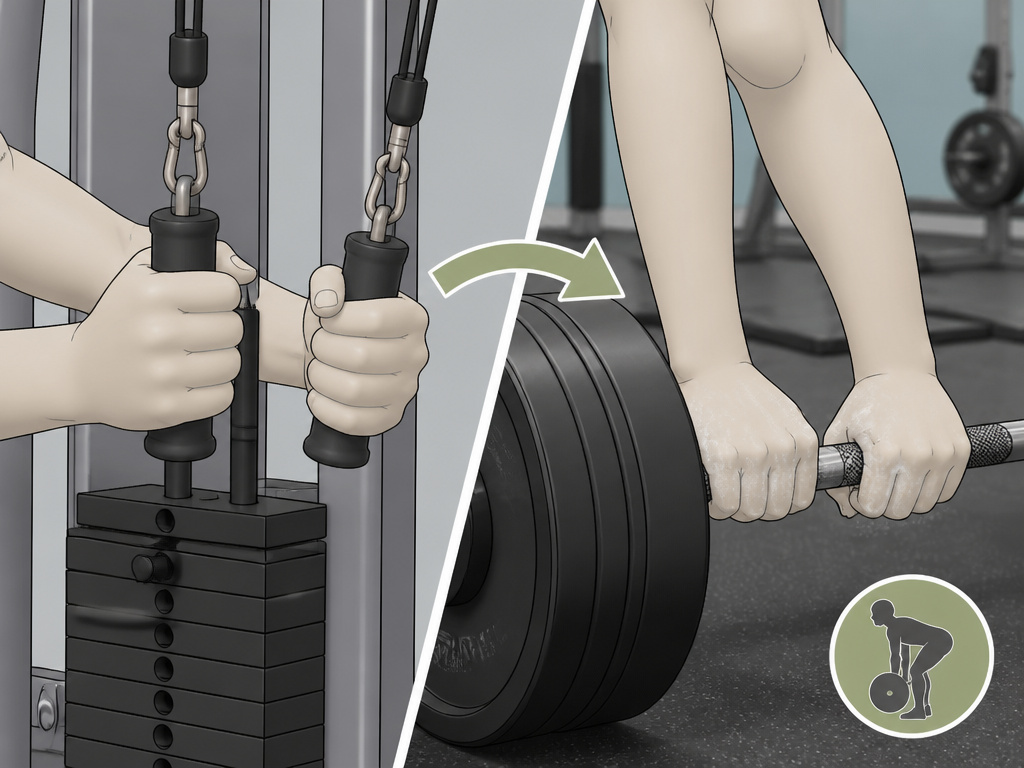
Machines ask less of you, and sometimes that’s exactly the right trade.
AUSactive is unusually direct about this. Machines require less skill because the movement path is guided, which makes them a more suitable mode for beginners or people with coordination problems. Free weights produce neural adaptations that more closely replicate sporting situations, which makes them the better choice for athletes.
The same document adds a nuance most gym arguments skip: a mixture of multi-joint and single-joint work is fine for general health, but an emphasis on multi-joint exercises should be made for anyone chasing strength.
- Machines first if you’re new, coming back from a layoff, or training alone without a spotter.
- Free weights once the movement pattern is automatic, because the balance demand is part of the training effect.
- Both, eventually. The split between them is a phase question, not a personality.
I teach the hip hinge before I teach anything loaded. Get someone to feel their hamstrings take the load once, with a flat back and the bar over midfoot, and half the back-pain conversations disappear. That single pattern carries into deadlifts, rows, carries, and picking a suitcase off the floor. (If a hinge consistently hurts rather than stretches, that’s a clinician question, not a programming one.)
Equipment matters less than people think, but it isn’t nothing. A barbell that will outlast your enthusiasm is worth having. I log every set so the history view makes the frequency question easy to answer.
Upper/Lower vs Push Pull Legs vs Bro Split: Which Wins
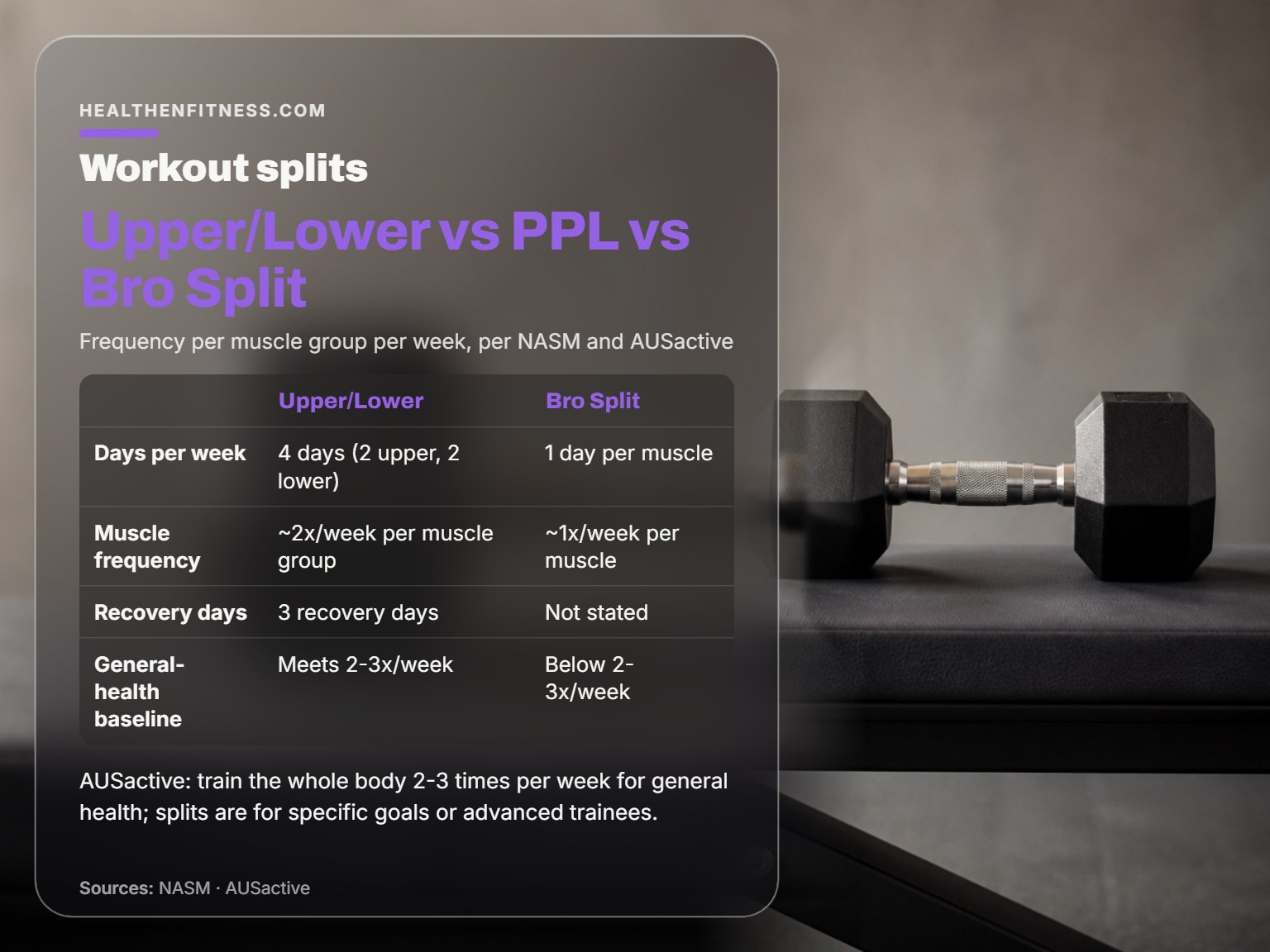
NASM and Healthline say full-body often wins at three days, while ACE frames splits for clients already training full-body multiple days a week and ready to devote more time. Everything else is scheduling preference dressed up as physiology.
The common workout splits all reduce to the same handful of shapes, and the differences between them are smaller than the internet suggests.
Upper/Lower: The Default for Four Days
The NASM upper/lower split guide describes the classic structure as four days, two upper and two lower, which leaves three recovery days in the week. Each muscle group gets trained about twice weekly, with one higher-volume and one lower-volume day per region. NASM’s programming note is the part people skip: put the harder day where you’re freshest and keep the second exposure of each region lighter.
Most 4-day workout splits run upper/lower for exactly this reason. Healthline’s example uses two movements per body part for 3-4 sets of 6-12 reps, and the same structure can be run as a 6-day version if you repeat upper and lower before taking a rest day.
Push Pull Legs: Fine If You’re Already Consistent
The push pull legs split organizes training by movement pattern rather than by muscle, which is a perfectly sound way to divide a week. It also tends to run six days, and six days is a commitment many people struggle to hold.
Common mistake: Building a six-day plan around a schedule you’ve never actually kept. The missed sessions stack up, and the muscle groups parked at the end of the week get skipped every single time.
The Bro Split: What It Costs You
The bro split gives every muscle its own day, which means each one gets trained roughly once a week. That sits below the twice-weekly frequency NASM describes and below the two-to-three sessions a week AUSactive sets as the general-health baseline.
It isn’t useless. If you’re advanced, you enjoy it, and you’ll actually show up for it, the frequency ceiling is a smaller problem than adherence. For a beginner in year one, it’s the wrong trade.
The 48-Hour Rule and the Rest Days You’re Actually Allowed
It’s Wednesday night. Your quads are still sore from Monday and the plan says squat.
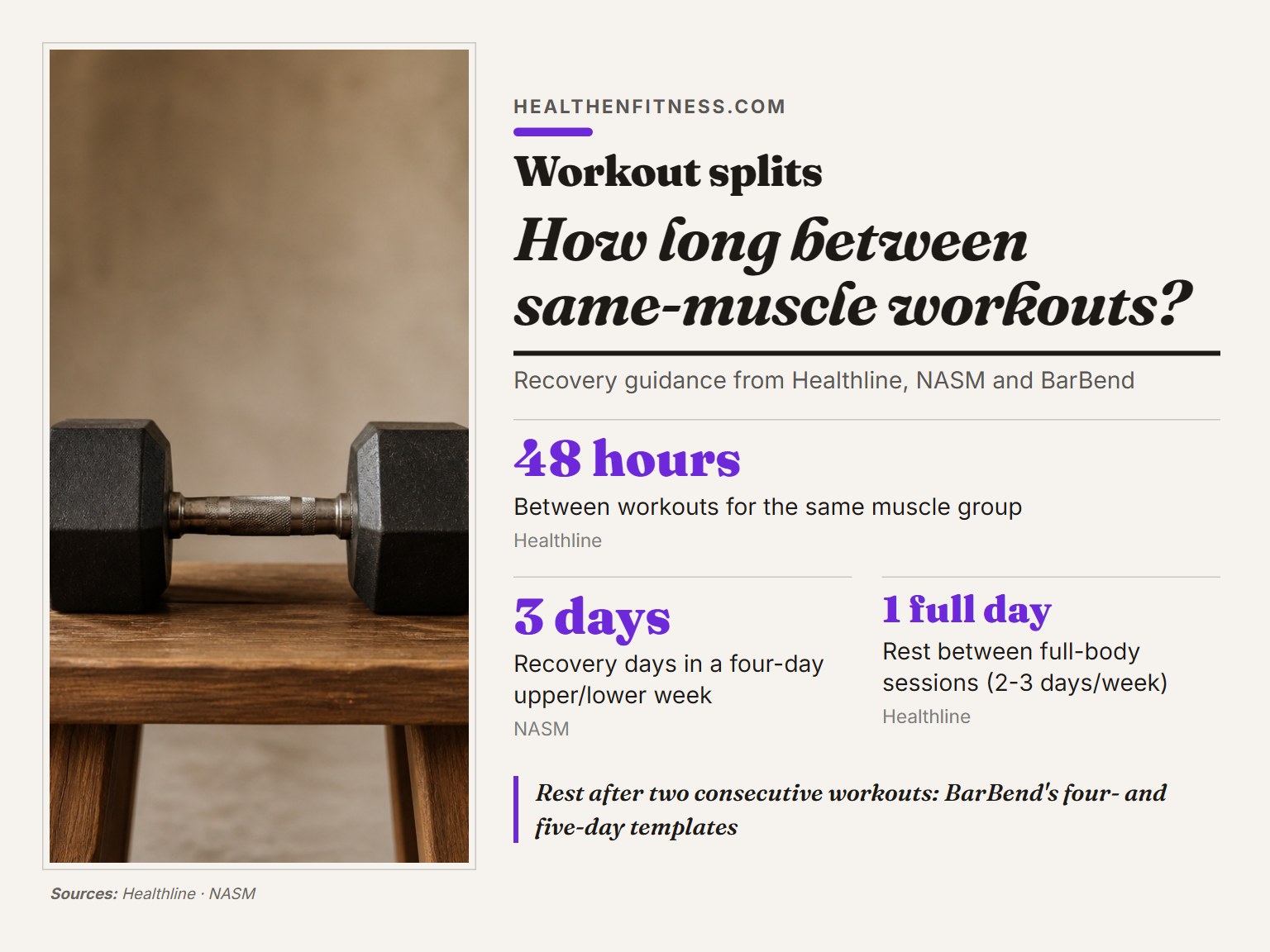
Healthline’s medically reviewed guidance recommends allowing muscles to recover for 48 hours between workouts for the same muscle group. Forty-eight hours sounds generous until you count it out: legs Monday evening means Wednesday evening is your first green light, and that’s assuming you slept.
Train the same muscle hard on back-to-back days and the second session is the one that suffers. Expect the drop when fatigue you never cleared starts showing up as stalled weights and a warm-up that feels like a work set.
Where this goes sideways: Squeezing a session in because the calendar had a gap. The first session’s repair work is still underway, and the second one runs on empty without ever feeling obviously bad.
What recovery actually looks like, in practice:
- A full rest day between full-body sessions, which is what Healthline’s full-body split assumes.
- Three recovery days across a four-day upper/lower week, per NASM’s structure.
- Rest after two consecutive workouts, which is how BarBend arranges both its four-day and five-day templates.
Once you know your frequency, structure a workout week around the days you’ll genuinely show up rather than the days that look good on paper.
Where This Advice Breaks Down (and Who It Wasn’t Tested On)
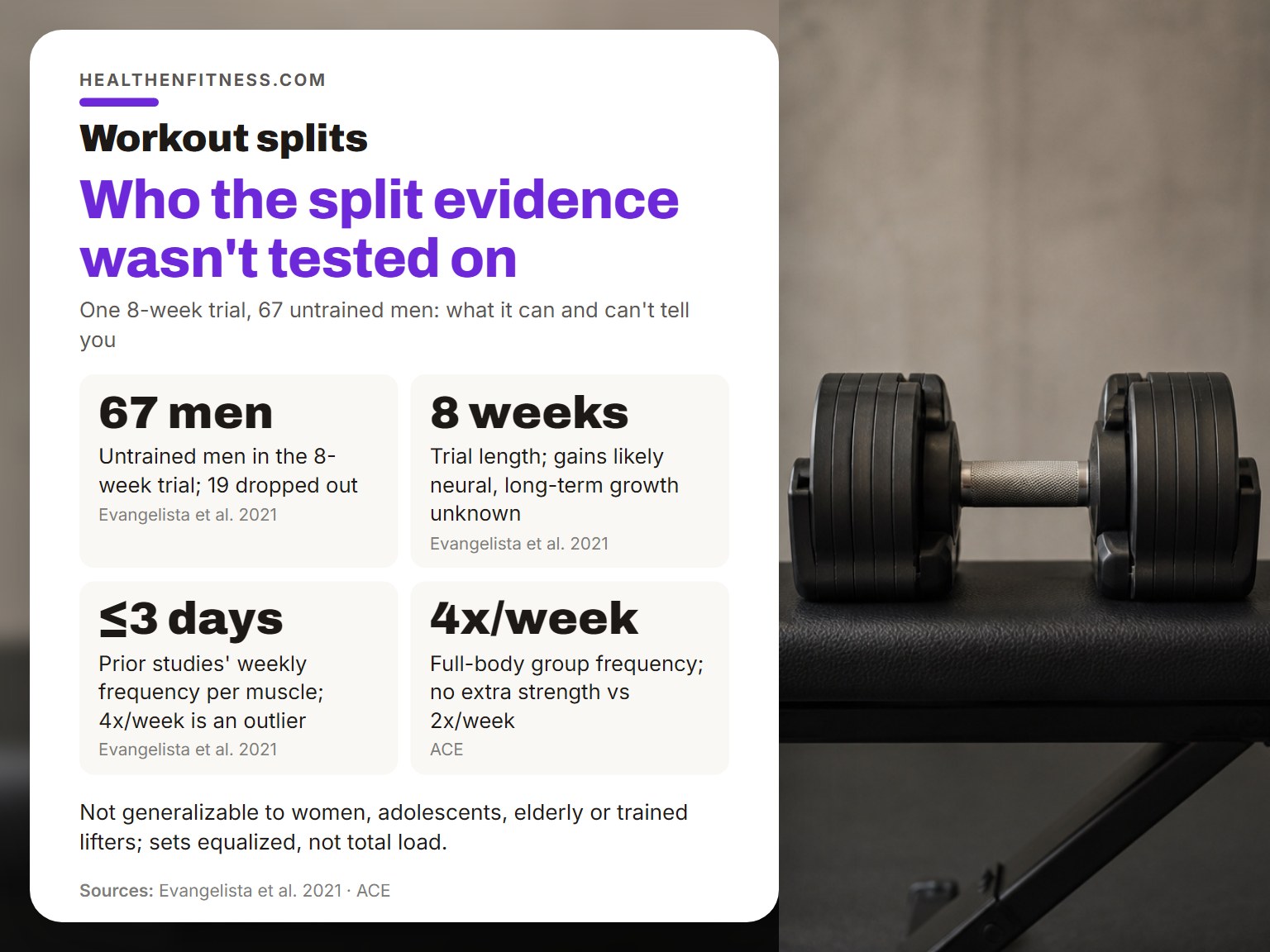
The strongest head-to-head evidence here comes from 67 untrained men in an eight-week trial, and that’s a narrow slice of humanity.
The Evangelista authors say so themselves. Their findings can’t be generalized to women, adolescents, elderly people, or trained lifters, and they warn that higher frequencies may accelerate the onset of overtraining in those groups. The study also equalized set count rather than total load lifted (sets times reps times load), which the authors flag as a possible confounder.
Two more limits worth knowing. Strength gains at eight weeks were probably driven by neural adaptations, so longer-term muscle growth outcomes are unknown. And muscle thickness was measured at the mid-belly only, while growth is region-specific, so mid-belly readings may understate what a split actually does.
There’s also a context point the trial makes about itself: most prior studies used frequencies of three or fewer days per muscle group per week, which makes the four-times-a-week result an outlier rather than a settled ceiling.
I’ll add my own limits. I’m not the person to ask about marathon or triathlon blocks, because I’ve never coached or trained for those demands. And if you’re coming back from a serious injury or surgery, generic programming advice can mislead you badly. See a clinician first.
Frequently Asked Questions
How many days a week should I train?
AUSactive puts general health at two to three whole-body sessions a week on non-consecutive days, and ACE says at least two days a week realizes the basic benefits of resistance training. Above that, the return depends on your goal and your schedule. AUSactive puts general health at two to three whole-body sessions a week, and NASM notes full-body often delivers more effective stimulus at about three days a week.
Is a full-body workout better than a split?
NASM and Healthline say full-body often delivers more effective stimulus at three days a week or fewer, while ACE frames splits for clients already training full-body multiple days a week and ready to devote more time. NASM states that at roughly three days a week a four-day split doesn’t fit cleanly and full-body often delivers more effective stimulus. Splits make sense when you have four or more days and a specific goal.
How many sets should I do per muscle group?
AUSactive recommends at least one set per muscle group, with 2-3 sets of 8-12 reps associated with greater benefit as fitness improves. ACE’s hypertrophy row goes up to 3-6 sets. Start low, add sets only when you’re recovering well between sessions.
Should I train to failure?
AUSactive states that training to failure is not necessary for general health. Aim for the final rep of a set to land between 15 and 18 on the RPE scale, where 20 is failure. Failure has a place in specific hypertrophy blocks, and it costs recovery you may want elsewhere.
How long should I rest between sets?
It depends on the goal. ACE prescribes 2-3 minutes for general muscular fitness, 30-90 seconds for hypertrophy, 2-5 minutes for strength, and 30 seconds or less for endurance. The Evangelista trial used 60 seconds for both groups, and BarBend suggests 90 seconds to 3 minutes for strength and hypertrophy work.
Can I run a 4-day upper/lower split if I only have 3 days?
You can, but you’d be running it badly. NASM is explicit that a four-day split doesn’t fit cleanly at three days a week. Run full-body three times instead, and move to upper/lower when your week opens up.
The Bottom Line
If you can’t point at specific days on next week’s calendar and name the hour, the split question is premature. That’s the threshold. Get the days first, and the programming follows.
Here’s the concession, though. If you’ve been training consistently for years, or you’re preparing for a sport, the frequency ceiling described here doesn’t bind you the same way. The Evangelista sample was untrained men, and trained lifters have different recovery profiles and different goals. You’ve earned the right to a more elaborate week.
Everyone else should run full-body two or three times a week, log the sessions, and change nothing until the log proves the plan is too easy.
Do this today: put three non-consecutive training days in your calendar and leave the split name blank until you’ve kept them for a month.
