
Is It OK to Use Your Phone at the Gym? What the Data Says
This post contains affiliate links. As an Amazon Associate, we earn from qualifying purchases.
Using your phone at the gym is fine, with one condition: the function decides the outcome. In a controlled treadmill study, music raised walking speed to 3.4 mph and heart rate to 122.3 bpm, while texting dropped speed to 2.8 mph. Music helps the session in the treadmill trial, while aggregate daily phone use is linked to lower fitness in survey work.
The gap between 3.4 mph and 2.8 mph comes from a design detail worth knowing when you ask is it ok to use your phone at the gym. The treadmill display was covered for all four bouts, and the grade stayed flat at zero percent. Nobody could chase a number on the console. With the screen blank, the phone became the only thing setting the pace.
What follows is the measured version of this question: what each phone function does to pace, heart rate and enjoyment, where the real etiquette lines sit, and the one habit that starts most gym friction.
Key Takeaways
- Music raises both pace and effort: 3.4 mph and 122.3 bpm against 3.1 mph and 115.4 bpm with no phone at all.
- Texting is the worst of the three: 2.8 mph and 109.9 bpm, slower and lower than simply walking phone-free.
- Talking is the odd one: it slows you to 2.8 mph but lifts enjoyment to 5.4 cm against 4.3 cm on a liking scale.
- Camping on a bench with your phone is the etiquette failure, not the phone itself.
- The evidence stops at treadmill walking and at a young-adult sample, so treat it as a starting point.
What Happens to Your Workout When You Pick Up the Phone?
Forty-four walkers, four thirty-minute treadmill bouts, and one covered speed display. That’s the setup behind almost every number below.
In a randomized within-subjects trial, forty-four participants completed four thirty-minute treadmill bouts at a fixed zero percent grade with the speed display covered. Mean walking speed reached 3.4 mph with music, 3.1 mph with no phone, and 2.8 mph while talking or texting. Music differed from every other condition at p less than or equal to 0.014.
The cell phone use treadmill exercise study ran every participant through all four conditions, so each person got compared against themselves. That removes most of the usual noise about fitness levels, sleep and motivation. What’s left is the phone.
| Condition | Speed (mph) | Heart rate (bpm) | Liking (cm VAS) |
|---|---|---|---|
| Music | 3.4 | 122.3 | 7.5 |
| No phone | 3.1 | 115.4 | 4.3 |
| Talking | 2.8 | 112.6 | 5.4 |
| Texting | 2.8 | 109.9 | 5.1 |
Cover the speed readout and the belt feels faster than it is. Your stride shortens, your eyes drop to the console out of habit, and the number you were chasing is gone. That’s the condition these walkers trained in for thirty minutes at a stretch.
Music came out ahead on every measure. Heart rate hit 122.3 bpm with music against 115.4 bpm with no phone, and the liking score jumped to 7.5 cm on a visual scale where the phone-free walk sat at 4.3 cm.
Texting did the opposite. It pulled speed to 2.8 mph and heart rate to 109.9 bpm, both below the walk with nothing in your hand. Talking landed in the same place on speed, at 2.8 mph and 112.6 bpm.
I’ve watched people pick up the pace the moment a song lands. I’ve watched the same people coast through a text thread for half a mile without noticing.
Why Music Helps and Texting Doesn’t
Music wins. That part is settled. What the design can’t tell you is why.
The Function-Specific Finding
The authors landed on a narrow conclusion: the relationship between phone use and exercise appears specific to the function being used. Music is one function. Talking is another. Texting is a third. Treating them as a single habit called “phone use” is where most advice goes wrong.
Talking is the interesting case. Speed dropped to 2.8 mph, yet the liking score rose to 5.4 cm against 4.3 cm with no phone, significant at p = 0.05. Two measures moved in opposite directions inside the same thirty minutes.
So a phone call mid-workout makes the session more pleasant and less productive. Both things. At once.
Where the Evidence Runs Thin
The treadmill is the first limit. The authors state it plainly: they only examined treadmill exercise, which isn’t the mode everyone picks. Nothing in this trial was tested on free weights, a bike, or a class.
The second limit is the conversation itself. Talking and texting were simulated by research staff working from a pre-determined script. Nobody was having a real argument with their landlord mid-set.
The third is age. The wider literature clusters at 13 to 18 and 19 to 25. If you’re 52 and reading this on a recumbent bike, those numbers describe somebody else.
The Scrolling Problem the Treadmill Study Didn’t Measure
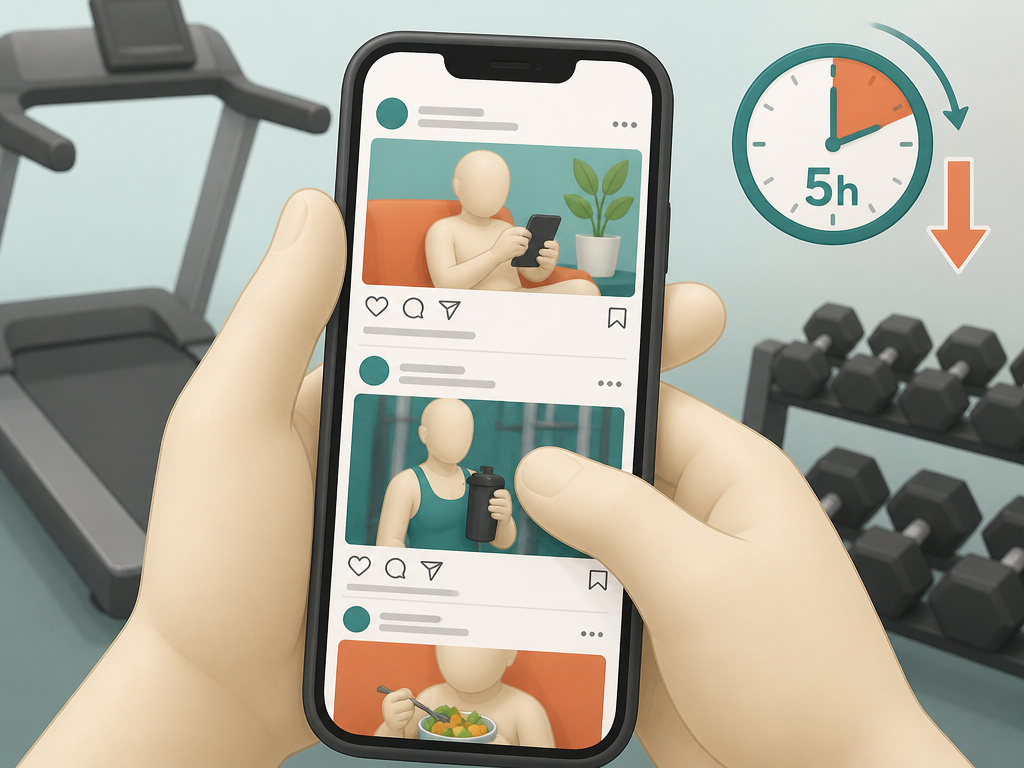
The treadmill numbers only cover thirty minutes of deliberate exercise, so they say nothing about the is it ok to use your phone at the gym question across the other twenty-three and a half hours.
That’s where the second body of work comes in. In a sample of U.S. College students, a cell phone use and fitness study found phone use negatively associated with cardiorespiratory fitness after controlling for sex, self-efficacy and percent body fat, at beta = -0.25 and p = 0.047.
The same sample averaged just over 300 minutes of phone use a day, and 88.2% said they used the phone mainly for leisure. Five hours is a lot of sitting.
| Phone habit | What the research links it to | How strong the link is |
|---|---|---|
| More than 2 hours a day | Less physical activity | One study, cited in a review |
| Heavy daily use | Lower cardiorespiratory fitness | Beta = -0.25, p = 0.047 |
| Smartphone addiction | Lower muscle mass, higher fat mass | Cited in review, small samples |
| Long daily use | Aches in back, neck, wrists, hips, knees | Cited in review |
A 2019 mobile phone physical activity deficit review looked at 14 articles and found 9 showing a negative relationship between phone use and physical activity. The review’s own summary is narrower than the headline: inappropriate use is associated with low levels of motivation.
Common mistake: Reading the aggregate studies as proof that your phone ruins your workout. Those negative findings describe total daily use across months, not the eight minutes you spend queuing a playlist before your first set.
Here’s the honest version. The two literatures don’t agree, and they aren’t measuring the same thing.
Rebold’s trial found a positive effect for one function. Lepp’s survey work and the 2019 review found a negative effect for aggregate use. Both hold up, because a thirty-minute treadmill bout and a five-hour daily habit answer different questions.
So Is It OK to Use Your Phone at the Gym Between Sets?
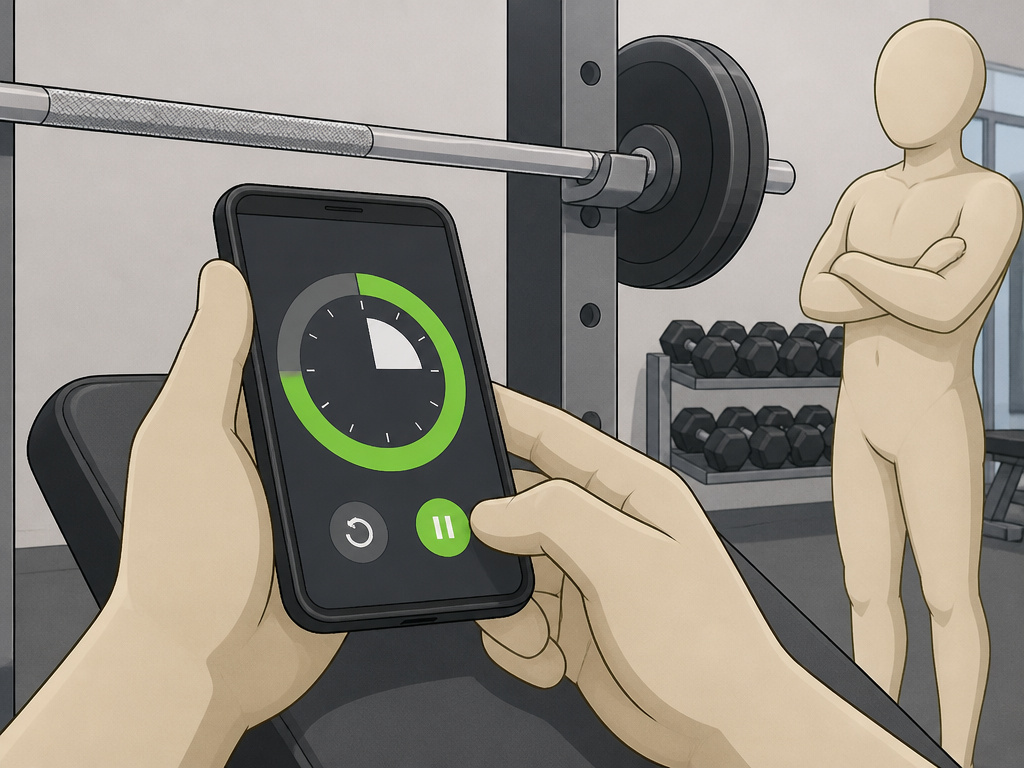
Would you stand four feet from someone’s bench and start a phone call? Probably not. The same move feels normal when the phone is already in your hand, which is why it keeps happening.
Start with basic gym etiquette rules before you worry about the screen. Most of them come down to awareness: re-rack, wipe down, don’t hover.
Here’s my short list for phone use between sets:
- Music and a timer: fine, always.
- A quick text on a machine nobody else wants: fine, and nobody will remember it.
- A full conversation on speaker while three people wait for the leg press: the fastest way to become the story someone tells at dinner.
- Scrolling for four minutes with your bag on the seat beside you: this is the one that starts arguments.
The line sits at whether someone else is waiting on you. Nothing else.
I won’t take a call on the gym floor, and it has nothing to do with manners. I lose track of my rest timer every single time, and then I’m the guy sitting on a bench for nine minutes doing nothing. (I did this for a year, so no judgment.)
If a call can’t wait, walk to the lobby. Leave the phone in your bag during the last set of a heavy compound. The extra ninety seconds it takes to fish it out is exactly the ninety seconds somebody else needed on that rack.
Most of these moments never turn into a gym conflict because one person says one short sentence first.
The Bench Camping Rule That Prevents Most Fights
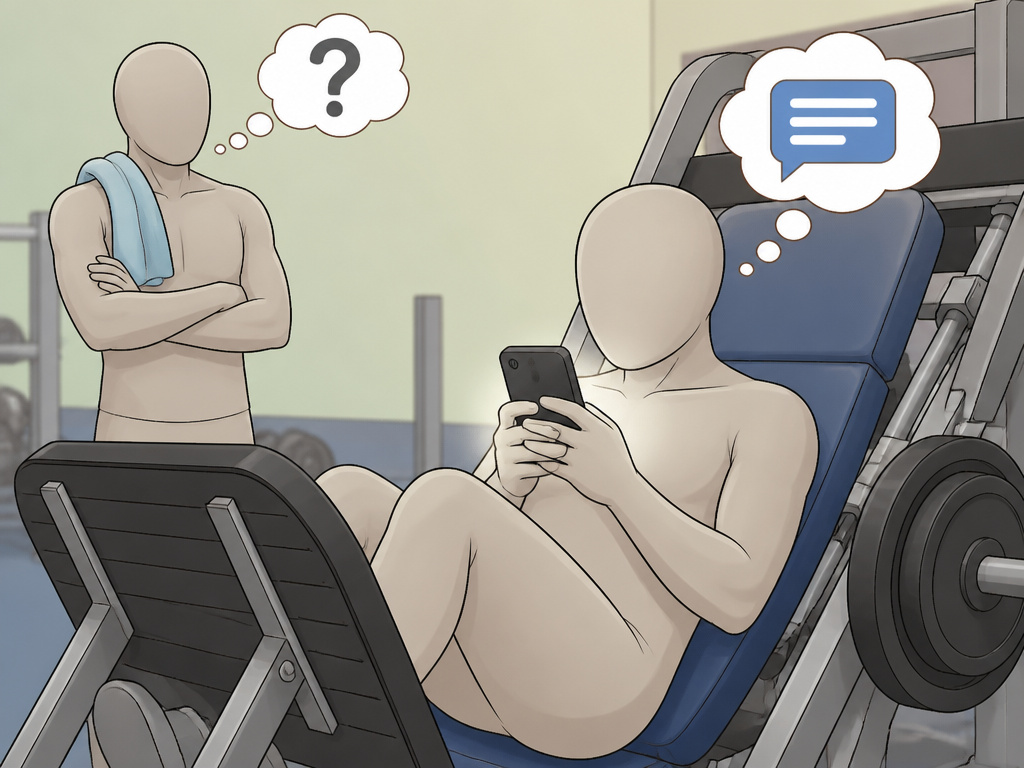
You finish a set on the leg press. Someone is standing four feet away with a towel over one shoulder, not saying anything. You pick up your phone to check a message. They sigh.
That sigh is the whole problem. The waiting person can’t tell whether you’re mid-set, resting, or gone for the next ten minutes. Your phone gives them no information, so they have to guess, and guessing turns into hovering.
The 20-Second Ask
Learning how to share gym equipment takes about thirty seconds. The sentence is: “How many sets do you have left?” It works because it asks for a number, and a number is a commitment.
The four-step version:
- Ask how many sets are left before you touch anything. Skipping this is how two people end up loading the same bar from opposite sides.
- Say your number out loud, then actually do that many. Saying “two more” and then doing five is worse than saying nothing, because the other person planned their whole session around your word.
- Offer to let them work in if the weight is close. A plate change takes less time than the stare-down.
- Put the phone face down while you’re on the machine. A face-down phone reads as “between sets.” A phone in your hand reads as “I live here now.”
If you can’t say how many sets you have left, you’re not training. You’re occupying.
A phone on speaker sits in the same noise category as dropping weights at the gym. Loud, avoidable, and the sort of thing people remember about you.
Headphones, Mounts, and the Gear That Keeps Your Eyes Off the Screen
Sealed or open-ear earbuds solve more gym phone problems than any app. One in, one ear open, and you can hear “are you using this?” without digging anything out of a pocket.
Earbuds That Keep the Phone in Your Pocket
Sound tells you which mode you’re in. Sealed earbuds cut the room to a hum, so the belt and the plates fade and you stop checking the screen for a reason to look up. Open models let the clack of a dropped dumbbell through, which is what you want when somebody is trying to get your attention.
The short gear list:
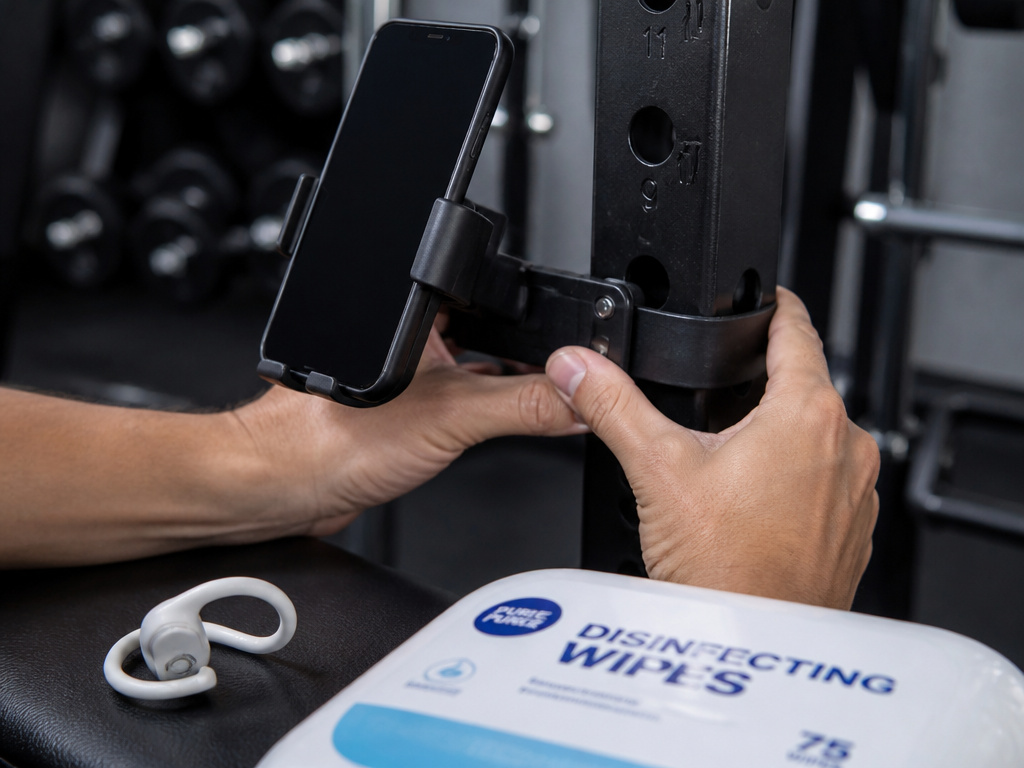
- A gym phone holder that clamps to a rack upright or a treadmill console. Boring, and it keeps the screen out of your hand.
- Open-ear or single-earbud picks from the best wireless earphones for gym list, so you aren’t deaf to the room.
- Disinfecting wipes in a flat canister. It fits a side pocket, it doesn’t leak, and you stop being the person who leaves a wet bench behind.
- A phone grip or similar accessory if you film sets. It stops the phone sliding off a bench mid-rep.
Open-ear earbuds are the pair I’d hand to someone who takes calls mid-session, because transparency mode makes the handoff to “sorry, what?” instant.
Easy to miss: A phone left on a bench while you refill a bottle looks abandoned. Someone will move it, and then you’ll both lose ten minutes to a conversation neither of you wanted.
If you’re filming your lifts, angle the phone so the frame excludes everyone else. Two seconds of adjustment, one saved conversation.
When the Phone Actually Helps (and Who the Research Left Out)
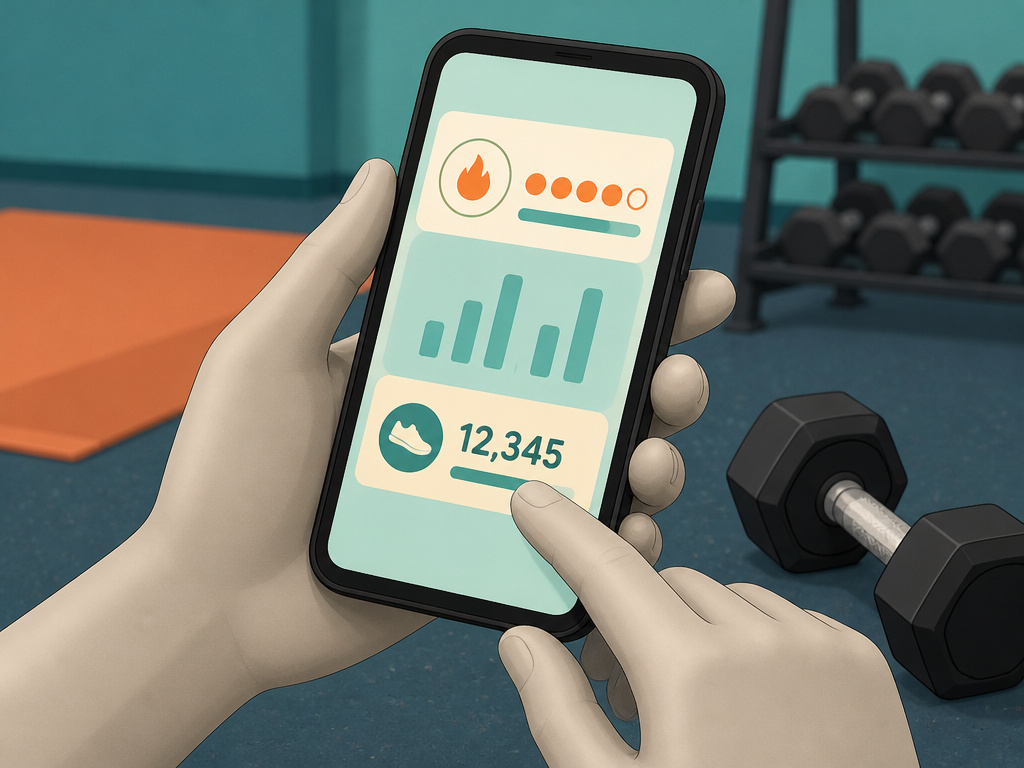
Six people in the Lepp sample said their phone made them more active. Small number, real effect: they reported that phone use connected them to a physically active peer group.
The same paper makes the point directly. The cell phone can motivate physical activity as well as disrupt it, and the authors flag health apps as a place where that might matter.
The 2019 review agrees on the mechanism, if not the size. It notes that smartphone use doesn’t necessarily lead to sedentary behavior, that plenty of apps help people train, and that people doing more moderate and vigorous activity are the ones most likely to consult their phone about health.
So the split is honest: Lepp et al. Note the phone may motivate physical activity, while the 2019 review finds excessive use produces a sedentary lifestyle and reduces exercise time.
The radiation question comes up in every comment section, and the CDC cell phone radiation facts page is where that conversation belongs. It doesn’t settle anything about scrolling between sets.
One more limit worth stating. I’m not a clinician, so I can’t tell you whether your neck pain comes from the phone, the bench press, or the drive to the gym. The review links heavy smartphone misuse to aches in the back, neck, wrists, hips and knees, and that’s as far as I’d take it without a professional opinion.
Frequently Asked Questions
Is it rude to text between sets?
Only if someone is waiting on the equipment you’re sitting on. A quick text on a machine nobody wants is invisible. The same text on the only squat rack in the building reads as a claim on the rack.
Does listening to music actually make you work harder?
In the treadmill trial, yes. Music produced 3.4 mph against 3.1 mph with no phone, and heart rate ran 122.3 bpm against 115.4 bpm. The difference held against every other condition at p less than or equal to 0.014.
What about taking a call during a workout?
Expect to slow down. Talking dropped walking speed to 2.8 mph in the same study, below the phone-free walk. The odd part is that people liked the session more, 5.4 cm against 4.3 cm on a liking scale.
Is phone use why I’m not seeing progress?
Not on its own. The negative findings are about total daily use, and one study put the association with cardiorespiratory fitness at beta = -0.25 after controlling for sex, self-efficacy and body fat. That’s a real link and a modest one.
Does any of this apply to lifting?
No. The treadmill trial tested walking only, and the authors say so directly. Nobody has run that four-condition design on a squat rack, so treat the numbers as a direction rather than a measurement of your session.
How long is too long between sets?
Long enough that someone else notices. If your rest keeps stretching because the screen keeps offering something new, you’ve turned a set into a seat.
The Bottom Line
Here’s the trigger I’d use: if you’ve been on the same machine for a full song and finished two sets, the phone has taken over. Put it in your bag for the next exercise and see whether the session feels shorter.
The concession is that all of this rests on treadmill walking and a young-adult sample. If you’re older, or you lift rather than walk, you’re extrapolating. The direction of the finding holds up. The exact numbers describe a young adult on a treadmill.
One thing to try this week: queue your playlist before you walk in, then leave the phone in your bag for the first two exercises. No scrolling, no checking.
And if someone is standing four feet away with a towel over one shoulder, the answer to “are you using this?” is yes or no. Keep it simple and keep showing up.
