High Bar vs Low Bar Squat: Which Should You Use?
This post contains affiliate links. As an Amazon Associate, we earn from qualifying purchases.
The high bar vs low bar squat comparison comes down to where the bar sits and what that position does to your torso. Low bar allows most lifters to move more weight, while high bar keeps the torso upright and loads the quads harder. A 2025 study of 19 recreational lifters found low-bar 1RM loads significantly higher than high-bar (F=35.4, p<0.001).
That word “most” is doing real work, because a second study of 12 experienced male lifters found no meaningful gap at all: 129.1 kg high bar against 130.2 kg low bar at 3RM. Both results are real. They measured different things, and knowing which one matches your training is the whole high bar vs low bar squat decision.
What follows walks through bar position, the load research in both directions, muscle emphasis, and how to pick a style you can run with for the next few months.
Key Takeaways
- Low bar allows most lifters to load more: a 2025 study of 19 recreational lifters found significantly higher 1RM loads with the bar sitting lower on the back.
- High bar keeps the torso upright and puts more of the work on the quads, which is why weightlifters stay there.
- The contradicting study used 3RM, not 1RM, and reported 129.1 kg versus 130.2 kg with no significant difference.
- Give a style switch at least a few months before you judge it, because the motor pattern takes that long to settle.
- Depth has to stay the same in both styles, so never trade squat depth for a bar position that feels easier.
Where the bar sits, and why 3 inches changes the whole lift
The bar travels 2 to 3 inches down your back between the two styles. That small move drags torso angle, knee flexion, and muscle emphasis along with it.
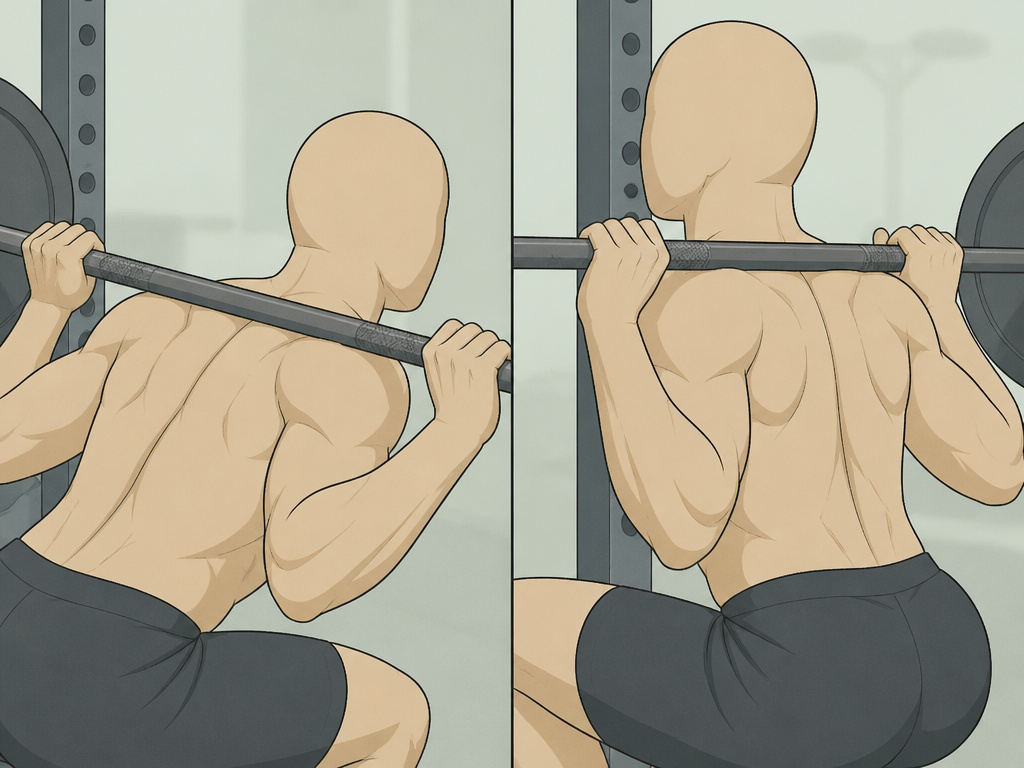
High-bar placement rests the bar on the upper traps and produces a more upright torso with greater knee flexion. Low-bar placement sits below the traps, increases forward lean, and increases the internal moment arm at the hip. A 2017 review found greater knee flexion in the high-bar squat in 11 of 14 studies examined.
Set the bar low and you feel it settle against the shelf of bone below the traps, pressing into the rear delts instead of resting on top of them. That contact point is the whole difference. Everything else follows from it.
I squatted high bar for two years without ever checking where the bar actually sat. It was about an inch higher than it needed to be, which explained more about my forward lean than any mobility drill did.
| Feature | High Bar | Low Bar |
|---|---|---|
| Bar position | Top of the traps | 2-3 inches lower, below the traps |
| Torso angle | More upright | More forward lean |
| Knee flexion | Greater (11 of 14 studies) | Less |
| Muscle emphasis | Quadriceps | Glutes, erectors, adductors |
| Typical use | Weightlifting, quad focus | Powerlifting, maximum load |
Getting the bar to stay put matters more than people expect in the high bar vs low bar squat, and a center-knurled bar can help reduce sliding on high-bar sets. Once the bar is stable, the rest is proper squat form rather than brute strength.
Does low bar actually let you lift more weight?
Three peer-reviewed studies and one practitioner review land in two camps, and the split is worth understanding before you pick a side.
The strongest single result comes from the 2025 Appl. Sci. Paper out of the University of Castilla-La Mancha. Nineteen recreational lifters (9 men, 10 women) performed 1RM tests in both styles across two sessions spaced a week apart. Low bar produced significantly higher 1RM load and significantly higher mean force.
Kristiansen and colleagues found the same direction in 2021, with a different design. Fourteen recreationally trained participants did 3RM tests across three bar positions, and the load ranking came out safety bar lowest, then high bar, then low bar. Their biomechanical comparison of squat bar positions concluded that a lifter chasing the greatest possible load should attempt low bar first.
Then Men’s Health reported a study pointing the other way.
| Source | Protocol | Finding |
|---|---|---|
| Appl. Sci. 2025 (n=19) | 1RM, recreational lifters | Low bar significantly higher (F=35.4, p<0.001) |
| Kristiansen 2021 (n=14) | 3RM, recreationally trained | Low bar > high bar > safety bar |
| Men’s Health report (n=12) | 3RM, experienced male trainees | 129.1 kg vs 130.2 kg, not significant |
| Stronger by Science | Practitioner review | 5-10% more weight low bar than high bar |
Why the two studies disagree
The Men’s Health study used 12 experienced male trainees and a 3RM protocol. The Appl. Sci. Study used 19 recreational lifters of both sexes and a true 1RM. Neither source reconciles the gap, and neither author claims the other is wrong.
The most likely explanation sits in the protocol. A 3RM is a submaximal estimate with more room for technique drift, and a smaller sample of experienced lifters has less room for a difference to reach significance. That is an inference, not a finding. Treat it as one.
What the numbers mean for you
If you are chasing a max single, the weight of the evidence favors low bar, though Men’s Health reports no significant strength difference between the two placements. If you are training in the 3 to 8 rep range and your technique wobbles under fatigue, the practical gap shrinks toward nothing.
The velocity data adds a wrinkle worth knowing. The 2025 study found no significant difference in 1RM mean velocity between the two styles, but did find significant velocity differences at matched submaximal loads. Men’s Health reported no significant barbell velocity differences at all. Both can be true at once, because they measured at different intensities.
The Glassbrook high-bar low-bar squat study offers the cleanest way to think about it. Low bar produced comparable vertical ground reaction forces to high bar despite greater absolute loads. That makes low bar a more efficient way to move weight, which is a slightly different claim than “low bar makes you stronger.”
Which squat style builds which muscles?
Bar position changes which muscles do the most work, but less than the internet suggests.
The Glassbrook review found greater erector spinae, adductor, and gluteal activity in the low-bar squat, and greater quadriceps activity in the high-bar squat. Kristiansen’s team found greater gluteus maximus activity in the safety-bar squat than the high-bar squat, and larger knee extension moments for the safety bar compared with low bar.
- Quads: high bar wins, mostly because of the greater knee flexion and the more upright torso.
- Glutes and erectors: low bar wins, driven by the forward lean and the longer hip moment arm.
- Hamstrings: closer to a tie than the coaching content admits, and Stronger by Science points out there is not even a significant difference in hamstring activation between back squats and front squats.
- Adductors: low bar, per the review data.
That last point deserves a caveat. If changing from a back squat to a front squat does not meaningfully shift hamstring activation, then moving the bar 3 inches down your back is unlikely to change your hamstring development either. The front squat vs back squat comparison is the bigger lever if hamstrings or quad emphasis is your actual goal.
The stiff-ankle problem that decides it for a lot of people
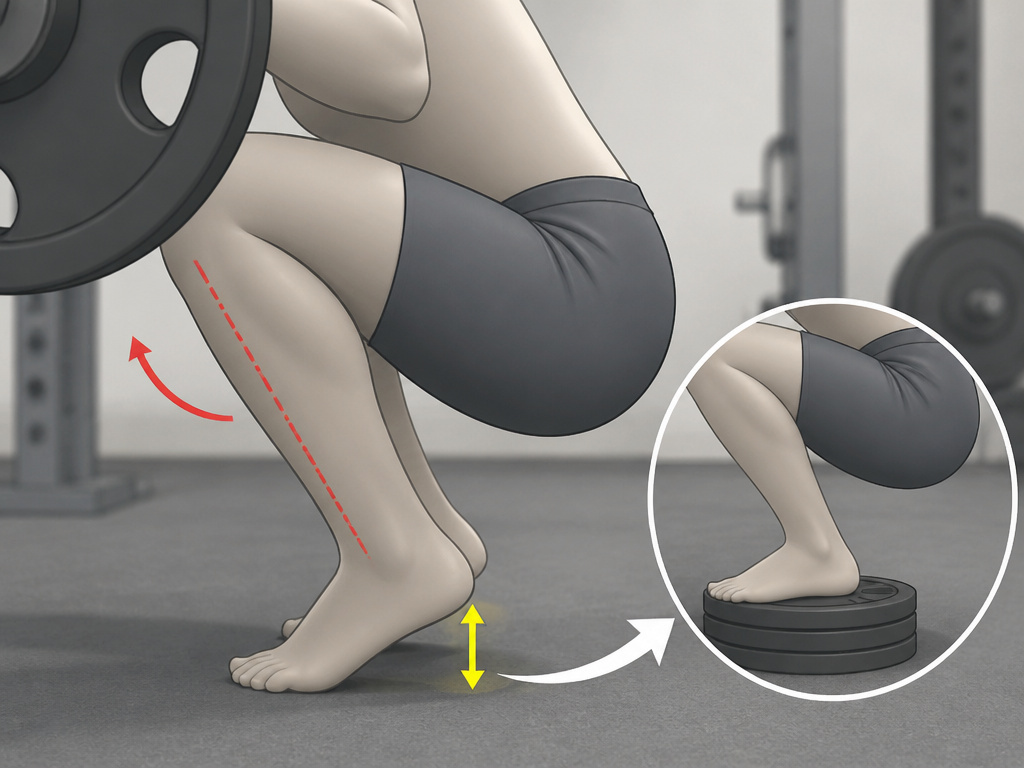
A lifter sets up, drops into the hole, and the heels come off the floor before the hips are anywhere near depth. The whole body drifts forward onto the balls of the feet, and the plates start to rattle as the bar path wanders.
That pattern has nothing to do with bar position and everything to do with ankle mobility. I have watched the same edge case play out with desk workers over and over: tight hips, tight ankles, and a squat that only reaches depth if the heels come up. Putting small plates under the heels for a few weeks usually gets them into a comfortable position while the mobility catches up.
The fix matters here because it changes which style feels available to you. A lifter who cannot hold an upright torso at depth will find high bar frustrating and low bar surprisingly comfortable, since the forward lean is built into the position. Coaches also use heel elevation to add range of motion and knee flexion, which pushes the lift back toward a quad emphasis regardless of where the bar sits. That is a coaching cue, not a measured finding, so treat it as a tool rather than a rule.
Whatever you do, hold the same squat depth in both styles. The IPF Technical Rules require the top surface of the thigh at the hip joint to sit below the top of the knee, and that standard does not move because you changed your bar placement.
Easy to miss: A small heel lift changes the squat more than a bar position change does. It buys range of motion and knee flexion, which is often the thing a stiff-ankled lifter was actually chasing.
How to switch styles without wrecking your progress
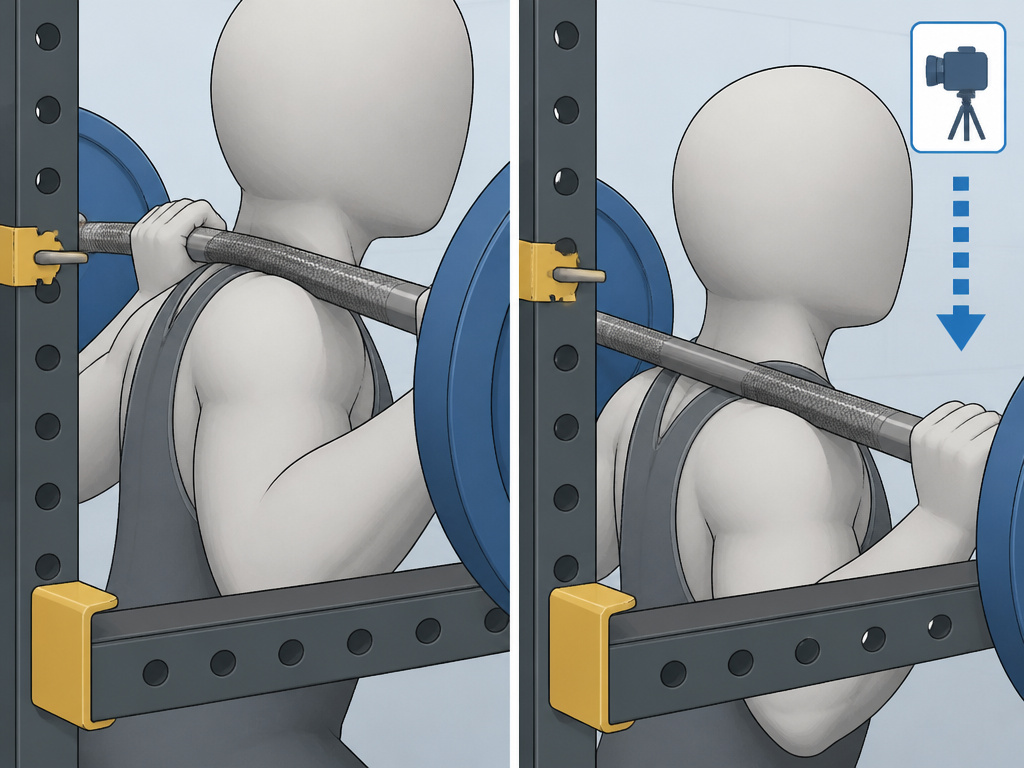
Three things break when people switch: load, depth, and patience. Fix them in that order.
Stronger by Science recommends at least a few months of squatting mostly or exclusively low bar to learn the motor pattern, which tells you the timeline involved. Establishing a new skill takes more practice than maintaining an old one.
- Cut the load for the first couple of weeks. The new position changes your mechanics, and holding your old numbers forces your body to cheat the rep. Skipping this step is how a style switch turns into a strained lower back.
- Set your safety bars before the first session, not after. A failed rep in an unfamiliar position is the one time you genuinely need them. Here is how to handle safety bars properly.
- Film one set from the side every session for the first month. Depth is the first thing to go when the bar moves, and you will not feel it happening.
- Learn to fail the rep before you need to. Knowing how to bail out of a squat removes the fear that makes people cut depth on a heavy single.
- Hold the new style for eight to twelve weeks before judging it. Two sessions tells you nothing except that the bar felt strange on your rear delts.
I won’t switch anyone’s bar position in the same month they’re chasing a PR. The load drops for two or three weeks while the pattern settles, and stacking a max attempt on top of that is how people get hurt.
Where this goes sideways: Cutting depth to make the new position feel easier. The bar moves down, the chest drops, and the squat quietly gets shorter without anyone deciding to cut it.
For a home setup, a rack with adjustable safeties covers both styles without you having to think about it again.
What to do if you compete, and what to do if you don’t
Competing changes the answer completely, and the sources split on exactly this point.
Stronger by Science is blunt about powerlifting: learn to squat low bar, because more weight can be moved and the sport measures weight, not torque. The same article argues there is no reason for a weightlifting or CrossFit athlete to ever squat low bar, since a more upright torso helps ingrain the catching position for cleans and snatches.
Kristiansen’s group lands in a similar place from the other direction. Their recommendation is low bar first when the goal is lifting the greatest load possible, and a safety-bar squat when the goal is greater gluteus maximus activity.
- Powerlifter: low bar, and give it a few months of near-exclusive use before you compete with it.
- Weightlifter or CrossFit athlete: high bar, with no real reason to change.
- General gym lifter chasing leg size: either one, chosen by which position your joints tolerate at depth.
- Lifter with cranky shoulders or wrists: high bar, because the low-bar rack position demands more external rotation than most people have.
If you compete, learn low bar and give it a few months. If you don’t compete, pick the one your joints tolerate and stop reading about it.
One more honest note. Men’s Health frames the high-bar squat as carrying a lower risk of back injury, and none of the peer-reviewed studies in this set measured injury rates at all. That claim is editorial, not evidence. If you want a broader menu of options, these squat variations cover the patterns worth rotating through.
Frequently Asked Questions
Is low bar squat better than high bar?
For moving the most weight, the evidence leans low bar: two peer-reviewed studies found significantly higher loads with low bar and Stronger by Science puts the typical gap at 5 to 10 percent, though Men’s Health reports no significant strength difference between high-bar and low-bar 3RM. For quad development or weightlifting carryover, high bar is the better fit, though Kristiansen et al. Recommend low bar first when the goal is lifting the greatest load possible.
Can I train both styles in the same program?
Yes, and plenty of strong lifters do. One lifter in a coaching interview described rotating high bar, low bar, front squat, Jefferson, and Anderson squats depending on the day. The catch is that switching mid-block makes it harder to track progress, so most people pick a primary style and use the other as a variation.
Does low bar squat hurt your shoulders?
It can, because the low-bar rack position asks for more shoulder external rotation than high bar. Lifters with stiff shoulders often cannot get the bar to sit below the traps without their wrists taking the load. If that is you, high bar is the simpler answer.
Which style is easier on the knees?
No study in this set measured knee injury rates, so any answer is a guess. What the data does show is that high bar involves greater knee flexion and low bar involves more forward lean and hip moment. If your knees complain, load management matters more than bar position.
How long does it take to get comfortable with a new bar position?
Stronger by Science recommends at least a few months of squatting mostly or exclusively in the new style to learn the motor pattern. Expect the rear delts to complain at first and the position to feel normal after some weeks of practice.
The Bottom Line
Here is the threshold I would actually use. If you compete in powerlifting, or your only question is how much weight you can put on the bar, learn low bar and give it a few months before you decide anything. If you don’t compete, the load difference is small enough that joint comfort and depth should decide it for you.
The thing most people skip is the depth check. Film one set from the side in each style before you commit. If one position allows you to hit the same depth with less heel lift and less forward drift, that is your answer regardless of what any study says about group averages.
One concession worth stating plainly: everything above assumes a lifter with reasonable ankle and hip mobility. If your heels come up in an empty-bar squat, fix that first. Bar position is a detail compared to a squat you can actually get to depth in.
Do this today: film one set from the side, note where the bar sits, and write down whether your heels stayed down.
