
Gym Etiquette for Beginners: What Actually Matters
This post contains affiliate links. As an Amazon Associate, we earn from qualifying purchases.
Gym etiquette for beginners rests on three habits: put every weight back where you found it, wipe the bench down when you finish, and don’t hold a machine through a long rest. Beyond those, policies are local. Peak-hour time limits, phone rules, and filming rules differ enough between gyms that you have to read your own facility’s sheet.
Those local rules carry real weight. Appalachian State’s employee wellness program treats facility access as a privilege tied to following the published rules, and it enforces that through a progressive conduct process that starts at the first violation. A beginner who ignores the gym etiquette for beginners sheet is collecting strikes, not just dirty looks.
Three habits, four genuine disagreements, and one sentence that defuses a rack standoff. That’s the shape of what’s below.
Key Takeaways
- Re-rack everything before you leave the station. Weights left on a bar or the floor create a trip hazard, and at Appalachian State re-racking is a written rule.
- Offer the work-in once your rest runs longer than a set. Nike’s trainers describe idling at a machine during a long rest as “camping,” while Appalachian State encourages members to let others work in between sets whenever practical and to ask first.
- Check the peak-hour limit before you start cardio. Trinity College Dublin caps cardio machines at 15 minutes at peak times, and Appalachian State caps machines at 10 to 15 minutes including rest.
- Wipe down after, and increasingly before. Blink Fitness trainer Ellen Thompson notes more members now clean machines before use, not just after.
- Read your own facility’s sheet once. Phone and filming policies swing from “not permitted at all” to “allowed if you’re discrete.”
The Three Habits That Cover Most of Gym Etiquette for Beginners
Rack the weight, wipe the bench, release the machine. Do those three and you’ll avoid nearly every complaint other members actually make.
Re-racking means returning dumbbells to the rack in order, stripping plates from bars and returning them to the trees, and putting collars, clips, and bands back on their hooks. Equipment left loaded or on the floor creates a trip hazard and forces the next member to unload another person’s work before starting a set.
The re-rack rule shows up in nearly every published policy set. Appalachian State files it under “Re-Rack = Respect” and adds separate lines about never dropping dumbbells and not slamming weight stacks. Georgetown’s recreation team asks members to return weights to where they got them from, or to ask a Fitness Attendant if they find weights where they don’t belong.
There’s a mechanical reason behind the courtesy. A loaded bar or a plate on the floor is a trip hazard, and staff have to clear it before the next person can work. Re-racking weights properly costs less time than the set did.
The Cleveland Clinic gym etiquette guide opens on the reason this matters so much: uncertainty about the rules is enough to keep beginners from walking through the door at all.
Common mistake: Wiping the bench and walking off with the plates still on the bar. The next person has to unload your work before they can start theirs, and at peak hours that’s the specific thing people get angry about.
How Long Can You Stay on a Cardio Machine?
Fifteen minutes at peak, unlimited when the gym is quiet. That’s Trinity College Dublin’s rule, and it’s one of the few written down with a hard number attached.
| Facility | Stated limit | When it applies |
|---|---|---|
| Trinity College Dublin | 15 minutes | Peak times, cardio machines |
| Appalachian State (HPFS) | 10 to 15 minutes | Per machine, including rest periods |
| Brookhaven National Laboratory | 20 minutes | Cardio machines |
| South Tyneside Council | 20 minutes | Any equipment, busy periods |
| Monash University | No fixed number | A limit may be applied at peak |
Read that table again if you’re a beginner. The gap between 10 and 20 minutes is the difference between finishing your session and getting asked to move.
Trinity’s policy also spells out the other half: if the gym isn’t busy, stay on the cardio machines as long as you like. The limit exists for turnover, not for punishment. If you want a long session, go when it’s quiet.
Appalachian State’s version is stricter in one specific way. Its 10-to-15-minute cap includes rest periods, so a slow walk between intervals still eats the clock. The South Tyneside workout etiquette guidelines apply a 20-minute cap to any equipment during busy periods, which is the most generous number in this set.
Facility documents like the Brookhaven Lab gym etiquette rules are worth ten minutes before a first visit. They’re where the real numbers live.
Before you start: Two hazards worth naming. Stripping plates from one side of a loaded bar first will tip it, and the far collar can swing into your shin. Letting a dumbbell fall instead of setting it down is a written violation at facilities like Appalachian State, and it’s how floors and toes get damaged. Unload evenly, one plate per side.
Sharing Equipment: One Sentence Ends Most Standoffs
A beginner loads the bar, grinds out five reps, then sits on the bench for four minutes because the room is still spinning a little. Someone else is waiting. Nobody says anything, and everybody is annoyed.
I’ve watched that pattern end two ways. The person quits, or someone finally snaps at them. Now I tell beginners to never lift a weight that is too heavy for them, and the rest periods shrink on their own.
Here’s where the published rules get interesting. Appalachian State bans circuit training and supersets outright at Levine Hall Lab because the facility is small, and bans them at Varsity Gym from 11:00 a.m. To 2:00 p.m. And whenever two or more participants are actively using the space. The App State gym etiquette policies also encourage members to let others work in between sets whenever practical, and to ask first.
Nike’s trainers take a softer line. If your rest between sets is very short, staying put at the machine is fine. If your rest is long enough for someone else to finish a set, that’s camping, and you should let them in.
Both positions are reasonable. They just apply to different rooms.
The Work-In Script
The whole exchange is quick. Here’s the sequence:
- Wait until the person finishes a set and racks the weight. Interrupting mid-set is the one thing every source agrees on, including Trinity College Dublin, which asks members to wait until the set is finished before asking anything.
- Ask a closed question: “How many sets do you have left?”
- If the answer is two or more, offer: “Want to work in while I rest?”
- Step back from the bench while they take their set. Standing over them defeats the purpose.
If they say no, let it go. You’ve lost nothing, and you now know how long the wait is.
When Two People Want the Same Rack
Squat racks are the worst offender because there’s usually one. Good squat rack etiquette comes down to a single habit: ask before you unload someone’s bar, and never strip plates you didn’t put on. If the bar is loaded and nobody’s standing there, ask before you unload someone’s bar rather than assuming it’s abandoned.
Nike’s trainers say that if your rest period is long enough for someone else to complete a full set, you should offer the machine, while Appalachian State encourages members to let others work in between sets whenever practical and to ask first.
Asking for a spot follows the same logic. Trinity requires a spotter for heavy lifts and specifies that the spotter must actually be capable of handling the weight, so asking for a spot means asking someone who can lift it, not the nearest person on their phone.
Wiping Down Equipment Takes Less Time Than the Set Did
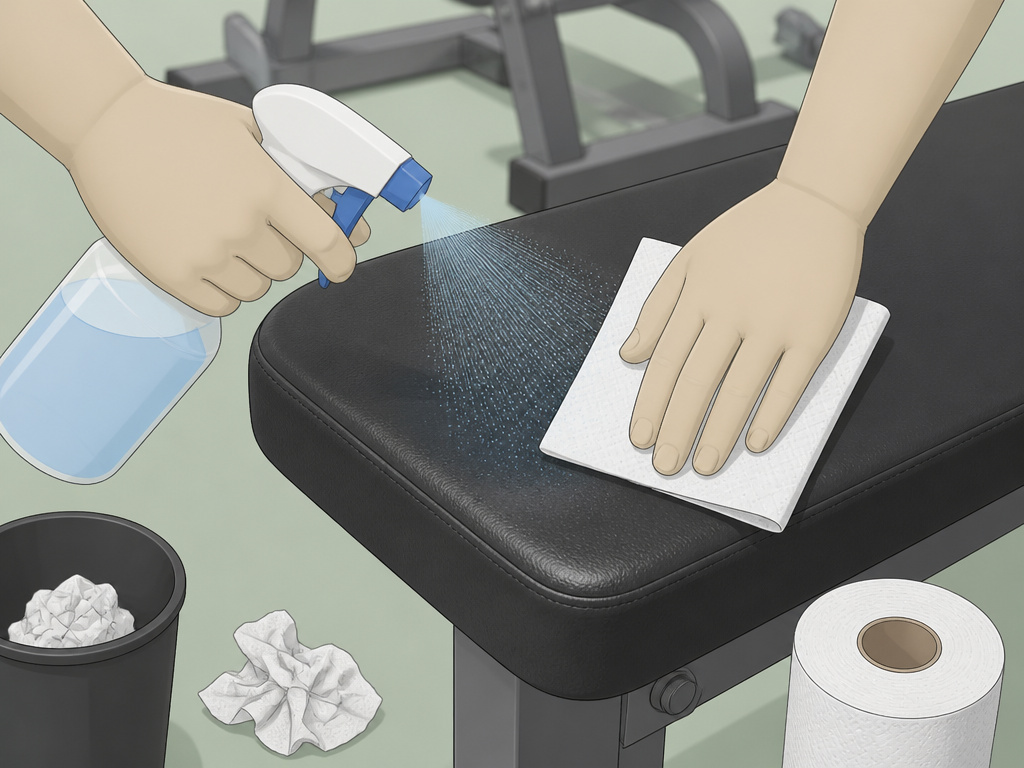
Spray, wipe, done. The whole job runs about as long as re-racking your plates, and it’s the habit that separates a beginner who gets nods from one who gets stares.
The specifics vary by building. Appalachian State provides Virex spray bottles and Wypall towels throughout its facilities. Georgetown keeps Gym Wipe stations around the floor. If your gym stocks nothing, bring your own wipes in your bag.
You’ll know a machine hasn’t been wiped because the pad stays cold and slightly tacky under your forearm. That film is somebody else’s set. Georgetown’s recreation team points out that wiping down equipment after use helps reduce the spread of infections and illnesses, which is the practical case for it.
What to Actually Use
- Facility spray and paper towel first. Virex and a Wypall is the combination Appalachian State supplies, and it’s designed for the equipment you’re on.
- Your own wipes as backup. Bring your own wipes so you can clean equipment when the facility stocks nothing.
- Never a soaked towel. Excess liquid runs into the pad seams and the frame joints, and it sits there.
- Toss the wipe in the bin. Blink Fitness’s Ellen Thompson notes members now toss wipes in trash cans instead of leaving them on or near machines. That last part is the whole difference.
The gym hygiene rules that actually get enforced are short: wipe what you touched, and don’t leave the evidence behind.
One thing I’ve changed my mind on: I used to wipe only after. Now I do a quick pass before, especially on anything with a pad. It takes very little time and it’s the single easiest upgrade a beginner can make.
A few facilities go further and tie access to what you bring, so the Monash University fitness centre etiquette sheet is worth a look before a first session if your gym is affiliated with a university.
Is It Rude to Use Your Phone Between Sets?
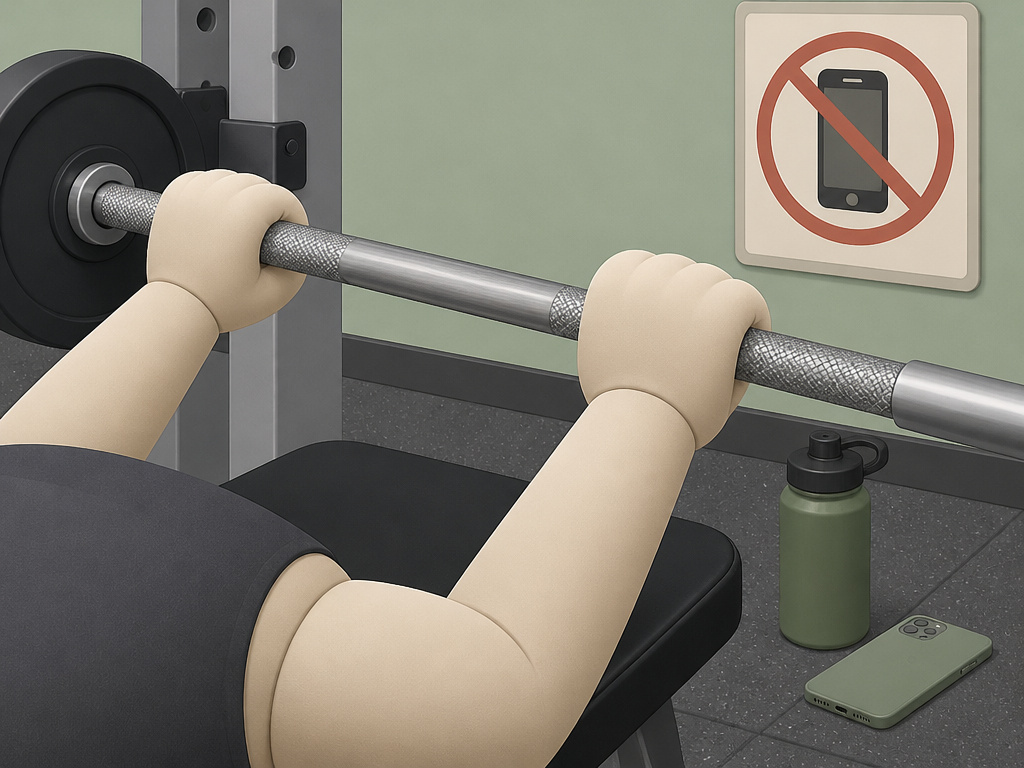
Depends entirely on the building, and this is the rule where published policies diverge the most.
Trinity College Dublin bans mobile phones in the gym outright, for the consideration and privacy of other members. Appalachian State allows phones but asks members to take calls in private spaces. Georgetown wants calls moved to the lobby or lounge, and specifically asks members not to sit on a machine while texting. Nike’s position is the loosest: phone use on its own isn’t bad etiquette, and it only becomes disrespectful when you’re blocking equipment or camping between sets.
Filming splits the same way. Appalachian State prohibits recording video during facility use. Georgetown permits photography and video as long as it doesn’t interrupt other members or create a safety risk, and asks members to be discrete. Nike discourages the workout photoshoot because filming tends to keep you on equipment longer than necessary.
So “is it rude” has no universal answer. Check your sheet.
The short version: If your gym has no posted phone policy, default to Nike’s line. Scroll off the floor, never while holding a machine, and take calls outside the training area.
Here’s the diagnostic version, since most awkward moments follow a predictable path:
| What you notice | What’s probably happening | What to do |
|---|---|---|
| Someone hovering near your bench | Your rest is longer than their set | Offer the work-in and step back |
| A member glaring at your phone | You’re on it while holding equipment | Move off the floor to scroll |
| Staff asking you to stop filming | Recording is banned outright here | Put the phone away and ask about the policy |
| Nobody re-racking around you | Peak hour, thin staff presence | Re-rack yours anyway |
If you want the longer version of the phone question, the phone rules at the gym break down by facility type.
When Someone Else Breaks the Rules, Say This
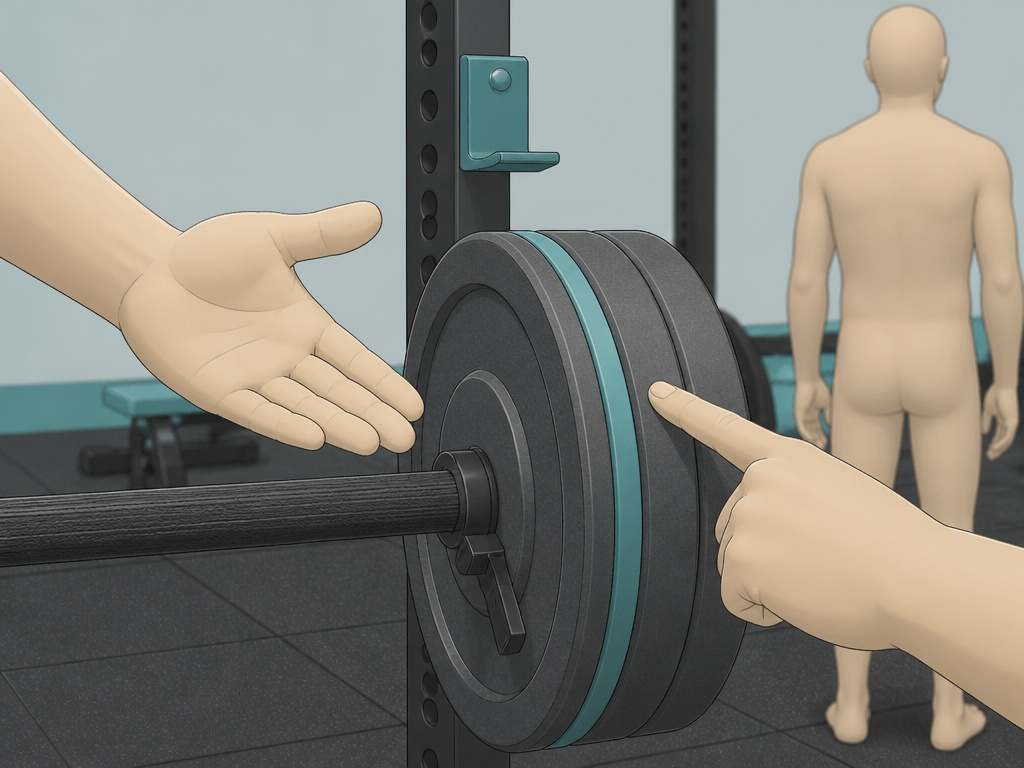
Say one sentence, calmly, and then drop it. That’s the whole strategy.
The reason to keep it short is that most rule-breaking in a gym is absent-minded rather than hostile. Someone left a bar loaded because they got a phone call. Someone’s sitting on the leg press scrolling because they genuinely forgot other people exist for a minute. I’ve done both.
Start with the smallest possible ask. “Mind if I work in?” handles a camper. “Are you using this plate?” handles a hoarder. “Could you re-rack when you’re done? I need that bar” handles the loaded-bar problem without an accusation in it.
- Ask once, plainly. No sighing, no pointed staring, no repositioning their equipment.
- Give them the easy out. “No worries if you’re mid-set” costs nothing and keeps it friendly.
- Escalate to staff only if it repeats. Appalachian State’s conduct process starts at a first violation, so staff do have a path. Use it for a pattern, not a one-off.
- Skip it entirely if you’re not safe. If someone is aggressive, walk away and find an attendant. No rack is worth a confrontation.
Skip this if: The person is clearly mid-set or wearing headphones and focused. Wait until they rack the bar. Interrupting a working set is the one breach every source, from Trinity College Dublin to Nike, agrees is worse than the original problem.
The full playbook for handling gym conflict covers the cases where a single sentence doesn’t land.
Frequently Asked Questions
Do I need to bring my own towel to the gym?
It depends on the facility. Some require one for access, others supply spray and paper towels at no cost. Appalachian State provides Virex spray bottles and Wypall towels throughout its facilities, and Georgetown has Gym Wipe stations around the floor. If your gym stocks nothing, bring a small towel and your own wipes.
Is it OK to ask someone how many sets they have left?
Yes, and it’s the standard opener. Wait until they finish the set and rack the weight before you ask. Trinity College Dublin’s policy explicitly asks members not to interrupt people mid-set by talking or asking a question. One short question after a set is normal gym conversation.
What happens if I break a gym rule?
At most facilities, nothing dramatic at first. Appalachian State runs a progressive conduct process that begins with a first violation and treats facility access as a privilege tied to following published rules. In practice, staff will usually just tell you. The bigger cost is social, and it’s easy to avoid by reading the sheet once.
Can I film my sets for form checks?
Check your facility first. Appalachian State prohibits recording video during facility use. Georgetown allows photography and video as long as it doesn’t disrupt other members or create a safety risk, and asks members to be discrete. Nike’s trainers discourage filming during a workout because it keeps you on equipment longer and can capture people who don’t want to be filmed.
Why do people get annoyed when I rest on a machine?
Because your rest blocks their set. Nike’s trainers describe a long rest at a machine as camping and say to let someone work in if your rest is long enough for them to complete a set, while Appalachian State encourages members to let others work in between sets whenever practical and to ask first.
Are supersets allowed in a gym?
Often not, and the rules are specific. Appalachian State bans circuit training and supersets entirely at Levine Hall Lab due to the facility’s limited size, and bans them at Varsity Gym during 11:00 a.m. To 2:00 p.m. Or whenever two or more participants are actively using the space. Nike’s guidance allows a circuit only if you invite others to use the machines you’re not on.
The Bottom Line
You don’t need to memorize a rulebook. Read your facility’s sheet once and check exactly two things: the peak-hour window, and whether phones are allowed on the floor. Those are the two that vary most between buildings and cause the most friction.
One thing to try this week: time your rest between sets on the machine you use most. If it runs long enough for someone else to finish a full set, that’s your work-in window, and offering it costs you nothing but a few seconds of standing.
The concession worth stating plainly: rules vary by facility. Appalachian State bans supersets outright at Levine Hall Lab regardless of how empty the room is, purely because of floor space, while Nike’s trainers say staying put is fine on very short rests and Appalachian State encourages members to let others work in between sets whenever practical and to ask first.
Keep it simple and keep showing up. The etiquette follows once the habit does.
