
Boutique Fitness Studio vs Gym: Which Should You Join?
This post contains affiliate links. As an Amazon Associate, we earn from qualifying purchases.
In the boutique fitness studio vs gym choice, a boutique sells small coached classes in a compact space, while a gym sells open-floor access for a monthly fee. Boutiques win on attention and accountability. Gyms win on price, hours, and equipment variety. Trial both before you sign.
The compact part is measurable in the boutique fitness studio vs gym question. Club-Intel’s report on the boutique studio industry puts the average US fitness studio at roughly 3,600 sq ft, with 75% of them under 5,000 sq ft. That’s smaller than most people picture when they hear the word studio.
What follows is the comparison that actually moves the decision: class size and coaching ratios, the cost structure behind each billing model, the equipment that separates the two, and a one-week test you can run before you pay for anything.
Key Takeaways
- Class size is the product. Published caps for boutique groups run from 4 people per coach up to 20 members per class, depending on who’s setting the number.
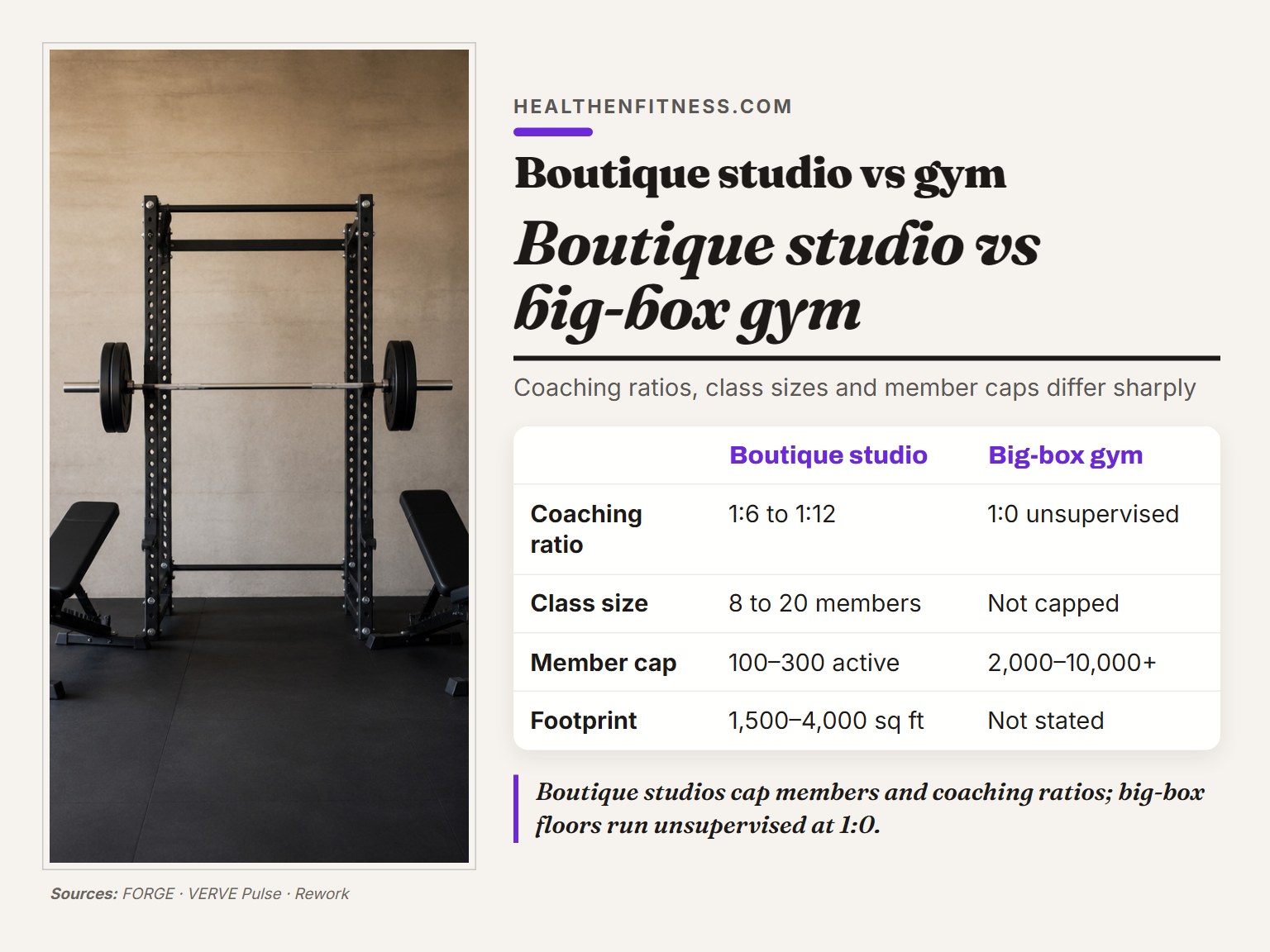
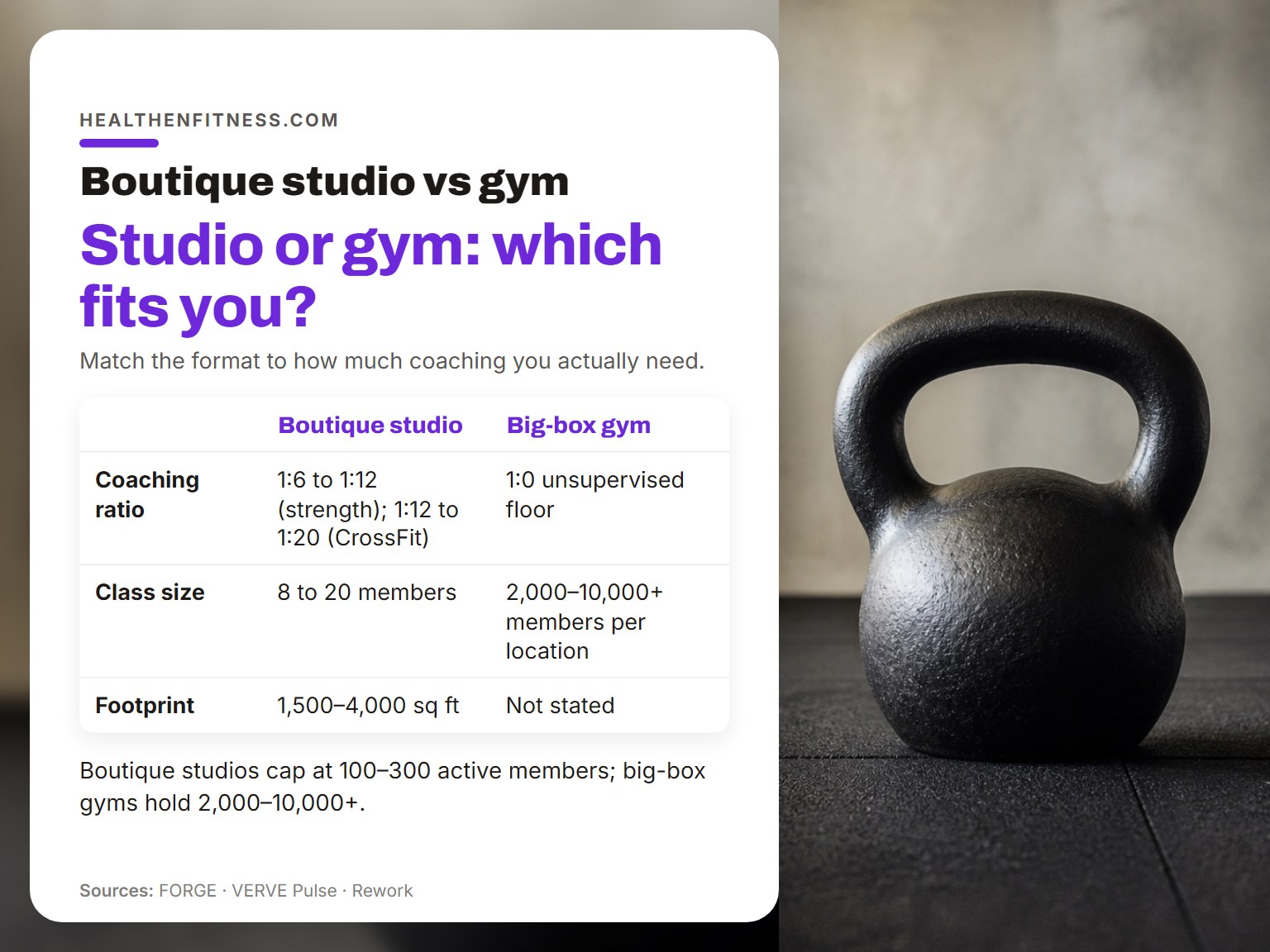
- Coaching ratios split the formats. FORGE puts boutique strength studios at 1:6 to 1:12, CrossFit boxes at 1:12 to 1:20, and unsupervised gym floors at 1:0.
- Billing shapes differ. Boutiques charge per class, gyms charge per month, so the two headline numbers aren’t the same unit.
- Staff is the biggest line item. Wages represent 44% of total revenue in the studio industry, per the Hapana/McCrindle survey.
- Test at your real training hour. Rack availability at 6pm tells you more than any guided tour at 11am.
What Actually Separates a Boutique Studio From a Gym
Club-Intel’s industry report is the closest thing this category has to a hard number. The average US fitness studio ran about 3,600 sq ft in 2017, and 75% came in under 5,000 sq ft.
A boutique studio is defined by size and coaching density rather than by branding. Club-Intel puts the typical boutique under 10,000 sq ft, with 75% of US studios under 5,000 sq ft and an average of roughly 3,600 sq ft. Technogym draws the line at 400 sq m, about 4,300 sq ft.
That second definition matters. Technogym’s newsroom describes a boutique as under 400 sq m total, with most of the floor given to activity space and reception cut down to a small desk. Two more sources widen the gap: Rework puts the typical boutique footprint at 1,500 to 4,000 sq ft, and VERVE Pulse, an Australian equipment supplier, says 80 to 250 sq m.
| Source | How it defines a boutique | Class or coaching ratio |
|---|---|---|
| Club-Intel (AFS data) | Under 10,000 sq ft; 75% under 5,000 | Not specified |
| Technogym | Under 400 sq m (about 4,300 sq ft) | Not specified |
| Rework | 1,500 to 4,000 sq ft typical | 100 to 300 active members |
| VERVE Pulse | 80 to 250 sq m | 8 to 20 members per class |
None of these is a standard. They’re trade estimates from parties with different incentives, and the spread is wide enough that “boutique” tells you almost nothing about the room you’re walking into.
The part nobody mentions: A 4,000 sq ft studio and a 9,000 sq ft studio both call themselves boutique. Ask for the floor plan before you compare class counts, because the same class size feels very different in each.
Boutique Fitness Studio vs Gym: Who Wins Each Goal
Pick by goal.
A big box gym runs on volume. That’s why the floor is unsupervised, the hours run long, and nobody notices if you skip a month. FORGE’s comparison puts the coaching ratio on an unsupervised big-box floor at 1:0, which is a polite way of saying there’s no coaching at all.
A boutique runs on retention. The model depends on you coming back, so the operator has a reason to keep classes small and coaches familiar.
| Factor | Boutique studio | Big-box gym |
|---|---|---|
| Class size | 4 to 20, capped by design | Larger and more variable |
| Coaching | 1:6 to 1:12 in strength studios | 1:0 on the open floor |
| Billing | Per class or class pack | Monthly membership |
| Equipment | Few pieces, chosen for the format | Wide variety, queues at peak |
| Commitment | Fixed times, book ahead | Walk in whenever |
| Best for | Beginners, accountability | Self-directed lifters |
Where the gym floor wins
Equipment variety, hours, and price. A gym can stock a leg press, a hack squat, five benches, and a cardio line because the cost spreads across thousands of members. Rework notes that big-box locations can carry 2,000 to 10,000+ members, while boutiques typically cap somewhere between 100 and 300 active members.
If you already know your program and you train at odd hours, that spread works for you. I’d take a quiet floor with two racks over a packed one with twelve.
Where the small room wins
Beginners. Not because beginners are fragile, but because a new movement pattern needs eyes on it. Amrita Yoga & Wellness makes the operator case that small classes let an instructor see and correct form mid-class. That’s a studio’s own claim, so weigh it accordingly, but it lines up with what the ratio numbers imply.
There’s a real cost to the studio side too. Fixed class times mean booking ahead, and a missed booking is a missed session.
So How Many People Are Actually in the Room With You?
The honest answer is that nobody agrees, and the published numbers run from 4 to 20.
- Boutique Fitness caps small-group training at 4 people per coach, with private training at 1:1.
- PEAKFIT Studio in Asheville caps group sessions at 4 to 8 members.
- FORGE puts boutique strength studios at 1:6 to 1:12 and a CrossFit box at 1:12 to 1:20, against 1:0 on an unsupervised gym floor.
- VERVE Pulse says 8 to 20 members per class, which is a very different experience from a room of four.
- LMCC Fitness splits it further: 8 to 16 per semi-private session, and 5 to 15 in the space at peak for a strength or cardio studio.
Why the published class sizes disagree
Three reasons. First, “small group” means different things to a personal training studio and a group class operator. Second, several of these sources sell equipment, and a smaller class number makes the equipment budget look better. Third, ratio and headcount aren’t the same measure: a 1:12 ratio with two coaches on the floor is 24 people.
You can hear the difference before you count anyone. In a six-person room the coach’s shoes squeak on the rubber between cues, and a correction lands mid-rep. In a thirty-person class the music covers the floor and the cue arrives after you’ve finished the set.
Ask two questions on the tour: what’s the class cap, and how many coaches are on the floor at that cap.
The Cost Gap Isn’t Where You Think It Is

Staff wages eat 44% of total revenue in the fitness studio industry, according to the Hapana/McCrindle survey of 324 US studio owners and managers.
That one line explains more about studio pricing than any equipment list. A studio running a 1:6 ratio needs one coach for every six people in the room. A gym with one floor attendant for 400 members doesn’t.
Sources don’t fully agree on what drives the rest. Amrita Yoga & Wellness attributes the higher studio cost to low instructor ratios and specialized equipment. Rework attributes it to premium pricing and identity, arguing that studios charge more because the experience signals quality. Both can be true at once, and neither has published a cost breakdown that settles it.
The billing shape matters as much as the total. Boutiques charge per class or in class packs. Gyms charge monthly. Comparing a class price to a monthly fee is comparing a session to a subscription, and the gym membership math only works once you know how often you’ll actually go.
What most people get wrong: Comparing a per-class price to a monthly fee as if they’re the same unit. Three studio sessions a week is a different commitment from one monthly debit, and which one looks cheaper depends entirely on attendance.
One more thing. A premium gym with a spa and a juice bar doesn’t make you stronger. You’re paying for amenities, and amenities don’t spot your bench.
Studios have a version of the same problem. PEAKFIT markets infrared sauna, red light therapy, and body composition tracking as the boutique differentiator for adults over 40. No equipment manufacturer in this research supports recovery tech as a defining feature of the category, so treat that as one operator’s positioning rather than a rule.
Equipment Is Where the Two Formats Really Diverge
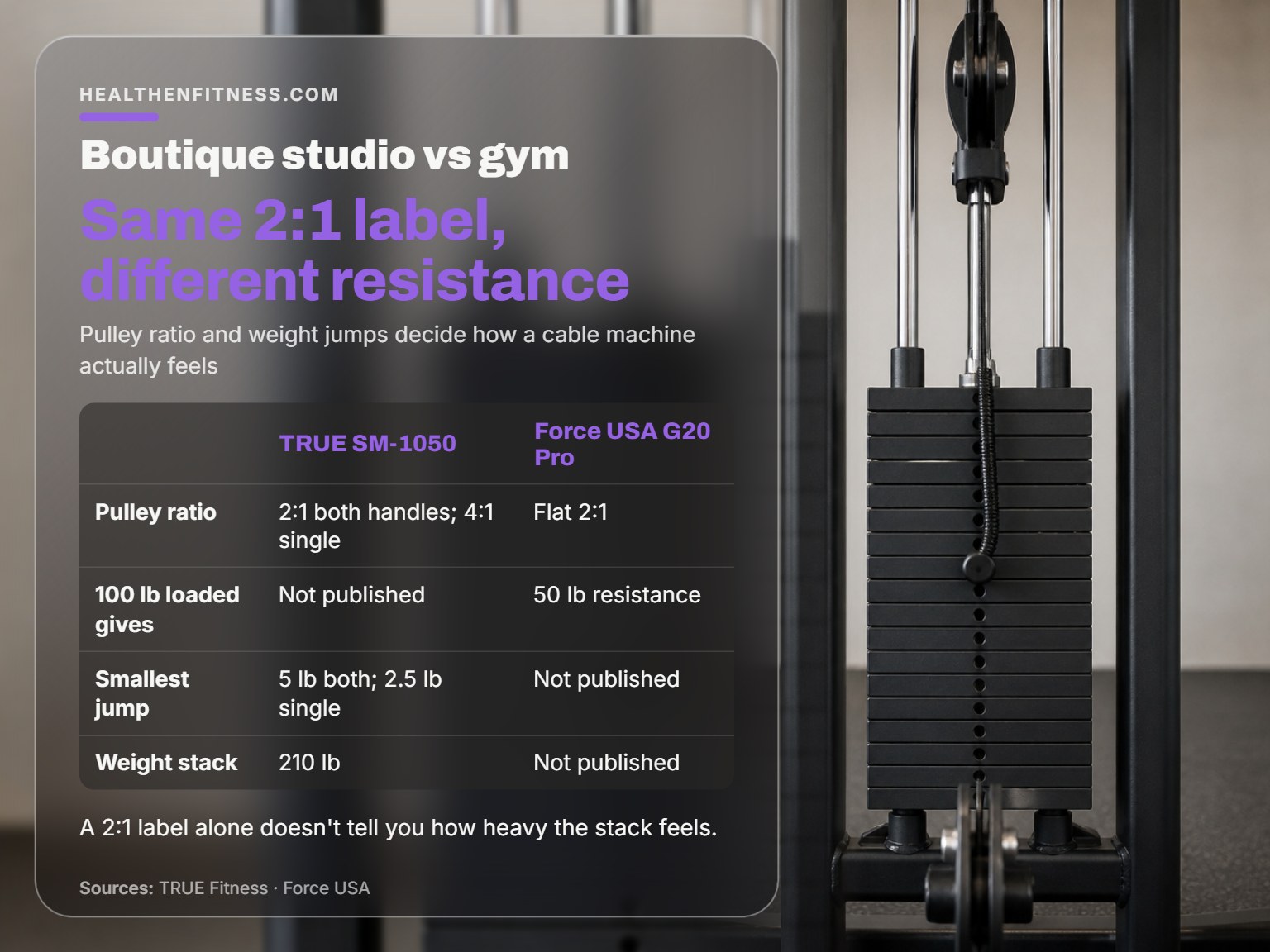
A functional trainer’s pulley ratio decides how heavy the stack actually feels.
TRUE Fitness publishes a 2:1 resistance profile on the SM-1050 Quickfit Pro with both handles, and 4:1 with a single handle. Force USA publishes a flat 2:1 on the G20 Pro, where 100 lb loaded gives 50 lb of resistance. Same category on the label, different math underneath.
The pulley ratio problem nobody mentions
Two machines both sold as 2:1 aren’t necessarily the same machine. TRUE’s number changes with the handle configuration. Force USA’s doesn’t. If you’re comparing a studio’s cable station to the one at your gym by feel, you’re comparing two resistance models.
Judge a cable machine by the smallest jump it allows, not the biggest number on the stack. TRUE’s SM-1050 moves in 5 lb increments with both handles and 2.5 lb with one, which is a usable range for a beginner. A stack with coarse steps forces you to load past what you can control.
Durability is the other half. Force USA markets the G3 as a near-commercial all-in-one. BarBend’s hands-on review disagrees, calling it not quite commercial-grade and smaller than most functional trainers by design. The spec sheet holds up either way: 11-gauge steel, a 992 lb unit rating, and a lifetime frame warranty.
Bench claims are worth checking too. Technogym sells the Bench as a workout bench. Men’s Health UK’s test says it isn’t a true weight bench at all, with no incline, no decline, and no adjustable seat. Technogym’s own listing doesn’t publish a maximum capacity.
For a small studio floor, the FITBENCH Studio is the more honest version of that idea: a 6 sq ft footprint, a 1,000 lb capacity, and 8 incline positions that actually adjust.
Four things to check on any machine before you build a program around it:
- Smallest weight jump. A stack that moves in 5 lb steps lets a beginner progress. One that jumps in big blocks doesn’t.
- Adjustability you’ll use. Eight incline positions only matter if the bench is stable at each one.
- Footprint against class size. A 6 sq ft bench in a room with 12 people is a trip hazard.
- Warranty split. Frame, parts, and labor usually run on three separate clocks.
LMCC Fitness, which builds and ships studio equipment, applies a rule that cuts through most of this: if a piece won’t be used 20+ hours a week in peak season, leave it off the order.
A cable stack that’s been used hard sounds hollow at the bottom of the travel, a dull clank instead of a clean stop. That’s usually a worn pulley, and it’s the first thing to check on a used machine.
How to Test a Studio or Gym in One Week
Three things decide whether a place is worth joining: the hour you’d really train, the coach in the room, and the exit terms.
Everything else is decoration.
Before you start: Unfamiliar rack heights and bench settings are where first-week tweaks happen, so set the pins before you add weight. A coach who hasn’t seen you move can’t correct a pattern you brought in with you. Book a form check before your first loaded session, not after.
- Train at your real hour. Visit at 6pm on a Tuesday, not 11am on a Saturday. FORGE notes that unsupervised big-box floors run at a 1:0 coaching ratio, so at peak you’re waiting for equipment with no coach to help. If that’s your hour, that wait is your program.
- Count the racks and the dumbbells. Two racks for 400 members is a scheduling problem. So is a dumbbell rack that skips from 25 lb straight to 40 lb.
- Ask for the class cap and the coach count. If the answer is vague, that’s the answer.
- Read the exit terms. Month-to-month and annual contracts behave very differently when your schedule changes. Ask what happens if you move or get hurt.
- Take one class and one open-floor session. The class tells you about coaching. The open session tells you about the room.
Most of choosing a gym comes down to step one, and most people skip it. The 2pm tour and the 6pm floor are effectively two different buildings.
Use the same approach you’d take to find a gym near you: check the location at your actual commute time, not on a map at your desk.
I’d rather see a beginner join a plain room with two racks and a coach who knows their name than a club with a spa and nobody on the floor. The equipment matters less than whether someone corrects your setup in week one.
Which One Should You Join?
Match the format to how much coaching you actually need.
Choose the studio if
- You’re new to lifting or coming back after years off, and you want someone watching your setup.
- You’ll show up for a booked class but not for an open floor. Accountability is the actual product.
- You want one discipline done well, whether that’s reformer Pilates, spin, or barbell strength.
- You can commit to fixed times. If your calendar moves weekly, the booking model fights you.
Choose the gym if
- You already know your program and you don’t need cues.
- You train at odd hours and want the place open when you get there.
- You want equipment variety: a leg press, a hack squat, and a cardio line in one room.
- You’d rather book a personal trainer occasionally than pay for coaching on every visit.
A hybrid sits between the two, and it’s the fastest-growing answer. Rework describes boutique studios adding open-access hours to fill the dead time between class blocks, and hybrid members paying for coached sessions plus floor access. If you want both, ask whether the studio sells open-floor hours separately.
If you want one answer and you’re new to this: join the smaller place with a coach who learns your name, even if the equipment is older. If you already train consistently and know what you’re doing, a modest local gym with two racks and a full dumbbell set covers almost everything.
Frequently Asked Questions
Is a boutique fitness studio worth the extra cost?
Only if you use the coaching. The premium pays for a low instructor ratio and a capped class, so the value shows up in corrections you actually receive. If you’d rather train alone with headphones, you’re paying for a service you won’t use.
How many people are usually in a boutique class?
Published caps range from 4 people per coach up to 20 members per class, depending on the operator and the format. Ask for both the class cap and the number of coaches on the floor, because those two numbers together tell you the real ratio.
Can you get the same results at a regular gym?
For strength and general fitness, yes, provided you know how to program and you actually show up. Where the gym falls short is technique correction, since the floor ratio is effectively 1:0. That gap is what a single personal training session a month can cover.
What size counts as a boutique studio?
It depends who you ask. Club-Intel draws the line under 10,000 sq ft, Technogym says under 400 sq m (about 4,300 sq ft), Rework says 1,500 to 4,000 sq ft typical, and VERVE Pulse says 80 to 250 sq m. There’s no agreed standard.
Do boutique studios offer open gym access?
Some do, and it’s becoming more common. Rework describes studios adding open-access hours to fill the gaps between class blocks, which also gives class members a way to train on their own schedule.
Before You Go
Here’s the threshold that settles most of these decisions: if a studio can’t tell you its class cap and its coach-to-member ratio in one sentence, that’s your answer. A place that runs small classes knows the number by heart.
Fair warning on the other side. A gym that looks well stocked at 11am can be unusable at 6pm, and the tour never shows you that.
One thing to try this week: book a single drop-in class at the studio and a day pass at the gym, both at the hour you’d actually train. Then compare how the room felt, not how the website looked.
This all changes if you’re training for a meet or a specific sport. Neither format is built around peaking for a date on a calendar, and that’s a conversation for a coach who works with competitive lifters.
Keep it simple and keep showing up.
