
Types of Workout Splits Explained: Which Fits Your Week?
This post contains affiliate links. As an Amazon Associate, we earn from qualifying purchases.
The main types of workout splits explained here are full-body, upper/lower, push/pull/legs, body-part, and five-day plans; a 2024 meta-analysis of 14 studies found split versus full-body training made no significant difference to strength or muscle growth when weekly volume was equated.
That qualifier, when weekly volume was equated, is carrying most of the weight in that sentence. Match the sets and the label on your program stops predicting much. Mismatch them and the label tells you nothing about why you stalled in week five.
What follows walks through the five splits you’ll actually see in a gym, what each one demands of your week, and where the published sources flatly disagree with each other.
Key Takeaways
- Volume-matched comparisons show no clear winner between split and full-body training, so pick the schedule you’ll actually repeat.
- Twice-weekly frequency per muscle group is a structural point NASM and Lift Vault both land on.
- A 3-day PPL and a 6-day PPL are different programs. Fitsly puts the 3-day version at once per muscle per week.
- Collapsing a bro split into 3 days can push sessions past 2 hours, per NASM’s own write-up.
- 48 hours between sessions for the same muscle is Healthline’s stated recovery floor, and it’s the number most split templates quietly break.
What the Research Says About Split vs Full-Body
Fourteen studies. One mean difference of 1.19 kg.
Across 14 studies, split training differed from full-body training on bench press strength by a mean difference of 1.19 kg, 95 percent confidence interval -1.28 to 3.65, p = 0.34. That interval crosses zero, so the finding is not statistically significant.
Ramos-Campo and colleagues published that comparison in 2024, and it remains a peer-reviewed head-to-head split versus full-body training meta-analysis. Read the confidence interval before you read the headline.
What the Meta-Analysis Actually Measured
The bench press number is the one everybody quotes. The rest of the data tells the same story.
Lower-limb strength came out at a mean difference of 2.47 with a 95 percent interval of -2.11 to 7.05 and p = 0.29 across 14 studies. Elbow extensor cross-sectional area landed at 0.30 [-2.65, 3.24], p = 0.84, across 4 studies. Elbow flexors: 0.17 [-2.54, 2.88], p = 0.91, across 5 studies. Vastus lateralis: -0.08 [-1.82, 1.66], p = 0.93, across 5 studies.
Every single interval crosses zero. If you want one sentence to screenshot, this is it.
Match the weekly sets first, then argue about the split. Two plans with the same volume land in the same place on average, so the tiebreaker is which one you’ll actually attend.
NASM doesn’t quite agree, and it’s worth knowing that before you pick a side. Their upper/lower guide frames the split as more focused and recoverable than full-body training at higher frequencies, which implies split superiority once you train often enough. The meta-analysis finds equivalence. Both positions are on the record, and neither is a misreading of the other.
The Five Main Types of Workout Splits Explained in One Table
Here’s the whole taxonomy in one place, with the weekly shape each source actually describes.
| Split | Typical week | Frequency per muscle | Best fit |
|---|---|---|---|
| Full-body | 3 to 4 sessions | 2 to 3 times | Beginners, 2 to 3 days |
| Upper/lower | 4 days, 2 upper and 2 lower | About twice | 4 days, some experience |
| Push/pull/legs | 6 days | Twice on the 6-day version | 6 days, higher volume |
| Body-part (bro) | 5 days | Once | Advanced, high volume |
| Five-day ULPPL | 5 days | Mixed | 5 days, variety |
The table hides the interesting part. Lift Vault notes that strength programs cluster at 3 or 4 training days a week, usually full-body or upper/lower, while hypertrophy programs run 4 to 6 days and lean toward body-part or PPL structures. Your goal shifts the shape of the week before your preference gets a vote.
If you want the longer version of this decision tree, there’s a full walkthrough on how to choose a workout split that goes past the five names.
Does the Split Matter More Than Weekly Volume?
Healthline cites a 2024 review finding that two weekly full-body workouts produced the same strength gains and hypertrophy as a four-day split routine, provided weekly volume matched. That’s the same conclusion the meta-analysis reached, arriving from a different direction.
Runner’s World complicates it slightly. They cite a May 2018 review and meta-analysis in Sports Medicine finding that more frequent training translates into greater strength gains, though the authors note those effects may be driven by training volume rather than frequency itself. So frequency looks powerful right up until you control for sets, at which point it mostly dissolves into volume.
Which leaves the practical question: how often should each muscle get hit? NASM calls roughly twice-weekly frequency per muscle group a well-supported driver of progress. Lift Vault says upper/lower splits tend to hit each muscle twice a week and calls that superior to once-weekly training, while Healthline describes a 4-day version with a rest day between cycles. Two independent sources, same number.
The training frequency per muscle group question deserves its own pass, because the answer changes with your experience level and how hard your sets actually are.
Full-Body Splits: The Default That Fits Most First Years
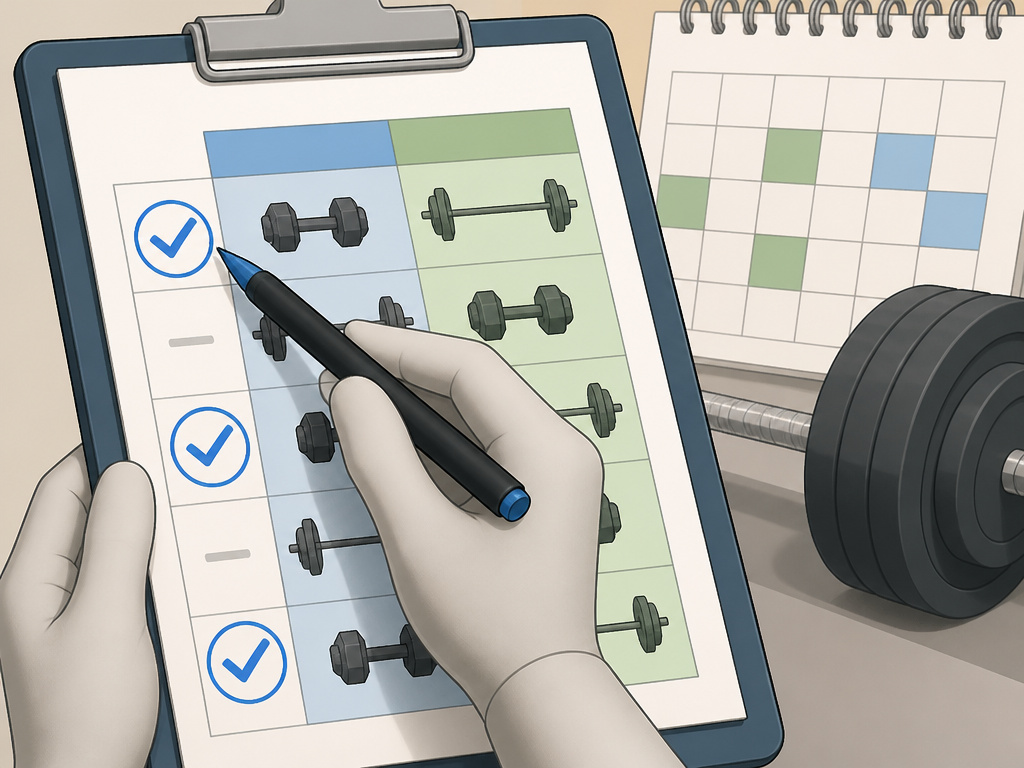
I once coached a student who told me flat out that she hated exercise. We agreed on short sessions, three days a week, and nothing else. She kept it up for months, and the lesson stuck with me: a plan you’ll repeat beats a plan that impresses you.
Full-body training is that plan for most people starting out. Healthline describes it as training all muscles 2 or 3 days per week with at least 1 full day of recovery between sessions, and their 3-day example uses 1 movement per body part at 2 to 3 sets of 8 to 12 reps. MyProtein puts full-body at 3 to 4 times a week with 8 to 12 reps over 3 to 4 sets.
Three sources broadly agree on full-body for beginners, and it isn’t the six-day plan on the poster.
An A/B Week That Hits Everything Twice
- Day A: squat pattern, horizontal push, horizontal pull, plus one hinge. Short and boring.
- Day B: hinge pattern, vertical push, vertical pull, plus a single-leg movement.
- Alternate A and B across three sessions with a rest day between each. Add a fourth session only when recovery keeps up.
- Keep the same two templates for a stretch, which removes the excuse of rebuilding the session on your phone between sets.
Common mistake: Adding exercises instead of adding weight. A full-body session that keeps growing every week turns into a long ordeal, and the last exercises get whatever energy is left.
You’ll hear the plates before you feel the problem. A bar loaded unevenly rattles against the sleeve on the first rep, and by the third set your lower back has already figured it out.
If you’re still weighing the two broad approaches, this full-body vs split comparison covers the trade-offs without the tribalism.
Upper/Lower Splits: The Middle Ground That Earns Its Reputation
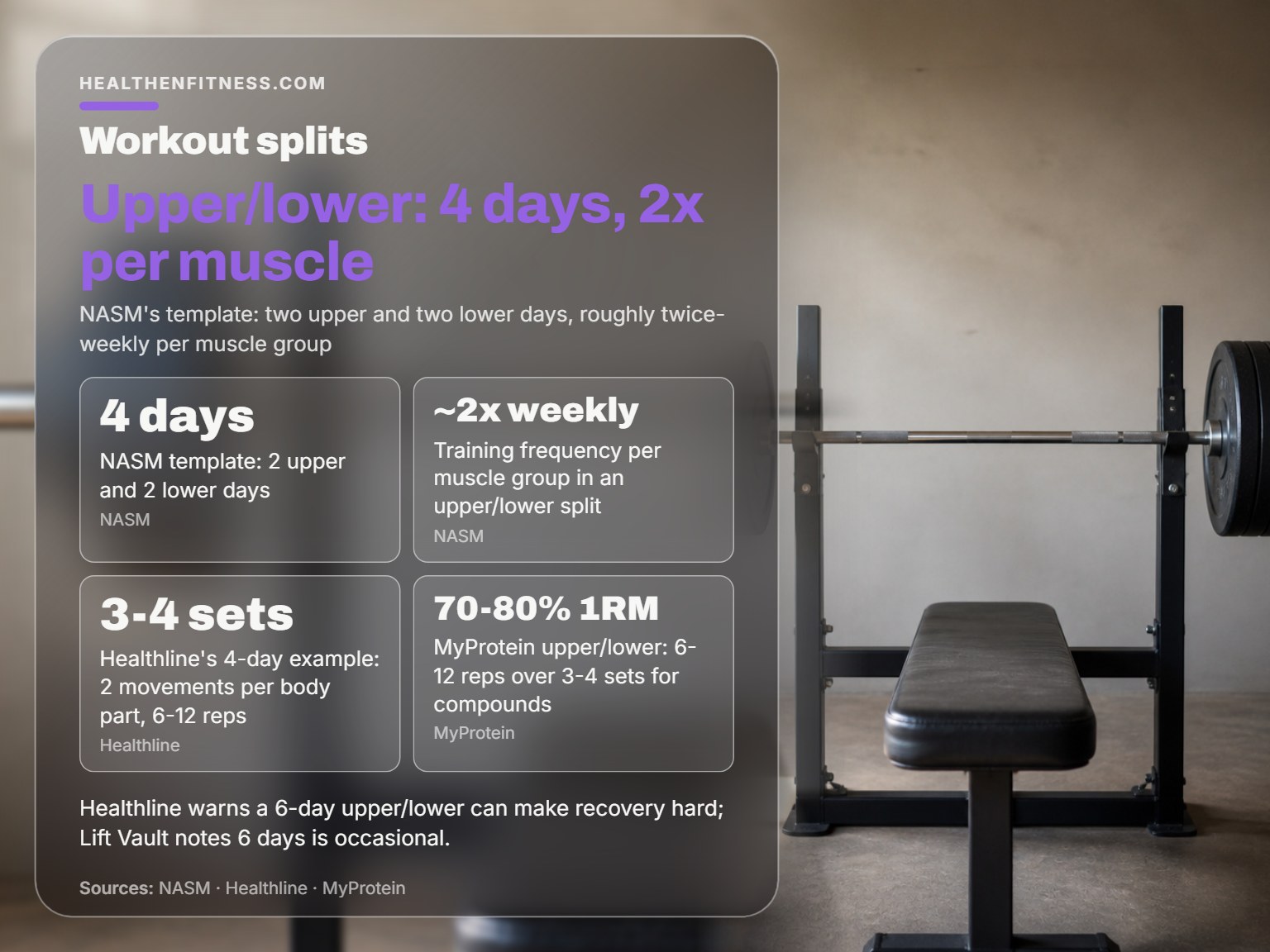
The NASM upper/lower split programming guide specifies a 4-day template with two upper and two lower days, roughly twice-weekly frequency per muscle group, and typically one higher-volume and one lower-volume day per region. That last detail is the one most people skip, and it’s the reason the template recovers as well as it does.
Healthline’s 4-day example runs two movements per body part at 3 to 4 sets of 6 to 12 reps. MyProtein prescribes 6 to 12 reps over 3 to 4 sets for compounds, or 8 to 15 reps over 3 sets, at around 70 to 80 percent of 1RM.
Where the sources split is the six-day version. Healthline warns that a 6-day upper/lower can make it hard to fully stimulate all muscles and to recover. Lift Vault notes that upper/lower splits occasionally program six days. Both are describing the same template at different volumes, and the disagreement is really about whether you can recover from it.
For most people with a job, the upper lower split at four days is the version worth running first.
Push/Pull/Legs: Which Version Are You Actually Running?
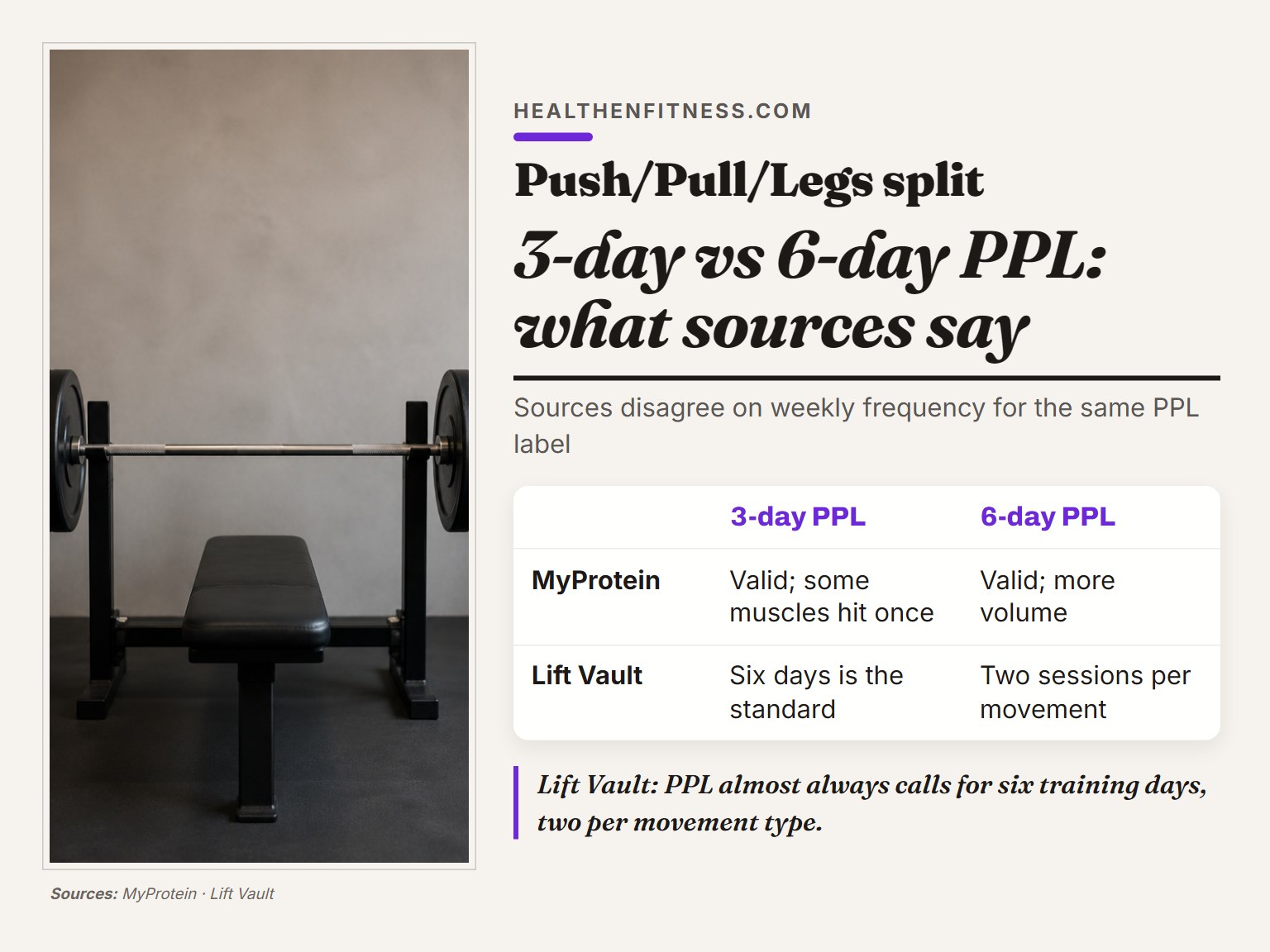
Ask two lifters what PPL means and you may get two different weekly frequencies. The sources don’t agree either.
| Source | 3-day PPL | 6-day PPL |
|---|---|---|
| Fitsly | Each muscle once weekly | Everything twice |
| MyProtein | Valid, some muscles hit once | Valid, more volume |
| Lift Vault | Six days is the standard | Two sessions per movement |
Fitsly states plainly that the 6-day double-PPL is what most people mean by PPL, and that the 3-day version trains each muscle once weekly. MyProtein treats both as legitimate PPL formats and notes that on the 3-day version some muscles only get hit once a week. Lift Vault says PPL splits almost always call for six training days, two for each movement type. Healthline describes PPL by movement pattern without pinning down a frequency at all.
The 3-Day PPL vs the 6-Day PPL
The 3-day version is a schedule convenience. It fits a busy week and it keeps the push, pull, and leg distinction, but Fitsly puts it at once-weekly frequency per muscle, while MyProtein treats the 3-day PPL as a valid format.
The 6-day version gets you to twice weekly. It also asks for six gym days, and that’s where most people quietly fall off. MyProtein’s rep guidance for PPL is compounds at around 6 to 10 reps over 3 to 4 sets and accessories at 8 to 12 reps over 3 sets.
The full breakdown of push pull legs covers the day-by-day structure if you’re leaning that way.
Body-Part Splits: What the One-Muscle-a-Day Plan Gets Right
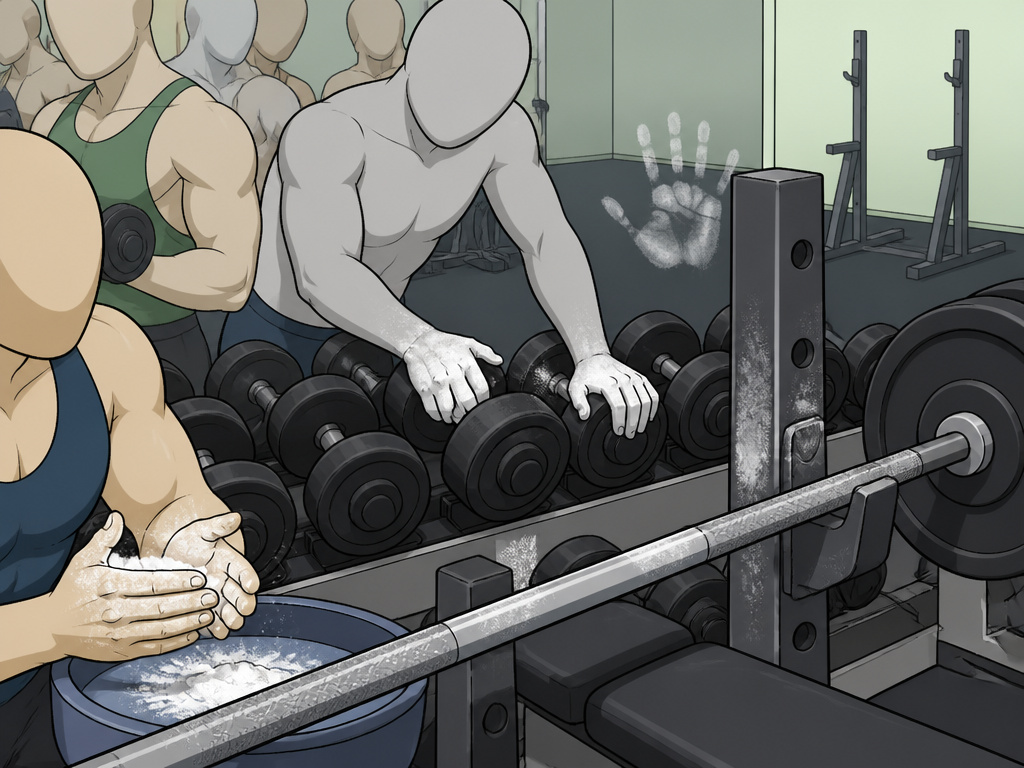
Picture the free-weight area on a Monday. Every bench is taken, every rack is full, and nobody is anywhere near the squat stands. That’s a body-part split in the wild.
NASM identifies the most common bro split as a 5-day split across major muscle groups. Their bro split effectiveness article concedes the format can be effective for certain people and circumstances, provided progressive overload is applied through increasing total volume and intensity over time with adequate recovery. Then it adds the line that gets quoted: there’s nothing specifically magical about splitting workouts this way that makes them vastly superior.
I spent my early gym years on a five-day body-part split because a magazine told me to. What I built was a schedule I couldn’t recover from and a chest day I dreaded. The training worked once I started sleeping and eating like someone who trained.
MyProtein calls a five-day bodybuilding split the go-to approach for muscle building, while NASM says bro splits can be effective but are not vastly superior. That’s a real disagreement between two credible sources, and the honest read is that the five-day split works for people who can load and recover from that volume.
Peloton notes five-day splits are often used by more advanced exercisers doing high-volume work. MyProtein says beginners may prefer to start with a full-body approach. Both point the same direction for anyone in their first stretch of training.
Where this goes sideways: Collapsing a bro split into 3 days. NASM warns those sessions can run upwards of 2 hours, and that the volume can be too much for newer lifters to load at once. Shorter sessions with less total workload is their fix.
There’s history here worth knowing. BarBend notes that 1940s bodybuilder Steve Reeves was famous for following a full-body split, long before the one-muscle-per-day model took over. The bro split has a lineage, and so does the thing it replaced.
Chalk tells you how the session went. A chalky handprint at hip height on the mirror means the setup was right. Chalk smeared at shoulder height usually means the bar drifted.
How Many Days a Week Do You Actually Have?
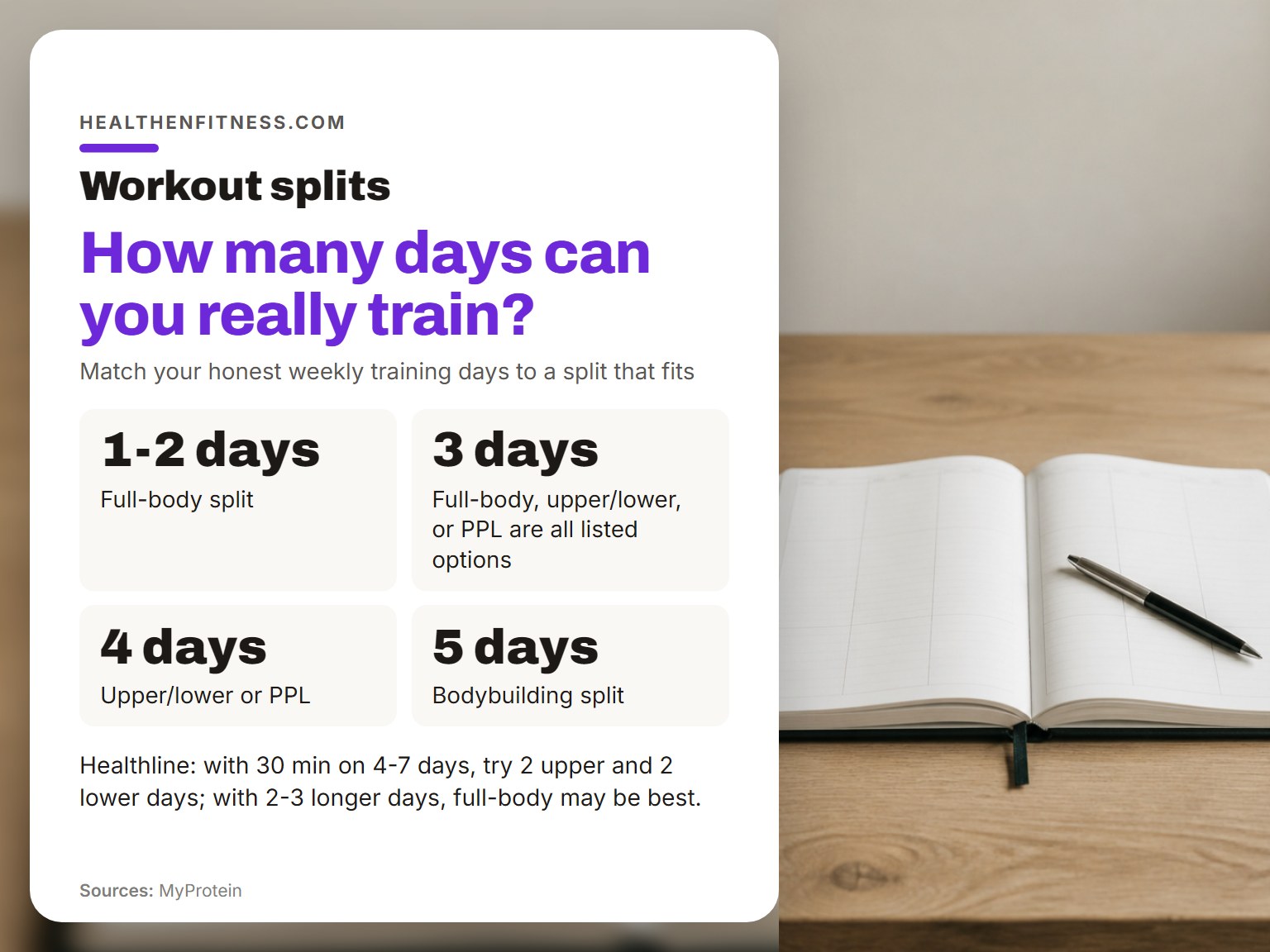
Count the days you can genuinely attend, not the days you’d like to. A client of mine kept missing evening sessions until we moved training to lunchtime, and the missed weeks simply stopped. The schedule was the program all along.
| Days you can train | Split that fits | Notes |
|---|---|---|
| 1 to 2 | Full-body | Hits everything each session |
| 3 | Full-body, upper/lower, or PPL | All three are listed options |
| 4 | Upper/lower or PPL | Rest between cycles |
| 5 | Body-part or ULPPL | One region per day |
| 6 | Upper/lower, PPL, hybrid, or ULPPL | Needs real recovery |
| 7 | Hybrid or ULPPL | Only if recovery holds |
Healthline’s scheduling guidance is blunter than the table. With 30 minutes of exercise time on 4 to 7 days a week, they suggest upper body on 2 days and lower body on 2 days. With only 2 or 3 days but longer sessions, a full-body split may be the best option. MyProtein’s day mapping lands in the same place.
Here’s the sequence I’d use to pick one:
- Count real training days for the next month, not the ideal week. Getting this wrong hands you a plan you abandon before it’s had a chance to work.
- Match that number to the table above. Choosing a six-day split when you have four means every missed session lands on the same muscle group twice in a row.
- Set weekly volume before you set exercises. If total sets drop when you switch splits, the volume-matched research no longer describes what you’re doing.
- Run it long enough to judge it. Switching every time a session feels bad means you never find out whether the last plan was working.
When to Back the Split Down
Healthline recommends allowing muscles to recover for 48 hours between workouts targeting the same group, while Lift Vault and NASM point to roughly twice-weekly frequency per muscle as a well-supported driver of progress.
- Strength dropping across two sessions in a row on the same lift. That’s fatigue, not a bad day.
- Soreness that’s still there when the next session for that muscle comes around. The plan is outrunning your recovery.
- Sessions creeping past the time you actually have. NASM’s 2-hour warning on collapsed bro splits applies to any split you’ve overstuffed.
- Dread before a specific day. If chest day makes you want to skip the gym entirely, the split is costing you attendance.
If four days is your realistic number, the 4-day workout split options are worth a look. If three is the honest answer, start with the 3-day workout split list instead.
Frequently Asked Questions
What are the main types of workout splits?
Full-body, upper/lower, push/pull/legs, body-part (often called a bro split), and five-day variations like ULPPL. Each one is a way of distributing the same weekly work across different days, which is why the research keeps finding them roughly equivalent when volume matches.
Is a split better than full-body training?
Not according to the 2024 meta-analysis, which found no significant difference in strength or hypertrophy when weekly volume was equated. NASM argues upper/lower is more recoverable than full-body training at higher frequencies, so the two positions genuinely differ. For most people the deciding factor is attendance, not physiology.
How many days a week should I train?
It depends on the split you pick. Full-body typically runs 3 to 4 sessions a week, upper/lower usually 4, and PPL almost always 6. Healthline suggests that with 30 minutes on 4 to 7 days a week you might train upper body twice and lower body twice.
Is a bro split bad for beginners?
NASM says bro splits can be effective for certain people, but also warns the volume can be too much for newer lifters to load at once. MyProtein recommends beginners start with a full-body approach. The frequency is the bigger issue: one session per muscle per week gives you fewer chances to practice the movements.
How long should I rest between training the same muscle?
Healthline recommends 48 hours between workouts for the same muscle group, while NASM and Lift Vault both point to roughly twice-weekly frequency per muscle as a well-supported driver of progress.
Before You Go
One threshold worth carrying with you: if your weekly set count for a muscle drops when you change splits, you haven’t changed programs, you’ve changed training volume. Fix that first and the label becomes a scheduling preference.
None of the types of workout splits explained here will out-train a week you don’t show up for. Start smaller than you think you need to, and let the frequency do the work.
Do this today: open your calendar, count the days you can actually reach the gym this month, and pick the split from the table that matches that number.
