
10 Best Cable Home Gyms in 2026
This post contains affiliate links. As an Amazon Associate, we earn from qualifying purchases.
For a true home gym upgrade, the Body-Solid Powerline PFT100 Cable Crossover is our best overall pick. It has dual 160 lb independent weight stacks that allow for true isolateral training. If space is tight, the Centr 1 Home Gym Functional Trainer offers a compact footprint with impressive versatility. The Inspire Fitness FTX Functional Trainer is the best dual weight stack option for balanced cable work.
The challenge with choosing a cable home gym isn’t just about picking the shiniest machine, it’s about fitting your space, your strength level, and your workout style. You need to know if you have the ceiling height for a tall unit, the floor space for a dual-stack crossover, or the wall strength for a mounted station.
This guide is based on a thorough review of manufacturer specs, expert round-ups, and patterns in owner feedback across ten different machines. We break down the key differences so you can confidently choose the setup that matches your home and your goals.
Top 10 Cable Home Gyms in the Market
Certain content that appears on this site comes from Amazon. This content is provided "as is" and is subject to change or removal at any time.
The Best Cable Home Gyms, Reviewed
Body-Solid Powerline PFT100 Cable Crossover

What We Like
- Dual 160 lb independent weight stacks
- 10-year frame warranty
- Electrostatically applied powder coat finish
Trade-offs
- 476 lb weight requires sturdy floor
- 83" height needs tall ceiling clearance
Two independent 160-pound weight stacks let you work each side of your body separately, which is the whole point of a cable crossover. That isolateral movement means your dominant arm can’t cheat for the weaker one, so both sides build evenly. The 10-year frame warranty tells you Body-Solid expects it to last. For someone setting up a home gym who wants true gym-quality cable work without the commercial price tag, this delivers the core function: smooth, balanced resistance for a huge range of exercises.
The trade-off is size and weight. At 476 pounds and 83 inches tall, this is not a machine you tuck into a corner or move around easily. It needs a dedicated spot with at least eight feet of ceiling height. If you have the floor space and want a true cable crossover that won’t wobble or shift, this is the one.
Centr 1 Home Gym Functional Trainer

What We Like
- 165 pulley adjustments for variety
- 33 vertical positions target any muscle
- Compact footprint for home use
- Industrial-grade steel with matte finish
Trade-offs
- 312 lbs requires careful floor placement
- Single 160 lb stack limits heavy two-arm work
The Centr 1 Functional Trainer offers 33 adjustable pulley positions and 165 exercise options, so you can target nearly every muscle group without needing extra attachments or a second machine. Its 160 lb weight stack suits a range of strength levels, and the compact footprint, roughly five feet wide and deep, fits neatly into a spare room or garage corner. Built from industrial-grade steel with a matte black finish, it feels sturdy without dominating your space. For someone who wants a full-body cable gym that doesn’t require a dedicated room, this is a smart pick.
A single 160 lb stack is the main limitation here. If you’re used to cable crossovers or pressing movements with both arms, you’ll have less resistance than on a dual-stack machine like the Inspire Fitness FTX, which offers two 165 lb stacks. The Centr 1 also weighs 312 pounds, so moving it around once assembled requires planning where it will live. But for the person who values variety and a clean, compact setup over brute resistance, the Centr 1 delivers a surprising amount of workout in a small package.
Inspire Fitness FTX Functional Trainer

What We Like
- Two 165 lb weight stacks
- Compact footprint for a functional trainer
- Space for phone/tablet and storage rack
Trade-offs
- At 544 lb, moving it requires serious help
- 85-inch height needs tall ceiling clearance
Two independent 165-pound weight stacks give you the freedom to work both arms simultaneously with equal resistance, something many single-stack trainers can’t match without awkward swapping.
Weight and height are the main considerations: at 544 pounds and 85 inches tall, this machine demands a sturdy floor and a ceiling high enough to avoid head bumps during pull-ups. Compared to a wall-mounted option like the Goimu WM1, which saves space and weight, the FTX is a permanent fixture, once it’s placed, you’re not easily rearranging it. That stability gives you confidence during heavy cable work, making it a good fit if you have the dedicated space and want a dual-stack system.
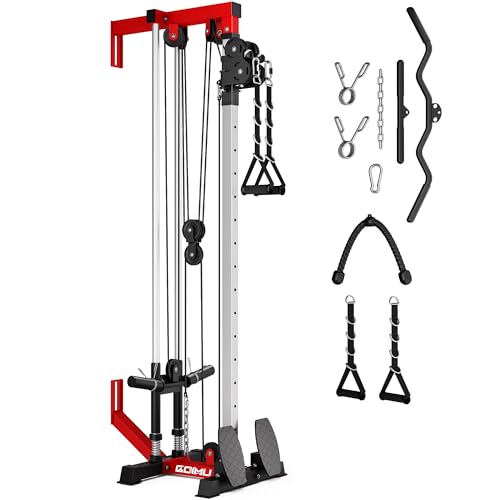
Goimu WM1 Wall Mount Cable Station
What We Like
- 17 adjustable pulley positions for varied angles
- 1:1 and 2:1 ratio switch for heavy or light lifts
- Wall-mounted design saves floor space
- Includes lat bar, tricep rope, and D-handles
Trade-offs
- Requires concrete or masonry wall for installation
- At 81.3 lb, mounting needs sturdy hardware
- No weight stack, uses plate loading (not included)
The 17 pulley positions let you hit chest flys at shoulder height, tricep pushdowns from the top, and lat pulldowns from the top. All without the wobble that freestanding machines often bring. For someone building a garage gym on a budget, the ability to switch between a 1:1 ratio for heavy lifts and a 2:1 ratio for lighter endurance sets makes it feel like two machines in one. The included attachments cover most cable exercises, so you are not hunting for extra gear.
The wall requirement is the main catch: this unit needs a concrete or masonry wall, which rules out drywall-only garages. Compared to the Body-Solid Powerline PFT100, which has a larger footprint and sits on its own floor frame, the Goimu saves space but demands a solid mounting surface. At 81.3 pounds, it is manageable for installation with a helper, and you will need a drill rated for masonry.
Mikolo Wall Mount Cable Machine

What We Like
- 118 lb built-in weight stack
- 19 adjustable pulley positions
- Ultra-compact wall-mounted design
Trade-offs
- 118 lb stack is lighter than dual-stack models
- Wall mounting requires sturdy wall and installation
- 2:1 ratio feels lighter without adapter attached
A 118 lb selectorized weight stack built right into the frame means you never have to fumble with loose plates or worry about storing them. This is the setup for someone who prefers a full-body cable station without giving up half their garage floor. Nineteen adjustable pulley positions cover everything from high chest flys to low bicep curls, and the 14-gauge steel frame with reinforced brackets keeps things steady mid-rep.
The compact wall-mounted footprint comes with a lighter total resistance compared to freestanding dual-stack machines such as the Inspire Fitness FTX, which carries two 165 lb stacks. If heavy lat pulldowns or rows are your main goal, you may outgrow the 118 lb stack faster than you’d like. But for the home gym owner who values space, simplicity, and a clean training zone, this Mikolo delivers a surprising range of motion without the wobble or the footprint of a full-size functional trainer.
Goimu WM3-V4 Folding Squat Rack

What We Like
- Folds to 4.3 sq ft for storage
- Dual independent 1:1 ratio pulleys
- 15 adjustable pulley heights
- 5 configurable workout modes
Trade-offs
- Requires wall mounting for stability
- No weight stack; uses your own plates
A folding design that shrinks to just 4.3 square feet means this rack turns a cramped corner of an apartment or garage into a real strength setup without eating your living space. When you open it up, you get a full power rack with a dual independent pulley system that lets you do cable flies, lat pulldowns, and rows using your own weight plates. The 15 adjustable pulley heights and five quick-switch modes, from half rack to functional trainer, make it easy to move between heavy squats and cable isolation work without rearranging the room.
You have to bolt this unit to a wall, and unlike the Centr 1 Home Gym Functional Trainer with its built-in 160 lb weight stack, the Goimu requires you to supply and load your own plates. That keeps the initial cost lower and lets you use the plates you already own, but it also means more setup time between exercises. For anyone who values floor space above all else and already has a set of plates, this folding design delivers serious versatility in a tiny footprint.
Product photos
JELENS H11 Home Gym Workout Station

What We Like
- 150 lb weight stack for progressive resistance
- Three pulley positions for varied exercises
- Thickened steel frame with U-shaped base
- Adjustable seat, leg extension, and butterfly arms
Trade-offs
- 150 lb stack limits heavy lifters over time
- Four separate boxes to unpack and assemble
A 150 lb weight stack and three pulley positions give you the foundation for a full-body workout without needing a rack of dumbbells. The JELENS H11 covers leg extensions, seated rows, chest flys, and more, all from one frame. Thickened steel with a U-shaped base keeps things stable during pulls, and the adjustable seat, leg pedal, and five-level butterfly arms let you dial in the fit. It’s a practical all-in-one for someone who wants cable-based strength training at home without juggling multiple machines.
A 150 lb stack will feel light for experienced lifters chasing progressive overload, and the 79.9-inch height means you’ll need a ceiling that clears that measurement. Assembly comes in four boxes, so set aside an afternoon. Compared to the Centr 1 Home Gym Functional Trainer, which offers 160 lbs and 33 pulley positions, the JELENS gives you fewer cable angles but a more compact footprint for tighter spaces. It suits the home gym builder who values simplicity and a dedicated weight stack over maximum versatility.
Product photos
JELENS CC01 Cable Crossover Machine

What We Like
- Triangular design saves floor space
- 15 pulley height settings for variety
- Detachable pull-up bar rated 500 lbs
- Smooth PU-coated steel cables
Trade-offs
- No weight stack included, plate-loaded only
- Requires 2-3 people for 1.5-hour assembly
The triangular frame keeps the unit stable during heavy pulls, and the 15 height adjustments let you target everything from chest flies to triceps pushdowns with smooth PU-coated cables. It fits anyone looking for a full-body cable setup at home but unable to spare a whole wall or corner for a traditional crossover station.
The cable pulley system handles up to 210 pounds, which is enough for most home gym routines, while the detachable pull-up bar supports 500 pounds for heavier bodyweight work. Assembly takes about 1.5 hours with two or three people, so plan a weekend afternoon and a helper. The whole machine sits in just 12.1 square feet, making it practical for an apartment or small home gym.
Product photos
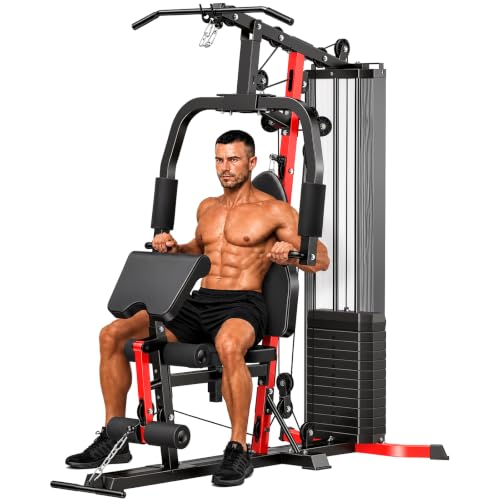
ROBORE Home Gym System
What We Like
- Selectorized 160 lb weight stack for quick changes
- High, mid, and low pulley positions for full-body training
- Adjustable seating and removable preacher curl pad
- Guarded weight stack and non-slip base for safety
Trade-offs
- At 220 lb, moving it around the room takes effort
- 66-inch length needs a decent floor footprint
- Only three pulley positions limit cable angle variety
A 160 lb selectorized weight stack means you can adjust resistance in seconds without fumbling with plates, which is exactly what makes this station so approachable for someone new to cable training. The adjustable seat and removable preacher curl pad let you dial in a comfortable position for chest, back, arms, and legs, so you are not fighting awkward angles while learning the movements. It is built for the person who wants a straightforward strength routine at home without the intimidation of a crowded gym floor or complicated setup procedures.
A 160-pound weight stack gives you more built-in resistance than many 150-pound home gyms in this class, so you can train with progressive overload without loading plates. The selectorized stack lets you change weight quickly for drop sets or everyday strength work. With high, mid, and low pulley positions, you get cable training for back, arms, shoulders, chest, abs, and legs using the included lat bar and short row bar.
Product photos
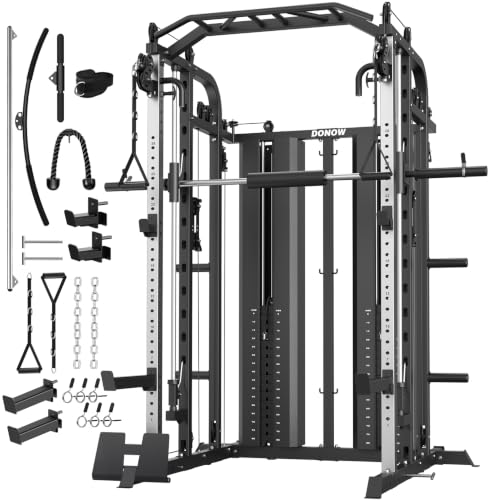
DONOW Smith Machine with Weight Stacks
What We Like
- Dual 352 lb weight stacks for heavy cable work
- Linear-bearing Smith bar for smooth, stable lifts
- Enclosed steel weight stack covers for safety
- True independent cable crossover for isolation exercises
Trade-offs
- Large footprint at 78.6 inches wide needs generous space
- 2:1 cable ratio halves felt resistance on pulleys
A dual weight stack system with a total of 352 lb (at a 2:1 cable ratio) and a linear-bearing Smith bar means you can handle guided squats and cable work without constantly swapping plates. This machine packs a true independent cable crossover into a single frame, so exercises like flyes, lat pulldowns, and rows feel fluid and commercial-grade. It suits someone who wants a dedicated Smith machine and a full cable station in one footprint, especially if you prefer selectorized stacks over loading pins for quick weight changes.
The trade-off comes down to space and the 2:1 cable ratio. At nearly 79 inches wide, it demands more floor room than a compact functional trainer like the Inspire Fitness FTX, that machine squeezes two 165 lb stacks into a 54-inch width. The 2:1 pulley system means the cable moves twice as far as the weight stack, so you’ll need to load up more than expected for lat pulldowns or rows. If your gym area is tight, this machine might feel oversized, but for a combined Smith and cable crossover, it delivers real versatility.
Product photos
How We Evaluated Cable Home Gyms
We started by analyzing the specifications and design of each machine, weight stack capacity, pulley configurations, footprint, and build materials. Then we looked at patterns in owner feedback to understand real-world assembly experiences, long-term durability, and which features actually matter for daily use. This research-led approach means we can highlight the trade-offs you won’t see on a product page.
For cable home gyms, four criteria mattered most. Weight stack design is critical: independent dual stacks allow for balanced, unilateral training, while a single stack simplifies the machine but limits heavy two-arm work. Pulley adjustability determines how many exercises you can perform. More positions mean more angles for chest flies, triceps pushdowns, and face pulls. Footprint and clearance are non-negotiable for home use. We looked at height, width, and depth to help you avoid a machine that won’t fit your room. Finally, build quality and warranty separate a machine that lasts a decade from one that wobbles after a year.
We gathered data from manufacturer documentation, expert round-ups, and the collective experience of hundreds of owners. This gives you a reliable, honest picture of what each machine is like to live with, without the hype.
For a deeper look at the broader category, see our full collection of best cable machines for home gyms. If you are specifically looking to save floor space, our guide to compact cable machines covers the most efficient designs.
What To Look For In Cable Home Gyms
Choosing a cable home gym means balancing your available space, your strength goals, and your budget. Here are the key factors to consider before you buy.
Look for a machine with a weight stack that matches your current strength and room to grow. Prioritize pulley adjustability for exercise variety. Measure your ceiling height and floor space carefully. Check the warranty as a sign of build confidence.
Weight Stack and Resistance
The weight stack is the heart of any cable home gym. Dual independent stacks (like the 160 lb stacks on the Body-Solid Powerline PFT100) let you work each side of your body separately, which is great for correcting imbalances and training unilaterally. Single-stack machines are more compact but limit you to one arm or both arms at the same resistance. Also note the cable ratio: a 2:1 ratio means the stack feels half as heavy, which can be useful for beginners or for high-rep work, but it limits maximum resistance.
Footprint and Ceiling Clearance
Measure your space before you buy. Many dual-stack machines like the Inspire Fitness FTX stand over 80 inches tall and need a ceiling of at least eight feet. Wall-mounted options like the Mikolo wall mount cable machine save floor space but require a sturdy concrete or masonry wall for installation. If you are working with a small room, consider the cable machines for small spaces we have reviewed.
Pulley Adjustability and Exercise Variety
More pulley positions mean more exercises. The Centr 1 offers 165 pulley adjustments and 33 vertical positions, allowing you to hit every muscle group from every angle. Machines with fewer positions, like the ROBORE Home Gym System with only three, still cover the basics (chest, back, shoulders, arms) but limit your ability to target muscles from different angles. For the full range of moves you can perform, check our guide to cable exercises.
Build Quality and Warranty
Look for steel frames, smooth pulley systems, and quality cable coatings. A longer warranty, like the 10-year frame warranty on the Body-Solid, is a strong sign of confidence in the build. Also consider the weight of the machine itself: heavier machines are generally more stable but harder to move. A good set of cable attachments can also expand your machine’s versatility.
- Measure your ceiling height and floor space with a tape measure before shopping.
- Check the weight stack capacity and cable ratio to ensure it matches your strength level.
- Look at the number of pulley positions to gauge exercise variety.
- Verify wall-mounting requirements if choosing a space-saving model.
A heavier machine with a longer warranty is almost always worth paying more for.
Cable Home Gyms Compared
The table below compares the ten cable home gyms side by side, highlighting their weight stacks, footprints, and best-use scenarios so you can quickly see how they stack up.
| Product | Weight Stack | Dimensions | Weight |
|---|---|---|---|
| Body-Solid Powerline PFT100 Cable Crossover | 2 x 160 lb | 42.3"L x 62.6"W x 83"H | 476 lb |
| Centr 1 Home Gym Functional Trainer | 160 lb | 81.5"H x 51"W x 62"L | 312 lbs |
| Inspire Fitness FTX Functional Trainer | Two 165 lb | 40 x 54 x 85 in | 544 lb |
| Goimu WM1 Wall Mount Cable Station | N/A | 28.1 x 24.8 x 78.7 in | 81.3 pounds |
| Mikolo Wall Mount Cable Machine | 118 lbs selectorized | N/A | N/A |
| Goimu WM3-V4 Folding Squat Rack | N/A | 33.5 x 50.0 x 85.0 in | N/A |
| JELENS H11 Home Gym Workout Station | 150 lbs | L 74.8 x W 38.5 x H 79.9 in | N/A |
| JELENS CC01 Cable Crossover Machine | N/A | 64.2 x 53.9 x 81.9 in | 146 lbs |
| ROBORE Home Gym System | 160 lb | 66 x 38 x 79 in | 220 lb |
| DONOW Smith Machine with Weight Stacks | 352LB Weight Stacks | 54.7 x 78.6 x 88.0 in | N/A |
Frequently Asked Questions
What is the best cable home gym for a small apartment?
The Centr 1 Home Gym Functional Trainer is the best compact cable machine for small spaces thanks to its compact footprint and 165 pulley adjustments. If you cannot spare any floor space, the Goimu WM1 Wall Mount Cable Station saves room entirely by mounting to a wall, though it requires a concrete or masonry wall for installation.
How much weight do I need in a cable home gym?
For most users, a weight stack of 150-160 lb is sufficient for full-body training. If you are an advanced lifter, look for dual-stack machines like the Inspire Fitness FTX with two 165 lb stacks, or the DONOW Smith Machine with dual 352 lb stacks. Remember that a 2:1 cable ratio halves the felt resistance, so a 160 lb stack feels like 80 lb.
Can I build muscle with a cable home gym?
Yes. Cable machines provide constant tension throughout the range of motion, which is excellent for muscle growth. With the right program and enough resistance, you can build significant strength and size. Our guide to using a cable machine covers the essential exercises for a full-body routine.
Are wall-mounted cable machines as good as free-standing ones?
Wall-mounted machines save floor space and can be very stable when installed correctly on a concrete or masonry wall. However, they often have lighter weight stacks (like the Mikolo’s 118 lb) and require permanent installation, which may not suit renters. Free-standing machines are easier to move and usually offer heavier stacks.
What is the difference between a functional trainer and a cable crossover?
A functional trainer typically has two independent weight stacks and adjustable pulleys that can move up and down, allowing for a huge range of exercises. A cable crossover is a specific type of functional trainer designed primarily for chest flies and cable crossovers, often with a wider frame. For more detail, see our comparison of functional trainers.
The Bottom Line
The Body-Solid Powerline PFT100 Cable Crossover is the best overall pick for home gym owners who have the floor space and ceiling height to accommodate its 476 lb frame and 83-inch height. Its dual 160 lb independent weight stacks and 10-year frame warranty make it a long-term investment for serious training.
If your space is limited, the Centr 1 Home Gym Functional Trainer packs 165 pulley adjustments into a compact footprint. The Goimu WM1 Wall Mount Cable Station is the best budget-friendly option for those with a suitable wall. For heavy lifters who want a Smith machine too, the DONOW Smith Machine offers dual 352 lb stacks.
The single most important factor is honest space measurement. A machine that does not fit your ceiling height or floor area will be a frustrating mistake. Measure twice, check the specs, and choose the machine that fits your room and your strength goals.
