
Arnold Split Explained: The 6-Day Program
This post contains affiliate links. As an Amazon Associate, we earn from qualifying purchases.
The Arnold split explained in one line: six training days a week, split into push, pull, and legs, run twice through so every muscle group gets trained twice weekly. Arnold Schwarzenegger popularized it in his 1985 Encyclopedia of Modern Bodybuilding, and it assumes years of training, high volume tolerance, and a schedule that allows near-daily gym time.
Twice-weekly frequency is the part that gets copied wrong. The sessions are dosed so you can return to the same pattern two days later, and that dosing was built around a professional’s calendar, not a lunch break.
What follows is the actual weekly structure, the reason the frequency holds up, and the honest case for picking something else. Including the stretch where I ran this thing badly and learned what it costs.
Key Takeaways
- Six days, three patterns, twice each. Push, pull, and legs rotate through the week so every muscle group gets trained twice.
- The frequency is the good part. Hitting a muscle twice a week is a sound idea that survives outside this specific program.
- The volume is the problem. The per-session workload assumes years of base and a schedule most people don’t have.
- Beginners should skip it. Three full-body days will outpace it through year one, and that’s not close.
- Keep the Arnold press. One movement from the template is worth stealing no matter which split you run.
The Arnold Split Explained: What the Week Actually Looks Like
The structure fits on an index card. Six days on, one off, with the push, pull, and legs rotation running through the week twice.
Push sessions pair pressing patterns for the chest, shoulders, and triceps. Pull sessions pair rowing and pulling patterns for the back and biceps. Leg sessions cover quads, hamstrings, glutes, and calves. The rotation repeats so each pattern is trained twice within a seven-day cycle, with a rest day between the two halves.
The rotation matters more than the exercise list. The exact movements shift depending on which retelling of the program you read, and the structure is the stable part.
| Day | Session | Primary Work |
|---|---|---|
| Day 1 | Push | Chest, shoulders, triceps |
| Day 2 | Pull | Back, biceps, rear delts |
| Day 3 | Legs | Quads, hamstrings, calves |
| Day 4 | Push | Same pattern, different exercise selection |
| Day 5 | Pull | Same pattern, different exercise selection |
| Day 6 | Legs | Same pattern, different exercise selection |
Day 7 is rest. In practice a lot of people take two rest days and compress the rotation, which changes the program into something closer to a push pull legs split run on a five-day week. That’s a fine program. It just isn’t this one.
What Each Session Actually Contains
- Push days center on pressing: bench press, an incline press, and a shoulder press, with triceps work to finish.
- Pull days center on rowing and pulling: barbell rows, chin-ups or lat pulldowns, and a curl variation. Rear delts get trained here too, which a lot of people forget.
- Leg days cover the whole lower body: squats or leg press, a hinge like Romanian deadlifts, and calf work.
- Abs and lower back usually get tacked onto whichever day has room left.
Arnold’s own version leaned on free weights and very high set counts. Your version can lean on whatever you’ll actually repeat twice a week. The muscle group combinations matter more than the specific machines you pick.
Why Does Training Each Muscle Twice a Week Matter?
Because the growth signal from a hard session fades well before seven days pass. A once-a-week hit leaves most of the week with nothing driving adaptation.
That’s the mechanism behind the frequency argument. Training a muscle creates a period of elevated repair and rebuilding, and that period doesn’t stretch to the next session a week out. Splitting the same weekly volume across two sessions keeps the signal topped up without making any single session absurd.
Which is why the frequency idea travels so well. You can run it on three days, four days, or six. The types of workout splits that hold up over time almost all land on twice-weekly training per muscle group in some form.
If you can only train three days a week, train the whole body each time. Three full-body sessions beat one chest day, one back day, and one leg day, every time.
You feel the difference around week three, not week one. The second push day of the week is the one where your shoulders ache before you even unrack the bar, and that ache is information about how the first push day was dosed.
What most people get wrong: Copying the six-day schedule while keeping their old per-session volume. Six days at old volume is double the weekly work, and the soreness that lands on day nine is the bill arriving.
Is the Arnold Split a Beginner Program?
No. It was written by someone with a decade of training behind him, for readers in a similar spot.
Three things make it a poor fit for year one. The volume per session assumes you already know how to pace a working set. The six-day schedule assumes you can show up six times. And the exercise selection assumes you can already bench, row, and squat with enough control that fatigue doesn’t wreck your technique.
I ran a six-day split in my twenties because a magazine told me to. I was sore for months and stronger for none of them.
What Year One Should Look Like Instead
Three full-body days a week, with an A day and a B day that alternate. That’s the whole program. It fits a beginner’s recovery, it trains everything three times a week, and it leaves room to actually learn the movements.
When you’re ready to choose a workout split with more moving parts, the decision usually comes down to how many days you’ll genuinely show up, not how many days sound impressive.
- Day A: a squat pattern, a horizontal press, a horizontal pull, and a hinge.
- Day B: a hinge or lunge, a vertical press, a vertical pull, and a carry.
- Add one small accessory each day if you have gas in the tank. Skip it if you don’t.
The bro split pros and cons are worth reading for the same reason. Once-a-week training isn’t evil, it’s just slower than it needs to be for someone in their first couple of years.
Skip this if: you’ve been training less than a year, you sleep badly, or your job is physical. Six days of this volume on top of a tired body produces joint aches by week five, not muscle.
How Do You Run It Without Burning Out?
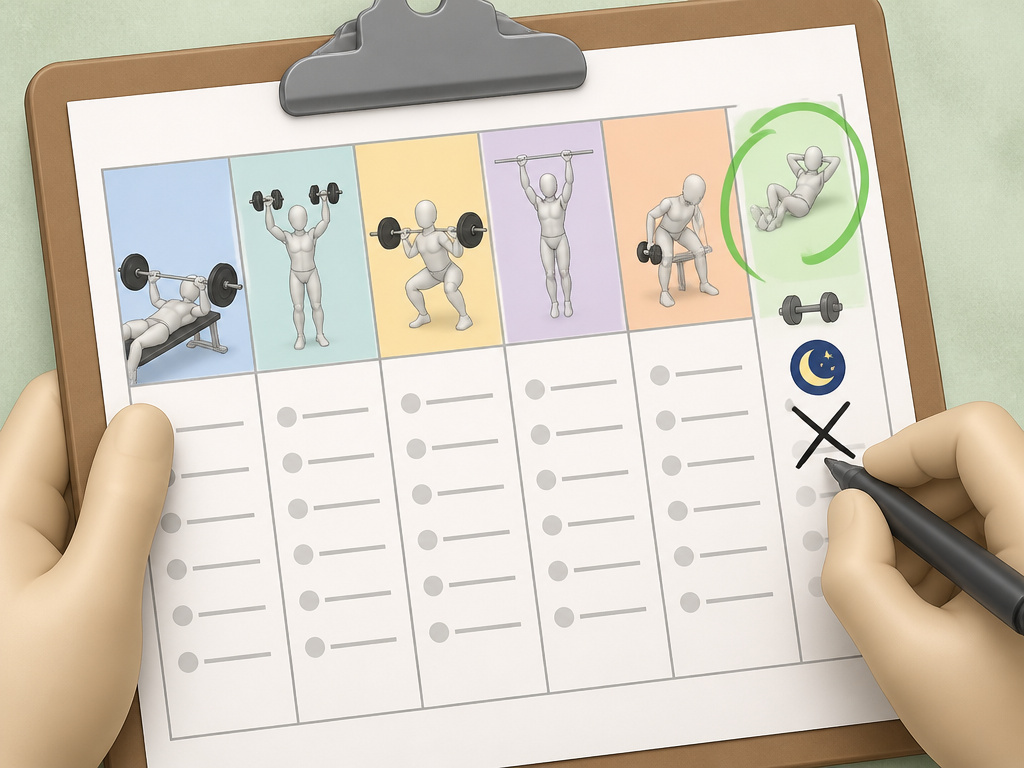
Ramp in slowly, cap the volume, and treat the rest day as part of the program rather than a failure.
Here’s the sequence I’d use if someone insisted on running it.
- Start with four days, not six. Run push, pull, legs, and a second push in week one and see how the second push day feels. Skipping this step means you discover your recovery limit on day eleven, mid-session, with a barbell on your back.
- Cut the per-session sets by a third for the first three weeks. The program’s original set counts were built for someone with a professional’s recovery. Matching them cold is how people end up with cranky shoulders by week four.
- Put the heaviest compound first, every session. Fatigue accumulates across six days, and the lift you care most about should get the freshest version of you.
- Take the rest day even when you feel fine. Feeling fine on day four is normal. It doesn’t mean the accumulated work isn’t there.
- Drop a day before you drop sleep. If life gets tight, run five days and keep the rest. A 6-day workout split only works when the recovery behind it is real.
Timing catches people out too. Six of those a week is a genuine time commitment, and pretending otherwise is how week three becomes week zero.
Where this goes sideways: Adding a sixth day before you’ve adapted to five.
Arnold Split vs Full-Body and Upper-Lower Splits
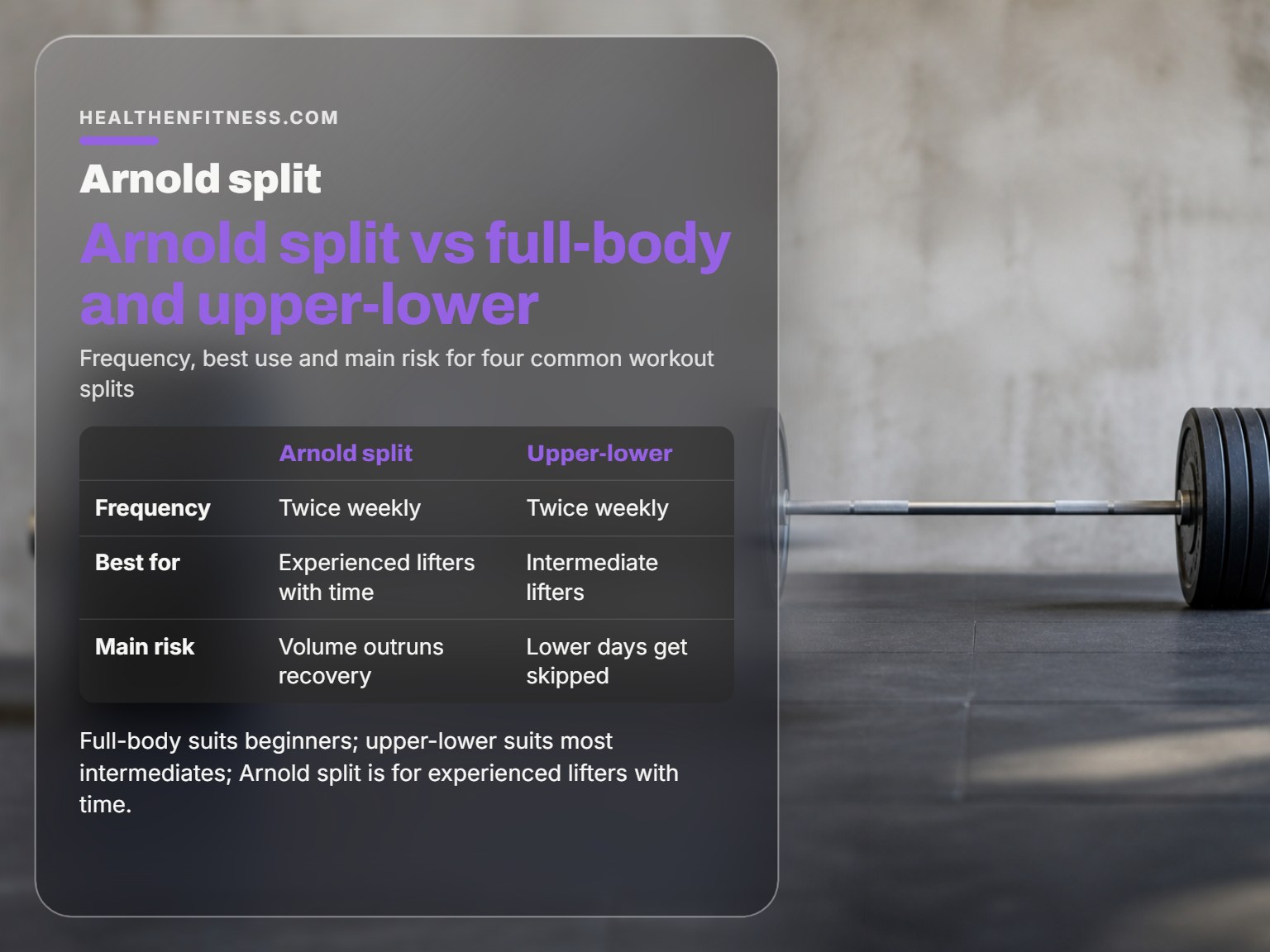
The program with the famous name is usually the wrong first program. That’s the whole comparison in one sentence, and the table below is the longer version.
| Program | Frequency per Muscle | Best For | Main Risk |
|---|---|---|---|
| Arnold split | Twice weekly | Experienced lifters with time | Volume outruns recovery |
| Full-body, three days | Three times weekly | Beginners, first year | Sessions run long |
| Upper-lower, four days | Twice weekly | Intermediate lifters | Lower days get skipped |
| Bro split | Once weekly | People who like single-focus days | Slow progress per muscle |
The best workout splits all share one trait: they match the number of days to the life attached to them. A perfect six-day plan you run four days a week is a four-day plan with guilt.
When Upper-Lower Wins
Upper-lower wins for almost everyone in the middle. It gives you twice-weekly frequency, it fits four days, and it doesn’t demand that you reorganize your week around the gym.
The honest ranking, for most people reading this: full-body first, upper-lower second, push-pull-legs third, and the Arnold split a distant fourth unless you’re already deep into training and have the schedule for it.
That’s not a knock on the program. It’s a knock on borrowing a professional’s week and expecting an amateur’s recovery to cover it.
The Movements Worth Keeping, Whatever Split You Run

The Arnold press is the one movement from this program that outlived it, and it’s worth learning properly.
It’s a dumbbell shoulder press that starts with the palms facing you and rotates outward as you press. The rotation puts the front delt through a longer range than a standard press, and it’s genuinely harder than it looks at light weight. Good Arnold press form matters more here than on a flat press, because the rotation is where people cheat.
Three other things from the template are worth stealing:
- Pairing push and pull in the same week, close together. The frequency idea, not the volume.
- Training rear delts on pull day rather than hoping they show up. They rarely do on their own.
- Finishing with a small, boring accessory instead of a fourth compound. Triceps and calves get this treatment, and they respond to it.
Everything else, including the set counts and the twice-a-day sessions, can stay in 1985. Schwarzenegger’s own account of that era is well documented, and it describes a training life that most people with jobs can’t replicate.
I keep the Arnold press in rotation and skip nearly everything else from the template. Small win, and it took me years to admit that’s the honest version.
Frequently Asked Questions
How many days a week is the Arnold split?
Six training days with one rest day, running push, pull, and legs twice through the week. Some people compress it to five days by taking two rest days, which changes the recovery math and makes it a more forgiving program.
Can a beginner do the Arnold split?
Beginner can physically do the movements, but the volume and frequency are a poor match for year one. Three full-body days will produce faster progress with less joint wear, and the schedule is far easier to sustain.
What is the difference between the Arnold split and push pull legs?
Push pull legs is the underlying structure. The Arnold split is that structure run twice in a week at very high volume. A standard PPL is often run once through per week or on a five-day rotation, which is a meaningfully lighter program.
Does the Arnold split build muscle faster?
Not inherently. Twice-weekly training per muscle group is the part that drives results, and you can get that frequency from a four-day upper-lower split. The extra two days add volume, and volume only helps if you recover from it.
What should I do if I want to try it anyway?
Run four days for the first month, cut the per-session sets by a third, and keep the rest day.
The Bottom Line
That’s the Arnold split explained as plainly as I can put it: a frequency idea worth keeping, wrapped in a volume load most people shouldn’t copy.
Here’s the threshold that decides it. If you can’t currently train five days a week for a month without your sleep, your appetite, or your joints complaining, six days is off the table regardless of how good the program looks on paper. Fix the four-day version first.
And if you’re in your first year of training, close this tab and go do three full-body sessions this week. Squat, press, row, hinge, carry. That’s the program that will still be working for you in twelve months.
Do this today: write down the three days you’ll actually show up next week, and put a full-body session on each one.
