
Ashwagandha for Stress and Training: What Trials Show
This post contains affiliate links. As an Amazon Associate, we earn from qualifying purchases.
Ashwagandha for stress and training has real trial support. Standardized root extracts at 225 to 600 mg a day, taken for 30 to 90 days, lowered stress scores and cortisol in multiple randomized trials. An 8-week study of 80 adults found 600 mg a day plus resistance training improved strength and endurance. Certainty of evidence is rated low.
Those numbers come from a specific kind of product: a standardized extract with a measured withanolide content, run for a set number of weeks. The same word sits on a dozen different bottles with very different chemistry inside. That gap between what was tested and what’s on the shelf is what makes ashwagandha hard to judge.
What follows: the stress trials, the training trials, the dose argument researchers are still having, and a straight answer on who should leave it alone.
Key Takeaways
- 600 mg a day for 8 weeks was the dose in the resistance-training trial that showed strength and endurance gains.
- Stress trials used doses from 225 mg to 600 mg a day, and the extract mattered as much as the number.
- Certainty is rated low for both stress and anxiety, so treat this as promising rather than settled.
- Three months is the safety ceiling in federal guidance; longer use hasn’t been studied.
- Skip it entirely if you’re pregnant, breastfeeding, or awaiting surgery; for thyroid conditions, NCCIH says not recommended while NIH ODS cites a trial showing thyroid hormone changes, so talk to a doctor.
Ashwagandha for Stress and Training: What the Trials Measured
Several separate stress trials sit on the NIH ODS ashwagandha fact sheet, and no two used the same product. Doses ran from 200 mg twice daily up to 600 mg a day, over 30 days to 12 weeks.
Standardization is the number that matters on an ashwagandha label. A root extract standardized above 5 percent withanolides carries a measured, consistent share of the plant’s active compounds. A root-and-leaf extract at 2.5 percent does not. Trials run on one preparation cannot be assumed to describe the other, and the published dose ranges reflect that split.
The longest stress result comes from a 90-day trial of 130 adults aged 20 to 55. They took one 300 mg capsule a day of a sustained-release root extract called Prolanza, standardized to 15 mg withanolides. Stress scores and sleep quality both improved, and serum cortisol came down.
Shorter trials point the same way. A 30-day study of 60 stressed adults, mean age 34, used a root-and-leaf extract (NooGandha) at 225 mg or 400 mg a day. Both doses improved stress, anxiety and food-craving scores. The lower dose also lowered saliva cortisol.
One trial went the other way. A 12-week study of 120 overweight adults used Witholytin, 200 mg of a 1.5 percent withanolide extract twice daily. Perceived stress didn’t budge. Fatigue did drop.
| Extract tested | Daily dose and duration | Main finding |
|---|---|---|
| Prolanza | 300 mg, 15 mg withanolides, 90 days | Stress and sleep improved; cortisol fell |
| NooGandha | 225 or 400 mg, 30 days | Stress and anxiety scores improved |
| Shagandha | 500 mg plus 5 mg piperine, 60 days | Stress and anxiety scores fell |
| Witholytin | 400 mg, 1.5% withanolides, 12 weeks | No stress change; fatigue improved |
| KSM-66 | 600 mg, over 5% withanolides, 8 weeks | Anxiety improved only in insomnia group |
The pattern is hard to miss. The one product that missed on stress was also the weakest concentration in the set, at 1.5 percent withanolides.
Does Ashwagandha Help With Anxiety?
The anxiety file is the messiest one, and the three main sources describe it differently: the KSM-66 trial found anxiety improved only in people with insomnia, the pooled review found anxiety scores fell (SMD -1.55) at low certainty, and NCCIH says the evidence for anxiety is unclear.
- KSM-66 trial, 8 weeks: anxiety symptoms improved in people with insomnia, and did not improve in people without it.
- Pooled review: anxiety scores fell by an SMD of -1.55 against placebo, at low certainty of evidence.
- NCCIH: some preparations may help insomnia and stress, and the evidence for anxiety is unclear.
The KSM-66 detail is worth sitting with. That trial ran 8 weeks in people with and without insomnia, using a root extract standardized above 5 percent withanolides at 300 mg per capsule, two capsules a day. The insomnia group improved on sleep quality and anxiety symptoms. The group without insomnia improved on sleep but not on perceived anxiety.
I take that split seriously. If your anxiety is really a sleep problem wearing a costume, ashwagandha might help and you’d be fixing the right thing by accident. If it’s loud on a calm, well-slept day, the evidence gets thin fast.
A separate ashwagandha cortisol meta-analysis found cortisol, stress scores and anxiety scores all dropped. The NCCIH ashwagandha safety guidance lands somewhere else again, saying the evidence for anxiety is unclear.
So stress and sleep have the most consistent support. On anxiety, the systematic review found scores fell (SMD -1.55) at low certainty, while NCCIH says the evidence is unclear. And if you’re carrying a heavy load outside the gym, managing life stress moves an anxiety score further than any capsule. Running on five hours a night does the opposite, which is why sleep debt and training will flatten your performance no matter what’s in the bottle.
The Dose Question: 125 mg, 300 mg, or 600 mg a Day?
Three numbers get called the right dose, and each one comes from a different study design.
A 2024 trial published in Nutrients describes 125 mg a day as the lowest clinically validated dose. That trial used a root-and-leaf aqueous extract.
The dose-response work points higher. A systematic review of the stress and anxiety literature placed the stress benefit at 300 to 600 mg a day, and cited 120 to 1,000 mg a day as the range needed to reduce fatigue and increase time to exhaustion.
The training trial used 600 mg a day, split into 300 mg twice daily.
What the dose-response analysis found
That same review reported a favorable anxiety effect up to 12,000 mg a day. The ceiling doesn’t match any trial dose in this file, where the highest was 500 mg a day. I’d treat that figure as a statistical artifact rather than a target.
What the trials actually used
Most of them landed between 225 and 600 mg a day, and every one ran for at least 30 days. That’s your practical window.
Common mistake: Buying a 1,000 mg capsule because more sounds stronger. The trials that worked used 300 to 600 mg of a standardized extract, so a big unstandardized dose doesn’t map onto any of the results above.
What the Training Trials Actually Found
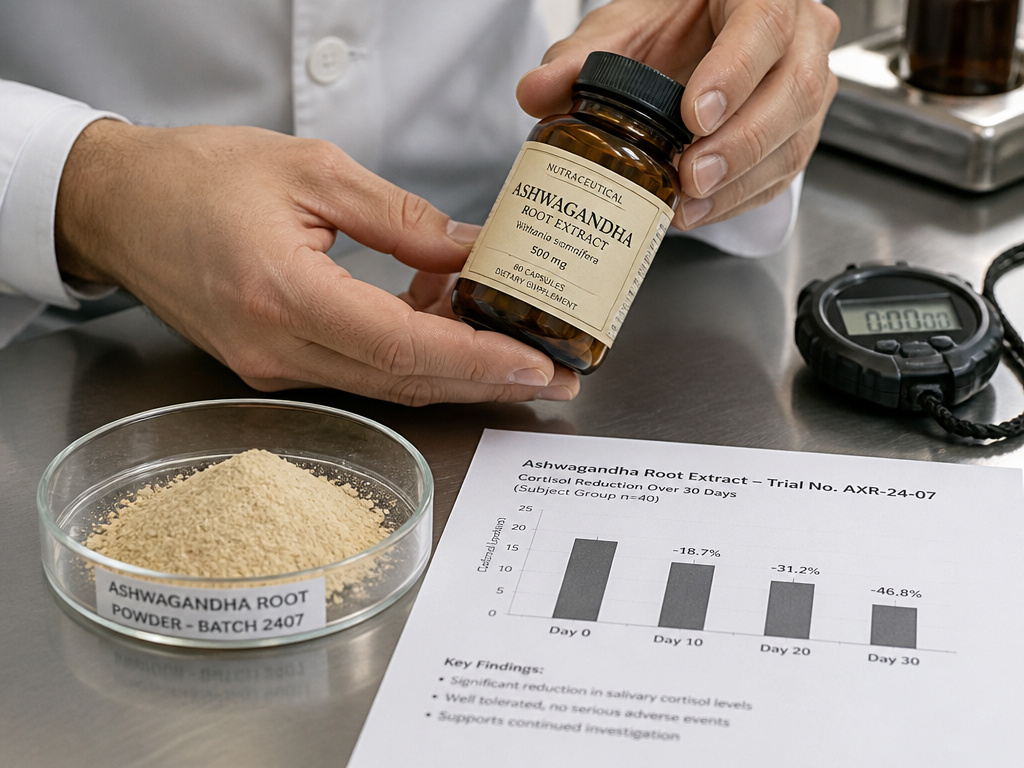
The ashwagandha resistance training study is the one to read if strength is your goal. It ran 8 weeks with 80 healthy adults aged 18 to 45, all of whom had been training at least three months before screening.
Participants took 300 mg twice daily of a root extract standardized above 5 percent withanolides, or a placebo, and everyone did the same 8-week resistance program. Muscle strength, muscle growth and endurance all improved more on the extract. Seven participants were excluded for poor compliance, three on ashwagandha and four on placebo.
The exclusion list matters as much as the results. Anyone taking performance supplements, steroids, anti-hypertensives, beta-blockers, hormonal contraceptives, corticosteroids or psychotropics was kept out. That’s a clean sample, and a clean sample isn’t your average gym.
A sports-medicine ashwagandha systematic review in athletes backs the direction. Five of the reviewed studies found VO2max improved more than placebo. In hockey players, core strength and stability scored 65.7 against 51.5 for placebo. Supplementation also reduced markers of exercise-induced muscle damage and stabilized creatine kinase.
Testosterone moved too, by about 66.5 ng/dl in men across the reviewed data. The testosterone boosters aisle leans on that number hard.
Here’s where it gets uncomfortable. NCCIH states plainly that there isn’t enough evidence to determine whether ashwagandha helps athletic performance. That sits next to a trial that found exactly that, and a review that found it five times over. The difference is what each source counts as enough.
My read: the training effect is real but small, and it showed up in people who were already training and eating properly. If strength is the goal, supplements for muscle growth with better evidence should come first, and basic workout recovery habits before any of them.
Which Extract Was Tested Matters More Than the Milligram Count
KSM-66, Shagandha, Prolanza and Witholytin are not interchangeable, and the labels don’t always make that obvious.
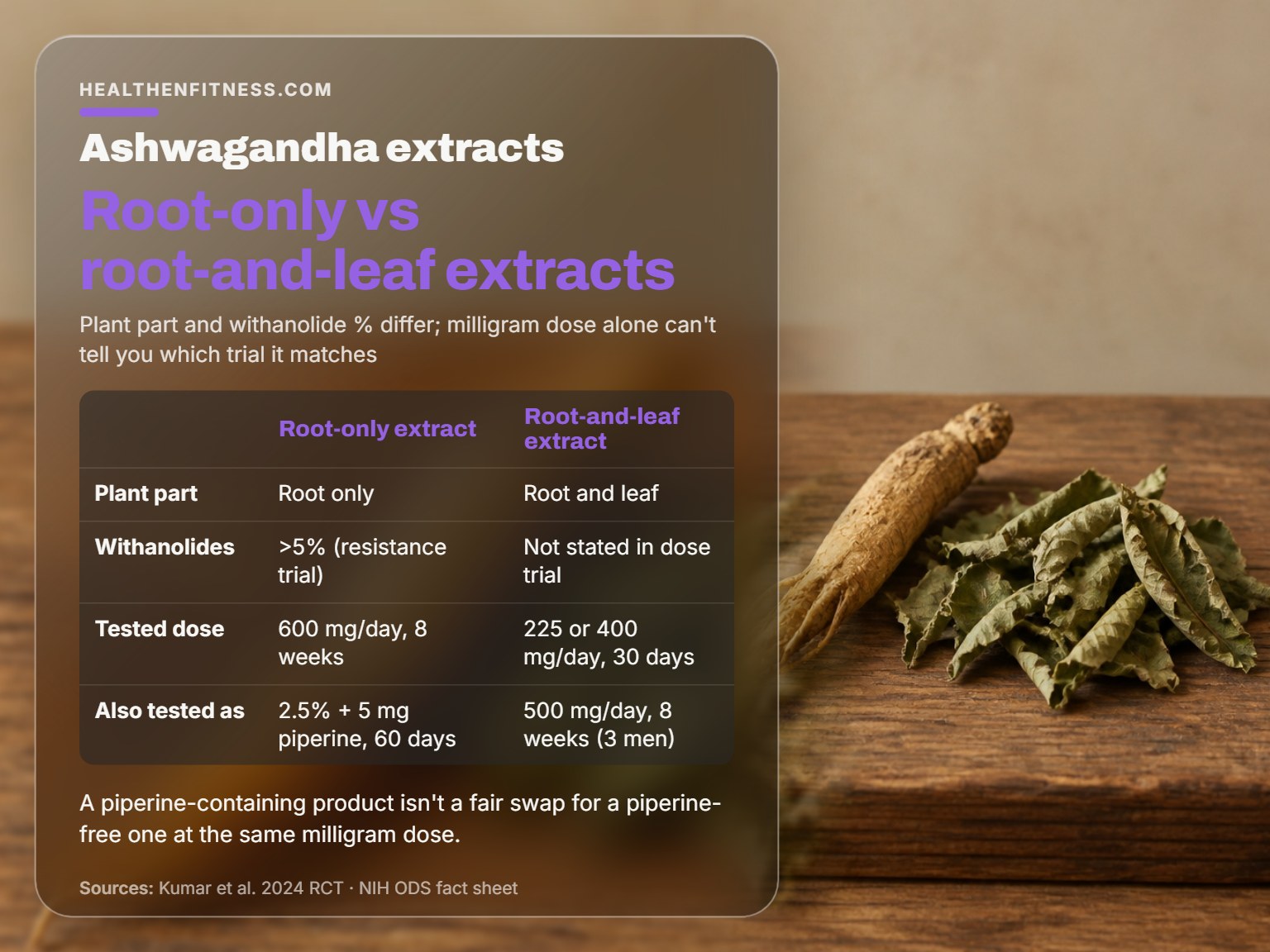
Three different preparations show up in the research. The resistance-training trial used a root-only extract standardized above 5 percent withanolides. The Nutrients dose trial used a root-and-leaf aqueous extract. A 60-day stress trial used 500 mg of root extract at 2.5 percent withanolides plus 5 mg of piperine.
Root-only versus root-and-leaf
The plant part changes the chemistry. Root-only and root-and-leaf extracts are different products with different regulatory treatment, and the withanolide percentage is the only number on the label that lets you compare them.
Piperine adds another variable. It’s included to improve absorption, which means a piperine-containing product isn’t a fair swap for a piperine-free one at the same milligram dose.
Open a capsule of plain root powder and it smells earthy and bitter, closer to dried hay than to anything you’d call pleasant. That’s normal. What you want on the label is the standardized percentage and the plant part, printed clearly.
If a bottle lists a milligram dose and no withanolide percentage, you can’t tell which trial it belongs to. Buy the one that tells you.
For a plain starting point, Gaia Herbs sells a root extract standardized to 2.5 mg withanolides per 350 mg capsule, which is the preparation used in that 30-day student trial.
Who Should Skip Ashwagandha
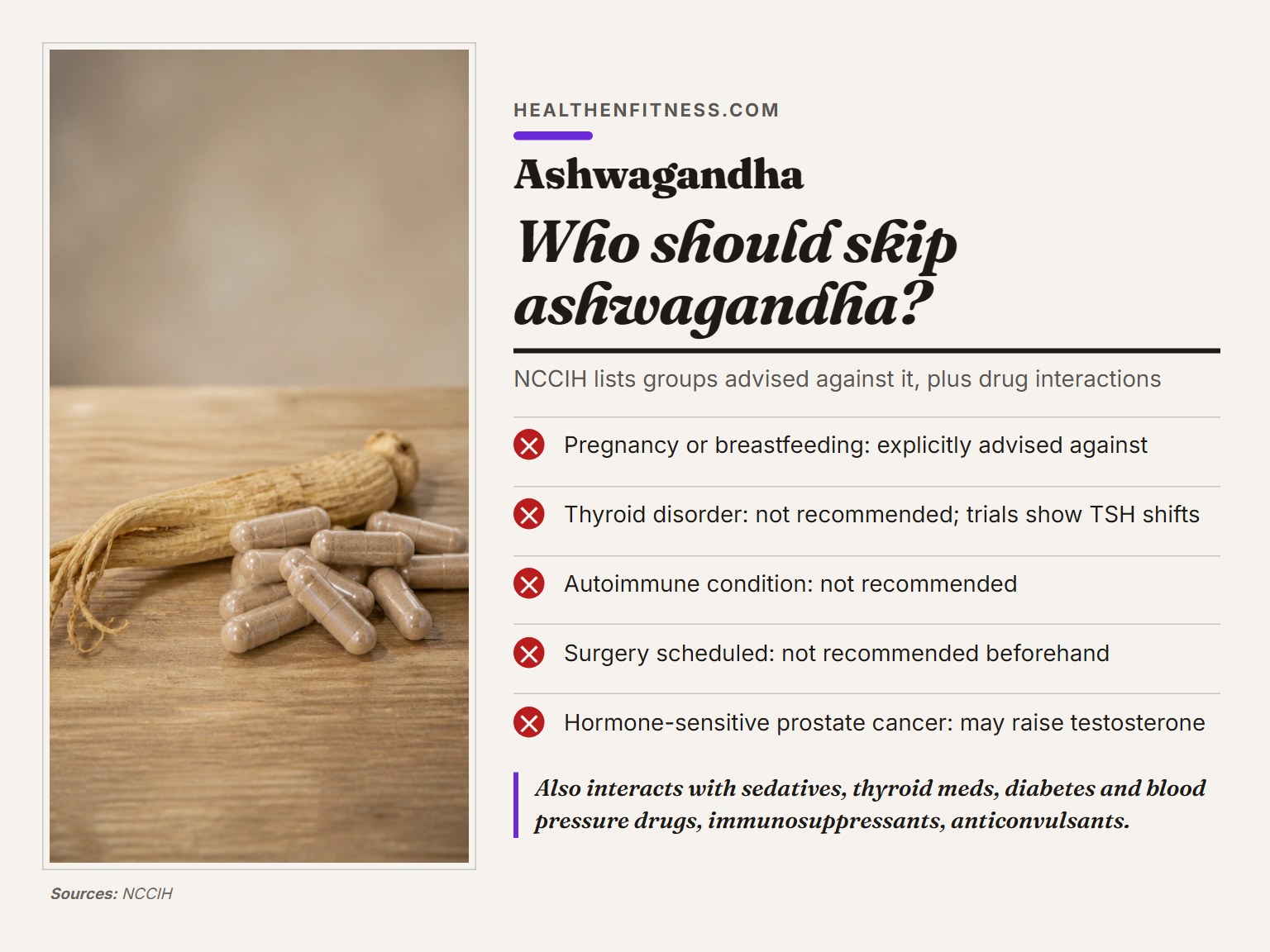
NCCIH lists several situations where ashwagandha isn’t recommended, and two of them surprise people.
Before you start: Ashwagandha is not recommended during pregnancy or breastfeeding, and not before surgery. It can interact with sedatives, thyroid medication, diabetes drugs, blood pressure drugs, immunosuppressants and anticonvulsants, so check everything you already take. Rare cases of liver injury have been reported, so stop and see a doctor if you notice jaundice or unusual fatigue.
The thyroid picture is genuinely split. A small trial of 50 people with subclinical hypothyroidism found 300 mg twice daily for 8 weeks lowered TSH and raised T3 and T4 against placebo. NCCIH, working from the same body of evidence, says ashwagandha isn’t recommended for people with thyroid disorders. Both statements are defensible. A hormone that moves in a trial is a hormone that moves, and moving thyroid numbers is exactly what you don’t want to do unsupervised.
| Group | Why | Source |
|---|---|---|
| Pregnant or breastfeeding | Explicitly advised against | NCCIH |
| Thyroid disorder | Not recommended; trials show TSH shifts | NCCIH and NIH ODS |
| Autoimmune condition | Not recommended | NCCIH |
| Surgery scheduled | Not recommended beforehand | NCCIH |
| Hormone-sensitive prostate cancer | May raise testosterone | NCCIH and NIH ODS |
| On sedatives or thyroid meds | Known interaction risk | NCCIH |
The prostate cancer line is the one people miss. Because ashwagandha may raise testosterone, NCCIH advises people with hormone-sensitive prostate cancer to avoid it. The NIH fact sheet puts it more gently, saying it might not be safe. Either way, that’s a conversation with an oncologist.
Side effects are mostly mild and boring. Drowsiness, stomach upset, diarrhea and vomiting get reported. If you land the drowsy version, don’t take it before a morning lift.
How to Test It on Yourself Without Wasting Three Months
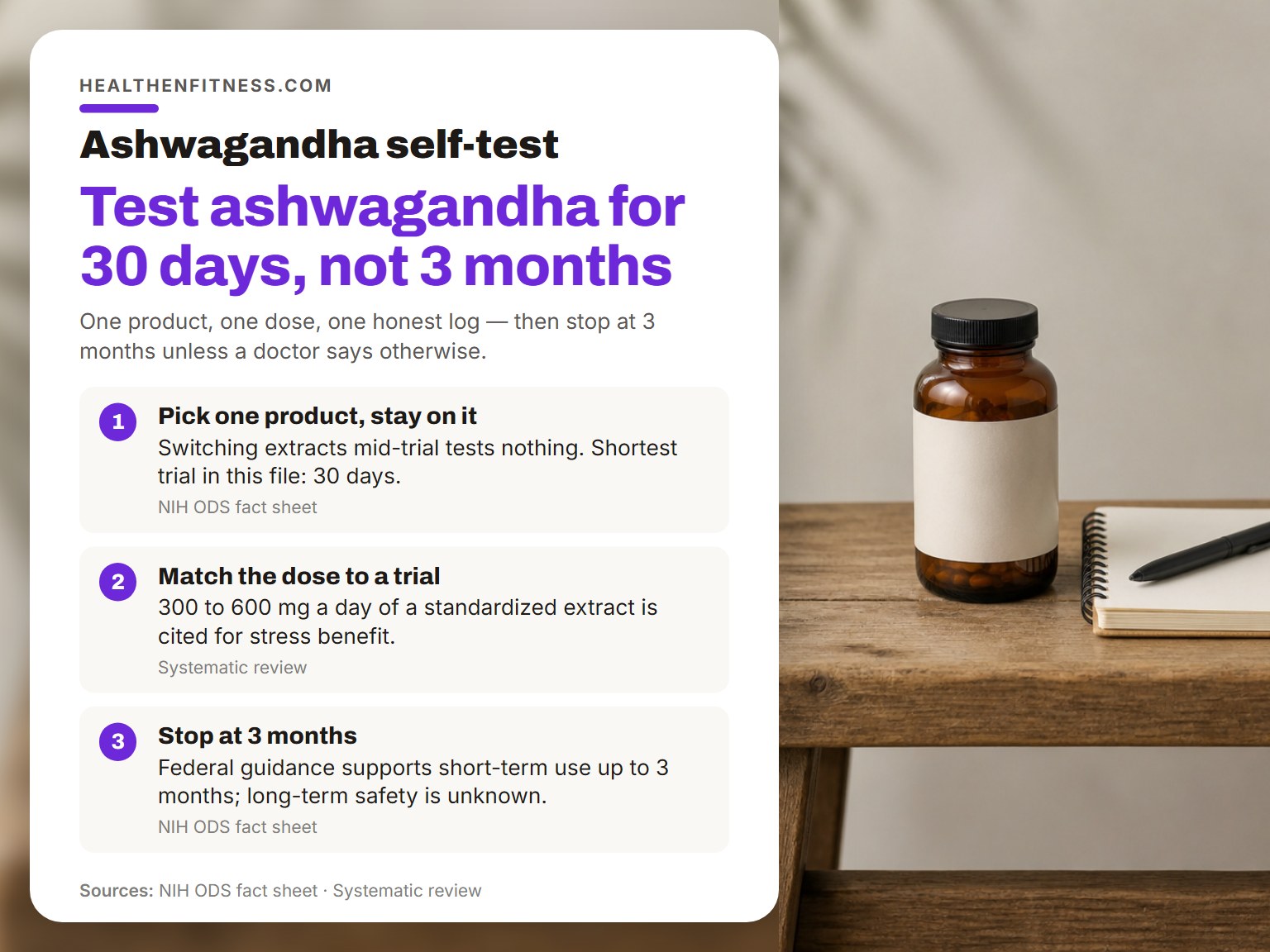
Three rules make a self-test worth running: one product, one dose, one honest log.
- Pick one product and stay on it. Switching extracts halfway through means you’ve tested nothing, and you’ll have a strong opinion built on noise. The shortest trial in this file ran 30 days, so give it 30 days minimum.
- Match the dose to a trial. 300 to 600 mg a day of a standardized extract is the range with the most support. Going higher doesn’t map onto any result here.
- Change nothing else. Start ashwagandha, a new pre-workout and a calorie cut in the same week and you’ll never know which one did what.
- Stop at three months unless a doctor says otherwise. Federal guidance supports short-term use up to 3 months, and long-term safety is unknown.
Where this goes sideways: Starting three supplements in the same week. By day 30 you’ll have a firm opinion and no evidence, and you’ll keep buying all three.
What to log
- Sleep quality, rated 1 to 5, the morning after.
- One strength number you can repeat, like bench press at a fixed rep count.
- How you felt at 3pm, which is where stress shows up for most people.
- Anything that might be a side effect, with the date next to it.
Thirty days is the shortest trial on that list.
And skip the pre-workout stack while you’re testing. Caffeine at a premium price is still caffeine, and it muddies the read on everything else.
One bottle, one month, one number.
Frequently Asked Questions
How long does ashwagandha take to work for stress?
The trials that showed stress benefits ran 30 to 90 days, with the shortest at 30 days. A systematic review put the effective window at 30 to 112 days. Give it a full month before you judge it.
Can I take ashwagandha every day?
Daily dosing is what every trial in this file used. Federal safety guidance supports daily use for up to 3 months. Beyond that, the long-term data doesn’t exist yet.
Does ashwagandha help with muscle growth?
One 8-week trial of 80 adults found 600 mg a day plus resistance training improved strength, muscle size and endurance. A review of athletes found similar strength and VO2max effects. NCCIH still says there isn’t enough evidence to call it an athletic aid, so the honest answer is “probably a little.”
What is the best time of day to take ashwagandha?
No trial in this file tested timing against a placebo. Drowsiness is a listed side effect, so if it makes you sleepy, take it in the evening. If it doesn’t, the time of day likely doesn’t matter.
Is ashwagandha safe to take long term?
Federal guidance supports short-term use up to 3 months and says long-term safety is unknown. Rare liver injury cases have been reported. Staying on it past three months is a doctor conversation, not a label decision.
The Bottom Line
Here’s the concession. If you’re sleeping six hours, eating badly and training four days a week, ashwagandha won’t rescue any of that. The trials enrolled people who were already training and already stable. That’s the population the results describe.
The trigger for trying it: your sleep and training are consistent, your stress is still high, and you want one variable to test. That’s a reasonable place to stand, and 300 to 600 mg a day of a standardized root extract for 30 days is a fair trial.
The contrarian bit: I’d rather see you spend the money on a third gym session than on a second supplement. Ashwagandha has real evidence behind it and low certainty attached to that evidence. Both things are true at once.
That’s the honest version of the ashwagandha for stress and training story. Today, just write down your bedtime for the next seven nights. That number tells you more about your stress than any bottle will.
