
Sleep Debt and Training Performance: What the Data Shows
This post contains affiliate links. As an Amazon Associate, we earn from qualifying purchases.
Sleep debt and training performance connect through a measurable drop: a 2022 meta-analysis of 69 studies found that sleeping six hours or less per night cut physical performance by 7.56 percent overall. That pooled figure hides enormous variation, and the strength data is genuinely contested.
Craven’s team set the six-hour line as the operational cutoff. Control groups slept more than six hours per 24; sleep-loss groups slept six or less. Effects showed up in deprivation and late-restriction protocols. Early restriction produced no consistent effect at all.
What follows is what the numbers actually say, where the studies contradict each other, and how to adjust a training week when you’ve slept badly. No seven-to-nine-hours sermon. You’ve heard that one.
Key Takeaways
- Six hours or less per night is the cutoff the research uses to define sleep loss, and the pooled performance hit is 7.56 percent.
- The strength question is unresolved. One meta-analysis found strength affected; two other studies found it largely held up.
- Morning sessions survive sleep loss better in the pooled data, though one strength study tested at 5 p.m. And found no drop.
- Competition night costs about 60 minutes of sleep, and 80 minutes if the event starts at 6 p.m. Or later.
- A 60-minute nap helped one measure in one group and did nothing for grip strength in either group.
What the Sleep Debt and Training Performance Research Shows
Craven and colleagues pooled 69 publications and 227 outcome measures in a 2022 Sports Medicine meta-analysis. The headline result was a 7.56 percent average decline in physical performance under sleep loss, with a 95 percent confidence interval running from -11.9 percent to -3.13 percent.
Sleep loss in the pooled literature is defined as six hours or less of sleep per 24-hour period, with control conditions above six hours. The 2022 meta-analysis of 69 publications reported an overall physical performance decrement of 7.56 percent, with a 95 percent confidence interval of -11.9 to -3.13 and an I-squared value of 98.1 percent.
That I-squared figure is the part worth sitting with. 98.1 percent heterogeneity means the studies disagreed with each other far more than they agreed with the average. The 7.56 percent describes the pile of studies, not your body on a given Tuesday.
There’s a second caveat buried in the sample. The pooled group was 89 percent male (n=959), so nobody has really tested whether the number holds for women. If you’re female and reading a headline that quotes 7.56 percent as a universal rule, that’s a gap, not a finding.
For the fuller picture on individual sleep targets, the site’s breakdown of how much sleep athletes need covers the range by training load rather than a single number.
How Big Is the Performance Drop, Really?
Seven and a half percent sounds small until you attach it to something specific. The New Zealand Defence Force officer-trainee cohort is the cleanest field data in this set: 22 trainees, 36 nights of actigraphy across a six-week course, mean sleep of 6:10.
Split at a midpoint of 6:15, the study produced two groups. The UNDERS averaged 5:51 of sleep and the OVERS averaged 6:27. On the 2.4 km run the study reported 59.8 against 44.9 (d=0.26). On press-ups, 4.7 against 3.2 (d=0.45). That is the same sleep duration military training study that most popular summaries skip, because the between-group gap is only 36 minutes of sleep.
Thirty-six minutes. That’s the whole intervention.
What most people get wrong: Treating the 7.56 percent as a fixed penalty you can budget for. The heterogeneity is 98.1 percent, which means the average describes the studies, not your training week.
Here is how the numbers stack up across the sources:
| Measure | What the research found | Source |
|---|---|---|
| Overall performance drop | 7.56% pooled decline | Craven et al. 2022 |
| Decline per hour awake | About 0.4% per hour before exercise | Craven et al. 2022 |
| Competition-night sleep loss | 60 min shorter total sleep time | Fullagar et al., BJSM |
| Night events (start 18:00+) | 80 min shorter total sleep time | Fullagar et al., BJSM |
| Day events | 20 min shorter total sleep time | Fullagar et al., BJSM |
The 0.4 Percent Per Hour Rule
The dose-response figure is the most useful single number in the whole set. Craven’s team reported roughly 0.4 percent performance decline per hour awake before exercise, and only in the deprivation and late-restriction protocols.
Read that against a normal day. Wake early after a short night, train in the evening, and you’re many hours awake before the first rep. The research doesn’t promise the decline is perfectly linear across that span, but the direction is clear enough to plan around.
Does Sleep Loss Actually Cost You Strength?
Does a bad night cost you strength? Three credible sources give three different answers, and the honest summary is that nobody has settled it.
- Craven et al. 2022 found significant negative effects of sleep loss across all exercise categories, including 66 strength outcome measures.
- Knowles et al. reviewed 17 resistance-training studies and concluded sleep deprivation had little effect on muscle strength, with force loss showing up in multi-joint movements but not single-joint ones.
- The two-night nap study (30 strength-trained males) found grip strength unaffected by either restriction protocol or the nap, with p above 0.005.
| Source | Strength verdict | What it measured |
|---|---|---|
| Craven et al. 2022 | Strength declines with sleep loss | 66 strength outcome measures pooled |
| Knowles et al. | Little effect on strength | 17 resistance-training studies |
| Nap study (n=30) | Strength holds | Grip strength, two nights restriction |
The inadequate sleep and muscle strength study is the one I’d read first if you train for strength specifically, because it separates compound lifts from isolation work. Its finding is narrower than the headlines suggest.
Why the Strength Studies Disagree
Knowles offers the most plausible explanation. The review states that impairment under sleep loss appears when exercise is performed without specific interventions designed to increase motivation. Group training or caffeine can mask the deficit.
That reframes the whole question. A lifter in a noisy gym with a training partner and a pre-workout may be functionally fine on five hours. The same lifter alone in a garage at 6 a.m. May not be.
The bar that felt like a warm-up last Tuesday feels welded to the floor. Same weight, same rest, different nervous system.
For the recovery side of this, the site’s piece on sleep and muscle growth covers what happens after the session rather than during it.
Morning vs Afternoon: When Does Sleep Debt Bite Hardest?
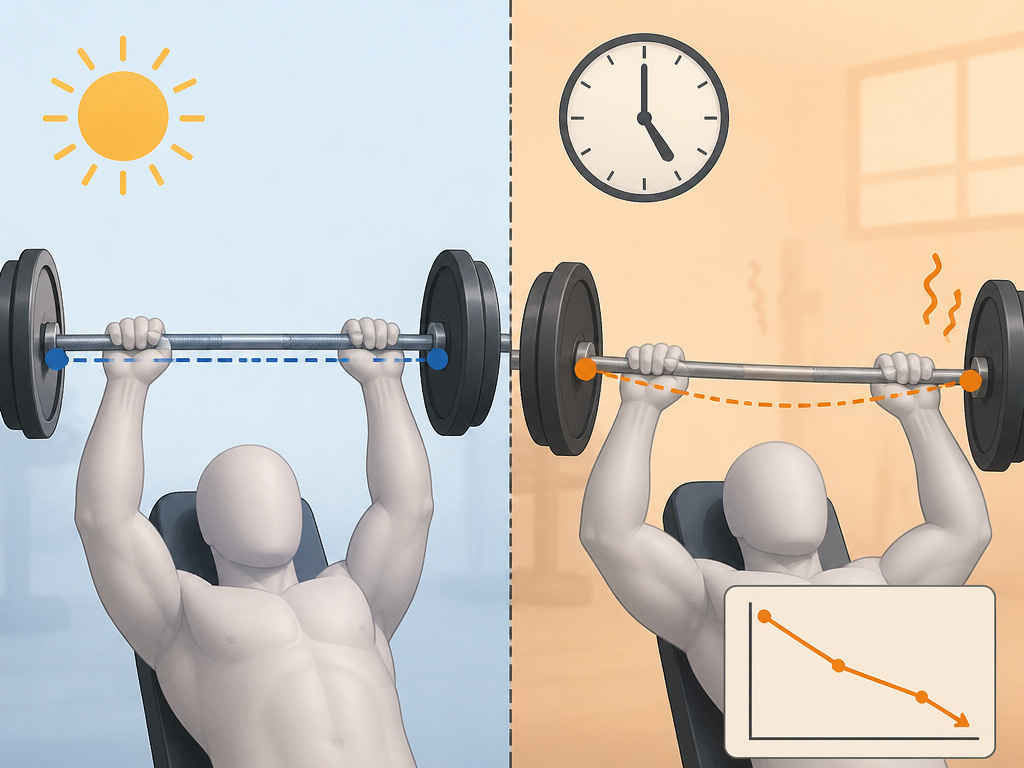
Craven’s team found morning tasks largely unaffected by sleep loss, while afternoon effects were consistent, and recommended prioritising morning exercise when short on sleep; the nap study, however, tested at 17:00 and found strength preserved.
That’s a clean, actionable finding. It also runs straight into the nap study, which tested at 17:00, squarely afternoon, and found strength preserved. Two credible sources, opposite implications for a 5 p.m. Session.
I wouldn’t build a training week around the morning-versus-afternoon split if strength is your goal. The pooled data is dominated by endurance and skill tasks. The one study that tested afternoon strength directly found no drop. Move the session if it’s easy to move; don’t restructure your life over it.
The wider picture in the sleep and athletic performance review covers injury risk and mental performance alongside the physical side.
Set an early alarm after six hours and the first set feels normal. It’s the fourth set, forty minutes in, where the bar speed drops and you start bargaining with yourself.
If you want a practical framework rather than more data, the site’s guide to train with poor sleep walks through session adjustments step by step.
What Competition Night Does to Sleep
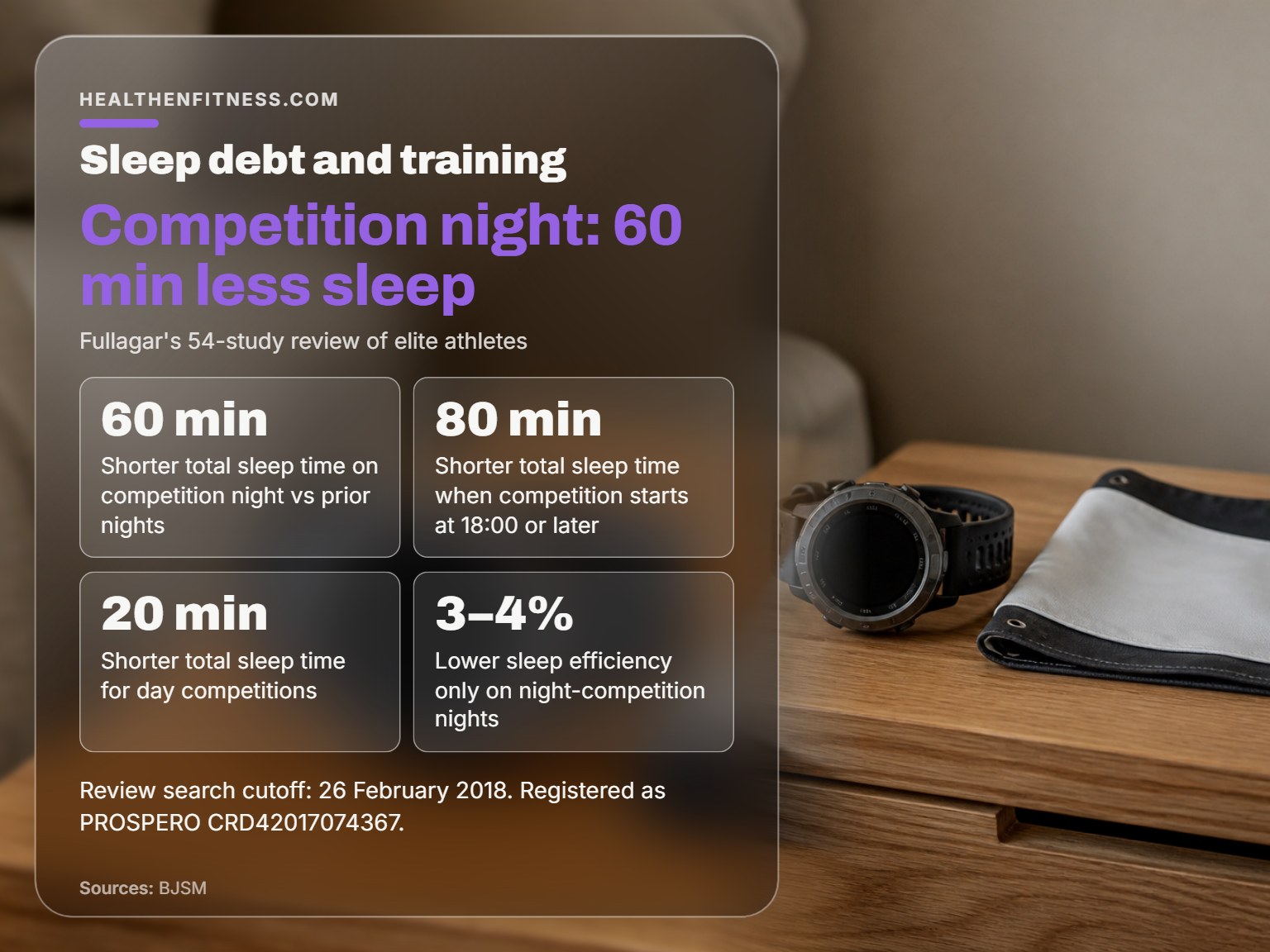
Competition night costs 60 minutes of total sleep time. Fullagar’s 54-study review, registered as PROSPERO CRD42017074367, found that across elite athletes, total sleep time on competition night ran an hour shorter than on prior nights, with sleep efficiency 1 percent lower.
The split by start time is sharper than the headline.
Night Events vs Day Events
For competitions starting at 18:00 or later, total sleep time was 80 minutes shorter. For day competitions, 20 minutes shorter. Sleep efficiency dropped 3 to 4 percent, and only on night-competition nights.
The review also named specific triggers of sleep impairment:
- Training start before 07:00
- Training load increase above 25%
- Late-night or early-morning travel departures
- Eastward travel
- Altitude ascent
That training-load trigger is worth circling. A jump above 25% in weekly load is enough to disturb sleep, which then degrades the recovery the load increase was supposed to drive. It’s a loop, and it’s the same loop the site covers in its piece on life stress and training.
One more caveat: the review’s literature search cut off on 26 February 2018. It predates most of the post-2020 work on sleep extension in athletes, so treat it as a strong baseline rather than the current edge of the field.
Do Naps Rescue a Bad Night?
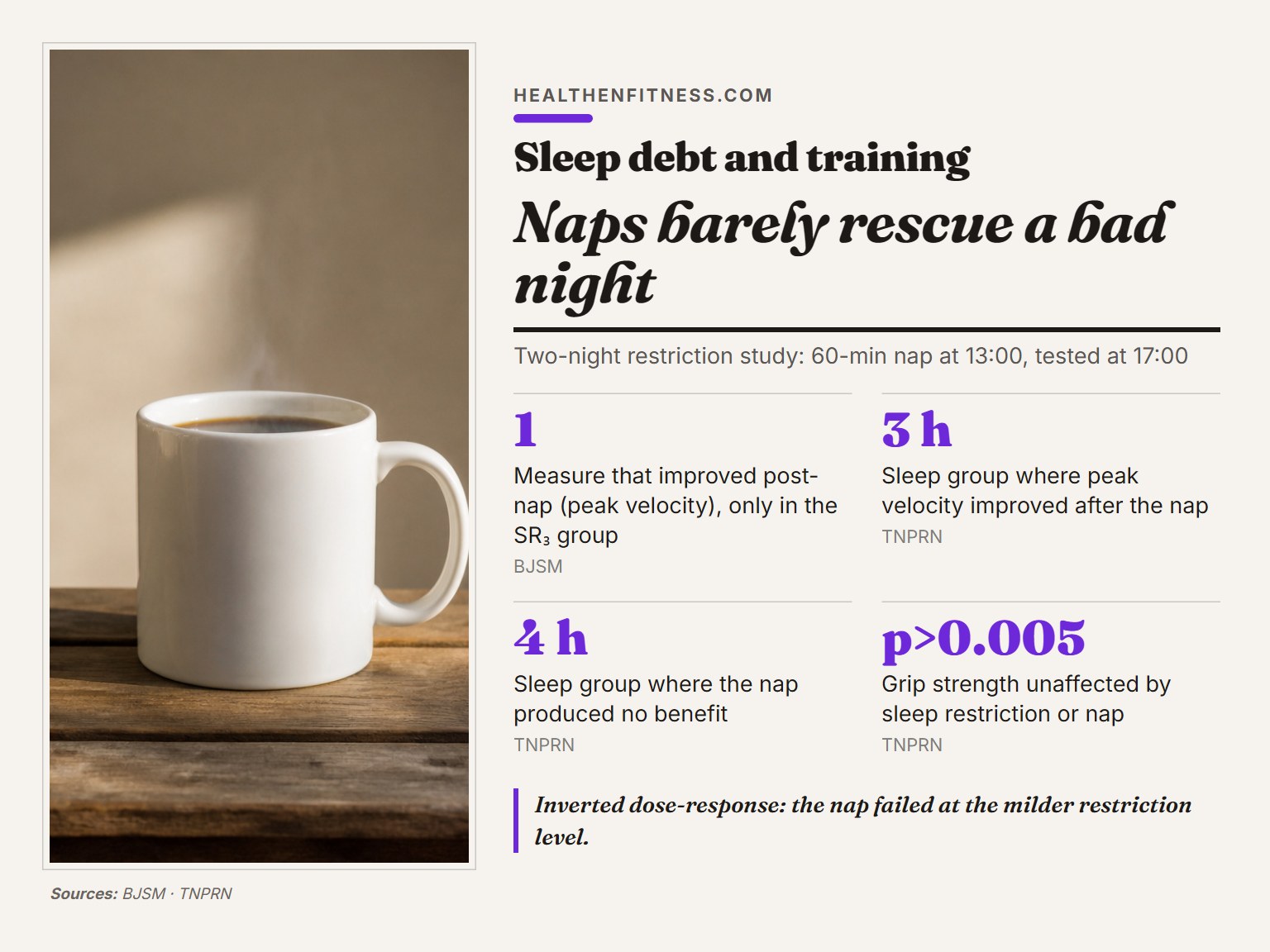
The nap data is thinner than the internet makes it sound. A 60-minute nap at 13:00, with testing at 17:00, produced exactly one improvement in the two-night restriction study.
Peak velocity went up after the nap, and only in the group that slept three hours. The group that slept four hours got nothing.
That’s an inverted dose-response. The nap failed at the milder restriction level. The authors attribute it to baseline strength differences between the groups, which is a careful way of saying the result is fragile.
A nap is a patch, not a repair. If you need one every single day to get through your sessions, the problem is upstream of the nap.
Grip strength was unaffected by the nap in either condition. So if your definition of “rescued” is “I can still grip the bar,” the nap did nothing measurable.
The elite-athlete restriction protocol is the starker data point. Self-reported sleep dropped from 7.4 hours to 4.0, and actigraphy-measured sleep from 6.7 to 3.7. Maximal jump performance dropped and lower-extremity joint coordination variability changed, per the sleep restriction jump performance study.
Altered coordination variability is the finding I’d pay attention to. It means the movement pattern itself shifted, not just the force output.
The site’s look at naps for recovery covers the timing question in more detail. And if you’re trying to work out whether your fatigue is sleep debt or something deeper, the checklist of overtraining syndrome signs is the place to start.
What to Actually Do About Sleep Debt
A few years back I got ambitious with my own programming and added volume faster than I should have. Around week three my sleep went sideways, and my main lifts dropped instead of climbing. I now schedule a lighter week before my body demands one, which is the single change that has kept me training consistently.
That’s the loop from the Fullagar data playing out in a garage gym. Load goes up, sleep goes down, performance follows.
Before you start: If you’ve had a very short night, skip max-effort lifts and sprint work. The jump-kinematics study found sleep restriction altered lower-extremity joint coordination variability in elite athletes, and altered coordination under load is how a knee gets tweaked rather than a rep getting missed.
Here’s what I’d actually change, in order:
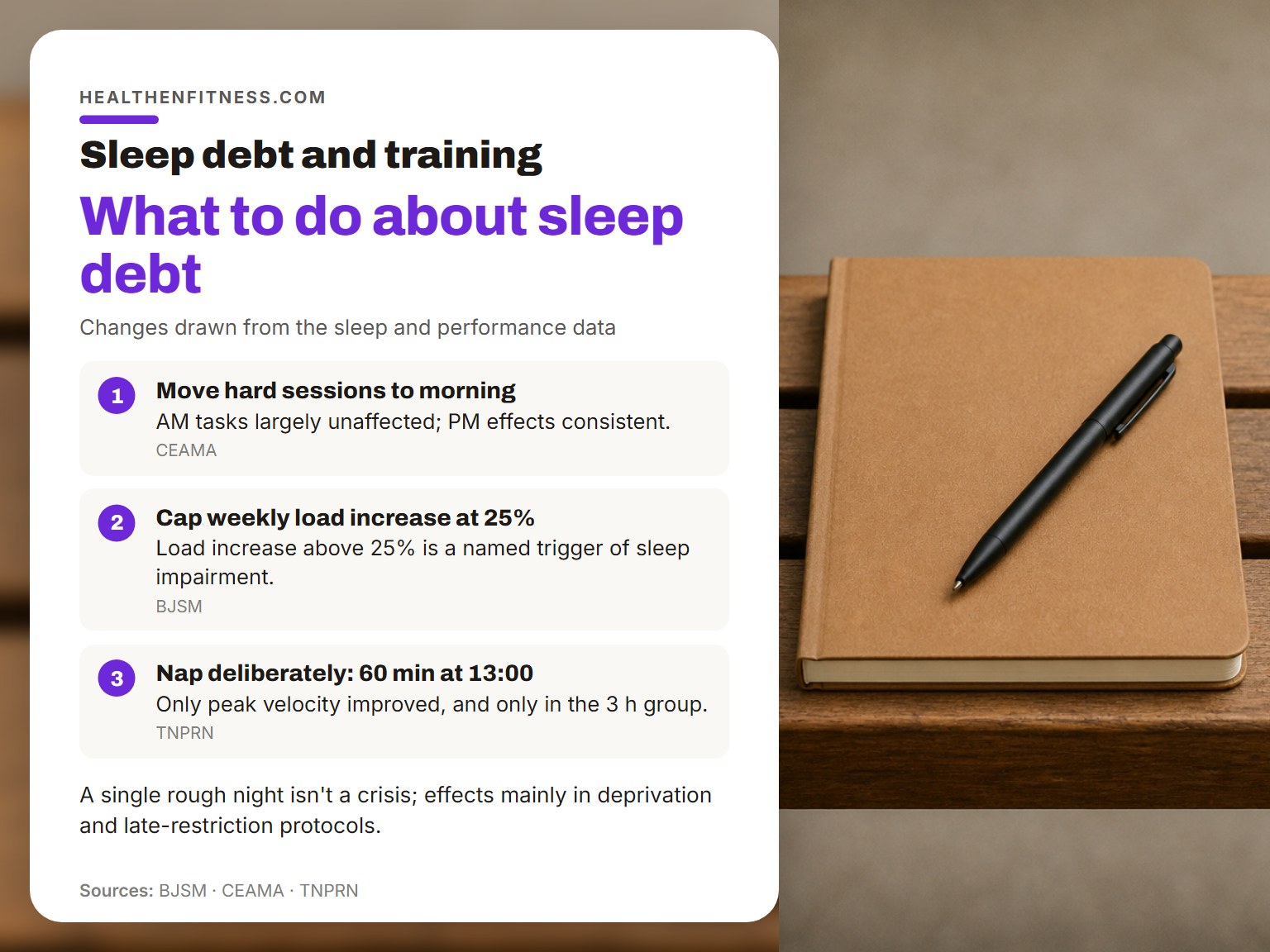
- Move the hard session to the morning. Craven’s pooled data found morning tasks largely unaffected while afternoon effects were consistent, though the nap study tested at 17:00 and found strength preserved.
- Cap the weekly load increase at 25 percent. Fullagar’s review lists a jump above 25% as a named trigger of sleep impairment. Blow past it and you’re borrowing recovery from the week after next.
- Log sleep hours next to your main lift. Two lines in a notebook. An Oura Ring is the least intrusive of the wearables and the one I’d point most people toward if they want a score. A Whoop gives you more data than you’ll use. A Garmin does the same job if you already wear one for running.
- Use a nap deliberately, not as a rescue. 60 minutes at 13:00 is the protocol that showed a benefit, and only for peak velocity in the three-hour group.
- Stop treating a bad night as a reason to skip the week. One short night in Craven’s data produced effects mainly in deprivation and late-restriction protocols. A single rough Tuesday isn’t a crisis.
On step 3, the site’s guide to improve sleep quality is more useful than any wearable dashboard. And if you’re already three weeks into a bad stretch, the plan for recovering from a performance slump is a better fit than another hard block.
Caffeine deserves its own line here. It’s the most common masking tool in the gym, and the site’s breakdown of caffeine and sleep covers the timing trade-off. Knowles noted that caffeine may mask the deficit under sleep loss, which is useful on the day and unhelpful across the week.
Frequently Asked Questions
How much sleep do you need before a hard training session?
The research defines sleep loss as six hours or less per 24 hours, so that’s the line to watch. Craven’s pooled data found performance dropped about 0.4 percent for every hour you’ve been awake before exercise, which compounds if you started from a short night.
Does sleep debt affect strength training as much as cardio?
The evidence is split. Craven’s meta-analysis found significant effects across all categories including 66 strength measures. Knowles found little effect on strength, with losses only in multi-joint movements. The nap study found grip strength untouched by either restriction or nap.
Can you catch up on sleep debt over the weekend?
The data in this set is thin on that question. The two-night nap study found a 60-minute nap helped peak velocity in one restriction group and did nothing for grip strength in either. Nothing here supports a weekend lie-in reversing a week of short sleep.
Is it better to train tired or skip the session?
It depends on the session. Morning tasks were largely unaffected in Craven’s pooled data, while afternoon effects were consistent, though the nap study tested at 17:00 and found strength preserved. My call: if it’s a max-effort lift and you’ve had a very short night, skipping costs you less than grinding through it badly.
Do naps help with sleep debt and training performance?
60-minute nap at 13:00 improved peak velocity after a three-hour night in one study, but not after a four-hour night, and it had no effect on grip strength. Treat naps as a patch on a bad day, not a fix for the week.
The Bottom Line
One threshold worth writing down: if you’re sleeping six hours or less, don’t test a max that week. The pooled research doesn’t support the attempt, and the NZDF cohort data shows the cost landing on the run and the press-up count even at a 36-minute sleep gap between groups.
This all changes if you’re a competitive athlete with a fixed calendar. You can’t move the meet. In that case, the Fullagar data on competition-night sleep loss is the thing to plan around rather than fight. Night events starting at 18:00 or later cost 80 minutes, so the plan has to account for the 80 minutes before race week, not after.
And if you’re somewhere in the middle, training for general strength and not chasing a number, the research is more forgiving than the headlines suggest. Start smaller than you think you need to.
Today, just write down last night’s sleep hours and today’s main lift. One line each. Do it for two weeks and you’ll have your own data instead of mine.
