
How Long Should You Hold a Stretch? 5 to 120 Seconds
This post contains affiliate links. As an Amazon Associate, we earn from qualifying purchases.
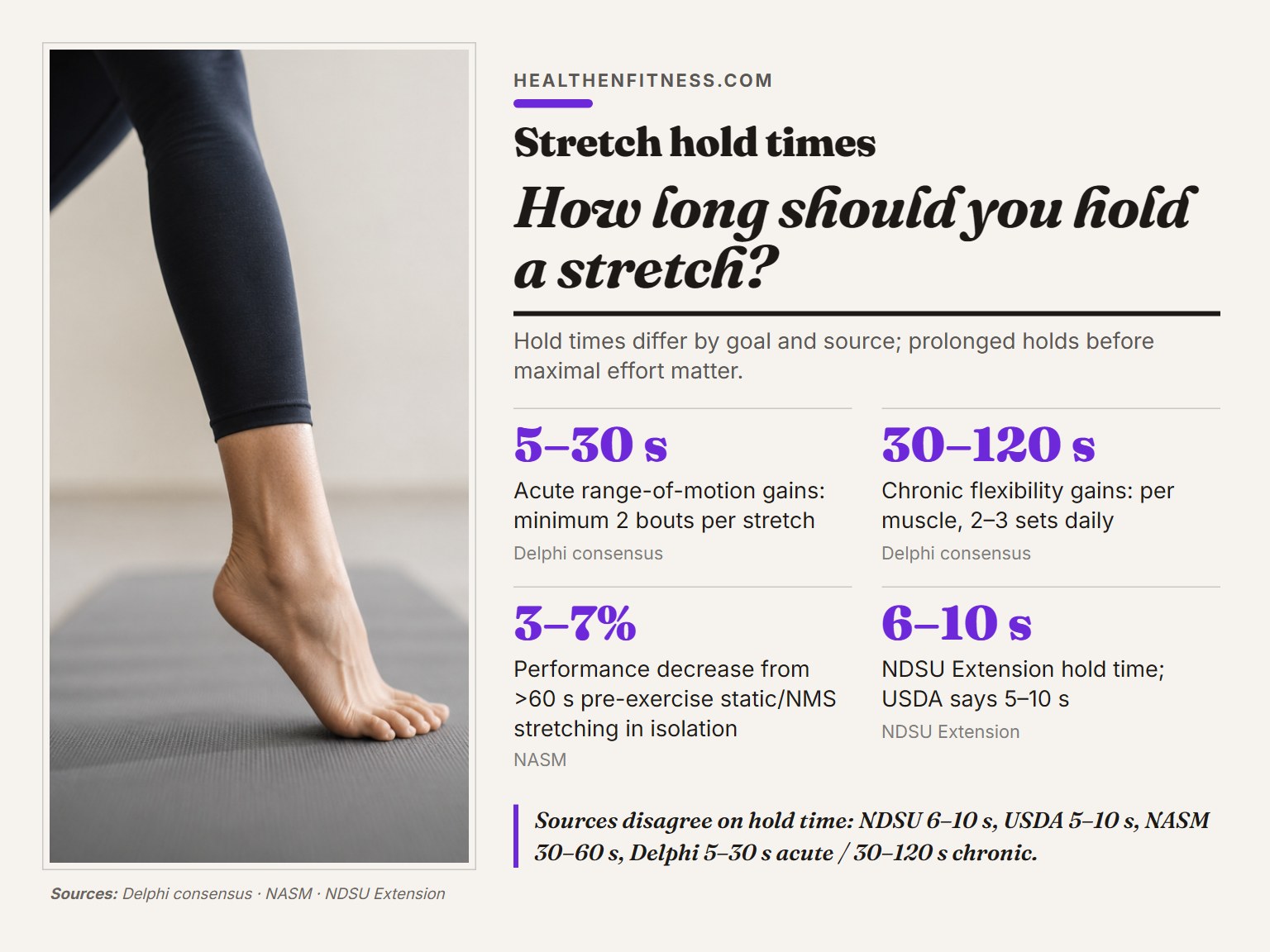
To answer how long you should hold a stretch: it depends on your goal. For an immediate range-of-motion boost, a 2025 Delphi consensus says 5 to 30 seconds per stretch, minimum two bouts. For lasting flexibility, hold 30 to 120 seconds per muscle, 2 to 3 sets daily.
That 5-to-30 second window is where the numbers start to split, because the figure you memorized in gym class was probably 30 seconds flat. The research has moved since then, and not every source has caught up. The bigger issue is that one hold duration can’t serve both a warm-up and a dedicated flexibility session, which raises the question of how long should you hold a stretch.
What follows is the honest version: where the major sources actually disagree, which joints ignore the standard rule, and how to pick a hold time for the session you’re about to do.
Key Takeaways
- 5 to 30 seconds per stretch, minimum two bouts, covers an immediate range-of-motion boost, per the 2025 Delphi consensus.
- Holds over 60 seconds on an isolated muscle before maximal or explosive effort can hurt performance, the Delphi panel warns.
- Your quadriceps and hip adductors may not respond to the standard rule at all, according to meta-analyses cited in that consensus.
- Breathe through every hold. Holding your breath can push blood pressure above safe levels, NDSU Extension notes.
Why Six Credible Sources Give You Six Different Hold Times
Six credible sources, six different answers, and a spread from 5 seconds to 2 minutes. That’s the actual state of the evidence, and anyone who tells you there’s one number is skipping the part where the research disagrees.
Here’s the table that should be on every gym wall, because it shows the disagreement instead of hiding it:
| Source | Recommended Hold | Context |
|---|---|---|
| NDSU Extension | 6-10 seconds | General static stretching |
| USDA MTDC (2009) | 5-10 seconds | Workplace fitness manual |
| dcp.psc.gov federal bulletin (citing ACSM 2006) | 15-30 seconds per muscle per day | General guidance |
| NASM | 30-60 seconds | Flexibility training |
| Delphi consensus (2025) | 5-30 seconds acute; 30-120 seconds chronic | By goal |
| Bandy & Irion (1999) | 15 seconds beats 5 seconds | Active ROM |
A 2025 Delphi consensus published in the Journal of Sport and Health Science recommends 5 to 30 seconds per stretch for acute range-of-motion gains and 30 to 120 seconds per muscle for chronic flexibility.
The spread isn’t a scandal. It reflects different questions. NDSU Extension and the USDA manual were written for general populations doing basic static stretching. NASM’s 30-to-60-second recommendation targets dedicated flexibility training. The 2025 Delphi panel split its answer by goal, which is the most useful framing available.
Where it gets interesting is the frequency conflict. USDA says 2 to 3 times per week. NASM says 3 to 5 days per week. The Delphi panel says daily for chronic gains.
Easy to miss: The frequency question matters as much as the duration question. A 30-second hold done twice a week won’t produce the same result as the same hold done daily, and the sources don’t agree on which schedule is right.
What Changes When You’re Stretching for Flexibility vs. A Warm-Up
The goal changes the dose, which is the single most useful thing to take from the 2025 consensus on how long should you hold a stretch, and it explains why the sources look like they’re fighting when they aren’t.
For an acute range-of-motion boost right now, the panel’s minimum is 5 to 30 seconds per stretch, with at least two bouts. That’s the warm-up window. Short and repeated, done inside a dynamic warm-up, it doesn’t hurt performance.
For chronic flexibility, the dose is bigger: 30 to 120 seconds per muscle, 2 to 3 sets daily. That’s a separate session, not a warm-up.
The mechanism matters here. A short hold works on stretch tolerance, which is why you feel looser immediately. A longer hold works on the tissue itself, which is why the changes stick around. NASM’s scientific rationale describes the same split: high-force, shorter-duration stretches emphasize elastic (temporary) deformation, while low-force, prolonged stretching emphasizes plastic (long-term) changes.
What most people get wrong: Treating a warm-up stretch and a flexibility session as the same thing. They’re different doses with different goals, and running the flexibility dose before a heavy lift is where the performance hit comes from.
Static Stretching Before Lifting: What the Research Actually Says
I stopped doing long static stretching right before lifting years ago. It made me feel loose, but my first heavy sets felt weaker, and I couldn’t figure out why until I read the research. The short version: I was borrowing flexibility I didn’t need and paying for it in force output.
The 2025 Delphi panel is explicit about this. Prolonged static stretching of more than 60 seconds on an isolated muscle before maximal or explosive contractions impairs performance. Short-duration static stretching inside a dynamic warm-up doesn’t.
NASM puts a number on the impairment: 3 to 7 percent decrease in strength and performance after acute prolonged pre-exercise static stretching done in isolation. That effect generally lasts less than 10 minutes, though some studies found strength impaired up to an hour.
Behm and Chaouachi, cited in the PLOS ONE paper by Mizuno and colleagues, recommend keeping pre-exercise static stretching under 30 seconds, while the 2025 Delphi consensus and NASM flag impairment only above 60 seconds on an isolated muscle.
The 30-Second Pre-Lift Ceiling
Thirty seconds per muscle, done once or twice, is a conservative pre-lift dose; the 2025 Delphi consensus and NASM flag impairment only above 60 seconds on an isolated muscle, while Behm and Chaouachi recommend staying under 30 seconds.
Common mistake: Holding a 90-second calf stretch right before squats. You’ll feel loose, then your first working set will feel heavier than it should, and you’ll blame the bar instead of the stretch.
What to Do Instead
A few better warm-up options, in order of usefulness:
- Leg swings, 10 per side, front to back and side to side
- Bodyweight squats, 10 slow reps with a two-second pause at the bottom
- Hip circles, 8 in each direction
- Two or three progressively heavier ramp-up sets of the lift you’re about to do
That last one does more for your first working set than any static stretch will. Form first, then add weight.
I won’t hold a static stretch longer than 30 seconds before a heavy set. The performance cost shows up on the first working set, and you’ll blame the bar.
If you want a structured version of that, this dynamic stretching routine pairs well with a few ramp-up sets. And if you’re already dealing with a specific tight spot, the pre-workout stretches that actually help are the short, movement-based ones.
Which Muscles Ignore the Standard Rule?
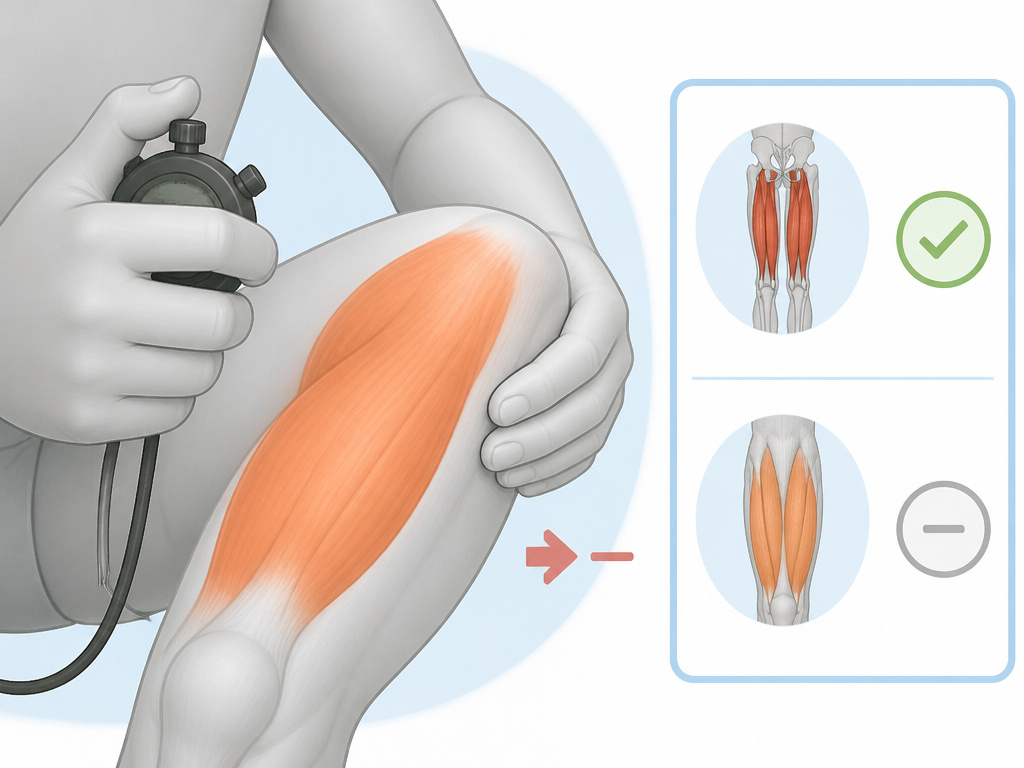
Your quadriceps don’t care about your stopwatch. That’s the part most hold-duration guides skip, and it’s where a single number falls apart fastest.
The Konrad meta-analysis cited in the Delphi consensus found no significant chronic range-of-motion improvement for the quadriceps across three measures. The Behm meta-analysis found non-significant acute improvement for the hip adductors across four studies. Ankle dorsiflexion range of motion is limited by bony configuration, which means no amount of holding will change the ceiling.
I spent a year stretching my quads every day and saw zero change, which is exactly what the Konrad meta-analysis would have predicted.
| Muscle/Joint | What the Research Shows | Adjustment |
|---|---|---|
| Quadriceps | No significant chronic ROM gain (Konrad) | Longer holds may not help |
| Hip adductors | Non-significant acute improvement (Behm) | Don’t expect quick wins |
| Ankle dorsiflexion | Limited by bony configuration | Stretching won’t add much |
| High-volume muscles | Delphi notes may need longer durations | Go toward 120 seconds |
| Hamstrings | 30 s, 5x/week, 6 weeks produced change (Bandy) | Standard protocol works |
The Delphi panel also notes that muscles which, due to volume, architecture, or resting tension, may need longer stretch durations. That’s the panel’s way of saying the standard rule is a starting point, not a finish line.
If you’re working on a specific area, the hamstring stretches that actually move the needle follow the Bandy protocol: 30 seconds per hold, five times a week, six weeks before you judge the result.
Where this goes sideways: Applying the 30-second rule to your quadriceps and expecting the same result you got from your hamstrings. Six weeks of daily holds won’t budge a muscle the meta-analysis says doesn’t respond to duration.
How Often Should You Stretch to Actually Gain Range of Motion?
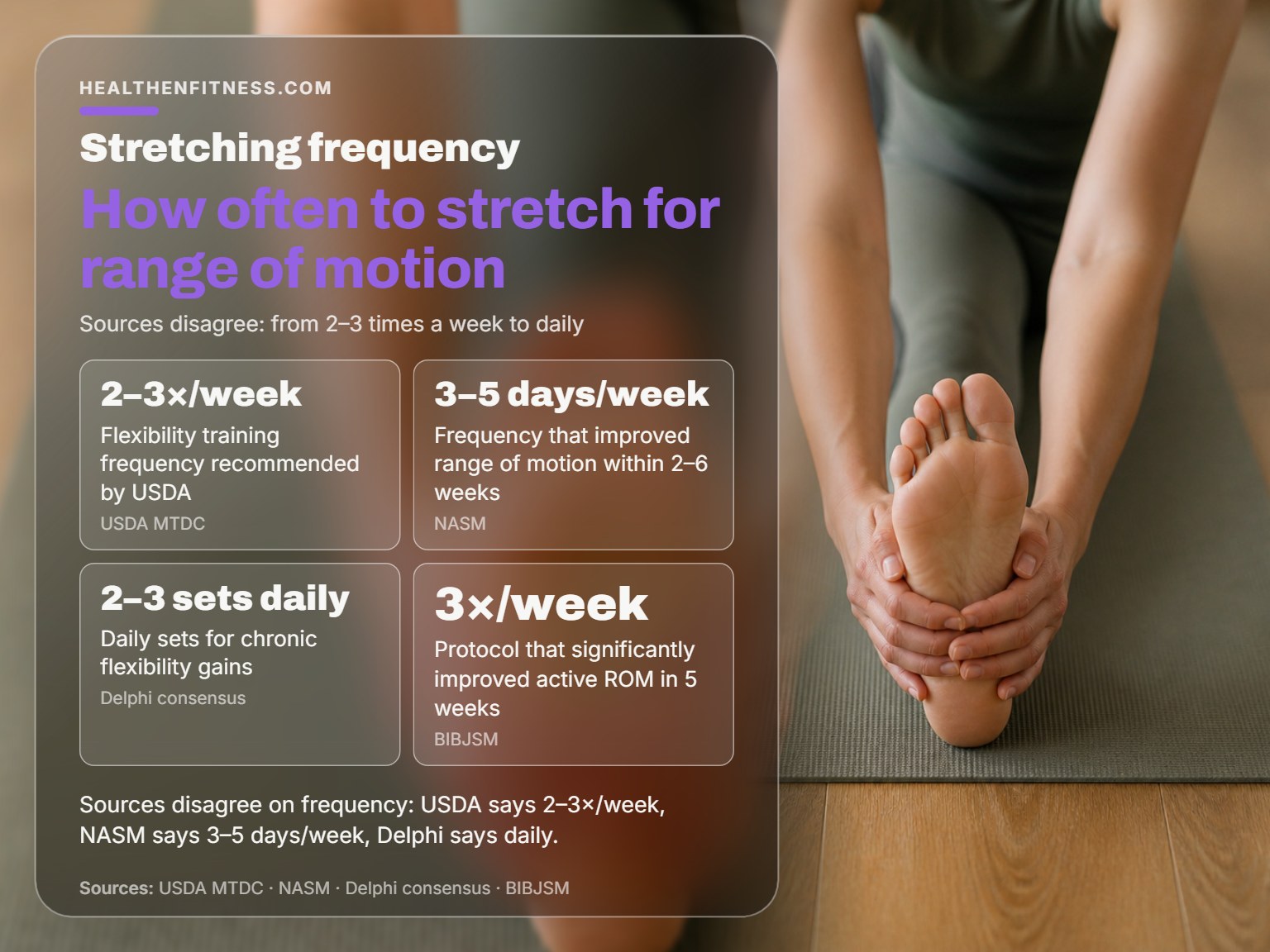
Frequency is where the sources disagree most, and it’s the variable most people ignore when they ask how long should you hold a stretch. You can hold a stretch for the perfect duration and still see nothing if you only do it twice a week.
USDA’s manual recommends 2 to 3 times per week. NASM says range of motion can improve within 2 to 6 weeks if you stretch 3 to 5 days per week. The 2025 Delphi consensus says 2 to 3 sets daily for chronic gains.
Bandy and Irion’s 1999 trial is the cleanest data point on the low end. Their protocol was static active stretching 3 times a week for 5 weeks, and it produced significant improvements in both active and passive range of motion. The 15-second group beat the 5-second group for active ROM, even though both groups totaled 45 seconds per exercise.
The federal bulletin citing ACSM adds a useful nuance: one hamstring stretch of 30 seconds daily produced the same results as three stretches of 30 seconds over 6 weeks. That’s a real finding, and it means you don’t need a long routine to see progress.
I’ve run the daily experiment on myself, and the honest version is that consistency beat duration every time. A single 30-second hamstring hold done every morning did more for my squat depth than a 10-minute stretching session done once a week. The first two weeks felt like nothing was happening, and then around week three my hamstrings stopped complaining when I sat cross-legged.
Common mistake: Stretching hard for 20 minutes once a week and calling it done. The research points the other way: shorter holds done more often beat longer holds done rarely.
If you want a template to follow, a full-body stretching routine done 3 to 5 days a week follows NASM’s frequency, though USDA says 2 to 3 times per week and the Delphi panel says daily for chronic gains.
The Breathing and Pain Rules That Matter More Than Your Timer
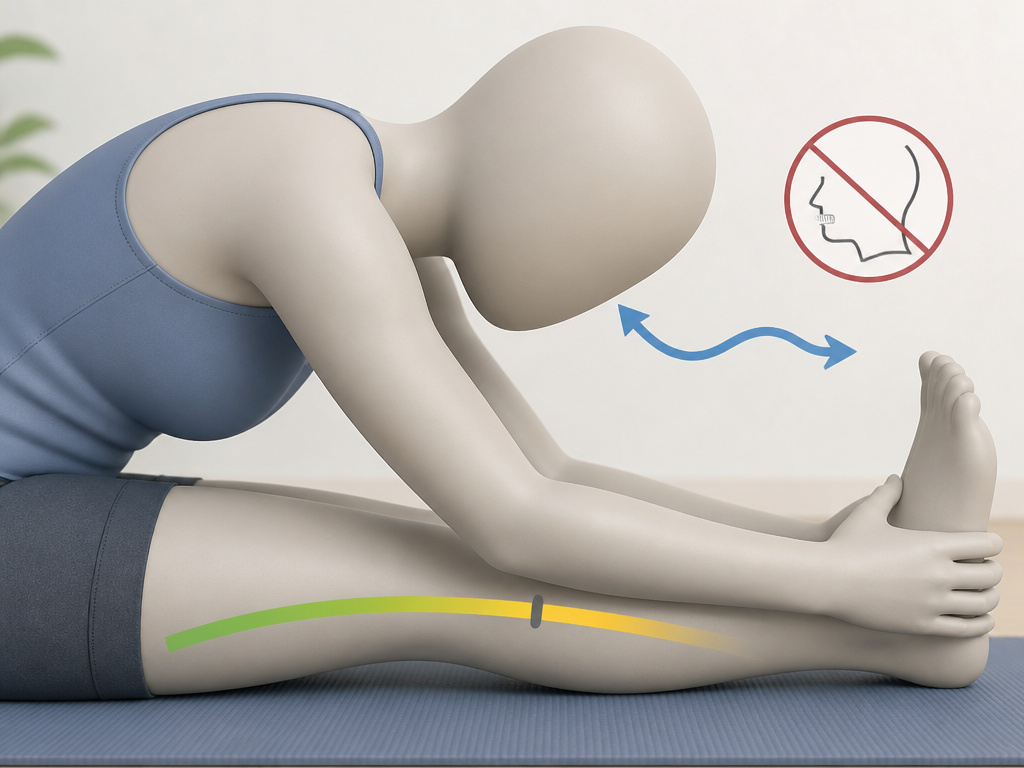
Two rules matter more than the number on your stopwatch, and both come from NDSU Extension: breathe continuously, and don’t stretch into pain.
Holding your breath during a stretch may increase your blood pressure above safe levels. A held breath shows up as a red face and a clenched jaw, and your training partner can spot it from across the room. Breathe through the hold and your blood pressure stays within normal limits.
On the pain question, NDSU is blunt: “no pain, no gain” has no place in a stretching program. NASM says the same thing in different words, recommending you stretch to the onset of discomfort but not elicit significant discomfort or pain. Opt for moderate stretch tension.
If you can’t breathe through the hold, you’re holding too hard. Breathe, ease off, and the range comes anyway.
Intensity doesn’t buy you much. The Behm meta-analysis cited in the Delphi consensus found no significant difference between low- and high-intensity stretches. Stretching harder doesn’t produce more range of motion, and it does raise your injury risk.
Ballistic or bouncing stretching is the other thing to skip. NDSU says it’s not good for muscles and tendons. The federal bulletin cites Quinn (2010) explaining why: the muscle may reflexively contract when re-stretched quickly, which raises injury risk.
If you want a more advanced technique that does produce bigger gains, PNF stretching has better evidence than static or ballistic stretching for range-of-motion increases, per the federal bulletin.
How to Pick Your Hold Time in 30 Seconds
Here’s the decision rule, stripped down to what matters.
- Decide what you’re stretching for. If it’s a warm-up, go short: 5 to 30 seconds per stretch, two bouts, inside a dynamic warm-up. If it’s a dedicated flexibility session, go longer: 30 to 120 seconds per muscle, 2 to 3 sets.
- Check the clock against the 60-second ceiling before lifting. Anything over 60 seconds on an isolated muscle before maximal or explosive effort can cost you 3 to 7 percent of your performance, per NASM.
- Pick your frequency. Daily if you want chronic gains, per the Delphi panel. 3 to 5 days a week if you’re following NASM. 2 to 3 times a week if you’re following the USDA manual and just want general maintenance.
- Breathe and stop at moderate tension. No breath-holding, no pain, no bouncing.
- Give it 6 weeks before you judge it. Bandy’s protocol ran 6 weeks. NASM says 2 to 6 weeks. Anything shorter and you’re guessing.
I’ve made every mistake on this list, which is why the steps are this simple. That part matters more than it sounds.
If you’re building this into a post-training habit, post-workout stretching is the lowest-risk slot, because your muscles are already warm and the performance cost doesn’t apply.
And if you want to avoid the mistakes that actually cause problems, this list of stretching mistakes that cause injury covers the ones I see most often.
Frequently Asked Questions
Is 30 seconds enough for a stretch?
For most people and most goals, yes. NASM recommends 30 to 60 seconds per muscle, and the federal bulletin cites research showing 30 seconds daily produces more range-of-motion gain than 15 seconds over 6 weeks. The 2025 Delphi consensus puts the chronic-gain window at 30 to 120 seconds, so 30 seconds sits at the low end of that range and is a reasonable default.
Should I stretch before or after a workout?
After, if you’re doing static stretching. The federal bulletin says stretching should be done after exercise while muscles are still warm, and the USDA manual says the most effective time to stretch is after physical training. Before a workout, stick to short dynamic movements and a few ramp-up sets instead.
Can you hold a stretch too long?
Yes, in a specific context. The Delphi consensus warns that prolonged static stretching of more than 60 seconds on an isolated muscle before maximal or explosive contractions impairs performance. Outside that pre-lifting window, longer holds of 30 to 120 seconds are the recommended dose for chronic flexibility gains.
Does stretching longer give better results?
Not automatically. The Behm meta-analysis found no significant difference between low- and high-intensity stretches, and the Konrad meta-analysis found no significant chronic range-of-motion improvement for the quadriceps regardless of hold time. Duration matters up to a point, but frequency and consistency matter more.
Is it bad to bounce while stretching?
Yes. NDSU Extension says ballistic stretching is not good for muscles and tendons. The federal bulletin cites Quinn (2010) explaining that the muscle may reflexively contract when re-stretched quickly, which raises injury risk. Static holds are the safer choice.
How long until I see results from stretching?
NASM says range of motion can improve within 2 to 6 weeks if you stretch 3 to 5 days per week. Bandy and Irion’s trial ran 5 weeks at 3 times per week and produced significant improvements. Give it at least 6 weeks before you decide it isn’t working.
Before You Go
Here’s the one thing I’d want you to take from all of this: pick your hold time based on what you’re about to do, not on a number you memorized in gym class.
If you’re warming up for a lift, keep it short. Five to 30 seconds per stretch, two bouts, inside a dynamic warm-up. Save the longer holds for after training or a separate session.
If you’re chasing flexibility, the dose is 30 to 120 seconds per muscle, 2 to 3 sets, done daily or close to it. Give it six weeks before you judge it.
Try this week: pick one tight spot, hold it for 30 seconds after your next workout, and do it every day for two weeks. That’s it. No routine, no app, no 10-step program. Just one hold, done consistently, and see what changes.
