
Static vs Dynamic Stretching Explained: Which to Use
This post contains affiliate links. As an Amazon Associate, we earn from qualifying purchases.
Static vs dynamic stretching explained in one line: static holds build long-term range, while dynamic movement primes you for the session ahead. The 2023 Konrad review of 77 studies ranked static and PNF above dynamic for lasting range, though Thomas et al. 2018 ranked static above PNF; dynamic work is favored for warm-up by Behm and Chaouachi because prolonged holds can blunt force and jump height, while ACSM does not contraindicate short pre-activity static holds.
That split shows up in the numbers. The same review found static and PNF barely separated from each other, and both sat above ballistic and dynamic training for chronic range gains. Where the reviews part company is how PNF ranks, which matters if you were planning to build a whole program around it.
What follows covers the range evidence, the warm-up evidence, the hold-time disagreement between ACSM and the NHS, and a weekly plan small enough to survive a bad week. By the end you’ll be able to pick a method for the next twenty minutes and for the weeks ahead.
Key Takeaways
- Static holds build range over weeks. The 2023 Konrad review of 77 studies ranked static and PNF above dynamic and ballistic for chronic range of motion.
- Dynamic drills belong before the session. Prolonged static holds before activity showed drops in isometric force, jump height, and some sprint scores in Behm and Chaouachi’s review.
- Hold times are not settled. ACSM gives 10-30 seconds for most adults, 30-60 seconds for older adults, and NHS guidance suggests about 15-20 seconds after exercise.
- ACSM sets the frequency floor at 2-3 days a week and notes daily work may add more range, while NHS guidance runs a roughly 5-minute flexibility set twice weekly.
- Stretching won’t fix soreness. Cochrane pooled data puts the benefit at roughly 0.5-1 point on a 100-point scale.
Static vs Dynamic Stretching Explained: What 77 Studies Show
Seventy-seven stretch-training studies went into the 2023 Konrad review in the Journal of Sport and Health Science, and the ranking came out lopsided.
Static and PNF protocols hold a joint near end range for a sustained period, while ballistic and dynamic drills pass through range without parking there. Pooled data from 77 trials in healthy adults ranked static and PNF above ballistic and dynamic methods for chronic range of motion, with static and PNF roughly equivalent to each other.
Time near end range is the variable that drives the adaptation.
A marching drill and a three-minute hamstring hang both move a joint. Only one of them keeps that joint parked where the tissue has to adapt, and that’s the one the pooled data favors.
| Method | Best For | Evidence Note |
|---|---|---|
| Static holds | Building range over weeks | Ranked above dynamic for chronic range |
| Dynamic drills | Warm-up before power work | Least likely to blunt force output |
| PNF | Range work with a partner | Ranked roughly level with static |
| Ballistic | Bounce-heavy sports | Can raise range when done well |
What the Ranking Actually Means
The reviews don’t agree on everything. Konrad’s team put PNF level with static holds. A smaller 2018 synthesis from Thomas and colleagues ranked static above both ballistic and PNF. Both agree that weeks of stretch training beat none.
If you want the partner-assisted version, PNF stretching is worth learning properly rather than copying from a short clip.
Why Dynamic Wins the Warm-Up and Static Wins the Weeks After
For a while I opened every lifting session with a long hamstring and hip hold. It felt productive. My first heavy set kept coming up slow, and I blamed sleep for months. When I swapped the holds for leg swings and bodyweight squats, the first set came back.
Behm and Chaouachi’s 2011 review explains what I was feeling. Prolonged static holds before activity produced measurable drops in isometric force, jump height, and some sprint and agility scores. Dynamic work showed less of a dip and occasionally helped.
A heavy set after a long hold feels like pushing through wet sand. The bar moves, but the speed isn’t there.
I’d rather see a few minutes of leg swings and empty-bar squats than a long block of floor holds before you touch a working weight. The warm-up should look like the thing you’re about to do.
A dynamic warm-up doesn’t need to be elaborate. Pick four moves and run them slow:
- Leg swings, front to back, 8 to 10 slow reps
- Walking lunges with a reach
- Bodyweight squats, controlled
- Arm circles until the shoulders loosen up
That covers most of what a general session needs. If you want a longer version, here’s how to warm up before a workout without turning the warm-up into a workout of its own.
How Long Should You Hold a Static Stretch?
There’s no single number, and the sources don’t pretend otherwise.
| Source | Hold Duration | Context |
|---|---|---|
| ACSM 2011 position stand | 10-30 seconds | Most adults |
| ACSM 2011 position stand | 30-60 seconds | Older adults |
| NHS guidance, reviewed 2023 | 15-20 seconds | After exercise |
| Active Health Center, citing PubMed | 20-30 seconds, 3-4 holds | Splitting the weekly dose |
ACSM sets the volume target at about 60 seconds total per exercise across 2-4 repetitions. NHS guidance runs shorter, roughly 15-20 seconds per hold in a cool-down. Both land in a similar neighborhood without matching exactly.
When the Numbers Disagree, Pick the Middle
20 seconds per hold sits inside ACSM’s adult range and at the top of the NHS figure, while 20–30 seconds matches the split-dose suggestion from the dose-ceiling literature.
Common mistake: Adding seconds every week as if hold time were a progress bar. Past the point where the tension stops easing, the extra time buys nothing and the position gets sloppy.
If you want the full breakdown, this guide to how long to hold a static stretch goes deeper on the numbers.
Does Static Stretching Before Lifting Really Weaken You?
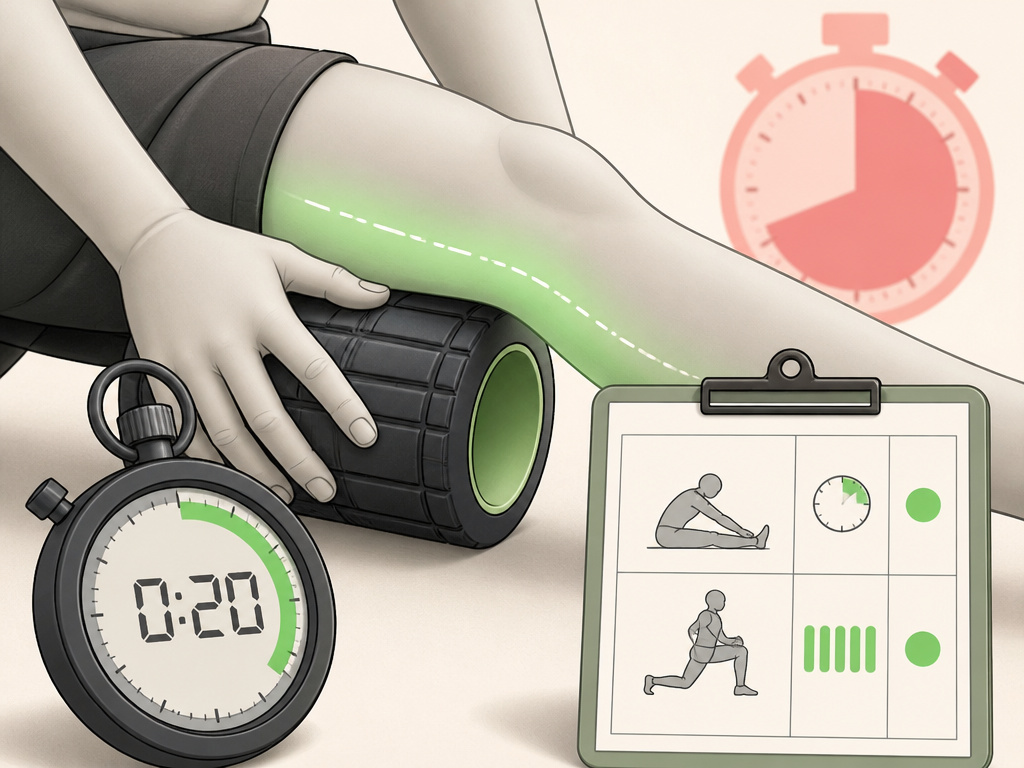
The internet banned static stretching before training. The actual studies tested much longer holds than most people picture.
Behm and Chaouachi found the drops after prolonged holds, often well beyond a minute per muscle. ACSM’s position stand doesn’t contraindicate short static holds before activity, and frames static and dynamic work as complementary parts of a flexibility plan. A source-reviewed guide on static and dynamic stretching calls a short, gentle static visit to a needed position a grey zone, best followed by specific warm-up sets.
A short, gentle static hold before training sits in a grey zone. Long holds, the kind that run well past a short gentle visit to a needed position, are where the force and jump data turn against you.
So the blanket ban is stricter than the evidence supports. What the data supports is a dose limit, not a prohibition.
Where this goes sideways: Bouncing into a painful range and calling it dynamic. Stop if a joint swells, locks, or shoots.
Most of the trouble comes from impatience.
A list of common stretching mistakes covers the rest of the failure modes.
The Weekly Plan: 4 Minutes a Session, 10 Minutes a Week
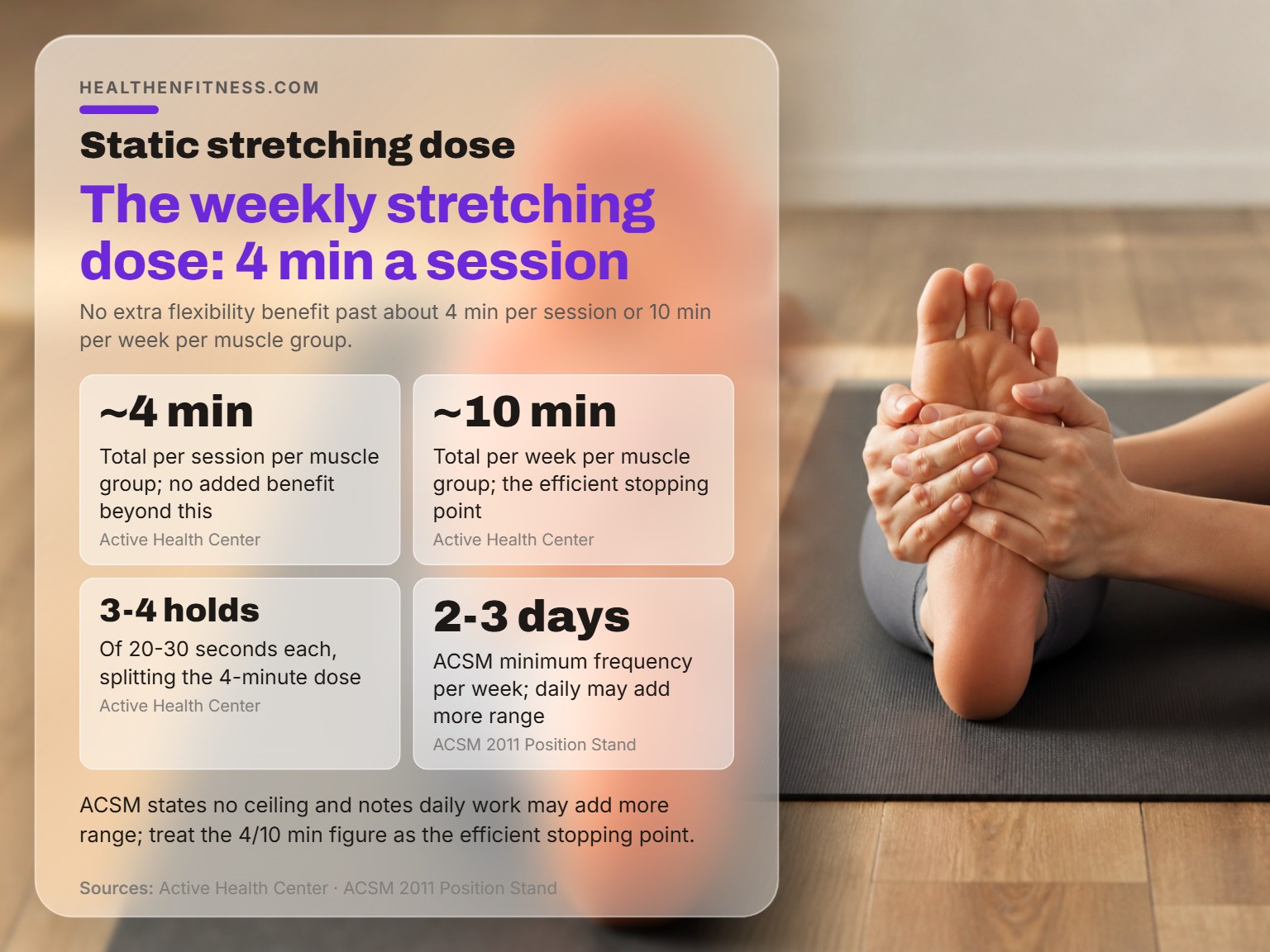
Ten minutes per week per muscle group is the whole dose.
That figure comes from Active Health Center, citing the PubMed synthesis behind the dose ceiling. It found no additional flexibility benefit past about 4 minutes total per session or 10 minutes per week for a given muscle group. ACSM’s stand doesn’t state a ceiling and notes daily work may add more range. Treat the ceiling as the efficient stopping point.
Before you start: Sharp pain at a joint line is a stop signal, not a target. If a joint swells, locks, or shoots, stop and get it checked. Coming back from an injury or managing joint disease means getting the range and positions tailored by a professional first.
- Pick two or three muscle groups per session. Spreading thin across too many areas gives each one too little time near end range to matter.
- Do 3-4 holds of 20-30 seconds. Skipping the count is how a short session turns into a long one you quit.
- Breathe out as you settle in. Holding your breath raises tension everywhere and makes the stretch feel tighter than it is.
- Stop at mild to moderate tension. Sharp pain is a stop sign, and pushing through it is how people end up sidelined.
- Put the session after training or on its own. Static work slots in cleanly as post-workout stretching or as an evening routine.
Splitting the Dose Across the Week
ACSM sets the frequency floor at 2-3 days per week and notes daily stretching may produce greater range gains. NHS guidance runs a roughly 5-minute flexibility set twice weekly. Those aren’t the same prescription, and both are defensible.
If you want a ready-made sequence, a full-body stretching routine built around 3-4 holds per area fits the numbers above.
What Stretching Won’t Do for You
You finish a hard leg session, wake up two days later sore, and stretch because that’s what you’ve always been told to do. The soreness barely budges.
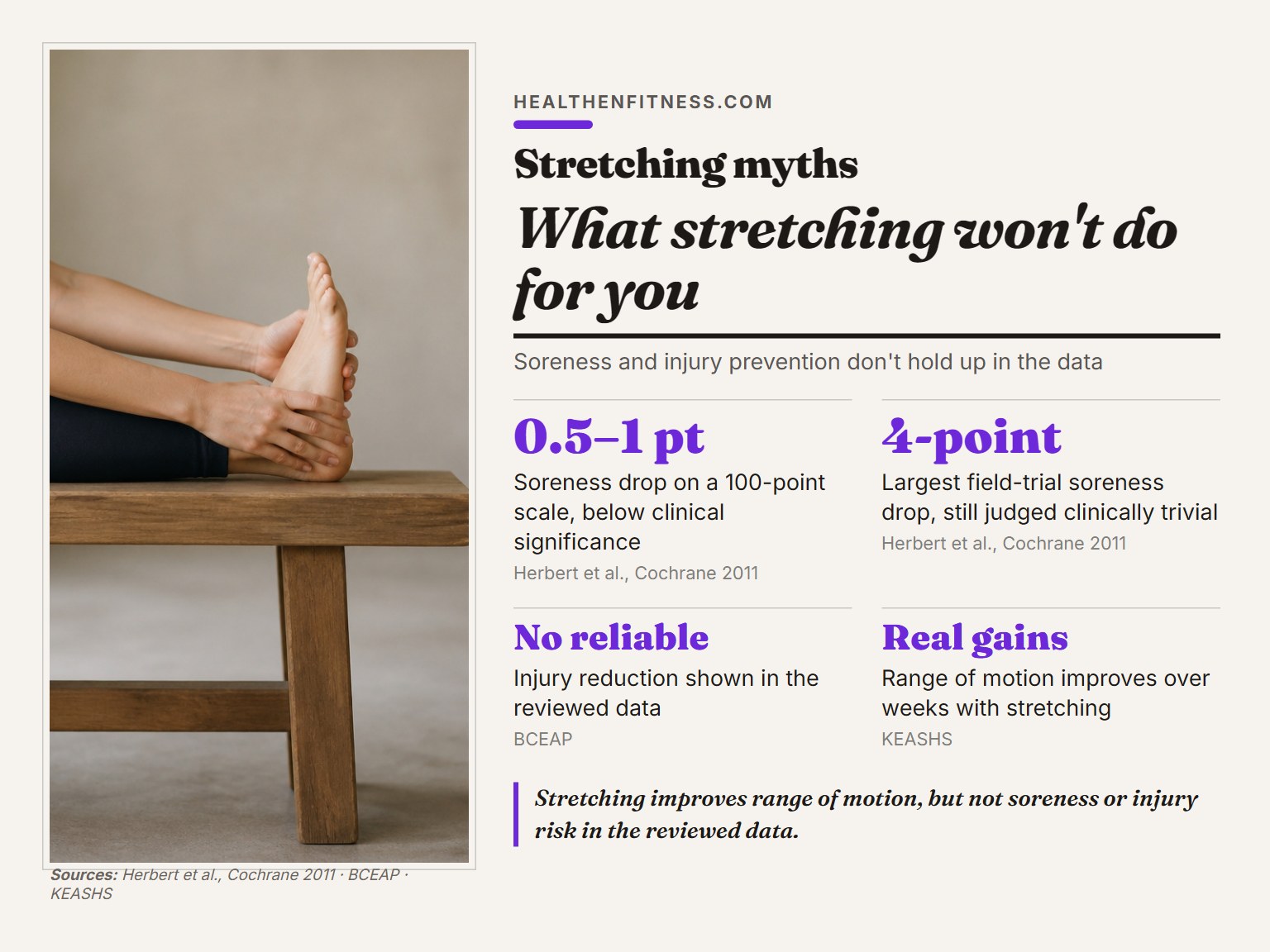
Herbert and colleagues, in a 2011 Cochrane review, pooled the trials and found stretching before or after exercise reduced soreness by about 0.5 to 1 point on a 100-point scale. That’s below clinical significance. One large field trial showed a 4-point drop, still judged trivial.
Injury prevention is the other claim that doesn’t survive contact with the data. Behm and Chaouachi note stretching hasn’t been reliably shown to prevent injury, and some older data suggest hypermobile people injure more. Active Health Center frames stretching as supporting posture and comfortable movement without disputing injury prevention, so the sources part ways there.
- Soreness: about 0.5 to 1 point on a 100-point scale
- Injury risk: no reliable reduction in the reviewed data
- Range of motion: real, measurable gains over weeks
- How you feel day to day: the part most people actually notice
A friend of mine stretched tight hamstrings and felt worse, not better. Controlled hip hinges and slow Romanian deadlifts did more for his hamstring than the stretching did. Research on strength training and range of motion backs that up: strength work can improve range, and keeping both tends to give the best functional result.
If you want the longer version of that argument, here’s whether stretching prevents injury and what the evidence says about stretching sore muscles.
Static, Dynamic, Ballistic, PNF: Picking Your Tool
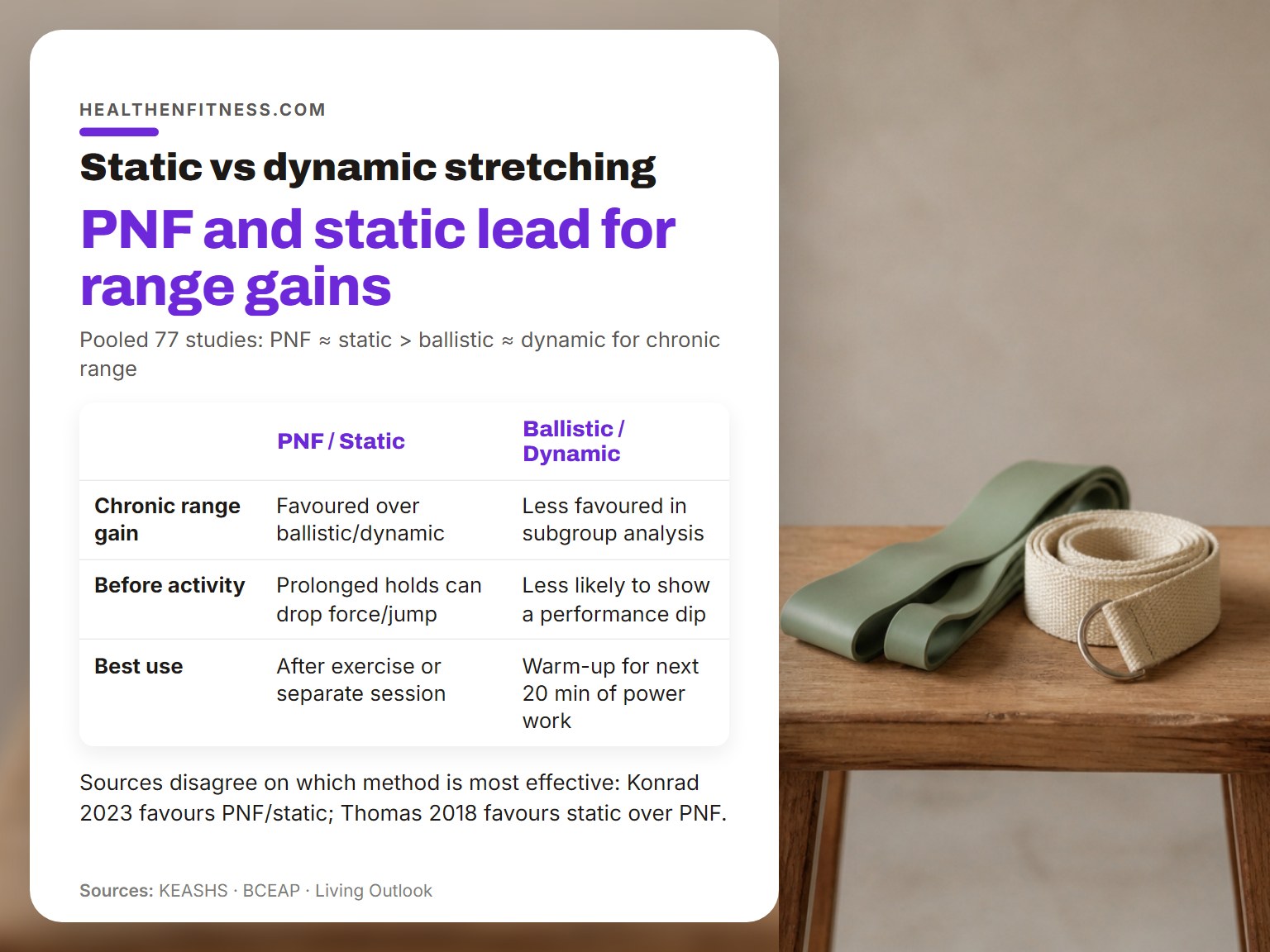
Four methods, four jobs.
Static holds for range you want over time. Dynamic drills for the twenty minutes in front of you. Ballistic work for sports where you bounce, and only when you can control it. PNF when you have a partner and want range fast.
Gear That Fits Each Method
A resistance band covers band pull-aparts and end-range strength work without much setup. A yoga strap makes passive static holds easier to hold without rounding your back. A cork block props a tight hip or shoulder so the position stays honest.
Apps split the same way. GOWOD’s activation flows lean dynamic. Pliability and Bend fill their libraries with static and slow holds. StretchIt mixes flexibility classes with strength at end range.
None of those will rescue a program that’s already too big. If the difference between mobility vs flexibility still feels fuzzy, sort that out before buying anything.
Frequently Asked Questions
Is static or dynamic stretching better for flexibility?
Konrad’s 2023 review ranks static and PNF roughly equal and above ballistic and dynamic for range, while Thomas et al. 2018 ranked static above PNF. Konrad’s 2023 review of 77 studies ranked static and PNF above ballistic and dynamic methods for chronic range of motion, with static and PNF roughly equal. Dynamic work still earns its place as a warm-up, where it’s less likely to blunt force output.
Should I stretch before or after a workout?
Dynamic movement before, static holds after. Prolonged static holds before activity produced drops in isometric force and jump height in Behm and Chaouachi’s review. A short, gentle static hold before training sits in a grey zone, so save the longer work for after.
How long should I hold a stretch?
ACSM gives 10-30 seconds for most adults and 30-60 seconds for older adults. NHS guidance suggests about 15-20 seconds after exercise. Active Health Center, citing a PubMed synthesis, splits the dose into 3-4 holds of 20-30 seconds. Twenty to thirty seconds satisfies all three.
Does stretching prevent injury?
Not reliably. Behm and Chaouachi found stretching hasn’t been shown to prevent injury, and some older data suggest hypermobile individuals injure more. Build range because you want range, not because you’re buying insurance against a strain.
Can I skip stretching if I lift weights?
You can skip the long routines, but not the range work. Strength training can improve range of motion, and Active Health Center notes that combining strength with targeted stretching tends to give the best functional result. Ten minutes a week per muscle group covers it.
Is PNF better than static stretching?
The reviews disagree. Konrad’s 2023 analysis put PNF level with static holds for range gains. A smaller 2018 synthesis from Thomas and colleagues ranked static above PNF. Both beat ballistic and dynamic training for chronic range, so the choice comes down to whether you have a partner available.
The Bottom Line
If a hold runs long right before a heavy set, cut it. Do that work after training, or on its own later in the day.
The rest is dose. Four minutes per session, ten minutes a week per muscle group, two to three days a week minimum. That’s small enough to survive a bad week, which is the only kind of plan that lasts.
That’s static vs dynamic stretching explained in the simplest terms I can manage: dynamic before, static after, and a dose small enough to keep.
Start smaller than you think. Pick one lift this week, do 3-4 holds of 20-30 seconds on the muscle that limits it, and put them after the session. Then do it again next week.
