
Stretching Mistakes That Cause Injury: What to Avoid
This post contains affiliate links. As an Amazon Associate, we earn from qualifying purchases.
The stretching mistakes that cause injury are dose errors: too much force, too long a hold, or stretching a tissue that needs rest. Pooled trial data puts the injury benefit of pre-exercise stretching at a hazard ratio of 0.95, with a 95% confidence interval of 0.78 to 1.16.
Force is the variable that decides whether the stretching mistakes that cause injury help or hurt. Push a muscle past its comfortable end range and it answers with a protective contraction, which is why bouncing and yanking leave you tighter than you started.
The five mistakes below are the ones I see most in a gym: the belief that stretching is injury insurance, the hold that runs too long, the cold stretch before a first set, the stretch applied to a healing muscle, and the bounce. Each one gets what the research actually shows and the swap I’d make instead.
Key Takeaways
- Stretching does not meaningfully cut all-injury risk. The pooled estimate sits at a hazard ratio of 0.95, and a 2,377-person trial found 0.97. Both confidence intervals cross 1.
- One large trial did find a muscle, ligament and tendon benefit (HR 0.75), but the 2025 expert consensus calls that effect small and flags a bone and joint trade-off.
- Hold times in the trials that produced the injury data ran 15 to 30 seconds, not the two-minute hangs people copy from social media.
- Cary Orthopedics advises against stretching a muscle you strained in the last few days, saying it won’t ease the pain and can slow healing, while Peloton recommends a gentle stretch after every workout to release tension.
- For a chronically tight muscle, load beats length. Strength work plus flexibility training outperformed strength work alone in the workplace data.
Mistake 1: Stretching to Prevent an Injury It Can’t Prevent
The pooled hazard ratio was 0.95, a statistically non-significant effect.
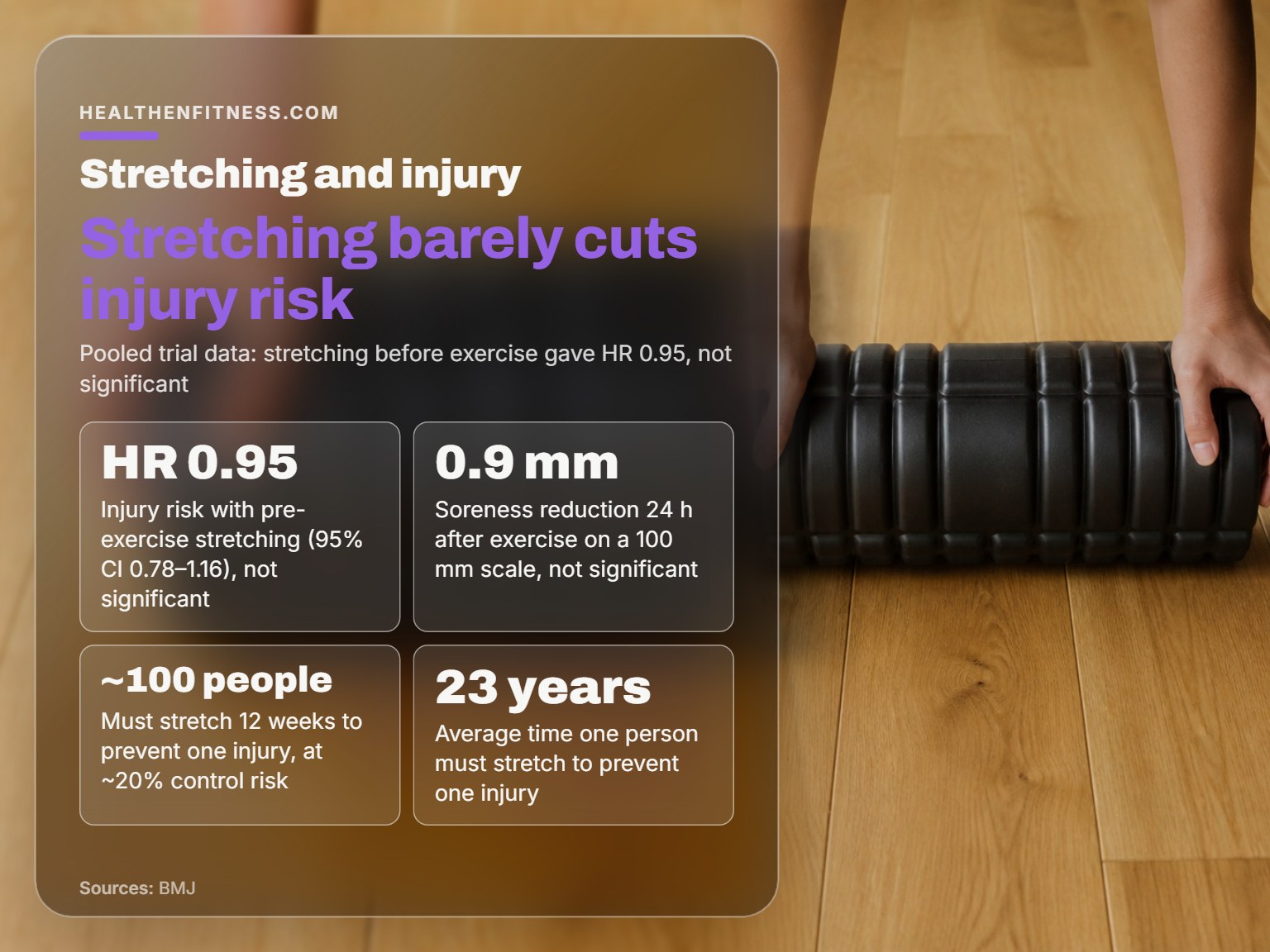
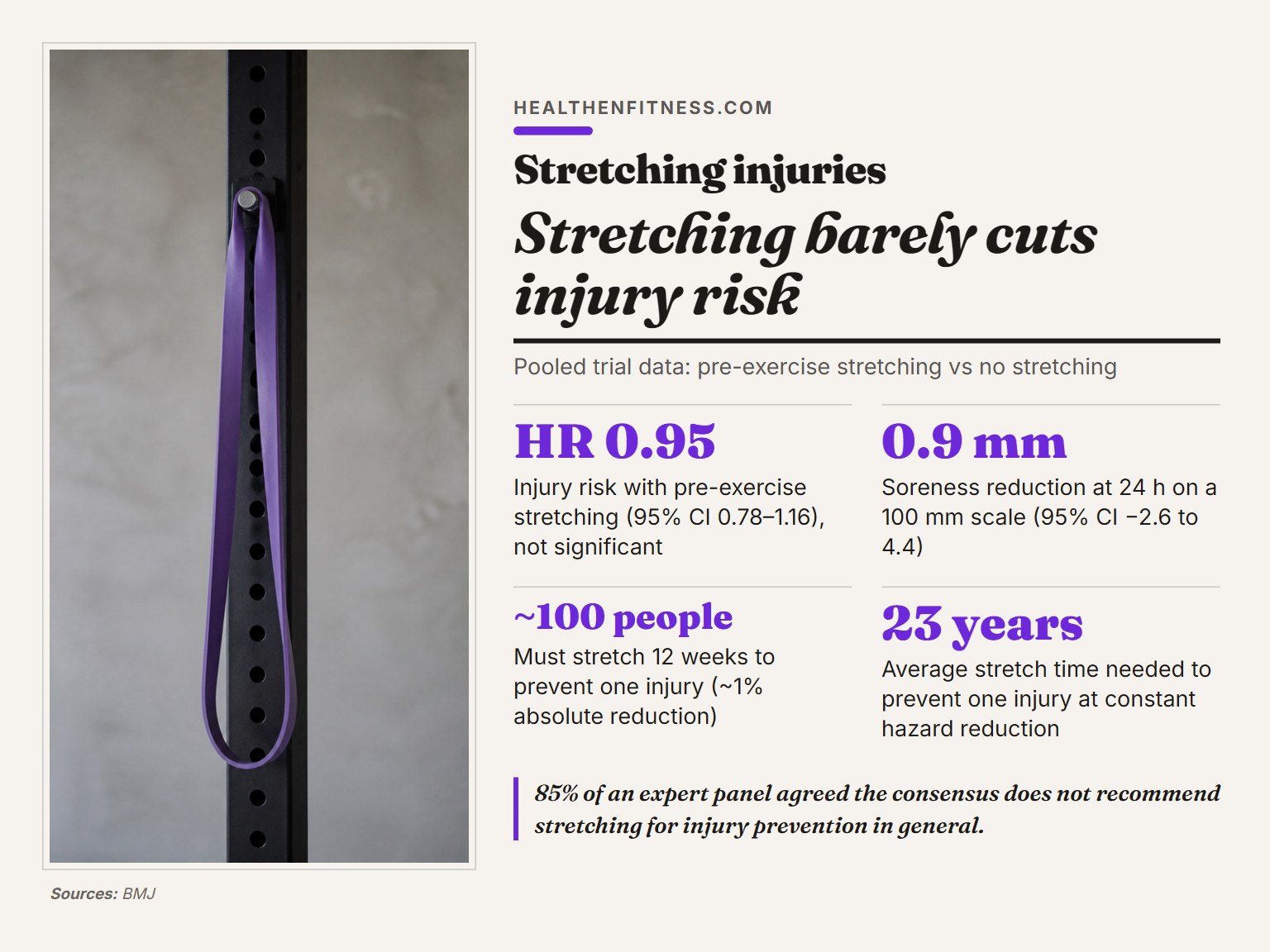
Pooled data from five randomised trials found pre-exercise stretching produced a hazard ratio of 0.95 (95% CI 0.78–1.16), which was statistically non-significant. In army recruits with roughly 20% injury risk over 12 weeks, that translates to about one injury prevented per 100 people stretching. Recruits counted as injured only if unable to return to full duties within three days.
Herbert and Gabriel’s systematic review of stretching effects, published in the BMJ in 2002, pooled the injury data at a hazard ratio of 0.95. The 95% confidence interval ran from 0.78 to 1.16. An interval that wide and that centred near 1 means the data can’t rule out no effect at all.
Run the practical version. In army recruits carrying roughly 20% injury risk across 12 weeks, a 5% relative reduction works out to about 1% absolute. That’s roughly 100 people stretching for 12 weeks to prevent one injury. If the hazard reduction held constant, the average subject would need to stretch for 23 years.
Jamieson’s 2009 trial in the British Journal of Sports Medicine, with 2,377 participants, landed in the same place on total injuries: hazard ratio 0.97, confidence interval 0.84 to 1.13.
So when a headline promises injury prevention, check which outcome the number is attached to. All-injury risk and muscle-and-tendon risk are different questions with different answers.
Where this goes sideways: Reading the muscle-and-tendon subgroup result as a green light for long pre-workout routines. The same body of studies the panel reviewed showed increased bone and joint injury risk alongside the muscle benefit.
Mistake 2: Holding a Stretch Too Long and Pushing Past Comfort
Hold times in the research are shorter than the ones people use at the gym. The protocols that produced the trial results used holds of 15 to 30 seconds, not the leisurely two-minute hangs that are among the stretching mistakes that cause injury.
| Source | Protocol used | What it tells you |
|---|---|---|
| Henning et al. 1997 | 5 stretches per hour, 15 seconds each, 6 body-part groupings | Short, frequent holds were the tested dose |
| Saltzman 1998 | 1-2 minute sessions after every 45 minutes of work | The break may have done the work |
| Amako et al. 2003 | 30-second holds, 20-minute sessions, before and after training | Long sessions, still 30-second holds |
| Hartig & Henderson 1999 | 4 sessions per day, 30-second hold repeated 5 times | Volume came from frequency |
| Jamieson 2009 | 30-second holds across 7 muscle groups, before and after activity | The largest trial used 30 seconds |
That’s the honest read on stretch hold times. The number in a study describes what the researchers did, not a prescription handed down for your hamstring.
Da Costa and Vieira’s review flagged this problem repeatedly. In the Saltzman study they examined, the improvement couldn’t be separated from the rest breaks the software introduced. Their overall verdict on the workplace stretching literature was “mixed” and of “relatively low methodological quality.”
The Delphi consensus on stretching exercise adds a distinction most articles skip. It separates acute effects, meaning one session, from chronic effects, meaning weeks of training. On acute pre-training stretching, the panel states the injury effects are “not clearly investigated.” Only the chronic question has real data behind it.
Is Stretching Before Exercise the Same as Warming Up?
No, and treating them as one thing is where the cold-stretch problem starts.
A warm-up raises core temperature and pushes blood flow into the working tissue. A stretch done cold does neither. Cary Orthopedics puts the order bluntly: warm up first with light aerobic work, then stretch. They also split the types, with dynamic work in the warm-up and static holds after the session.
The static vs dynamic split matters more here than most people expect. A dynamic warm-up moves joints through range under light load, which is closer to what the first set of squats will ask for.
You can feel the difference. A warm-up leaves you warm through the legs and slightly out of breath. A cold stretch leaves you exactly as you were, just briefly longer.
Here is the honest version of my own position. I’d rather see you do two progressively heavier sets of the first lift than ten minutes of static work, and I’ve held that view for years. But I’ll flag it as a preference rather than a finding, because the panel’s point stands: nobody has cleanly tested single-session pre-training stretching against injury in a controlled way.
Common mistake: Using a static hamstring hold as the entire warm-up. You get a brief range gain and none of the temperature rise that makes the first working set feel safe.
Mistake 4: Stretching an Injured Muscle to Loosen It Up

Three days after tweaking something in your lower back it feels tight, so you reach for a gentle stretch. That instinct is the mistake.
Cary Orthopedics is direct about it: stretching an injured muscle will not help with pain and can prolong healing, though Peloton recommends a gentle stretch after every workout to release tension. Injured tissue needs rest, plus heat or ice as needed. Once it has healed, you reintroduce low-intensity work slowly.
Knowing how to train around injury matters more than knowing how to stretch it. The tightness you feel around a strain is guarding, and guarding is a protective response rather than a shortened muscle asking for length.
Before you start: A strained muscle that swells and guards will get worse under a stretch, not better. Sharp pain during a hold, or pain that lingers past the stretch, means stop and get it looked at. Pain that persists beyond a few days warrants an orthopaedic opinion rather than another YouTube video.
What to do instead of stretching it
- Leave the tissue alone for the first few days. Stretching a fresh strain adds load to tissue that is already inflamed, and the tightness gets worse rather than better.
- Train the parts that don’t hurt. Upper body work, the opposite limb, easy walking. Skipping this costs you a fortnight of habit, which is harder to rebuild than the tissue.
- Reintroduce range gradually once pain has settled. Slow, unloaded movement first. If the tightness returns within an hour, you went too early.
- Load it before you lengthen it. Controlled strength work at a comfortable range builds capacity that a passive stretch never will.
Mistake 5: Bouncing and Chasing Range You Don’t Own
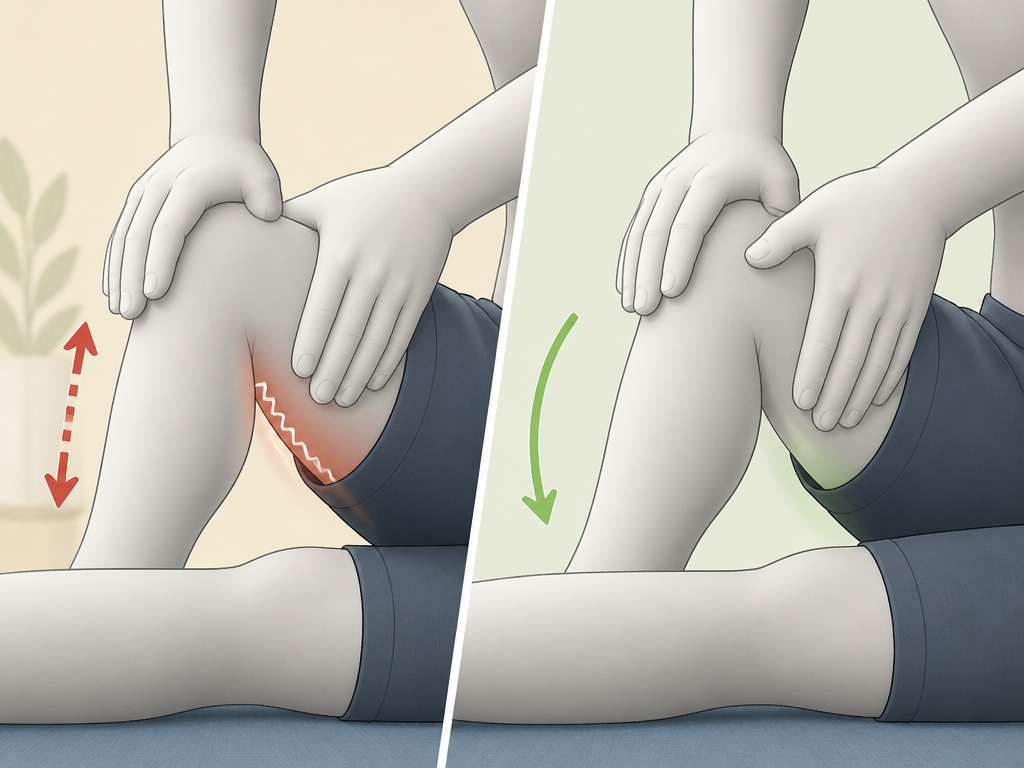
Bouncing is the fastest way to make a muscle fight you.
Ballistic motion triggers the muscle to tighten protectively, which defeats the whole point. Cary Orthopedics notes it can also push you deeper than you intended, because the protective signal arrives a beat late. The fix they give is simple: ease in gradually, hold 10 to 15 seconds, release, and repeat, though Jamieson’s trial protocol used 30-second holds.
Bounce into a hamstring stretch and you’ll feel the muscle grab and shorten under your hand rather than lengthen. That grab is the signal, not an obstacle to push through.
A Scientific Reports stretching posture study of 32 therapists found manual stretching was rated significantly less comfortable than device-assisted work for the hamstrings (−2.89 points) and gluteal muscles (−2.48 points), both P<0.001. The authors are careful about what that means: their tool measures postural risk factors, not injury, and it can’t speak to internal loads or tissue damage.
The discomfort data still points somewhere useful. Hard manual force on a muscle is uncomfortable for the person on the table and awkward for the person doing it. Slow entry at the edge of comfort is the version that gets repeated.
Easy to miss: The edge of comfort is a location, not a challenge. Peloton instructor Hannah Corbin describes it as being at the edge of your comfort zone without going outside it, and warns that forcing a split on day one makes the muscle seize up to protect itself.
Save the longer holds for post-workout stretching, when the tissue is already warm and you’re not about to load it.
Why Does Stretching Feel Good and Still Leave You Tight?
The nervous system is doing most of the work in that feeling, and it resets fast.
A friend of mine spent six weeks stretching tight hamstrings every morning. By the end he was tighter than when he started, and mildly annoyed about it. What actually moved the needle was slow hip hinges under load, a few sets at a time, until the bottom position stopped feeling like a threat.
That story lines up with the workplace data better than the stretching advice does. In one reviewed study of manual handling workers, flexibility improved in the group doing strength training plus trunk flexibility work. It did not improve in the group doing strength training alone. The combined group also posted higher percentage gains in static and dynamic strength than the strength-only group.
Notice what that says. Stretching didn’t hurt anything; it just needed a strength stimulus alongside it to produce a change worth having.
I’ve stopped telling people to stretch a tight muscle and started asking what they want it to do. If the answer is “touch my toes,” fine, stretch it. If the answer is “squat without my back rounding,” the fix is usually load and control rather than length.
The CDC stretching at work report is worth reading for how messy this gets. A four-year study of aircraft manufacturing employees found no statistical difference in flexibility between people who later reported back pain and people who didn’t. The authors concluded flexibility wasn’t a meaningful predictor of injury risk.
Then the same document reports the opposite flavour of finding. Among 320 healthy firefighters, total back injury costs were almost six times greater for the least flexible group than the most flexible.
And then a third. In a Danish municipality cohort, men having their first episode of low back pain were significantly more flexible in flexion than men with no history, which suggests joint laxity as a cause rather than a protection.
Three findings, three directions. Anyone selling a single clean rule about flexibility and back pain is skipping the part where the data argues with itself.
The soreness vs injury distinction decides what you do next. Soreness that eases as you warm up is fine to train through. Pain that sharpens with movement is not.
Stretching vs Strength Work: The Swap That Actually Changes Something
Loaded work wins on almost every outcome that matters here, and it doesn’t need much equipment. A TheraBand resistance band anchored to a rack gives you a controlled end-range pull. A foam roller handles the tissue around the hip before you load it. If floor work is where you’ll actually put the time in, a comfortable mat is the difference between doing it and skipping it.
| Mistake | What it looks like | The swap |
|---|---|---|
| Stretching as insurance | 10 minutes of static holds before every session | Two lighter sets of the first lift |
| Marathon holds | Two-minute hangs that leave you aching | 15-30 second holds, repeated |
| Cold static work | Toe touches before your first set | Dynamic warm-up, then load |
| Stretching a fresh strain | Loosening a muscle that hurts | Rest, then graded loading |
| Bouncing for range | Reps of ballistic pulsing | Slow entry, hold, release |
The better lever is injury prevention exercises that build tissue capacity, not range you can’t control. Loaded stretching at the bottom of a squat or a Romanian deadlift does both at once, and it’s the version I’d pick if you only had time for one.
If a muscle has been tight for months and stretching hasn’t budged it, treat it as a capacity problem. Load it, control it, and give it a few weeks.
Frequently Asked Questions
Does stretching before exercise prevent injury?
Not in any meaningful way on the total-injury numbers. Herbert and Gabriel’s pooled analysis found a hazard ratio of 0.95 with a confidence interval crossing 1, and Jamieson’s 2,377-person trial found 0.97. Jamieson did find a significant reduction in muscle, ligament and tendon injuries specifically, at HR 0.75.
How long should you hold a static stretch?
Henning’s protocol used 15-second holds five times an hour, while Amako, Hartig and Jamieson all used 30 seconds. Cary Orthopedics recommends 10 to 15 seconds, released and repeated, while Jamieson’s trial protocol used 30-second holds.
Is it bad to stretch a pulled muscle?
Yes. Stretching injured tissue won’t ease the pain and can slow healing. Rest it, use heat or ice as needed, and reintroduce gentle movement once it has settled. Pain lasting beyond a few days is worth an orthopaedic opinion.
Why do I feel tighter after stretching?
Bouncing and forcing range trigger a protective contraction, so the muscle shortens instead of lengthening. Going too deep has the same effect. Ease in slowly, stay at the edge of comfort, and breathe through the hold rather than holding your breath.
Can stretching replace a warm-up?
No. A warm-up raises core temperature and increases blood flow, and a cold stretch does neither. Dynamic movement belongs in the warm-up, and static holds belong after the session or in a separate slot.
Is bouncing while stretching dangerous?
It can be. Ballistic motion triggers the muscle to tighten protectively and can push you deeper than you intended. Slow, gradual entry with a short hold gets you the same range with less risk.
The Bottom Line
One trigger worth keeping: if a muscle has felt tight for weeks and stretching hasn’t changed it, stop stretching it and start loading it. That’s the pattern behind most of what the research shows, and it’s the one I’d act on first.
The other thing I’d hand you is a concession. None of this means stretching is useless. Jamieson’s trial found a real reduction in bothersome soreness, with 24.6% of weeks affected in the stretch group against 32.3% in controls. If you stretch because it makes training feel better, keep going. Just don’t file it under injury insurance.
Here’s what I’d actually do this week. Before your next session, skip the static routine and run two progressively heavier sets of whatever your first lift is. Then, if you still want the stretch, do it afterwards when the tissue is warm. Start smaller than you think you need to, and see how the first set feels.
