
How to Load a Barbell Safely: Step-by-Step
This post contains affiliate links. As an Amazon Associate, we earn from qualifying purchases.
To load a barbell safely, check the bar’s rated capacity first, load and unload it horizontally, and add one plate at a time on alternating sides. A Les Mills SMARTBAR caps at 45 kg total and 3 plates per side; exceeding that can bend the bar and voids the warranty. Learning how to load a barbell safely protects both the equipment and the lifter.
That 45 kg ceiling is a manufacturer number, and it’s the figure that decides whether a bar survives a training block, so knowing how to load a barbell safely starts here. Load past it and the bar takes a bend you won’t feel until the roll goes wrong in your hands.
What follows is six rules in the order I’d apply them, plus the two places where the manuals flatly contradict each other and you have to pick a side.
Key Takeaways
- Check the rated capacity first. A Les Mills SMARTBAR tops out at 45 kg / 100 lb total, and going over can bend the bar and voids the warranty.
- Load and unload horizontally. Never with the bar standing on one end, even for a single plate.
- Match plate order to the bar you own. SMARTBAR wants the largest plate innermost; a standard barbell loads heaviest outward from the center.
- Collar every working set. Warm-ups included, not just the heavy ones.
- Store it horizontal, plates off, indoors. The SMARTBAR’s storage range is -5 °C to 50 °C.
What Does It Mean to Load a Barbell Safely?
Safety here covers four separate things that get collapsed into one word: how much the bar will hold, how you physically get plates onto it, how you keep it balanced, and how you put it away. Miss any one and the failure shows up later.
A fixed-weight or selectorized barbell carries a stated maximum load, a per-end maximum, and a plate-count cap. The Les Mills SMARTBAR is rated to 45 kg total and 22.5 kg per end, with no more than three plates per side and the largest plate loaded innermost, hard against the gator.
That gator is the molded collar at each end of the sleeve, and “innermost” means the biggest plate sits right against it. Everything smaller stacks outward from there.
Selectorized bars work differently. The MX Select MX100 uses 10 plates per cradle at 4 lb / 1.8 kg each, and you pick weight with a dial rather than by sliding plates on. The MX80-S allows 13 weight increments up to 80 lb per handset. Neither one has a plate-count rule you can break, because you never touch the plates mid-set.
Different machines, different rules. That’s the whole reason this gets confusing.
Rule 1: Know the Bar’s Weight Capacity Before You Touch a Plate
45 kg is the number that matters on a Les Mills SMARTBAR, and it lives in the manual rather than on the bar itself. Most people find it after something bends.
Here’s the honest version: I loaded bars for years without ever looking up a rating or learning how to load a barbell safely. Home bars and gym bars felt interchangeable, so I treated them that way. They aren’t.
| Bar | Rated Load | Per-End or Per-Cradle Limit | Plate Rule |
|---|---|---|---|
| Les Mills SMARTBAR | 45 kg / 100 lb total | 22.5 kg / 50 lb per end | Max 3 plates per side |
| MX Select MX80-S | Up to 80 lb per handset | 13 weight increments | No stated plate cap |
| MX Select MX100 | 10 plates per cradle | 4 lb / 1.8 kg per plate | Dial positions 1-10 |
The SMARTBAR figure is a hard ceiling in both directions. You can hit 45 kg with three heavy plates per side or with a stack of light ones, and the manual caps you at three plates regardless of what they weigh. Going over “could result in a bent bar,” per Les Mills, and it voids the warranty outright.
That last part matters more than the bend. A bent bar you can feel. A voided warranty you find out about by email.
The MX80-S takes the opposite approach. It has no plate-count cap because the plates are internal, and the limit is expressed as 13 weight increments topping out at 80 lb per handset. Two brands, two completely incompatible ways of answering “how much is safe.” Check the barbell weight capacity of your specific bar before you assume either answer applies.
Before you start: A loaded bar that comes off a J-hook unevenly will tip before you can catch it, and a selector dial moved while the bar is out of its cradle releases the plates outright. Check that both ends are seated and both dials are locked before the first rep.
Rule 2: Load and Unload Horizontally, Never With the Bar on End
Horizontal only. That’s the SMARTBAR rule for loading and unloading, and it’s the one people break most often because standing a bar on its end feels efficient.
The Les Mills manual is explicit: load and unload with the bar horizontal, never with it on one end. For home storage it goes horizontal on a solid, level surface or on a Wall/Vertical Rack, with the plates removed.
There’s a related rule that catches people in small spaces. Don’t leave the bar, loaded or empty, hanging over a SMARTSTEP or anything else where the weights or the bar end are unsupported. A bar with one end in the air is a bar waiting to pivot.
The part nobody mentions: Dragging a bar across the floor damages the rubber ends. The Les Mills manual lists dragging alongside dropping and throwing, which tells you the rubber takes the damage, not the steel.
The handling list is short and worth memorizing:
- No dropping, throwing, or dragging, ever.
- Remove rings and jewellery before you touch the knurling. It scratches the bar and the bar scratches you back.
- Keep the bar away from moisture and direct heat.
- Store with plates off, not loaded.
That last bullet is the one I’d argue with if I hadn’t read the manual. Leaving plates on saves setup time tomorrow. It also means the bar sits loaded and unsupported, which is exactly the condition the storage rule exists to prevent.
Rule 3: Loading Order Depends on the Bar You Own
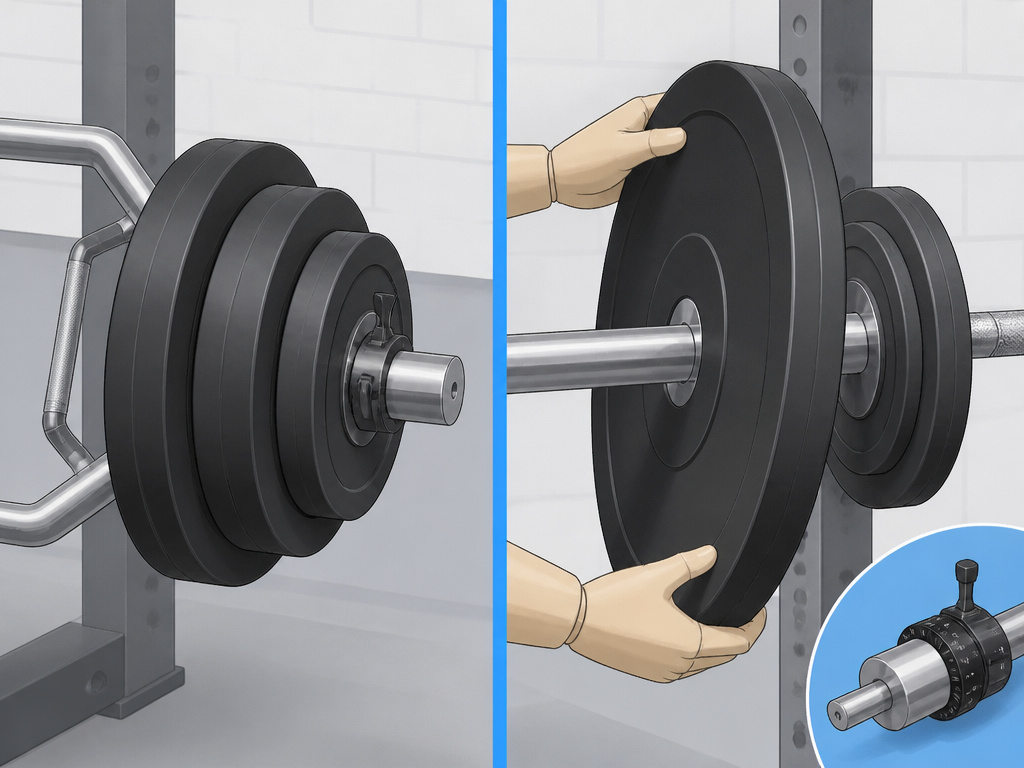
The Les Mills manual says largest plate innermost. The Doclyss Fitness guide says heaviest plate outward from the center. Both are correct for the bar they describe, and neither one is universal.
Les Mills SMARTBAR: Largest Plate Innermost
Les Mills specifies loading largest to smallest with the heaviest plate closest to the gator, capped at three plates per side. The logic is mechanical: the sleeve is stiffest near the collar, so the heaviest load sits where the bar can carry it without flexing.
Standard Barbells: Heaviest Plate Outward
The Doclyss Fitness loading guide reverses that. Load plates heaviest to lightest, moving outward from the center of the bar, one plate at a time on alternating sides. On a long Olympic bar with a wide collar spacing, that’s the convention most gyms teach.
| Question | Les Mills SMARTBAR | Standard Barbell (Doclyss) |
|---|---|---|
| Plate order | Largest plate innermost, against the gator | Heaviest plate outward from center |
| Plate count | Max 3 per side | Not specified |
| Load position | Horizontal only, never on end | In the rack or on the floor |
Selectorized Bars Skip the Question Entirely
On an MX80-S or MX100, plate order is a non-issue. You set the dial and lift. What replaces it is a different rule: never move the selector dial while the bar is out of the cradle and in use. The MX80-S manual states plainly that moving the dial releases the weight plates from the handset.
The same manual also permits setting different increments on each end, then warns that doing so will unbalance the barbell. Permitted and sensible aren’t the same thing.
Rule 4: One Plate at a Time, Alternating Sides
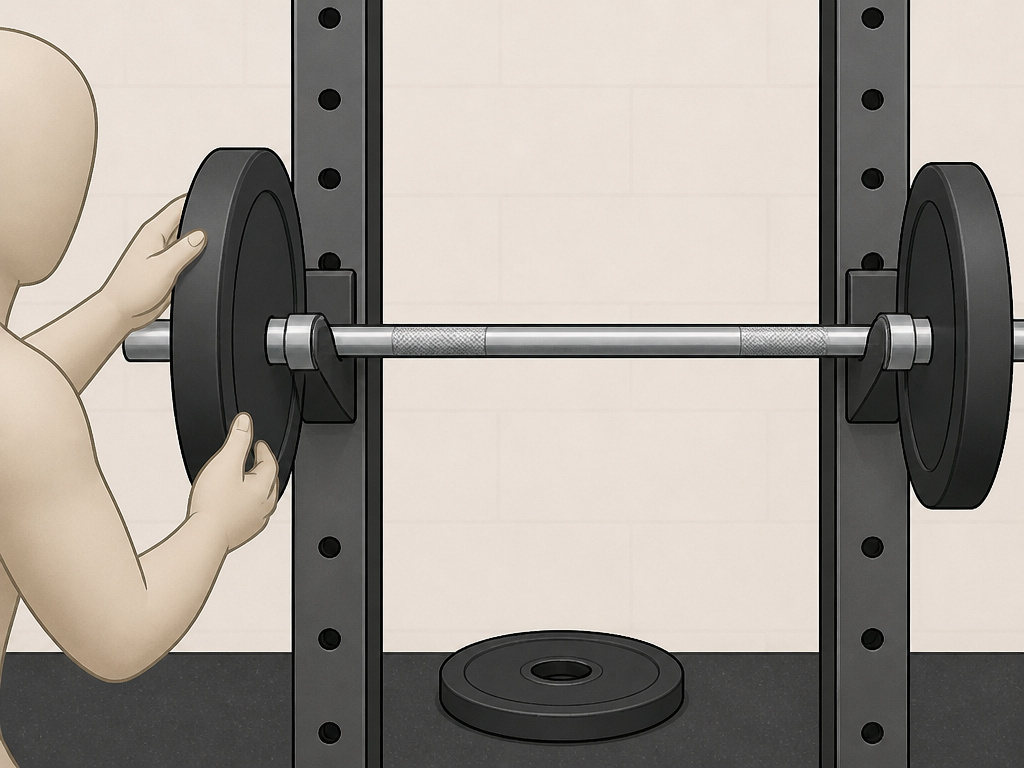
You’ve got a plate in each hand and a bar sitting in the J-hooks. Sliding both on at once feels faster. It also puts the bar’s center of mass outside the hooks for a second or two, and a light bar will pop out of a J-hook in less time than that.
Doclyss is direct about it: load one plate at a time on alternating sides to keep the bar balanced. Most racks tolerate some imbalance, and the habit becomes essential as the weight climbs.
Here’s the sequence I’d give anyone loading a racked bar:
- Set the hooks level on both sides before anything else. Uneven J-hook heights create an unstable setup, and the bar tips the moment the second plate goes on.
- Load one plate left, then one plate right. Loading both on one side first swings the center of mass outward and the bar can lift off the hook.
- Slide each plate fully to the collar. A plate left short of the collar shifts under load and the bar rolls in your hands mid-rep.
- Collar both sleeves before the first rep. Without collars, a plate can walk off the sleeve on a lopsided rep, and you find out at the worst moment.
Deadlifts are the exception, and the reason is physical. The bar sits on the ground, so it can handle being loaded unevenly for a moment. Doclyss recommends loading one side at a time for floor lifts, which is faster and perfectly safe because the floor carries the imbalance.
Testify Strength & Conditioning goes further and contradicts the racked-bar habit entirely. Their advice is to skip putting the first plate on the bar while it’s racked. Instead, set the plate on the floor with the numbers facing up, thread one end of the barbell through it, rest the other end on the floor, and slide the bar through until the plate meets the collar.
That works, and it’s a genuinely better method for a heavy first plate on a deadlift. It’s also not addressed by any of the manufacturer manuals here, so treat it as coach convention rather than a rule.
A bar loaded one plate heavy on the left settles into the J-hook with a hollow clack instead of a solid thud. That sound is your warning, and it comes just before the bar leaves the hook.
Common mistake: Loading plates onto a racked bar without checking that both J-hooks sit at the same height. An uneven hook tips the bar the moment the second plate goes on, and the heavier the plate, the less time you have to react.
Rule 5: Collars Go On Every Working Set
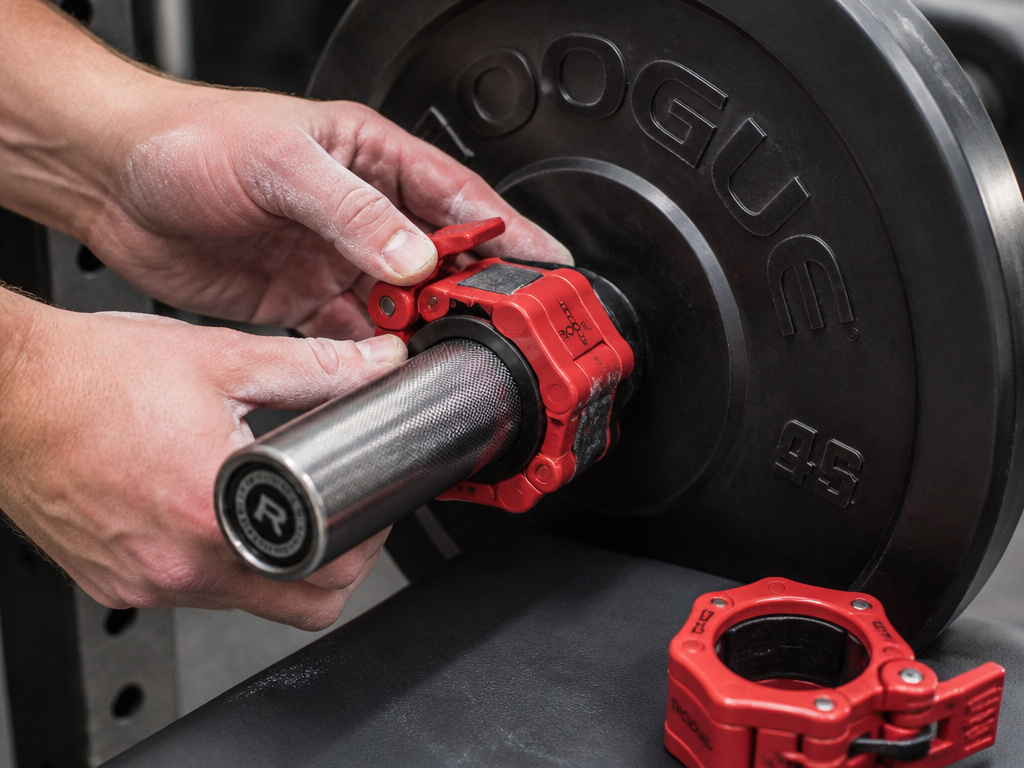
I skipped collars on a bench set once because it was just warm-ups. One side crept off a plate mid-set and the bar tilted before I got it back to the hooks. Spring collars go on every working set now, no exceptions, and I don’t care how light the bar is.
That’s the whole argument, and it takes ten seconds to lose. A plate that walks on a warm-up walks further on a working set.
I won’t bench heavy alone without safeties set or a spotter standing there. Dumping the weight off one side works, and it’s also how people tear something trying to steer the drop. Set the bench press safety arms and skip the drama.
Doclyss raises the same point from the other direction. Some lifters bench without clips on purpose so they can dump the bar off the sides if they get stuck alone. That’s a real strategy, it’s not universally endorsed, and the manual-backed answer is a spotter. The MX80-S manual says to use one for heavy repetitions. If you’re going to rely on dumping the barbell as your safety net, at least practice it once with a light load so the first attempt isn’t the real one.
Rule 6: Store It Right and the Bar Outlives Your Program
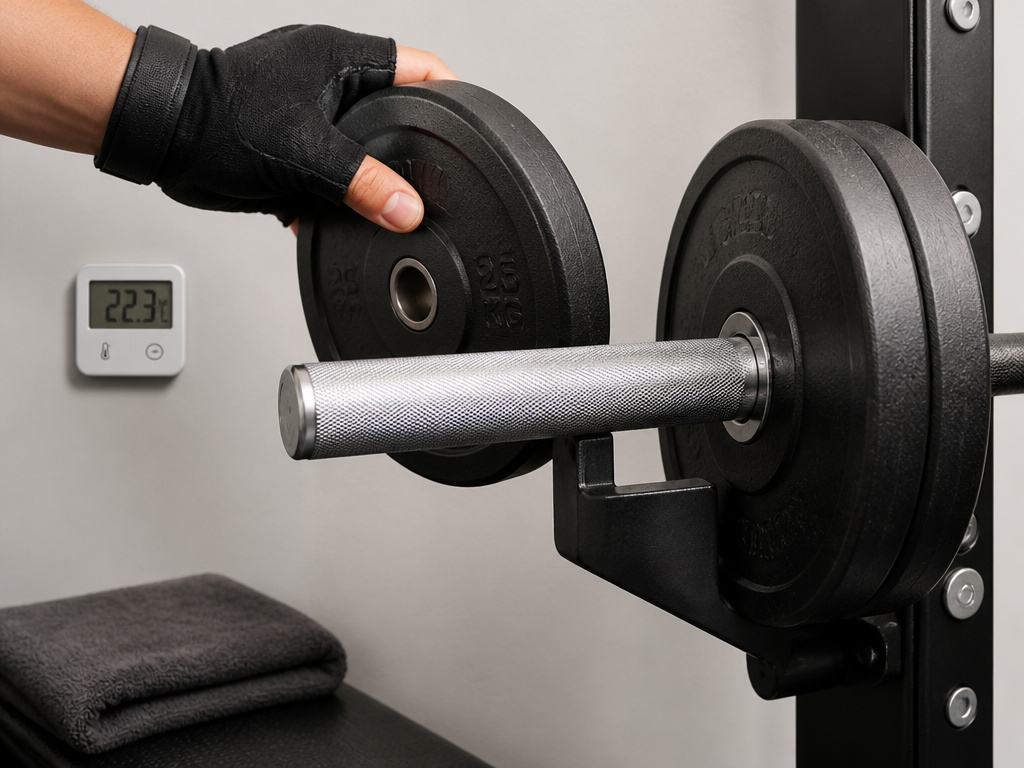
Storage is where a bar quietly dies. Not dramatically, not with a bang. It sits in a cold garage for a winter and comes out feeling different.
The Les Mills temperature spec is the one people miss: the SMARTBAR must not be stored below -5 °C or above 50 °C. Store indoors, away from moisture and direct heat. An unheated garage in a cold climate can breach the low end without anyone noticing.
MX Select’s maintenance list is longer and mostly common sense:
- Keep the system dry, clean and free of dust.
- Clean plates and bar with disinfectant on a lint-free cloth.
- Keep dust off the system.
- Periodically shuffle the weight plates and check that the bolts are tight.
- Store and operate on level ground.
That shuffle step sounds like busywork until you understand why it matters. Periodically shuffling the weight plates and checking that the system bolts are tight is part of the MX80-S maintenance routine. The MX80-S manual also notes that a plate can dislodge if you pull the bar out at an angle; lifting vertically out of the cradle is the fix.
Plates off, bar horizontal, room temperature. Three habits, and the bar outlasts your program.
For the rack side of this, the same logic applies to how you put things away. Learning to rack weights properly keeps plates off the floor and off the bar, which is exactly what the SMARTBAR storage rule is asking for.
Which Loading Mistakes Actually Break Something?
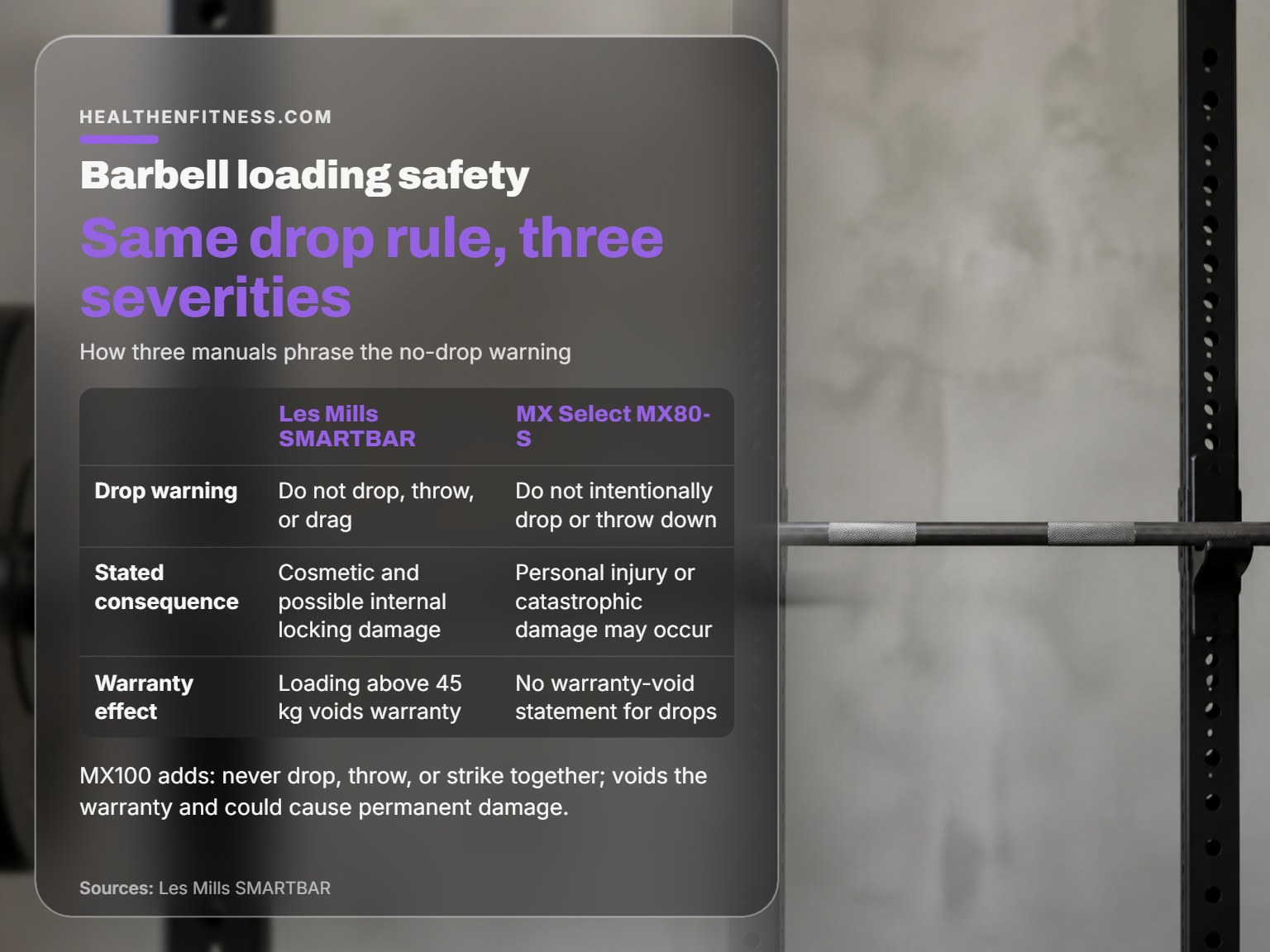
Three things break a bar: overloading it, dropping it, and dragging it across the floor. Everything else is cosmetic.
The drop warnings are where the three manufacturers diverge most, and it’s worth seeing how differently they phrase the same instruction. Les Mills says do not drop, throw, or drag, and notes that drops cause cosmetic and possible internal locking damage. The MX80-S manual warns that intentional dropping or throwing may cause personal injury or catastrophic damage. The MX100 manual says never drop, throw, or strike together any MX Select System, that it voids the warranty, and that it could cause permanent damage.
Cosmetic, then catastrophic, then warranty-voiding. Same rule, three severities. Don’t merge them into one sentence.
| Symptom | Likely Cause | Fix |
|---|---|---|
| Extra plate lifts out with the bar | Pulling the bar out at an angle | Lift vertically out of the cradle |
| Bar rack feels loose | Loose bolts | Check that the system bolts are tight |
Two of those are load-related and two are maintenance, which is roughly the split you’d expect. The angle-pull one is the sneaky failure, because it looks like the bar is malfunctioning when the real problem is how you took it out.
If you’re setting up a rack at home, the power rack safety bars belong at a height that catches a missed rep before you ever load a plate. And if nobody’s spotting you, the habits in this guide to training alone safely matter more than the loading order does.
Frequently Asked Questions
How much weight can I put on a Les Mills SMARTBAR?
The SMARTBAR is rated to 45 kg / 100 lb total, with a maximum of 22.5 kg / 50 lb per end. Les Mills also caps you at three plates per side, with the largest plate loaded innermost against the gator. Loading above 45 kg could bend the bar and voids the manufacturer warranty.
Should the heaviest plate go on first or last?
It depends on the bar. Les Mills specifies the largest plate innermost, closest to the gator, for the SMARTBAR. The Doclyss Fitness guide recommends loading heaviest to lightest moving outward from the center on a standard barbell. Follow the manual for the bar in front of you.
Do I need collars on every set?
If the bar takes plates, yes. A plate can creep off a sleeve on a lopsided rep, and warm-up weight doesn’t make that less likely.
Can I store a barbell in a garage?
Only if the garage stays within the storage range. Les Mills specifies -5 °C to 50 °C for the SMARTBAR, indoors, away from moisture and direct heat. MX Select asks for the system to be kept dry, clean and free of dust. An unheated garage in a cold climate may fall outside the SMARTBAR’s storage range.
Is it safe to bench press alone without a spotter?
The manufacturer answer is no. The MX80-S manual says to use a spotter for heavy repetitions. Some lifters bench without clips specifically so they can dump the weight off the sides when training alone, but that’s a fallback, not a plan. Set the safeties first.
The Bottom Line
Here’s the one thing to try this week: find the manual for your bar and read the load rating out loud. Not the brand page, the manual. That single number tells you whether the load you’re planning is inside spec.
That’s the boring part, and it works.
Fair warning on one limitation: none of this covers competitive peaking or sport-specific loading schemes.
Keep it simple and keep showing up.
