
How to Sleep After a Late Workout: What Actually Works
This post contains affiliate links. As an Amazon Associate, we earn from qualifying purchases.
Core temperature is the piece that decides most of this. It climbs during hard training and then falls slowly, and sleep onset tends to ride the same downward curve. A session that ends at 9:30 p.m. Asks your body to cool down and fall asleep at the same time. Knowing how to sleep after a late workout helps you work with that curve instead of against it.
What follows is the timing math, the two reviews that genuinely disagree about evening exercise, and the wind-down that works when you get home at 10 p.m.
Key Takeaways
- Give it 30 to 120 minutes. Core body temperature returns to baseline in that window after exercise ends.
-
Evening training doesn’t wreck sleep in healthy adults. A 2022 network meta-analysis found no disruption at any intensity.
-
If you can’t fall asleep easily, skip the nap. The same consensus says nappers with sleep-onset trouble should avoid naps entirely.
Why a Late Workout Leaves You Wired
Training raises core body temperature, and sleep onset tends to follow that temperature down.
Core body temperature rises during exercise and returns to baseline somewhere between 30 and 120 minutes afterward. Sleep onset normally coincides with the falling phase of that curve. A session ending close to bedtime places the cooling phase inside the intended sleep window, which is why the first 20 minutes in bed can feel restless.
That cooling window is why you can be exhausted and still stare at the ceiling, and it’s the core of how to sleep after a late workout. Your chest is still throwing heat. The pillow goes warm under your head within a minute or two, and you flip it over looking for the cool side.
The 2023 systematic review on exercise timing and circadian rhythm went a layer deeper. It found that short-term evening exercise delayed the melatonin rhythm and raised nocturnal core body temperature. It also found no negative effect on NREM sleep or sleep efficiency. Both things hold at once: the physiology shifts, and the sleep itself still works.
Feeling alert at 10:30 p.m. After a hard session doesn’t mean anything is wrong. You’re warm. Treat the post-workout recovery window as a cooling problem first and a relaxation problem second.
The heat problem
Most sleep advice is aimed at your head. The late-workout version is aimed at your skin and your blood. Blood flow is still redirected toward the muscles and away from the gut, and the heat you generated has to go somewhere.
That’s why a hard session at 9 p.m. Feels different from an easy one at the same hour. Effort drives the temperature rise, and the cooldown clock starts when you stop.
How Long After Training Should You Wait Before Bed?
Ever finished a session at 9 p.m. And climbed into bed an hour later feeling like you’d just had an espresso?
The 2021 expert consensus on sleep and the athlete flags 18:00 to 21:00 as the late training window and treats it as a known sleep risk. The same consensus puts the night-time target at 7 to 9 hours for healthy adults and 8 to 10 for teenagers.
The 30-to-120-minute figure is the useful part. Applied to a real finish time, it looks like this:
| Last set ends | Earliest sensible bedtime | Comfortable bedtime |
|---|---|---|
| 6:00 p.m. | 6:30 p.m. | 8:00 p.m. |
| 7:00 p.m. | 7:30 p.m. | 9:00 p.m. |
| 8:00 p.m. | 8:30 p.m. | 10:00 p.m. |
| 9:00 p.m. | 9:30 p.m. | 11:00 p.m. |
Those rows aren’t rules. They’re the temperature window applied to a clock. If you finish at 8 p.m. And try to sleep at 8:15, you’re asking for the restless version of the night, so how to sleep after a late workout means respecting the gap.
If you have any flexibility at all, moving the session earlier beats every wind-down trick below. That’s the whole argument for workout timing mattering more than sleep hygiene does.
It’s useful context, and it won’t answer a question about your 9 p.m. Session.
Does Evening Exercise Actually Wreck Your Sleep?
A few years back I pushed my training volume up too fast. The late sessions took the blame. Looking back, the total load was the problem and the clock time was close to irrelevant.
That distinction matters, because the research here is genuinely split and the split is narrower than the headlines suggest.
| Measure | Yue et al. 2022 | 2023 review |
|---|---|---|
| NREM sleep and efficiency | No disruption found | No negative effect |
| REM sleep | Down 1.95% after high intensity | Not reported |
| Melatonin rhythm | Not reported | Delayed |
| Night-time core temperature | Not reported | Raised |
The network meta-analysis of evening exercise and its headline is blunt: regardless of intensity, acute evening exercise completed before bedtime doesn’t disrupt sleep in healthy young and middle-aged adults.
Where the two reviews actually diverge
They agree on sleep stages and disagree on timing signals. That’s a real difference, and it’s the one that matters if you’re the kind of person who lies awake feeling alert rather than uncomfortable.
There’s an internal wrinkle worth knowing too. The same meta-analysis ranks moderate intensity as the most likely to improve sleep, while its own headline says intensity doesn’t matter.
So the honest answer to the question in the heading is: mostly no, with a small asterisk for hard sessions late at night.
None of this argues for skipping the session. The sleep and muscle growth relationship runs through total sleep, not through the hour you happen to train.
The Cool-Down That Actually Drops Your Core Temperature
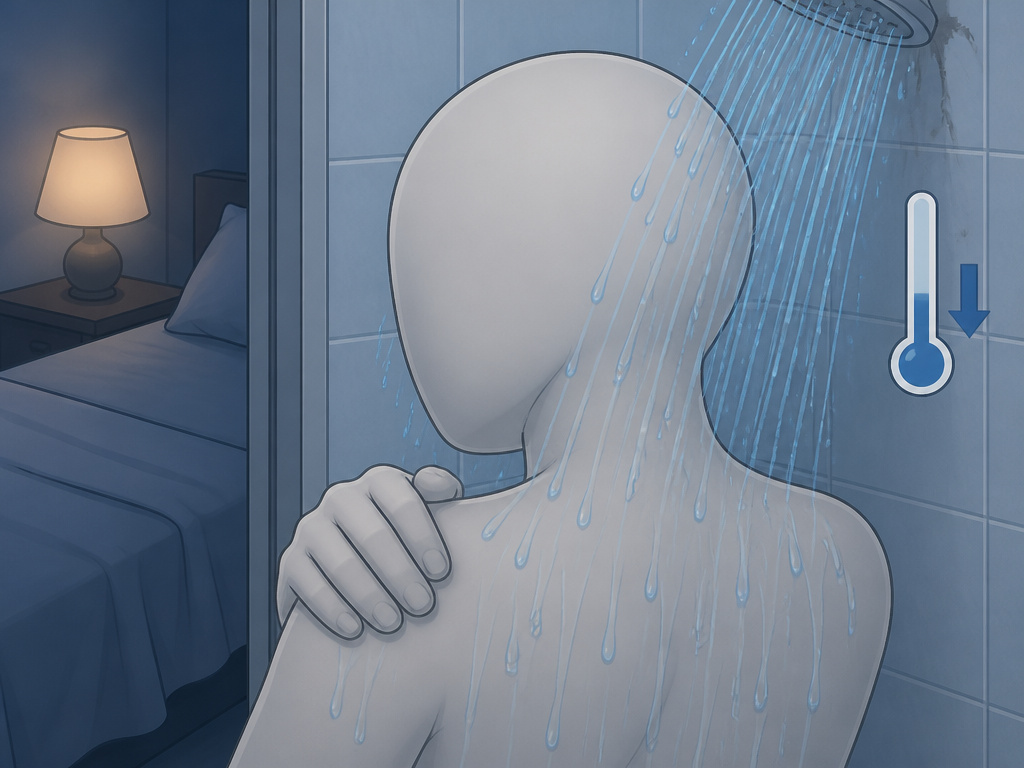
A cool shower does one useful thing and one useless thing.
I used to spend ten minutes on a foam roller before squats and then wonder why I felt flat. These days it’s a short pass per stiff area, then straight into bodyweight squats while the range is still fresh. Rolling after a workout is a different story. It feels nice, and it has never once changed how I felt the next morning. Sleep did more for that than any roller I’ve owned.
Here’s the sequence that actually helps after a late session:
- Finish with five minutes of easy movement. Walking or easy cycling lets heat come off gradually. Going from a hard set straight to the car leaves you warm and twitchy.
- Take a cool shower, not an ice bath. Cool water on the skin makes you feel cooler right away. The core temperature drop still runs on its own 30-to-120-minute clock, so the shower buys comfort, not speed.
- Drop the room temperature. A warm bedroom holds the heat in. Cool enough that a sheet is enough is the target.
- Dim the lights the moment you walk in. Bright overhead light tells your body it’s still daytime. One lamp is enough to get changed by.
I’d rather see you cut the last set short and get to bed earlier than finish the session and lie there staring at the ceiling. The set you skipped costs you almost nothing. The hour of sleep does not.
The cool down after workout piece of this is the part people rush. Five minutes of easy movement costs you almost nothing and it’s the difference between lying down warm and lying down ready.
Naps: 30 Minutes or a Full Hour?
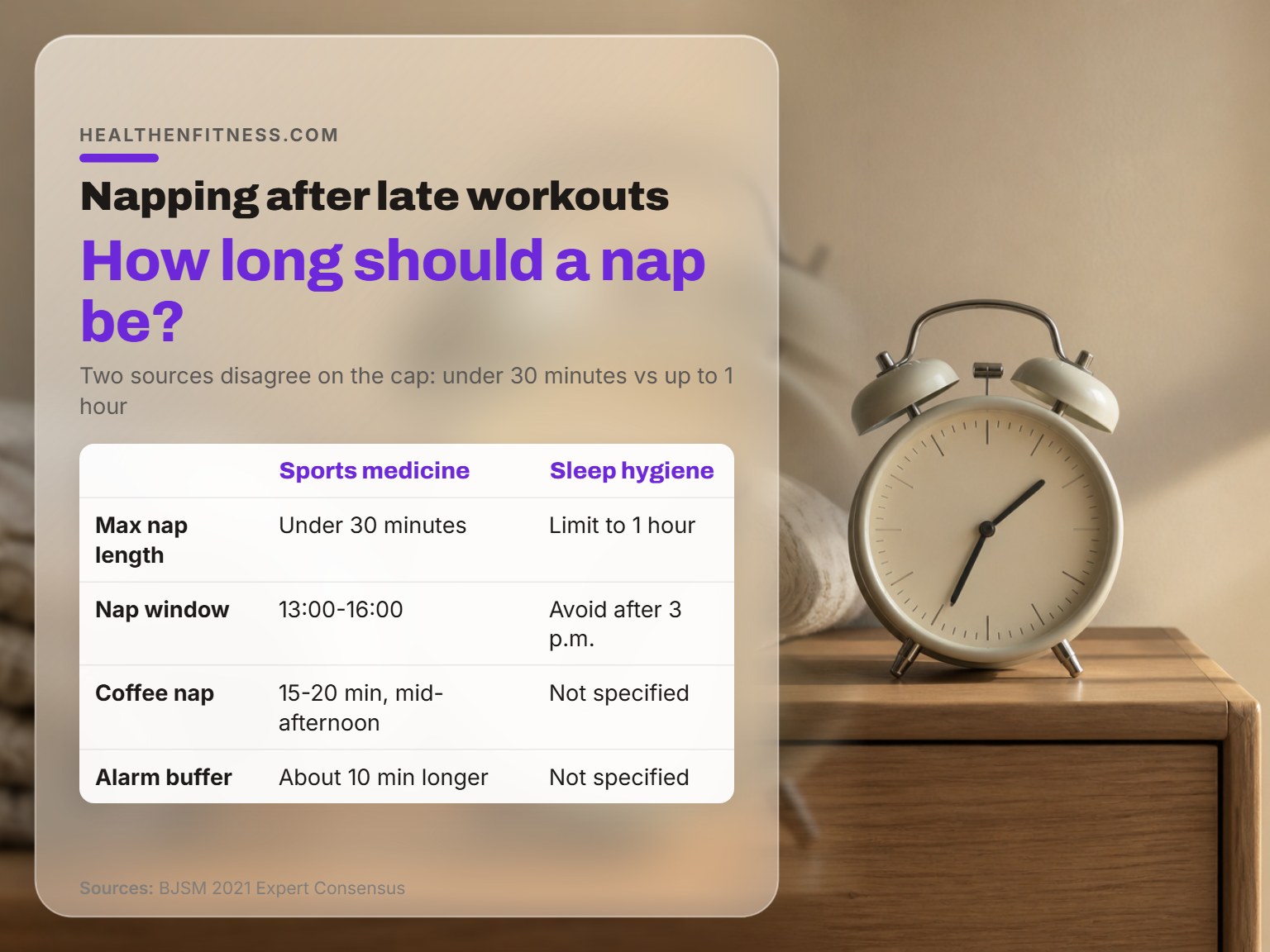
The two sources don’t agree on nap length, and neither one is obviously wrong.
- Under 30 minutes is the sports-medicine consensus, because it keeps you out of the deeper stages that produce sleep inertia.
- The window is 13:00 to 16:00, the post-lunch dip.
- Coffee nap: 15 to 20 minutes, mid-afternoon, with the alarm set about 10 minutes longer than the nap itself to allow for sleep-onset time.
- The stricter version: a sleep-hygiene review says cap it at 1 hour and avoid napping after 3 p.m.
Both positions are defensible. The sports-medicine consensus is written for athletes trying to top up recovery. The sleep-hygiene review is written for the general population, where a long nap can eat into night-time sleep.
Set the alarm for the right length
The 10-minute buffer is the detail people miss. You spend the first chunk of it falling asleep, and an alarm set at 20 cuts the nap short of what you intended.
If you nap and then still can’t sleep at night, the nap is the problem. Cut it before you cut the workout.
A nap long enough to reach deep sleep leaves you groggier than the sleep debt did.
The sleep hygiene recommendations put the outer limit at 1 hour, which is a different answer to the same question. Where the two disagree, the stricter one is the safer default for anyone who struggles at night.
If you want the recovery side of the argument, naps for recovery covers it. Just don’t let a 90-minute afternoon nap become the reason you’re awake at midnight.
Caffeine, Light, and the Wind-Down That Works
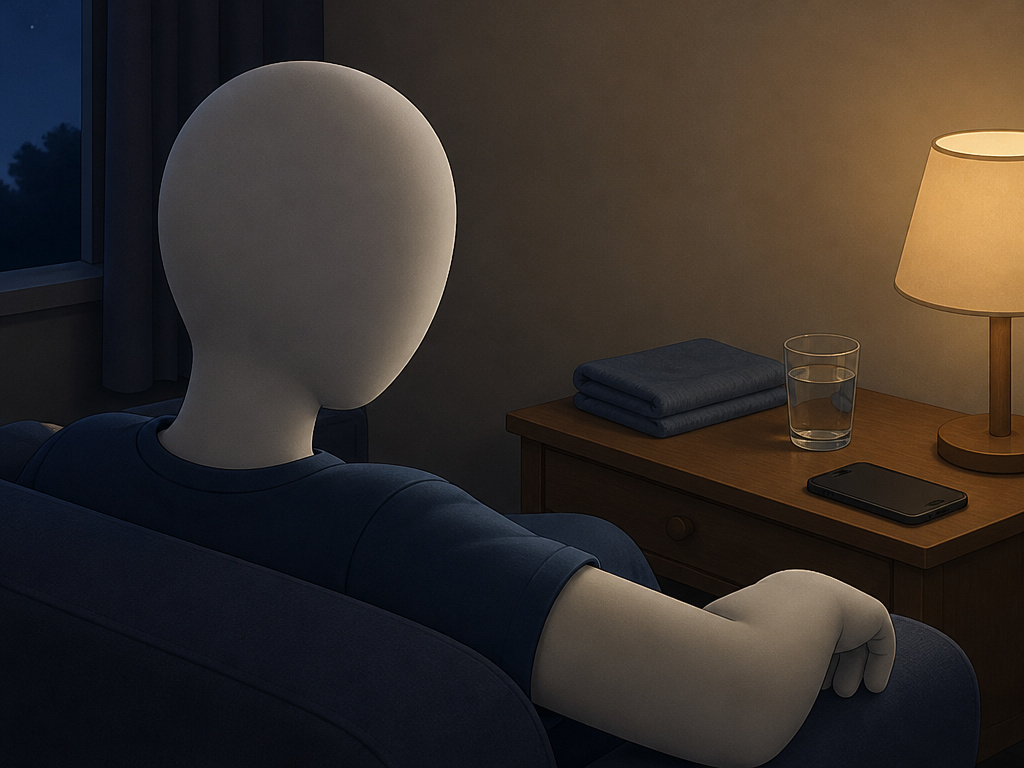
It’s 10:40 p.m. You’re home, you’ve eaten, and you’re on the couch with your phone at full brightness in a dark room. The whole ceiling is lit up.
Start with caffeine., and the late workout gets blamed for it. If you’re going to keep one variable steady this week, keep that one. The caffeine and sleep trade-off is the easiest thing on this list to fix and the one people defend hardest.
Then the light. A phone at full brightness in a dark room is a small sun. Dim the screen, or better, put it face down across the room.
Where this goes sideways: Chasing a late session with a big meal and a coffee, then wondering why 11:30 p.m. Feels like 7 p.m. The meal and the stimulant both keep you alert, and you’ll still be awake at 12:15 without understanding why.
The 20-minute version
- Cool shower.
- Lights down to one lamp.
- Phone face down, alarm set.
- Easy breathing or gentle stretching on the floor.
That’s it. No app, no protocol. The bedtime routine that survives a late finish is the short one you’ll actually do at 10:45 p.m. When you’re tired.
When This Advice Is Wrong for You
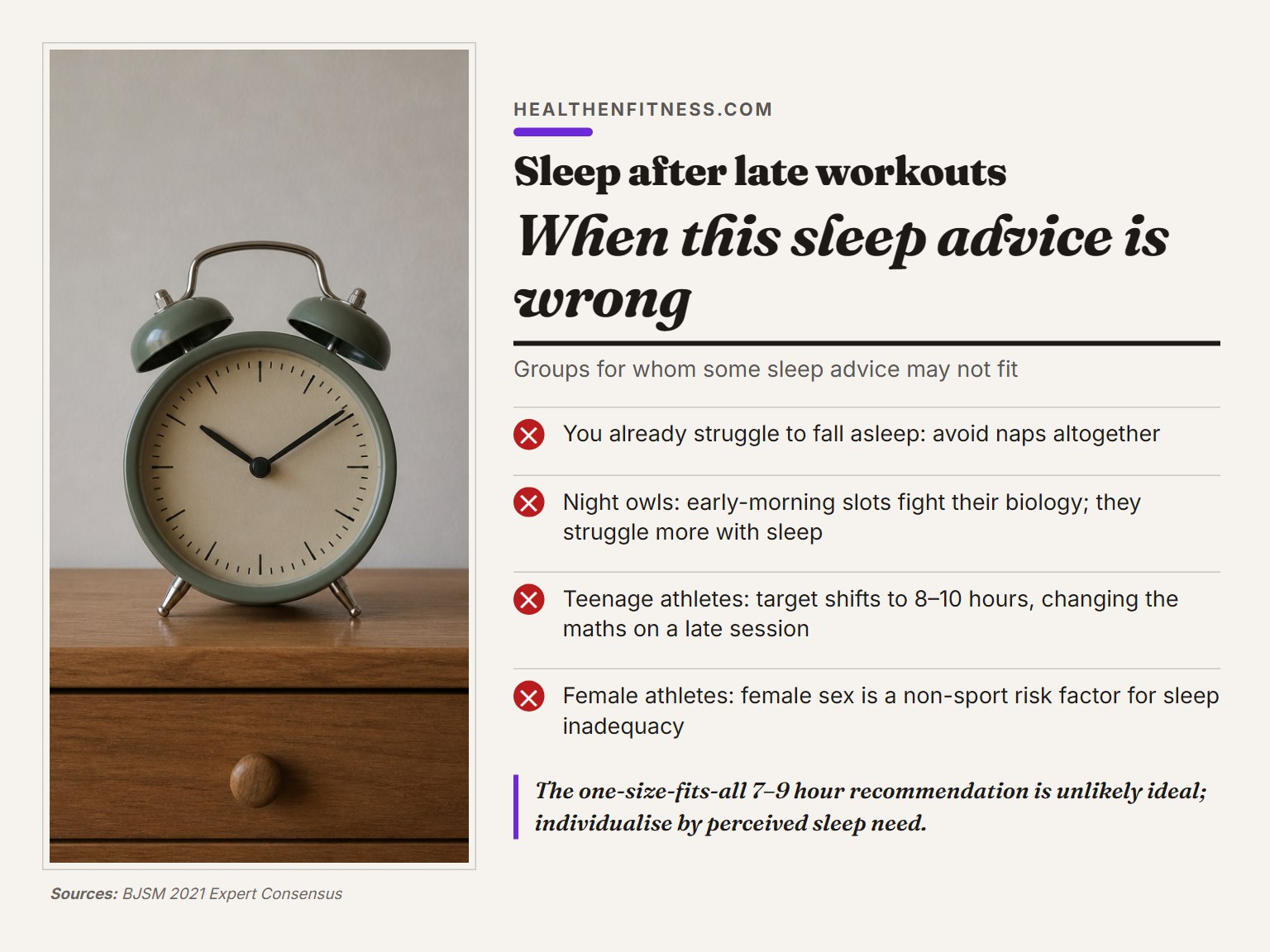
Three groups should ignore most of what’s above.
- You already struggle to fall asleep.
- You’re a night owl. The same consensus notes night-owl athletes struggle more with their sleep. An early-morning slot fights their biology rather than working with it.
- You’re a teenage athlete. The target shifts to 8 to 10 hours, which changes the maths on a late session entirely.
- You’re a female athlete. Female sex is flagged as a non-sport risk factor for sleep inadequacy. The evidence base is thinner than it looks.
Skip this if: You’re waking at 3 a.m. Most nights. That’s not a timing problem and no wind-down fixes it. Get it looked at by someone qualified before you rearrange your training week around it.
The consensus also pushes back on the standard advice itself. It calls the one-size-fits-all 7-to-9-hour recommendation unlikely to be ideal for health and performance, and recommends individual targets based on perceived sleep need. That’s a useful permission slip. If you consistently need more than the range, you probably do.
Frequently Asked Questions
Is it bad to work out right before bed?
For healthy young and middle-aged adults, the evidence doesn’t support that. A 2022 network meta-analysis found that acute evening exercise completed before bedtime doesn’t disrupt subsequent sleep, regardless of intensity. The practical issue is comfort, not damage: you’ll be warm, and warmth makes the first 20 minutes restless.
How long should I wait after a late workout before sleeping?
Core body temperature returns to baseline somewhere between 30 and 120 minutes after exercise ends. Thirty minutes is the floor and two hours is comfortable.
Should I take a cold shower to cool down faster?
Cool shower makes your skin feel cooler immediately, which helps you get comfortable. The core temperature drop still follows its own timeline of 30 to 120 minutes. You’re buying comfort, not skipping the wait.
Can I nap to make up for a late workout?
Possibly, with conditions. The 2021 sports-medicine consensus recommends naps under 30 minutes, taken between 13:00 and 16:00, and says athletes with trouble falling asleep should avoid them entirely. A separate sleep-hygiene review allows up to 1 hour but says avoid napping after 3 p.m.
Why do I feel wired but tired after training late?
Two things are happening. Core temperature is still elevated, and the 2023 review found evening exercise also delays the melatonin rhythm. Your body is warm and your clock has shifted slightly later. Both settle, and neither means the session was a mistake.
The Bottom Line
Move the session earlier or move bedtime later. One of the two has to give.
This all assumes you’re healthy and sleeping reasonably otherwise. If you’re awake at 3 a.m. Most nights, or you can’t get through a day without a nap to prop you up, the late workout isn’t your problem and this article isn’t your fix. That’s a conversation for someone qualified, and I’d rather say so than pretend a cool shower covers it.
For everyone else the order is simple. Cool down, dim the lights, cut the caffeine early, and let the temperature curve do its work.
Today, just check what time your last set actually finished and count forward 30 minutes. That’s your earliest realistic bedtime, and it’s probably later than the one you’ve been trying to hit.
