
Signs You Are Doing Too Much Cardio: What to Check
This post contains affiliate links. As an Amazon Associate, we earn from qualifying purchases.
Signs you are doing too much cardio show up as symptoms during the effort, a pulse that goes irregular, performance sliding while volume climbs, sleep and mood falling apart, and catching every cold going. The honest part: research disagrees on whether high volume harms the heart, but nobody disputes that warning symptoms mean stop and get checked.
That second sentence is the part worth sitting with. Warning symptoms during exertion are where the signs you are doing too much cardio are clearest, and they’re also the signal people talk themselves out of, usually by calling it a stitch or a bad day.
What follows: the five signals in the order I’d take them seriously, what the major reviews actually found about heavy endurance training, the volume numbers worth checking your week against, and what a lighter week looks like when you need one.
Key Takeaways
- Symptoms during the effort outrank everything else. Chest pressure, breathlessness that outruns the pace, or lightheadedness means stop the session and get a medical review, not push through the last interval.
- The relative risk is high and the absolute risk is tiny. Vigorous activity raises the relative risk of an acute cardiac event between 2- and 107-fold, yet fitness-facility rates run at 1 nonfatal event per 1,124,200 person-hours.
- The unfit beginner is the highest-risk person in the room, not the veteran endurance athlete with ten marathons behind them.
- The weekly target is 150 to 300 minutes of moderate activity or 75 to 150 minutes of vigorous activity. Most people worried about “too much” are nowhere near the top of that range.
- A planned lighter week beats adding sessions when progress stalls, and it keeps you from quitting out of frustration.
The Sign That Outranks Every Other Sign
Chest discomfort during a session is the one thing on this list that ends the conversation. The ASPC clinical practice statement is blunt about it: warning symptoms often come before exertion-related acute cardiovascular events, and symptoms mean stopping the training or competition immediately and getting a medical review.
Vigorous activity carries a relative risk of acute cardiac events between 2- and 107-fold compared with rest or lighter exercise, according to the ASPC 2022 statement. The same document reports absolute rates in fitness facilities of 1 nonfatal cardiovascular event per 1,124,200 person-hours and 1 fatal event per 887,526 person-hours.
Read those two sentences together and you get the whole picture. The multiplier is large because the baseline during rest is close to zero. The absolute number is small because most people, most of the time, are fine.
In practice, the symptoms that count are the ones that show up during or just after exertion and don’t match the effort. Here’s how I’d sort them.
| What you notice | What it can point to | What to do |
|---|---|---|
| Chest pressure or pain during effort | Coronary heart disease, the leading cause of exercise-related sudden death in older athletes | Stop the session, get a medical review |
| Breathlessness out of proportion to the pace | A cardiac or respiratory limit on output | Stop, don’t push the last interval |
| Lightheadedness or near-fainting | Falling blood pressure or a rhythm problem | Sit down, seek review before training again |
| A pulse that feels irregular or skips | Atrial fibrillation, more common in high-volume endurance athletes | Get it checked, keep training easy meanwhile |
| Palpitations plus breathlessness | A possible structural or rhythm issue | Medical review before the next hard session |
Lightheadedness is the one people push through most often. It’s also the easiest to blame on the heat, the food, or the fact that you skipped breakfast. If you get feeling dizzy during exercise more than once in the same month, that’s a pattern, and patterns get checked.
What Does a Five-Fold Atrial Fibrillation Risk Actually Mean?
What does a five-fold increase in atrial fibrillation actually mean for a Tuesday morning run? It means the association is real and the practical consequence is smaller than the headline suggests.
Before you start: Known or hidden heart disease is the subgroup where vigorous activity carries the highest acute event risk, so get a clinician’s view before adding hard intervals if you have symptoms, a diagnosis, or a long history of doing nothing. Unaccustomed vigorous activity in unfit people with underlying heart disease is the exact scenario the ASPC statement flags for sudden cardiac death and heart attack. And no aspirin or beta-blocker taken just before a hard session has been shown to prevent those events.
The PMC review of excessive endurance exercise found that long-term sustained vigorous aerobic training, the marathon and professional cycling kind, is associated with as much as a 5-fold increase in the prevalence of atrial fibrillation. A separate analysis found highly active men were three times more likely to be prescribed flecainide, a drug used as a marker for lone atrial fibrillation, than sedentary men.
An irregular rhythm is easiest to feel at the wrist, two fingers below the thumb, where a skipped beat registers as a small gap and then a lurch. That’s a physical thing you can check in ten seconds, and it beats guessing from how you feel.
Here’s the counterweight. The same British Journal of Cardiology review states there’s currently no indication that chronic exercise promotes dangerous ventricular arrhythmias in people without underlying disease.
So the practical list is short:
- Feel your pulse after a hard session, not during it, when your own heartbeat is too loud to judge.
- Note whether it’s regular. A steady rhythm that’s fast is normal. A rhythm that stops and restarts is worth a look.
- Get it checked once if you notice it repeatedly, and keep training easy until you do.
- Don’t buy a gadget to settle the question. A watch showing your heart rate zones tells you how hard you’re working, not whether the rhythm underneath is regular.
What most people get wrong: Assuming a high heart rate on its own means something is wrong. A fast, regular pulse during hard effort is the system doing its job. It’s the irregularity that earns a trip to the doctor.
When Your Times Get Worse While Your Volume Gets Bigger
Performance that slides while training volume climbs is one of the signs you are doing too much cardio that I watch for first. It’s also the one most people explain away, because the explanation is always available: you’re tired, you slept badly, it’s humid.
The International Olympic Committee consensus statement calls this territory over-reaching and overtraining, and recommends monitoring athletes for early symptoms and signs of both. Poor load management with the maladaptation that follows is flagged as a significant risk factor for acute illness and overtraining.
The treadmill belt whines under you at the same speed it did last month, and the split on the console reads slower. Same effort, worse output, two or three weeks running.
The Three-Week Rule I Use
One bad week is noise. Three weeks of the same easy pace feeling harder is a trend, and a trend gets a response.
I don’t act on a single rough session, because I’ve had plenty of those and so has everyone I coach. I act on the third week in a row where the same easy pace costs more. At that point I cut volume before I touch anything else, because the alternative is usually a month off whether I planned it or not.
If you want the fuller checklist of what accumulated fatigue looks like, the signs of overtraining go well past sore legs. Mood and sleep get there before your times do.
Three weeks is a trend. One week is weather.
Do You Get a Cold Every Single Time You Push Your Volume Up?
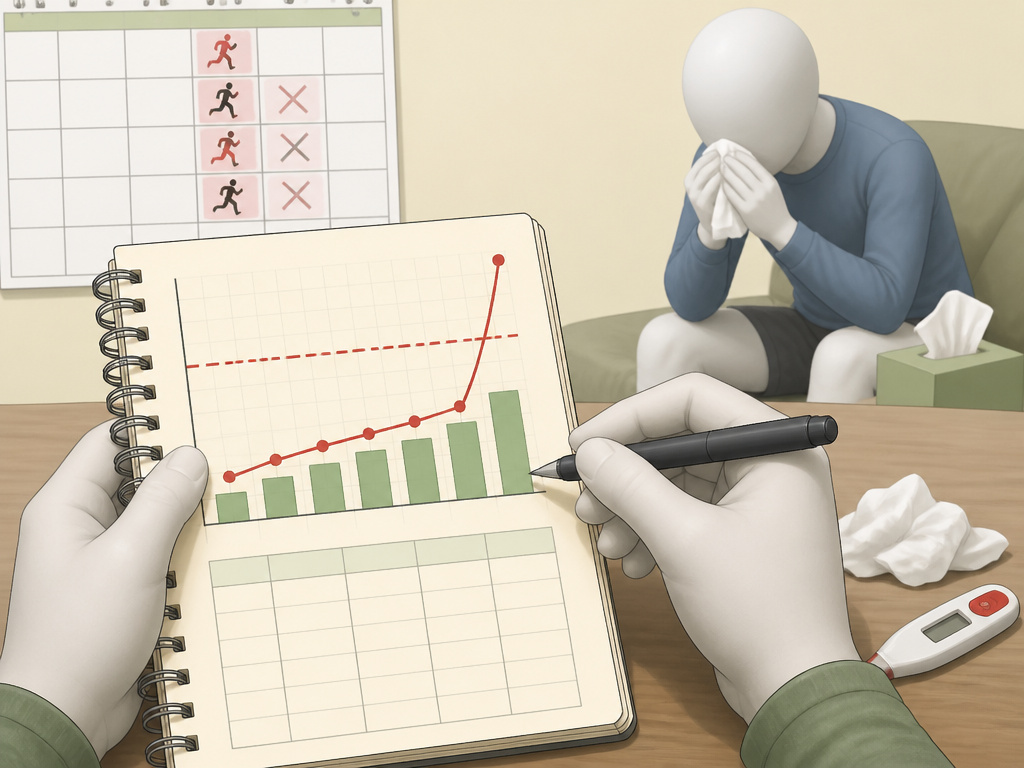
Do you get a cold every single time you push your volume up? That pattern has a name in the sports medicine literature, and it isn’t bad luck.
The IOC consensus statement on training load ties poor load management and the maladaptation that follows to a higher risk of acute illness. The same document recommends keeping weekly increases small, with injury data pointing to increments under 10 percent. It also recommends monitoring load using both external measures, like distance and pace, and internal ones, like how hard it felt.
The bullet points worth taking from it:
- Cap the weekly jump. Under 10 percent, and that’s the ceiling rather than the target.
- Don’t stack two big changes in one week. A longer long run plus a new interval block is two jumps wearing one coat.
- Schedule recovery on purpose, especially after a hard block, a race, or travel. Sleep, food, fluids, and actual rest days.
- Watch the life stuff too. The statement recommends reducing training load for athletes who look unfocused because of negative life events or ongoing daily hassles.
Where this goes sideways: Adding a long run and a hard interval block in the same week. The two jumps stack, the illness lands a fortnight later, and by then you’ve forgotten which week caused it.
That last bullet is where the rest days conversation usually starts, and it’s the one people skip because rest doesn’t feel like training.
Sleep, Mood, and the Load You Are Not Counting

The alarm goes at 6am and the first thought is how to get out of the session. That thought is data.
The IOC statement treats psychological load as part of the total picture, not a soft add-on. Negative life events and daily hassles raise illness risk in athletes, and the recommendation is to cut training and competition load for anyone who looks unfocused as a result. It also lists sleep, rest, active rest, and emotional support as part of scheduled recovery.
Here’s my honest read after years of coaching beginners. Most people who think they’re overtrained are under-eating, under-sleeping, or just sore, and a lighter week fixes it. That’s a coaching opinion, not a research finding, so weigh it accordingly.
If two of the three are off, sleep and mood, treat it as a training problem even when your legs feel fine. Sore legs are the last thing to show up and the first thing everyone checks.
This is also where I part company with the gadget crowd. None of them know you skipped dinner.
If your week is genuinely heavy at work, the balancing stress and training load question matters more than your resting heart rate does.
Where the Research Genuinely Disagrees
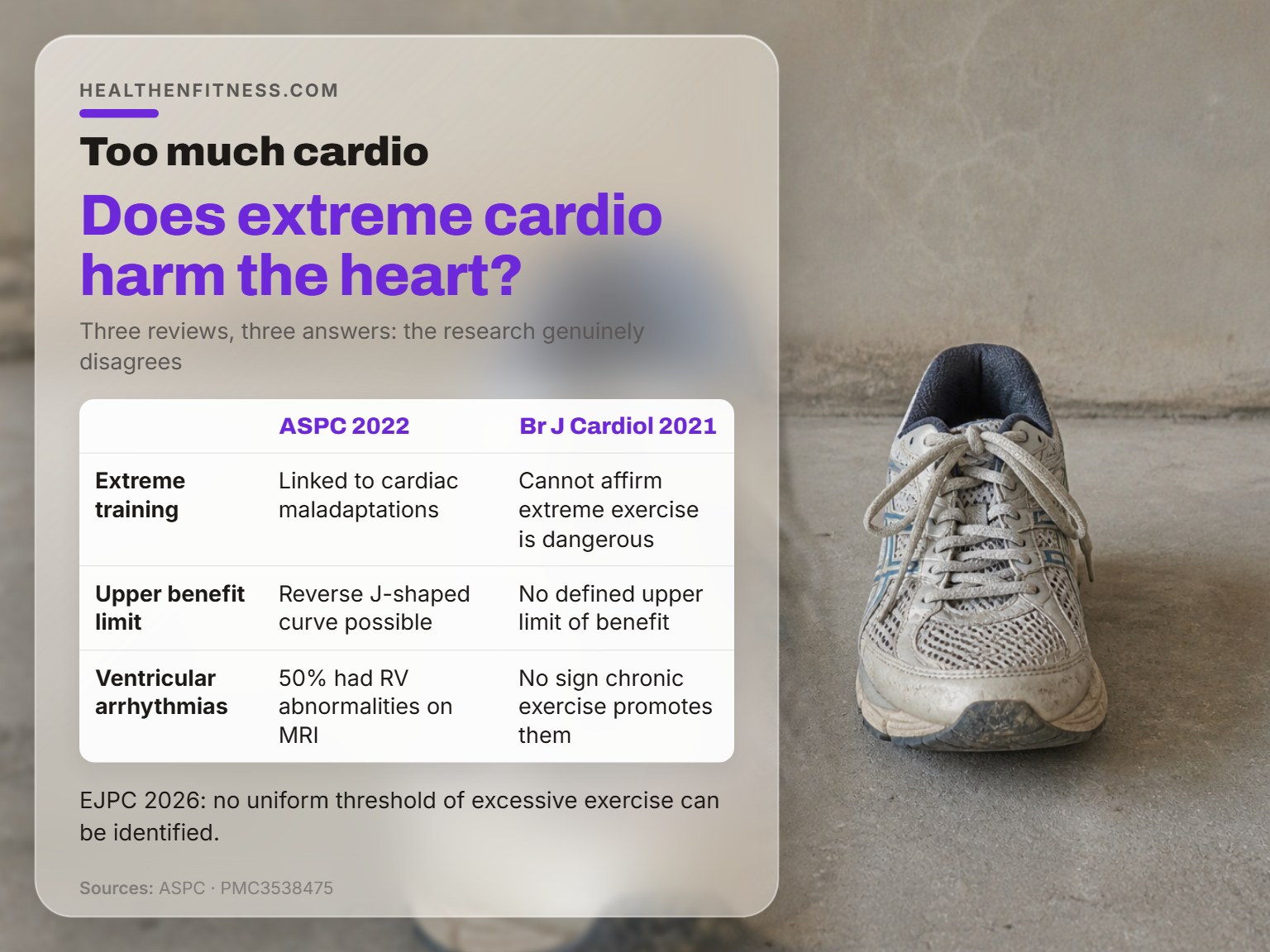
Three major reviews, three different answers, and none of them is lying. If you’ve read conflicting headlines about cardio and the heart, this is why.
| Question | One position | The other position |
|---|---|---|
| Does extreme endurance training harm the heart? | ASPC 2022: linked to accelerated coronary artery calcium, elevated biomarkers, myocardial fibrosis, and atrial fibrillation, possibly a reverse J-shaped curve | Br J Cardiol 2021: current evidence cannot affirm extreme exercise is dangerous, and no harm signal appeared at 10 times recommended levels |
| Is there an upper limit of benefit? | Br J Cardiol 2021: no defined upper limit of mortality benefit from exercise | EJPC 2026 review: no uniform threshold of excessive exercise can be identified |
| Do high volumes cause dangerous ventricular arrhythmias? | PMC3538475: half of endurance athletes with ventricular arrhythmia symptoms had right ventricular structural abnormalities on MRI | Br J Cardiol 2021: no indication chronic exercise promotes dangerous ventricular arrhythmias in those without underlying disease |
| Is coronary calcification in athletes a problem? | ASPC 2022: accelerated coronary artery calcium score is a potential maladaptation | Br J Cardiol 2021: athletes have mostly calcified plaques and lower heart disease risk, and the clinical significance is unclear |
The can too much exercise be dangerous review is the most reassuring of the three, and it still concedes that the clinical implications of atrial fibrillation in athletes aren’t well understood. The debate has run in the pages of can intensive exercise harm the heart and in reviews like the limits of cardiac performance study, and it hasn’t been settled.
Two things are widely agreed on. First, the AHA 2020 scientific statement identifies the unfit beginner going hard from nothing as the highest-risk edge case, not the veteran athlete. Second, there’s insufficient evidence to justify routine heart screening in young asymptomatic athletes or healthy people before they start moderate-to-vigorous exercise.
Bottom line: Br J Cardiol 2021 and the EJPC 2026 review say no uniform threshold of harmful exercise has been identified, while ASPC links extreme endurance training to potential cardiac maladaptations; the group everyone agrees is at risk is the one that jumps in hard from nothing.
There’s one more gap worth naming. The EJPC review points out that the data come mostly from male Caucasian athletes, with female and non-Caucasian evidence scarce or missing. If you’re not in that group, the uncertainty around you is wider than the headlines admit.
The Volume Numbers Worth Checking Your Week Against
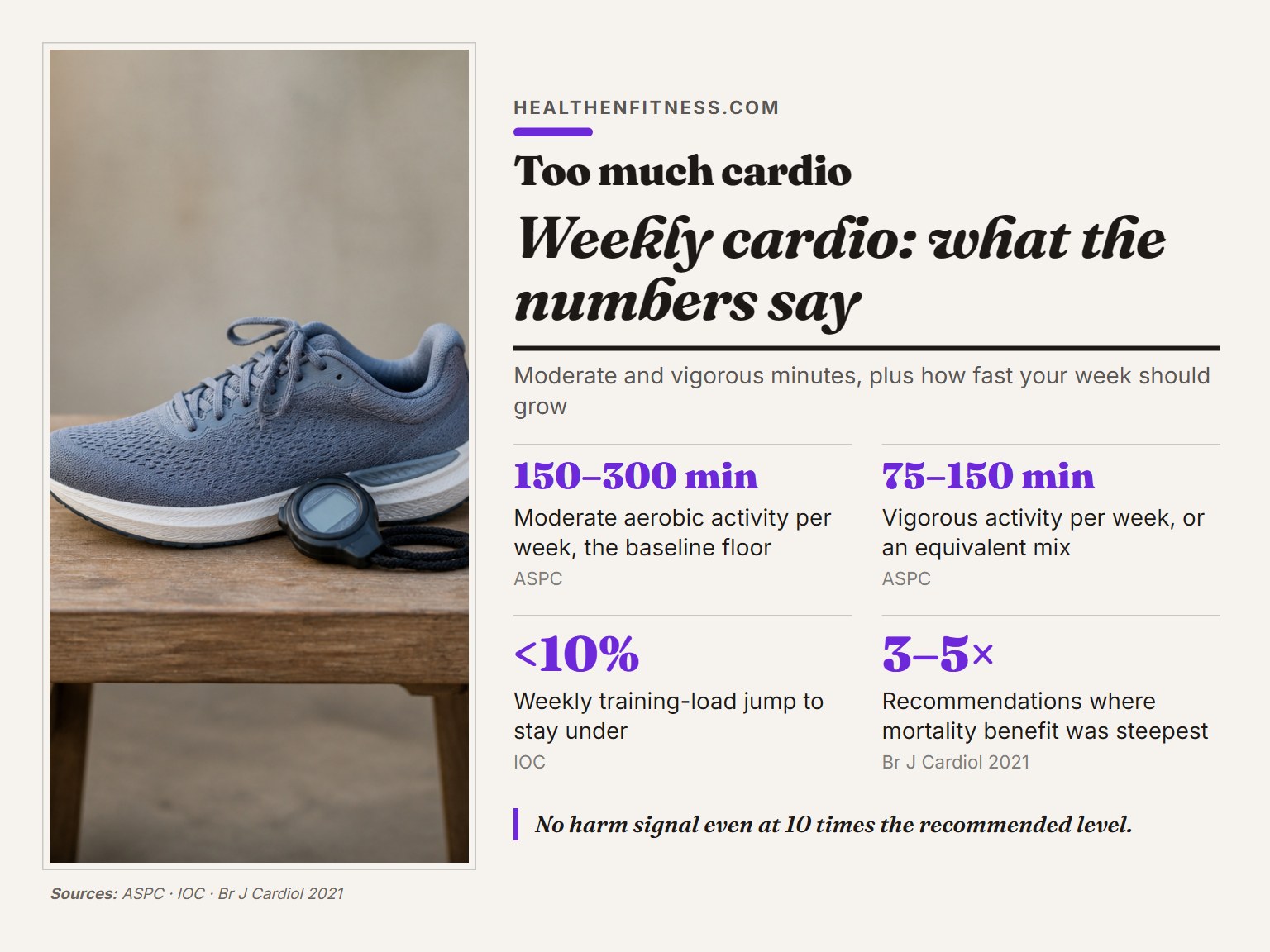
Start with 150 minutes. That’s the floor of the moderate-intensity range, and it’s where the ASPC statement puts the baseline: 150 to 300 minutes of moderate aerobic activity per week, or 75 to 150 minutes of vigorous activity, or a mix of the two.
Vigorous has a definition, which helps. The ASPC research brief summary sets it at 60 percent or more of functional capacity, or 6 METs and up. A MET is a multiple of resting energy use, so 6 METs means working six times harder than you do sitting still.
Here’s how to check your own week:
- Add your moderate and vigorous minutes separately. The guidelines treat 75 vigorous minutes as equivalent to 150 moderate ones, so a vigorous minute counts for roughly two moderate ones. Keep them apart until you’ve added them.
- Compare against the range, 150 to 300 moderate or 75 to 150 vigorous. Under it, the answer to “am I doing too much” is no.
- Check your weekly jump. Under 10 percent, per the IOC statement.
- Check when you last had a lighter week. If you can’t remember, that’s your answer.
There’s a useful number for the low end too. Walking and housework count for more than most people give them credit for.
At the other end, The Br J Cardiol 2021 review found the mortality benefit was steepest at 3 to 5 times the recommendations, with modest extra benefit above that and no harm signal at 10 times.
If you’re rebuilding from a long break, how much cardio per week is a better starting question than how fast you can go. And how long a cardio session should be matters less than the weekly total. Most of my easy work sits in zone 2 cardio because it’s repeatable, and repeatable is the whole point.
What a Lighter Week Actually Looks Like

A lighter week keeps the sessions and cuts the work inside them. That distinction matters, because the version people actually do is take four days completely off, feel great, then jump straight back to where they were.
I had a student start with a few shallow bodyweight squats, twice a week. Three months later they were doing a clean set of ten with control, and I’d honestly expected it to take longer. Steady frequency did more than any clever programming would have.
So the lighter week looks like this:
- Keep the same number of sessions. The habit is the asset. Protect it.
- Shorten each session rather than deleting days. Half the volume, same rhythm.
- Keep everything conversational. If you can’t hold a sentence, it’s not a lighter week.
- Check back in after it. If the same easy pace feels easier, the lighter week did its job. If nothing changed, look at food and sleep before you look at your training plan.
Easy to miss: A lighter week that turns into a total break costs you the routine, and rebuilding the routine is harder than rebuilding the fitness.
That’s the part I’d underline. The point of the lighter week is to keep showing up at a cost you can afford.
Frequently Asked Questions
How do I know if I’m doing too much cardio?
Start with the symptoms that show up during the effort: chest pressure, breathlessness that doesn’t match the pace, or lightheadedness. Then check the slower signals, which are performance sliding while volume climbs, sleep and mood falling apart, and getting ill every time you build. Volume alone rarely tells you much, because most people are under the guidelines rather than over them.
Can too much cardio damage your heart?
The research genuinely disagrees, and you should be suspicious of anyone who says otherwise. One position links extreme endurance training to accelerated coronary artery calcium, myocardial fibrosis, and atrial fibrillation. Another states that current evidence cannot affirm extreme exercise is dangerous, with no harm signal at 10 times recommended levels. The one thing all sides accept is that unaccustomed vigorous activity in unfit people with underlying heart disease is the dangerous scenario.
What are the signs of overtraining from cardio?
The IOC consensus statement points to monitoring for early signs of over-reaching and overtraining, and to poor load management as a risk factor. In practice that shows up as performance dropping on the same effort, sleep getting worse, mood flattening, and illness arriving every time you push volume. Soreness is the least reliable of these.
Should I get a heart screening before starting cardio?
For most healthy people without symptoms, the evidence doesn’t support routine screening before moderate-to-vigorous exercise. If you have symptoms, a known diagnosis, or a long history of inactivity, that’s a different conversation and it belongs with a clinician.
How many rest days do I need?
There’s no single number that fits everyone, and the IOC statement frames it as scheduling adequate recovery rather than hitting a fixed count. The practical version is to plan recovery after hard blocks, races, and travel, and to keep weekly load increases under 10 percent. If you can’t remember your last lighter week, you’re overdue for one.
Before You Go
One concession worth making plainly. If you have a diagnosis, a family history, or symptoms that show up when you exert yourself, everything above is background noise and the answer is a clinician, not a training plan.
For everyone else, here’s the contrarian bit. The person who actually needs to worry about doing too much cardio is rarely the person searching for signs of it. The worried searcher is usually doing three easy sessions a week and sleeping badly. The person at risk is the one who went from nothing to six hard sessions in a month and feels fine, right up until they don’t.
So the threshold I’d give you is this: if your weekly jump has been over 10 percent for three weeks running, or you can’t remember your last lighter week, cut volume now rather than after something breaks.
Today, just work out your moderate and vigorous minutes for last week and write the two numbers down. That’s it. No app, no score, no verdict. Just the number, so you know which conversation you’re actually having.
