
Does Stretching Prevent Injury? What the Trials Show
This post contains affiliate links. As an Amazon Associate, we earn from qualifying purchases.
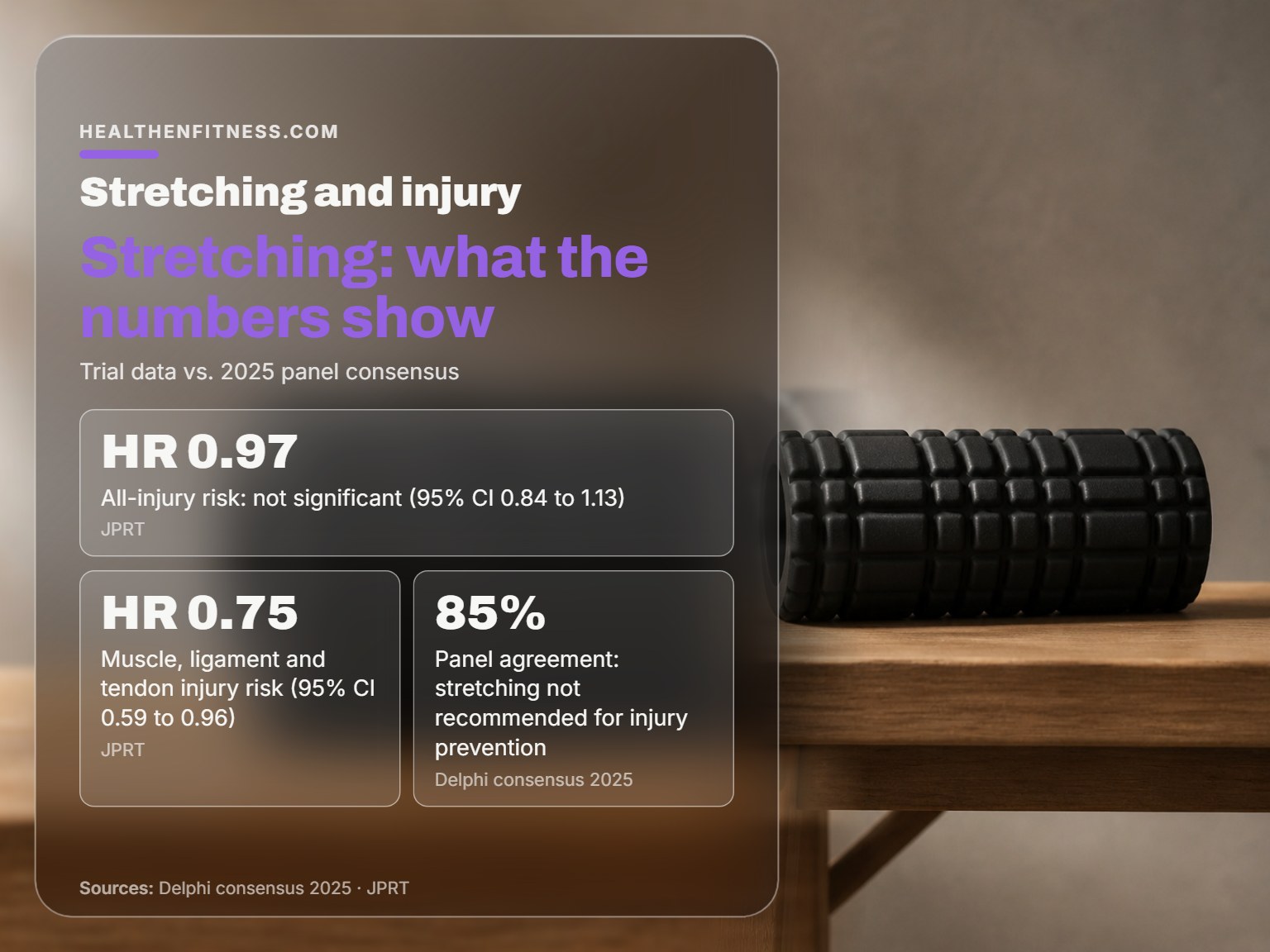
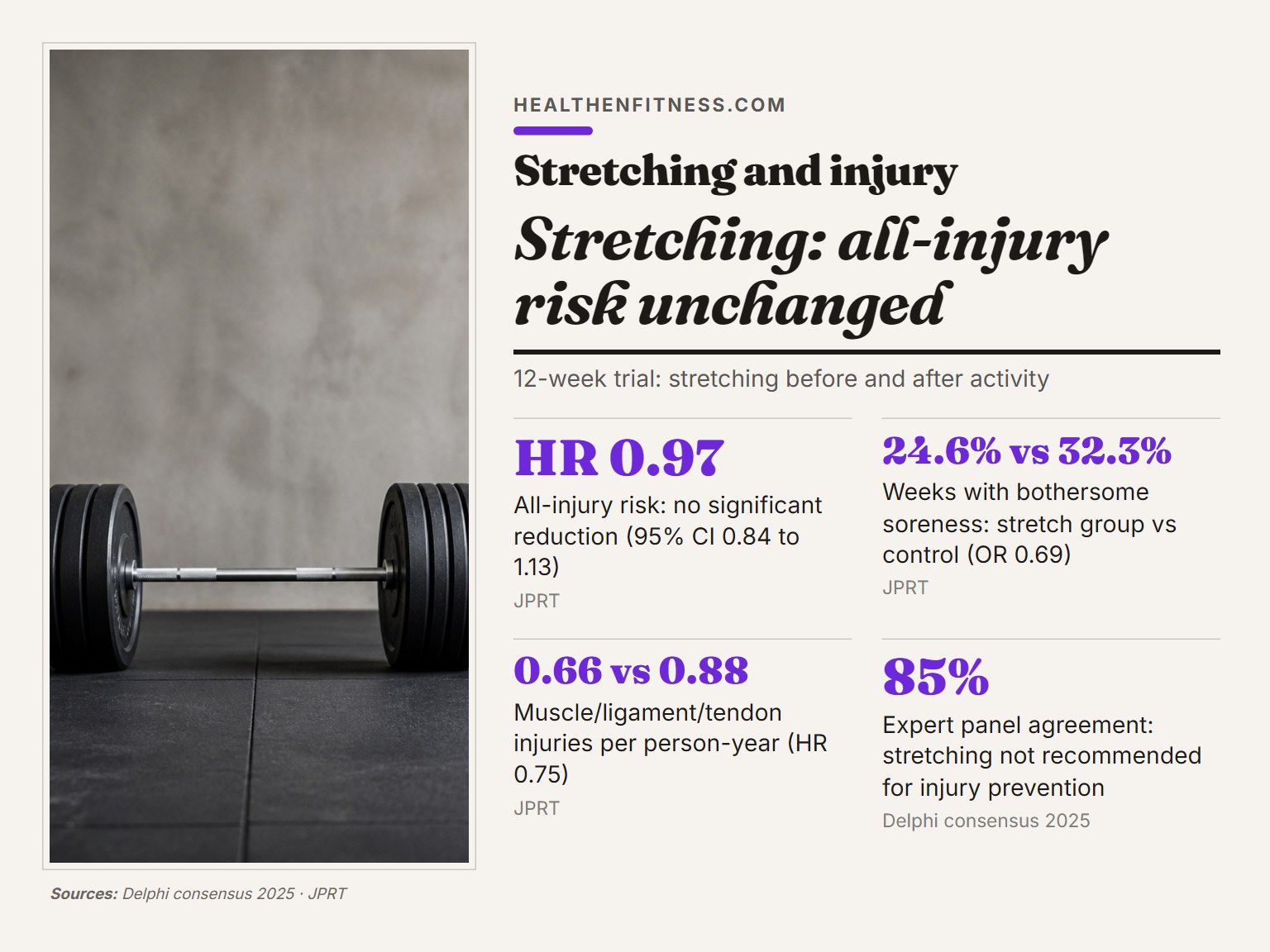
Stretching doesn’t prevent injury overall, according to the largest randomized trial on the question: 12 weeks, a hazard ratio of 0.97 for all injuries (95% CI 0.84 to 1.13). The same trial recorded fewer muscle and tendon injuries and less soreness in the stretching group.
That split is the whole argument. When you ask does stretching prevent injury, a hazard ratio of 0.97 pools everything from a rolled ankle to a stress fracture, and a held stretch has no plausible route to most of that list. A hazard ratio of 0.75 on muscle and tendon tissue is a narrower claim, and it’s the one you can test against your own training.
What follows is the trial data, the one point where the experts genuinely disagree, and a warm-up that loads the tissue you’re about to use.
Key Takeaways
- All-injury risk barely moves. The Jam trial’s hazard ratio was 0.97 (95% CI 0.84 to 1.13) over 12 weeks.
- Muscle and tendon injuries did drop. HR 0.75, with 0.66 injuries per person-year against 0.88 in the control group.
- Soreness fell the most. 24.6% of weeks in the stretching group versus 32.3% in the control group.
- A 2025 expert panel voted against stretching anyway. 85% agreement after three rounds that it isn’t recommended for injury prevention in general.
- Ramp-up sets beat a stretching routine for the first lift of the day.
Does Stretching Prevent Injury? What the Trials Actually Found
The largest trial on this question came back null.
The Jam trial followed adults for 12 weeks and collected self-reported outcomes every week. Participants stretched before and after activity. All-injury risk came out at a hazard ratio of 0.97, with a 95% confidence interval of 0.84 to 1.13. No clinically important or statistically significant reduction appeared.
A hazard ratio compares how often an event happens in one group against another, which is how the does stretching prevent injury question gets answered. Below 1.0 means fewer injuries in the stretching group. The 95% confidence interval is the range of values the data is compatible with, and this one straddles 1.0. So the result covers everything from a small benefit to a small harm.
Then in June 2025, a Delphi consensus panel published in the Journal of Sport and Health Science. The panel was made up of researchers with active sports practice backgrounds, and they reached 85% agreement after three rounds that stretching is not recommended for injury prevention in general.
I did the pre-lift stretch routine for years without ever asking what it was preventing.
That’s the headline: the Jam trial found no clinically important reduction in all-injury risk, while the 2025 Delphi panel went further and concluded stretching is not recommended for injury prevention in general.
Why a Null Result Makes Sense: Stretch Tolerance Is Not Tissue Compliance
Stretch tolerance and tissue compliance are two different things, and only one of them is what a strain cares about.
A 30-second hold teaches your nervous system to accept more range before it signals a stop. That’s a real change, and it’s why you walk out of a stretch feeling looser. A hamstring held at end range feels slack for a minute or two, then the tightness creeps back before your second work set.
A hold doesn’t change how the muscle behaves when it’s loaded fast and hard, which is the moment most strains happen. A critical review of stretching evidence made that argument directly: stretching won’t change muscle compliance during eccentric activity, and eccentric activity is where most strains are believed to occur.
The same review pointed out that in activities where excessive muscle length isn’t the constraint, like jogging, there’s no mechanism for stretching to do anything at all.
It also floated a less comfortable idea. Basic science work suggests stretching can produce damage at the cytoskeleton level, and that it can mask muscle pain in humans. Both claims rest on cross-sectional studies, which is the weakest design in the pile. I’d treat them as open questions.
Here’s what the mechanism argument means in practice:
- Range of motion goes up, measurably, within a session.
- Stretch tolerance goes up, so you can push further before your brain says stop.
- Tissue behavior under fast load changes little, which is the part a hamstring strain would care about.
- Bone, joint, and contact injuries don’t move at all.
The mobility vs flexibility split matters here, because chasing one trains the other and only one of them shows up under a barbell.
The Three Trials Side by Side
Three trials. Three populations. One flat result on total injuries.
| Trial | Who Was Studied | All-Injury Result |
|---|---|---|
| Jam 2009, Br J Sports Med | Adults, 12 weeks | HR 0.97 (95% CI 0.84 to 1.13) |
| Pope 2000, Med Sci Sports Exerc | 1,538 male army recruits, 12 weeks | HR 0.95 (95% CI 0.77 to 1.18) |
| Amako 2003, Mil Med | 901 military recruits | Total injury rate almost identical |
Pope 2000: 1,538 Recruits and a Hazard Ratio of 0.95
Pope’s trial is the one people cite for the “stretching does nothing” line. It ran male army recruits through 12 weeks of training with static stretching in every warm-up.
The full randomized trial of preexercise stretching is worth reading for the injury breakdown alone.
Amako 2003: The Cohort That Split the Result
Amako’s group studied military recruits with static exercises before and after every session. Total injury rates came out almost the same. Muscle and tendon injuries and low-back pain were significantly lower in the stretching group.
That’s the static stretching military recruits study that keeps the muscle-tendon question alive, because it found a tissue-specific effect while the total stayed flat.
My own read: the injury prevention exercises that earn their place are strength and load work, not more time in a stretch.
Where Stretching Does Help: Soreness and Muscle Strains
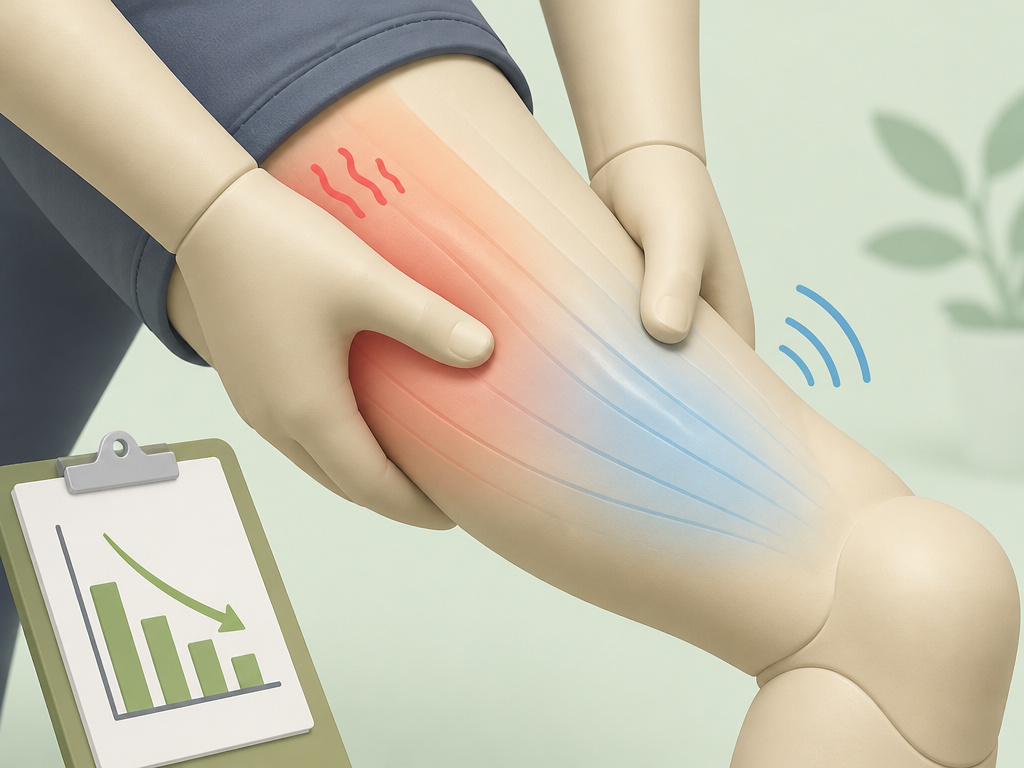
Soreness is where the stretching group actually won, and it won by a margin you can feel.
In the Jam trial, bothersome soreness showed up in 24.6% of weeks in the stretching group and 32.3% of weeks in the control group. The odds ratio was 0.69, with a 95% CI of 0.59 to 0.82. That interval sits entirely below 1.0, so this is one of the few results in the literature that clears the bar.
Muscle, ligament, and tendon injuries moved too. The stretching group recorded 0.66 injuries per person-year against 0.88 in the control, for a hazard ratio of 0.75 (95% CI 0.59 to 0.96).
So the summary splits in two. Stretching won’t keep you from getting hurt in general. It does seem to reduce how sore you feel and how often you tweak something in the muscle and tendon department.
I’ve felt that split from the other side. A training partner of mine had hamstrings that felt tight for months, and stretching them daily made the feeling worse. What finally moved it was slow hip hinges under load. The tightness was a strength problem wearing a flexibility costume.
If soreness is what derails your week, a short stretching block after training is the cheapest lever you have. The effect on Thursday’s workout is worth more than the effect on your injury risk.
The stretching for sore muscles question has more to it than this one outcome, and the trial only answers part of it.
The Bone and Joint Trade-Off the Panel Could Not Settle
The 2025 panel went further than the trial data supports, and its own paper shows the gap.
The Delphi consensus on stretching exercise states that a reduced muscle-injury risk “may be compensated for with more bone and joint injuries,” citing Takeuchi and colleagues. That’s a real concern and it deserves airtime. It’s also not something the biggest trial measured as significant.
Three positions, one dataset each:
| Claim | Who Holds It | What the Numbers Show |
|---|---|---|
| Stretching cuts overall injury risk | Common coaching practice | HR 0.97 (Jam) |
| Stretching cuts muscle and tendon injuries | Jam 2009; Amako 2003 | HR 0.75 (0.59 to 0.96); significant in Amako |
| Stretching trades muscle injuries for bone injuries | Delphi 2025, citing Takeuchi et al. | Not measured as significant in the biggest trial |
| Stretching isn’t recommended for prevention | Delphi 2025 panel | 85% agreement after three rounds |
I’ll take the trial data over the panel’s inference here, and I’ll say why: the trade-off claim is a hypothesis with a directional hint behind it, not a measured effect.
What to Do Instead: A Warm-Up That Actually Loads the Tissue
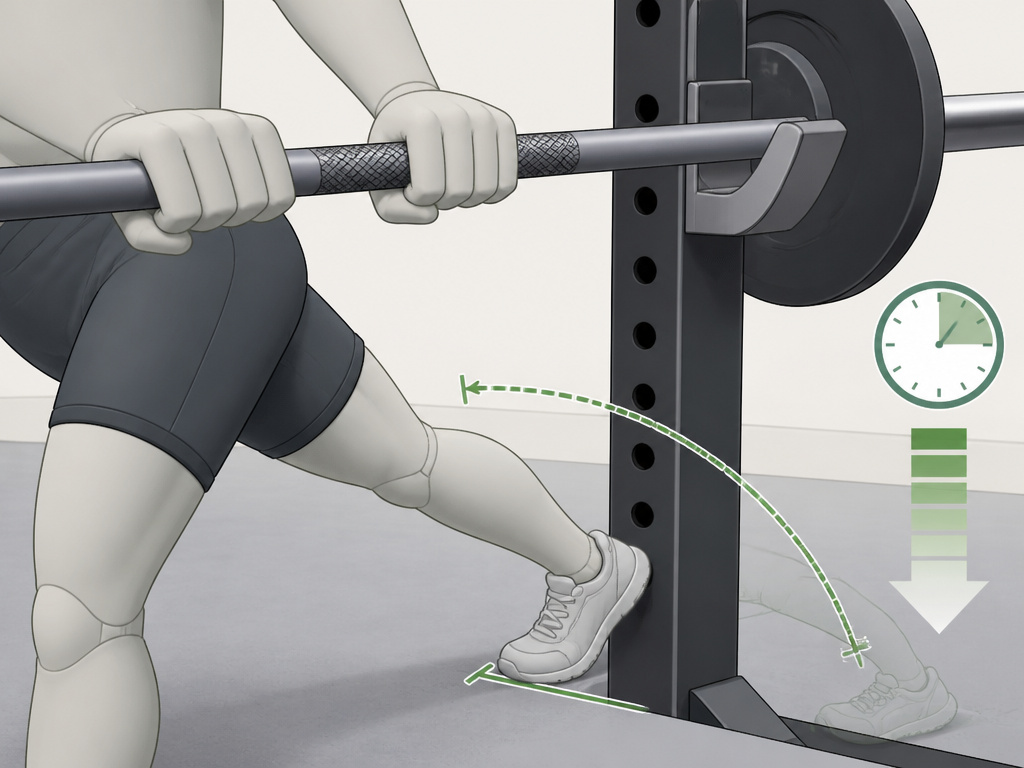
Three things happen in a warm-up, and none of them involve holding a stretch.
I dropped the long static routine before lifting a few years back. It made me feel loose, and then my first heavy set felt weaker than it should have, every time. I swapped it for leg swings and bodyweight squats and the cold-start feeling went away.
That experience lines up with what the trials tested: the protocols that got measured were static holds, and the all-injury numbers stayed flat.
Before you start: A ramp-up set done badly is still a loaded set. If a joint gives you a sharp pain rather than a dull ache, stop and get it looked at before you add weight. If you’re coming back from an injury, get clearance first, because a general warm-up won’t account for your specific tissue.
The Warm-Up I Actually Use
- Easy movement to raise temperature. Skip it and the first set feels sticky, like the muscle hasn’t woken up.
- Leg swings, front to back and across the body. Skipping these leaves the hip cold at exactly the angle a squat needs.
- A set of the actual lift with an empty bar. This is the rehearsal a stretch can’t give you.
- Ramp-up sets, adding weight and dropping reps. Miss this and your top set becomes your warm-up, which is how people pull things.
- Long holds after training or in a separate session. Put them here and you keep the range work without spending your freshest minutes on it.
By the third ramp-up set the plates stop rattling on the way down and the bar starts moving in one piece. That’s the signal you’re ready.
I won’t hand a beginner a stretching routine for injury prevention. I’ll hand them a warm-up that looks like a lighter version of the workout, because that’s the version they’ll actually repeat on a bad day.
The full warm-up routine matters more than the stretching block it replaces, and the pre-workout stretches that survive are the ones that look like the lift.
Is Static Stretching Before a Workout Worth It?
Ever noticed that the loosest you feel all day is right after a stretch, and it’s gone by the time you rack the bar?
That’s the real case for stretching as a pre-lift tool: the effect is short. A held stretch raises your tolerance for range for a while, and then it fades. If you want range for a specific lift, the stretch needs to happen close to the lift and stay short.
The static vs dynamic stretching split is the useful frame. Static holds buy range. Dynamic work buys range plus a rehearsal of the movement, which pays better before a heavy set.
Hold times matter less than people think. The how long to hold a stretch question has a practical answer sitting in the protocols themselves: neither trial’s stretching protocol produced an all-injury benefit.
A cold hamstring under a hard hold has a specific feel: a dull pull at the sit bone that turns sharp if you push past it. That sharp end is where people get hurt, not where they get flexible.
Common mistake: Grinding a cold muscle into a hard hold right before your first heavy set. You get a minute of looseness and then a first set that feels tight and weak, which is a bad trade at the exact moment you can least afford one.
I keep one short hold in my own warm-up for a single lift, and I put it after the first ramp-up set rather than before it.
Who Might Actually Benefit, and Who Is Wasting Ten Minutes
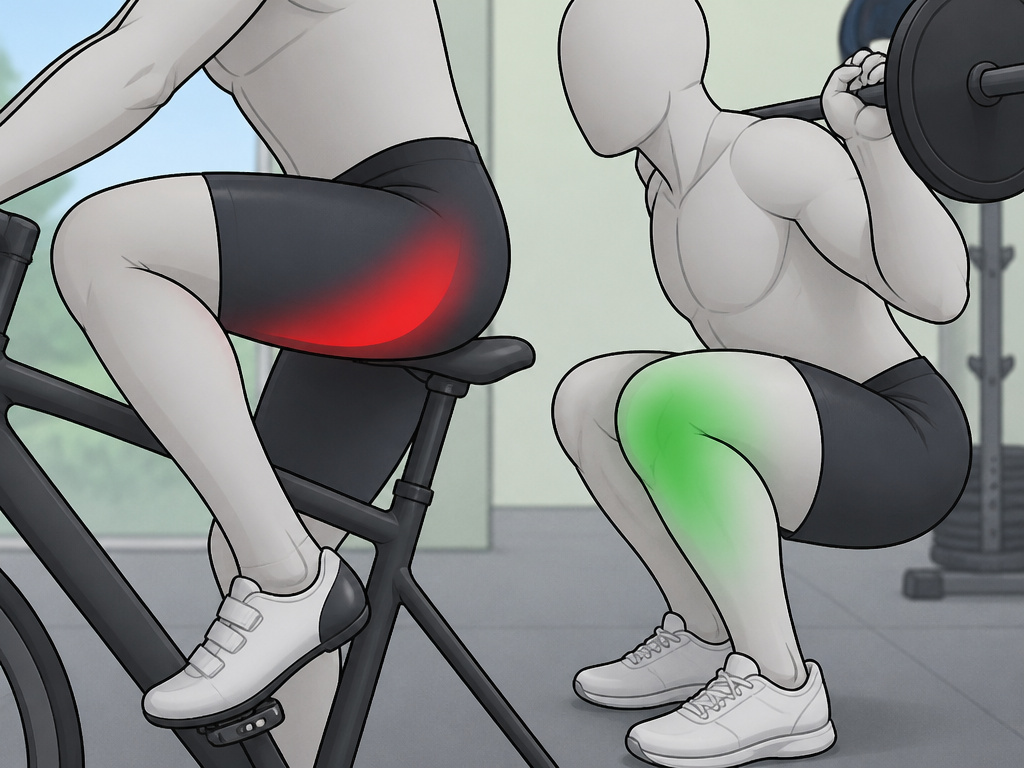
Picture a cyclist who can’t get their hip out of flexion at the top of a pedal stroke, and a lifter who can’t get their knee past their toe in a squat. Both call the feeling tight. Only one of them has a range problem.
The research has a couple of narrow signals. That’s a single study, in a specific population, measuring a specific site. It’s a hint.
The bigger gap is acute versus chronic. The 2025 panel noted that studies looking at pre-training stretching and injury risk only measure chronic effects, over weeks. Nobody has cleanly tested whether one stretch before one session changes anything. That question is open.
Here’s who I’d point toward a stretching block, and who I’d point elsewhere:
- End-range athletes like gymnasts, dancers, and martial artists, who need range as a skill.
- Cyclists with groin or buttock tightness, given the one signal in the literature.
- Lifters chasing a squat depth they can’t reach. Loaded work beats a hold here.
- Anyone using stretching as their only injury-prevention strategy. That one I’d drop.
Most of the stretching mistakes I see in a gym come down to timing: a hard hold on a cold muscle, then straight into a heavy set.
Skip this if: You already do two or three ramp-up sets before your first working set. Adding a stretching block on top buys very little and costs you the minutes you’d spend actually training.
Frequently Asked Questions
Does stretching before exercise prevent injury?
For all injuries combined, no. The Jam trial’s hazard ratio was 0.97 with a 95% CI of 0.84 to 1.13. For muscle and tendon injuries specifically, the picture is better: HR 0.75 with a CI of 0.59 to 0.96.
Is static stretching bad before a workout?
Not bad, just low value for injury prevention. A short hold close to the lift raises your tolerance for range, and the effect fades within minutes. Long routines eat the minutes you’d spend on ramp-up sets.
What actually reduces injury risk?
Load management and strength work carry more of the weight than stretching does. Ramp-up sets that rehearse the movement under increasing load do more for the first working set than a held stretch.
How long should I hold a stretch?
Neither of the two big trials produced an all-injury benefit. Longer holds buy more time in the same position, not a bigger effect.
Does stretching help sore muscles?
It’s the strongest result in the whole set. Bothersome soreness appeared in 24.6% of weeks in the stretching group against 32.3% in the control group, with an odds ratio of 0.69.
Why do experts still disagree about stretching?
The disagreement is about which outcome gets measured. All-injury risk stays flat across the trials. Muscle and tendon injuries drop in some cohorts. And the 2025 panel raised a bone and joint trade-off that the trial data can’t confirm.
The Bottom Line
Here’s the one number worth carrying around: a hazard ratio of 0.97. That’s the all-injury result from the biggest trial on the question, and it’s the reason stretching doesn’t belong in your injury-prevention plan.
What it does belong in is recovery. The soreness result is real, and it’s the strongest finding in the literature.
One concession before you go. If you’re a gymnast, a dancer, or a martial artist, range of motion is part of the job, and this whole argument shifts. You stretch because the sport demands the position, not because you think it’s protecting you.
For everyone else, here’s the try-this-week version: replace your pre-lift stretch with two ramp-up sets of the first lift, at the weight you’d normally start with, split into steps. Then see how the first working set feels.
That’s a small experiment you can run in one session. Keep it simple and keep showing up.
