
Mobility vs Flexibility Explained: What Actually Matters
This post contains affiliate links. As an Amazon Associate, we earn from qualifying purchases.
Mobility vs flexibility explained in one sentence: flexibility is the range a joint has when something else moves it, and mobility is the range you can move and hold yourself. You can be flexible and still fail a deep squat, and that gap is where the training goes.
The word “hold” carries the whole difference. Range that vanishes the moment you add a barbell, or stand up out of a chair, is passive range you haven’t earned yet. The body keeps taking it back until you can control it, which is why someone can pass a sit-and-reach test and still squat with their heels off the floor.
What follows is the plain version: what each word measures, the 60-second squat test I use to tell them apart, and the few movements that build range you can actually keep. No twelve-drill routines. No toe-touching contests.
Key Takeaways
- Flexibility is passive range. Mobility is controlled range. One is measured by what an outside force can move; the other by what you can move and hold.
- The test that matters is a 60-second deep squat with your heels down and your chest up. If you can’t hold it, more hamstring stretching won’t get you there.
- Load builds mobility faster than pulling does. A counterweighted squat hold teaches control that a passive stretch never touches.
- Ten minutes daily beats five minutes after a workout, and it beats a twelve-drill routine you quit in a week.
- Skip long holds right before heavy sets. Save them for after training, or give them their own slot in the day.
Mobility vs Flexibility Explained: What Each Word Actually Means
Two people can fold into the same shape on the floor and own completely different amounts of it. One is parked at the end of their passive range. The other is sitting in the middle of range they can control.
Flexibility describes passive range: how far a joint travels when an outside force moves it, such as gravity, a strap, or a partner. Mobility describes active range: how far the joint travels under the person’s own muscle effort, with control at the end. A joint can hold large passive range and small active range at the same time.
Passive range is what the tissue allows. Active range is what your body will actually let you use under load. The two drift apart fast when you stop training strength in the position.
Sit on the floor with your legs straight and reach for your toes. That’s passive range, and it tells you almost nothing about your squat. Stand up, lift one knee to hip height without leaning back, and hold it there. That’s active range, and it’s the one that shows up on the platform.
| Trait | Flexibility | Mobility |
|---|---|---|
| What it measures | Passive range at a joint | Range you control under load |
| How you build it | Long holds, straps, gravity | Slow reps, holds, light load |
| Test that shows it | Toe touch or sit and reach | 60-second deep squat |
| Typical giveaway | Reaches far, feels unstable | Stable, but stuck at the same depth |
Why Passive Range Doesn’t Show Up in Your Squat
Stretch a hamstring long enough and the tissue will let you go further. None of that teaches the hip to hold the position with a load on your back. So the range shows up on the floor and disappears under a barbell.
The static vs dynamic stretching question sits right here, because the two approaches build different jobs. One buys you length. The other teaches control of length.
The 60-Second Squat Test (and What Mine Showed Me)
I spent a solid month sitting in a flat-footed split for five minutes at a time, sure I was fixing my hips. Then I’d stand up, drop into a bodyweight squat, and my heels would come off the floor exactly like before.
That was the day the difference stopped being a theory for me. The split proved I had passive range. The squat proved I couldn’t use it.
So I changed the test. Can I sit in a deep squat for 60 seconds with my heels down and my chest up? If the answer is no, more hamstring pulling won’t fix it.
The squat tells you which of four things is going on.
| What You See | Likely Cause | What to Do First |
|---|---|---|
| Heels lift off the floor | Ankle can’t bend forward enough | Ankle rocks and calf work |
| Chest folds toward the floor | Stiff upper back, tight hips | Thoracic rotations, squat holds |
| Knees cave inward | Hip control, not hip range | Slow tempo squats, band work |
| Depth stops early, no pinch | Control, not tissue length | Counterweighted squat holds |
How to Run the Test
- Stand with your feet roughly shoulder-width apart, toes turned out slightly.
- Lower down as far as you can go without your heels lifting, and keep your chest tall.
- Sit there for a full 60 seconds and breathe normally. If your heels come up or your lower back rounds, you have your answer.
If you can’t hold a position for a minute with control, you don’t own that range yet. Stretch less. Load it more.
Check both sides while you’re down there. A squat that shifts onto one foot is a hip control problem, and it shows up long before it hurts.
Why Doesn’t Stretching Fix a Shallow Squat?
A hamstring stretch changes what the tissue allows. A squat asks what the hip can control, with your whole body weight sitting on top of it.
Passive range is cheap to gain. Sit in a stretch long enough and the tissue gives a little. That’s why a month of daily splits moved my passive range and did nothing at all for my squat depth. Stretching changes passive range, and it does that job well. It just doesn’t teach control.
The risk sits at the end of the range. Push into a position your muscles can’t hold and the joint takes the load instead of the muscle. That’s how a hamstring ends up feeling fine in a stretch and angry the next morning.
You’ll feel the pull leave the belly of the hamstring and settle behind the knee. When that happens, the tissue has run out of give and the joint has started paying.
I’ve stopped chasing depth in a stretch and started chasing control in the position. Two minutes in a hamstring stretch means nothing if I can’t reproduce that length standing up with my foot planted.
Once control is the goal, how long to hold a stretch stops being the interesting question. PNF stretching is the technique I’d learn first, since it pairs a short muscle contraction with a relaxed stretch instead of just hanging out at the end of your range.
The 10-Minute Daily Routine That Actually Sticks
Ten minutes a day beats an hour on Sunday, and it beats any routine you don’t repeat. The movements matter far less than the frequency.
I still start nearly every session with about five minutes of hip and shoulder drills, and I’ve done it for years. My squats and presses feel better for it. It costs me almost nothing, and it’s the closest thing to free progress I’ve found.
That’s the whole case for daily mobility work: short, boring, repeated. Pick a few movements you don’t hate and rotate them.
Before you start: Get two or three minutes of easy movement in first, because cold tissue pushed into end range is how people tweak a hamstring. Keep any counterweight light enough that you can still breathe, and back off if you feel a pinch at the front of the hip instead of a stretch. Skip loaded end-range work on a joint that’s swollen or hot.
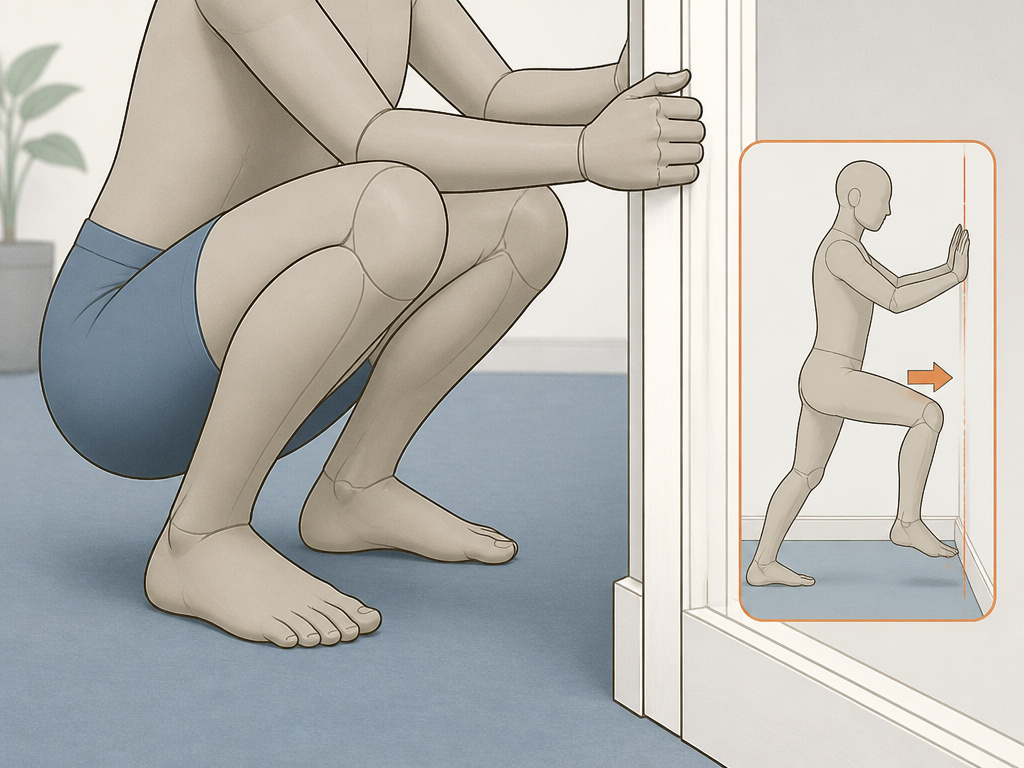
- Sit in a deep squat hold for 60 seconds with your heels down if they’ll stay there. Use a doorframe for balance, a pair of Rogue Gymnastic Rings hung at waist height, or a light plate at your chest if they lift. Forcing depth without support just teaches your ankles to cheat.
- Work through a slow set of hip circles each way. Skip these and the squat hold turns into a passive hang instead of a warm-up.
- Add a few thoracic rotations per side, turning through the upper back while your hand follows your eyes. Without them, a stiff upper back keeps your chest folded forward in every squat you do.
- Finish with ankle rocks, driving your knee toward the wall with your heel pinned down. Miss this and you’ll keep blaming your hamstrings for a squat that stops at the ankles.
How to Fit It Into a Week
Attach it to something you already do every day. Coffee, brushing your teeth, the two minutes you spend waiting for the kettle.
If daily isn’t realistic, put it on the days you already train, before you lift. A mobility warm-up routine that doubles as preparation is the easiest version to keep, because you’re not adding a second trip to the gym.
Does Hip Mobility Matter More Than Hamstring Flexibility?
If you can’t get below parallel, the hips and ankles decide your depth. The hamstrings take the blame.
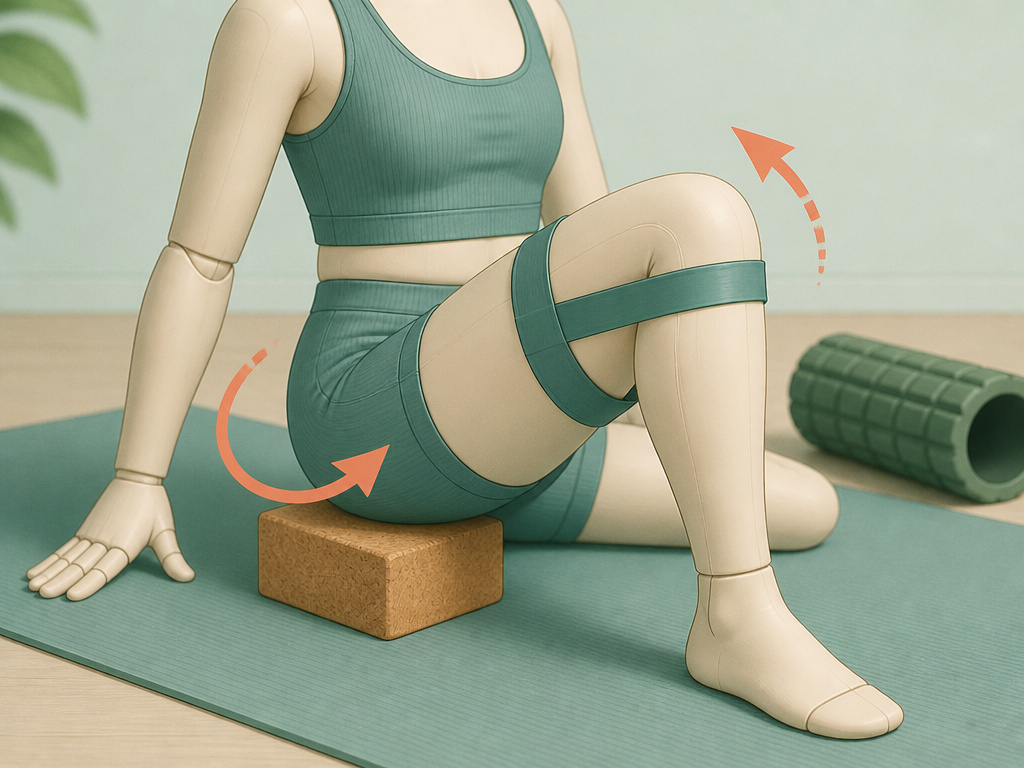
Hip range is where the squat lives. A 90/90 position (one hip and knee at right angles in front, the other behind), slow hip circles, and a counterweighted squat hold all work the same idea. Take the joint through range you can control, under a little load, without forcing anything.
Common mistake: Pushing into end range with no strength behind it. The stretch feels productive for a week, then the front of the hip starts pinching on the way up and you can’t figure out why.
Building hip mobility is a slow project, and it responds to frequency rather than effort. Five minutes most days does more than thirty minutes once a week. A Manduka cork block under your sit bone makes the 90/90 position survivable when your hips are tight, and a TheraBand loop around your knees during slow tempo squats gives your hips something to push against.
Rolling your quads on a TriggerPoint GRID for two minutes changes how the tissue feels. It doesn’t change how much range you own, which is why I stopped treating it as a fix.
Yoga deserves a mention here too. Treated as a strength and control practice, it’s excellent. Treated as a flexibility contest, it teaches people to sit in shapes they can’t control. And touching your toes is a poor scoreboard.
When to Stretch, When to Load, and When to Skip It
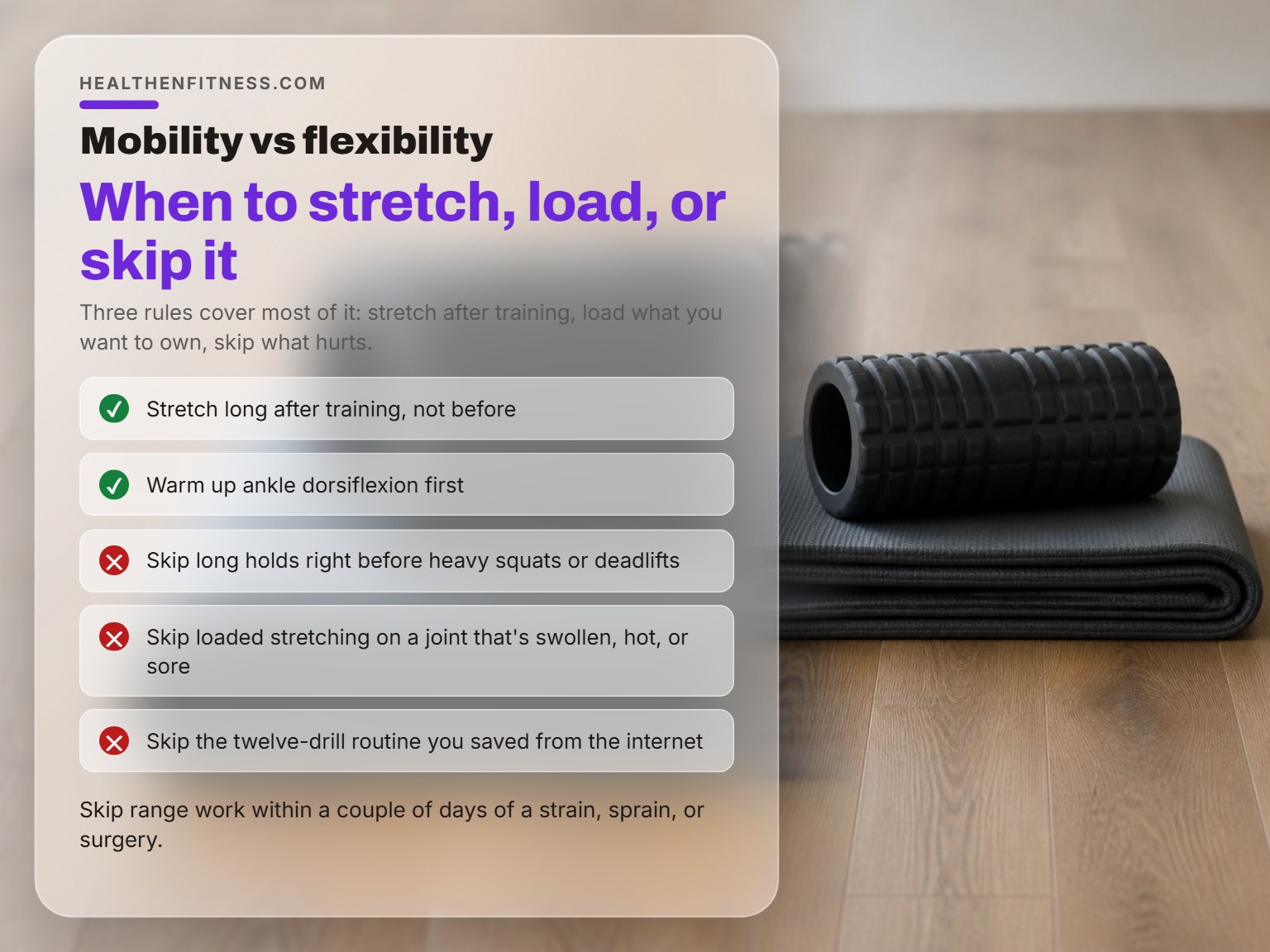
Three rules cover most of it. Stretch long after training, load the position you want to own, and skip anything that hurts in a way a stretch doesn’t.
Dynamic work belongs before you train, because it moves the joint through range you already have. Static holds belong after, or in their own slot later in the day. Ankle dorsiflexion, which is just how far your shin can travel over your foot, is the one to warm up first.
Two habits cause most of the damage. Bouncing at the end of a stretch gives the tissue a little more each rep, and by the next morning the hamstring feels bruised rather than loose. Chasing depth on a joint you can’t control feels fine in the moment, then the pinch shows up two days later at the front of the hip. The stretching mistakes people make are almost all variations on those two.
- Skip long holds right before heavy squats or deadlifts. You’ll feel loose and a little weak, and the bar will tell you on the first set.
- Skip loaded stretching on a joint that’s swollen, hot, or still sore from an injury. That’s a conversation with a clinician, not a mobility drill.
- Skip the twelve-drill routine you saved from the internet. If you can’t explain why a drill is in there, it’s filler.
Skip this if: You’re within a couple of days of a strain, a sprain, or surgery. Range work on healing tissue sets the timeline back by weeks, and a rehab plan beats anything on this page.
Frequently Asked Questions
Is mobility the same as flexibility?
Flexibility is passive range, the amount a joint moves when something else moves it. Mobility is the range you produce and control yourself. They overlap, but plenty of people have one without much of the other.
Can you be flexible but not mobile?
Yes, and it’s common. A person can fold into a deep stretch on the floor and still squat with their heels up or their chest collapsed. The passive range is there. The strength and control at that range aren’t.
How long does it take to improve mobility?
It moves faster than you’d think once you’re training control instead of just holding stretches. In my own case, squat depth changed within a few weeks of adding short daily work. The first thing that changes is how the position feels, not how deep you get.
Should I stretch before or after a workout?
Dynamic movement before, longer holds after or in a separate session. Stretching cold tissue into end range before you train doesn’t prepare the joint for anything. It hands you a range you haven’t warmed up to use.
Is yoga good for mobility?
Yes, if you treat it as a strength and control practice. Held shapes with attention to alignment build real range. Treated as a flexibility contest, it can push people into positions their muscles can’t hold, which is where the tweaks come from.
How often should I do mobility work?
Daily if you can, and short if you can’t. Ten minutes most days beats one long session a week, because the skill here is control, and control needs repetition.
The Bottom Line
Mobility vs flexibility explained in practice comes down to one question: can you hold the range you have? If you can’t sit in a deep squat for 60 seconds with your heels down and your chest up, that’s your project for the next month.
Start smaller than you think. One squat hold, a few hip circles, and a set of ankle rocks, done most days, will change more than a long list of drills you run twice.
This all assumes nothing hurts in a way a stretch doesn’t. If a joint is swollen, or you’re coming back from surgery or a serious injury, the plan changes and you want a clinician in the room, not an article.
I’d rather see you own one position than run through a dozen badly. Today, just sit in a squat for 60 seconds and see where your heels go.
