
Why Carbs Matter for Training: Endurance vs Lifting
This post contains affiliate links. As an Amazon Associate, we earn from qualifying purchases.
Carbs matter for training because they support harder work for longer: carbohydrate intake of 30–80 g/h at ≤8% concentration improved endurance time-trial performance by a weighted mean of 2.0 percent across 50 placebo-controlled crossover trials in adults, and it helps long, fasted lifting sessions more than short fed ones.
That 2.0 percent figure is an average, and the why carbs matter for training question hides the interesting part. The same body of research shows a 7.5 percent gain when a submaximal bout comes before a time trial, and a 15.1 percent gain in raw time to exhaustion. Where you land inside those numbers depends on how long you go and what you ate before you started.
What follows walks through the fuel side, the dose side, and the argument the strength research is still having with itself. By the end you’ll know which of your sessions actually need a carb plan and which ones are fine with breakfast.
Key Takeaways
- Endurance has the clearest evidence. Thirty to 80 grams per hour at 8 percent concentration or less lifted time-trial performance by a weighted mean of 2.0 percent across 50 trials.
- Lifting is genuinely contested. King et al. 2022 reported a session-volume SMD of 0.61; Henselmans et al. Found benefit in only 6 of 19 acute studies.
- Length and fasting are the switches. The resistance-training effect shows up in sessions over 45 minutes and after a fast of at least 8 hours.
- Above 60 to 90 grams per hour, you need blends. Single-sugar products at those rates risk GI distress.
- Skip carb cycling for now. Get a normal serving of oats, rice, or potatoes at most meals before you touch timing.
Why Carbs Matter for Training: What They Actually Do
Muscle glycogen is the stored carbohydrate your working fibers draw down during hard sets and long efforts. It’s the reason a session can feel light at minute ten and heavy at minute fifty.
Acute carbohydrate feeding improves endurance performance. Across 50 placebo-controlled crossover studies, intake of 30 to 80 grams per hour at 8 percent concentration or less produced a weighted mean 2.0 percent time-trial improvement, a 15.1 percent gain in time to exhaustion, and a 7.5 percent gain in submaximal-then-time-trial work in adults.
The endurance case is the settled one. That same carbs during endurance exercise evidence gets stronger the longer the protocol runs, which tells you something about what carbohydrate is actually doing. It’s buying you time at an intensity you can’t hold on fat alone.
The carbs vs fat for energy balance shifts toward fat at low intensity and toward carbohydrate as the effort climbs. A walk and a set of heavy squats are not asking the same question of your body.
Refilling muscle glycogen between sessions takes longer after long, hard work than after a short one. That’s why back-to-back hard days feel different from spaced ones, and it’s why the fueling question gets louder as your training week gets denser.
Here’s a number worth sitting with: post-exercise blood glucose showed a standardized mean difference of 2.36 with carbohydrate in the resistance-training meta-analysis, and blood lactate came in at 0.58. Those are big shifts in the blood, and they’re part of why the performance question is messier than it looks.
How Much Carb Do You Need? The Clock Decides
Ever looked at a gel packet and wondered whether you actually need it, or whether it’s just something to do with your hands?
Duration tracks intake more tightly than anything else in the why carbs matter for training literature. Jeukendrup’s review tiers carbohydrate targets by how long the event runs, and the tiers are wide enough that most recreational sessions land in the first row.
| Session Length | Carb Target | Basis |
|---|---|---|
| Up to about 1 hour | Small amounts; a mouth rinse counts | Jeukendrup review |
| 1 to 2.5 hours | 30 to 60 g per hour | Jeukendrup review |
| Over 2.5 hours | Up to 90 g per hour | Multi-transportable blends |
| Any rate above 60 to 90 g/h | Blends only | Single-sugar products risk GI distress |
The blend point deserves a plain explanation. Different sugars cross the gut wall through different transport routes, so a mix moves more carbohydrate per hour before your stomach starts pushing back. A single-sugar product at 90 grams per hour just queues up at one doorway.
A gel chased with too little water leaves a sticky film across your teeth and a sour edge at the back of your throat. That’s usually a drinking problem wearing a fueling costume.
Where you place those grams across the session is its own decision, and carb timing around workouts covers the pre-versus-during split in more detail. If you’re lining up something long, carb loading before a workout is the version that actually changes the starting line rather than the finish.
One honest caveat on the ceiling. Jeukendrup permits up to 90 grams per hour for events beyond 2.5 hours. The Journal of Nutrition meta-analysis only analyzed studies at 80 grams per hour or below and makes no claim above that line. Two credible sources, two different ceilings.
Two 2022 Reviews, Opposite Conclusions on Lifting
One standardized mean difference of 0.61. That’s the King et al. 2022 case for carbohydrate before you lift.
The comparison is worth seeing side by side, because both reviews are peer-reviewed and both looked at crossover trials.
| Question | King et al. 2022 | Henselmans et al. |
|---|---|---|
| Does acute carb help lifting? | Yes: session volume SMD 0.61 | Only 6 of 19 acute studies showed benefit |
| Fed state | Effect requires a fast of 8+ hours | No benefit in a fed state |
| Set threshold | Maximal-effort sets moderate the effect (b = 0.11) | Above 10 sets per muscle group |
| Dose-response | Carb dose does not moderate the effect | No dose-response found |
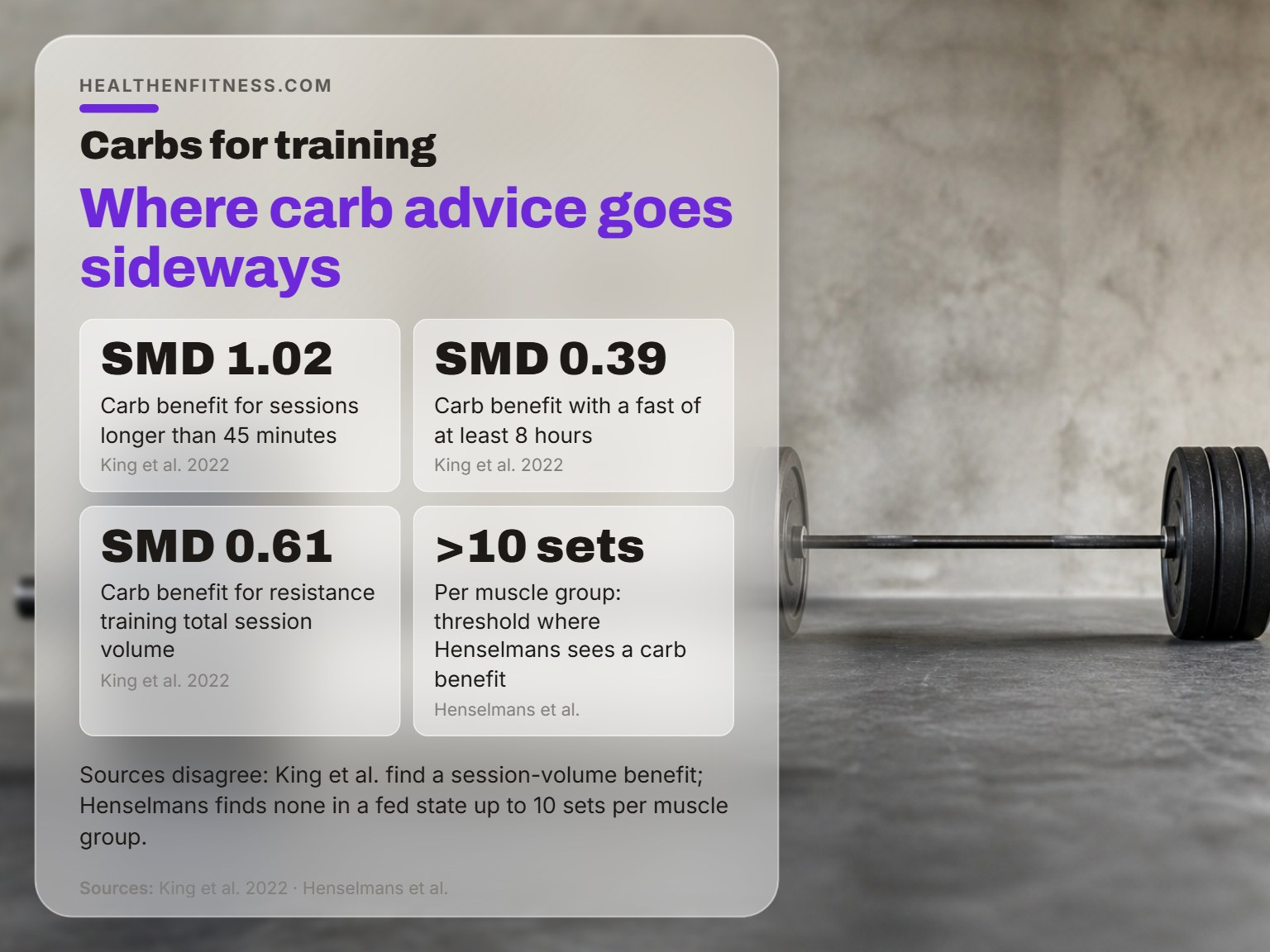
Henselmans et al. Looked at 49 studies and concluded that carbohydrate intake per se is unlikely to affect strength training performance in a fed state in workouts of up to 10 sets per muscle group. King’s meta-regression found that the number of maximal-effort sets moderates the effect, with sessions over 45 minutes showing an SMD of 1.02.
Notice that both reviews agree on the dose-response question. Neither finds one. Where they split is the baseline question of whether acute carbohydrate does anything for lifting at all.
I’d rather see a lifter eat a normal breakfast and train than fast and chase a protocol. The protocol looks better on paper. The breakfast actually gets done.
Under 45 Minutes, the Effect Disappears
King’s subgroup analysis found no benefit in short sessions, while Henselmans et al. Set the threshold at more than 10 sets per muscle group. If your whole workout is three sets of squats and you’re out the door in half an hour, the carb question is mostly academic.
I used to judge sessions by how wrecked I felt the next day. Some of my best training weeks left me barely sore at all, which took me years to accept. Performance is the measure, and performance is exactly what these two reviews are arguing about.
If you’re weighing the extremes, low carb vs high carb for lifting is the comparison that matters more than any single pre-workout choice. And if size is the goal rather than a number on a bar, carbs to gain muscle is where the total daily intake conversation lives.
Does Fasting Before Training Change the Answer?
Have you ever trained on an empty stomach, felt fine, tried it again a week later, and felt like you were moving through wet sand?
King’s subgroup analysis puts a number on that. A fast of at least 8 hours produced an SMD of 0.39 for carbohydrate benefit, and fed-state protocols erased the effect entirely. Henselmans also found the acute benefit concentrated in studies with fasted controls, though the two reviews frame the fasted-state question differently.
Low blood sugar has a physical signature. Your hands go cold on the bar, and standing up between sets makes the room tilt for half a second. That’s a fueling signal, not a character flaw.
If you eat breakfast within two hours of training, the carb question is mostly already answered. If you train at 6am on nothing, it’s the most important variable in the room.
There’s a related claim worth flagging as unsettled. Jeukendrup states that whether train-low strategies lead to enhanced performance in well-trained individuals is unclear. That’s a hedge from one of the field’s most-cited reviewers, and it should temper anyone selling fasted training as a performance upgrade.
And the blinding problem cuts both ways. One study found carbohydrate beat water but did not beat a sensory-matched placebo breakfast, which means the finding changes depending on what you compare against. King’s meta-analysis pooled crossover studies against placebo or water-only conditions and still found a session-volume benefit. Both things are true at once.
Which Carbs, and When to Eat Them
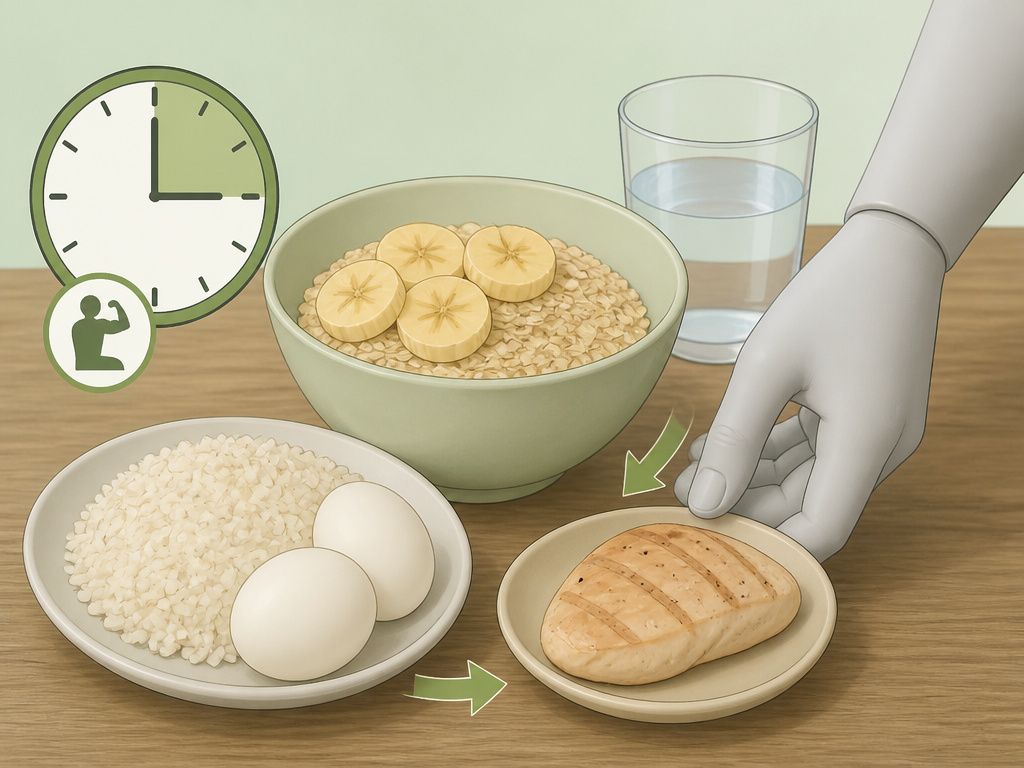
Oats, rice, potatoes, and fruit cover nearly everything a recreational lifter needs, and they’re all cheap and boring.
Here’s the pre-session sequence I’d hand a beginner, with the reason each step exists:
- Pick a familiar starch about two hours out. Rolled oats or a bowl of rice. Skipping this and training on fumes is how the last set turns into a grind.
- Add a palm of protein alongside it. Protein doesn’t fuel the session, but it turns a snack into a meal, and a meal is what stops you grazing for the next three hours.
- Keep fat low if you’re close to the session. Fat slows gastric emptying, and a heavy greasy breakfast an hour before squats sits in the stomach like a brick.
- Drink water with whatever you take during. Under-drinking turns a modest gel into a stomach ache, and the blame lands on the gel.
What a Pre-Session Plate Looks Like
For most people that’s a bowl of oats with fruit, or rice with eggs, or a potato and some yogurt. The best pre workout carbs list runs longer, but the short version is: something you’d happily eat on a normal Tuesday.
During longer sessions, intra workout carbs become the variable. A bottle of a multi-transportable carb drink or a couple of gels covers a two-hour session without turning your gut into a science experiment.
If you want to know how much you’re actually taking in, a food-logging app will log grams per hour without much fuss. Most people who think they’re taking 60 grams per hour are taking 30.
Where Carb Advice Goes Sideways
Cutting carbs hard and then blaming the workout is the version of this I see most.
I’ve done it. Two weeks of near-zero carbs, then a top set that felt like a max and a head rush when I racked the bar. I blamed the program for about ten days before I looked at the plate.
Common mistake: Jumping straight to 90 grams per hour on race day without practicing it. Most people who try that end up walking the second half, because the gut hasn’t been trained to absorb it.
Where this goes sideways: Cutting carbs to near zero while keeping training volume the same. By the second week the warm-up feels like a working set and your top set drops.
The Symptoms That Tell You It’s Fuel
Watch for these instead of guessing:
- Warm-ups that feel like work sets two weeks into a low-carb stretch, especially if sleep and stress haven’t changed.
- Dizziness on standing between sets, which is a blood pressure and blood sugar signal rather than a fitness signal.
- A session that fades after 45 minutes when the same session held up fine last month at the same load.
- Cold hands on the bar in a warm gym.
None of those prove anything on their own. Three of them together, for a week, is a pattern worth acting on before you change your program.
Frequently Asked Questions
Do I need carbs before every workout?
No. If you ate within a couple of hours of training and your session runs under 45 minutes, the resistance-training evidence shows no benefit from adding more. The case gets stronger when you train fasted or train long.
How many grams of carbs per hour should I take during a long session?
Jeukendrup’s review recommends 30 to 60 grams per hour for events of 1 to 2.5 hours, and up to 90 grams per hour for events over 2.5 hours using multi-transportable blends. Above 60 to 90 grams per hour, single-sugar products risk GI distress.
Why do two reviews disagree about carbs and strength training?
King et al. Found a session-volume benefit of SMD 0.61 concentrated in sessions over 45 minutes and fasts over 8 hours. Henselmans et al. Concluded carbohydrate is unlikely to help in a fed state at up to 10 sets per muscle group. They weighted the same evidence base differently.
Does carb dose matter for lifting?
Neither review found a dose-response relationship for strength performance. King’s meta-regression found that carbohydrate dose does not moderate the resistance-training effect, and Henselmans found no dose-response either. Dose matters far more in endurance work, where targets are tiered by duration.
What should I eat before an early morning session?
Something familiar and mostly carbohydrate, eaten about two hours out if you can manage it. If you can’t, a small carb-and-protein snack beats training on nothing, especially if your session runs past 45 minutes.
The Bottom Line
Here’s the threshold I’d actually use. If your sessions run under 45 minutes and you eat beforehand, carbs are a background variable. Don’t build a system around them. If your sessions run past an hour, or you train fasted, or you’re doing more than 10 sets for a muscle group in one go, that’s when the plate and the bottle start earning their keep.
One concession worth stating plainly. None of this rescues a program that’s too hard, too often. Fuel is one input, and the research above is arguing about a modest slice of the total picture.
There’s also a genuine gap in what I can tell you. If you’re training for a specific sport or coming back from an injury, the general-population numbers here get thin fast, and a clinician or a sport-specific coach should be making those calls.
Today, just eat one normal serving of rice, oats, or potatoes before your next session and see whether the last set feels different.
