Overtraining Syndrome Signs and Symptoms: Spot It Early
This post contains affiliate links. As an Amazon Associate, we earn from qualifying purchases.
Overtraining syndrome signs and symptoms follow three stages: functional overtraining with muscle aches and poor sleep, sympathetic overtraining with insomnia and a resting heart rate above 100 bpm, and parasympathetic overtraining with fatigue, depression, and a resting heart rate below 60 bpm. Around one-third of all runners experience it at some point.
Those three stages come from Cleveland Clinic‘s patient guidance on overtraining syndrome signs and symptoms, and they’re handy for spotting patterns. Sports medicine researchers frame the same symptoms a little differently. The ECSS and ACSM joint consensus statement treats sympathetic and parasympathetic signs as sport-type correlates: aerobic athletes trend toward one set, anaerobic athletes toward the other.
What follows walks through each stage’s symptoms, the heart-rate numbers that actually separate them, the places where credible sources disagree about duration and severity, and the recovery steps that hold up. By the end you’ll know which signals mean take a lighter week and which mean call a doctor.
Key Takeaways
- Stage 1 hides in plain sight: muscle stiffness, anxiety, poor sleep, and catching colds more often are the first clues, not a dramatic collapse.
- Resting heart rate is the cheapest test you have: above 100 bpm at rest points to the sympathetic stage, below 60 bpm points to the parasympathetic stage.
- Recovery timelines disagree across sources: Cleveland Clinic says weeks to months, the ECSS/ACSM consensus requires more than 2 months of performance decrement, and Budgett reports 6 to 12 weeks with rest.
- Rule out the boring stuff first: negative energy balance, low iron, low magnesium, and poor sleep mimic OTS and are far more common.
- The fix is rest, not a new program: light activity is fine, but ramping up before recovery can reset your progress and make it worse.
What Are the Three Stages of Overtraining Syndrome?
Cleveland Clinic divides overtraining syndrome into three stages based on which branch of the nervous system is affected and which symptoms show up. Stage 1 is functional overtraining. Stage 2 is sympathetic, sometimes called Basedow’s overtraining syndrome. Stage 3 is parasympathetic, sometimes called Addison’s overtraining syndrome.
Overtraining syndrome is a clinical diagnosis with no single confirmatory test. The ECSS and ACSM consensus defines it as a performance decrement lasting more than two months, accompanied by mood disturbance or other stress symptoms not explained by another disease. No proposed diagnostic marker has met the criteria for general clinical acceptance.
Cleveland Clinic notes that OTS isn’t always progressive. You can have any stage without the others. That matters because the staging model is a description, not a staircase.
| Stage | Branch affected | Signature symptoms | Heart rate sign |
|---|---|---|---|
| Stage 1 (functional) | Early warning, no clear branch | Muscle pain, weight change, anxiety, poor sleep, frequent colds | None listed |
| Stage 2 (sympathetic) | Fight-or-flight | Insomnia, irritability, agitation, tachycardia, high blood pressure | Above 100 bpm at rest |
| Stage 3 (parasympathetic) | Rest-and-digest | Fatigue, depression, loss of motivation, bradycardia | Below 60 bpm at rest |
Where the staging model breaks down
Kreher and Schwartz present sympathetic and parasympathetic alterations as parallel sport-type correlates, not sequential stages. Sympathetic signs (insomnia, irritability, tachycardia) show up more in anaerobic sports. Parasympathetic signs (fatigue, depression, bradycardia) show up more in aerobic sports.
That’s a different mental model from Cleveland Clinic’s ladder. For a lifter doing heavy squats and a marathoner doing long runs, the same syndrome can look completely different. Same syndrome, different look.
Cleveland Clinic says Stage 3 is usually the most severe and takes the longest to recover from, while the ECSS/ACSM consensus says there’s no scientific evidence to confirm or refute that OTS symptoms are more severe than NFOR. The ECSS/ACSM consensus says there’s no scientific evidence to either confirm or refute the assumption that OTS symptoms are more severe than NFOR (non-functional overreaching). Kreher and Schwartz go further: the difference between OTS and NFOR is based on time to recovery, not the degree or type of symptoms.
In short: the stage labels are a useful shorthand, but the underlying research treats them as flexible categories, not a fixed ladder.
Stage 1: The Warning Signs You Can Easily Miss
Overtraining syndrome signs and symptoms in stage 1 are mild and easy to mistake for normal training soreness. Cleveland Clinic lists muscle pain and stiffness, unexpected weight loss or weight gain, anxiety, poor sleep or waking up tired, and getting sick more often with minor issues like colds.
The weight change is the one most people skip past. You didn’t change your diet, but the scale moved. That’s a signal.
I’ve watched training partners push through this stage for weeks because nothing hurt badly enough to stop. The cold that lingers. The sleep that doesn’t refresh. The mood that sours on rest days. Those are the tells.
Common mistake: Treating stage 1 as “just soreness” and adding a lighter week only after performance tanks. By then you’ve usually crossed into stage 2, and recovery stretches from a few weeks to months.
If you’ve been pushing through a training slump for weeks, that’s the pattern to break. A planned lighter week is the simplest insurance.
The weight change most people skip
Unexpected weight loss or gain is on Cleveland Clinic’s stage 1 list for a reason. Both directions signal that your body isn’t recovering the way it should. Losing weight without trying can mean you’re under-fueling. Gaining it can mean cortisol and water retention are climbing.
Neither one is diagnostic on its own. Both are worth logging alongside sleep and resting heart rate.
Which Symptoms Point to Stage 2 vs Stage 3?
Stage 2 and stage 3 sit on opposite sides of your autonomic nervous system. Stage 2 is the sympathetic, fight-or-flight side: insomnia, mood changes like irritability or agitation, tachycardia (a resting heart rate above 100 bpm), and high blood pressure.
Stage 3 is the parasympathetic side: fatigue, depression, losing motivation to train, and bradycardia (a resting heart rate below 60 bpm).
Worth knowing before you start: A single morning heart rate reading tells you almost nothing. You need a baseline from a series of normal readings to spot the drift. Without that baseline, a slightly elevated morning reading could just be a bad night’s sleep.
The CNS fatigue that lifters talk about is a related but separate thing. Central nervous system fatigue shows up as heaviness and slow bar speed. OTS shows up as a systemic drop across mood, sleep, and heart rate at once.
| Symptom you notice | Likely stage | First move |
|---|---|---|
| Resting HR above 100 bpm | Stage 2 (sympathetic) | Cut intensity by 50 to 70 percent |
| Resting HR below 60 bpm | Stage 3 (parasympathetic) | Full rest, see a provider |
| Persistent colds, poor sleep | Stage 1 (functional) | Take a lighter week |
| Mood drop, loss of motivation | Stage 3 (parasympathetic) | Talk to a provider about mental health |
| Insomnia, irritability | Stage 2 (sympathetic) | Drop high-intensity sessions |
Why the numbers matter more than the labels
The bpm cutoffs are the most concrete thing in the whole framework. Tachycardia is defined as more than 100 beats per minute at rest. Bradycardia is lower than 60 beats per minute at rest. Those are objective numbers you can check against your own baseline.
The stage labels are squishier. A single symptom can sit in two stages depending on which researcher you ask. The numbers travel better.
Why the Research on Overtraining Is Thinner Than You’d Think
A 2022 systematic review by Weakley and colleagues found zero studies that met their criteria: objective pre-OTS performance data, suppression lasting more than four weeks, and documented psychological change. Zero.
The finding reflects how hard it is to study a syndrome that takes months to develop and varies wildly between people.
The ECSS and ACSM consensus states plainly that none of the proposed diagnostic markers meets the criteria for general acceptance. Cleveland Clinic, by contrast, presents a staged symptom list and a panel of tests (blood glucose, urea, uric acid, ammonia, creatine kinase, urinary cortisol, pulmonary function tests, EKG) as if they’re diagnostic. The two framings don’t quite line up.
Here’s where I’d put my money: those tests are useful for ruling out other causes. They’re less useful for confirming OTS itself. If your doctor orders a full panel, the point is to find what’s actually wrong, not to stamp “overtraining” on your chart.
The part nobody mentions: Bell and colleagues surveyed 605 athletes and found that 92.5 percent of maladaptation cases had additional non-training stressors. The training load was rarely the whole story.
That’s why life stress belongs in the same conversation as training load. A hard month at work plus a hard month in the gym is two stressors, not one.
How Long Does Overtraining Syndrome Last?
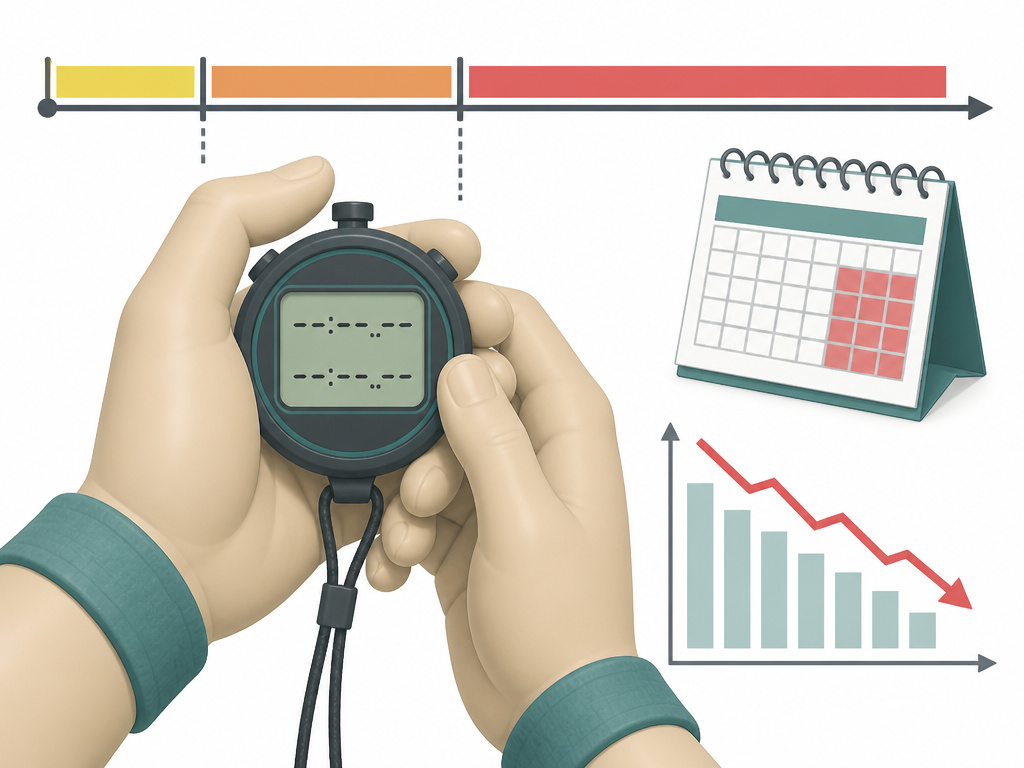
The honest answer is that no one agrees on a single number. Three credible sources give three different timelines, and they’re not measuring the same thing.
- Cleveland Clinic: earlier stages usually last around a few weeks; more severe stages can last for months or longer.
- ECSS/ACSM consensus: OTS requires a performance decrement lasting more than two months.
- Budgett: symptoms normally resolve in 6 to 12 weeks with rest and regeneration strategies.
Those three positions aren’t actually contradicting each other. Cleveland Clinic is describing how long symptoms last. The ECSS/ACSM is setting a diagnostic floor. Budgett is describing typical recovery with rest. All three can be true at once.
What that means for you: if you’ve been dragging for a short while, you might be at the front edge of stage 1. If you’ve been dragging for more than two months, you’re in OTS territory by the consensus definition, and a deload week isn’t going to cut it. The deload length question gets a lot more serious once you’re past that threshold.
Which Athletes Are at Highest Risk?
Cleveland Clinic lists the risk factors clearly:
- Competitive or high-level athletes ramping up before a meet or competition
- Kids and teens who specialize in one sport early
- Children under pressure to win no matter what
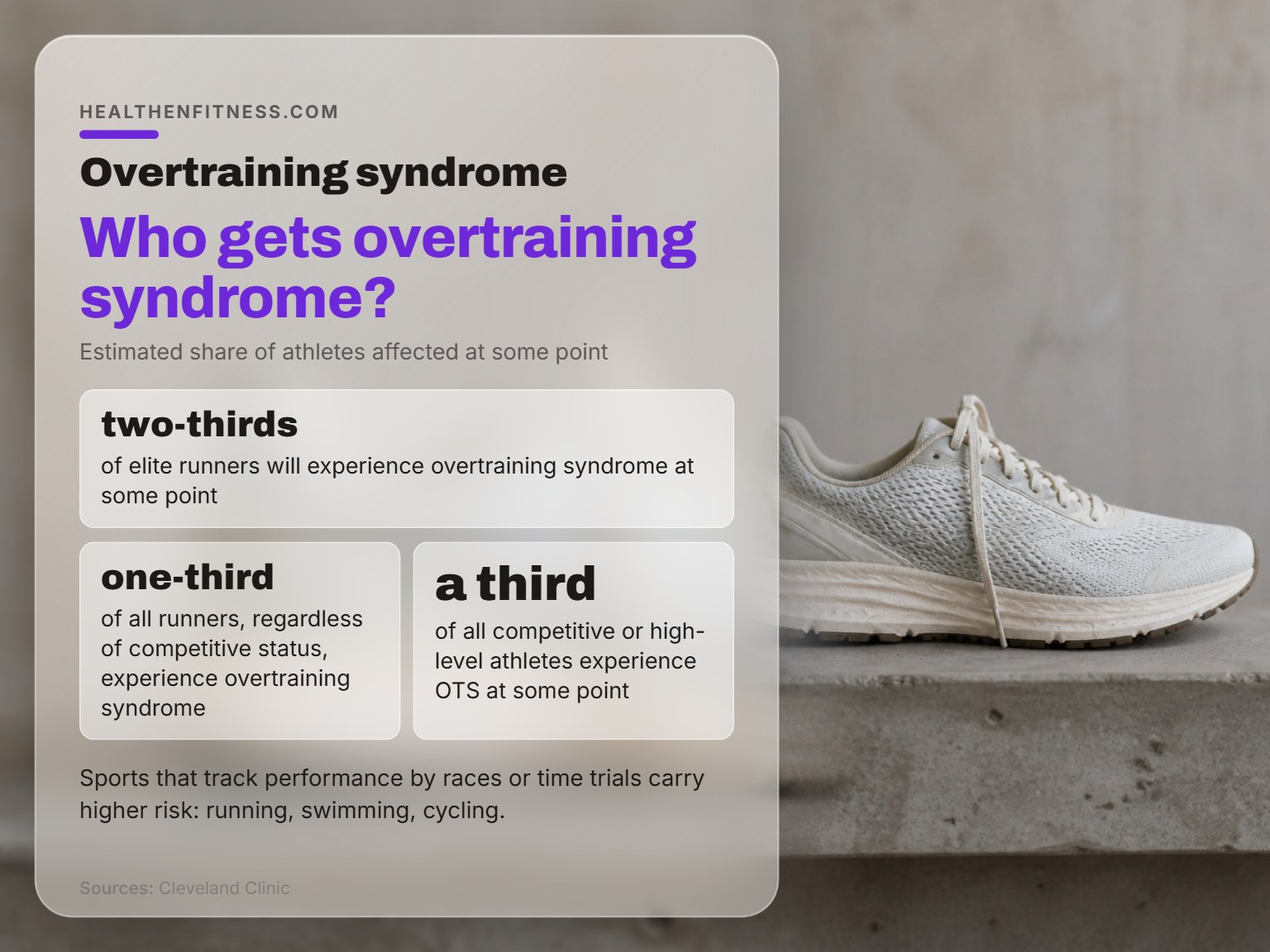
- Sports that track performance by races or time trials: running, swimming, cycling
The common thread is a performance clock. When your sport has a number attached to it, you’re more likely to push past warning signs to hit the number.
Studies estimate around two-thirds of elite runners will experience OTS at some point. Around one-third of all runners, regardless of competitive status, will too. Experts think around a third of all competitive or high-level athletes experience it at some point.
Resistance-trained athletes are a different story. Bell and colleagues concluded that the multidimensional nature of fatigue and individual variability “precludes definitive prognostic symptoms or differential diagnostic factors.” Translation: the aerobic-derived staging model doesn’t transfer cleanly to lifters.
That’s a real gap. For now, if you’re a lifter and you think you’re overtrained, treat the stage labels as a rough guide and lean harder on the confounders list below.
How Do You Actually Recover and Prevent It?
The best treatment is rest and time. Cleveland Clinic is blunt about it: how long you need to stop competing or training depends on how severe your symptoms are.
If you’re a runner or cyclist, the signs of overtraining tend to show up in easy sessions before they show up in hard ones. If your easy pace feels like a race pace, that’s a flag.
Before you start: If you have chest pain, fainting, or a resting heart rate that stays above 100 bpm or below 60 bpm for more than a few days, see a provider before you touch another workout. Overtraining syndrome can affect both physical and mental health, and a full panel is the fastest way to rule out thyroid, cardiac, and nutritional causes.
Light workouts or a little exercise may be possible, but don’t push. If you ramp up training before you’ve recovered, you can reset your progress and make OTS worse. Cleveland Clinic calls that chronic overtraining syndrome, and the timeline stretches from weeks to months.
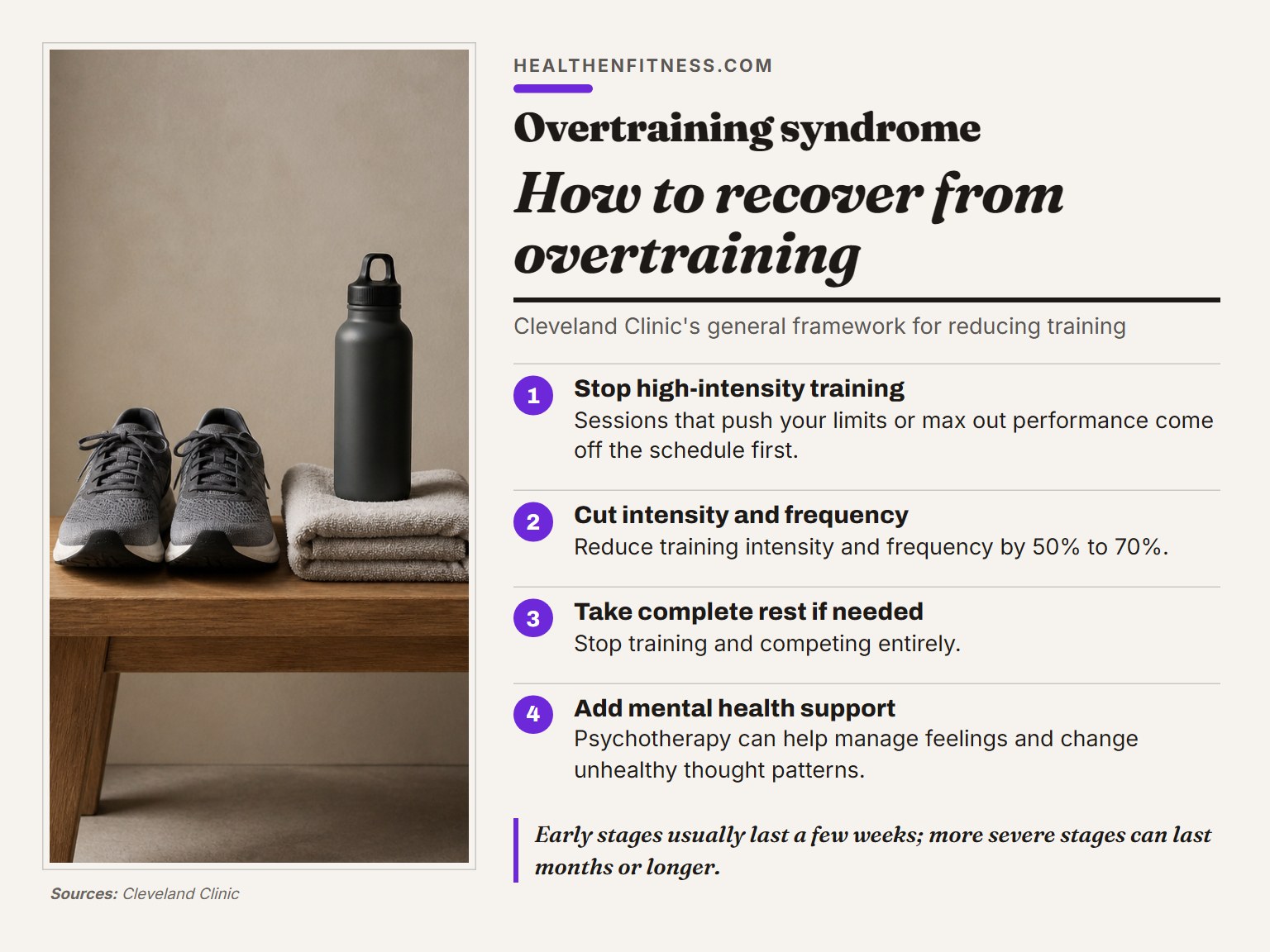
Here’s the general framework Cleveland Clinic gives:
- Stop high-intensity training. Sessions designed to push your limits or max out performance come off the schedule first.
- Reduce intensity and frequency by 50 to 70 percent. That’s the range Cleveland Clinic cites for the middle step.
- Take complete rest if needed. Stop training and competing entirely for a period your provider recommends.
- Add mental health support if symptoms are emotional. Psychotherapy can help manage feelings and change unhealthy thought patterns.
- Keep a workout journal after you return. Tracking performance and symptoms helps you spot warning signs before they compound.
Cleveland Clinic also lists a set of confounders to rule out before anyone calls it OTS:
- Negative energy balance
- Insufficient carbohydrate or protein
- Iron deficiency
- Magnesium deficiency
- Allergies
- Organic disease or infection
Most beginners land there. I’ve seen more people fix their “overtraining” by eating more and sleeping well than by taking a month off. I’ve also been the guy who took the month off and skipped the food part, which is a very efficient way to stay stuck.
How many rest days you actually need depends on the same variables, and sleep debt compounds all of them. So does your post-workout recovery routine, or lack of one.
If you want a number to compare against, a fitness tracker or smart ring will log your resting heart rate overnight without you thinking about it. None of them diagnose OTS. They just give you a baseline.
The HRV number on your wrist gets treated like a traffic light: green means go, red means rest. I’ve watched beginners agonize over a small drop while ignoring the fact that they slept poorly and skipped dinner. The heart rate variability and training readiness picture is more complicated than a single score.
Easy to miss: The ECSS/ACSM consensus requires “an additional stressor not explained by other disease” before calling it OTS. That stressor is often life stress, not training stress. If your job just got harder, your training didn’t change, and your performance dropped, the training isn’t the problem. Give it a period of lighter training and see if the numbers come back.
Frequently Asked Questions
What is the first sign of overtraining syndrome?
Muscle pain and stiffness that lingers longer than normal, plus poor sleep or waking up tired. Cleveland Clinic lists these as stage 1 symptoms, along with anxiety, unexpected weight change, and getting sick more often with minor issues like colds.
Can overtraining syndrome go away on its own?
Sometimes, if you catch it at stage 1 and actually rest. More severe stages can last for months or longer, and Cleveland Clinic warns that ramping up training before recovery can make it worse. If symptoms have lasted more than two months, that meets the ECSS/ACSM threshold for OTS, though Cleveland Clinic describes earlier stages as lasting around a few weeks and Budgett reports symptoms normally resolving in 6 to 12 weeks with rest.
How do I know if I’m overtrained or just tired?
Rule out the boring stuff first: negative energy balance, insufficient carbohydrate or protein, iron deficiency, magnesium deficiency, allergies, and organic disease. Those are the confounders the ECSS/ACSM consensus says to exclude before anyone calls it OTS. If those are clean and your performance has dropped for weeks, that’s a different conversation.
Does overtraining affect mental health?
Yes. Cleveland Clinic lists depression, anxiety, mood changes, and loss of motivation as symptoms, and notes that the psychological symptoms are just as real and serious as the physical ones. Psychotherapy can help, and a provider may suggest it alongside rest.
Can I still work out with overtraining syndrome?
Light workouts or a little exercise may be possible, but don’t push your body. Cleveland Clinic says the best treatment is rest, and how long you need to back off depends on severity. If you ramp up too early, you can reset your progress.
The Bottom Line
If your performance has dropped and you’re sleeping badly, start with a lighter week. Cut intensity and frequency by 50 to 70 percent, eat enough, and sleep. If that doesn’t turn it around, see a provider.
Here’s a threshold worth remembering: the ECSS/ACSM consensus uses more than two months as its cutoff, though Cleveland Clinic describes earlier stages as lasting around a few weeks and Budgett reports symptoms normally resolving in 6 to 12 weeks with rest. The ECSS/ACSM consensus uses exactly that cutoff, and the recovery timeline at that stage runs to months, not days.
One concession worth naming. This advice comes from general fitness experience, not from a sports medicine practice. If you’re a competitive athlete with performance goals, or if you’ve had a recent injury or surgery, get a coach or a clinician involved. I’m not the right person for that conversation.
Today, just start writing down your morning resting heart rate. That’s your baseline. Everything else below depends on it.
